An independently-made pickup for a post-Menahem Golan Cannon, John Frankenheimer's THE FOURTH WAR was a timely winding-down-of-the-Cold War thriller that failed to find an audience in the spring of 1990, bombing in 15th place its opening weekend as the much more high-profile HUNT FOR RED OCTOBER was still playing to packed houses. Though his days as an A-lister were done, Roy Scheider's steely star power and gravitas remained as strong as ever in an intense performance as Col. Jack Knowles, a career Army man and legendary Vietnam War hero with a history of bad behavior and losing his temper. He's been stationed at faraway bases like Manila and Guam and granted the respect he's earned from his service but essentially kept on a tight leash with easy assignments designed to keep him out of trouble. His buddy Gen. Hackworth (Harry Dean Stanton) gives him another shot in the limelight with a command post at an Army base at the West German/Czechoslovakia border. After witnessing Soviet officers kill a potential defector as he was running to cross into West Germany, Knowles starts a pissing contest with Soviet base commander Valachev (Jurgen Prochnow) that starts with snowballs, escalates to rocket launchers, and eventually, an international incident that takes them to the brink of WWIII.
Scheider and Prochnow are excellent as battle-hardened warriors--one shattered by Vietnam, the other by Afghanistan--who don't know what to do with themselves in peacetime. They served their country with honor, but war is all they know and when they have no war to fight, they're happy to create their own. Both actors do a terrific job of conveying the rage they can't articulate while the same time giving off subtle indications--a look, a half-hearted smile--indicating that underneath all the fighting, there's a grudging respect for what the other guy's been through and an acknowledgment that they speak the same language. Frankenheimer (THE MANCHURIAN CANDIDATE, THE TRAIN) was a pro wise enough to spare us a hackneyed "We're a lot alike, you and I" discussion between Knowles and Valachev, and while it gets silly and implausible at times, Scheider and Prochnow keep it grounded and compelling, and there's fine support from Tim Reid as Knowles' by-the-book second-in-command. A solid little gem from Frankenheimer's lost years prior to his ANDERSONVILLE and RONIN resurgence in the late '90s, THE FOURTH WAR followed 52 PICK-UP (also with Scheider) and the Don Johnson actioner DEAD-BANG, all three Frankenheimer joints deserving better receptions than moviegoers gave them. He stumbled badly with his next project, 1991's dismal YEAR OF THE GUN, an ill-advised Andrew McCarthy/Sharon Stone thriller set in Italy during the Red Brigades domestic terror attacks and the kidnapping of former Prime Minister Aldo Moro, which was an even bigger box-office bomb than THE FOURTH WAR and one of the great director's worst films. (R, 91 mins)
Written and directed by Eric Red. Cast: Roy Scheider, Adam Baldwin, Harley Cross, Cooper Huckabee, Suzanne Savoy, Frank Bates. (R, 86 mins)
With a title that sounds like a late '80s buddy cop comedy, COHEN AND TATE was all but abandoned by Hemdale, who only gave it a limited release with zero publicity or advertising in January 1989 before it quietly appeared on video store shelves a year later. The directorial debut of Eric Red, who made a name for himself as a screenwriter with 1986's THE HITCHER and 1987's NEAR DARK, the mob thriller/road movie COHEN AND TATE, inspired by O. Henry's short story The Ransom of Red Chief, may be a surface departure from Red's work in the horror genre, but it's pretty squarely in his wheelhouse, as he loves the sinister potential and inherent unease of late nights on dark highways and deserted back roads. COHEN AND TATE makes excellent use of color, particularly in the recurrent red glow of taillights on the faces of the characters, giving it an effectively moody feel that makes it ideal for 2:00 am viewing. COHEN AND TATE was quickly forgotten after its initial, far-below-the-radar release, but has proven surprisingly resilient in cult movie circles. Shout! Factory has just answered the demand with a special edition Blu-ray release, which features a Red commentary, interviews with cast and crew members, and deleted/alternate scenes, including several scenes of graphic violence that had to be toned down to avoid an X rating.
After witnessing a mob hit in Houston, nine-year-old Travis Knight (Harley Cross of THE BELIEVERS and THE FLY II) and his parents are put in witness protection at a small Oklahoma farmhouse. Thanks to an FBI agent on the mob's payroll, two hired killers show up and slaughter the agents and Travis' parents before hitting the road back to Houston to deliver Travis to the bosses. Cohen (Roy Scheider), the older of the two and sporting a hearing aid, is cynical about his job and knows he's expendable and that guys like him can get whacked at any moment, but he's a professional and does what he's paid to do. He's always worked alone, and he's offended that the bosses made him take a partner for this job: the hulking, sadistic, hot-headed Tate (Adam Baldwin), who just wants to shoot Travis in the head and be done with it. Cohen doesn't like Tate and the feeling is mutual. The perceptive Travis picks up on this and starts playing the two against each other before forming a tentative alliance with Cohen when they both figure out that Tate would just as soon kill both of them. The job gets more complicated when a radio report reveals that Travis' dad (Cooper Huckabee) has somehow survived his gunshot wounds and has given a description of the pair to the police--perhaps the bosses have realized that Cohen's lost a step or two in his advancing age--who are now actively pursuing the pair on the way from Oklahoma to Houston.
COHEN AND TATE is an involving little B-picture but it has some major issues. Suspension of disbelief is one thing, but the plot is frequently too far-fetched for its own good. For instance, early on, when Travis briefly escapes and ends up with a highway patrolman (Frank Bates), does it make any sense at all that Cohen, ostensibly the cooler, more level-headed of the two killers, would drive up behind the cruiser and shoot the patrolman in the head, forcing Travis to steer the speeding vehicle from the passenger seat? Don't they need to deliver him alive? On what planet does that make sense? Cohen might be hard of hearing, but he's not suffering from dementia. Also witness what might be cinema's least likely way of getting through a roadblock in a scene that's often cited as suspenseful highlight but just seems silly and unintentionally funny. And how does Tate chase Travis across a busy highway with Frogger-levels of speeding traffic in both directions, while hoisting a shotgun, and yet, no one seems to notice? Not only that, but the highway was practically empty two seconds earlier. Where did all this traffic come from? Did a sellout performance at Plot Convenience Playhouse just let out?
OK, so COHEN AND TATE has some problems. But Red's stylish direction and the work of the three leads do a lot of the heavy lifting that salvages Red's script occasionally dropping the ball. The great Scheider delivers one of his best performances in one of his last big-screen leads before aging into supporting roles, TV and straight-to-video. His Cohen is a fascinating character--in a retrospective doc on the Blu-ray, Red describes Cohen as a gangster with a "samurai code"--and one to which Scheider fully commits. Late in the film, the cool, steely Cohen turns momentarily frantic and helpless when his hearing aid pops out, and Red says that bit was all Scheider's idea to use the hearing aid as more than just a visual prop. Baldwin, best known at the time for the title role in 1980's MY BODYGUARD and as Animal Mother in Stanley Kubrick's FULL METAL JACKET (1987), though he would go on to co-star in the cult TV series FIREFLY and its big-screen spinoff SERENITY, is a good match with Scheider and the two do a fine job of getting on one another's nerves. But it's Cross who's really the emotional center of the film and he plays it very believably and never gets annoying, displaying a wisdom beyond his years that the young actor possessed in real life: he was interviewed on TODAY in 1987 to plug THE BELIEVERS, and the then-nine-year-old actor cited LAST TANGO IN PARIS as his favorite Marlon Brando movie. Cross appeared in a few films into his teen years, most notably the little-seen underground film THE BOY WHO CRIED BITCH (1991) and Alex de la Iglesia's insane PERDITA DURANGO (1997) aka DANCE WITH THE DEVIL but hasn't acted since a bit part in 2004's KINSEY. He stayed in touch with Bates over the years, with the two eventually becoming business partners and founding the Hint Mint line of breath mints.
COHEN AND TATE writer/director Eric Red
Red reteamed with NEAR DARK director Kathryn Bigelow for her 1990 film BLUE STEEL, was one of several screenwriters who turned in a draft for the troubled ALIEN 3 (1992), and directed two horror films (1991's BODY PARTS and 1996's BAD MOON) and a Showtime movie (1996's UNDERTOW) before making news more for his personal problems than his work. Years of battling financial troubles and personal demons culminated in a bizarre and tragic 2000 incident that involved a car crash that might've been a Red suicide attempt but inadvertently killed two bystanders instead, followed by Red getting out of his vehicle and slitting his own throat with a shard of glass. This horrific incident essentially derailed his filmmaking career. While his former writing partner Bigelow has gone on to Oscar glory with THE HURT LOCKER and the acclaim of last year's ZERO DARK THIRTY, Red has only made one film since the accident (2008's straight-to-DVD 100 FEET) but has become a regular fixture on the convention circuit and at midnight screenings of THE HITCHER and NEAR DARK. It didn't take long for those Red-penned films to find an audience, but COHEN AND TATE's fan base has been gradually expanding over the last 20+ years, and Red has even recently hosted some screenings of it. The odd circumstances of his suicide attempt still follow him but he seems to have rebuilt his life and gained acceptance in cult movie circles.
COHEN AND TATE isn't an undiscovered classic by any means. It suffers from too many lapses in logic to entirely work as a credible thriller, but fans of the actors, particularly Scheider, should definitely give it a look. Scheider (1932-2008) had a reputation for being difficult (he bailed on THE DEER HUNTER and only agreed to do JAWS 2 to avoid a lawsuit, and during the shooting of JAWS 2, he and director Jeannot Szwarc allegedly came to blows), and his days on the A-list ended quite abruptly in the mid-1980s. COHEN AND TATE showed that even though he may have fallen out of favor in Hollywood as a leading man, he still had that same fire and that same intensity that he brought to essential films like THE FRENCH CONNECTION, JAWS, SORCERER, and ALL THAT JAZZ. COHEN AND TATE isn't necessarily a great movie, but it does showcase a great Roy Scheider performance.
Directed by John Frankenheimer. Written by Elmore Leonard and John Steppling. Cast: Roy Scheider, Ann-Margret, Vanity, John Glover, Clarence Williams III, Robert Trebor, Doug McClure, Kelly Preston, Lonny Chapman. (R, 110 mins)
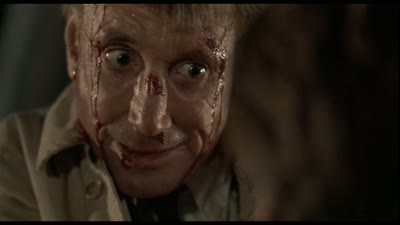
"Something about your face makes me wanna slap the shit out of it" - Roy Scheider as Harry Mitchell in 52 PICK-UP
Cannon honchos Menahem Golan and Yoram Globus were at the pinnacle of their success in 1985-86. Hits like MISSING IN ACTION, AMERICAN NINJA, DEATH WISH 3, and THE DELTA FORCE, to name just a few, made Cannon titles an almost weekly presence in movie theaters. On top of that, Golan & Globus started to get more ambitious, fancying themselves modern-day movie moguls and using the profits from their commercial hits to finance more highbrow material, and they seemed to rely on Russian director Andrei Konchalovsky to make that happen. Sure, they occasionally tried more serious films like Jason Miller's THAT CHAMPIONSHIP SEASON (1982), but it wasn't until the mid-1980s that Golan and Globus got serious about Cannon being a prestigious name. In quick succession, Konchalovsky directed MARIA'S LOVERS (1984), RUNAWAY TRAIN (1985), DUET FOR ONE (1986), and SHY PEOPLE (1987) for Cannon, with RUNAWAY TRAIN earning Oscar nominations for stars Jon Voight and Eric Roberts, and SHY PEOPLE winning a Best Actress award for Barbara Hershey at the 1987 Cannes Film Festival. With the exception of RUNAWAY TRAIN, audiences pretty much ignored these films, and Konchalovsky moved on, unsuccessfully trying to adapt to the Hollywood game with 1989's TANGO & CASH in one of the most egregiously bizarre mismatchings of director and material in all of cinema. It didn't work, and though Konchalovsky received sole credit as director, he was fired midway through production and replaced by PURPLE RAIN director Albert Magnoli.
Cannon continued their quest for respect from highbrow critics, with Golan & Globus producing or distributing films by the likes of Roman Polanski (1986's PIRATES), Jean-Luc Godard (1987's KING LEAR), Franco Zeffirelli (1986's OTELLO), Dusan Makavejev (1988's MANIFESTO), Emir Kusturica (1985's WHEN FATHER WAS AWAY ON BUSINESS), Liliana Cavani (1985's THE BERLIN AFFAIR), Lina Wertmuller (1986's CAMORRA), and Fons Rademakers, whose THE ASSAULT won the 1986 Oscar for Best Foreign Language Film. But these expensive films lost a ton of money, and soon enough, audiences grew tired of the same old Charles Bronson, Chuck Norris, and Michael Dudikoff movies that kept Cannon afloat and despite a couple of latter-day hits with a young Jean-Claude Van Damme (BLOODSPORT and CYBORG), the company was on life support by 1989. 52 PICK-UP, released in the fall of 1986, represents somewhat of a middle ground between Cannon's commercial fare and their aspirations to be Taken Seriously. Based on a novel by the great Elmore Leonard that Cannon liked so much that they made two versions of it in two years (1985's barely-released THE AMBASSADOR retained almost no elements of Leonard's 52 Pick-Up novel, moving the setting to the Middle East for the Israel-Palestine conflict--hardly Leonard's specialty--and is only remembered today as a trivia note for being Rock Hudson's final film), 52 PICK-UP is a crackling, nail-biting thriller that Leonard himself co-scripted, so it's fairly faithful to the book, with the biggest difference being a change in location from Detroit to Los Angeles, which was enough to make Leonard unhappy with the finished film.
John Frankenheimer (1930-2002)
52 PICK-UP also represents a typical Cannon practice of getting veteran personnel who can still do the job but maybe aren't as in-demand as they once were: in addition to providing regular employment for career journeymen like Michael Winner and THE GUNS OF NAVARONE director J. Lee Thompson, another good example of this is 1985's FOOL FOR LOVE, directed by Robert Altman years before his 1992 comeback with THE PLAYER. For 52 PICK-UP, they hired the legendary John Frankenheimer, director of such classics as THE MANCHURIAN CANDIDATE (1962) and THE TRAIN (1964). Frankenheimer was in a serious slump by 1986, with his career stalled by a string of mediocre films and years of alcoholism. Frankenheimer went into rehab after shooting 1982's THE CHALLENGE and wouldn't fully rebuild his reputation until several acclaimed made-for-cable films in the mid-1990s (AGAINST THE WALL, ANDERSONVILLE, GEORGE WALLACE), followed by a major career resurgence with 1998's RONIN. Frankenheimer died in 2002 a respected filmmaker at the top of his game (even with 1996's THE ISLAND OF DR. MOREAU on his resume), something he most definitely wasn't when Golan & Globus hired him for 52 PICK-UP, but they took chances on people who had fallen out of favor and deserved another shot, like Altman and Norman Mailer, who directed 1987's TOUGH GUYS DON'T DANCE for Cannon. 52 PICK-UP was easily Frankenheimer's best film in nearly a decade.
The film centers on Harry Mitchell (Roy Scheider), a successful, self-made man with blue collar roots, who got rich when the U.S. government bought his steel patent to use in manufacturing airplanes. Mitchell's got a nice house in the suburbs, a restored Jag, and a loving wife in Barbara (Ann-Margret), who's about to launch a city council campaign at the urging of her D.A. candidate boss (Doug McClure). Mitchell's also a sugar daddy to 22-year-old Cini (Kelly Preston), who works part-time in a Skid Row "live nude models" dump. He's got Cini set up in a nice apartment and he's also got a problem: he's being blackmailed with a sex tape showing him on a vacation with Cini ("You told your wife you were at a convention!") and the two of them in a motel room. The blackmailers are a trio of drug dealers and scuzzy sycophants in the L.A. porn underworld: ringleader Raimy (John Glover), a financial whiz and amateur pornographer who manages a XXX theater; nervous, weaselly Leo (Robert Trebor), and coke-addled psycho Bobby Shy (a terrifying Clarence Williams III). They've got Cini and demand $105,000 from Mitchell in exchange for the tape. Mitchell doesn't want to jeopardize Barbara's political aspirations, so he confesses the affair to her and decides he isn't paying the blackmailers, instead sending them an envelope stuffed with paper and a note reading "Bag Your Ass!" Raimy breaks into Mitchell's house, steals a sportjacket and Mitchell's gun and uses it to kill Cini and frame Mitchell (all on videotape for Mitchell's benefit), and now demands $105,000 per year for the rest of Mitchell's life in exchange for their silence. Mitchell, who prides himself on never relying on others, knows he'll never be rid of these shitbags but refuses to go to the cops, opting to set up an elaborate plan to deal with them himself, using his wits and street smarts and turning the three of them against one another.
It's not only a more high-minded Cannon product with a rejuvenated Frankenheimer onboard, but also with talent like Scheider and Ann-Margret heading the cast (and reunited from the 1973 French thriller THE OUTSIDE MAN). At 54, Scheider was nearing the end of a hugely-successful decade-plus run as an A-lister, and while 46-year-old Ann-Margret wasn't exactly at the peak of her career, she brought not just name recognition but a certain degree of class to the proceedings that wasn't normally inherent in a Cannon film. But in aiming toward comparitively older moviegoers, Cannon made the same mistakes they made in many of their Bronson films: an overabundance of violence and sex that much of that demographic found off-putting. Frankenheimer spends a lot of screen time with the sleazy dealings of Raimy and his cohorts, including a wild party that features cameos by several famous porn stars (Jamie Gillis, Herschel Savage, Amber Lynn, Barbara Dare, Sharon Mitchell, and, of course, Ron Jeremy), and a few nude photo shoots, etc. 52 PICK-UP is one of the sleazier Cannon outings, but the nudity, the seedy L.A. locations, the drug abuse and the general unpleasantness (an enraged Raimy abducts Barbara late in the film, shooting her full of heroin and--offscreen--raping her) are vital to the film's atmosphere and the sense that Mitchell is leading himself and his wife into a dangerous and destructive world. Indeed, Glover, Trebor, and Williams vividly create three of the most loathsome, repulsive villains you'll ever see.
But the center of the film is the relationship between Harry and Barbara, and Scheider and Ann-Margret both do excellent work here, especially in the scene where Harry confesses the affair. With very little dialogue, Ann-Margret conveys the pain and the hurt, saying she's sensed it for a while and quietly says "22...that's young. We've been married 23 years. That's longer than she's been alive." And when Harry keeps fumblingly saying "It's not that simple," Barbara practically spits "Oh...did you play Daddy?" Some of Leonard's trademark snappy wit shines in the script as well, with Harry explaining the situation to his trusted attorney (Lonny Chapman) and saying "I must've thought I was falling in love. What an asshole," and when he goes to ambush Raimy at his porno theater, Harry asks the cashier "The movie...is it any good?" to which she deadpans "Beautiful...five bucks." Scheider was an unheralded master at disposing a villain with a smartass quip or, better yet, taking a bad guy's snide catchphrase and throwing it back at him at the best possible moment. One could argue that this started with "Smile, you son of a bitch!" from JAWS, but it was also reflected in his turning the obnoxious "Catch ya later!" back at Malcolm McDowell in 1983's BLUE THUNDER, and around the 28th time Glover's Raimy snottily calls Scheider's Mitchell "Sport" in 52 PICK-UP, you know that'll be coming back to bite him in the ass.
Ultimately, despite good reviews, many citing it as Frankenheimer's best film in years, and extensive publicity, 52 PICK-UP was a box-office dud, landing in 8th place its opening weekend and going on to gross just $5 million. Scheider and Frankenheimer teamed up again for 1990's little-seen THE FOURTH WAR, an interesting and underrated post-Cold War thriller. While Frankenheimer's career picked up, Scheider's wound down. He stayed busy for the next two decades in supporting roles, straight-to-video movies, and spent a couple of years on the NBC series SEAQUEST DSV (and reportedly hated it, essentially quitting the show after two seasons but making three brief appearances in the third season after being replaced by Michael Ironside), but by the end of the decade, like Cannon, Scheider's big-screen movie-star days were essentially over. He died in 2008. Leonard had already seen several of his stories and novels turned into films, going back to 1957's 3:10 TO YUMA, 1967's HOMBRE, 1969's THE BIG BOUNCE (remade in 2004), 1974's MR. MAJESTYK, and 1985's STICK, among others. The most famous big-screen Leonard adaptation is probably Quentin Tarantino's JACKIE BROWN (1997), based on the novel Rum Punch, but GET SHORTY (1995) and OUT OF SIGHT (1998) are also held in high regard, along with the FX series JUSTIFIED, with Timothy Olyphant as Raylan Givens, a character in several Leonard works. Now 87, Leonard is still writing and still living in the suburban Detroit area, which he's called home since he was nine years old.
Two long sought-after cult items in the MGM archives have finally been released as part of the MOD (manufactured-on-demand) "MGM Limited Edition Collection," available from Warner Archive at www.warnerarchive.com.
THE OUTSIDE MAN (France - 1973)
This French thriller, shot in some marvelously distinctive Los Angeles locales, is one of the more unique oddities in early '70s crime cinema.Equal parts film noir, European art film, and post-FRENCH CONNECTION action thriller, THE OUTSIDE MAN also boasts one of the most amazingly eclectic casts of its era. Strange that it's been forgotten by all but the most devout cult movie obsessives. Jean-Louis Trintignant stars as a French hit man contracted to whack L.A. crime boss Ted de Corsia (a veteran TV and movie tough guy in his last film). Trintignant then finds his belongings have disappeared from his hotel, a determined mystery man (Roy Scheider) is on his tail and constantly firing shots at him, and he can't get out of L.A, and it all leads up to a wild shootout at the mortuary viewing of de Corsia's body, which isn't in a casket, but rather, seated upright in a chair, stogie in hand. The supporting cast is unbelievable: Ann-Margret as a sexy strip club bartender who helps Trintignant get a fake passport; Angie Dickinson, sadly underutilized as de Corsia's much-younger wife, who's having an affair with sleazy stepson Umberto Orsini, who ordered the hit on his dad; THE MARY TYLER MOORE SHOW's Georgia Engel and a very young Jackie Earle Haley as a mother and obnoxious son briefly held hostage by Trintignant; Michel Constantin as Trintignant's boss; Felice Orlandi as the detective investigating the mob-related mayhem; Alex Rocco as one of Orsini's flunkies; future Lucio Fulci regular Carlo de Mejo as the fake passport connection; Carmen Argenziano as a biker; John Hillerman as a department store manager; and Talia Shire as a mortician's assistant. There's a few loose ends (I didn't quite get the involvement of the Jesus-freak hitchhiker), but THE OUTSIDE MAN is a highly entertaining snapshot of early 1970s L.A., complete with a funky-ass Michel Legrand score and presented with a distinctly off-kilter European flavor courtesy of director Jacques Deray (BORSALINO), who co-wrote the script with Jean-Claude Carriere and Ian McLellan Hunter.
The transfer is 1.85:1 and anamorphic, but it's a bit battered and muddy in several spots. Admittedly not the best transfer you'll ever see, but perfectly watchable (and the DVD opens with a disclaimer that the best available elements were used), and miles ahead of, say, the YouTube clip above. The packaging displays a PG rating, but this is actually the uncensored European cut, complete with some full frontal nudity in a strip club that was cut from the film's US release. THE OUTSIDE MAN has had occasional airings on cable over the years (I recall seeing it on TBS many years ago), but it's great to see MGM removing it from the vault to be discovered anew. (PG, 105 mins)
WINDOWS (US - 1980)
Opening in January 1980, WINDOWS has the distinction of being the first major theatrical release of the 1980s. It was also the first of two controversial, gay-themed thrillers that faced accusations of stereotyping and demeaning the community it was depicting. The other--William Friedkin's CRUISING--was in theaters less than a month after WINDOWS and has since come to be held in somewhat higher regard even with its dated depictions of the gay S&M/leather bar subculture. WINDOWS, however, still has a much longer wait for a critical reassessment, even though it does have its defenders. The directorial debut of famed cinematographer Gordon Willis (who photographed, among others, all three GODFATHER films, THE PARALLAX VIEW, ALL THE PRESIDENT'S MEN, and Woody Allen's films from ANNIE HALL to THE PURPLE ROSE OF CAIRO), there's no denying WINDOWS is a beautifully shot film, with picture-perfect shot compositions and tons of priceless Brooklyn-in-1979 scenery. The Brooklyn Bridge and the Twin Towers are onscreen as much as the main actors. As a snapshot of an era gone by, WINDOWS is worth the price of admission. But Willis is saddled with a terrible script by Barry Siegel (his only writing credit) and lets things languish at a paralyzingly slow pace for an alleged thriller. Mousy Emily (Talia Shire) is raped in her apartment by a creep with a switchblade who tape-records the assault. She moves into a new apartment and is spied on from across the river via telescope by friend and former neighbor Andrea (Elizabeth Ashley), a crazed lesbian with obsessive designs on the soon-to-be-divorced Emily, designs so strong that she actually paid the rapist to break into Emily's apartment, in the hopes that it would make Emily turn to her for support (well, that and she has a tape-recording of Emily being violated that she can listen to in her more hot & bothered moments). When the traumatized Emily, a sometime-stutterer who's still in speech therapy, starts taking baby steps toward a relationship with Bob (Joseph Cortese), the nice, sensitive detective handling her case, Andrea goes even further off the deep end.
I can appreciate Willis (who also served as his own cinematographer) wanting to go for a low-key psychological thriller, but the pace is almost glacial and story elements are completely illogical, especially the way the rapist is apprehended (Emily gets back in the cab?!), and in the fact that the primary villain's identity is made clear much too early. The finale, which goes on forever, with Andrea holding Emily captive, is terribly-handled, never suspenseful, and anti-climactic in the extreme. WINDOWS is plodding, dull, and inconsistently-acted by Shire and Ashley (who have an equal number of good and bad moments), and Cortese, in his first major-studio film before going on to a long TV career that's still active today, is one of the dullest, charisma-free leading men you'll ever see. But having said all that, WINDOWS is not that bad. It's not very good, mind you...just not the dumpster fire that its reputation would suggest. From a technical standpoint, fanatics of 1970s-1980s NYC location shooting like me will find it of much historical value (the Brooklyn Bridge facing the NYC skyline has rarely been shot as well as it is here). The film has a cult following that stems mainly from it not being very easy to see all these years. There were some sporadic cable airings in the '80s and it turned up on VOD several years ago, but it was never released on VHS, and this MGM MOD release (a good-looking 1.85:1 anamorphic transfer) is its first on any home video format in the US. Willis immediately went back to his old job, photographing Woody Allen's STARDUST MEMORIES and as of now, 32 years later, has yet to direct a second film of his own. And WINDOWS, much like CRUISING, is one of those films that most of the people involved simply refuse to discuss. (R, 94 mins)
Directed by Peter Medak. Written by Leonard Michaels. Cast: David Dukes, Richard Jordan, Harvey Keitel, Frank Langella, Roy Scheider, Craig Wasson, Treat Williams, Stockard Channing, Cindy Pickett, Ann Dusenberry, Marilyn Jones, Jennifer Jason Leigh, Ann Wedgeworth, Helen Shaver. (R, 101 mins)
It has to be difficult to take an ensemble cast of seven good-to-great actors under the direction of the guy who made THE RULING CLASS (1972) and THE CHANGELING (1980) and have it turn into a total grease fire, but that's exactly what happened with the atrocious 1986 bomb THE MEN'S CLUB. Leonard Michaels wrote the screenplay, and it's based on his own novel, so you can't say the filmmakers disregarded the source. I haven't read the book, but judging from what plays out over the course of the film, it's clearly a case of "what worked on the page doesn't translate to the screen." There's lots of long-winded, meandering speeches that probably read fine, even in the script, but just come off as mannered and "acting class"-y in the film. It starts off bad and gets worse, and at some points you can almost see the looks of resigned defeat on the faces of the cast. Looks that say, "Look, we're here, we're in this, let's just get it done and move on." And when actors as good as the guys here are put in situations like this, it often brings out the worst in them. That's exactly what happens throughout THE MEN'S CLUB.
Therapist Kramer (Richard Jordan) is hosting a guys' discussion group, ostensibly to talk "man to man" about women, careers, etc. but it quickly devolves into an excuse for puerile, adolescent shenanigans, which is the whole point of Michaels' novel. But on the screen, none of this behavior comes off as plausible at all. It starts with Kramer himself. As played by Jordan, he's eccentric at best, and deranged at worst. I don't know if Jordan came up with these tics on his own or if Michaels or director Peter Medak told him to act this way, but the guy's a completely creepy weirdo. The rest of the guys range from shallow to mostly repugnant: there's sex-addict ex-baseball star Cavanaugh (Roy Scheider), college prof Phillip (David Dukes), milquetoast lawyer Harold (Frank Langella), stressed-out businessman Solly (Harvey Keitel), doctor Terry (Treat Williams), and auto parts store manager Paul (Craig Wasson). Williams and particularly Wasson seem to be relegated to the background early on and neither actor embarrasses himself. Nor does Dukes, who gives the best performance of the bunch. But man, are Scheider, Keitel, Langella, and Jordan awful! It's not entirely their fault. These characters and these scenarios are unplayable for any actor. The characters are loathsome to begin with, which is fine. I don't subscribe to the belief that characters have to be likable. But in films like this, they have to be plausible. They're not playing "real" people. When they take a break in the conversation to destroy the inside of Kramer's house, you have to wonder what planet any of them are living on. And that's before they gather in a circle and howl like dogs. That particular scene is actually embarrassing to watch, but it at least leads to a really good, show-stealing, one-scene performance by Stockard Channing as Kramer's wife, who walks in on the wreckage and lets Kramer have it. Channing is terrific in her five minutes of screen time, which seems to come from another, much better film. But after that brief high point, things immediately get even worse than before.
While Kramer stays behind, Harold takes the others to the House of Affections, a high-class brothel run by a madame (Ann Wedgeworth) with a creepy ventriloquist doll, which leads to a bunch of bad smooth jazz and horrible acting. The guys get turns with ladies of their choosing, and Solly immediately falls for Allison (Marilyn Jones), which leads to a mock "wedding" officiated by Harold, who's decked out in what can best be described as Joker makeup. Don't ask.
In Marshall Fine's 1998 biography Harvey Keitel: The Art of Darkness, the late Dukes, who died in 2000, is interviewed and explains that the actors got together for two weeks prior to the start of filming and talked, improvised, worked out scenes, and generally got a feel for one another and how they would work that into the film. Dukes goes on to say that shortly into filming, it became apparent that what they were doing wasn't working. I'm sure there's more to the story (Fine also writes about how Keitel and Langella disliked one another, and how the shot where Langella cuts eyes and a mouth into a paper plate and puts it over his face, was improvised by a frustrated Langella as a response to Keitel needing endless takes for a monologue about how all he wants is a woman to stick her tongue in his mouth), and it's entirely possible that the bad acting by such reliable pros was just a defense mechanism or maybe just a valiant effort to salvage something. Whatever the reason, Scheider, Langella, and Keitel have rarely been worse, and I suppose it worked for Jordan that his character exits halfway through the film.
Other films have explored men's issues and male bonding and the whole "boys being boys" thing with the unabashed raunchiness on display here and have worked (the films of Neil LaBute come to mind, though they're markedly more misanthropic). But THE MEN'S CLUB just doesn't, and it's almost tragic because of the talent involved. How do you get these guys together and have it derail so badly? It's been said that no one sets out to make a bad movie, but sometimes they just turn out that way. I believe everyone approached THE MEN'S CLUB with noble intentions, but it just got away. From everyone. Maybe Williams and Wasson stayed in the background by choice. During the wedding scene, I swear you can see Williams trying to get out of some shots.
THE MEN'S CLUB was given a small release in the fall of 1986, and to the surprise of no one, tanked at the box office. It was in regular rotation on cable for a while, which is where I saw it as a teenager, and probably gave it a pass because there were a lot of naked women in the second half. It's not on DVD, has just one external review and seven user reviews on IMDb, but it's streaming on Netflix (in a 1.78 widescreen print) if you're so inclined. If anyone is even aware of this film today, it's because of a YouTube clip that made the rounds a while back, which is hilarious when taken out of context. Plus, in retrospect, it provides a look at things to come for future nudity enthusiast Keitel.




 Cannon continued their quest for respect from highbrow critics, with Golan & Globus producing or distributing films by the likes of Roman Polanski (1986's PIRATES), Jean-Luc Godard (1987's KING LEAR), Franco Zeffirelli (1986's OTELLO), Dusan Makavejev (1988's MANIFESTO), Emir Kusturica (1985's WHEN FATHER WAS AWAY ON BUSINESS), Liliana Cavani (1985's THE BERLIN AFFAIR), Lina Wertmuller (1986's CAMORRA), and Fons Rademakers, whose THE ASSAULT won the 1986 Oscar for Best Foreign Language Film. But these expensive films lost a ton of money, and soon enough, audiences grew tired of the same old Charles Bronson, Chuck Norris, and Michael Dudikoff movies that kept Cannon afloat and despite a couple of latter-day hits with a young Jean-Claude Van Damme (BLOODSPORT and CYBORG), the company was on life support by 1989. 52 PICK-UP, released in the fall of 1986, represents somewhat of a middle ground between Cannon's commercial fare and their aspirations to be Taken Seriously. Based on a novel by the great Elmore Leonard that Cannon liked so much that they made two versions of it in two years (1985's barely-released THE AMBASSADOR retained almost no elements of Leonard's 52 Pick-Up novel, moving the setting to the Middle East for the Israel-Palestine conflict--hardly Leonard's specialty--and is only remembered today as a trivia note for being Rock Hudson's final film), 52 PICK-UP is a crackling, nail-biting thriller that Leonard himself co-scripted, so it's fairly faithful to the book, with the biggest difference being a change in location from Detroit to Los Angeles, which was enough to make Leonard unhappy with the finished film.


 But the center of the film is the relationship between Harry and Barbara, and Scheider and Ann-Margret both do excellent work here, especially in the scene where Harry confesses the affair. With very little dialogue, Ann-Margret conveys the pain and the hurt, saying she's sensed it for a while and quietly says "22...that's young. We've been married 23 years. That's longer than she's been alive." And when Harry keeps fumblingly saying "It's not that simple," Barbara practically spits "Oh...did you play Daddy?" Some of Leonard's trademark snappy wit shines in the script as well, with Harry explaining the situation to his trusted attorney (Lonny Chapman) and saying "I must've thought I was falling in love. What an asshole," and when he goes to ambush Raimy at his porno theater, Harry asks the cashier "The movie...is it any good?" to which she deadpans "Beautiful...five bucks." Scheider was an unheralded master at disposing a villain with a smartass quip or, better yet, taking a bad guy's snide catchphrase and throwing it back at him at the best possible moment. One could argue that this started with "Smile, you son of a bitch!" from JAWS, but it was also reflected in his turning the obnoxious "Catch ya later!" back at Malcolm McDowell in 1983's BLUE THUNDER, and around the 28th time Glover's Raimy snottily calls Scheider's Mitchell "Sport" in 52 PICK-UP, you know that'll be coming back to bite him in the ass.


