THE CIRCLE (France/UAE/US - 2017) Directed by James Ponsoldt. Written by James Ponsoldt and Dave Eggers. Cast: Emma Watson, Tom Hanks, John Boyega, Karen Gillan, Bill Paxton, Ellar Coltrane, Patton Oswalt, Glenne Headly, Nate Corddry, Judy Reyes, Mamoudou Athie, Smith Cho, Amir Talai, Poorna Jagannathan, Eve Gordon. (PG-13, 110 mins) Based on the 2013 novel by Dave Eggers, who shares screenplay credit with director James Ponsoldt (THE SPECTACULAR NOW), THE CIRCLE has a premise with such a short window of topicality that the movie adaptation feels dated just four years later. It doesn't help that TV shows like MR. ROBOT and BLACK MIRROR have already explored similar themes much more effectively, but THE CIRCLE loses the satirical elements of Eggers' novel and opts for a much more heavy-handed approach. What might've worked on the page doesn't work always work on the screen, as characters here don't have conversations as much as they drop exposition and make important speeches. Everything has to be simplified so the audience can stay caught up, then it starts glossing over things so much that the entire second half of the film is a complete mess. A lot of this was likely due to negative test screenings leading to extensive reshoots being done in January 2017, just three months before the film's release and long after filming wrapped in late 2015. The film goes in a completely different direction than the book, so much so that it's a safe assumption that the finished film isn't exactly a collaborative effort between Eggers and Ponsoldt.
Mae Holland (Emma Watson) is temping in customer service at the local water department when her Scottish college friend Annie (Karen Gillan) lands her an interview with her employer, The Circle. A Google-like tech empire in Silicon Valley, The Circle is always pioneering advances in social media and software dedicated to making people "connected." Their latest product launch involves "SeeChange," a tiny, round camera that can be placed anywhere and go unnoticed, utilizing GPS and facial recognition software and generating much in the way of moral and ethical dilemmas over privacy and surveillance. Circle founder and CEO Eamon Bailey (Tom Hanks) claims that such advances are for the greater good of humanity, but loner Mae's gut reaction is one of apprehension. The mostly millennial employees base their lives around The Circle, living in dorm-like apartments "on campus," and participating in "suggested" activities on their off time with a fervent and almost cult-like devotion to their employer. Mae is passive-aggressively reprimanded by a Circle social media adviser for not taking part in the events and for going home to visit her parents--mom Bonnie (Glenne Headly) and dad Vinnie (the late Bill Paxton in his last film)--and she's somewhat alarmed that The Circle already knows her father is suffering from multiple sclerosis. Mae is chastised for taking a job with The Circle by her childhood friend Mercer (Ellar Coltrane of BOYHOOD), who hates texting and the internet and has no doubt condescendingly uttered, at least once in his life, "I don't even own a TV." Her friendship with Mercer falls apart after she shares a pic of his custom-made antler chandeliers and outraged millennials start following him around to harass him get in his face, and shout "deer killer!" After an incident involving her trespassing to go kayaking ends with her being rescued after being seen on a SeeChange camera aimed at the bay, Mae makes the ultimate commitment to The Circle: she goes "transparent," wearing a small camera 24/7 to document every moment of her life for Circle's 240 million members. This plot turn could've been a great BLACK MIRROR episode in the hands of Charlie Brooker, and it also recalls both Bertrand Tavernier's remarkably ahead-of-its-time cult film DEATH WATCH (1980) as well as Peter Weir's THE TRUMAN SHOW (1998), but once Circler comments turn up on the screen for most of the remainder of the film, it more or less starts to look like INSTAGRAM: THE MOVIE.
Mae's advance up the ladder at The Circle puts a strain on her friendship with Annie as well as her relationship with her parents, who are also required to install cameras at their house. Those cameras are taken offline when Mae's followers, seeing what Mae sees, accidentally catch a glimpse of her parents having sex with the aid of a penis pump for her disabled father, humiliating both of them. Mae also forms a muddled alliance with Ty Lavitte (John Boyega of STAR WARS: THE FORCE AWAKENS), a legendary hacker who works for The Circle, designing a program that's been hijacked by Bailey and his business partner Tom Stenton (Patton Oswalt) to spy on every Circle user and store all of their personal information, phone calls, e-mails, texts, etc. Much to Lavitte's disgust, Bailey and Stenton use this information to blackmail a senator (Eve Gordon) who's been publicly critical of The Circle, and with Mae's help, they even concoct a plan to tie The Circle into voter registration records and not only allow users to vote through their Circle account, but require them to be Circle users in order to vote ("The US government needs us more than we need them," Stenton says). There's some heady implications in a lot of what goes on in THE CIRCLE, especially the ultimate fate of Mercer as a scathing critique of social media hysteria, but Ponsoldt bungles it at every turn. THE CIRCLE is content to lecture the audience and too often comes off like it's taking an approach to technology that's equal parts Stubborn Luddite and Scared Old Man. What could've been a smart, topical critique of our reliance on technology and our willingness to sacrifice privacy and human interaction for convenience and a feeling of connection with the rest of the world comes off as smug and sanctimonious, complete with a laughably simplistic non-ending that has Mae staging a revolt against Bailey and Stenton and literally Pied Pipering her newly-woke colleagues out of a darkened, pitch black auditorium through an exit door, outside into the light. Watson is a capable actress but she's strangely one-note here. Boyega seems to have been affected most by the reshoots, looking like he spent his entire time on the set unsuccessfully trying to locate Ponsoldt, while Paxton musters what trace amounts of dignity he can with a penis pump and in another scene that requires him to piss himself. What little novelty this misfire offers comes from seeing Hanks and Oswalt atypically cast as quietly sinister villains, but neither seems to have spent more than a few days working on this, enough for one to surmise that when Bailey turns to Stenton at the end and says "We are so fucked," it's very possible that it was just Hanks talking to Oswalt without knowing the cameras were rolling. Altered extensively from Eggers' novel, THE CIRCLE is disjointed, already past its sell-by date, and completely unsure of what point its even trying to make.
About a decade ago, British filmmaker Christopher Smith seemed to be establishing himself as a promising genre figure with the subway tunnel horror flick CREEP (2005), the office-team-building-retreat slasher film SEVERANCE (2006), the lost-at-sea mindfuck TRIANGLE (2009), and the medieval witchcraft saga BLACK DEATH (2011). Smith was building some momentum (SEVERANCE and TRIANGLE quickly found cult followings, and the excellent BLACK DEATH got some critical acclaim), but things sort-of sputtered out for him. He seemed to settle into hired-gun mode with the 2012 miniseries LABYRINTH, based on the Kate Mosse novel. LABYRINTH wasn't seen in the US until it aired on the CW in 2014, and he followed that with an unexpected departure in the barely-released 2014 family comedy GET SANTA, the biggest outlier in his filmography so far. The modern-day noir DETOUR is a return to form of sorts for writer/director Smith. He gets to play with time and linear structure a bit and he explores themes of doppelgangers that figured so prominently in TRIANGLE. And he allows himself some room to show off a little by throwing in some obvious split-screen shout-outs to Brian De Palma. For a while, Smith gets dangerously close to making DETOUR a little too smug and cute for its own good, right down to main character Harper (Tye Sheridan, grown up a bit since JOE and MUD) having a poster for the 1966 Paul Newman movie HARPER on his bedroom wall and later seen watching Edgar G. Ulmer's 1945 Poverty Row cheapie classic DETOUR on TV.
But just when you're about to justifiably give up, Smith talks you off the ledge and DETOUR's gimmicky structure actually starts showing a purpose, and the characters have a lot more going on under the surface. The film gets better as it goes along, really reaching its stride in the second act before the third, where it doesn't quite fizzle out but offers one improbable plot twist too many. Harper is a rich California college kid whose mother is in a coma after a car accident and whose stepdad Vincent (Stephen Moyer) seems to already have a mistress and is counting the days until his wife finally dies. Out drinking at a shithole bar in a rough part of town, Harper makes the acquaintance of Johnny Ray (Emory Cohen of THE PLACE BEYOND THE PINES), an abusive, bullying psychopath with a long-suffering stripper girlfriend named Cherry (Bel Powley of THE DIARY OF A TEENAGE GIRL). Drunk Harper talks about hypothetically paying Johnny $20,000 to follow Vincent to Vegas and kill him. He's understandably caught by surprise when Johnny and Cherry turn up at his front door the next morning ready to hit the road and whack his stepfather. Harper tries to reason with Johnny but Johnny's the kind of unstable lunatic who's always looking for a fight, won't take no for an answer and no matter what you say, it's wrong ("You wanna fuck her?" Johnny asks Harper about Cherry. Harper: "No!" Johnny: "What, you think she's ugly?"). At this point, Smith breaks the film into two diverging narratives--one showing Harper, Johnny, and Cherry heading to Vegas to kill Vincent and a second where Harper turns his back and Johnny and goes back into his house, choosing to confront Vincent himself. Both narratives head in unexpected directions that keep DETOUR consistently interesting before settling into a more conventional mode for the finale. There's some nice twists involving the characters and their motivations, and Irish actor John Lynch (Shades in Richard Stanley's 1990 masterpiece HARDWARE) has a memorable turn channeling GANGS OF NEW YORK-style Daniel Day-Lewis as an enraged pimp to whom Johnny owes $50K under the threat of taking Cherry away from him and selling her to a guy who'll keep her locked up and "use her for a hillbilly fuck-mat." Cape Town and other South African locations don't really convince as stand-ins for California or Nevada, but despite that and a few other missteps, DETOUR is a not-bad little thriller that fits nicely into the Smith oeuvre and should find some admirers on Blu-ray and streaming. Magnet released this on VOD and on five screens in the US to an abysmal opening weekend gross of $145. (R, 97 mins)
MEAN DREAMS (Canada/US - 2017)
There's a bit of a Terrence Malick-circa-BADLANDS vibe to this Canadian thriller shot in Sault Ste. Marie and set in the rural outskirts of upper peninsula Michigan. It's not just in its quiet opening shots of character walking through a cornfield, but in its tried-and-true lovers-on-the-run scenario. That sense of serene calm doesn't last long as young high-school dropout Jonas Ford (Josh Wiggins of MAX) toils in the fields on his family's on-life-support farm, dealing with an embittered dad (Joe Cobden) and an alcoholic mom (Vickie Papavs). He finally finds some light in his dark existence when he meets Casey Caraway (Sophie Nelisse of THE BOOK THIEF), a teenage girl who moved into the next house down the road with her widower father Wayne (the late Bill Paxton, in his next-to-last film), who's just been hired as a new cop in town. Wayne objects to all the time Casey's been spending with Jonas and makes it clear he's not welcome anymore, but things really escalate when Jonas, who has seen Wayne hiding a duffel bag full of drugs in his garage, intervenes when he catches Wayne beating Casey. Jonas goes to the police chief (Colm Feore), who completely blows him off, and ends up on an unintended ride-along after breaking into Wayne's garage and hiding under the tonneau cover of his truck bed as Wayne drives off for a meet with some dealers, kills them, and keeps the drugs and the money for himself. Through not the most plausible means, Jonas manages to get away with the money and takes off with Casey, with an enraged Wayne not far behind.
The script by Kevin Coughlin and Ryan Grassby doesn't offer much in the way of surprises, but director Nathan Morlando (CITIZEN GANGSTER) really establishes a moody, downbeat atmosphere of rural despair that gives its lovestruck heroes sufficient reason to impulsively run away. The romance moves a little too quickly and Jonas blows right by some red flags ("Do you lie a lot?" he asks, to which Casey replies "All the time"), and it has moments that strain credulity, like Jonas getting a nasty cut in his abdomen and Casey stitching it up and disinfecting it after robbing a pharmacy at gunpoint. The choking feeling of desperation and needing to get as far away as possible is made somewhat more plausible by Paxton's vicious performance as an all-around bad guy (his very presence in this is a shout-out to the 1992 cult movie ONE FALSE MOVE and 1998's A SIMPLE PLAN), easily one of the most despicable characters the beloved actor was ever tasked with playing. MEAN DREAMS doesn't have an original thought in its head, but it's well-made, Wiggins and Nelisse are appealing young stars, and Paxton always made anything better just by being in it. He'll be missed. (R, 105 mins)
SMALL CRIMES (UK/France/US - 2017) Directed by Evan Katz. Written by Evan Katz and Macon Blair. Cast: Nikolaj Coster-Waldau, Robert Forster, Jacki Weaver, Gary Cole, Molly Parker, Macon Blair, Pat Healy, Michael Kinney, Daniela Sandiford, Shawn Lawrence, Larry Fessenden, Tara Yelland. (Unrated, 95 mins) Based on a 2008 novel by Dave Zeltserman, the Netflix Original film SMALL CRIMES belongs to that ever-growing post-BLUE RUIN subgenre where names like Jeremy Saulnier and Macon Blair keep turning up (you could also lump BAD TURN WORSE in there, even though it was made by others). Saulnier (GREEN ROOM) isn't involved in SMALL CRIMES, but Blair is, as a co-writer and co-star, just a couple of months after his excellent I DON'T FEEL AT HOME IN THIS WORLD ANYMORE also bowed as a Netflix Original. Shot in Quebec but set in small-town America, SMALL CRIMES recalls BLUE RUIN more than the visceral horrors of GREEN ROOM or the Coen Bros. aura of the misanthropic I DON'T FEEL AT HOME,. It's more of a character study centered on Joe Denton (GAME OF THRONES' Nikolaj Coster-Waldau), a disgraced ex-cop who can't stay out of trouble. Dubbed the "Slash Cop" by the local press after a knife attack that left current District Attorney Phil Coakley (Michael Kinney) with significant scarring, Joe has just been paroled after six years in prison, during which time his wife took their two daughters, changed their last names, moved far away, and got a restraining order against her ex-husband. Once he's out, everyone seems to be lining up for revenge, from Coakley's seductive daughter (Daniela Sandiford) to his former partner Lt. Dan Pleasant (Gary Cole), who reminds him that they have some unfinished business. On the take before he was sent to jail, Joe had a side job with Pleasant on the payroll of mob boss Manny Vassey (Shawn Lawrence). Manny is on his deathbed in the last stages of colon cancer, but he's been subpoenaed to testify to a grand jury by Coakley. Coakley wants to reopen the investigation into the mysterious "suicide" of a cop who was about to expose Joe and Pleasant's corrupt dealings with Manny, who wants to clear his conscience before he dies. Pleasant tells Joe he needs to whack Manny to kill Coakley's case and make amends for all the trouble he caused him, and once that's done, he'll see about getting him in contact with his daughters, since he's owed a favor by a family court judge he helped cover up a fatal hit-and-run. But killing Manny in a matter of a few days proves virtually impossible, as he's under constant protection by his men and his empire is being run by his hot-tempered, idiot son Junior (Pat Healy), who warns Joe to stay away.
Joe is the perfect kind of antihero for this subgenre: a hapless shit magnet who can't stop fucking everything up. He talks a lot about "second chances" and "making things right," but even he knows he's full of shit. No one knows him better than his tough-love mother Irma (Jacki Weaver), who tells it like it is compared to his more enabling father Joe Sr. (Robert Forster), an arthritic, retired firefighter who just can't say no to his son. But you can see from his mournful expressions and his slumped shoulders that Joe Sr. knows his son is a lost cause. Staying out all night his first day out of jail and drinking at a bar, Joe returns home the next day to scornful criticism from Irma and tries to deflect it by showing off the sobriety chip he received in prison. She calls him out immediately, spitting "You expect me to be happy that you didn't drink while you were in jail?" Joe begins dating Manny's nurse Charlotte (Molly Parker), and the more involved they get, the darker the cloud you can practically see looming over her. Joe may have feelings for her, but first and foremost, he sees her as a way to get to Manny to save his own ass.
Danish actor Coster-Waldau, with a flawless American accent, is very good as Joe, who starts every day with the best intentions but can't maintain the illusion for very long, not even to himself. He's matched by Weaver and Forster (an unsung national treasure), both doing magnificent work as loving parents who can't figure out where they went wrong ("I saw something in you when you were young and I didn't do anything about it," his dad tells him as he's kicking him out of the house, adding "You bring mayhem with you, Joe"). Cole has one of his all-time great "Gary Cole" roles as the sarcastic and ironically-named Pleasant. Whether he's barking out some great quotables ("You're battin' zero, shithead," "Goddamn, I miss high school!" and "Figure it out! Put in some work instead of gettin' your dick wet," when Joe leaves Charlotte's place and tells him he can't get to Manny, and "If you can't clip Manny, clip the mutant," referring to the disfigured Coakley). Cult movie scenesters will also enjoy the brief appearances of Healy (THE INNKEEPERS, COMPLIANCE) and the ubiquitous Larry Fessenden--once a promising filmmaker before becoming the Michael J. Pollard of his generation--as a strip club manager. Director/co-writer Evan Katz (CHEAP THRILLS) lets the proceedings play out at a leisurely pace but, as things are wont to do in creative endeavors involving Macon Blair (who also has a supporting role as the younger brother of the "suicide" cop), things get much more dark and bleak as doomed inevitability runs its course. Even though he spent six years locked up, Joe is the kind of guy who can talk his way out of most dilemmas--dilemmas that he usually creates for himself. But as SMALL CRIMES reaches its legitimately shocking conclusion--the kind of ending that would probably induce an audible collective gasp from an audience if this was playing in theaters--it becomes clear that he's just about exhausted all of his chances and any amount of goodwill even from those closest to him. The story gets a little convoluted at times, especially in the way that Katz and Blair take almost the entire film to really let you in on what Joe did to end up where he is, but when the pieces fall into place, SMALL CRIMES is a worthy addition to the Six Degrees of Saulnier subgenre, if you will, and one of the better Netflix Originals of late.
NEVER TOO YOUNG TO DIE (US - 1986) Directed by Gil Bettman. Written by Steven Paul and Anton Fritz (Tony Foutz). Cast: John Stamos, Vanity, Gene Simmons, George Lazenby, Robert Englund, John Anderson, Ed Brock, Peter Kwong, Tara Buckman, Tim Colceri, Randy Hall, Branscombe Richmond, Patrick Wright. (R, 96 mins) A demented mash-up of GYMKATA, THE ROCKY HORROR PICTURE SHOW, and Andy Sidaris that was demanded by no one, NEVER TOO YOUNG TO DIE has a minor cult following but isn't nearly the gut-buster it should be considering its individually insane ingredients. It never takes itself seriously, but it doesn't quite demonstrate the cleverness or the panache required to be the kind of self-conscious, winking 007 parody that its fan base claims it to be. Making his big-screen debut, John Stamos, then best known for his stint as Blackie Parrish on GENERAL HOSPITAL and still a year away from the premiere of FULL HOUSE, is Lance Stargrove, a star gymnast at a posh private school. He's estranged from his father, CIA agent Drew Stargrove (George Lazenby, the one-and-done 007 of 1969's ON HER MAJESTY'S SECRET SERVICE), who's killed trying to thwart the evil schemes of performance artist and hermaphrodite supervillain Velvet Von Ragnar (Gene Simmons). The elder Stargrove infiltrated the Ragnar compound to steal the key component of his nefarious master plan: a disc encrypted with data containing codes Ragnar needs to dump tons of radioactive waste into the city's water supply and decimate it for decades to come...that is, unless of course he's paid a hefty ransom. The disc ends up in Lance's possession as Ragnar's goons come after him, prompting him to team up with his dad's sultry partner Danja Deering (Vanity) to secure the disc and stop Ragner's reign of toxic terror...if they don't kill each other first!
The brainchild of producer/screenwriter Steven Paul (A MILLION TO JUAN, BABY GENIUSES, KARATE DOG), who's still active in the business (he's one of the producers of the recent GHOST IN THE SHELL), NEVER TOO YOUNG TO DIE was intended to be a more serious action movie in its earliest stages. But Paul's script went through numerous overhauls, with the only other credited writer being "Anton Fritz," a pseudonym for Tony Foutz, who was a minor figure in the Rolling Stones' inner circle back in the late '60s. At one point, Foutz was planning a HELP!-style dystopian sci-fi musical for the Stones that never happened. Instead, he took that idea and turned it into SATURATION 70, which ended up starring Gram Parsons, Michelle Phillips of the Mamas & the Papas, and Brian Jones' young son. Foutz started shooting the film in 1969 but funding dried up and he never finished it. Foutz worked as a production assistant on a few Italian films and was a member of the Gene Corman/Monte Hellman-led team of fixers brought in to salvage 1979's AVALANCHE EXPRESS after star Robert Shaw and director Mark Robson both died during production. Foutz also had a brief career as a screenwriter in the '80s, though that seemed to be the result of a friendship with Ben Gazzara, as Foutz's only writing credits under his real name are three Italian films that starred the future Jackie Treehorn: Marco Ferreri's TALES OF ORDINARY MADNESS (1983), the obscure Gazzara-directed vanity project BEYOND THE OCEAN (1990), and FOREVER (1991), which doesn't appear to have ever been released. It's unclear how Foutz ended up on NEVER TOO YOUNG TO DIE, but his and Paul's work was later rewritten by director Gil Bettman (whose claim to fame was directing the video for Sammy Hagar's 1984 hit "I Can't Drive 55") and Lorenzo Semple Jr., one of the key architects of the 1960s BATMAN TV series and a top journeyman screenwriter of the 1970s on films like THE PARALLAX VIEW (1974), THREE DAYS OF THE CONDOR (1975), THE DROWNING POOL (1975), KING KONG (1976), FLASH GORDON (1980), and NEVER SAY NEVER AGAIN (1983). According to "pop culture historian" Russell Dyball's commentary on the just-released NEVER TOO YOUNG TO DIE Blu-ray (which includes a bonus option to view the film in a blurry VHS transfer), Bettman and Semple are the ones who steered the script into the level of high camp reflected in the finished film, despite Paul's wish to keep it more straight-faced. Neither Bettman nor Semple receive credit for their script contributions, and it's telling that only one of the film's four writers wanted his name on it.
Bettman also directed the Tawny Kitaen/Lee Curreri rock romance CRYSTAL HEART around the same time, but mainly settled into a sporadic TV career, with his only other feature being the 1997 straight-to-video Fred Williamson/Cynthia Rothrock thriller NIGHT VISION. His direction on NEVER TOO YOUNG TO DIE is largely undistinguished, with inept, clumsily-edited action sequences (several editors are credited, including Paul Seydor, who would later become a reputable Sam Peckinpah biographer) and an uneven tone that results from an inability to commit to being a legitimate action movie or a campy comedy, ulltimately succeeding at neither (STEELE JUSTICE, another '80s action obscurity recently resurrected on Blu-ray, achieves this balance much more successfully). Ragnar and his dune buggy-driving creeps look like they wandered in off the set of an Italian post-nuke (check out Ed Brock as "Pyramid"), and a gloriously-mulleted Stamos is never believable as an action hero, not even when he's beating the shit out of the venerable Branscombe Richmond as one of Ragnar's henchmen and especially not when he's trading would-be 007 witticisms with Ragnar. You won't mistake Stamos for Sean Connery (or George Lazenby for that matter) when he smirks "You're half of each, but I'm a whole man...and I don't have time for this. I gotta save the world!" Vanity never looked better than she did here, exhibiting a convincingly icy badassery that would've excelled in a better film--watch her in NEVER TOO YOUNG TO DIE and you can see she would've made a terrific Bond girl.
NEVER TOO YOUNG TO DIE was barely released in theaters before finding its ultimate destination: gathering dust on video store shelves. The real reason anyone remembers it today isn't Stamos, it isn't Vanity, it isn't a cackling Robert Englund, taking a break between NIGHTMARE ON ELM STREET films as Ragnar's weaselly computer nerd sidekick, it's not the fact that Danja's CIA boss is obviously someone wearing what appears to be the world's least convincing Chuck Norris disguise, and it's not the anthemic "Stargrove" theme song. It's rock icon Simmons' flamboyantly over-the-top performance as Ragnar. Simmons was trying to launch a career as an actor during this period, and did some solid work as the villain in the underrated 1984 Tom Selleck sci-fi thriller RUNAWAY. He also appeared in a 1985 MIAMI VICE episode, the 1986 cult classic TRICK OR TREAT and he played a terrorist pursued by Rutger Hauer in 1987's WANTED DEAD OR ALIVE, but it's Ragnar that will ultimately go down as his crowning achievement (?) on the big screen. Putting more effort into this than he did any of Kiss' generally lackluster studio albums from the period, Simmons is having a blast here, vamping and strutting across the screen like a freakish fusion of Mae West and Chyna, rolling his eyes back, showing off his legendary tongue, performing at a drag bar called "The Incinerator," and finally, being defeated by young Stargrove's gymnastic prowess, falling off a dam to his death after Lance unveils his ultimate power move: ripping open the homicidal hermaphrodite's shirt and biting him/her on the tit. John Stamos was in the news and on the talk show circuit recently, sharing memories of his friend Don Rickles after the comedian's passing. They were close for a number of years, with Stamos and FULL HOUSE co-star Bob Saget regularly taking the comedy legend out to dinner, which usually consisted of listening to endless insults being hurled their way. Let's hope Mr. Warmth saw NEVER TOO YOUNG TO DIE and never let Stamos hear the end of it.
FREE FIRE (UK - 2017) Directed by Ben Wheatley. Written by Amy Jump and Ben Wheatley. Cast: Sharlto Copley, Armie Hammer, Brie Larson, Cillian Murphy, Jack Reynor, Sam Riley, Michael Smiley, Noah Taylor, Patrick Bergin, Babou Ceesay, Enzo Cilenti, Tom Davis, Mark Monero. (R, 90 mins) A critical and fan favorite who's received so many accolades that he's in danger of becoming the British Ti West, Ben Wheatley has what it takes to be major voice in genre filmmaking and he's been endorsed by the esteemed likes of Martin Scorsese and Edgar Wright. But other than two standout films--2012's beyond misanthropic black comedy SIGHTSEERS and 2013's profoundly unsettling A FIELD IN ENGLAND--the results have been mixed at best. I never understood the critical acclaim and scenester love for his 2011 breakthrough KILL LIST, a film that can only knock you on your ass or even surprise you in the slightest if you're a serious, well-versed film connoisseur who's somehow never heard of THE WICKER MAN. Last year's HIGH-RISE gave Wheatley his largest budget and biggest-name cast yet, but his adaptation of J.G. Ballard's 1975 novel, with its Margaret Thatcher premonitions and themes and ideas seen in so many subsequent things over time, seemed in 2016 like little more than a nice-looking exercise in production design and pointless retro '70s fetishism. With his latest film FREE FIRE, which gets a cosmetic cred boost from an executive producer credit for A FIELD IN ENGLAND fan Scorsese, Wheatley and his wife and regular screenwriting partner Amy Jump offer their take on the 1990s staple of the post-Tarantino crime flick, combined with some retro '70s leftovers from HIGH-RISE.
In 1978 Boston, Chris (Cillian Murphy) and Frank (Wheatley regular Michael Smiley) are two IRA members in town to buy guns with the help of local small-time criminals Justine (ROOM Oscar-winner Brie Larson), Bernie (Enzo Cilenti) and Frank's idiot nephew Stevo (Sam Riley). They're all greeted outside an abandoned factory by the sardonic Ord (Armie Hammer), who arranged a meet with South African arms dealer and "international asshole" Vernon (Sharlto Copley) and his associates Martin (Babou Ceesay), Gordon (Noah Taylor), and Harry (Jack Reynor). Stevo, bruised and battered from a fight he got into the night before after smashing a bottle over a woman's head and being beaten by her cousin, recognizes Harry as that cousin and tries to keep a distance from the negotiations, which are going south when Chris discovers Vernon, aka "Vern & Learn," didn't bring the weapons he ordered, instead trying to push lesser inventory off on him. Tensions escalate but Ord helps cool things down until everything blows up when Harry recognizes Stevo. Pushing and shoving leads to a forced apology from Stevo, but when he ends up boasting about what he did to Harry's cousin, Harry grabs a gun and shoots him, which sends various parties scattering about the main area of the factory as a feature-length gunfight erupts, with the added bonus of two hidden snipers--Howie (Patrick Bergin sighting!) and Jimmy (Mark Monero)--trying to pick off members of both groups for the mystery figure who hired them to abscond with both the guns and the money.
After a 15-minute set-up that includes CCR's "Run Through the Jungle"--apparently now required to be in every Brie Larson movie--being played as the characters walk through the warehouse, FREE FIRE is essentially a 75-minute version of the RESERVOIR DOGS standoff, which is amusing for a few minutes until it devolves into tedium. These buffoons are the worst shots in the history of gunfights, never killing anyone and mainly just clipping arms, legs, and shoulders, sometimes with the help of a ricocheting bullet, and before long everyone's just crawling around trying to get the edge on everyone else. This also leads to a lot of "Fuck you! No, fuck you! Gimme the money! Fuck you!" ad nauseum. It says a lot about the utter obnoxiousness of this character ensemble when Sharlto Copley is playing maybe the third-most annoying of the bunch. Top honors go to Riley's Stevo and Reynor's Harry. Murphy's Chris and Larson's Justine (this was shot two years ago, before ROOM was released) are the most reasonable and tolerable of the criminals, while Hammer's smirking, smartass Ord is obviously meant to be the source of quips that aren't nearly as quotable as Jump and Wheatley think they are.
There's a great '70s Ennio Morricone-goes-prog original score by EX MACHINA composers Geoff Barrow and Ben Salisbury, a few funny lines that land and a couple of inspired gags--one involving Vernon completely engulfed in flames and using a fire extinguisher on himself, the other involving a van running over a guy's head and splattering it flat while an 8-track blares John Denver's "Annie's Song" from its radio, maybe the most jarringly incongruous use of a song accompanying horrific violence this side of the scalding LAYER CAKE beatdown set to Duran Duran's "Ordinary World"--but FREE FIRE doesn't really have enough to it to sustain even a 90-minute film. It's a throwback to Quentin Tarantino's RESERVOIR DOGS and Guy Ritchie's LOCK, STOCK AND TWO SMOKING BARRELS, with a little of Troy Duffy's cult classic THE BOONDOCK SAINTS with its Boston setting, but in the end, FREE FIRE isn't even on the level of a latecomer like Joe Carnahan's SMOKIN' ACES. It's fine that Wheatley holds those films on a pedestal, but he doesn't really do anything to justify FREE FIRE's existence. It's perfectly watchable and will probably be a Netflix and cable favorite for the next two decades that you end up watching because you can never remember until halfway through that you've already seen it, but it's still a prefab cult movie that doesn't understand cult cred is earned and not instantly granted just because of kitschy music and references to shoulder pads and 8-track tapes. Plus, Wheatley falls into the same trap Duffy did on the lackluster BOONDOCK SAINTS II, mistaking "insufferable assholes yelling and shouting" for "funny."
THE LOST CITY OF Z (US/UK - 2017) Written and directed by James Gray. Cast: Charlie Hunnam, Robert Pattinson, Sienna Miller, Tom Holland, Angus Macfadyen, Franco Nero, Ian McDiarmid, Edward Ashley, Clive Francis, Pedro Coello, Matthew Sunderland, Johann Myers, Aleksandar Jovanovic, Murray Melvin. (PG-13, 141 mins) Though he's been at it for nearly 25 years to significant critical acclaim, James Gray is a filmmaker perpetually in search of his big break. The first half of his career was plagued by long stretches of inactivity--his 1994 debut LITTLE ODESSA was followed by Harvey Weinstein shelving THE YARDS for two years before relegating it to a limited release in 2000 and several years passed before he returned with WE OWN THE NIGHT in 2007--while the second half was stalled by Joaquin Phoenix's Andy Kaufman-esque faux-meltdown while hitting the talk shows to plug 2009's TWO LOVERS, and 2014's THE IMMIGRANT was all but personally sabotaged by Harvey Weinstein, who acquired the kind of movie that cleans up during awards season and buried it in a blatant display of score-settling after clashing with Gray on THE YARDS. Gray could be forgiven if he was starting to feel that the entire movie industry was conspiring against him, but he's built a passionate cult of admirers among cineastes with his consistently excellent work over the years. Arguably the best American filmmaker working today that nobody knows about, Gray is an artist who was simply born too late. Influenced by the icons of past generations, from Sidney Lumet to Francis Ford Coppola to Martin Scorsese, Gray would've flourished in the 1970s. His early, gritty films have the distinctly vivid NYC feel that Lumet mastered, and THE IMMIGRANT--Gray's best film thus far--recalled the early 20th century immigrant experience in NYC as effectively as the young Vito Corleone scenes in THE GODFATHER PART II or the whole of Joan Micklin Silver's HESTER STREET.
Coming just three years after THE IMMIGRANT, Gray's latest film is the most radical departure of his career thus far, an adaptation of David Grann's 2009 non-fiction chronicle of British Army Lt. Percy Fawcett's obsession with finding a mythical ancient city deep in Amazonia, eventually disappearing with his son sometime in 1925, never to be seen again. As the film opens in 1905, Fawcett (played here by SONS OF ANARCHY's Charlie Hunnam, in a role originally intended for executive producer Brad Pitt), is a career military man and exemplary officer and marksman who's nonetheless consistently passed over for promotions and commendations as a result of his being the son of a drunken disgrace ("He's been rather unfortunate in his choice of ancestors," one high-ranking general from the "jolly good, old chap!" school harumphs to another). Fawcett doesn't rock the boat, going wherever he's ordered even if it means being away from his wife Nina (Sienna Miller) and their young son Jack. He's given an unusual opportunity by the Royal Geographical Society to put his cartography skills to use by journeying into Amazonia to map out a border between Bolivia and Brazil, who are ready to declare war over the region's rich rubber plantations. Assembling a small expedition that includes appointed aide-de-camp Henry Costin (Robert Pattinson) and fellow officer and friend Arthur Manley (Edward Ashley), Fawcett also traces the source of the Rio Verde river and is hailed a hero when he arrives back in England. But while in the harsh region, Fawcett found traces of the existence of an ancient culture, an indigenous people who left evidence of art, craftsmanship, and language centuries earlier. The Society and its stodgy old-timers are expectedly incredulous, refusing to believe that "savages" are capable of sophisticated, intelligent thought and reason. Fawcett organizes another journey into the region, this time accompanied by James Murray (Angus Macfadyen, BRAVEHEART's Robert the Bruce and CRADLE WILL ROCK's Orson Welles in his best role in years), a veteran Arctic explorer who was second-in-command on the Shackleton expedition. The aging and out-of-shape Murray proves to be dead weight in the heat of the rain forest, growing ill and being sent off on his own with a native guide only to later accuse Fawcett of abandoning and leaving him to die. WWI beckons and Fawcett's explorations are put on hold until years later, when he and his now grown eldest son Jack (Tom Holland, soon to be seen as Peter Parker in the upcoming SPIDER-MAN: HOMECOMING) set off to find Fawcett's Moby Dick--The Lost City of Z (pronounced "zed")--to prove his theories of the existence of the ancient, yet advanced culture.
Even more ambitious than THE IMMIGRANT, THE LOST CITY OF Z finds Gray embracing the '70s auteur spirit, shooting on 35mm film (again working with IMMIGRANT cinematographer Darius Khondji) and actually taking Hunnam, Pattinson, and the other actors deep into remote regions of Colombia to shoot among the hazardous elements. Likewise, the bulk of the scenes at home in England are shot in actual locations (the scene where Fawcett's ship docks back home is a CGI effect that sticks out like a sore thumb). As a producer, Pitt seems to be someone who, when the opportunity presents itself, gets behind filmmakers drawn the kind of classical '70s aesthetic to which Gray subscribes, as seen in his work with Andrew Dominik (THE ASSASSINATION OF JESSE JAMES BY THE COWARD ROBERT FORD and KILLING THEM SOFTLY) and even Angelina Jolie's turgid but very '70s Antonioni-lite BY THE SEA. The use of film and actual places makes you smell the jungle and feel the sweltering humidity, and it gives THE LOST CITY OF Z a sense of texture and the feeling of an adventure saga of old, something David Lean might've made made with Peter O'Toole in the 1960s or Werner Herzog with Klaus Kinski in the 1970s. It's hard not to be reminded of the Herzog/Kinski masterpieces AGUIRRE: THE WRATH OF GOD and FITZCARRALDO throughout THE LOST CITY OF Z, especially early on when, deep in the heart of the Bolivian jungle, they stumble on an opera house right in the middle of a rubber plantation owned by Baron de Gondoriz (Franco Nero), an actual historical figure whose depiction here is an obvious shout-out to Kinski's Brian Sweeney Fitzgerald in FITZCARRALDO. Comparisons to AGUIRRE come later as Fawcett descends into a certain level of madness, though subtly played, as he and Jack face certain death and he tries to calm his son with a wide-eyed declaration of "Whatever happens...it is our destiny!" But ultimately, the film THE LOST CITY OF Z most resembles is Bob Rafelson's acclaimed and unjustly forgotten 1990 exploration saga MOUNTAINS OF THE MOON--a throwback epic even way back then--which examined the rivalry between Richard Francis Burton and John Hanning Speke's attempts--together and separate--to find the source of the Nile.
THE LOST CITY OF Z works best when it's on the river or in the jungle. It's when Fawcett is back home with his family that things get a little shaky. Gray doesn't do the best job managing the passage of time. It's never quite clear, at least as it's presented here, how he's "been gone for years" when every time he returns home, Nina has an infant child. In actuality, Fawcett mapped the Bolivia/Brazil border and discovered the source of the Rio Verde on two different expeditions. Here, it's presented as happening on the same one. While there were expeditions that lasted a few years, he had to return home to England more than is presented here or else the existence of the two kids can't be explained. At one point, it's flat-out mentioned "You've been gone for years," while Nina is holding what looks like a six-month-old baby. Whether we're supposed to make the leap that yes, he's coming home a lot and leaving again, isn't handled in the smoothest fashion. Hunnam turns in a powerful performance, though it's Pattinson who impresses in the quieter sidekick role. Pattinson never seemed at ease with the blockbuster attention that the TWILIGHT movies gave him, as one can see in his career choices since, which have seen him tackling two ambitious if unsuccessful projects with David Cronenberg (COSMOPOLIS, MAPS TO THE STARS) and David Michod's underrated Australian dystopian revenge drama THE ROVER. By the success of TWILIGHT, you'd think Pattinson would be locked in as the star, but he takes the supporting character and really creates something with it, and the bond that develops between Fawcett and Costin feels richer and more developed than anything involving Fawcett and his wife and kids, and the fact that we don't know a whole lot about Jack makes the father-son bonding and the final act seem rushed, which ultimately compromises the impact of the closing scenes. Still, despite the hiccups, this is majestic, passionate moviemaking that you really don't see anymore (is it a sad state of affairs when you see an establishing shot of the jungle and feel a sense of relief that you aren't hearing CCR's "Run Through the Jungle" as accompaniment?), and we could always use films like THE LOST CITY OF Z that offer a tangible, organic "reality" that you just don't get with today's overabundance of CGI and greenscreen bullshit. I don't know about you, but I'm willing to go a little easy on some screenplay flaws for some believable scenes of actors in actual risky situations in actual unpleasant conditions.
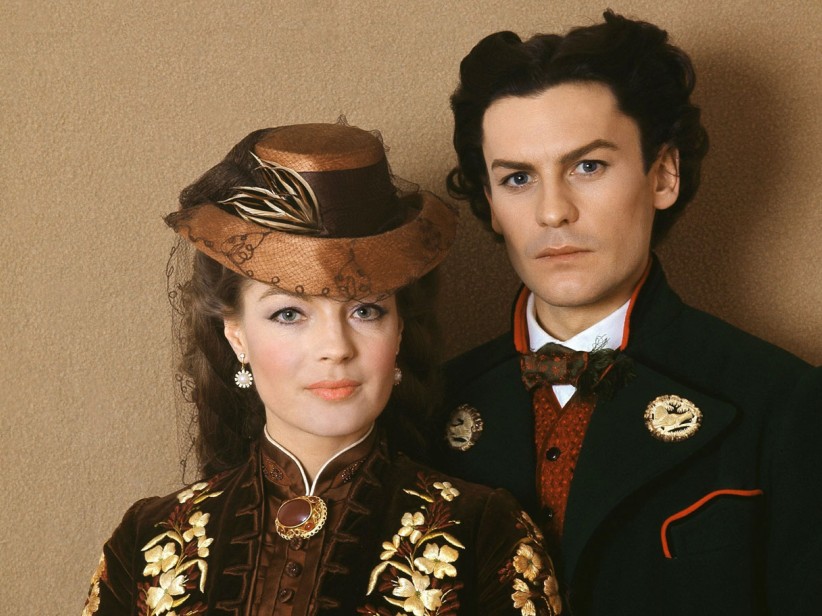
LUDWIG (Italy/France/West Germany - 1973) Directed by Luchino Visconti. Written by Luchino Visconti, Enrico Medioli and Suso Ceccho D'Amico. Cast: Helmut Berger, Romy Schneider, Trevor Howard, Silvana Mangano, Gert Frobe, Helmut Griem, Isabella Telezynska, Umberto Orsini, John Moulder Brown, Sonia Petrova, Folker Bohnet, Heinz Moog, Adriana Asti, Marc Porel, Nora Ricci, Mark Burns, Maurizio Bonuglia, Anne-Marie Hanschke, Gerard Herter, Henning Schluter, Eva Axen. (Unrated, 238 mins)
The most problematic work in the canon of the great Italian filmmaker Luchino Visconti, LUDWIG, an epic chronicle of the 1864-1886 reign of Ludwig II, "the mad king of Bavaria," was regarded as a beautiful but costly and self-indulgent folly upon its release in 1973. With an original running time of just under four hours, distributors all over the world balked at the film's length--so extreme that it seemingly depicted Ludwig's 22-year reign in real time--which led to a plethora of differing versions from country to country. In Italy, it was cut from 238 minutes to 186. US distributor MGM took the 186-minute version and cut it down to 173 for its NYC premiere in March 1973. That R-rated version was quickly withdrawn and LUDWIG was relaunched in Chicago a few months later at 137 minutes and re-rated PG, and that's the version that went into general release in the US over the summer and fall of 1973, running a full 101 minutes shorter than Visconti's intended vision (the PG cut presumably nixed any references toward Ludwig's sexual tendencies and a few scattered instances of male frontal nudity--were they concerned that a Visconti epic needed to bring in a younger demographic?). British audiences got the same 137-minute cut when it finally bowed in the UK in 1978, German moviegoers got a 144-minute version, and the Australian cut was whittled down a bit more to 133 minutes. Visconti apparently oversaw the first initial cut to 186 minutes for Italy and, whether willlingly or under duress, signed off on it, but beyond that, he was not involved in any further tweaks and alterations. Visconti died in 1976--his health worsened by a stroke he suffered midway through the shooting of LUDWIG--and over the years as the film fell into relative obscurity as the black sheep of a legendary auteur's filmography, there were so many different versions prepared for each market around the world, with so many wildly disparate running times that it became a virtual impossibility for anyone to remember what Visconti's intended LUDWIG even looked like.
The complete version of LUDWIG was released on DVD by Koch Lorber Films in 2008, but it was a flawed presentation that only included the Italian dub as an audio option with accompanying English subtitles. Visconti shot the film with the cast speaking English (with the intent of dubbing some of the Italian, French, and German supporting actors who had thicker accents or were speaking phonetically), which is how it played in US theaters, but the English soundtrack was only put in place for the assembly of the 173-minute US cut, and that was presumed lost over the ensuing 35 years or, perhaps more likely, clearing the rights to the English soundtrack and creating an integrated English/Italian audio track required more money and time than Koch Lorber was willing to spend. Arrow Video, under their prestige "Arrow Academy" banner, have released a four-disc Blu-ray/DVD combo set of the complete 238-minute LUDWIG--along with a separate viewing option that breaks it down into a five-part miniseries as it later played on Italian television--that offers the Italian soundtrack as well as the long-MIA English soundtrack for the first time in America since its theatrical release in 1973. There is one caveat: MGM never had the full-length version and were only given the 186-minute Visconti compromise, so they only saved the English track for the footage they used to assemble the 173-minute version for that initial NYC premiere. That means 65 of the restored version's 238 minutes automatically switch to Italian with English subtitles at random times. Some may find it distracting that just over 70% of the film is in English, but it's the best it's ever going to get if you want to hear the main stars and the more fluent-in-English members of the supporting cast speaking with their own voices.
But it's these switches to the Italian soundtrack that tell a bigger story: there's a lot of plot and exposition that gets spelled out in the Italian-language scenes, and if these were nixed for American audiences, it had to be pretty impossible to keep up with the narrative and have even the slightest idea what was going on, and even more so when it was chopped down further from 173 to 137 minutes. By the time Roger Ebert reviewed the 137-minute re-edit for the Chicago Sun-Times in June 1973, awarding it one star out of four, it was apparently an incoherent dumpster fire that lost all but one of the periodic cutaways to Ludwig underlings giving testimony directly to the camera. These bits happen a lot in the complete version and help provide some context as to what was going on in Bavaria during this time. I say "some context" because even at 238 minutes, LUDWIG remains a meandering, unwieldy mess that requires keeping access to Wikipedia at the ready if you want to know how most of the characters relate to one another or what purpose they serve in Ludwig's orbit, because much of that is information that Visconti is simply not interested in providing.
The film opens in 1864, the day that 19-year-old man-child Ludwig (played by Visconti's muse and longtime partner Helmut Berger) assumes the throne with the intent of being a caring and humble leader despite little working knowledge of being a ruler. He's incapable of comprehending how the Bavarian government operates and shows little interest in learning, but he loves the lavish life and all the pomp and circumstance, immediately portending a mix of oblivious naivete and stubbornness that strongly suggests he's in way over his head and that if he had to campaign for the job, his slogan would've been "Make Bavaria Great Again." Ludwig would be termed "The Mad King" as time went on, but Visconti is sympathetic to his subject. Far from being "mad," Ludwig is painted more as a tragic figure, one who was taken advantage of by those closest to him and one who would be continually frustrated by his inability to find true love and happiness. Historians have always questioned the claim that he was "insane," and now generally agree that it was an excuse used by his opponents to remove him from the throne. The conclusion these days is that he was a distant, awkward person who probably never wanted to be king in the first place, and his frequent instances of erratic psychological instability may have been the result of increasing isolation and loneliness and even royal inbreeding. For much of his reign, Ludwig wants nothing more than to marry his cousin, Countess Elisabeth of Austria (Romy Schneider), but she continually rejects him, even unsuccessfully trying to arrange a marriage for him with her younger sister Sophie (Sonia Petrova).
Far from being a "mad" tyrant, he tries to compensate for his ignorance as a leader and the repeated rejections by Elisabeth by pouring himself into the arts, architecture, and other grandiose displays of extravagance. He views art as "the antidote for evil and corruption in society," and becomes the primary benefactor of disgraced composer Richard Wagner (Trevor Howard), who arrives in Bavaria with his conductor Alan von Bulow (Mark Burns) and his wife Cosima (Silvana Mangano), with whom Wagner is having an affair. Wagner and Cosima view Ludwig as a useful idiot, bilking and hustling everything they can out of the young king ("This half-witted boy," Wagner chuckles to Cosima), who is more than happy to give them everything they desire, including a palatial residence and a personal opera house designed exclusively for the staging of Wagner operas. Ludwig drains his personal fortune and exhausts any available credit through the Bavarian treasury to order the construction of one castle after another throughout his kingdom, many of which are exact copies of ones that already exist in France. He's informed by everyone--from Elisabeth to close advisers like Count von Holnstein (Umberto Orsini, who's definitely dubbed) and Count Durckheim (Helmut Griem)--that he's being used, that he's reckless and irresponsible in his spending, that Wagner is squandering taxpayer money, and that the Von Bulows are shameless opportunists looking for a free ride. Elisabeth lays into him most harshly, telling Ludwig point-blank that "Your pathetic friendship with Wagner gives you the illusion of creating something...just as I give you the illusion of love." Ouch.
This all sounds like compelling drama, but Visconti isn't concerned with things like narrative and story construction. Sure, these story elements are there, but it's dramatically inert and told with much emotional distance, as if he wants to make the audience feel as isolated and closed-off as his subject. It's an experiment that doesn't really make for compelling cinematic storytelling, and LUDWIG is often as dry and clinical as those educational history films that one-time fellow neo-realist Roberto Rossellini was making for Italian television around the same time. Granted, LUDWIG is much more opulent and visually stunning, with very few exteriors and almost all of the scenes shot in the actual castles and palaces that Ludwig had constructed during his reign. Even when Bavaria goes to war with Austria against Prussia, we see not a single battle that would seem to be a requirement in such a massive historical epic. Ludwig simply decides to side with Austria and is eventually told that they've lost the war. On one hand, you get what Visconti is doing: by seeing nothing whatsoever of the war, the audience is in the same mindset as Ludwig, who was utterly unconcerned with it and was completely unaffected by it win or lose. But telling the story in this manner gives the film a choppy and incomplete feel even at four hours. Even with Ludwig's interactions with Elisabeth and Wagner and his gradual retreat into proto-Howard Hughes seclusion even to those closest to him (it's also feasible that he suffered from social anxiety disorder), it's still nearly three hours before Visconti gets anything resembling dramatic momentum going, when Count Durckheim is called in for an inquiry with top-ranking Bavarian officials at the behest of the duplicitous Count von Holnstein (the closest thing LUDWIG has to an outright villain). This secret group is conspiring to have Ludwig declared insane, which would force him to abdicate and give power to his uncle Prince Luitpold (Gerard Herter), as the next in line of succession is Ludwig's schizophrenic younger brother Prince Otto (John Moulder Brown), who's already been deemed even less capable of assuming the throne than his elder sibling. This long sequence--where Durckheim angers the rebellious government officials and defiantly professes his loyalty to Ludwig, refusing to have any part in the coup--plays out in Italian, meaning it was completely absent from the US cut. Again, how could anyone watching this movie in an American cinema in 1973 have even a hint of a clue as to what was happening?
LUDWIG was Visconti's most personal and ambitious film, and it's in many ways a summation of all of his obsessions and fixations. You can draw a straight line from Burt Lancaster's Prince of Salina in 1963's THE LEOPARD through Dirk Bogarde's Gustav von Aschenbach in 1971's DEATH IN VENICE and Berger's Ludwig through Lancaster's aging, nameless Professor in 1974's underrated CONVERSATION PIECE: lost men out of their time, living in the past, obsessed with beauty, art, decadence, and decay, sheltering themselves by hiding away in opulent mansions and/or dilapidated palazzi from a changing society they no longer understand in a world that's left them behind. From 1965 until his death in 1976, the openly gay Visconti was romantically involved with the much-younger Berger, who made his mark in Marlene Dietrich drag in Visconti's THE DAMNED but always seemed overtly androgynous even when he was playing tough guys in Eurotrash thrillers like 1975's ORDER TO KILL and 1977's MAD DOG KILLER. Visconti's and Berger's relationship (now 72, the bisexual Berger eventually married Italian actress Francesca Guidata but still refers to Visconti as the one great love of his life) is reflected throughout the director's later years, particularly with von Aschenbach's obsession with a teenage boy in DEATH IN VENICE and in Ludwig's fixations on attractive young men like officer Hornig (Marc Porel) and actor Joseph Kainz (Folker Bohnet). He spies on another young officer skinny-dipping and is also seen in a state of depressed malaise, in a decadent hideaway surrounded by nude young men lounging about the premises (I'm guessing that scene wasn't in the PG version). Watching Ludwig's decline and fall hastened by his commitment to an unattainable artistic vision at odds with everyday practicality, LUDWIG is as much about the Bavarian king as it is about Visconti himself.
But in lieu of anything to really drive the narrative for the first three hours, Visconti instead opts to make LUDWIG one of the most stunningly beautiful films you'll ever see. The location shooting in the castles, coupled with the art direction, the cinematography by Armando Nannuzzi (who would infamously lose his right eye in 1985 in an on-set accident during the making of Stephen King's MAXIMUM OVERDRIVE) and Piero Tosi's Oscar-nominated costume design make it a thoroughly captivating visual experience, especially on Blu-ray. As far as the performances go, Berger commits, looking haggard and thinner by the end, with greasy hair and augmented with convincingly rotted-looking teeth. He gets an enraged outburst every few scenes (if you watch with the Italian track, he's dubbed by Giancarlo Giannini), but when the film never lets you get into the heart and mind of Ludwig, what's the point? Faring much better is Howard, who benefits most from the recovery of the English soundtrack. The veteran British character actor (Visconti's second choice after Laurence Olivier turned it down) is just superb here, a larger-than-life presence stealing every scene he's in as the self-serving and subtly manipulative Wagner, who seems to genuinely like "this half-witted boy" but still puts himself first before all. Howard is so good here that had critical and commercial response to LUDWIG not been so toxic, he probably could've gotten a Best Supporting Actor Oscar nomination.
Berger and Visconti on the set
But man, this is a horse-pill. It's easy to draw comparisons between LUDWIG and another visually intoxicating but impenetrable and alienating epic that was a little further on the horizon: Michael Cimino's 1980 western HEAVEN'S GATE. Like that film, LUDWIG is a breathtaking sight to behold but its storytelling mechanics leave a lot to be desired. Both films were chopped down to more accessible, commercial lengths that rendered them incomprehensible, and now both are available in their intended versions (Visconti's estate gave its approval to Arrow's restoration). And both films essentially destroyed the careers of the filmmakers who lovingly crafted them, auteurs whose single-minded focus is exhaustingly precise, but caused them to lose sight of the bigger picture. Cimino is so concerned with nailing the accuracy of the time period in HEAVEN'S GATE, right down to whatever the most barely visible extra in the background is doing, that he forgets important details that lead to such questions as "Why are Jeff Bridges and John Hurt even in this movie?" Likewise, Visconti was so zeroed in on the atmosphere and the look of Ludwig's era, shooting in as many actual locations as possible, and getting the decor and the sets and the clothing down perfectly that he forgot to write a complete script with a beginning, middle, and end. Characters appear and disappear with baffling suddenness, you don't know who they are, the motivations of some are really fuzzy, and you may find yourself asking such questions as "Why is Gert Frobe even in this movie?" Visconti battled back as best he could after his stroke and would still make two more films--1974's CONVERSATION PIECE and 1976's THE INNOCENT--but LUDWIG would be the last one he'd see released in America in his lifetime. It was a huge flop and made him a pariah to the major studios. Visconti died in March 1976 at the age of 69, and CONVERSATION PIECE, even with a screen legend like Burt Lancaster starring, didn't hit American theaters until it was picked up by a fledgling New Line Cinema in 1977, while THE INNOCENT remained unseen in the US until the small arthouse outfit Analysis Films released it in 1979.
The 137-minute, PG-rated version of LUDWIG
opening in Toledo, OH on September 7, 1973.
It lasted one week.