EMMANUELLE (France - 1974) Directed by Just Jaeckin. Written by Jean-Louis Richard. Cast: Alain Cuny, Sylvia Kristel, Marika Green, Daniel Sarky, Jeanne Colletin, Christine Boisson, Samantha, Gaby Brian, Gregory. (X, 94 mins) Based on the scandalous 1959 novel by Emmanuelle Arsan that was long-rumored to be at least semi-autobiographical, 1974's controversial EMMANUELLE was a groundbreaking, X-rated deep-dive into post-LAST TANGO IN PARIS softcore erotica and it's likely that there never would've been a Skinemax without it. Focused on the intense sexual awakening of a beautiful and sexually-gifted but naive young woman, Emmanuelle was the first in a series of erotic novels by "Arsan," initially thought to be the pseudonym of French-Thai novelist Marayat Rollet-Andriane, an occasional actress who had a prominent supporting role as Richard Attenborough's love interest in the 1966 epic THE SAND PEBBLES, but the actual writer was later revealed to be her UNESCO diplomat husband Louis-Jacques Rollet-Andriane. The directing debut of French photographer Just Jaeckin, EMMANUELLE was a much-discussed sensation worldwide and made an international sex symbol of 22-year-old Dutch actress Sylvia Kristel, who would, for better or worse, be inextricably linked with the character for the rest of her career. As the film opens, Kristel's Emmanuelle is flying to Bangkok to visit her diplomat husband Jean (Daniel Sarky). They have an open marriage, though only Jean seems to take advantage of it and wishes his wife would indulge in similar exploits to share with him. Jean considers this the one negative aspect of his marriage to Emmanuelle, boasting to a colleague "I married her because no woman enjoys making love more, or does it better." Once in Bangkok, she's encouraged by other women, most of whom have slept with Jean, to explore her wild side, with young Marie-Ange (Christine Boisson) admonishing "He's only your husband...you have to take a lover if you want to be a real woman!" before masturbating in front of her to a magazine photo of a smiling Paul Newman.
Emmanuelle confesses that she had sex with two strangers on the flight from Paris to Bangkok, joining the mile-high club in the first-class cabin with a man across the aisle while others watched, then she was whisked away to the restroom by another man emboldened by her fearlessness. Jean has aggressive sex with Arianne (Jeanne Colletin), who also desires Emmanuelle, confronting her with "You're nude under your dress, aren't you...have you made love since I last saw you?" Emmanuelle is coveted by everyone, and she finds unexpected passion with archaeologist Bee (Marika Green, aunt of actress Eva Green). Emmanuelle confesses her love for Bee, who likes her very much but politely rejects her. A heartbroken Emmanuelle is chastised by Ariane ("What I live for is pure enjoyment. Your violins, your hearts and flowers, your promises of eternal love make me sick"), who boasts of her fling with Jean in a country club locker room dialogue exchange that pretty much sums up Euro softcore porn in a nutshell:
Ariane: "You know, I made love with your husband."
Emmanuelle: "Yes, he mentioned it. How'd it go?"
Ariane: "I thought you knew, it was practically rape."
Emmanuelle: "Help me unhook my brassiere."
As Jean grows jealous over Emmanuelle's sudden interest in taking advantage of the open marriage that was all his idea, it's Ariane who suggests that she visit Mario (Alain Cuny), an aging playboy and an expert in the ways of mature lovemaking. Mario is infatuated with Emmanuelle at first sight but refuses to make love to her, instead promising to take her to "the land of eroticism." This essentially involves a series of degrading activities that include being pawed by a vagrant, drugged in an opium den and gang-raped to pilfered King Crimson riffs, and then taken to an underground fight club where Mario promises Emmanuelle to the winner. He's really just a perv--and presumably impotent--who likes to watch, and it's the last third of EMMANUELLE that really becomes unpleasant to watch, and not just through the lens of 2019. I don't wish to sound like a representative of Woke Twitter, and I'm not advocating canceling EMMANUELLE 45 years after its release, but it's hard to imagine the Mario section of the film, with Emmanuelle experiencing her ultimate sexual awakening through one humiliation and degradation after another, being a turn-on to audiences or even a symbol of female empowerment, since it's all for Mario's pleasure. Even after this, Mario still doesn't sleep with Emmanuelle and moves on to his next subject, offering the kind of explanation where the only suitable response would be a kick in the balls: "I collect situations. I want to find the next Emmanuelle...through the looking glass!"
It's putting it mildly to say that EMMANUELLE hasn't aged well, but it obviously set the template for the countless European-made "sexual awakening of a young woman" films that came in its wake, such as Corinne Clery in THE STORY OF O (1975) and Dayle Haddon in THE FRENCH WOMAN (1977), both directed by Jaeckin; Sirpa Lane in Roger Vadim's CHARLOTTE (1975); Patti D'Arbanville in BILITIS (1977); Olivia Pascal in VANESSA (1977); and Annie Belle in both ANNIE (1976) and LAURE (1976), the latter written and co-directed by the Rollet-Andrianes, and featured "Arsan" herself as the title character's sexual mentor (the film was released in the US in 1982 as FOREVER EMMANUELLE). EMMANUELLE itself spawned two sequels (all three films have just been released on Blu-ray by Kino Lorber) and was so popular that it was spoofed in the 1978 British comedy CARRY ON EMMANUELLE. But it's the BLACK EMANUELLE series (note the missing "M") with Laura Gemser that was the most successful of the knockoffs, and in many ways, surpasses the inspiration (and Gemser most closely resembles the real Arsan). Released in the US by Columbia with the attention-getting tag line "X was never like this," EMMANUELLE is insufferably pretentious, with the constant hot air blather of "making love" growing unintentionally funny very quickly. It really fancies itself as something chic, artistic, and profound, and the presence of top-billed Cuny (memorable in Federico Fellini's LA DOLCE VITA and FELLINI SATYRICON) certainly gives it an air of importance, though the respected actor was said to be difficult and later commented that he only took the role to show his contempt for modern cinema. It also exploits the exoticism of Thailand and the Far East, with a particularly memorable shot of a dancer using a certain orifice to smoke a cigarette that's exactly the kind of thing you think of when you hear "bar in Bangkok." But it's Kristel's film from beginning to end. She's lovely and has haunting eyes that hypnotize when she stares into the camera, and it's easy to see why EMMANUELLE catapulted her to fame, while at the same time leaving her hopelessly typecast.
EMMANUELLE opening in Toledo, OH on 2/27/1976
EMMANUELLE 2 aka EMMANUELLE: THE JOYS OF A WOMAN (France - 1975; US release 1976) Directed by Francis Giacobetti. Written by Bob Elia. Cast: Sylvia Kristel, Umberto Orsini, Frederic Lagache, Catherine Rivet, Venantino Venantini, Caroline Laurence, Henry Czarniak, Tom Clark, Marion Womble, Florence Lafuma, Claire Richard, Laura Gemser, Eva Hamel, Christiane Gibelin, Sterling St. Jacques. (X, 91 mins) With no shortage of "Emmanuelle Arsan" stories, and with EMMANUELLE being such a worldwide box-office smash (it opened in the US in December 1974 and moved across the country slowly, letting the notoriety continue to build, and it was still hitting first-run theaters in America well into 1976), a sequel was inevitable. Just Jaeckin passed on directing, not wishing to be associated strictly with EMMANUELLE, and instead made the similarly X-rated, S&M-themed THE STORY OF O and the brothel-set THE FRENCH WOMAN. Kristel returned for EMMANUELLE 2, better known by its eventual US title EMMANUELLE: THE JOYS OF A WOMAN, directed by a debuting Francis Giacobetti. It's a loose sequel, with a markedly more confident and assured Kristel playing what appears to be an Emmanuelle, if not the same Emmanuelle from the previous film, with Jean now either an engineer or an architect and played by Italian actor Umberto Orsini (THE DAMNED, VIOLENT CITY). The film opens with Emmanuelle boarding a ship to Hong Kong, where Jean is working, but a booking snafu forces her into a dormitory sleeping arrangement with some commoner women, which instantly leads to some girl-on-girl action between a now sexually-emboldened Emmanuelle and young traveler Ingrid (Caroline Laurence), who seduces Emmanuelle by confessing a violent gang-rape fantasy. Emmanuelle and Jean continue to have the most open marriage imaginable, with Jean practically salivating over her exploits. Jean is also providing room and board to a pilot named Christopher (Frederic Lagache), who sleeps with his propellor (?) and, of course, becomes a fantasy object for Emmanuelle, especially after he takes her to an acupuncturist and she masturbates to him with needles sticking out of her face. In Emmanuelle's absence, Jean has been sleeping with (or, in the parlance of EMMANUELLE, "making love to") Laura (Florenca Lafuma), the younger wife of aging diplomat Peter (Tom Clark). When she isn't fantasizing about Christopher or masquerading as a prostitute in a Hong Kong brothel and having sex with three men in a consensual re-enactment of Ingrid's rape fantasy, Emmanuelle becomes obsessed with Laura's virginal stepdaughter Anna Marie (Catherine Rivet). She eventually convinces the naive young girl (oooh...could she remind Emmanuelle of her younger self?) to partake in a threesome where Jean is only all too happy to deflower the young woman. You know, if that's what Emmanuelle wants and all...
Of course, that's after the film's most famous scene, a long massage sequence where Emmanuelle, Jean, and Anna Marie are given soapy, oily rubdowns and happy endings by a trio of masseuses, including one played by Indonesian actress Laura Gemser, who made such an impression in this one scene that she would immediately be cast in the Italian knockoff BLACK EMANUELLE, which led to her own series of films that lasted well into the 1980s. EMMANUELLE: THE JOYS OF A WOMAN understands first and foremost what drew audiences to EMMANUELLE and as such, it doesn't waste time with endless philosophizing about "making love" and instead just gets down to it. It's much closer in spirit to the Italian-made Gemser series, perhaps in part since it features Italian actors like Orsini and Eurocult regular Venantino Venantini (who would also appear in three of Gemser's BLACK EMANUELLEs), seen here as a tattooed polo player who gets fellated by Emmanuelle in a locker room before fisting her. EMMANUELLE: THE JOYS OF A WOMAN is often jawdropping in its brazen explicitness, rivaling the carnal content of any of Gemser's outings, so much so that even after being cut down to 84 minutes for its 1976 US release by Paramount (yes, Paramount), it still got handed an X rating. It wasn't quite as big of a hit as its predecessor, but it enjoyed a reasonably successful run as a midnight movie into the early 1980s. EMMANUELLE: THE JOYS OF A WOMAN is the best of the Kristel EMMANUELLEs by far (strangely, Giacobetti never made another movie), and Kino Lorber's Blu-ray offers the uncut 91-minute version, so plan accordingly..
EMMANUELLE: THE JOYS OF A WOMAN
opening in Toledo, OH on 10/22/1976
Further evidence that things just used to be different: here's
EMMANUELLE: THE JOYS OF A WOMAN playing
at a goddamn mall in Toledo, OH on 6/16/1978
GOODBYE EMMANUELLE (France - 1977; US release 1981) Directed by Francois Leterrier. Written by Monique Lange and Francois Leterrier. Cast: Sylvia Kristel, Umberto Orsini, Jean-Pierre Bouvier, Alexandra Stewart, Olga Georges-Picot, Charlotte Alexandra, Caroline Laurence, Sylvie Fennec, Radiah Frye, Jacques Doniol-Valcroize, Erik Colin, Jack Allen, Bob Asklof, Greg Germain, Patrick Victor. (R, 98 mins) The EMMANUELLE series made Kristel an international star, though it limited her to largely similar roles in various Euro erotica outings ranging from artsy to commercial, including Alain Robbe-Grillet's PLAYING WITH FIRE (1975), Roger Vadim's GAME OF SEDUCTION (1976), and Walerian Borowczyk's THE STREETWALKER (1976). Kristel returned to her signature role for the final film in the original trilogy, 1977's GOODBYE EMMANUELLE, which reteamed her with Umberto Orsini as Jean but under the direction of a third helmer, this time Francois Leterrier, who had a minor hit in France with 1973's PRIVATE SCREENING, with Francoise Fabian, Jane Birkin, and Bulle Ogier. GOODBYE EMMANUELLE drastically tones down the "anything goes" titillation of its predecessor and desperately wants to be taken seriously like Jaeckin's original. It's got a very catchy theme song by Birkin and her husband, renowned French singer and composer Serge Gainsbourg, and its cast has more prestigious actors than usual, like Olga Georges-Picot (Alain Resnais' JE T'AIME, JE T'AIME, Fred Zinnemann's THE DAY OF THE JACKAL, Woody Allen's LOVE AND DEATH) and Canadian-born Alexandra Stewart (Francois Truffaut's THE BRIDE WORE BLACK and DAY FOR NIGHT, Louis Malle's BLACK MOON). But it gets everything about EMMANUELLE fundamentally wrong. The central premise has Emmanuelle, now traveling to the Seychelles, where Jean is (allegedly) working, but this time, she's growing tired of the sexual histrionics of their open marriage--of course, not before an opening threesome with Jean and local dressmaker Angelique (Radiah Frye). She even begins sympathizing with frigid Clara (Sylvie Fennac, a dead ringer for Dayle Haddon), who tried to play that game with her husband, Jean's friend Guillaume (Erik Colin), but just wasn't into it. Clara also blames Emmanuelle and Jean for Guillaume's sudden interest in pursuing an open marriage and his obsession with perfecting the art of "lovemaking," which is understandable since it's all anyone in these movies ever fucking talks about. Emmanuelle develops feelings for Gregory (Jean-Pierre Bouvier), a filmmaker scouting locations in the area, who doesn't believe in Jean's lifestyle philosophy and happens to catch Emmanuelle at the very moment she's been thinking the same thing, especially her growing disgust with how Jean and all of the expat swinger couples in their social circle pass eager, nubile young Chloe (Charlotte Alexandra) amongst themselves for their endless sexual pleasure. Though Jean loves nothing more than being turned on by Emmanuelle's stories of making love to other men, he soon grows jealous of Gregory and starts deliberately sabotaging her relationship with him, driving Emmanuelle to make the decision to abandon her sexually adventurous world and consider settling down with Gregory.
The less said about GOODBYE EMMANUELLE, the better. "Emmanuelle Goes Monogamous" might've seemed like a thought-provoking and even subversive idea on paper, but it's deadening in execution, unless you're a big fan of the endless "making love" philosophizing and highbrow poseurdom that constitute everything you fast-forwarded through in your teenage years in an impatient dash to get to "the good parts." The good parts are few and far between in the impossibly dull GOODBYE EMMANUELLE, and it must've been apparent to any potential US distributors. While EMMANUELLE was released by Columbia and EMMANUELLE: THE JOYS OF A WOMAN by Paramount, GOODBYE EMMANUELLE went unseen in America until it was picked up in 1981 by ambitious young concert promoter Harvey Weinstein, who was looking to get into the movie distribution game, thus earning the film its only claim to future notoriety by being the first release of the fledgling Miramax Films. It was so tame that it didn't even need any trimming for an R rating. And it was only given a spotty release, with Weinstein's acquisition likely due less to the fading brand recognition of the EMMANUELLE films (even Gemser's EMANUELLEs were being retooled as women-in-prison grinders like CAGED WOMAN and WOMEN'S PRISON MASSACRE) and more because Kristel, then in the midst of a short-lived run in Hollywood after 1979's THE CONCORDE: AIRPORT '79 and 1980's THE NUDE BOMB, was having a pretty good year in 1981, and here was one of her EMMANUELLE movies, sitting there unclaimed. 1981 saw Kristel reunite with Jaeckin for the future cable favorite LADY CHATTERLEY'S LOVER and she also enjoyed her biggest US success that same year with PRIVATE LESSONS. Like EMMANUELLE, PRIVATE LESSONS was another influential first centered on Kristel, in this case kickstarting a string of "horny, virginal teenage dweeb inexplicably gets seduced by his hot teacher" comedies (followed by the likes of HOMEWORK, MY TUTOR, and THEY'RE PLAYING WITH FIRE) that wouldn't have a chance in hell of being made today, much less being huge moneymakers at the box office, and, it bears mentioning, inspiring Van Halen's hit "Hot for Teacher."
But it's the success of PRIVATE LESSONS that was a blessing and a curse for Kristel. It finally gave her a non-EMMANUELLE hit, but a scheming agent talked her into signing her percentage profits over to him, so while the film was a smash hit, she barely made anything from it. Coupled with the collapse of her often volatile relationship with Ian McShane, who she met while making 1979's THE FIFTH MUSKETEER, and a worsening drug and alcohol problem (she was very open in later years about having a serious cocaine addiction in the late '70s and into the '80s), Kristel was quickly bottoming out personally and professionally. Out of desperation, she was lured back to the world of Emmanuelle for the 1984 Cannon reboot EMMANUELLE IV, which played like an erotic take on SECONDS, almost insulting then-32-year-old Kristel by having her Emmanuelle go through plastic surgery to emerge in a younger incarnation played by Mia Nygren. After that, Kristel was simply taking jobs for the money, from 1985's MATA HARI to the same year's German-made women-in-prison potboiler RED HEAT to a disastrous attempt to once again crack the American market with 1988's DRACULA'S WIDOW, which was caught up in the bankruptcy of DeLaurentiis Entertainment Group and ended up going straight to video. The increasingly dubious and decreasingly-budgeted EMMANUELLE series continued without her, but Kristel was eventually reduced to starring in 1993's EMMANUELLE 7, which has the title character now running a virtual reality lab where people can fulfill their sexual fantasies. The same year, she appeared as "Old Emmanuelle" (Kristel was 41 at the time) in a series of French made-for-cable movies where she's featured in wraparound segments recounting her youthful sexploits to a new Mario (George Lazenby, of all people), with young Emmanuelle played by Venezuelan actress Marcella Walerstein. Kristel remained in Europe, working primarily in France, Italy, and her native Netherlands in obscure films and on TV, but her career never bounced back. While she successfully conquered her substance abuse issues, she spent the bulk of the '00s battling cancer, first in her throat, then spreading to her lungs, and she suffered a stroke shortly before her death in 2012 at just 60.
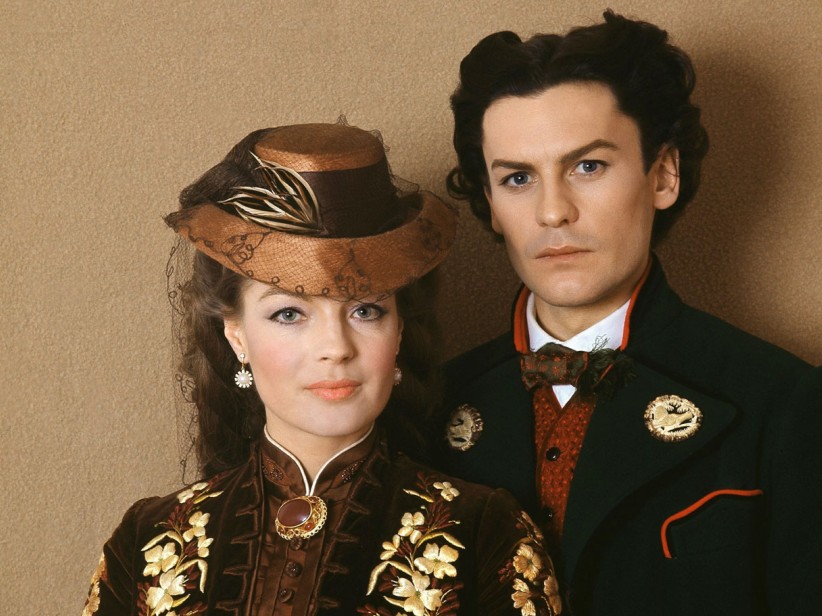
LUDWIG (Italy/France/West Germany - 1973) Directed by Luchino Visconti. Written by Luchino Visconti, Enrico Medioli and Suso Ceccho D'Amico. Cast: Helmut Berger, Romy Schneider, Trevor Howard, Silvana Mangano, Gert Frobe, Helmut Griem, Isabella Telezynska, Umberto Orsini, John Moulder Brown, Sonia Petrova, Folker Bohnet, Heinz Moog, Adriana Asti, Marc Porel, Nora Ricci, Mark Burns, Maurizio Bonuglia, Anne-Marie Hanschke, Gerard Herter, Henning Schluter, Eva Axen. (Unrated, 238 mins)
The most problematic work in the canon of the great Italian filmmaker Luchino Visconti, LUDWIG, an epic chronicle of the 1864-1886 reign of Ludwig II, "the mad king of Bavaria," was regarded as a beautiful but costly and self-indulgent folly upon its release in 1973. With an original running time of just under four hours, distributors all over the world balked at the film's length--so extreme that it seemingly depicted Ludwig's 22-year reign in real time--which led to a plethora of differing versions from country to country. In Italy, it was cut from 238 minutes to 186. US distributor MGM took the 186-minute version and cut it down to 173 for its NYC premiere in March 1973. That R-rated version was quickly withdrawn and LUDWIG was relaunched in Chicago a few months later at 137 minutes and re-rated PG, and that's the version that went into general release in the US over the summer and fall of 1973, running a full 101 minutes shorter than Visconti's intended vision (the PG cut presumably nixed any references toward Ludwig's sexual tendencies and a few scattered instances of male frontal nudity--were they concerned that a Visconti epic needed to bring in a younger demographic?). British audiences got the same 137-minute cut when it finally bowed in the UK in 1978, German moviegoers got a 144-minute version, and the Australian cut was whittled down a bit more to 133 minutes. Visconti apparently oversaw the first initial cut to 186 minutes for Italy and, whether willlingly or under duress, signed off on it, but beyond that, he was not involved in any further tweaks and alterations. Visconti died in 1976--his health worsened by a stroke he suffered midway through the shooting of LUDWIG--and over the years as the film fell into relative obscurity as the black sheep of a legendary auteur's filmography, there were so many different versions prepared for each market around the world, with so many wildly disparate running times that it became a virtual impossibility for anyone to remember what Visconti's intended LUDWIG even looked like.
The complete version of LUDWIG was released on DVD by Koch Lorber Films in 2008, but it was a flawed presentation that only included the Italian dub as an audio option with accompanying English subtitles. Visconti shot the film with the cast speaking English (with the intent of dubbing some of the Italian, French, and German supporting actors who had thicker accents or were speaking phonetically), which is how it played in US theaters, but the English soundtrack was only put in place for the assembly of the 173-minute US cut, and that was presumed lost over the ensuing 35 years or, perhaps more likely, clearing the rights to the English soundtrack and creating an integrated English/Italian audio track required more money and time than Koch Lorber was willing to spend. Arrow Video, under their prestige "Arrow Academy" banner, have released a four-disc Blu-ray/DVD combo set of the complete 238-minute LUDWIG--along with a separate viewing option that breaks it down into a five-part miniseries as it later played on Italian television--that offers the Italian soundtrack as well as the long-MIA English soundtrack for the first time in America since its theatrical release in 1973. There is one caveat: MGM never had the full-length version and were only given the 186-minute Visconti compromise, so they only saved the English track for the footage they used to assemble the 173-minute version for that initial NYC premiere. That means 65 of the restored version's 238 minutes automatically switch to Italian with English subtitles at random times. Some may find it distracting that just over 70% of the film is in English, but it's the best it's ever going to get if you want to hear the main stars and the more fluent-in-English members of the supporting cast speaking with their own voices.
But it's these switches to the Italian soundtrack that tell a bigger story: there's a lot of plot and exposition that gets spelled out in the Italian-language scenes, and if these were nixed for American audiences, it had to be pretty impossible to keep up with the narrative and have even the slightest idea what was going on, and even more so when it was chopped down further from 173 to 137 minutes. By the time Roger Ebert reviewed the 137-minute re-edit for the Chicago Sun-Times in June 1973, awarding it one star out of four, it was apparently an incoherent dumpster fire that lost all but one of the periodic cutaways to Ludwig underlings giving testimony directly to the camera. These bits happen a lot in the complete version and help provide some context as to what was going on in Bavaria during this time. I say "some context" because even at 238 minutes, LUDWIG remains a meandering, unwieldy mess that requires keeping access to Wikipedia at the ready if you want to know how most of the characters relate to one another or what purpose they serve in Ludwig's orbit, because much of that is information that Visconti is simply not interested in providing.
The film opens in 1864, the day that 19-year-old man-child Ludwig (played by Visconti's muse and longtime partner Helmut Berger) assumes the throne with the intent of being a caring and humble leader despite little working knowledge of being a ruler. He's incapable of comprehending how the Bavarian government operates and shows little interest in learning, but he loves the lavish life and all the pomp and circumstance, immediately portending a mix of oblivious naivete and stubbornness that strongly suggests he's in way over his head and that if he had to campaign for the job, his slogan would've been "Make Bavaria Great Again." Ludwig would be termed "The Mad King" as time went on, but Visconti is sympathetic to his subject. Far from being "mad," Ludwig is painted more as a tragic figure, one who was taken advantage of by those closest to him and one who would be continually frustrated by his inability to find true love and happiness. Historians have always questioned the claim that he was "insane," and now generally agree that it was an excuse used by his opponents to remove him from the throne. The conclusion these days is that he was a distant, awkward person who probably never wanted to be king in the first place, and his frequent instances of erratic psychological instability may have been the result of increasing isolation and loneliness and even royal inbreeding. For much of his reign, Ludwig wants nothing more than to marry his cousin, Countess Elisabeth of Austria (Romy Schneider), but she continually rejects him, even unsuccessfully trying to arrange a marriage for him with her younger sister Sophie (Sonia Petrova).
Far from being a "mad" tyrant, he tries to compensate for his ignorance as a leader and the repeated rejections by Elisabeth by pouring himself into the arts, architecture, and other grandiose displays of extravagance. He views art as "the antidote for evil and corruption in society," and becomes the primary benefactor of disgraced composer Richard Wagner (Trevor Howard), who arrives in Bavaria with his conductor Alan von Bulow (Mark Burns) and his wife Cosima (Silvana Mangano), with whom Wagner is having an affair. Wagner and Cosima view Ludwig as a useful idiot, bilking and hustling everything they can out of the young king ("This half-witted boy," Wagner chuckles to Cosima), who is more than happy to give them everything they desire, including a palatial residence and a personal opera house designed exclusively for the staging of Wagner operas. Ludwig drains his personal fortune and exhausts any available credit through the Bavarian treasury to order the construction of one castle after another throughout his kingdom, many of which are exact copies of ones that already exist in France. He's informed by everyone--from Elisabeth to close advisers like Count von Holnstein (Umberto Orsini, who's definitely dubbed) and Count Durckheim (Helmut Griem)--that he's being used, that he's reckless and irresponsible in his spending, that Wagner is squandering taxpayer money, and that the Von Bulows are shameless opportunists looking for a free ride. Elisabeth lays into him most harshly, telling Ludwig point-blank that "Your pathetic friendship with Wagner gives you the illusion of creating something...just as I give you the illusion of love." Ouch.
This all sounds like compelling drama, but Visconti isn't concerned with things like narrative and story construction. Sure, these story elements are there, but it's dramatically inert and told with much emotional distance, as if he wants to make the audience feel as isolated and closed-off as his subject. It's an experiment that doesn't really make for compelling cinematic storytelling, and LUDWIG is often as dry and clinical as those educational history films that one-time fellow neo-realist Roberto Rossellini was making for Italian television around the same time. Granted, LUDWIG is much more opulent and visually stunning, with very few exteriors and almost all of the scenes shot in the actual castles and palaces that Ludwig had constructed during his reign. Even when Bavaria goes to war with Austria against Prussia, we see not a single battle that would seem to be a requirement in such a massive historical epic. Ludwig simply decides to side with Austria and is eventually told that they've lost the war. On one hand, you get what Visconti is doing: by seeing nothing whatsoever of the war, the audience is in the same mindset as Ludwig, who was utterly unconcerned with it and was completely unaffected by it win or lose. But telling the story in this manner gives the film a choppy and incomplete feel even at four hours. Even with Ludwig's interactions with Elisabeth and Wagner and his gradual retreat into proto-Howard Hughes seclusion even to those closest to him (it's also feasible that he suffered from social anxiety disorder), it's still nearly three hours before Visconti gets anything resembling dramatic momentum going, when Count Durckheim is called in for an inquiry with top-ranking Bavarian officials at the behest of the duplicitous Count von Holnstein (the closest thing LUDWIG has to an outright villain). This secret group is conspiring to have Ludwig declared insane, which would force him to abdicate and give power to his uncle Prince Luitpold (Gerard Herter), as the next in line of succession is Ludwig's schizophrenic younger brother Prince Otto (John Moulder Brown), who's already been deemed even less capable of assuming the throne than his elder sibling. This long sequence--where Durckheim angers the rebellious government officials and defiantly professes his loyalty to Ludwig, refusing to have any part in the coup--plays out in Italian, meaning it was completely absent from the US cut. Again, how could anyone watching this movie in an American cinema in 1973 have even a hint of a clue as to what was happening?
LUDWIG was Visconti's most personal and ambitious film, and it's in many ways a summation of all of his obsessions and fixations. You can draw a straight line from Burt Lancaster's Prince of Salina in 1963's THE LEOPARD through Dirk Bogarde's Gustav von Aschenbach in 1971's DEATH IN VENICE and Berger's Ludwig through Lancaster's aging, nameless Professor in 1974's underrated CONVERSATION PIECE: lost men out of their time, living in the past, obsessed with beauty, art, decadence, and decay, sheltering themselves by hiding away in opulent mansions and/or dilapidated palazzi from a changing society they no longer understand in a world that's left them behind. From 1965 until his death in 1976, the openly gay Visconti was romantically involved with the much-younger Berger, who made his mark in Marlene Dietrich drag in Visconti's THE DAMNED but always seemed overtly androgynous even when he was playing tough guys in Eurotrash thrillers like 1975's ORDER TO KILL and 1977's MAD DOG KILLER. Visconti's and Berger's relationship (now 72, the bisexual Berger eventually married Italian actress Francesca Guidata but still refers to Visconti as the one great love of his life) is reflected throughout the director's later years, particularly with von Aschenbach's obsession with a teenage boy in DEATH IN VENICE and in Ludwig's fixations on attractive young men like officer Hornig (Marc Porel) and actor Joseph Kainz (Folker Bohnet). He spies on another young officer skinny-dipping and is also seen in a state of depressed malaise, in a decadent hideaway surrounded by nude young men lounging about the premises (I'm guessing that scene wasn't in the PG version). Watching Ludwig's decline and fall hastened by his commitment to an unattainable artistic vision at odds with everyday practicality, LUDWIG is as much about the Bavarian king as it is about Visconti himself.
But in lieu of anything to really drive the narrative for the first three hours, Visconti instead opts to make LUDWIG one of the most stunningly beautiful films you'll ever see. The location shooting in the castles, coupled with the art direction, the cinematography by Armando Nannuzzi (who would infamously lose his right eye in 1985 in an on-set accident during the making of Stephen King's MAXIMUM OVERDRIVE) and Piero Tosi's Oscar-nominated costume design make it a thoroughly captivating visual experience, especially on Blu-ray. As far as the performances go, Berger commits, looking haggard and thinner by the end, with greasy hair and augmented with convincingly rotted-looking teeth. He gets an enraged outburst every few scenes (if you watch with the Italian track, he's dubbed by Giancarlo Giannini), but when the film never lets you get into the heart and mind of Ludwig, what's the point? Faring much better is Howard, who benefits most from the recovery of the English soundtrack. The veteran British character actor (Visconti's second choice after Laurence Olivier turned it down) is just superb here, a larger-than-life presence stealing every scene he's in as the self-serving and subtly manipulative Wagner, who seems to genuinely like "this half-witted boy" but still puts himself first before all. Howard is so good here that had critical and commercial response to LUDWIG not been so toxic, he probably could've gotten a Best Supporting Actor Oscar nomination.
Berger and Visconti on the set
But man, this is a horse-pill. It's easy to draw comparisons between LUDWIG and another visually intoxicating but impenetrable and alienating epic that was a little further on the horizon: Michael Cimino's 1980 western HEAVEN'S GATE. Like that film, LUDWIG is a breathtaking sight to behold but its storytelling mechanics leave a lot to be desired. Both films were chopped down to more accessible, commercial lengths that rendered them incomprehensible, and now both are available in their intended versions (Visconti's estate gave its approval to Arrow's restoration). And both films essentially destroyed the careers of the filmmakers who lovingly crafted them, auteurs whose single-minded focus is exhaustingly precise, but caused them to lose sight of the bigger picture. Cimino is so concerned with nailing the accuracy of the time period in HEAVEN'S GATE, right down to whatever the most barely visible extra in the background is doing, that he forgets important details that lead to such questions as "Why are Jeff Bridges and John Hurt even in this movie?" Likewise, Visconti was so zeroed in on the atmosphere and the look of Ludwig's era, shooting in as many actual locations as possible, and getting the decor and the sets and the clothing down perfectly that he forgot to write a complete script with a beginning, middle, and end. Characters appear and disappear with baffling suddenness, you don't know who they are, the motivations of some are really fuzzy, and you may find yourself asking such questions as "Why is Gert Frobe even in this movie?" Visconti battled back as best he could after his stroke and would still make two more films--1974's CONVERSATION PIECE and 1976's THE INNOCENT--but LUDWIG would be the last one he'd see released in America in his lifetime. It was a huge flop and made him a pariah to the major studios. Visconti died in March 1976 at the age of 69, and CONVERSATION PIECE, even with a screen legend like Burt Lancaster starring, didn't hit American theaters until it was picked up by a fledgling New Line Cinema in 1977, while THE INNOCENT remained unseen in the US until the small arthouse outfit Analysis Films released it in 1979.
The 137-minute, PG-rated version of LUDWIG
opening in Toledo, OH on September 7, 1973.
It lasted one week.