ZEDER aka REVENGE OF THE DEAD (Italy - 1983; US release 1984) Directed by Pupi Avati. Written by Pupi Avati, Maurizio Costanzo and Antonio Avati. Cast: Gabriele Lavia, Anne Canovas, Paola Tanziani, Cesare Barbetti, Bob Tonelli, Ferdinando Orlando, Enea Ferrario, John Stacy, Alessandro Partexano, Marcello Tusco, Aldo Sassi, Veronica Moriconi, Enrico Ardizzone, Maria Teresa Toffano, Andrea Montuschi. (Unrated, 99 mins) Mid '80s gorehounds had to be pretty pissed off when they saw REVENGE OF THE DEAD in a theater or a drive-in back in the summer of 1984 and into early 1985. With an ominous TV spot that hyped much but showed nothing, and poster art depicting zombies bursting out of the sewer through a sidewalk, accompanied by a prominently displayed and always-promising "This film contains scenes which may be considered shocking..." box in place of an MPAA rating, REVENGE OF THE DEAD looked to be the latest in a long-line of gore galore extravaganzas like George A. Romero's DAWN OF THE DEAD, the Lucio Fulci essentials ZOMBIE, THE GATES OF HELL, and HOUSE BY THE CEMETERY, Bruno Mattei/"Vincent Dawn"'s NIGHT OF THE ZOMBIES, and Juan Piquer Simon's Spanish-made chainsawgasm PIECES, among others. But the ad campaign and the promise of "shocking" gore scenes were all a misleading ruse that would've made any huckstering B-movie wheeler-and-dealer proud. Distributed in the US by the exploitation outfit Motion Picture Marketing, co-owned by mobster-turned-Christian motivational speaker Michael Franzese, REVENGE OF THE DEAD was a retitling of ZEDER, a thoughtful, intelligent study of the paranormal by Italian director Pupi Avati (THE HOUSE WITH LAUGHING WINDOWS) that had very little gore and even less in the way of onscreen zombies. Quickly dismissed by fans for its slow pace and lack of splatter--I rented it in the late '80s as an impatient teenager and shut it off halfway through out of boredom--REVENGE OF THE DEAD found some defenders as time went on. In the late '90s, it got a DVD release from Image Entertainment under its original ZEDER title and it finally began to be judged on its own terms by American genre enthusiasts, rather than for not being the zombie gut-muncher that MPM's US ads promised. ZEDER is back once more, significantly upgraded on Code Red's new Blu-ray, with reversible artwork for the nostalgic among us who still want to call it REVENGE OF THE DEAD, and its latest release makes a strong case for Avati's film being one of the unheralded classics of its era.
In 1956, a young girl named Gabriella (Veronica Moriconi) has psychic powers and is used by a team of researchers to help find the source of inexplicable supernatural occurrences in a house that have resulted in at least one murder. She's drawn to the basement, where the skeleton of one Paolo Zeder is found buried under the concrete floor. Someone exclaims "It's a K-Zone!" Cut to 1982, as struggling, blocked writer Stefano (Gabriele Lavia of DEEP RED and BEYOND THE DOOR) is given a secondhand typewriter for inspiration by his wife Alessandra (Anne Canovas). The ribbon quickly fades and breaks and while unspooling it, Stefano is fascinated by the bizarre writings he sees typed along the used ribbon. It mentions the work of Zeder, a renowned metaphysicist, and his belief in K-Zones. Consulting an old teacher, Prof. Chesi (John Stacy), Stefano learns that K-Zones are a term given to places throughout history, often with geological similarities, that defy the natural laws of life and death, existing in a place of "zero time" where life and death are interchangeable, and though it's never been proven, an area that could theoretically allow a return from the dead
Through some old-fashioned detective work from his cop friend Guido (Alessandro Partexano), Stefano discovers the typewriter was previously owned by a priest named Don Luigi Costa, but a visit to Costa proves pointless as the rude cleric is hostile and uncooperative, refusing to discuss the writings on the typewriter ribbon. A return visit to ask one more question leads to the first instance of Stefano realizing something is up: he's informed by young priest Don Mario (Aldo Sassi) that Costa left the parish over a decade earlier and the man he spoke with was an impostor. The impostor is Giovine (Ferdinando Orlando), who's part of a French-funded research team that includes an adult Gabriella (Paola Tanziani) and Dr. Meyer (Cesare Barbetti), who led the 1956 investigation that uncovered Zeder's skeleton. With the backing of a sinister, high-ranking government official (Edward G. Robinson lookalike Bob Tonelli), Meyer and his team are attempting to prove the existence of K-Zones. Stefano grows more obsessed with Zeder's ideas and what Costa was writing, eventually finding out that Costa recently died, followed by a visit to the cemetery where Costa is interred only to find his tomb empty. Despite Alessandra's objections, his investigation leads him to the Milano Marittima area of the seaside town of Cervia, where Meyer's team has set up a top-secret lab in an abandoned building.
Stefano's dogged pursuit of the truth has echoes of any number of protagonists in earlier Dario Argento films, and while their styles are different, Avati's film often feels like a '70s giallo with a decidedly paranormal bent. Avati lacks the style and flash of Argento, but he makes up for it by establishing a deeply unsettling tone throughout, one that grows positively suffocating the more Stefano gets in over his head and has no idea of the power of the conspiratorial forces he's up against (and the whole bit with the secret discovered on an old typewriter ribbon is the best idea an in-his-prime Argento never thought of--almost like something the alchemist Varelli would've done in INFERNO). ZEDER/REVENGE OF THE DEAD is about a quarter century ahead of its time in terms of the ominous "slow burn" Avati lets simmer to a boil throughout. Perhaps one reason the film plays so much better today than in the zombie flesh-eater days of the 1984 grindhouse is that it's finally caught up to the slow-burn ethos that's so prevalent in the horror genre today. Budding genre filmmakers of today would be wise to study ZEDER if they want to see how slow burn is done right (based on one early scene in IT FOLLOWS, I'm willing to bet that film's director David Robert Mitchell is a ZEDER fan), and when Avati finally gets the scares going, the attentive viewer is so paralyzed by dread and a palpable sense of doom that the effect is terrifying. Riz Ortolani's bombastic and incredibly loud score--which sounds like Goblin produced a mash-up with some unused PSYCHO cues from Bernard Herrmann--helps as well, even though it seems at odds with the film's generally low-key mood. There's one good jump scare early on, but the other memorable moments throughout are the kind that creep up on you and stick with you for long after the movie's over: Avati's use of shadows; the scene in the gym swimming pool that's a blatant shout-out to Val Lewton and the 1942 CAT PEOPLE; what Stefano sees when he looks through a telescope into the abandoned building; and the devastating finale that's caused many to wonder if Stephen King stole a major element of this for his novel Pet Sematary or if Avati ripped it off from him--King's novel was published in November 1983, and ZEDER was released in Italy in August 1983, so the similarities are likely pure coincidence.
In recent years, there's been a surge of interest in urban exploration of abandoned structures (often termed "ruin porn"), especially "dead malls" that sit vacant and make for eerily fascinating photographs and YouTube videos (check out the work of photographer/videographer Seph Lawless for a great primer on the subject). To that end, ZEDER has one of the all-time great horror movie locations in the abandoned Colonia Varese, once a resort for the Fascist Youth Program in the 1930s. It became a hospital for German soldiers and a place to detain Allied POWs in WWII before being dynamited by the Nazis in 1945. Abandoned and left to the elements since the end of WWII, the Colonia Varese is an unforgettably striking location and delivers probably the most memorable performance in the film just by being there. Home to squatters in recent years, the building has been deemed a nuisance and talk of its demolition has been going on for some time. It still stands as of now, but if nothing else, let ZEDER serve as the definitive celluloid document of this fascinating example of fascist architecture-turned-ruin porn, with Avati turning a troubling monument to a dark part of Italy's past into one of the scariest places you'll ever see in a horror movie, a real-life house of horrors that should be as iconic a location as the fictional PSYCHO house and THE SHINING's Overlook Hotel or actual places like DAWN OF THE DEAD's Monroeville Mall and the EXORCIST steps in Georgetown. Dismissed 30-plus years ago for not being something it never should've been sold as in the first place, ZEDER/REVENGE OF THE DEAD has very quietly built a small but devoted cult following over the years. It's a unique and ambitious film that gets better and reveals deeper layers with each viewing, and with it looking better than it ever has on Code Red's Blu-ray (it also features new interviews with Avati and Lavia), the time has come for ZEDER to take its rightful place among the masterpieces of Italian horror.
REVENGE OF THE DEAD opening
in Toledo, OH on June 22, 1984
SUPER FUZZ (Italy - 1980; US release 1981) Directed by Sergio Corbucci. Written by Sergio Corbucci and Sabatino Ciufini. Cast: Terence Hill, Ernest Borgnine, Joanne Dru, Marc Lawrence, Julie Gordon, Lee Sandman, Sal Borgese, Woody Woodbury, Dow Stout, Herb Goldstein, Sergio Smacchi, Don Sebastian, Claudio Ruffini, Jack McDermott. (PG, 101 mins) If you were an 8-to-10-year-old boy anywhere from 1981 to 1984, chances are there was a brief moment in time when SUPER FUZZ was your favorite movie. Playing regionally across the US from the fall of 1981 to the summer of 1982, SUPER FUZZ became a sleeper hit and is probably the best known Terence Hill solo movie in America after the early '70s smashes THEY CALL ME TRINITY (1970) and TRINITY IS STILL MY NAME (1971) that paired him with frequent co-star Bud Spencer. Born in 1939, Hill, whose career began under his real name Mario Girotti in films like Luchino Visconti's THE LEOPARD (1963), found a niche in post-Sergio Leone/Clint Eastwood spaghetti westerns in the late '60s after adopting the Americanized "Terence Hill" pseudonym. Likewise, "Bud Spencer" was an alias for burly Carlo Pedersoli, and starting with 1967's GOD FORGIVES...I DON'T! and its sequels, 1968's ACE HIGH and 1969's BOOT HILL, Hill and Spencer made over 20 films together, with the last being 1994's TROUBLEMAKERS. By 1970, they were among the top box office draws in Europe, with the two TRINITY spaghetti western spoofs becoming major successes in the States. The duo would periodically make solo films but they were almost never as well-received on their own as they were together, though Hill enjoyed some success teaming with Henry Fonda for the Sergio Leone-produced 1973 spaghetti western MY NAME IS NOBODY. But when he tried his luck at crossing over to Hollywood in 1977, starring with Jackie Gleason in the comedy MR. BILLION and with Gene Hackman in the epic Foreign Legion adventure MARCH OR DIE, both films bombed and Hill went back to Italy to lick his wounds. Spencer's only attempt at going Hollywood never came to fruition: in 1987, Menahem Golan tried to kickstart an American career for him with the Cannon family comedy MY AFRICAN ADVENTURE, but Spencer was ultimately replaced by Dom DeLuise and the film retitled GOING BANANAS. His best-known solo vehicle away from Hill is 1979's THE SHERIFF AND THE SATELLITE KID, an Italian-produced, Georgia-shot CLOSE ENCOUNTERS OF THE THIRD KIND-inspired kids movie that skipped US theaters and debuted on cable. Spencer was paired with young Cary Guffey, memorably abducted by aliens in the Spielberg classic but here playing a cute extraterrestrial child who lands in Atlanta and spends a lot of time hanging out at Six Flags with the gruff Italian western star.
"Supa snoooo-paaaaah!"
While Spencer was making SATELLITE KID and its 1980 sequel WHY DID YOU PICK ON ME?, Hill starred in SUPER SNOOPER, a superhero cop comedy shot in Miami and directed by DJANGO auteur Sergio Corbucci. SUPER SNOOPER was acquired by Avco Embassy and retitled SUPER FUZZ for its October 1981 US release. Rather than opening it in theaters nationwide, Avco Embassy struck a limited number of prints and rolled it out regionally, moving from the west coast to the east coast at malls and drive-ins over a nine-month period. With a big TV push, the film became a moderate hit whose cult grew exponentially when it appeared on HBO by 1983, where its frequency in airing was perhaps rivaled only by THE BEASTMASTER. Possibly among the ten dumbest comedies ever made, SUPER FUZZ is ingratiatingly silly and filled with enough slapstick antics that it's easy to see why it appealed to young boys at an impressionable age. With his slight Italian accent giving him an Inspector Clouseau-meets-Latka Gravas goofball charm, Hill is engaging in a cartoonish way, mugging shamelessly as grinning, wide-eyed doofus Dave Speed, a rookie Miami cop delivering a traffic citation to an abandoned part of the Everglades where the government is testing a nuclear bomb (!). Unable to make it out in time, he's presumed killed in the line of duty until he reappears several hours later, boasting telepathic powers thanks to the radiation exposure. Paired with irate Willy Dunlop (Ernest Borgnine), a disgraced captain busted down to patrol duty, Dave finds he can see through and move objects, walk on water, catch bullets with his teeth, land on his feet after jumping out of the window of a skyscraper, outrun cars, fly through the air, create a makeshift radio just by making the "call me" gesture with his hand, and later, when he's falsely accused of murder, he can escape execution multiple times by beating the gas chamber, the electric chair, hanging, and a firing squad. His Kryptonite is the color red, a fact uncovered by fading '40s starlet Rosy Labouche ('40s and '50s leading lady Joanne Dru, in her first film since 1965 and her last before her death in 1996), the aging moll of Miami gangster Tony Torpedo (Marc Lawrence). Torpedo's nefarios plan is using his fish distribution company as a front for a counterfeit money operation that's being targeted by Dave and Willy, a former Hollywood stuntman still nursing a 40-year-old crush on Rosy.
Borgnine most likely shouting "ARE YOU CRAZY?!"
SUPER FUZZ's infectious stupidity starts immediately, with the theme song "Super Snooper," performed by The Oceans. It's the kind of song that sticks with you forever, and its oft-invoked refrain--just one quick "Supa snooooo-paaaaaah!" functioning as a de facto mic drop whenever Dave does something amazing--was probably enough to induce giggle fits in the target demographic then and nostalgic chuckles to that same group now. There is no limit to how ludicrous SUPER FUZZ can be: marvel at how Dave gives three Torpedo guys a beatdown in a dog kennel, then frees the dogs and then crams the three guys into the cage as Corbucci ends the scene with goons panting; behold Dave's ability to communicate with fish while he's under water; and brace yourself for his ultimate display of superhero power ("Supa snooooo-paaaaaah!") as he rescues Willy from a sunken boat by chewing some gum and blowing a bubble so big that it lifts them out of the water and flies them high in the sky above Miami. Hill and Borgnine make a likable team, with Borgnine's Willy especially blustery over Dave's budding romance with his niece Evelyn (Julie Gordon). If you revisit SUPER FUZZ now and don't find yourself transported back to your childhood days of carefree innocence and a significantly less-refined taste in comedy, you can at least get shitfaced by taking a drink every time a harumphing, bloviating Borgnine gets a flustered "Why I oughta..." look on his face and shouts "Are you crazy?!" whenever Super Fuzz does something obviously crazy.
"Supa snoooo-paaaaah!"
Avco Embassy made a few incidental changes to SUPER SNOOPER in its rechristening as SUPER FUZZ: some of the score cues throughout were replaced with more American-sounding library tracks and some minor edits were made to shorten the running time by a few minutes. The version currently streaming on Amazon is the European SUPER SNOOPER cut, in a pristine HD print with English audio and Italian credits sporting the title POLIZIOTTO SUPERPIU. Kudos to Avco Embassy for not messing up a great thing and leaving the song "Super Snooper" alone. A beloved figure in Italy, Hill is still with us--he's been starring as a crime-solving priest in the popular Italian TV series DON MATTEO since 2000--is very active on social media, and still looks spry and youthful at 78 (Spencer died in 2016 at 86). Where's the SUPER FUZZ Blu-ray with a Terence Hill commentary?
SUPER FUZZ opening in Toledo, OH on 1/29/1982
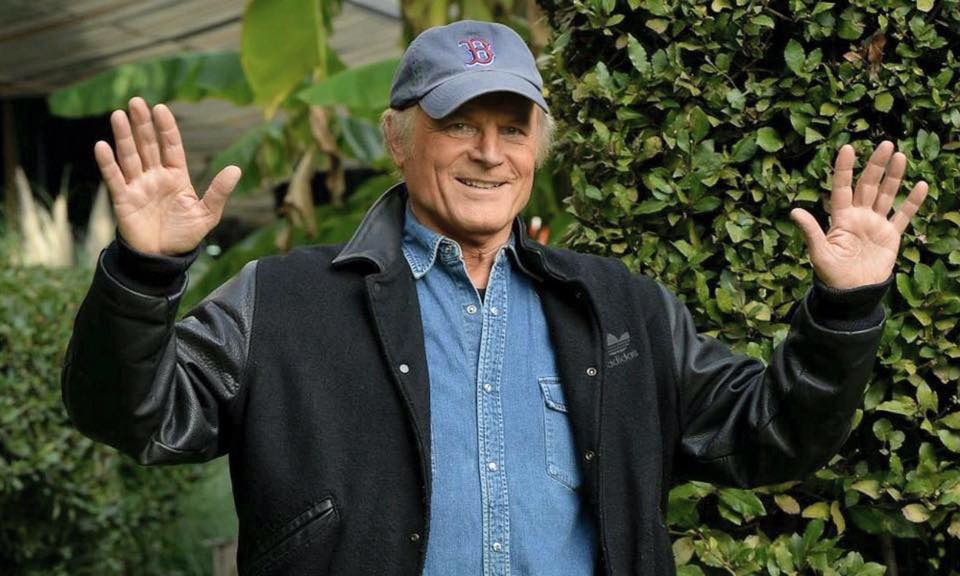
A recent photo of Hill, posted on his official Facebook page.
Nominated for 2016's Best Foreign Language Film Oscar (it lost to Asghar Farhadi's THE SALESMAN), TONI ERDMANN was one of the most critically-praised arthouse titles of last year. The third film from acclaimed German writer/director Maren Ade, and her first since 2009's EVERYONE ELSE, TONI ERDMANN has some amusing moments, heartfelt observations, and fine performances from its two leads, but at an absurdly bloated 162 minutes, there's simply too much of it, as Ade obviously loved everything she shot so much that she wasn't willing to part with any of it. Winfried Conradi (Austrian actor Peter Simonischek) is a retired, widower music teacher and an affable eccentric, an incessant prankster who's introduced answering the door for a package and telling the delivery driver it was ordered by his brother, who's just been paroled from prison where he was serving time for sending mail bombs. He excuses himself to get his brother, who's revealed to just be Winfried in a different robe, with a wig and fake teeth. The set of fake teeth is his go-to prop, and when his beloved, elderly, and blind dog Willi dies, Winfried is sure to take them with him to Bucharest, where he drops in for an unannounced visit with his daughter Ines (Sandra Huller, so memorable in 2006's REQUIEM). Ines is a consultant for firm dealing in oil export, and it shouldn't come as a surprise that her goofball dad gets in the way despite her insistence that he keep his silliness at a distance. Winfried is a free spirit who wants to enjoy the moments as they happen and not take life so seriously. He tries to pass this philosophy on to Ines, but she's only focused on her work, and the two have a falling out ("Do you have any plans in life other than slipping fart cushions under people?") after she misses an important meeting because she dozed off and Winfried didn't wake her.
That's the first hour of TONI ERDMANN. There's a lot of insider talk about the corporate world and how the structure is such that Ines has to work twice as hard as her male counterparts to make an impression, and even after she delivers a presentation to her boss Henneberg (Michael Wittenborn), he concludes the meeting with "Well, gents," choosing only to address the men in the room. Ade makes salient points like this, but belabors them. It's roughly 65 minutes in before we finally meet "Toni Erdmann," who shows up at a bar where Ines is having drinks with two female colleagues. "Toni" is clearly Winfried in his most grandiose prank yet, with a shaggy black wig and those same fake teeth, the Tony Clifton to his Andy Kaufman, claiming to be a life coach visiting Bucharest for the funeral of his Italian dentist friend's turtle. This kind of absurdist humor provides the highlights of TONI ERDMANN, but these moments are too sporadic. As "Toni," Winfried keeps following Ines around, meddling in her work life, eventually working his way into her office to act as a life coach for Henneborg and later trying to pass himself off as the German ambassador to Romania. Ade eventually caves to shock comedy with a pair of much-talked about scenes that really aren't that funny: one in a hotel room where Ines denies sex to workplace friend-with-benefits Tim (Trystan Putter), forcing him to masturbate and ejaculate on to a tray of petits four brought up by room service, after which she scarfs down one of the semen-covered appetizers. The other is the impromptu "naked party" sequence that was hailed as a set piece of Blake Edwards-ian genius but is really just awkward, uncomfortable, and not funny, especially when Winfried crashes it wearing a Bulgarian kukeri costume. Of course, it goes for sentiment at the end when father and daughter reach an understanding, but should it have taken a meandering and punishing two hours and 40 minutes to get there? TONI ERDMANN has already been deemed a modern classic, and yeah, there's some big laughs scattered throughout, Huller has a great incredulous, deadpan glare and convincingly belts out an impressive version of Whitney Houston's "The Greatest Love of All," and Simonischek often demonstrates a kind of Peter Sellers-meets-Sasha Baron Cohen quality with his endless antics (though his "Toni Erdmann" get-up really looks a lot like the late, great Alan Bates). With a 93% rating on Rotten Tomatoes, I'm obviously in the minority by not adoring this film, but by the two-hour point, part of me was hoping Winfried would choke to death on those goddamn fake teeth the next time he slipped them into his mouth with an impish grin. A Hollywood remake is already in the works, with Kristen Wiig and Jack Nicholson in his first film since 2010's HOW DO YOU KNOW? (R, 162 mins)
WAR ON EVERYONE (UK/UAE - 2016; 2017 US release)
An equal opportunity offender, the aptly-titled WAR ON EVERYONE is a bile-soaked, misanthropic screed of a buddy/cop movie from Irish writer/director John Michael McDonagh (THE GUARD, CALVARY). The story centers on two outrageously dirty cops running rampant in Albuquerque, New Mexico: brainy and philosophical Bob Bolano (Michael Pena) and impulsive anger management case Terry Monroe (Alexander Skarsgard). Sort of like a well-dressed STARSKY AND HUTCH filtered through BAD LIEUTENANT, Bolano and Monroe are introduced deliberately running over a mime and telling a witness that they can get away with because they're cops. They've just been taken off suspension by the perpetually flustered Lt. Stanton (Paul Reiser) after allegations of bribery and corruption and an unfortunate incident involving Bolano beating the shit out of a racist colleague who called him a "wetback," with Stanton explaining "This is the police department! We're surrounded by racist pigs!" but empathizing by explaining "I get it that he's racist...I understand. I'm married to a chink. I have chink kids." That's WAR ON EVERYONE in a nutshell: a feature-length trigger warning that wallows in cheap shots not just at Asians, but at African-Americans, homosexuals, transgender, Muslims, Quakers, dyslexics, overweight kids, people with MS, bad British teeth, the mentally ill, Stephen Hawking, and the Irish, just to show McDonagh's not excluding anyone. Much of it is admittedly funny in a "Did they just go there?" kind-of way, but WAR ON EVERYONE's convoluted plot feels like a half-baked rough draft that Shane Black scribbled out and would've tossed aside until he could devote his full attention to it. After framing an informant named Reggie X (Malcolm Barrett) with drug possession, Reggie coughs up some info: he was the getaway driver for a $1 million racetrack heist orchestrated by sleazy, heroin-addicted British dignitary Lord James Mangan (Theo James). After numerous run-ins with Mangan and his fey underling, strip club manager Russell Birdwell (Caleb Landry Jones as old-school Crispin Glover), Bolano and Monroe plot to steal the racetrack take for themselves which, naturally, leaves a trail of corpses all over Albuquerque.
There's also time for Monroe to have a romance with stripper Jackie (Tessa Thompson of CREED), and for him to find the caring soul within when it comes to Danny (Zion Leyba), a nice kid whose mother's been arrested for killing his father for reasons that are deliberately left obscure but, of course, will tie into the main plot much later. There's a lot in WAR ON EVERYONE that's amusing, but too much of it is just posturing attitude and characters saying things just to see how offensive the film can get. Elsewhere, McDonagh (the older brother of IN BRUGES writer/director Martin McDonagh) tries too hard to do some post-Tarantino pop culture riffing, with Monroe being an obsessive Glen Campbell fanatic (there's a Monroe/Jackie dance number set to "Rhinestone Cowboy"), Bolano and Reggie griping that "you can't see Jennifer Lopez's tits" in OUT OF SIGHT, and Monroe trying to recall if the first movie he ever saw was THE BLUE LAGOON or DOC SAVAGE: MAN OF BRONZE. There's scattered moments where WAR ON EVERYONE gets some momentum going and scores an occasional sterling bit of quotable dialogue ("European jizz?"), and James (the DIVERGENT series) makes a truly loathsome villain, but McDonagh probably should've given his script another polish before rolling the cameras. (R, 98 mins)
TANK 432 (UK - 2016)
There's a strong sense of the familiar with TANK 432. It's produced by cult filmmaker Ben Wheatley (KILL LIST, HIGH-RISE, the upcoming FREE FIRE), and it's the feature writing/directing debut of protege Nick Gillespie, who's served as a camera operator on all of Wheatley's films. The plot begins with faint echoes of Neal Marshall's DOG SOLDIERS before becoming something more surreal and psychological and by the end, it feels like a longer-than-usual episode of BLACK MIRROR, something that's probably inevitable in UK genre fare given the show's popularity and fervent following. An enemy is closing in on a team of mercenaries led by blustery, barking Smith (Gordon Kennedy), who orders everyone to retreat and leave injured Capper (Wheatley semi-regular Michael Smiley) behind with a bone jutting out of his leg. Smith has two hooded prisoners in orange jumpsuits and they pick up another tag-along in an unnamed woman (Alex March), who they find in utter hysterics until she's sedated by medic Karlsson (Deirdre Mullins). The squad is rounded out by unstable Gantz (Steve Garry), who's already seeing flashing visions of a barely-discernible creature following them, and requisite voice-of-reason Reeves (Rupert Evans, of Amazon's THE MAN IN THE HIGH CASTLE), who's struggling to hold it together. After finding several headless bodies of decapitated mercenaries in a barn, Smith leads everyone--minus one of the two prisoners who's killed a scuffle, leaving only Annabella (April Pearson) as the recovered quarry in their unspecified assignment--to an abandoned tank in the middle of an empty field. Deciding it's the safest place to take refuge from whatever is pursuing them, they all pile into its cramped, claustrophobic confines.
It isn't long before everyone's sanity starts to crumble, especially once they're inside and the only door in or out is jammed and no one can pry it open. Whatever's after them taunts them from outside, clanging and banging on the tank. Gantz unsuccessfully tries to start the tank, shits himself, and goes catatonic after being exposed to a strange orange powder. And Karlsson finds a box filled with files--on each of them. Too much of TANK 432 is just everyone shouting at one another, and Gillespie tips his hand too early with constant shots of Smith eyeballing everyone, scribbling in a notebook, and being evasive whenever anyone asks what he's writing, making it fairly obvious that things aren't what they seem, there's some kind of secret, and that Smith is on it. When that secret is finally revealed, it's hardly worth the elaborate and shouty buildup. Gillespie does a decent job establishing a tense atmosphere early on, but the film eventually grows tedious, and by the time Capper improbably reappears, Gillespie and Wheatley just let their buddy Smiley run rampant, ranting and yelling and basically hijacking the climax. (Unrated, 88 mins, also streaming on Netflix)
GOING IN STYLE (US - 2017) Directed by Zach Braff. Written by Theodore Melfi. Cast: Morgan Freeman, Michael Caine, Alan Arkin, Christopher Lloyd, Matt Dillon, Ann-Margret, John Ortiz, Peter Serafinowicz, Joey King, Kenan Thompson, Josh Pais, Maria Dizzia, Siobhan Fallon Hogan, Melanie Nichols-King, Ashley Aufderheide. (PG-13, 96 mins) 1979's GOING IN STYLE was sold as a wacky comedy about a trio of elderly retirees robbing a bank in Groucho Marx disguises. But the stick-up was only a small part of the story, which primarily focused on the three aging widowers (George Burns as Joe, Art Carney as Al, and Lee Strasberg as Willie) looking for something to alleviate the boredom, the loneliness, and the depression of getting old and spending their days sitting in the park feeding the pigeons. The breakthrough film for 28-year-old writer/director Martin Brest (who would go on to make BEVERLY HILLS COP, MIDNIGHT RUN, SCENT OF A WOMAN, and the career-ending GIGLI), GOING IN STYLE was a comedy but a dark and character-driven one, with poignant and heartfelt observations about growing old, living with regrets, and knowing you don't have a lot of time left. It wasn't a feel-good movie. Hell, Al and Willie both die, and Joe not only gets nabbed, but he's in prison at the end. Nearly 40 years later, GOING IN STYLE gets the remake treatment, appropriately cast with three living legends--Michael Caine as Joe, Alan Arkin as Al, and Morgan Freeman as Willie--but the results aren't the same. GOING IN STYLE '17 is perfectly acceptable in a dumb and unchallenging kind of way. It's less a story than it is a focus group-approved checklist of cliches, tropes, and contrivances. This new take is a GOING IN STYLE that's a mash-up of GRUMPY OLD MEN, THE BUCKET LIST, and HORRIBLE BOSSES. It's all about the bank robbery, now an intricately-planned heist with alibis, decoys, a getaway vehicle, and an ethnic accomplice in Jesus (John Ortiz), a Latino version of Jamie Foxx's Motherfucker Jones from HORRIBLE BOSSES, There's no depth to GOING IN STYLE '17. The humor is limited primarily to "It's funny because they're old!" jokes like a motorized scooter chase, Joe and Willie smoking weed and getting the munchies, and Al rediscovering the long-dormant sexual dynamo within after hooking up with still-foxy grocery clerk Annie (Ann-Margret).
Written by Theodore Melfi, whose script existed several years before he scored big by writing and directing HIDDEN FIGURES, and directed by, of all people, SCRUBS star, GARDEN STATE auteur, and emo cautionary tale Zach Braff, GOING IN STYLE '17 goes out of its way to give the trio substantial reasons to rob the bank. Retired from a Brooklyn steel mill that's about to screw over their workforce and move its operations to Vietnam, Joe, Al, and Willie find their pensions frozen with no money coming in. This causes Joe's house to go into foreclosure when his mortgage triples after being sold on a sketchy refinancing offer by the asshole loan manager (Josh Pais) at the bank. Joe is at the bank trying to deal with this issue when it's robbed by a trio of highly-coordinated gunmen. When Joe finds out the same bank that's foreclosing on him also holds the steel mill's liquidated pension accounts, the seed is planted. He convinces his best buddies to go along with him on a robbery by promising to only take the money they'd be getting in their pensions for the next seven or so years (estimating how long they'll likely be alive) and if any more is accrued, they'll give it to charity. After a test run of their crime skills fails miserably when they're busted shoplifting at the neighborhood market (this entire sequence is embarrassingly awful), they decide they need help from a pro, and end up meeting Jesus through Joe's weed-dealing ex-son-in-law Murphy (Peter Serafinowicz). Jesus helps them map out the heist, helps them set up alibis, and teaches them how to hotwire a car, at which the old guys are immediately experts. Sporting Frank Sinatra, Dean Martin, and Sammy Davis Jr. Rat Pack masks, they barely pull off the robbery--a bank employee hits the silent alarm, but according to the movie's own timeline, it takes roughly 30 minutes for the police to arrive--but are pursued by dogged FBI agent Hamer (Matt Dillon), who knows they're his guys but can't prove it.
GOING IN STYLE '17 is so concerned with making the audience love its altruistic, irascible old geezers that it constantly stacks the deck against them for maximum sympathy: Joe's house in foreclosure, his daughter (Maria Dizzia) and granddaughter (Joey King) live with him after they get away from loser Murphy, Willie's in late-stage renal failure and hasn't told anyone that he needs a kidney transplant ASAP or he'll die, and he desperately wants to be closer to his own daughter and granddaughter who live across the country. Al has no pressing issues other than his innate grouchiness, which is vintage late-career Arkin, but his work here is awfully similar to 2012's already-forgotten STAND-UP GUYS, where he, Al Pacino, and Christopher Walken played aging mobsters pulling off One Last Job. GOING IN STYLE '17 is beneath its stars, but Freeman, Caine, and Arkin are so good at doing whatever they do whenever they're onscreen in anything that there's some moderate level of enjoyment to be had, even if it's watching the three of them sitting around watching TV and arguing about who THE BACHELORETTE's choice should be. But the whole thing is too formulaic and too afraid to take chances, like embracing the inherent sense of melancholy that Burns, Carney, and Strasberg were allowed to do back in 1979.
Burns, Strasberg, and Carney in the original 1979 version.
GOING IN STYLE '17 doesn't want to address any of these serious concerns in an intelligent, mature, and dignified way. It lacks the courage to allow any of its heroes to die (is there any chance Willie doesn't find a donor?) and goes for easy laughs like an old woman screaming "Who the fuck took my scooter?" when Joe commandeers it fleeing the grocery store, because geriatrics dropping vulgarities is a can't-miss, as decreed in the Burgess Meredith Amendment of 1993. It wants to show Freeman and Caine stuffing ham and pork loins down their pants and then getting all hazy and glassy-eyed after blazing up with Jesus' weed, or Arkin and Ann-Margret panting in a post-coital sweat. It's mostly good-natured and not done in a mean-spirited or mocking way (though there's several laughs at the expense of a senile and perpetually befuddled lodge brother played by Christopher Lloyd in total Reverend Jim mode), but at the same time, these are cheap and lazy jokes that allow the film to coast on the charm and the accomplishments of its three Oscar-winning stars. They're fun to watch, but wouldn't you almost rather watch 96 minutes of Freeman, Caine, and Arkin just sitting around bullshitting and telling stories? GOING IN STYLE '79 was a modest hit at the box office but is still fondly remembered by those who saw it 38 years ago. Will anyone remember GOING IN STYLE '17 38 days from now?
AFTERMATH (US/UK - 2017) Directed by Elliott Lester. Written by Javier Gullon. Cast: Arnold Schwarzenegger, Scoot McNairy, Maggie Grace, Martin Donovan, Judah Nelson, Kevin Zegers, Larry Sullivan, Glenn Morshower, Hannah Ware, Jason McCune, Mo McRae, Mariana Klaveno, Christopher Darga, Lewis James Pullman. (R, 93 mins) Though he's now in the William Shatner self-deprecation phase of his career, Jean-Claude Van Damme very quietly established himself as a capable actor in a series of above-average and under-the-radar straight-to-DVD action movies throughout the '00s. In a similarly stealth fashion, in addition to action fare like the EXPENDABLES movies, THE LAST STAND, and ESCAPE PLAN, a post-Governator Arnold Schwarzenegger has made attempts to turn into a serious dramatic actor in a pair of low-profile departures when no one was looking. First was 2015's MAGGIE, a straight-faced zombie apocalypse saga where Arnold played a loving father determined to hold on to the shred of humanity in his teenage daughter after she's turned into one of the walking dead. And now, the grim drama AFTERMATH gives the nearly-70-year-old former action hero a chance to further stretch outside his comfort zone. Written by Javier Gullon (ENEMY) and counting Darren Aronofsky (BLACK SWAN) among its 27 credited producers, AFTERMATH is inspired by the story of Vitaly Kaloyev, a Russian man whose wife and two children were killed when two planes collided over Germany in the summer of 2002. He blamed supervising air traffic controller Peter Nielsen, who retired from his job and moved away but two years later, Kaloyev, still consumed by grief and rage, tracked him down to a small town in Switzerland, showed up at his front door, and stabbed him to death in front of his family.
AFTERMATH relocates the story to Cincinnati, OH (after all, this is also a Grindstone Entertainment and Emmett/Furla production), where Russian-born Roman Melnyk (Schwarzenegger) is a naturalized American citizen who has settled into a honest, hard-working, blue collar life as a construction site manager. Upon arriving at the airport to pick up his wife and pregnant adult daughter, who are returning home from an extended visit to see family in their native Kiev, Roman is ushered into an office where an airport staffer informs him that the plane carrying his wife and daughter crashed. Director Elliott Lester (the Jason Statham actioner BLITZ) cuts from Roman to Jacob Bonanos (Scoot McNairy), the air traffic controller on the graveyard shift who's left alone in the control tower when the required second controller decides to take a break, leaving Jacob to deal with a malfunctioning phone that requires him to remove his headset, causing him to notice too late that two passenger jets are headed toward one another (Lester very effectively depicts the crash not with special effects and destruction, but by both planes simply vanishing from Jacob's screen). Jacob is ushered into a conference room where he explains what happened and is assured that no one is blaming him, but he's so overcome by guilt in the days and weeks after that his wife Christina (Maggie Grace) decides it's best for her and their young son Samuel (Judah Nelson) to be away from him for a while, especially when vandals spray-paint "Killer" and "Murderer" over the front of their house. Meanwhile, Roman is finding it difficult to accept what's happened, especially when no one offers an apology and he's only met with smirking derision by the airline's slick, arrogant lawyer (Kevin Zegers), who repeatedly talks over him and tosses a $160,000 settlement contract across a table to him, refusing to even look at a photo of Roman's wife and daughter. Put on administrative leave and with his personal life falling to pieces, Jacob loses the support of his company-man boss (a perfectly-cast Martin Donovan), who encourages him to take a severance package, change his name, relocate to another city and start his life over. A year goes by, during which time Jacob has moved away and changed his name, while Roman is contacted by an ethically-challenged reporter (Hannah Ware) who's written a book about the fatal mid-air collision and alerts him to Jacob's whereabouts.
AFTERMATH sometimes feels like it's stacking the deck, with Zegers' attorney being such an unconscionable prick that you'll wish old-school Schwarzenegger would pummel the shit out of him. And it puts both Roman and Jacob through the usual tropes of grief, with Roman getting drunk and standing atop an under-construction building and contemplating jumping, while Jacob downs some pills before gathering his senses, purging them about 30 seconds later. One scene that seems almost too ludicrous and thoroughly unbelievable actually happened: when Roman manages to sneak into the crash site as a volunteer, he happens to see his daughter's pearl necklace on a branch and nearby, finds her body dangling high up in a tree that broke her fall from the sky. That actually happened when Kaloyev infiltrated a team of volunteers at the German crash site. Lionsgate isn't doing much with AFTERMATH, banishing it to VOD and a small handful of theaters. The trailer sells it as a sort-of formulaic Schwarzenegger revenge thriller, but it's a somber and low-key meditation on grief felt by two men who have lost everything in an incredible tragedy. It's inevitable that the focus will be on Schwarzenegger doing straight drama in what could be called his COP LAND, but doing so would detract from the outstanding performance by McNairy, who's become one of the most reliable character actors in movies today (KILLING THEM SOFTLY, ARGO, 12 YEARS A SLAVE). Jacob's negligence on duty was a legitimate mistake (though the trailer is edited as such that it looks like he's thoughtlessly getting coffee instead of doing his job), and you feel his anguish, especially in a difficult scene where he breaks down after being told 271 people are dead. Gullon's script puts Roman and Jacob through too a few too many cliched plot turns (their drinking, Jacob's fights with his wife, a paranoid Jacob stocking up on guns, Roman getting kicked out of the cemetery, where he spends his nights sleeping by his wife and daughter's graves), but by sticking to the events of its inspiration, it doesn't absolve anyone. This is especially true of Roman, who's slow-boiling anger goes way beyond wanting a sincere apology when he decides to take a concealed knife with him when he knocks on Jacob's door, proof positive he's gone from grief to madness and not in a cathartic, crowd-pleasing way. As good as Schwarzenegger was in MAGGIE, he didn't sound much like a midwestern farmer, and it helps that his performance here marks one of the few times in his career that his character has an excuse for that distinctive accent. That said, I'm not sure if there's an excuse for why, in 2017, we're still seeing Arnold's ass in a scene where Roman showers after work.
THE ASSIGNMENT (France - 2017) Directed by Walter Hill. Written by Walter Hill and Denis Hamill. Cast: Michelle Rodriguez, Sigourney Weaver, Tony Shalhoub, Anthony LaPaglia, Caitlin Gerard, Ken Kirzinger, Darryl Quon, Caroline Chan, Brent Langdon, Adrian Hough, Terry Chen, Paul McGillion. (R, 94 mins)
At 77 years of age and in his sixth decade in the movie industry, the great Walter Hill is far beyond the point of needing to prove himself to anyone. He works very infrequently these days--2013's underrated BULLET TO THE HEAD was his first big-screen gig in over a decade, though he did direct the acclaimed 2006 AMC miniseries BROKEN TRAIL. But in his prime, Hill was one of the giants. His incredible mid '70s to early '80s run that included classics like 1975's HARD TIMES, 1978's THE DRIVER, 1979's THE WARRIORS, 1980's THE LONG RIDERS, 1981's SOUTHERN COMFORT, and 1982's 48 HRS remains one of the best streaks a director could ever have. Even later, slightly lesser films that don't quite scale the heights of Hill in his heyday--1984's STREETS OF FIRE, 1987's EXTREME PREJUDICE, 1988's RED HEAT, 1989's JOHNNY HANDSOME, 1992's TRESPASS--still have those distinctly cynical. macho, tough guy Hill elements. Hill never gets mentioned in the same breath as the likes of auteurs that flourished in the '70s, like Scorsese, Coppola, or De Palma, but in his own way, he's every bit as significant to that era of Hollywood moviemaking. And that's just one reason why it's hard to even write about THE ASSIGNMENT, Hill's latest and arguably worst film. He took his name off of 2000's big-budget sci-fi bomb SUPERNOVA, with credit going to the non-existent "Thomas Lee" (a disgruntled Hill walked off the movie when filming wrapped, while Jack Sholder handled reshoots and, of all people, Francis Ford Coppola was pressed into service to edit the mess into something releasable), and while SUPERNOVA was indeed terrible, THE ASSIGNMENT might be worse.
Originally titled TOMBOY: A REVENGER'S TALE and shown at last year's Toronto Film Festival as (RE)ASSIGNMENT, THE ASSIGNMENT made some waves for its potentially offensive handling of transgender issues and its depiction of gender confirmation as punishment. It opens with a framing story in a Mendocino psych ward where disgraced quack surgeon Dr. Rachel Jane (Sigourney Weaver) is kept in a strait-jacket while she's interviewed by psychiatrist Dr. Ralph Galen (Tony Shalhoub). Galen's job is to determine if Jane is competent to stand trial after she's the sole survivor of a brutal massacre in the basement of her mansion, where she's set up an experimental surgery ward where she's been working since losing her medical license two years earlier. Dr. Jane tells Dr. Galen of the events that led to her being apprehended, and it involves a ruthless hit man named Frank Kitchen. Three years earlier, Kitchen was hired to whack Jane's sleazy, drug-addled strip club manager brother Sebastian (Adrian Hough) before being double-crossed by crime boss Honest John (Anthony LaPaglia), who delivered him to Dr. Jane. Jane proceeded to perform gender reassignment surgery on Frank, both as revenge for Sebastian's murder and to "liberate you from the macho prison you've been living in." Frank (Michelle Rodriguez plays Frank pre-and-post-op) wakes up in a locked room in a shitbag hotel OLDBOY-style, with a taunting tape recording of Jane explaining what she did. Frank gets out of the hotel and reconnects with Johnnie (Caitlin Gerard), a nurse-by-day, stripper-by-night with whom he had a one-nighter shortly before being screwed over by the ironically-monikered Honest John. Frank devises a convoluted revenge plot to get back at everyone, from Honest John to various Russian and Asian mobsters and finally the psychotic Dr. Jane, before planning to run off with Johnnie, who falls for the new Frank much like she did the old.
There's no way to sugarcoat it: THE ASSIGNMENT is a mess. Barely propelled by uninspired and now-cliched '80s synth cues by none other than 76-year-old disco producing icon Giorgio Moroder, it's little more than series of framing devices, with Dr. Jane telling her story to Dr. Galen and then with an on-the-run Frank setting up a camera in a skeezy hotel room and filming herself telling her story, leading to two simultaneous series of flashbacks that end up working at cross purposes. Hill also pointlessly and inconsistently uses some comic book panels in some scene transitions--much like the changes he made for his little-loved director's cut of THE WARRIORS--and because he seems to like those comic book shout-outs so much, that's ultimately the most "Walter Hill" thing about THE ASSIGNMENT. BULLET TO THE HEAD wasn't top-shelf Hill but it at least felt like a vintage Walter Hill film, and had an inspired Sylvester Stallone-Jason Momoa axe fight to keep things interesting. Like John Carpenter with his forgettable 2011 comeback THE WARD and Dario Argento with his clueless 2012 take on DRACULA, Hill brings none of his signature style and personality to this cheap-looking B-movie that's so utterly generic that it could've been made by any journeyman DTV hack. Throw Keoni Waxman's, Steven C. Miller's, or Ernie Barbarash's name on this and the only difference would be your drastically lowered expectations. Working from a script co-written by Denis Hamill (Pete Hamill's younger brother and the screenwriter of such beloved classics as 1985's TURK 182! and 1987's CRITICAL CONDITION) that he's had sitting around since the late '70s and wasn't smart enough to put directly into the paper shredder when he dusted it off after 35 years, Hill doesn't even pepper the film with his customary smartass humor or even a visit to Torchy's. It's dour and dull, with asides and threads that serve no purpose (the comic book panels are annoying, I'm not really sure what the Asian and Russian mobsters had to do with anything, and much is made of Dr. Jane's Edgar Allan Poe obsession, but it never leads anywhere), and of course it ends up in a dark, gloomy abandoned warehouse that houses Dr. Jane's SAW-like dungeon of demented surgical procedures.
A story insane enough to fuse elements of film noir and body horror should be a wild ride and an instant cult classic, but THE ASSIGNMENT is drab, depressing, and borderline incoherent. Weaver tries to have some fun with her role, looking a lot like an uptight warden in a 1980s women-in-prison movie (of course, she's got some secret kinks involving a hulking nurse assistant played by Ken Kirzinger), but her long, bitch-on-wheels monologues are poorly-written and grow tiresome, and it's ultimately another example of the limited opportunities for aging actresses when this is what a 67-year-old, three-time Oscar-nominee has to settle for if she wants a lead. Weaver's AVATAR co-star Rodriguez seems trapped in a pair of unplayable roles, but tries to give it her all and seems legitimately committed to this lost cause, whether she's baring all after the surgery or walking around with a huge prosthetic dick before it. She looks like a bearded Sal Mineo in her scenes as a pre-op Frank, and post-op, she's just doing a more forced-than-usual version of her glowering, tough-talking Michelle Rodriguez act. Given how his older classics have set a standard for tough-guy ballbusting and he-man masculinity, THE ASSIGNMENT could've been a sly, transgender commentary on such attitudes and its depictions in the action and thriller genres, but once the central gimmick is established, Hill has nothing more to say about it, going for some early and cheap shock value (Rodriguez strutting around with a massive, dangling cock) before switching to autopilot and opting to make the kind of forgettable, Redbox-ready Lionsgate dump job you've seen a hundred times before, with 99 of them done better. As far as any controversy is concerned, the embarrassingly bad THE ASSIGNMENT didn't offend me as a supporter of the transgender community. It offended me as a longtime supporter of Walter Hill.
Affected and mannered by design, Natalie Portman's feature-length impression of Jackie Kennedy carries this artsy, dream-like collage by acclaimed Chilean filmmaker Pablo Larrain (TONY MANERO, NERUDA). Taking place in the week after the assassination of JFK (Danish actor Caspar Phillipson), JACKIE is a largely experimental work that isn't concerned being a straightforward biopic, and that works in its favor about as often as it works against it. A framing device has Jackie being interviewed by a journalist (Billy Crudup) at the family home in Hyannis Port several days after her husband's funeral. She makes it clear from the outset that she won't indulge the obvious ("You want me to describe the sound the bullet made when it collided with my husband's skull?"), and she will shape the story and have final edit over what is written and presented to the public. From the moment LBJ (John Carroll Lynch) is sworn in on the flight back to D.C., a shell-shocked, blood-splattered Jackie is adamant about making sure her husband is honored and his public persona preserved. Whether she's planning his memorial or telling her story to the journalist, Jackie is constructing an image, that will shape the world's perception of herself and JFK for years to come. Her goal is to present to the world "the brief, shining moment that there was a Camelot," while acknowledging "There won't be another Camelot...not another Camelot."
As intricately constructed as its subject's public image, JACKIE is equal parts Stanley Kubrick and Terrence Malick. The often stream-of-consciousness monologues delivered by Jackie aren't nearly as wandering and meandering as more recent Malick, and the cold, clinical presentation and long tracking shots are straight out of Kubrick 101. Shooting in Super 16 gives the film a grainy and almost voyeuristic immediacy into Jackie's grief, but the more it goes on, the more ponderous it becomes. Larrain lets Mica Levi's Oscar-nominated score do a lot of the dramatic heavy lifting, and while there's a number of striking images throughout, JACKIE's insistence on keeping everyone--from its supporting characters to the audience watching--at a distance becomes a detriment. The script by Noah Oppenheim (whose two previous writing credits are THE MAZE RUNNER and ALLEGIANT) gets lost in frequently pretentious pontification, with Jackie telling a priest (the late John Hurt in one of his last roles; he died a month after the film's release) things like "The characters you read on the page become more real than the characters who stand beside us." In JACKIE's interpretation of its subject, the First Lady is someone who always seems to playing a part or playing to an audience ("I love crowds!" she tells JFK in a flashback), and to that extent, Portman's performance is remarkable in that it conveys that sense of deliberately manufactured artifice. It's nice that Larrain attempted something more than a cookie-cutter biopic, but in using such tactics, he never lets you in, and the large supporting cast--Hurt, Crudup, Lynch, Peter Sarsgaard as an unconvincing Bobby Kennedy, Greta Gerwig as White House Social Secretary and Jackie's friend Nancy Tuckerman, Richard E. Grant as Bill Walton--exists largely to listen to Jackie wax philosophical and marvel at Portman's uncanny interpretation with her clipped, airy inflections. JACKIE is ambitious and beautifully crafted, but Larrain's technique is too distant and clinical for its own good. (R, 100 mins)
PATERSON (US/Germany/France - 2016)
A quiet film even by Jim Jarmusch standards, PATERSON is a low-key character piece focusing on a Paterson, NJ bus driver named Paterson (Adam Driver) and--it's never really specified--his wife or girlfriend Laura (Golshifteh Farahani), and their English bulldog Marvin (a fine canine performance by eight-year-old Nellie, who was diagnosed with cancer during production and died shortly after filming). A creature of habit, Paterson wakes up every day between 6:10 and 6:15 am, eats a bowl of Cheerios, and walks to work. In his down time and on his lunch breaks, he writes poetry in a journal. When he gets home, Laura makes dinner and tells him about her day, which usually involves her constantly changing life goals ("I need to learn how to play the guitar so I can become a country singer and be as big as Tammy Wynette," she tells Paterson, who's obviously just hearing about this dream for the first time, right between her wanting to be a fashion designer, a painter, and hoping to start her own cupcake business), then he walks Marvin and stops at a neighborhood dive bar run by Doc (Barry Shabaka Henley), for one beer and some conversation before calling it a night. This is Paterson's daily routine, which we follow over the course of a week, and in the context of the film, we see little in the way of a social life (they go see ISLAND OF LOST SOULS at a revival house on Saturday) and nothing in the way of family or friends (a photo on a table tells us that Paterson is a former Marine). PATERSON is about finding heart and soul in the mundane and the everyday, whether it's Paterson being inspired by a box of Ohio Blue Tip matches or eavesdropping on slice-of-life passenger conversations while he's behind the wheel. To that extent, it feels a little like Wayne Wang and Paul Auster's 1995 arthouse hit SMOKE, but the daily repetition recalls Chantal Akerman's JEANNE DIELMAN and the general mood of the film comes off somewhat like Jarmusch's attempt at making a less-precious Wes Anderson film (the recurring use of twins gets a little too cute after a while). The atmosphere is intriguing--Jarmusch sets his scenes in old-school Jersey neighborhoods that have likely been unchanged for decades, and Paterson himself seems like a man not made for these times (he doesn't even have a cell phone). It's a film about the millions of average nobodies who have artistic ideas within them that need to come out but everyday life just happens. Flighty but loving Laura wants Paterson to publish his poetry, but he writes it mainly for himself. He's fine with that, and he's happy. There's a reverence for the history of Paterson, whether it's the invocation of revered Paterson-born poet William Carlos Williams, whose most well-known collection is titled Paterson, and in the framed photos of hometown heroes on the wall of Doc's bar. On a cursory glance, not much happens in PATERSON, but it very subtly sneaks up on you, as in a late sequence where Paterson, on one of his solitary walks, meets a kindred spirit in a traveler from Osaka (Masatoshi Nagase, who was in Jarmusch's MYSTERY TRAIN back in 1989) carrying a tattered Japanese translation of Paterson, that really carries some unexpected emotional resonance. (R, 118 mins)
MAX ROSE
(US - 2016)
Screened at the 2013 Cannes Film Festival and shelved for three years until it hit a few theaters in the fall of 2016, MAX ROSE marks the first significant big-screen role for Jerry Lewis since 1995's little-seen FUNNY BONES. Lewis brings much emotion and poignancy to the title character, a forgotten jazz pianist who had a brief day in the sun in the late 1950s but never became a star. As MAX ROSE opens, 87-year-old Max is dealing with the death of Eva (Claire Bloom), his wife of 65 years. He's understandably hit hard by it ("I can't even remember my life without her," he says) and despite the doting attention of his adult granddaughter Annie (Kerry Bishe) and attempts at bonding from his somewhat estranged son Chris (Kevin Pollak), Max grows obsessed with something he uncovered in the days before Eva's death: a makeup compact with a hidden inscription from a "Ben," dated November 5, 1959, the day he was in across the country in a NYC studio cutting his only record. Max is haunted by the notion that Eva had a secret lover and questions the whether his marriage and his entire life has been a lie, even breaking down and airing this potentially dirty laundry during the eulogy at Eva's funeral. A health scare permanently sends cantankerous Max to a retirement home, where he's not enthused about knitting and cooking classes but finds some buddies in a likable trio of fellow old-timer widowers (played by Rance Howard, Lee Weaver, and legendary political satirist Mort Sahl, and watching guys like Sahl and Lewis riff provides some of MAX ROSE's best moments), but he can't get "Ben" out of his mind. When he eventually finds out who Ben is and that he's still alive (Dean Stockwell turns up in the third act), Max realizes he can't have any kind of closure until he gets to the bottom of Eva's relationship with him.
MAX ROSE was written and directed by Daniel Noah, a producer on recent notable cult films like TOAD ROAD and A GIRL WALKS HOME ALONE AT NIGHT. Noah based the Max Rose character on his own grandfather, so there's no doubting his sincerity in the project, which was probably key in getting an essentially retired Lewis onboard. While things take a decidedly predictable turn (there's obviously an explanation for the inscription and no way the film will turn the saintly Eva into a cheating wife) and grow increasingly maudlin in the home stretch, with a closing scene that's audience manipulation at its most shameless, it's hard to not like MAX ROSE. This is almost entirely due to the sentimentality of seeing Lewis in a starring role once again after all these years. Like Clint Eastwood in GRAN TORINO, it's a film that sinks or swims on its star, in each case a cultural icon with decades of familiarity working in his favor. Lewis is a joy to watch here, even if he's grown notoriously prickly and abrasive with age, and he's convincing and heartbreaking in the small, quiet moments where Noah really nails the emotional impact of losing someone after so long: Max sitting alone in the living room, the house eerily silent; or deciding it's time to throw out Eva's toothbrush and her things in the medicine cabinet; or spotting the book she was reading, left on the coffee table with its bookmark sticking out at the halfway point, and realizing she'll never finish it. This is the kind of film that probably would've gotten a big push a decade or two ago, with a sentimental Oscar nod for Lewis all but guaranteed. But after some significant retooling following its panned Cannes screening in 2013 (which resulted in Fred Willard being cut from the film completely, which may be a factor in its truncated running time), there's no place for something like MAX ROSE in today's market. Some movies skew old and still get wide releases (the recent Shirley MacLaine-starring THE LAST WORD and the new remake of GOING IN STYLE come to mind), but is anyone under 80 going to pay to see a new Jerry Lewis movie in 2016? And while there are no doubt a good number of tech-savvy geriatrics, how many are into streaming and VOD? My dad is 73 and shakes his head and makes a face like he's sniffing Limburger when you mention "streaming" to him. MAX ROSE isn't any great shakes, but it's awfully hard to dislike, and a must for Jerry Lewis fans...if they're even aware of its existence. (Unrated, 84 mins, also streaming on Netflix)