tenebre

tenebre
Showing posts with label Sigourney Weaver. Show all posts

Saturday, April 8, 2017

In Theaters/On VOD: THE ASSIGNMENT (2017)


THE ASSIGNMENT
(France - 2017)

Directed by Walter Hill. Written by Walter Hill and Denis Hamill. Cast: Michelle Rodriguez, Sigourney Weaver, Tony Shalhoub, Anthony LaPaglia, Caitlin Gerard, Ken Kirzinger, Darryl Quon, Caroline Chan, Brent Langdon, Adrian Hough, Terry Chen, Paul McGillion. (R, 94 mins)

At 77 years of age and in his sixth decade in the movie industry, the great Walter Hill is far beyond the point of needing to prove himself to anyone. He works very infrequently these days--2013's underrated BULLET TO THE HEAD was his first big-screen gig in over a decade, though he did direct the acclaimed 2006 AMC miniseries BROKEN TRAIL. But in his prime, Hill was one of the giants. His incredible mid '70s to early '80s run that included classics like 1975's HARD TIMES, 1978's THE DRIVER, 1979's THE WARRIORS, 1980's THE LONG RIDERS, 1981's SOUTHERN COMFORT, and 1982's 48 HRS remains one of the best streaks a director could ever have. Even later, slightly lesser films that don't quite scale the heights of Hill in his heyday--1984's STREETS OF FIRE, 1987's EXTREME PREJUDICE, 1988's RED HEAT, 1989's JOHNNY HANDSOME, 1992's TRESPASS--still have those distinctly cynical. macho, tough guy Hill elements. Hill never gets mentioned in the same breath as the likes of auteurs that flourished in the '70s, like Scorsese, Coppola, or De Palma, but in his own way, he's every bit as significant to that era of Hollywood moviemaking. And that's just one reason why it's hard to even write about THE ASSIGNMENT, Hill's latest and arguably worst film. He took his name off of 2000's big-budget sci-fi bomb SUPERNOVA, with credit going to the non-existent "Thomas Lee" (a disgruntled Hill walked off the movie when filming wrapped, while Jack Sholder handled reshoots and, of all people, Francis Ford Coppola was pressed into service to edit the mess into something releasable), and while SUPERNOVA was indeed terrible, THE ASSIGNMENT might be worse.


Originally titled TOMBOY: A REVENGER'S TALE and shown at last year's Toronto Film Festival as (RE)ASSIGNMENT, THE ASSIGNMENT made some waves for its potentially offensive handling of transgender issues and its depiction of gender confirmation as punishment. It opens with a framing story in a Mendocino psych ward where disgraced quack surgeon Dr. Rachel Jane (Sigourney Weaver) is kept in a strait-jacket while she's interviewed by psychiatrist Dr. Ralph Galen (Tony Shalhoub). Galen's job is to determine if Jane is competent to stand trial after she's the sole survivor of a brutal massacre in the basement of her mansion, where she's set up an experimental surgery ward where she's been working since losing her medical license two years earlier. Dr. Jane tells Dr. Galen of the events that led to her being apprehended, and it involves a ruthless hit man named Frank Kitchen. Three years earlier, Kitchen was hired to whack Jane's sleazy, drug-addled strip club manager brother Sebastian (Adrian Hough) before being double-crossed by crime boss Honest John (Anthony LaPaglia), who delivered him to Dr. Jane. Jane proceeded to perform gender reassignment surgery on Frank, both as revenge for Sebastian's murder and to "liberate you from the macho prison you've been living in." Frank (Michelle Rodriguez plays Frank pre-and-post-op) wakes up in a locked room in a shitbag hotel OLDBOY-style, with a taunting tape recording of Jane explaining what she did. Frank gets out of the hotel and reconnects with Johnnie (Caitlin Gerard), a nurse-by-day, stripper-by-night with whom he had a one-nighter shortly before being screwed over by the ironically-monikered Honest John. Frank devises a convoluted revenge plot to get back at everyone, from Honest John to various Russian and Asian mobsters and finally the psychotic Dr. Jane, before planning to run off with Johnnie, who falls for the new Frank much like she did the old.


There's no way to sugarcoat it: THE ASSIGNMENT is a mess. Barely propelled by uninspired and now-cliched '80s synth cues by none other than 76-year-old disco producing icon Giorgio Moroder, it's little more than series of framing devices, with Dr. Jane telling her story to Dr. Galen and then with an on-the-run Frank setting up a camera in a skeezy hotel room and filming herself telling her story, leading to two simultaneous series of flashbacks that end up working at cross purposes. Hill also pointlessly and inconsistently uses some comic book panels in some scene transitions--much like the changes he made for his little-loved director's cut of THE WARRIORS--and because he seems to like those comic book shout-outs so much, that's ultimately the most "Walter Hill" thing about THE ASSIGNMENT. BULLET TO THE HEAD wasn't top-shelf Hill but it at least felt like a vintage Walter Hill film, and had an inspired Sylvester Stallone-Jason Momoa axe fight to keep things interesting. Like John Carpenter with his forgettable 2011 comeback THE WARD and Dario Argento with his clueless 2012 take on DRACULA, Hill brings none of his signature style and personality to this cheap-looking B-movie that's so utterly generic that it could've been made by any journeyman DTV hack. Throw Keoni Waxman's, Steven C. Miller's, or Ernie Barbarash's name on this and the only difference would be your drastically lowered expectations. Working from a script co-written by Denis Hamill (Pete Hamill's younger brother and the screenwriter of such beloved classics as 1985's TURK 182! and 1987's CRITICAL CONDITION) that he's had sitting around since the late '70s and wasn't smart enough to put directly into the paper shredder when he dusted it off after 35 years, Hill doesn't even pepper the film with his customary smartass humor or even a visit to Torchy's. It's dour and dull, with asides and threads that serve no purpose (the comic book panels are annoying, I'm not really sure what the Asian and Russian mobsters had to do with anything, and much is made of Dr. Jane's Edgar Allan Poe obsession, but it never leads anywhere), and of course it ends up in a dark, gloomy abandoned warehouse that houses Dr. Jane's SAW-like dungeon of demented surgical procedures.


A story insane enough to fuse elements of film noir and body horror should be a wild ride and an instant cult classic, but THE ASSIGNMENT is drab, depressing, and borderline incoherent. Weaver tries to have some fun with her role, looking a lot like an uptight warden in a 1980s women-in-prison movie (of course, she's got some secret kinks involving a hulking nurse assistant played by Ken Kirzinger), but her long, bitch-on-wheels monologues are poorly-written and grow tiresome, and it's ultimately another example of the limited opportunities for aging actresses when this is what a 67-year-old, three-time Oscar-nominee has to settle for if she wants a lead. Weaver's AVATAR co-star Rodriguez seems trapped in a pair of unplayable roles, but tries to give it her all and seems legitimately committed to this lost cause, whether she's baring all after the surgery or walking around with a huge prosthetic dick before it. She looks like a bearded Sal Mineo in her scenes as a pre-op Frank, and post-op, she's just doing a more forced-than-usual version of her glowering, tough-talking Michelle Rodriguez act. Given how his older classics have set a standard for tough-guy ballbusting and he-man masculinity, THE ASSIGNMENT could've been a sly, transgender commentary on such attitudes and its depictions in the action and thriller genres, but once the central gimmick is established, Hill has nothing more to say about it, going for some early and cheap shock value (Rodriguez strutting around with a massive, dangling cock) before switching to autopilot and opting to make the kind of forgettable, Redbox-ready Lionsgate dump job you've seen a hundred times before, with 99 of them done better. As far as any controversy is concerned, the embarrassingly bad THE ASSIGNMENT didn't offend me as a supporter of the transgender community. It offended me as a longtime supporter of Walter Hill.

Friday, January 6, 2017

In Theaters: A MONSTER CALLS (2016)


A MONSTER CALLS
(US/Spain - 2016)

Directed by J.A. Bayona. Written by Patrick Ness. Cast: Lewis MacDougall, Sigourney Weaver, Felicity Jones, Liam Neeson, Toby Kebbell, Geraldine Chaplin, James Melville, Ben Moor, Dominic Boyle, Oliver Steer. (PG-13, 108 mins)

Acclaimed Spanish filmmaker and Guillermo del Toro protege J.A. Bayona (THE ORPHANAGE, THE IMPOSSIBLE) crafts his first genuine masterpiece with A MONSTER CALLS, adapted by Patrick Ness from his 2011 novel. The book came from an original idea by Siobhan Dowd, who planned to write it herself but only got as far as outlining the project before succumbing to terminal breast cancer in 2007, a battle that inspired the story. Dowd's editor passed her notes on to Ness, who agreed to write the novel. As a director, Bayona seems more akin to classic-era Spielberg than del Toro (Bayona is currently at work on the next JURASSIC WORLD movie, due in summer 2018), demonstrating a gift for getting natural performances out of young and inexperienced actors. He coaxes a star-making from young Lewis MacDougall (PAN) as Conor O'Malley, a lonely 12-year-old boy in a small British town trying to cope with the slow decline of his terminally ill mother (Felicity Jones). Treatment after treatment doesn't work, and Conor has no one to turn to--his grandmother (Sigourney Weaver) is cold and stand-offish, and his father (Toby Kebbell) split several years ago and has since started a new family in Los Angeles ("You could come for Christmas and meet your sister," he tells Conor, who snaps "Half-sister"). He's bullied on a daily basis at school by Harry (James Melville) and spends his time sketching and drawing, a passion he inherited from his mother, who wanted to go to art school but put it on the backburner when she became pregnant with him. Conor is plagued by recurring nightmares in which he's clinging to his mother as she dangles over a bottomless hole that's opened up, always followed at 12:07 am by an ancient yew tree in the cemetery behind their home coming to life.


Voiced and motion-captured by Liam Neeson, the giant, fire-breathing tree monster is in Conor's imagination but mentors him in dealing with his problems--with the bullies at school, with his grandmother, the resentment he feels toward his father, and his refusal to accept that his mother is near death. The monster tells Conor three stories that have little to do with one another and whose points are initially lost on him. In them, nothing is black and white. People who are presumed evil are actually not and vice versa and there are no clear answers for anything. Conor is, as the tree monster says, "A boy, too old to be a child and too young to be a man." He's faced with thoughts that he can't process. He wants his mother to recover but is angry with her when the last-ditch attempt at treatment doesn't work. He's happy to see his visiting father, but it doesn't take long before he realizes that he's not the priority when Dad declines his request to move with him to L.A. ("There's just no room," Dad says). Things take a devastating turn when Mom is readmitted to the hospital and Conor is forced to stay with Grandma and crosses a line that may irreparably damage any chance at establishing a positive relationship with her. The moral of the tree monster's stories all parallel plot developments in the film, and in doing so, the tree monster is preparing Conor for the inevitable truth he has to face: that his mother is going to die and there's nothing he can do to stop it.


For anyone who's lost a parent or a close family member to a long illness, A MONSTER CALLS may dig up emotions both devastating and cathartic. You'll recognize every thought that runs through Conor's head: his wish that treatment is a success and everything will get back to normal, his anger when that doesn't happen, his wish that the suffering would just end, a sentiment that he misconstrues as wishing she'd die, which causes him extreme guilt ("You don't want her to die," the tree monster reassures, adding "But you want the pain to end. For her and for you"). It's hard to discuss a lot of what happens in A MONSTER CALLS without giving away too much, but it's a powerful and deeply moving film that addresses a difficult subject in a mature and thoughtful way. I wouldn't be at all surprised if psychologists and families find it to be a therapeutic tool in the future for helping children cope with the pending loss of a terminally ill parent. It's a film about loss and grief that handles real life issues in a blunt but sensitive fashion. It isn't afraid to show its characters in a negative light because that's how life happens. There are moments where you'll intensely dislike Conor, no matter how much you empathize with his situation, making A MONSTER CALLS a special effects-heavy fantasy with much going on under the surface--"monster" has numerous meanings here--pulling no punches and unafraid to take risks. It's depressing, heartbreaking, comforting, and hopeful in equal measure, and is thus far my pick for 2016's best film.

Tuesday, March 10, 2015

In Theaters: CHAPPIE (2015)


CHAPPIE
(US - 2015)

Directed by Neill Blomkamp. Written by Neill Blomkamp and Terri Tatchell. Cast: Sharlto Copley, Dev Patel, Hugh Jackman, Sigourney Weaver, Ninja, Yo-Landi Vi$$er, Jose Pablo Cantillo, Brandon Auret, Jason Cope, Johnny Selema, Maurice Carpede. (R, 120 mins)

When DISTRICT 9 opened to rave reviews in 2009 and eventually landed a Best Picture Oscar nomination, it appeared as if South African writer/director and Peter Jackson protege Neill Blomkamp, making his feature debut, was going to be the next major name in sci-fi/fantasy cinema. His long-delayed sophomore effort ELYSIUM bowed in summer 2013 to mixed reviews and has seen its reputation plummet in the ensuing year and a half. ELYSIUM was heavy-handed in its politicizing, but flaws and all, it generally worked for me, and it's entirely possible that the scorn it received was just a matter of balancing out some of the overabundance of praise heaped on DISTRICT 9--a fine film, but one with plenty of its own problems. It was a situation reminiscent of Neil Marshall, feted as horror's latest wunderkind after THE DESCENT in 2005, but whose 2008 follow-up DOOMSDAY, an entertaining, John Carpenter and George Miller-inspired mix tape of '80s cult action and horror, ended up being an expensive flop dismissed and despised by fans who just didn't seem to get it. Not to sound all "haters gonna hate," but I'm still not sure what the DOOMSDAY audiences wanted that Marshall failed to deliver. The situation is similar to what Blomkamp got with ELYSIUM: some gripes and complaints that snowballed into a borderline irrational pile-on.

If anything might retroactively win over the ELYSIUM haters, it's Blomkamp's latest film CHAPPIE, the kind of misbegotten disaster that would derail a career in decades past. CHAPPIE is the work of a filmmaker who's bought into entirely too much of his own press, an agonizingly self-indulgent misfire that manages to get almost everything appallingly wrong. The tone of the film changes from scene to scene: sometimes it's a hyper-violent action movie, then it's practically a kiddie movie, then hopelessly maudlin, then stacked with half-assed political and religious subtext. Like its protagonist, Blomkamp seems to have the attention-span of a little kid, with the bulk of CHAPPIE coming off like a remake of ROBOCOP starring Johnny Five from SHORT CIRCUIT, and after cribbing from everything from BLADE RUNNER to PINOCCHIO, Blomkamp finally cashes out and ends up ripping off himself by turning it into a revamp of DISTRICT 9 with robots. There's precious little to praise and there's no way to sugarcoat it: CHAPPIE is incredibly and aggressively terrible.


An expansion of Blomkamp's 2004 short film TETRA VAAL, CHAPPIE is set a few years in the future in a Johannesburg that looks almost like a crime-plagued wasteland. In 2016, the government authorized the use of "Scouts," police robots designed and programmed by Deon Wilson (Dev Patel), an engineer with the Halliburton-like Tetravaal Corporation. The Scouts have drastically reduced the crime rate, driving the company's stock through the roof, making Wilson the golden boy of Tetravaal CEO Michelle Bradley (Sigourney Weaver). That doesn't go over well with Vincent Moore (Hugh Jackman), another Tetravaal engineer whose own militarized security program--giant ED-209-like war robots controlled via neural transmitters and called "Moose"--has its funding almost completely eliminated in favor of the Scouts. Wilson has been working on a program that creates a thinking consciousness in the Scouts, allowing them to form opinions and appreciate the finer things in life. Wilson's proposal is instantly rejected by the bottom-line-driven Bradley (one of the few good lines in the film is an incredulous Bradley laughing in Wilson's face and saying "Do you realize you just came to the CEO of a publicly-traded weapons corporation and pitched a robot that can write poems?"), which doesn't stop him from stealing Scout unit #22, one that's constantly in the facility for repairs and has finally been so damaged that it's earned a spot on the scrap heap, to attempt to run the artificial intelligence program on it himself. That plan falls apart when Wilson is carjacked by a trio of criminals--Amerika (Jose Pablo Cantillo), and Ninja and Yo-Landi, played by Ninja and Yo-Landi Vi$$er of the South African rap group Die Antwoord--who targeted Wilson and hope to get him to reprogram the junked Scout so it can help them in some heists they need to engineer in order for Ninja to pay back the money he owes to scuzzy crime boss Hippo (Brandon Auret). Wilson runs the A.I. program and Chappie (voiced and motion-captured by Blomkamp regular Sharlto Copley) is essentially a helpless child who quickly finds his way, even calling Yo-Landi and Ninja "Mommy" and "Daddy" respectively.

It's a hokey concept at best that never properly channels its excess of uneven tones in an orderly or coherent fashion. Chappie looks like a cute robot, with antennae that resemble bunny ears, but who thought it was a good idea to put a kiddie-looking robot in an R-rated action movie with copious F-bombs and graphic violence? CHAPPIE goes straight downhill when Ninja and Amerika teach Chappie to be "gangster," as the sentient Scout spends the rest of the film strutting around with a cartoonish swagger, assorted bling (like a gold chain that reads "Hustler"), and a "$" spray-painted on his helmet, and calling people "fuckmother." Perhaps it's meant to be funny--the audience was laughing out loud when Chappie suddenly commandeers Wilson's van for a car chase--but the rest of the film isn't. Weaver is appropriately bitch-on-wheelsy as the tough CEO, but she can play that role in her sleep, while Jackman has what it takes to make a formidable villain but his character makes no sense at all, and I'm not just referring to his pointless mullet. Moore is said to be ex-military, but he's a scientist who wears cargo shorts to work and carries a gun in a holster even when he's in the office at his cubicle. He assaults Wilson--smacking him in the head with the gun--in the office in front of everyone and goes back to his desk, with no consequences. And when a security team is sent out to find the renegade Chappie, it's Moore who's leading the assault unit. What is his job, exactly? And how does he expect to get away with switching the entire Scout patrol offline, sending Johannesburg into violent, anarchic chaos as a way to convince Bradley that it's time to unleash the Moose, when he sabotages the program from his own lab, via his own computer, using his own password?


Despite being the best-known cast members, Jackman, Weaver, and SLUMDOG MILLIONAIRE's Patel all have supporting roles as Blomkamp inexplicably makes the criminal trio the de facto leads. Ninja and Vi$$er have more screen time than anyone, and while Copley's vocal performance is as annoying as many of his recent acting turns, it's the Die Antwoord duo who earn the top acting dishonors. A little of these two goes a long way, and Blomkamp grants them entirely too much wiggle room. It's one thing to have their songs throughout the film, and another to have them playing characters who share their own names, but why is Ninja wearing a Ninja shirt with his own image and "Die Antwoord" on it? I can see that kind of self-aggrandizing nonsense happening in a no-budget Albert Pyun movie where Big Pun plays a gangsta wearing a Big Pun shirt, but here? And Yo-Landi's bedroom--the criminals live in what looks like a partially demolished building--has Die Antwoord publicity shots all over the wall. If Blomkamp is a Die Antwoord superfan and wants to hang with them, that's great. But putting them front and center in a $50 million Hollywood movie--surprisingly low-budget by today's standards--is distracting stunt-casting at its most ill-conceived. Blomkamp presumably learned his lesson, as reports surfaced that Ninja was nothing short of an abrasive, uncooperative asshole during production--clashing the most with Cantillo, a veteran, professional actor--prompting Blomkamp to retool the script to reduce Ninja's role and the need for his presence on set. By the end of the shoot, Blomkamp reached his breaking point with Ninja and was quoted as saying "I don't ever want to be in the same room with him again." Frankly, the idea of Blomkamp and Ninja having a combative Werner Herzog-Klaus Kinski working relationship is fascinating. Let's hope some behind-the-scenes meltdowns were caught by the making-of crew, because that's certain to be better than anything that ended up in CHAPPIE. It's difficult to ascertain right now if Blomkamp is a one-trick pony just three films in, but CHAPPIE is so alarmingly bad that perhaps we should hold off on getting too excited about his being handed the ALIEN franchise.


Friday, December 12, 2014

In Theaters: EXODUS: GODS AND KINGS (2014)


EXODUS: GODS AND KINGS
(US/Spain - 2014)

Directed by Ridley Scott. Written by Adam Cooper, Bill Collage, Jeffrey Caine and Steven Zaillian. Cast: Christian Bale, Joel Edgerton, Ben Kingsley, Sigourney Weaver, John Turturro, Aaron Paul, Ben Mendelsohn, Maria Valverde, Hiam Abbass, Ewen Bremner, Isaac Andrews, Indira Varma, Golshifteh Farahani, Ghassan Massoud, Tara Fitzgerald, Dar Salim, Andrew Tarbet, Ken Bones, Hal Hewetson, Kevork Malikyan, Giannina Facio. (PG-13, 150 mins)

EXODUS: GODS AND KINGS, Ridley Scott's epic, gargantuan retelling of the saga of Moses and Ramses, arrives on a wave of controversy so large that it could riding the parted Red Sea. Yes, the lead actors have an overwhelmingly white shade to them, no matter how much bronzing makeup they're wearing, and such casting is as antiquated a notion as massive, bloated Biblical epics of the Cecil B. DeMille variety. On one hand, it's nice to see something like this getting made today, but on the other, whether it's the legitimate issues of casting or addressing concerns of religious audiences, attempting a film of this sort in 2014 just seems to be asking for trouble, as evidenced by the myriad of theological hissy-fits surrounding the release of Darron Aronofsky's NOAH earlier this year.


Scott doesn't go as far off the rails here as Aronofsky did, and if there's any director who could pull something like this off today, it's the seemingly ageless BLADE RUNNER director. 77 years old and showing no signs of slowing down (though, like Clint Eastwood, he cranks his movies out so quickly that you have to question how much work he's delegating to the second unit, overseen by his son Luke), Scott is to be commended for making his CGI spectacles look as organic and practical as possible.  He's come a long way from the blurry, unconvincing Coliseum crowd shots of GLADIATOR in the primitive days of 2000.  With EXODUS: GODS AND KINGS, Scott goes old-school to a certain extent: the CGI and VFX teams handle the bulk of the heavy lifting, but there's an unusual number of actual sets in Spain and the Canary Islands, with real, costumed people milling about on them, and it makes a difference. It brings a living, breathing vitality to these scenes. Of course, digital takes over when it has to, but even then, Scott and the technicians go the extra mile to make it look convincing. As it is, EXODUS: GODS AND KINGS isn't one of Scott's essential films, but it's one of his best-looking.


The core story remains the same: in Memphis in 1300 BCE, Moses (Christian Bale) is a general in the army of Egyptian pharoah Seti (John Turturro as Mark Strong). Seti trusts Moses and views him as just as much of a son as his actual offspring, the vain Ramses (Joel Edgerton). Seti even privately confesses to Moses that he feels he would make a better leader than Ramses. Moses goes on an official mission to Pitham to check in on Seti's Viceroy (Ben Mendelson) overseeing the Hebrew slaves and concludes that the Viceroy is living too much like royalty, wasting too much money, and blatantly mistreating the slaves. While there, Moses is informed by aged slave Nun (Ben Kingsley) that he was born a Hebrew and raised an Egyptian. Moses refuses to believe Nun's story but when the Viceroy gets wind of it, he reports the news to Ramses, who has just succeeded his late father. Ramses is conflicted, but exiles Moses out of Memphis. Nine years pass and Moses is now a shepherd married to Zipporah (Maria Valverde) and with a son, Gershom (Hal Hewetson). When Moses is hit on the head during a mudslide, he has a vision of God, personified as a young boy (Isaac Andrews), who tasks him with freeing his people. Once back in Memphis, where Ramses has become every bit the cruel tyrant Seti predicted, Moses' efforts are slow and ineffective, prompting God to take matters into His own hands and unleash the ten plagues on Egypt. Ramses, perhaps one of civilization's earliest one-percenters, refuses to free the Hebrew slaves, citing the economic impossibility, though after the plague of the first-born claims his own son, the devastated Pharoah tells Moses and the slaves to leave. He quickly has a change of heart, swearing vengeance on Moses and leading his army into the mountains to kill Moses and the slaves, who had a four-day head start but are stopped by the Red Sea.


Scott and the committee of screenwriters (among them SCHINDLER'S LIST Oscar-winner Steven Zaillian) borrow a little of Scott's GLADIATOR with the recurring theme of a king father expressing doubts about his son's ability to rule (think of Richard Harris' Marcus Aurelius' concerns about Joaquin Phoenix's petulant Commodus). There's other interesting elements, like some present-day political parallels and the vengeful, Old Testament God being a little kid. Bale is a suitably driven, intense Moses and there's some ambiguity whether this could all be in his head. Though he doesn't take a strictly secular approach, Scott attempts to rationalize some of the more spiritual elements, such as the parting of the Red Sea being a catastrophic weather event complete with storms and swirling funnel clouds. The visual effects in the last third of the film, particularly the show-stopping parting of the Red Sea and Ramses' army's chariots trying to navigate narrow mountain roads, are jawdropping in 3D. But there's some negatives: as Ramses, Edgerton has little to do but scoff and scowl after a while, and the rest of the cast is really left adrift by some choppy editing and what would seem to be a contractual stipulation that Scott keep the film at 150 minutes, which it clocks in at exactly. Scott is one of the chief proponents of director's cuts and extended versions for DVD and Blu-ray (the director's cut of his 2005 epic KINGDOM OF HEAVEN being a textbook case held in especially high regard), and it's often painfully obvious that there's a longer EXODUS: GODS AND KINGS that will be surface at some point in the future (maybe doing this as a high-profile HBO or Netflix miniseries where characters and conflicts could be adequately established and built upon would've been a better idea). After a strong start, details start getting glossed over on the way to Moses' exile and then again during his return and the plagues, and Scott starts filling in the blanks with montages. Kingsley is in the whole film and is the focus of a few scenes, but mainly he's just hanging around in the background. At least he gets the spotlight once in a while, which is more than you can say for Aaron Paul as Joshua and Sigourney Weaver as Seti's wife Tuya, both of whom have almost no dialogue and whose entire roles consist of little beyond nodding or looking concerned about something someone else has said (Ramses is reluctant to banish Moses, and it's implied that Tuya is actually behind his forced exile, but it's hard to tell, since all she does is glare at him when it's brought up). Weaver had more screen time with her cameo in THE CABIN IN THE WOODS, and she and Paul are nothing more than prominently-billed extras here. Like KINGDOM OF HEAVEN's theatrical cut, it's a safe assumption that what's here is a compromised, incomplete version, and it's likely that a longer cut will expand on the themes and give its supporting cast something to do. As it is, EXODUS: GODS AND KINGS is a visually stunning piece of filmmaking, but unfortunately, it feels like you're only getting about 75% of it.


Thursday, January 31, 2013

On DVD/Blu-ray: CITADEL (2012), THE COLD LIGHT OF DAY (2012), and PARANORMAL ACTIVITY 4 (2012)

CITADEL
(Ireland/UK - 2012)

This dark, creepy, and very effectively-shot low-budget horror film has several scenes and images that are unnerving and intense, but it too often suffers from illogical plotting that smacks of writer's convenience.  Much of the mayhem that ensues in CITADEL, no matter how disturbingly claustrophohic and chilling it frequently tends to be, happens for nonsensical reasons.  Writer-director Ciarin Foy gets a lot right--enough that CITADEL is recommended for horror scenesters--but honestly, the script could've used one more polish or maybe another set of eyes giving it a once-over.  There's simply too many dumb things that have to happen for the story to unfold the way Foy wants it to.  Tommy (Aneurin Barnard, who looks like a disheveled Daniel Radcliffe) is raising his nine-month old daughter in a depressing Irish slum after his wife (Amy Shiels) was beaten by a group of hoodie-wearing children in their apartment building.  Tommy and the baby are on their own after the wife is removed from life support, and he lives in constant, paralyzing, agoraphobic fear of these feral children coming back to kill him and take his child, especially after the local priest (James Cosmo) tells him that's exactly what they'll do.  Tommy consistently finds evidence that these children, who often lurk outside his frosted-glass front door (a creepy image that seems indebted to the last shot of Andrezj Zulawski's 1981 film POSSESSION), have been in his apartment and even resorts to barricading himself and the baby in the bathroom at night, where he listens to them tap on the window and roam about the place.  When several of them attack Tommy and take the baby away, Tommy teams up with the priest, who's really quite insane, and Danny (Jake Wilson), a young blind boy who was once held captive by them, to raid the high-rise they inhabit, find the baby, and blow up the building.


Foy's inspiration for CITADEL stemmed from a brutal assault he endured at age 18 when he was attacked by a group of teenagers, beaten with a hammer and stuck with a syringe.  He suffered from debilitating agoraphobia afterwards and the script, with its overt horror an allegory for a more socio-economic statement, was undoubtedly therapeutic.  But that still doesn't explain why, at the beginning, Tommy and his wife don't ride down the elevator together.  He takes their bags down eleven floors and leaves her waiting in the hallway for no other reason that the script needs her to be attacked and put in a coma.  It doesn't explain why so many children are missing in this area and yet the cops don't investigate (a similar issue with the recent THE TALL MAN) and no parents seem to be looking for their kids.  And the whole "they can't see if you if you feel no fear" motif doesn't feel quite fully-baked when Danny starts going between being blind and being able to see, depending on what's going on in that particular scene.  Still, Foy manages to create some memorable scares, his depiction of this bleak urban hellscape is extremely unsettling, he gets a strong performance out of Barnard and a very appealing one by Wunmi Mosaku as a kind-hearted nurse who tries to help Tommy face his fears. I'll grade just about any high-rise mayhem flick on a slight curve, and there's no doubt Foy's got the chops and is a filmmaker to watch.  However, CITADEL's script has some shaky spots that should've been addressed.  (R, 84 mins)


THE COLD LIGHT OF DAY
(US/Spain - 2012)

A rather uninspired TAKEN knockoff, THE COLD LIGHT OF DAY got almost no publicity from US distributor Summit Entertainment and was quietly dumped on 1500 screens several months after it was released in the rest of the world.  It was in and out of most theaters in a week and grossed just $3 million, and while it's not a terrible movie, it's a pretty forgettable one despite a committed performance by Henry Cavill (the upcoming MAN OF STEEL), who gives 110% and acts as if this was going to be the biggest blockbuster of the year.  He certainly seems more invested in this than his more famous co-stars, who likely signed on for a working vacation in Spain.  The British Cavill is American businessman Will Shaw, who's meeting his family in Spain for a long-planned vacation.  Mom (Caroline Goodall) and his brother and the brother's girlfriend are kidnapped from their boat, and Will briefly teams up with his stern, CIA operative dad Martin (a visibly bored Bruce Willis) to find them before Martin is killed by a sniper.  Will meets his dad's Madrid-stationed colleague Carrack (Sigourney Weaver), who tells him that she and Martin stole a briefcase from a Mossad agent and the Israelis want it back.  Will, who's learned all sorts of things about his dad, including a secret second family he's had in Madrid, agrees to work with the Israelis to recover the case from the corrupt Carrack, who had Martin killed. 


Cavill makes a convincing action hero, even if the character isn't--how does he so quickly turn into a quick-thinking superspy capable of intensely choreographed fight scenes and gun battles?--but everyone else involved is just going through the motions, especially Weaver and Willis.  Weaver gets to ham it up near the end and fire an assault weapon while driving a speeding SUV in a typically incoherently-assembled car chase with CGI crashes and flips, but she can't even hide that she knows this is junk.  Willis has a much easier time sleepwalking since he exits the film around the 30-minute mark.  Director Mabrouk El Mechri previously helmed the acclaimed Jean Claude Van Damme confessional/mockumentary JCVD (2008), but doesn't have that level of inspiration here. THE COLD LIGHT OF DAY moves briskly, has a solid lead in Cavill, and kills 90 minutes on a slow night if nothing else is on and you need background noise while cleaning or folding laundry, but it's the kind of generic, predictable actioner that should've debuted in the $5 bin at Wal-Mart. (PG-13, 93 mins)


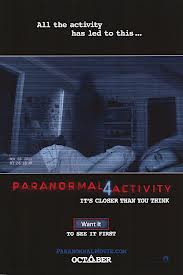
PARANORMAL ACTIVITY 4
(US - 2012)

This durable found-footage horror franchise has been a fall staple since 2009, but the latest entry's comparitively paltry box office is a strong sign of audience fatigue with the whole concept.  It still grossed a nothing-to-sneeze-at $50 million, but that's what PARANORMAL ACTIVITY 3 took in during its opening weekend.  The problem with these films is that in their attempts to shake things up and add new things to the story, they end up fracturing the continuity to the point where they aren't even trying to be cohesive anymore.  Oh, so Katie Featherston and her sister were part of some Hittite cult when they were kids?  OK, we'll just go in that direction now.  And use webcams to stay topical. It's hard to believe that the last three films have had the same screenwriter (Christopher Landon, Michael's son).  Is he just making this up as he goes along?  Also returning from the last film are CATFISH directors Henry Joost and Ariel Schulman, and PA4 deals with a family in Henderson, NV who end up taking in the strange little boy who just moved in across the street when his mother is taken to the hospital.  They've never even met the mother, and their only run-in with the kid is when he was found mysteriously hanging out in their backyard treehouse.  What police or rescue service would just dump a kid with a neighbor?  But the filmmakers need the kid to get in the house, because for some reason, the family's six-year-old son has some connection to Katie's nephew, who disappeared with his aunt and hasn't been seen in five years.  I wonder who the mysterious mother of the strange boy might be?  This formula is so played out that nothing about it is scary or even remotely suspenseful at this point.  If the action remains static for ten or so seconds, we know something will happen in a corner, or some figure will breeze by the camera.  Or if someone is looking into a webcam and turns their head, something will be behind them.  The filmmakers put forth minimal effort, dragging this out all the way up to an out of nowhere ending that isn't scary, just stupid and as rushed and random as anything else that popped into Landon's head when he sat down to shit out this script.  How soon before Katie is cryogenically frozen and the franchise moves to outer space with KATIE X?  The Blu-ray and DVD have both the unrated and theatrical versions, with the unrated running nine minutes longer and consisting of two or three superfluous scenes in the early going that add nothing to an already empty and pointless experience.  Needless to say, PARANORMAL ACTIVITY 5 is due out later this year.  (Unrated, 97 mins/R, 88 mins)

Saturday, October 6, 2012

On DVD/Blu-ray: RED LIGHTS (2012) and IRON SKY (2012)


RED LIGHTS
(Spain/US - 2012)

I'd probably have to go back to 2010's LEGION to find a horror film that starts off so promisingly and implodes as catastrophically as RED LIGHTS.  Written and directed by Rodrigo Cortes (the "Ryan Reynolds in a box" cult thriller BURIED), RED LIGHTS is an initially intriguing look at the world of academic skeptics debunking the supernatural.  Psychologist Margaret Matheson (Sigourney Weaver) and her physicist assistant Tom Buckley (Cillian Murphy) have never encountered a case of supposed paranormal activity or psychic phenomena they couldn't disprove.  Meanwhile, long-retired 1970's blind celebrity psychic Simon Silver (Robert De Niro) has emerged from self-imposed exile and Buckley wants to go after him, despite warnings from Matheson that Silver--with whom she's dealt before--is dangerous and nothing like the typical scam artists they usually face.  Cortes gets things rolling very effectively and there's a nice John Carpenter vibe to the film's first half, but it starts seriously skidding with the unexpected exit of one major character and the story just gets sillier by the scene, culminating in an infuriating twist ending that renders the preceding 105 minutes moot.  There's a lot of good actors left stranded--Joely Richardson, Toby Jones, and Elizabeth Olsen have supporting roles--and Cortes wastes an excellent performance by Weaver but, sorry to say, De Niro is a major reason why RED LIGHTS doesn't work.  He's horribly miscast, visibly bored, and just completely wrong for this film's personification of psychic evil.  It's never believable for a moment that Silver's return would cause such a media frenzy, and at no point does De Niro convey the kind of charisma that a huge celebrity of this sort should.  He's just a stone-faced, sleepwalking bore throughout, and for some reason, I kept picturing how perfect someone like Jeff Goldblum might've been as Silver--someone who can convincingly demonstrate both the eccentric charm and the sense of supernatural menace that's required.  Hell, even a Nicolas Cage would've at least brought some energy to the role.  I think De Niro was more engaged in FREELANCERS--either he's coasting for a quick paycheck and a free Spanish vacation or underplaying it to the point of catatonia. It's a shame, because RED LIGHTS starts off so well and is one of those rare horror films geared toward an adult audience, cast with living legends like De Niro and Weaver, and it just ends up a crushing disappointment. Almost worth seeing for the laughable Simon Silver flashback where a young actor with a stick-on mole does the worst De Niro impression this side of an open-mic night at your local Chuckle Hut.  Barely released in US theaters, grossing $52,000 on just 18 screens. (R, 114 mins)


IRON SKY
(Finland/Austria/Denmark/Germany/France/Australia - 2012)

Stylized, absurdist sci-fi comedy centered on the conspiracy theories that after WWII, the Nazis set up a secret base on the dark side of the moon.  Here, in 2018, they're led by the current Fuhrer, Kortzfleisch (Udo Kier) and they're planning on attack on Earth with their space fleet let by the massive warship Gotterdammerung.  They're accidentally discovered by two US astronauts.  They kill one and take the other, African-American James Washington (Christopher Kirby) prisoner, bleaching his hair and skin white to give him the perfect Ayran look.  Meanwhile, Washington is forced to accompany Kortzfleisch's ambitious second-in-command Adler (Gotz Otto) and his fiancee Renate (Julia Dietze) to Earth to obtain more of Washington's "computer phones" (cell phones) to aid in their takeover plot.  They end up sticking around on Earth when they cross paths with fashionista Vivian Wagner (Peta Sergeant), the bitch-on-wheels image consultant to the dim-witted, slogan-spouting Sarah Palin-esque US President (Stephanie Paul), who incorporates Renate's Nazi platitudes into her speeches.  Before long, Kortzfleisch arrives with the fleet and Adler puts the invasion in motion, with the Gotterdammerung forced to take on the space warship USS George W. Bush.


There's some sharp-edged satire throughout IRON SKY, particularly with the presentation of the American political scene (the US President is overjoyed that she gets to be a wartime President, citing that "They always get re-elected!"), and various plays on stereotypes (when Washington is a fugitive on the moon, the Nazis issue a news alert describing him as "unarmed and possibly angry"), and an inspired bit where Renate, a teacher, describes Chaplin's THE GREAT DICTATOR to her class as "a famous ten-minute short film," unaware that Nazi officials have censored the rest of it (I also liked the scene where United Nations representatives laugh at North Korea's hapless attempt to claim responsibility for the invasion of Earth).  There's some big laughs in IRON SKY, but it still seems like an SNL skit dragged out to feature length.  Perhaps a bit more sophisticated, yes, but it has long sections where it just seems to putter along.  Co-written and directed by Timo Vuorensola (who made two films in the STAR WRECK series of Finnish STAR TREK spoofs), IRON SKY got some attention in Europe as part of a new movement of communal, participatory filmmaking where online fans at an IRON SKY forum got to contribute ideas and pitched in with donations to help fund the film.  That's not to imply that it's some homemade, DIY film, when in fact, it's a multi-country co-production with an international cast, shot in several countries, with most of the interiors done in Australia.  IRON SKY isn't altogether successful and at times feels like a party guest who won't leave, but it does exhibit some occasionally daring bits of ballsy humor, and is definitely worth a look if you're in the right mood. (R, 93 mins)