ALAN PARTRIDGE (France/UK - 2013; US release 2014)
British actor/writer/comedian Steve Coogan's (PHILOMENA) best known character is clueless and insufferably self-aggrandizing radio and TV personality Alan Partridge. Coogan's been playing Partridge off-and-on on numerous British TV shows since 1991, and it's proven so popular that he had a change of heart on his plan to retire Partridge some years back. Coogan's first stab at bringing Alan Partridge to the big screen resulted in a blockbuster hit in British theaters, where it was called ALAN PARTRIDGE: ALPHA PAPA. The second half of the title was dropped by US distributor Magnolia, but it makes no matter. If you like snappy, misanthropic, foul-mouthed British humor in the vein of THE THICK OF IT and its big-screen spinoff IN THE LOOP (2009), you'll dig ALAN PARTRIDGE since it also features the contributions of co-writer Armando Iannucci, whose unique brand of biting humor has translated beautifully to American TV with HBO's blisteringly funny VEEP. Here, Partridge is the afternoon DJ at North Norfolk Digital, a small-time radio station that's just been bought out by a big-time media company run by the loathsome Jason Tresswell (Nigel Lindsay). Fearing for his job security, Partridge trash-talks veteran night DJ Pat Farrell (Colm Meaney) enough that Farrell is canned. Later that night, at a party thrown at the station by Tresswell, a disgruntled Farrell shows up and takes everyone hostage. Acting as a liaison between the police and Farrell, Partridge sees the siege and the inevitable media circus as his ticket back to the big time.
Even if you haven't seen much of Coogan's past work as Partridge, ALAN PARTRIDGE works just fine as a stand-alone film. You'll be able to fill in the blanks, like Partridge's insensitive interaction with doting assistant Lynn Benfield (Felicity Montagu) or the antics of his Geordie friend Michael (Simon Greenall). Coogan and Iannucci assembled a summit of ALAN PARTRIDGE writers older and newer to put this together, including Peter Baynham, who worked on the early Partridge material and went on to write BORAT with Sacha Baron Cohen, plus twin brothers Neil & Rob Gibbons, who worked on more recent PARTRIDGE incarnations with Coogan. Along with the writers, director Declan Lowney (a veteran of numerous British TV favorites like FATHER TED and LITTLE BRITAIN) approaches this in a fan-friendly fashion and doesn't fix what isn't broken, while at the same time making it accessible for the first-time viewer. Of course, if you know Coogan's style or have seen any of his work with Rob Brydon, you know what to expect. Whether he's being politically incorrect, extraordinarily self-centered, pretending to be on the phone to avoid talking to someone only to have it ring, or just being an outright coward (as someone's about to enter a room with guns blazing, Partridge tells one woman "I'll protect you" while sheepishly crouching behind her), Coogan is hilariously obnoxious throughout, and has a good foil in Meaney's ill-tempered Farrell. Sure, the whole concept is more than a little reminiscent of the 1994 radio station hostage comedy AIRHEADS, but Coogan and Iannucci bring enough of their distinctive style to the table to make it very worthwhile. (R, 90 mins)
CAPITAL (France - 2012; US release 2013)
Though he's dabbled in various genres, the great Greek-French filmmaker Costa-Gavras is best known for his politically-charged films like the Oscar-winning Z (1969), THE CONFESSION (1970), STATE OF SIEGE (1972), MISSING (1982), BETRAYED (1988), and MUSIC BOX (1989). He's never shied away from controversy, especially with 1983's HANNA K, a film whose perceived Palestinian sympathies got it yanked from theaters and probably had a hand in effectively ending Jill Clayburgh's run as a Hollywood A-lister. Costa-Gavras hasn't made an American film since 1997's ham-fisted MAD CITY, but he's been working fairly steadily in France over the last decade. His latest--and first to get US distribution since 2002's AMEN--is CAPITAL, which finds the 80-year-old director taking aim at the global financial meltdown in sometimes heavy-handed ways, and while it's not essential Costa-Gavras, it's still worth seeing. It's hard to make financial thrillers thrilling (the recent MOBIUS is a great example of how not to do it), and while the characters and the subplots are fairly standard-issue, CAPITAL gets some genuine momentum going once all the pieces are in place.
When the old-school CEO (Daniel Mesguich) of France-based Phenix Bank has a heart attack and gets an overly symbolic testicular cancer diagnosis (that's right--he doesn't have the balls for this business anymore), he nominates his protege Marc Tourneuil (Gad Elmaleh) to replace him. The board isn't happy, but figure Tourneuil is enough of a yes-man that they can bully him around and get what they want anyway. Tourneuil proves to be a hard negotiator and a driven businessman and immediately makes a number of bottom-line decisions that are so unpopular that even his mentor wants him fired. Phenix is in dire shape and in order to turn things around, Tourneuil forms an uneasy alliance with an aggressive Miami-based hedge fund overseen by ruthless financial titan Dittmar Rigule (Gabriel Byrne, who had one of his earliest major roles in HANNA K). Rigule plots an insider trading scam to drain Phenix's assets through a secret corporation, then overtake it with his own hedge fund, essentially using Phenix's money to buy themselves out. Tourneuil is promised a fat payday out of it and the first step is firing 10,000 Phenix employees worldwide to aid in shareholder (and Rigule) profit. Of course, Tourneuil's mind isn't always focused on Rigule's junkyard-dog act or the deceptive machinations of his own underlings, since his newfound power predictably turns him into a total asshole, ignoring his devoted wife (Natacha Regnier) and growing obsessed with a manipulative supermodel (Laura Gemser lookalike Liya Kebede), even blowing off meetings so he can fly to Tokyo to go down on her in an airport restroom. The relationship between Tourneuil and the supermodel is the most problematic element in CAPITAL, taking up too much time and going nowhere, and their final scene together is just unpleasant and bizarre. Costa-Gavras pulls no punches in his depiction of the high-rolling sociopaths that inhabit the financial world: even from the beginning, when the old CEO collapses on a golf course, Tourneuil is already grinning at the prospect of being put in charge. He's not a nice guy corrupted by power. He's an asshole who was patiently waiting for his turn. In the end, CAPITAL's points are simplistic and obvious, but the financial cat-and-mouse game between Tourneuil and Rigule (it's great fun watching Byrne turn from a smooth operator into a bloviating prick as the film goes on) provides some well-handled dramatic tension. It's no Z, but Costa-Gavras, still looking spry, energetic, and a good decade younger than his age in the DVD's making-of doc, still has a little gas left in the tank. (R, 114 mins)
HAUNT (US - 2014)
It's probably easier to just list the movies HAUNT rips off rather than attempt a review. Another in an ever-increasing (and ever-annoying) line of slow-burner horror films that mistakes "long stretches of lethargically-paced nothing" for "building tension" (thanks, Ti West!), HAUNT offers yet another dull and oblivious family moving into a cursed house because it's impossibly cheap thanks to all of the murders that have taken place under its roof. The Ashers--dad (Brian Wimmer), mom (Ione Skye), oldest daughter (Danielle Chuchran), son (Harrison Gilbertson), and younger daughter (Ella Harris)--relocate to a spacious Iowa home where the the previous family all met horrific ends except for the matriarch (SILVER LININGS PLAYBOOK'S Jacki Weaver), who ran a pediatrics practice from a home office. The ghostly activity starts with an EVP (electronic voice phenomenon) machine that's been left behind in a secret room next to Gilbertson's. Gilbertson meets a troubled teen (Liana Liberato) who lives down the road with her abusive father, and soon she's sleeping over with him, which is totally cool since his folks are the hippest and most easygoing parents around. Gilbertson and Liberato mess around with the machine and a voice tells him to "Get out of my room!" Soon enough, they're haunted by the usual apparitions out of nowhere, shadows lurk in hallways, wet footprints lead nowhere, and the youngest Asher is having long conversations with her dolls, standing in doorways in a catatonic stupor, and scratching the eyes and faces out of family photos. Might it all have something to do with a clumsily-placed flashback with Weaver helping out a young mother with a screaming baby girl? Gilbertson is so preoccupied playing savior with Liberato that he doesn't even notice the weird stuff going on with his little sister, which is fine since director Mac Carter and writer Andrew Barrer completely forget about her anyway. Instead, they just restage elements of INSIDIOUS, WHITE NOISE, THE AMITYVILLE HORROR, SINISTER, and of course, once they unleash the angry spirit of Weaver's teenage son, Gilbertson briefly becomes possessed and starts doing the herky-jerky JU-ON/GRUDGE shuffle. With no scares, thoroughly cardboard characters, and an egregious wasting of two-time Oscar-nominee Weaver, HAUNT (not to be confused with the recent and much better HAUNTER) is an instantly forgettable trifle that almost wears its half-assed laziness like a badge of honor, its only concern being how many movies it can crib from on its way to the $5 DVD bin at Wal-Mart. I guess the only good thing you can say about it is that no one in the family seems to own a video camera. (R, 86 mins, also available on Netflix Instant)
EDGE OF TOMORROW (US - 2014) Directed by Doug Liman. Written by Christopher McQuarrie, Jez Butterworth and John-Henry Butterworth. Cast: Tom Cruise, Emily Blunt, Bill Paxton, Brendan Gleeson, Noah Taylor, Kick Gurry, Charlotte Riley, Jonas Armstrong, Tony Way, Franz Drameh, Dragomir Mrsic, Masayoshi Haneda, Terence Maynard. (PG-13, 114 mins)
Admittedly, the trailers for EDGE OF TOMORROW didn't look promising. Based on the 2004 novel All You Need is Kill by Hiroshi Sakurazaka, EDGE appeared to be another chance to show Tom Cruise running around and saving the world, this time in a GROUNDHOG DAY-meets-STARSHIP TROOPERS scenario. Yes, that's part of the plot, and the film makes no secret that it's a mash-up potpourri of other military sci-fi films. But even before it establishes its central conceit, EDGE is subverting your expectations in creative and unpredictable ways. Yes, it fuses GROUNDHOG DAY and STARSHIP TROOPERS, and also ALIENS and WWII movies and video games and Tom Cruise running and feels like the kind of movie James Cameron might've made in the late '80s and early '90s before he publicly unleashed his inner Insufferable Asshole for all the world to see. But it takes those elements and sends them in an unpredictable direction, and when Cruise runs, he doesn't run like a hero saving the world. He stumbles and bumbles like a guy who's skated by on his personality and just likes wearing a uniform and whose grinning visage is all a show for the cameras. Cruise has some fun toying with his screen persona here, and that's just the beginning of the unexpected highlights that this furiously-paced, surprisingly inventive, and often quite witty sci-fi actioner has to offer.
Set five years into a Europe-based war with an alien race known as Mimics, EDGE opens with military media liaison Major William Cage (Cruise) being ordered by United Defense Forces commander Gen. Brigham (Brendan Gleeson) to act as an embedded correspondent with forces launching a massive invasion of France to hold off and defeat Mimic forces. Known as a ubiquitous presence on cable news as the chief UDF spokesperson and PR/propaganda flack, the arrogant Cage objects to being sent into combat, and ultimately tries to blackmail Brigham by threatening to publicly blame him for any casualties in the next day's attack. An enraged Brigham has him arrested and branded a deserter, and the next day, Cage wakes to find himself on a military base, stripped of his rank, busted down to Private, and being read the riot act by gung-ho Sgt. Farrel (Bill Paxton, whose presence is an obvious nod to ALIENS). Cage, despite almost no training and with the extent of his service being a smiling face on TV encouraging young people to join the fight, accompanies the troops on the invasion, which immediately ends in disaster: the Mimics knew they were coming and wipe out the UDF in five minutes, including Cage and legendary warrior and the heroic face of the UDF, Sgt. Rita Vrataski (Emily Blunt), aka "Full Metal Bitch" and "The Angel of Verdun" after leading the first UDF victory against the Mimics at Verdun. But then something funny happens: Cage wakes up, back on the base, at the same starting point as the previous day. He goes through the same botched attack again, and each time he's killed, he wakes up at the previous original point. His ability to finish everyone's sentences and predict the outcome of the UDF invasion are summarily dismissed as parlor tricks and the ravings of a coward trying to get out of military action, but during one time loop, Vrataski tells him "Find me when you wake up." Only she knows what he's talking about and how he's reliving every day once he's "killed," and together, they try to devise a plan of attack, based on their previous failures, of defeating the Mimics in France and finding the truth behind what they are, what they're capable of doing, and why only they have experienced the time loops.
Like Sakurazaka's novel, EDGE is essentially intended to be one long video game, and it's one of the very few instances where that's meant as praise. Witness the constant "resets" from the same starting point each time Cage is "killed" and the way he and Vrataski strategize and memorize every Mimic movement during the failed invasion in order to survive and "get to the next level." Director Doug Liman (SWINGERS, GO, THE BOURNE IDENTITY) and editor James Herbert handle the potentially unwieldy time element in expert fashion. Most impressive is the way time loops come to shockingly abrupt ends when Cage is unexpectedly killed and how, when the time loops seem to stop, we only gradually realize that Liman is only letting us see certain developments for the first time. In other words, we discover that Cage has been living these time loops for an undetermined amount of time, and there's a subsequent implication that even the precise starting point is something that's questionable in the context of the narrative. Liman holds it together in masterful fashion, but EDGE OF TOMORROW could've easily been an incoherent mess considering the committee of writers involved and the fact that it didn't even have a finished script until shooting was about to start. The screenplay is credited to Christopher McQuarrie (who won an Oscar for his USUAL SUSPECTS script) and Jez & John-Henry Butterworth (FAIR GAME), but the initial work was done by Dante Harper, whose original script was reworked by Joby Harold (AWAKE). Liman tossed out most of the work done by Harper and Harold and brought in the Butterworths, whose work was then revised by Simon Kinberg (SHERLOCK HOLMES, ELYSIUM). Kinberg departed the project and Cruise pal McQuarrie (who worked with the star on VALKYRIE and JACK REACHER, two of Cruise's most underrated films, and is set to direct the next MISSION: IMPOSSIBLE entry) was brought in to write an ending and give the script one final polish.
EDGE OF TOMORROW's seemingly frozen-in-time Europe looks terrific (I skipped the 3D version) and the CGI creatures are very well-done. It never pretends it isn't constructed on a foundation of great films that came before it, but it wastes little time in becoming its own beast. Going in expecting a by-the-numbers CGI blur, you may come away pleasantly surprised at the relatively old-school feeling of the whole thing. But that may just be part of the Cruise experience at this point. Yes, he's a crazy Scientologist, but he's one of the few genuine movie stars left who can still draw huge audiences just on the basis of his name. For all their accolades and media ubiquity, how many blockbuster mega-hits have guys like George Clooney or Brad Pitt had? Not many. People don't go see "Brad Pitt movies." They go to "movies with Brad Pitt," and often, mainstream audiences don't like them (THE TREE OF LIFE, KILLING THEM SOFTLY, THE COUNSELOR). People still go see "Tom Cruise movies" regardless of what they're about. Sure, one could argue that the 51-year-old Cruise is entering the self-deprecation phase of his career with the way he slyly mocks his image here (the patented "Cruise running" shot comes very early, and it's clumsy, awkward, and hilarious), but the guy's still got it. Sure, EDGE OF TOMORROW has a couple of plot holes (at the point in the time loop where Cage and Vrataski's Jeep runs out of gas, why doesn't Cage ever consider taking some gasoline cans along with them on the next loop?) and it may suffer from coming so closely on the heels of another Cruise sci-fi epic with last year's visually stunning but somewhat empty (and seemingly already-forgotten) OBLIVION. That was another film that stood on the shoulders of giants, but unlike EDGE, didn't take things to the next level. Contrary to the ho-hum trailer and TV spots we've been seeing, EDGE OF TOMORROW is incredibly entertaining and far better than it has any right to be, and it may very well be the summer's biggest surprise.
The story of the West Memphis Three, accused of the ritualistic murder of three little boys in West Memphis, AR, has been told in many ways since the horrific events of the summer of 1993. Books, countless investigative pieces, TV news profiles, and most notably, four documentaries--Bruce Sinofsky and Joe Berlinger's PARADISE LOST trilogy and the Peter Jackson-produced WEST OF MEMPHIS--seem to have covered the story from every possible angle. With that in mind, it seems odd to make a dramatization of the events now and odder still that it's directed by the great Egyptian-born Canadian filmmaker Atom Egoyan (EXOTICA). Egoyan's been in a slump for going on a decade now, with only 2008's ADORATION showing signs of the Egoyan of old: 2005's WHERE THE TRUTH LIES and 2009's CHLOE are easily his weakest films, with CHLOE in particular looking like a laughably dated erotic thriller that was found sealed in a film canister marked "1995." Egoyan's been spending a lot of his time in recent years making short films and documentaries, so it's likely that TRUTH and CHLOE were just mercenary director-for-hire gigs that provided a financial cushion. Unfortunately, DEVIL'S KNOT, based on Mara Leveritt's 2002 true-crime account of the same name, falls into the same category. Other than some familiar Egoyan actors like Bruce Greenwood and Elias Koteas, and some shots early on that recall the remorseful sense of melancholy of Egoyan's 1997 masterpiece THE SWEET HEREAFTER, DEVIL'S KNOT takes the story of the West Memphis Three and turns it into a perfunctory, workmanlike courtroom drama that offers no new perspective on the case other than to belatedly suggest that the father of one victim and the stepfather of another may have been involved in the murders. Despite some early signs that Egoyan might take a David Fincher/ZODIAC approach to examining the story, it doesn't take long to devolve into rote storytelling that anyone familiar with the case already knows, laid out in thoroughly by-the-numbers fashion by the screenwriting team of Paul Harris Boardman and SINISTER director Scott Derrickson, whose previous credits together include HELLRAISER: INFERNO, URBAN LEGENDS: FINAL CUT and THE EXORCISM OF EMILY ROSE. With that pedigree, it's pretty obvious Egoyan's just punching a clock on this one.
All the expected story elements are here: the parents demanding revenge, the town, the lazy police, and a stone-walling judge going into full-on, witch-hunt, "Satanic panic" mode. They're all in a frothing-at-the-mouth quest to pin the murders on a trio of social outcasts who had an interest in the heavy metal and the occult and a ringleader in Damien Echols (played here by James Hamrick) who was a loner from a broken home who dressed in black and was simply deemed "weird." The police work in this case was horribly shoddy, with one suspect, Jessie Misskelley, Jr (Kristopher Higgins), obviously mentally incompetent and thought to be "mildly retarded," coerced into confessing to the murders with wrong timelines and details completely inconsistent with the crime scene, but the cops ran with it anyway. Since these details, and the eventual Alford Plea release of the three convicted murderers in 2011 are old news, a lot of DEVIL'S KNOT focuses on the grieving Pam Hobbs (Reese Witherspoon), the mother of victim Stevie Branch, and her late discovery of Stevie's pocket knife in a box kept by her husband Terry (Alessandro Nivola). This, along with another knife that was given to Sinofsky and Berlinger (who briefly appear as themselves) by John Mark Byers (a hammy Kevin Durand), the father of victim Christopher Byers, and the police department's botched handling of a bloodied African-American man who was found in the ladies' room of a fast-food restaurant the night of the murders, would appear to indicate DEVIL'S KNOT's agenda in probing deeper into the case. If Egoyan was really interested in that, why not pursue Terry Hobbs and John Mark Byers for a documentary? Why devote time to defense team investigator Ron Lax (a miscast Colin Firth, struggling with a Southern accent) moping around after his wife (a one-scene drop-in by Amy Ryan) serves him with divorce papers? Who gives a shit about Ron Lax's failed marriage? This is the kind of film where the judge decrees to a packed courtroom that Misskelley will be tried separately from the others, but Lax still has to immediately lean over to his assistant and whisper "Separate trials...Jessie's gonna be tried on his own" just in case the audience is having trouble keeping up. With Oscar-winners Firth and Witherspoon onboard, and with justice for the West Memphis Three a longtime cause for many in the entertainment industry, DEVIL'S KNOT looks suspiciously like transparent Weinstein Company awards bait, but this time it backfired. The film got such a unanimously negative response at the 2013 Toronto Film Festival that Harvey Weinstein unloaded it on RLJ Entertainment, who rolled it out on VOD and a handful of screens a month before its DVD/Blu-ray debut. It's a strangely appropriate burial for such a shallow endeavor that barely scratches the surface as it treads down a path that's already been explored in much more insightful detail by others. (Unrated, 114 mins) IN THE BLOOD (US/UK - 2014)
Steven Soderbergh's HAYWIRE arrived with much publicity and positive reviews in early 2012 as the starring debut of former MMA sensation Gina Carano. It had a unusually highbrow supporting cast for such action fare and promised old-school fight scenes and delivered, but mainstream audiences weren't especially taken with Carano or with Soderbergh's directing style, which turned HAYWIRE into more or less an MMA arthouse film. Nevertheless, while it's a fixture in DVD bargain bins at a retailer near you and already little more than a footnote in Soderbergh's filmography, it has a minor cult following and Carano's future as a B-level DTV action star seemed inevitable. After a supporting role in last year's FAST & FURIOUS 6, she's back with the rather pedestrian IN THE BLOOD. For all the complaints action fans had about Soderbergh's artsy-fartsy pretensions with HAYWIRE, at least he made the action sequences count. Here, sometime hack actor-turned-fulltime hack director John Stockwell weighs things down with too many characters with too many subplots and not enough Carano ass-kicking. Shot in Puerto Rico, the first half-hour of IN THE BLOOD looks like a typical Stockwell effort, demonstrating his endless fascination with exotic, scenic tourist destinations (since 2002, he's also made BLUE CRUSH, INTO THE BLUE, TURISTAS, and DARK TIDE) as recovering heroin addicts and newlyweds Ava (Carano) and Derek Grant (Cam Gigandet) honeymoon in the Caribbean. They met in rehab--she came from the wrong side of the tracks and saw her father (Stephen Lang in flashbacks) murdered by drug dealers, he's the scion of a wealthy family whose asshole father (Treat Willliams) disapproves of Ava and tries to bully Derek into signing a pre-nup. While at a restaurant, Ava and Derek meet affable local Manny (Ismael Cruz Cordova) who talks them into a zip-lining excursion. While careening down the aptly-named "Widowmaker," Derek's line snaps and he plummets into the forest below. The medics won't let Ava ride in the ambulance and no hospital in town has any record of Derek being brought in. The local cops, led by the predictably useless chief (Luis Guzman), and her sneering father-in-law think she staged a kidnapping, or even killed him to gain access to the family's wealth. So, of course, under the tutelage of her father, she's been schooled in the ways of MMA (much to the surprise of Derek during an early nightclub skirmish), and she becomes an inevitable one-woman wrecking crew in the quest to find her missing husband.
Once Stockwell finally gets to the action, IN THE BLOOD has its moments, but they're few and far between. This should be a tight, fast B-movie, but at 108 minutes, it's at least 20 minutes too long and the pacing is laborious. Did we really need clunky subplots about Guzman's police chief or the feud between island crime lords Lugo (Amaury Nolasco) and Big Biz (Danny Trejo)? At least Nolasco's character eventually figures into the increasingly ludicrous plot, but Trejo has almost nothing to do until the script (written by Farrelly Brothers collaborator Bennett Yellin and THE HOWLING: REBORN screenwriter James Robert Johnston) clumsily has him turn up at the end and somehow be the hero, which seems completely counterproductive considering that this is supposed to be a Gina Carano vehicle. Carano would do better to work with an Isaac Florentine or a John Hyams, both the kind of low-budget action auteur who can really bring out the best in action stars like Jean-Claude Van Damme, Scott Adkins, and Dolph Lundgren. Carano's niche is practically pre-carved, but ponderous duds like IN THE BLOOD aren't going to do much to help her make her case. You're better off watching HAYWIRE again. (R, 108 mins) SMALL TIME (US - 2014)
Since his acrimonious departure from LAW & ORDER: SPECIAL VICTIMS UNIT in 2011 over a salary dispute, Christopher Meloni has been jobbing around from gig to gig, with an acclaimed but short-lived recurring role on TRUE BLOOD, supporting roles in 42 and MAN OF STEEL, and, more recently, the Fox sitcom SURVIVING JACK, which survived four episodes before being cancelled, and a hilarious arc as Julia Louis-Dreyfus' personal trainer/secret paramour on VEEP. In 2012, Meloni shot the low-budget SMALL TIME, written, directed, and self-financed by 24 creator Joel Surnow. It gives the veteran TV actor a rare big-screen lead, but it's also the kind of small, personal film that just doesn't generate much interest outside of film festivals. It opens strongly and succumbs to cliche and formula in its second half, but a decade ago, a film like SMALL TIME probably would've become a minor, word-of-mouth sleeper hit instead of getting the VOD dump-job from distributor Anchor Bay Films. Meloni is Al Klein, a master used-car salesman and co-owner of Diamond Motors, along with his best friend Ash Martini (Dean Norris). Al is going through a midlife crisis and can't commit to girlfriend Linda (Garcelle Beauvais), and as his son Freddy (Devon Bostick) is graduating from high school, Al fears the years have slipped away. Despite the protestations of his ex-wife Barbara (Bridget Moynahan) and her wealthy investment broker husband Chick (Xander Berkeley, the go-to actor for "asshole second husbands"), Freddy wants to skip college and work as a salesman with his dad. Wanting some father-son bonding time, Al welcomes Freddy onboard as he and Ash school him in the ways of wheeling and dealing.
Despite some funny scenes of car-lot hustling, SMALL TIME isn't another USED CARS-type comedy. The focus remains on Al and the realization that maybe this isn't the life he wants for his son, especially since his gift for closing deals almost immediately gives the impressionable Freddy a swelled head, which isn't helped by the encouragement of Ash, a well-meaning guy who loves Freddy but often comes off as a bad-influence uncle, and some cynical salesman friends who teach Freddy that "people are shit and they'll believe anything." Al and Ash may be fast-talking salesmen, but they're generally honest, and Al worries about the side of Freddy that the job is bringing out. SMALL TIME is a small labor of love for all involved, but once Freddy starts getting a shitty attitude, Surnow's script devolves into too many standard-issue tropes and conventions, culminating in a really bad moment when Bostick gets in Meloni's face and yells--what else?--"You're so...small-time!" There's also too many whimsical elements that film fest folks love: set in an undetermined period that would appear to be the early '80s, the film opens with an older Freddy narrating "It was the summer that changed my life"; montages set to soul and/or Latin music; gregarious ethnic supporting characters; and a kooky and improbably Scottish secretary (EXTRAS' Ashley Jensen) who has no idea how to make coffee. There's a lot in SMALL TIME that should completely derail it, but the consistently-underrated Meloni is the glue that holds it together. He's terrific here and his rapport with both Bostick and Norris (as well as in the seemingly improvised scenes with their lunch group of crass, old-school salesmen buddies played by Kevin Nealon, Ken Davitian, and Barry Primus) really manages to redeem the film's many inherently self-destructive elements. SMALL TIME is slight and predictable, but it's enjoyable enough, moves very briskly, and is a must-see if you're a Meloni fan. (R, 94 mins)
FILTH (Germany/US/UK/Sweden/Belgium - 2013; US release 2014) Written and directed by Jon S. Baird. Cast: James McAvoy, Jamie Bell, Eddie Marsan, Imogen Poots, Jim Broadbent, Joanne Froggatt, Shauna Macdonald, Shirley Henderson, John Sessions, Gary Lewis, Brian McCardie, Emun Elliott, Martin Compston, Kate Dickie, Iain De Caestecker, Joy McAvoy, Pollyanna McIntosh, Bobby Rainsbury. (R, 98 mins)
This grotesque adaptation of Irvine Welsh's 1998 novel suffers from the same problem that plagued the last movie based on a Welsh work, the little-seen Canadian film ECSTASY (2012). While FILTH doesn't have Canadian actors attempting to tackle Scottish accents and losing spectacularly, it does share with ECSTASY a sense that it's been kept in storage for 15 years and is only now being released. It seems inevitable that every film version of Welsh's work will look and feel like Danny Boyle's landmark TRAINSPOTTING (1996), but in the hands of a director with vision like, say, a David Cronenberg or a Terry Gilliam, FILTH's parade of filth could've had some unique gonzo artistry that would've made its own mark outside of the dated world of TRAINSPOTTING knockoffs. Instead, it's the work of writer/director Jon S. Baird, who has one other feature under his belt (the obscure 2008 crime drama CASS), with his only other credit of note being an associate producer on the 2005 cult film GREEN STREET HOOLIGANS. Baird is obviously a fan of Boyle and probably saw FILTH as a way to pay homage to both him and Welsh, but it's all so familiar and formulaic at this point. Baird's FILTH only makes fleeting mention of a key element of Welsh's novel: the tapeworm that's inside the protagonist's body and, as it grows and spawns, it starts narrating its own chapters. The elimination of that "character"--something with which a hypothetical Cronenberg or Gilliam would've had a blast--leaves Baird with little to do other than fashion FILTH as BAD LIEUTENANT with a Scottish burr.
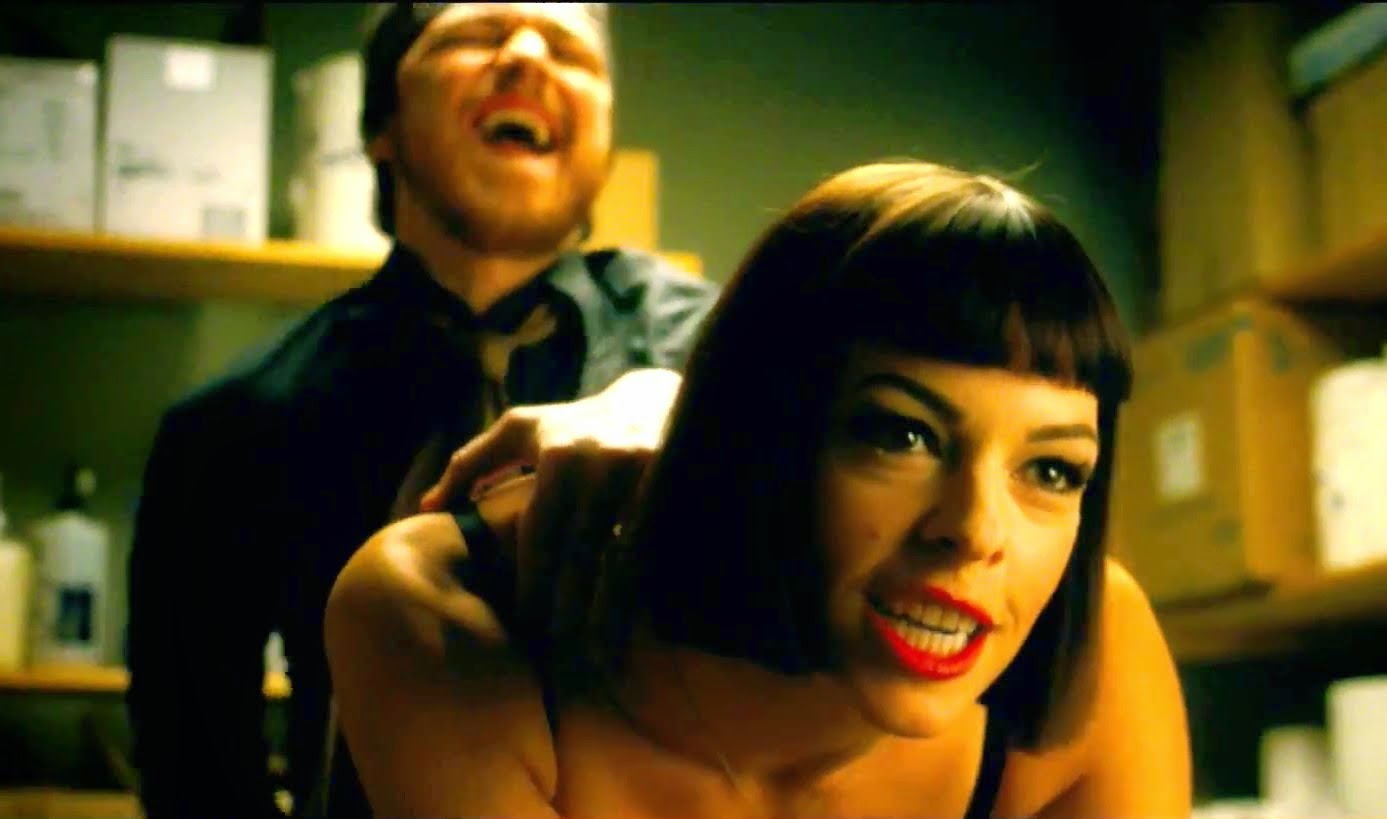
Det. Sgt. Bruce Robertson (James McAvoy), is an Edinburgh cop obsessed with discrediting the colleagues in line for the promotion he wants for himself. Robertson is a sociopath, a misanthrope, an alcoholic, a junkie, a thief, and a sex addict. He's corrupt and amoral, and his sickness has spread to his impressionable young partner Lennox (Jamie Bell), as the two routinely go on coke-and-hooker binges. While Lennox is questioning an 18-year-old man for engaging in unlawful sexual conduct with his under-the-age-of-consent 15-year-old girlfriend, Robertson is in the next room getting a blowjob from said underage girl in exchange for not telling her dad what she's been doing. Robertson is supposed to be investigating the murder of a Japanese tourist with Lennox and the ambitious Dunning (Imogen Poots), but they end up doing the leg work as Robertson instead spreads rumors about other cops, steals balloons from little kids, engages in mutual erotic asphyxiation with the wife (Kate Dickie) of an irate cop (Brian McCardie), makes obscene phone calls to the wife (Shirley Henderson) of his nebbishy, dweeby lodge brother Bladesey (Eddie Marsan), from whom he steals money to buy drugs, and then drags away on an ostensible bicycling trip to Hamburg, where he visits brothels on his own after slipping Bladesey some roofies, leaving him stranded at a gay bar, and forcing him to squint his way through the rest of the trip after stealing his incredibly thick-lensed eyeglasses, and throwing them in a river between periodic hallucinations with a mocking shrink (Jim Broadbent). Robertson is a bad guy---he's also bipolar and off his meds--and in his more introspective moments, pines for the wife (Shauna Macdonald) who left him, but some semblance of good exists deep within him when he tries to save a dying man on a busy street while everyone else stands around helplessly. The man's widow (Joanne Froggatt) sees he's a troubled soul but instead of letting her in, resorts to his maniacally excessive ways.
There's no denying McAvoy throws himself into the role much like Harvey Keitel and Nicolas Cage did in each of their interpretations of BAD LIEUTENANT. But FILTH the movie is a dumbed-down version of Filth the book and plays like stale retread of BAD LIEUTENANT filtered through TRAINSPOTTING. It doesn't even keep Welsh's very INVESTIGATION OF A CITIZEN ABOVE SUSPICION-esque ending. It's shot in very much the same style, and you can almost see Ewan McGregor as Robertson if this was made a decade and a half ago. Many of Welsh's novels take place in the same universe with recurring characters popping up throughout (for example: Begbie, played by Robert Carlyle in TRAINSPOTTING, is mentioned several times throughout Filth), and on the page, it's part of an ever-expanding, self-referential universe. On the screen, it just comes across as repetitive and uninspired. Welsh is one of the film's 34 (!) credited producers and obviously signed off on it (which, much like most authors selling book rights, probably involved getting paid and then had nothing else to do with it), but the alterations made to the story are to its detriment. Yes, film is a different medium, but Baird just seems interested in the most transgressive elements of Welsh's story with little concern for other things that were going on. An ambitious adaptation of Filth would've explored more than Robertson's over-the-top histrionics. I'm probably making FILTH sound like a bad movie. It's an OK film, moderately entertaining and never dull (and there is one admittedly brilliant use of David Soul's "Silver Lady"), but it never really tries, either. If shock value is all Baird was after, why didn't he just remake BAD LIEUTENANT? Why bother adapting Welsh's book if you're just going to toss its most unique elements?
Directed by Seth MacFarlane. Written by Seth MacFarlane, Alec Sulkin, and Wellesley Wild. Cast: Seth MacFarlane, Charlize Theron, Liam Neeson, Amanda Seyfried, Giovanni Ribisi, Neil Patrick Harris, Sarah Silverman, Wes Studi, Evan Jones, Matt Clark, Christopher Hagen, Rex Linn, Alex Borstein, John Aylward. (R, 116 mins)
One of FAMILY GUY and AMERICAN DAD creator Seth MacFarlane's strong suits is his voice acting ability, bringing life to most of the characters on his animated shows as well as to a talking teddy bear in his 2012 feature directing debut TED. What makes his latest film, A MILLION WAYS TO DIE IN THE WEST, different is that director/producer/co-writer MacFarlane also puts himself front and center as a leading man. His presence as an actor doesn't offer him the versatility and spontaneity that he demonstrates as various animated characters, and he just doesn't have the chops to carry a movie as "Seth MacFarlane." And make no mistake, that's essentially who he's playing in this western spoof that offers a decidedly 2014-ish MacFarlane as Albert Stark, a sensitive, cowardly sheep farmer with a snark-laden view of the Old West in the kill-or-be-killed 1882 Arizona frontier town of Old Stump. The Monument Valley location shooting and the sweeping, reverent score by Joel McNeely do a nice surface job of paying homage to John Ford westerns, but with his bland, one-note performance, his propensity for dragging jokes past their breaking point and continuing to beat it to death after that, and his general sense of self-indulgence, MacFarlane gets some scattered laughs but falls far short of hitting the mark. Forget any absurd comparisons to BLAZING SADDLES--this doesn't even measure up to RUSTLER'S RHAPSODY.
After negotiating his way out of a duel in front of all of the Old Stump townfolk, Albert is dumped by his embarrassed girlfriend Louise (Amanda Seyfried), who runs to the open arms of sneering, pompous mustachery boutique owner Foy (Neil Patrick Harris), who's rich and successful and everything Albert is not. When he's not drowning his sorrows at the saloon with his devoutly religious, repressed best friend Edward (Giovanni Ribisi) and his prostitute wife Ruth (Sarah Silverman), Albert is hanging out with Anna (Charize Theron), the tomboyish crack shot who just arrived in town with her brother Lewis (Evan Jones), who's already in jail for starting a bar brawl. What Albert doesn't know is that Anna is the wife of dastardly outlaw Clinch Leatherwood (Liam Neeson), who sent Anna and Lewis to Old Stump to pose as siblings and wait for the arrival of the rest of his gang as they hunt for gold in the region. With Lewis locked up, Anna realizes this is the perfect chance to escape Clinch's clutches and comes to genuinely like Albert, who's funny and kindly and everything Clinch isn't. Albert, meanwhile, is obsessing over Louise and asks for Anna's help in winning her back from the insufferably smug Foy. She helps train him in firing a pistol after he gets so jealous and enraged that he challenges Foy to a gunfight. Of course, all of their plans go awry when Clinch and the gang arrive in Old Stump earlier than expected, and word gets back to Clinch that his wife's been spending a lot of time with the hapless Albert.
MacFarlane can be a smart satirist and the script (co-written with regular collaborators Alec Sulkin and Wellesley Wild) gets in a handful of legitimately good laughs about various western cliches, the joylessness of old-timey photos, the sheer misery of what life must've been like back then, and occasional digs at religion, antiquated norms of that time ("Why are the Indians so mad all the time? We share this land with them, it's pretty much 50/50" and a carnival shooting gallery game called "Runaway Slave" are particularly stinging), and the present-day culture wars ("Oh, Parkinson's is one of those things that God gives you that somehow shows how much He loves you"). Anachronistic humor is inherent in this kind of thing, but MacFarlane just doesn't have the screen presence to make it work. Neither his character nor his performance are very funny. Too much of A MILLION WAYS TO DIE IN THE WEST is focused on Albert's whining about Louise and on his slowly-blossoming romance with Anna. MacFarlane may be a gifted voice actor, but on the screen himself, he never seems comfortable and a lot of the script seems to be geared toward stroking his own ego, whether Theron's Anna is laughing at everything he says or constantly affirming what a nice guy he is and how he deserves someone better than the shallow Louise. Theron does a good job of playing the always-appealing, no-bullshit, "just one of the guys" types, but she can't really sell the idea of finding the self-pitying, constantly-complaining Albert that interesting. The supporting cast is mostly wasted, but Harris steals the film with his inspired turn as the loathsome Foy, especially when he makes Louise suck the end of his perfectly waxed mustache while he fondles himself. But even Harris is forced to succumb to the frequent bouts of MacFarlane's toilet humor--quite literally, at one point. After being introduced early on, Neeson is absent until the third act, so he doesn't really have time to make Clinch Leatherwood (a great name, by the way) anything more than a two-dimensional caricature of a western heavy.
One criticism that's rightfully been leveled at MacFarlane over the years is the way he finds humor in beating a joke to within an inch of its life (think FAMILY GUY's infamous Conway Twitty cutaways or Peter Griffin's epic brawls with Ernie the Giant Chicken). Here, MacFarlane isn't content with a couple of mustache jokes when 15 will do, and even then he'll tack on two musical numbers about mustaches just to be sure. Even the funny observation about stone-faced people in photos of the era is rehashed multiple times. The most labored jokes center on the relationship between Edward and Ruth. Ruth is Old Stump's busiest prostitute, but she refuses to have sex with Edward before marriage. Edward goes to the whorehouse to wait until she's done working, and even uses his finest handkerchief to wipe "dirty cowboy cum" off of her face. The joke of Edward waiting downstairs while she loudly screws Old Stump's skeeziest is funny once, so of course MacFarlane repeats it five more times. His set-ups are also getting predictable. As Edward and Ruth leave for lunch, the madam (Alex Borstein) tells Ruth she's got someone planning to see her around 5:30 that day. "What does he want?" Ruth asks. Now, if you've seen enough of MacFarlane's work, you know the answer will be "Anal," and it is. But it's not enough. Edward and Ruth have to somehow be confused about how soon they should be back, and need clarification on what time the guy will be there. "Whenever he feels like putting his penis in your asshole," the madam tells her. "Anal" was predictable but amusing. But MacFarlane just lets the scene go on and on. And then Ruth can't sit down because, yes, her asshole hurts. This happens time and again throughout the film, and with its nearly two-hour running time, it goes on entirely too long. Just when things should be heating up for the confrontation between Albert and angry Clinch, MacFarlane sends the story an unfunny, running-time-padding detour which finds Albert hanging out with Cochise (Wes Studi) and drinking a hallucinogenic potion that has him tripping and the film looking like the old west version of a Storm Thorgerson-designed album cover. Why? Because nobody's going to stop him, that's why.
A MILLION WAYS TO DIE IN THE WEST isn't a terrible movie, but it's not a very good one. It probably could've been a little better with someone other than MacFarlane in the lead. He tries to go for a sort-of Jason Bateman-type demeanor with his snide detachment and wry observations pointing out the absurdity of his surroundings, but instead, he's loud, aggressive, and annoying. There's simply too much Seth MacFarlane in this movie. He also tries to milk some easy laughs out of several cameos, but only one approaches the sheer insanity of James Woods voicing himself as "James Woods" on FAMILY GUY, and making Peter watch VIDEODROME (Peter: "Does anyone get naked in this?" Woods: "Yeah. I do") or FLASH GORDON's Sam J. Jones turning up as himself in TED. What MacFarlane doesn't understand about parody is that it has to be done from a place of genuine affection. That's why the one really inspired cameo here works as well as it does. That's also what shines through in the best work of Mel Brooks and the ZAZ team in their AIRPLANE/TOP SECRET heyday, and that's why those parodies are timeless. While very disappointing, A MILLION WAYS TO DIE IN THE WEST is nowhere near the depths of say, a typical Friedberg/Seltzer abomination like DATE MOVIE or MEET THE SPARTANS. But it does share with those films a certain fundamental misunderstanding of what it means to parody something. Most of the dud jokes here--and there's a lot of them--would probably work as single brief cutaways in a FAMILY GUY episode, but MacFarlane's script isn't nearly as funny as he thinks it is and he doesn't seem to realize that parodying something at feature length requires a bit more than being a flippant smartass.
Veteran Andrew Bergman producer Mike Lobell (THE FRESHMAN, HONEYMOON IN VEGAS) began attempting to assemble a remake of the 1966 Shirley MacLaine/Michael Caine caper comedy GAMBIT as far back as 1997. Countless creative personnel were officially and unofficially attached to the new GAMBIT at various times over the next decade plus--directors Robert Altman, Mike Nichols, Alexander Payne, Anand Tucker, Bo Welch, Richard LaGravenese, and Doug Liman, writers Aaron Sorkin, Frank Cottrell Boyce, and Joel & Ethan Coen--and time and again, the project would stall and collapse. When LaGravenese was onboard around 2009, he rewrote much of the script, and again, it didn't make it out of pre-production. By the time filming finally started in 2011, Lobell had Michael Hoffman (ONE FINE DAY) directing, and LaGravenese's revisions were tossed in favor of the Coen Bros.' draft, which they penned during some down time between films a decade earlier. The Coens would probably prefer to forget they were ever involved in this doomed production, which bombed everywhere else in the world in 2012, prompting CBS Films to abruptly cancel the US release and shelve it for a couple of years in the hopes that everyone would forget about it. In a move of stealth deception that almost rivaled the Baltimore Colts sneaking away to Indianapolis in the middle of the night when no one was looking, CBS swiftly and silently released GAMBIT on VOD and on just nine screens in the US in late April 2014 with virtually zero publicity--probably not the desired end result of 15 years of work on Lobell's part.
It's often said that no one sets out to make a bad movie, that they sometimes just happen. Almost nothing goes right in the stunningly DOA GAMBIT, which tries to evoke the classic '60s caper aesthetic in a modern setting, but joke after joke after joke lands with such a dead thud that it actually feels uncomfortable watching a cast of pros flailing so helplessly. Considering the talent involved, there's no reason GAMBIT shouldn't be an enjoyable farce, but it's just a miserably dull misfire. Art appraiser Harry Deane (Colin Firth) is fed up with his venal boss, media baron Lionel Shabandar (Alan Rickman), and concocts a scheme with an art forger known as The Major (Tom Courtenay) to bilk him out of a fortune with a fake Monet. Helping them in the scam is hard-partying, trailer-park Texas rodeo gal P.J. Puznowski (Cameron Diaz), who lives with her senile grandmother (Cloris Leachman). Diaz plays it as broadly as possible (as does Stanley Tucci as Harry's German appraising rival), while Firth tries to be Michael Caine by way of Peter Sellers, whether he's losing his trousers or stuck on a ledge or repeatedly getting punched in the face or all manner of slapstick. This is the kind of stuff that should be funny, but everything is just off--the performances, the timing--everyone just seems lost and confused, with a "let's just get this over with" look on their faces. Everyone, that is, except for Rickman, who plays smug pricks as well as anybody and relishes the opportunity to do it again here. When Rickman is dismissively sneering at pretty much everything around him--it's possible he wasn't acting--GAMBIT has some spark. But Rickman's pomposity and the chance to hear Courtenay say "shitbag" aren't nearly enough to carry this all the way through. By the time GAMBIT resorts to fart jokes, it's a safe bet that everyone involved has officially given up. (PG-13, 89 mins) PATRICK (Australia/UK - 2013; US release 2014)
Hitchcock disciple and future PSYCHO II director Richard Franklin's PATRICK (1978) is one of the cornerstones of the Ozploitation scene. Written by the venerable Everett De Roche (LONG WEEKEND, ROAD GAMES, RAZORBACK), PATRICK dealt with a comatose young man wreaking telekinetic havoc in a hospital in a twisted display of obsessive love for a new nurse. It's rather slow and dry by today's standards, but the sight of Patrick lying in bed, eyes wide open, is one of the iconic horror images of the 1970s. The film did only modest business in Australia, but became a surprise hit in Italy, where its original score was wiped in favor of one by Goblin and was successful enough to generate its own Italian ripoff/fake sequel with Mario Landi's PATRICK STILL LIVES (1980), which turned Franklin's comparatively restrained little horror film a sleazy gorefest best known for its infamous "fireplace poker in the vagina" scene. PATRICK was acquired by Vanguard/Monarch for its 1979 US release, where it lost nearly 20 minutes of material to neuter it down to a PG rating and, as AIP did with MAD MAX a year later, the Australian cast was dubbed over by American voice actors. PATRICK remains a cult classic to this day, and exploitation superfan Mark Hartley, a native Australian behind such hugely enjoyable and infectiously fun documentaries as the Ozploitation love letter NOT QUITE HOLLYWOOD (2008) and the Filipino exploitation tribute MACHETE MAIDENS UNLEASHED (2010), as well as the upcoming ELECTRIC BOOGALOO: THE WILD, UNTOLD STORY OF CANNON FILMS, makes his narrative feature debut with this remake. NOT QUITE HOLLYWOOD jump-started the recent resurgence of interest in Australian cult cinema and it's very probable that a PATRICK remake wouldn't have happened were it not for NOT QUITE HOLLYWOOD. Hartley's love of '70s and '80s B-movies rivals that of Quentin Tarantino, but unfortunately, the comparisons end there: no matter how much his heart is in the right place by affectionately remaking one of his favorite films, Hartley's PATRICK is just not good, and it does no favors for vintage Ozploitation, PATRICK fans, or Hartley himself.
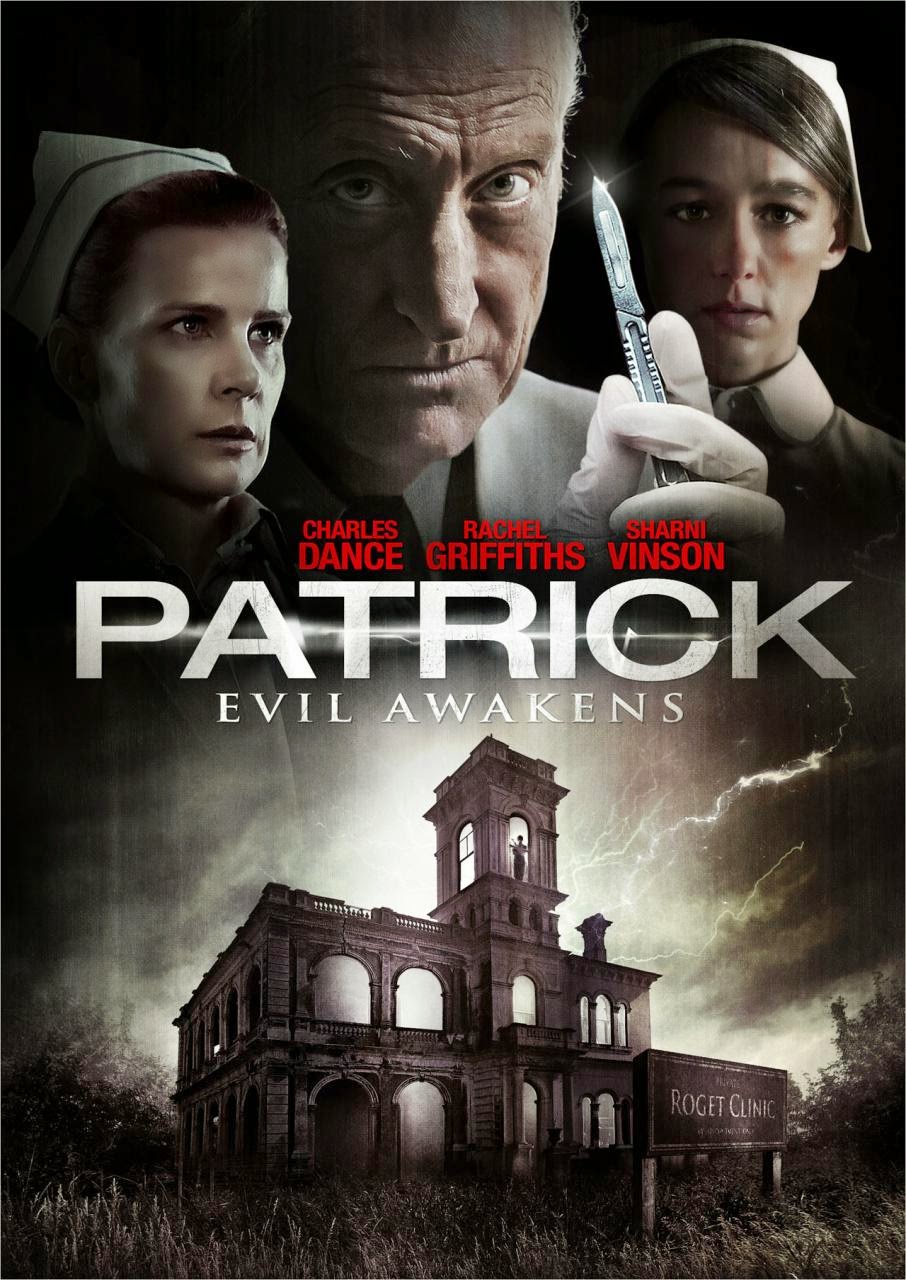
The plot is essentially the same: nurse Kathy Jacquard (Sharni Vinson of YOU'RE NEXT) gets a job at a hospital run by the stern Dr. Roget (Charles Dance) and his uptight head nurse daughter Matron Cassidy (Rachel Griffiths). Kathy is intrigued by comatose Patrick (Jackson Gallagher), who's been lying still and unresponsive since killing his mother and her boyfriend years earlier. Patrick seems to respond to Kathy in the form of reflexive spitting and transferring his thoughts to a computer monitor or via text to her phone (the lack of such technology forced him to communicate via typewriter in the original version). Of course, in true "One Froggy Evening" fashion, only Kathy sees this. Patrick is also able to control the minds and bodies of others, particularly those close to Kathy, whether it's her estranged boyfriend Ed (Damon Gameau) or doctor/potential suitor Brian (Martin Crewes). Kathy can't convince anyone of Patrick's brain activity, and as Dr. Roget's unethical, electro-shock treatments on Patrick increase, so do Patrick's violent tendencies and his drive to control Kathy and the people around her. Hartley is sure to pay homage to Franklin's film by giving the new Patrick the surname of the actor who played him in 1978 (Robert Thompson), giving Ed the surname Penhaligon, after the 1978 film's Kathy (British actress Susan Penhaligon), naming a hospital "The Royal Helpmann" after the 1978 Dr. Roget (Robert Helpmann), and in casting Ozploitation fixture Rod Mullinar (the 1978 Ed) in a small role as an asshole hospital administrator. He even pays brief tribute to PATRICK STILL LIVES (Italian title: PATRICK VIVE ANCORA) in the form of an end credits stinger. Hartley frames a lot of shots in the fashion of Hitchcock and De Palma, and has a score by regular De Palma collaborator Pino Donaggio, but it's so grating and over-the-top that it annoys more than enhances. Hartley also relies too much on cheap jump scares and some really bush-league, cheap-looking CGI that makes the whole project look like an Asylum ripoff of PATRICK. PATRICK '13 is a plodding, slowly-paced bore, with only Dance's acid-tongued villainy providing any entertainment (the way he spits "And you are prissy, meddling little bitch who's wasting my precious time, and I would dearly love for you to fuck off!" at Vinson is the highlight). He gave it a shot, but Hartley's first foray outside of the documentary realm is a resounding failure, though I have no doubt that ELECTRIC BOOGALOO will be his magnum opus. He's doing great things to preserve the memory of the B-movies that many of us hold so dear. But if PATRICK '13 is any indication, he just doesn't need to be making his own. (Unrated, 96 mins)
Indie filmmakers Joe Swanberg, Adam Wingard, Simon Barrett, and Ti West form the core of a relentlessly busy crew of DIY mumblecore filmmakers who took part in the V/H/S anthology and have received acclaim mostly in indie hipster circles but seemed poised to break into the mainstream with the terrific 2013 slasher film YOU'RE NEXT, directed by Wingard, written by Barrett, and co-starring Swanberg and West. West, who had some acclaim away from this posse with THE HOUSE OF THE DEVIL and the overrated THE INNKEEPERS, also directed Swanberg in the current THE SACRAMENT. Swanberg wrote and directed 24 EXPOSURES, which stars Wingard and looks like what might happen if West teamed up with Henry Jaglom to make a slow-burn re-imagining of the 1983 cult slasher film DOUBLE EXPOSURE. 24 EXPOSURES is obviously a film shot cheaply and quickly. It's as minimalist as can be, with some really bad acting and a score that vacillates between "1980s John Carpenter" and "Skinemax fuck scene." Wingard is "fetish photographer" Billy Wingard, who specializes in graphic still death shots of staged murders. Helping him is assistant/girlfriend Alex (Caroline White), who's open enough to allow model Callie (Sophia Takal) to join them in bed. Billy is also preoccupied with Callie's friend Rebecca (Helen Rogers), whose possessive boyfriend (Mike Brune) doesn't want her taking part in his photo sessions. Meanwhile, down-in-the-dumps and improbably-named detective Michael Bamfeaux (Barrett) is given the boot by his wife but still has to do his job, which involves investigating the murder of a model who never showed up for a scheduled shoot with Billy and Alex.
Starting with Wingard's character having the same surname, 24 EXPOSURES is meta almost to the point of self-parody. This is especially the case by the end when, after a whole lot of very little has happened, Bamfeaux, moonlighting as an aspiring writer, turns his search for the murderer and his friendship with Billy into a memoir as a literary agent (played by Swanberg) goes through a laundry list of his manuscript's flaws, go-nowhere plot details, and general construction weaknesses and rattles off ways to improve it, almost like Swanberg is stopping to critique his own film, still in progress. It's that kind of nonsense that shows he's more interested in being "clever" than constructing a real story. Some parts of 24 EXPOSURES look almost Tommy Wiseau-like in their sub-softcore-porn production value. You'd think for as long as Wingard and Barrett have been friends, they could at least convincingly play friends in a movie (Barrett, in particular, is awful). But this is the kind of film where the sense of amateurish artifice is intended and the bad performances are by design, but to what end? Other than Swanberg drawing facile parallels between Billy and Bamfeaux by showing them both eating dry cereal as a snack, there's no real attempt at character or thematic depth. 24 EXPOSURES is a tediously self-indulgent home movie made by guys who should know and have done better. It's either an inside joke among their clique or, more likely, an excuse for Swanberg and Wingard to hang out with some naked chicks on set. (Unrated, 77 mins)
ESCAPE FROM TOMORROW (US - 2013)
When it debuted at 2013's Sundance Film Festival, it seemed highly unlikely that ESCAPE FROM TOMORROW would ever be seen again afterwards. With an inheritance from his grandparents providing the budget, writer/director Randy Moore and his cast and crew pulled off one of the most audacious and ambitious guerrilla filmmaking stunts in the annals of cinema: with season passes to both Walt Disney World and Disneyland, they shot the bulk of the black & white film inside the parks, using scripts stored on their phones and armed with handheld (or concealed) cameras and sporting wardrobes that made them look like average tourists. Moore said in interviews that as many times as they went back to the parks and as many times as the actors got on the rides (he reportedly had the four main actors ride It's a Small World 12 times in a row until he got the shots he needed), none of the Disney cast members got wise to what they were doing. Much to the surprise of Moore and everyone else, Disney, fiercely protective of its image and its intellectual property, never attempted to block the film's release and never publicly addressed it, though it has been added to the online supplement to Disney A to Z: The Official Encyclopedia.
On the last day of a family vacation to Walt Disney World in Florida, Jim (Roy Abramsohn) gets a call from his boss telling him that he's been fired. Jim keeps this devastating news to himself and focuses on giving wife Emily (Elena Schuber) and kids Elliott (Jack Dalton) and Sara (Katelynn Rodriguez) one last fun day before going home. It's a day that becomes increasingly surreal as every song, every attraction, and every animatronic character becomes more sinister and nightmarish by the minute. And that's on top of the everyday horrors of a nagging wife, screaming kids, rude or constantly coughing patrons, lines that won't move, and Elliott getting sick on Space Mountain. Jim is also bewitched by two seductive, giggling French teenage girls (Danielle Safady, Annet Mehendru) who turn up everywhere before he starts deliberately following them. It's clear early on that Jim's current level of reality might not actually be, and the completely off-the-rails second half becomes a horrifically dystopian version of the Disney experience, fusing elements of TOTAL RECALL and VIDEODROME, with a cat-flu epidemic, turkey legs made of emu, rollercoaster decapitations, a secret crew of cleaners, and Disney princesses who double as high-priced courtesans for wealthy Asian businessmen. By the end, it's basically an elaborate TWILIGHT ZONE episode and would probably work better as such, but Moore's daring filmmaking process and his ability to make do with what he had--a lot of the shots are composed as such to avoid copyright infringements and being discovered--are very impressive. Regardless of how the film even turned out, it's a major accomplishment that he was able to get it done. As a story, it loses its way a bit and seems to drag even at 90 minutes, but as an exercise in DIY filmmaking, it's not to be missed. (Unrated, 90 mins)