A film so quiet and low-key that it could almost qualify as ASMR, FIRST COW is the latest from minimalist auteur Kelly Reichardt, best known for character pieces like 2006's OLD JOY and 2008's WENDY AND LUCY, as well as 2011's MEEK'S CUTOFF, a covered-wagon western so authentic that one scene focused on Michelle Williams as she spends several minutes painstakingly reloading a frontier-era rifle in real time. FIRST COW is a slow-burner even by Reichardt standards, and with a lot of scenes taking place in near-total darkness, it's the first of her movies that I've found to be a patience-tester in spots. Pacing and natural lighting hiccups aside, FIRST COW is still a good film, adapted from The Half-Life, a 2005 novel by frequent Reichardt collaborator Jon Raymond, and though they whittle the story down significantly, it still feels a bit stretched at just over two hours. A present-day prologue shows a woman (Alia Shawkat) walking her dog in the woods, where it sniffs out a partially exposed skull. The woman digs around the area and soon uncovers two human skeletons lying side by side. The setting immediately shifts to 1820 in the Oregon territory, where kind-hearted Maryland native "Cookie" Figowitz (John Magaro) is traveling with a group of surly fur trappers. He's responsible for collecting their vittles but earns their scorn and derision when the barren areas only yield scattered mushrooms and berries, along with a squirrel that got away. At a camp site, Cookie finds Chinese immigrant King-Lu (Orion Lee) hiding outside his tent in the middle of the night, fleeing a group of ruthless Russian trappers, one of whom he's accused of killing. Cookie feeds and shelters King-Lu, who takes off undetected at sunrise. After splitting from the trappers, Cookie heads to a remote trading post where he runs into King-Lu. A friendship is formed as they head nowhere in particular, though Cookie has a pipe dream of opening a hotel or a bakery in San Francisco. He talks of buttermilk biscuits, and after setting up camp, they spot a lone cow on property of a nearby estate. She's the only cow in the surrounding settlement, having lost her mate and calf in the journey overseas with British aristocrat Chief Factor (Toby Jones), who more or less runs the area by virtue of being the richest guy around.
With some egging on by King-Lu, Cookie sneaks onto Factor's property and milks the cow to create buttermilk for biscuits and scones, which become huge hits at the trading post. Even Factor is impressed ("I taste London in this cake! It's astonishing!" he exclaims), hiring Cookie to prepare some pastry for an upcoming gathering. The friendship between Cookie and King-Lu is mirrored by the bond formed between Cookie and the cow--named Evie--which is almost exposed when Factor shows her off to his guests and she affectionately nuzzles Cookie, knowing him from his covert nightly milkings. FIRST COW eventually becomes as much of a pursuit thriller as Reichardt allows once Factor discovers what's been going on and vows to kill Cookie and King-Lu, but her primary concern is the mood and the atmosphere in the film's intricately-crafted rustic production design. The pace is leisurely and the tone meditative, though there are some attempts at humor (asked about their special ingredients, King-Lu declares "Ancient Chinese secret!"), and the scenes between Cookie and Evie reveal a sensitive, respectful soul probably not cut out to be in such a dangerous environment (he even expresses sympathy to her over "the loss of your husband and your calf"). Magaro and Lee are a likable team, even if the material requires them to deliver largely internalized performances, and the supporting cast has some always-reliable character actor ringers like Jones, Ewen Bremner, Gary Farmer, and the late Rene Auberjonois in one of his last roles as a grubby old prospector (he died in December 2019). FIRST COW got some positive buzz and critical acclaim on last year's festival circuit, but like everything else from spring 2020, it was halted by the pandemic, opening in March in limited release a week before theaters began shutting down, with A24 eventually relaunching it on VOD in late July. (PG-13, 122 mins)
RETALIATION aka ROMANS (India/UAE/UK - 2017; US release 2020)
Hiding behind what appears at first glance to be a generic revenge thriller for Orlando Bloom is actually a grim and heavy day-ruiner of a British kitchen sink throwback that deals quite frankly with the PSTD effects of childhood sexual abuse. Shot in late 2015 and released everywhere else in the world as ROMANS in 2017 and into 2018, the newly-rechristened RETALIATION managed to fill a VOD void for Lionsgate and Saban Films when they needed pandemic product, likely the only reason this finally saw a US release after so long on the shelf. It's a hard sell even under ideal circumstances, but their decision to make it look like any random Redbox action movie is really doing it a disservice. It's a bit heavy-handed and lays the Biblical metaphors on a little thick at times, but Bloom is a revelation here in a harrowing performance as Malcolm, or "Malky" to his friends. Malky works on a demolition crew currently tearing down a dilapidated London church in his neighborhood--the very church he attended as young boy. Malky served two years in prison on an assault charge some years back, and considering that he's pushing 40, is referred to by everyone by his childhood nickname, and lives with his aging mum (Anne Reid of THE MOTHER) who can barely hide her disappointment in him, there are numerous indicators that his maturation has been stunted to some degree. But he holds down a job and has a casual relationship with Emma (Janet Montgomery), who works at the pub where he hangs out with his buddies after work, though he's prone to raging outbursts and shuts down whenever Emma talks about getting serious.
Malky goes off the deep end when he spots an elderly, white-haired man (James Sallie) at the pub. He instantly recognizes him as the priest who raped him when he was 12 and left the parish shortly after. As the memories come flooding back, Malky can no longer keep his issues bottled up inside. He pushes Emma away and we see his buried shame manifested in self-harming episodes, whether he stabs his hand repeatedly with scissors or violently sodomizes himself with a police truncheon in front of a full-length mirror ("I try to dig him out of me...I rape myself until I bleed," he later confesses). An expansion of ROMANS 12:20, a 2008 short film written by abuse survivor and counselor Geoff Thompson, directed by the Shammasian Brothers (Ludwig and Paul), and starring Craig Conway (DOOMSDAY) as Malky, RETALIATION is bleak and uncompromising. It takes some unexpected turns that are best left for the viewer to discover, and fans of Bloom will certainly want to give it a look, with the caveat that it's extremely downbeat and unpleasant. The only real downside is that the Shammasians and Thompson didn't need to be so on-the-nose with the symbolism, especially with the crew that employs Malky having a specialty in demolishing churches. We get it! And I really can't stress it enough--RETALIATION is not the movie the Blu-ray artwork is selling. (R, 96 mins)
THE BIG UGLY (US - 2020)
Several smaller distributors usually relegated to VOD managed to carve a niche for themselves during the initial months of the pandemic. In particular, IFC Films and Vertical Entertainment took advantage of the scarcity of product and got exposure for some unlikely titles at drive-ins and at the scattered handful of theaters that remained open over the spring and summer of 2020. One such title was Vertical's THE BIG UGLY, which opened on 68 screens in late July to become the #2 movie in the country, eventually staying in the top ten through August, which is not something one can normally say about a new film starring Vinnie Jones. The former footballer-turned-LOCK STOCK-era Guy Ritchie bloke and subsequent DTV fixture is in vintage "fookin' 'ell, mate!" mode as Neelyn, the top enforcer for London-based crime boss Harris (Malcolm McDowell). With their girlfriends in tow--Neelyn is in a committed relationship with Fiona (Lenora Crichlow), while Harris is a sugar daddy to paid escort Jackie (Elyse Levesque)--they land in the heart of Appalachia, where Harris has a large stake in the operation of West Virginia oil man Preston (Ron Perlman). Everything goes smoothly until Preston's Joffrey-esque asshole son Junior (Brandon Sklenar) hooks up with Jackie behind a bar and then tries to pick up Fiona after Neelyn goes back to the hotel to sleep it off following a brawl at the local shitkicker bar, appropriately called 86 ("Only you could get 86'd from a bar called the 86!" admonishes an outraged Harris). Neelyn wakes up in the morning and Fiona is nowhere to be found. Refusing to go back to London with Harris, he instead starts asking questions around town, finds Fiona's body floating in a lake, and confronts a smirking Junior, who has a large scratch across his forehead. Tempers flare, punches are thrown, and Neelyn ends up in jail, where Preston's loyal fixer Milt (Bruce McGill) more or less concedes that Junior is a worthless piece of shit, but he'll still be forced to intervene on his behalf if Neelyn tries to go after him. Any guesses what Neelyn decides to do anyway?
Co-produced by Jones, McDowell, and Perlman, and written and directed by Scott Wiper (who directed Jones in 2007's Stone Cold Steve Austin actioner THE CONDEMNED), THE BIG UGLY is the kind of uncomplicated B-movie that would've been banished to VOD and Redbox were we not in These Uncertain Times™. It's surprisingly engaging, considering Jones hasn't exactly been associated with high-quality titles of late. And while it's a tad overlong and it doesn't make much sense why Harris and Neelyn would've brought their girlfriends along for an overnight trip to rural West Virginia when they were heading back to London in the morning anyway, THE BIG UGLY generally works if you don't think too much about it. Much of that is due to Jones' gritty performance (imagine an older, grizzled Jason Statham) and Perlman's character having some unpredictable quirks, like ripping some local dipshits over their Confederate flag and tossing it in the trash, and adamantly refusing to engage in fracking (it isn't every day you get a liberal oil baron who's concerned about the environment). Sklenar (MIDWAY) is utterly loathsome as the thoroughly repugnant Junior, the kind of sniveling brat who thinks his dad's money is a pass to do whatever he wants, and who's such an irredeemable prick that his inevitable comeuppance is the kind of applause-worthy crowd-pleaser of a moment that we've missed in these months without going to theaters. Some minor nit-picks and contrivances aside, THE BIG UGLY is certainly above-average for this sort of thing, and as far as incongruous montage-into-closing credit needle-drops go, Exile's "Kiss You All Over" is as good a classic rock earworm as any. The film is dedicated to Jones' late wife Tanya, who died of cancer in 2019. (R, 106 mins)
BRITANNIA HOSPITAL (UK - 1982; US release 1983) Directed by Lindsay Anderson. Written by David Sherwin. Cast: Leonard Rossiter, Graham Crowden, Malcolm McDowell, Joan Plowright, Jill Bennett, Marsha Hunt, Robin Askwith, John Bett, Frank Grimes, Mark Hamill, Peter Jeffrey, Fulton Mackay, John Moffatt, Dandy Nichols, Brian Pettifer, Vivian Pickles, Marcus Powell, Arthur Lowe, Alan Bates, Catherine Wilmer, Dave Atkins, Peter Machin, Gladys Crosbie, Rufus Collins, Robbie Coltrane, Tony Haygarth, Richard Griffiths, Dave Hill, Roland Culver, Val Pringle, Liz Smith, Gordon John Sinclair, T.P. McKenna. (R, 116 mins) An anarchic, absurdist black comedy that's a scathing satire of England under then-Prime Minister Margaret Thatcher, 1982's BRITANNIA HOSPITAL was the final chapter of the very loosely-connected "Mick Travis" trilogy from director Lindsay Anderson and writer David Sherwin. Following 1968's IF... and 1973's O LUCKY MAN!, BRITANNIA HOSPITAL brings back Anderson protagonist Mick Travis (Malcolm McDowell), now a muckraking documentary filmmaker who relocated to Arkansas but is back in his native London to cover various goings-on at the beleaguered Britannia Hospital. They've got a lot on their plate, starting with a highly-publicized visit from the Queen Mother (Gladys Crosbie), with a laundry list of distractions putting the whole operation in jeopardy: striking nursing staff has led to a marked decline in patient care, including dead people left on gurneys at admitting; the socialist kitchen staff are refusing to prepare the elaborate meals demanded by the wealthy VIP patients; one of those patients is African dictator President Ngami (Val Pringle), a ruthless, Idi Amin-like despot who slaughters children in his country and is reputed to be a cannibal; Ngami's presence at the hospital has sparked intense protests by increasingly large crowds just outside the entrance gate; and quack mad doctor Professor Millar (Graham Crowden, reprising an O LUCKY MAN! character) is about to kick off the grand opening of the Japanese-financed Millar Center for Advanced Surgical Studies, a mysterious new wing of Britannia Hospital where he and his staff are conducting top secret experiments with unwitting patients, all of this under the watchful eye of an all-knowing AI supercomputer known as "Genesis."
A cable fixture in the mid '80s that's just out on Blu-ray from Kino Lorber (because physical media is dead), BRITANNIA HOSPITAL is, in a word, a lot. It's freewheeling to the point where it's easy to write it off as an unwieldy, chaotic mess and maybe it is, but there's a certain audaciousness to it that makes it impossible to just dismiss. The two storylines finally intersect at the end, but for much of its duration, the film feels like two wildly different Anderson projects that the director just threw together. The satirical bits involving the striking workers and the Queen Mother visit have a cynical, Paddy Chayefsky thing going on, while the sections with Travis investigating Millar take the film in a truly jarring direction that had to throw off highbrow critics who adored Anderson's previous work. The director was no stranger to disregarding cinematic convention, but a crazed Millar chopping off Travis' head and putting it onto a badly-stitched body in a grotesque FLESH FOR FRANKENSTEIN riff is something no Anderson fan in 1982 would've seen coming.
Each of the two disparate plot threads work in fits and starts--the splattery result of Millar's Travis experiment is hilariously over-the-top and outrageously gross in a way that prefigures the likes of Peter Jackson's DEAD ALIVE--but it also prevents BRITANNIA HOSPITAL from finding any kind of rhythm or momentum. Top-billed Leonard Rossiter, a veteran character actor (2001: A SPACE ODYSSEY, THE PINK PANTHER STRIKES AGAIN) who, by this point in his career, carved a niche for himself playing uptight, bureaucratic toadies, is perfectly cast as harried hospital administrator Vincent Potter, trying and failing to keep it together as things keep escalating beyond any semblance of control. Rossiter died unexpectedly of a heart attack in 1984 at just 57, and was such a workhorse to the end that he was still popping up on British TV and in movies as late as 1986's WATER, where he played yet another bureaucratic asshole, this time in the form of a pompous politician.
The ensemble cast is almost too packed to keep track of without taking notes, with appearances by Joan Plowright as a hospital union official; Robin Askwith as the head cook leading the kitchen revolt; Peter Jeffrey as a supercilious surgical chief; Mark Hamill--in between EMPIRE STRIKES BACK and RETURN OF THE JEDI--as Travis' sound engineer who spends most of the film in the production van watching TV and getting stoned on Nicaraguan weed, oblivious to his boss' cries for help when he's being decapitated by Millar; Marsha Hunt (a Mick Jagger ex long assumed to be the subject of "Brown Sugar") as a Millar nurse secretly getting info for Travis; John Bett in drag as a Buckingham Palace official named Lady Felicity; Richard Griffiths as hospital radio DJ Cheerful Bernie; Robbie Coltrane as a protester; and "guest patient" Alan Bates as a corpse, murdered by Millar after not dying quickly enough ("I'm afraid he's lingering"), for the purpose of his reanimation experiment only to have his head turn "pulpy" when it's kept at the wrong temperature, prompting Millar's need for Travis' head as an impromptu replacement. Not everything in BRITANNIA HOSPITAL works, but it's legitimately unpredictable and frequently batshit insane, though some things still resonate on a serious level, whether it's patient care and insurance concerns, or one unexpectedly topical scene where a peaceful female protester offers a flower to a cop only to get violently punched in the face, instantly sparking a massive riot that ultimately spills into the halls of the hospital.
THE CALLER (US - 1989) Directed by Arthur Allan Seidelman. Written by Michael Sloan. Cast: Malcolm McDowell, Madolyn Smith. (R, 97 mins)
An Empire Pictures production that really only turns into something recognizably "Empire Pictures" in its last ten minutes, THE CALLER is a bizarre oddity that connoisseurs of '80s cult movies have pretty much kept to themselves. A dialogue-heavy two-hander mostly confined to a single set except for a couple of exteriors and one brief drive down a mountain road, THE CALLER was written by Michael Sloan, best known as the creator of the acclaimed 1980s CBS series THE EQUALIZER. In its style and structure, it plays a lot like a TV-movie, not surprising given that journeyman director Arthur Allan Seidelman has spent most of his long career as a small-screen hired gun (though he did helm Arnold Schwarzenegger's 1970 debut HERCULES IN NEW YORK). Shot in Rome at Empire's Italian studio, THE CALLER opens with an exterior supermarket parking lot set so blatantly phony that you might be inclined to think it's some Italian production design team's idea of a "normal American parking lot." Whether that's a happy accident that's taking advantage of an existing set is up for debate, but the artifice in these early scenes of THE CALLER is so pronounced that it creates such a sense of disconnect from reality that, eventually, it's quite clear that it's by design. That also extends to the staginess of the entire project, set almost entirely in a remote cabin that seems designed more for a Country Living photo spread than a place where one might actually live. An unnamed woman (Madolyn Smith) returns home from shopping after finding an abandoned car in the forest around her home. She appears to live alone, but there are framed photos all over the house indicating that she has (or had) a husband and a daughter who are presently nowhere to be found.
After a bizarre phone conversation with her daughter ("It's gonna be really fine...this time. You'll see. You're gonna be proud of Mommy...what Mommy's going to do!"), there's a knock on the door. The caller is a stranger (Malcolm McDowell) who's been following her since she was out shopping. He says his car broke down and he needs to call for a tow. The tone of their subsequent conversation indicates that they may or may not already know each other or at least he knows about her. They feel one another out in ways that are alternately friendly, flirtatious, interrogating, accusatory, and cruel. He wants to know where her husband and daughter are. He suspects she may have killed at least the husband. She accuses him of acting like characters in cliched TV cop shows. Whenever she gets the upper-hand in a line of questioning, he says "A point for you." They're playing head games with one another, but that doesn't explain what appears to be blood seeping from the bottom of a cake box from her shopping trip, or the discovery of a doll hanging from a noose in a locked closet, with each accusing the other of putting it there.
Mind you, this synopsis makes just as much sense watching it play out as it does reading it. The artifice of the production design, along with the jarring tonal shifts, and the stilted acting, particularly by Smith, combine for a frequently off-putting effect but rest assured, it's all intentional. Things don't become any clearer after a fade to black around the midpoint, followed by the two of them crossing paths once again the next morning in the supermarket parking lot, with McDowell suddenly dressed like he just blew through a gift card from Bass Pro Shops. And there's never anyone else around (she stops at a gas station in the beginning of the film and leaves money on the pump when she can't find an attendant). Given Sloan's roots in television (he also created the short-lived Lee Van Cleef NBC ninja series THE MASTER), THE CALLER feels an awful lot like it should've been an episode of the '80s TWILIGHT ZONE revival, especially with what transpires in the absolutely bonkers climax. There's a good idea here, but it's a 30-to-45-minute TV episode idea that just becomes repetitive and tiresome as a feature-length film. That is, until it goes completely berserk in the last ten minutes. Given how it pans out, THE CALLER, just out on Blu-ray from Vinegar Syndrome (because physical media is dead), might be a rare example of a twist-ending film that plays better on a second viewing, when you know how it ends and can watch for all the hints along the way. Smith's mannered, erratic performance certainly makes a lot more sense once you know the big reveal. The film itself still may not make much sense by the end, and its an extremely laborious set-up getting there, but you can't help but admire its go-for-broke audacity and its off-the-charts WTF? factor. THE CALLER was shot in late 1986, but aside from a 1987 Cannes screening and another festival in Italy that summer, its release was stalled by Empire's financial troubles and eventual bankruptcy prior to its 1989 rebirth as Full Moon Entertainment. They sold a number of titles to various other distributors, and THE CALLER ended up with Trans World Entertainment, who gave it a belated straight-to-video at the tail end of 1989.
BOMBSHELL (US/Canada - 2019) Directed by Jay Roach. Written by Charles Randolph. Cast: Charlize Theron, Nicole Kidman, Margot Robbie, John Lithgow, Allison Janney, Malcolm McDowell, Kate McKinnon, Connie Britton, Mark Duplass, Liv Hewson, Brigitte Lundy-Paine, Rob Delaney, Stephen Root, Robin Weigert, Amy Landecker, Mark Moses, Richard Kind, Holland Taylor, Alanna Ubach, Anne Ramsay, Andy Buckley, Brooke Smith, Ben Lawson, Josh Lawson, Nazanian Boniadi, Brian d'Arcy James, Alice Eve, Elisabeth Rohm, Bree Condon, Ashley Greene, Tricia Helfer, Jennifer Morrison, Lisa Canning, Ahna O'Reilly, John Rothman, Tony Plana, Kevin Dorff, P.J. Byrne, Spencer Garrett, Michael Buie, Marc Evan Jackson, Katie Aselton. (R, 109 mins)
A chronicle of the Fox News sexual harassment scandal that brought down chairman and CEO Roger Ailes, BOMBSHELL belongs to that same "ripped from the headlines" subgenre that gave us THE BIG SHORT and VICE, generally decent films that provide easy Oscar bait for big-name actors to do uncanny impressions of ubiquitous figures. BOMBSHELL is very much in line with those films, and could make an unofficial trilogy with director Jay Roach's two previous HBO political docudramas, 2008's RECOUNT and 2012's GAME CHANGE. Those were instant Emmy and Golden Globe magnets, with RECOUNT giving Laura Dern a chance to do a remarkable take on Florida Attorney General Katharine Harris, and GAME CHANGE showcasing Julianne Moore and Ed Harris as dead-on versions of Sarah Palin and John McCain, respectively. But because these stories are so recent and the 24-hour news cycle so constantly there and in our faces, BOMBSHELL falls into the same trap as the rest of these kinds of movies: it entertains but offers nothing that we don't already know. Given Roach's history with HBO, it's surprising that BOMBSHELL is even in theaters. It follows the same formula and style as RECOUNT and GAME CHANGE, eschewing the snarky smartassery that Adam McKay brought to THE BIG SHORT and VICE, opting instead for occasional fourth-wall breaking while generally keeping it straightforward and serious.
The Fox News scandal broke in 2016 and BOMBSHELL is already the second 2019 project to tackle Ailes as a subject, following the Showtime limited series THE LOUDEST VOICE, with Russell Crowe as Ailes and Naomi Watts as Gretchen Carlson, the fired Fox News personality who was the first to sue him for sexual harassment. THE LOUDEST VOICE was more about the entire Ailes story, starting with the establishment of Fox News, while BOMBSHELL just deals with the scandal, with the focus being on Megyn Kelly (Charlize Theron), who finds herself under fire as the film opens in 2015, just after her debate scuffle with Donald Trump that led to his infamous "blood coming out of her...wherever" comment. Ailes (John Lithgow, with prosthetic jowls and a NUTTY PROFESSOR fat suit) sympathizes with the way Trump supporters are raging at her on Twitter, but wants her to play nice, as Fox and Trump are well on their way to a perpetual state of symbiotic co-dependence. At the same time, Carlson (Nicole Kidman) is ruffling feathers on the afternoon dead zone she's been given after being bounced from the highly-rated morning show FOX & FRIENDS, and when she's eventually fired, she decides to blow the doors off the worst-kept secret in the building: that Ailes is a serial sexual harasser and all-around creep, and that the network's "boys club"--the costly harassment settlements of Bill O'Reilly (played here by Kevin Dorff) are unspoken common knowledge among the grunts in the newsroom--has made for a toxic work environment. The mood is also fueled by deranged, right-wing paranoia that comes straight from Ailes, who at one point makes an off-the-cuff remark to his legal team about an Obama White House plot to have him murdered, a comment so batshit crazy that even his attorney Rudy Giuliani (Richard Kind) is seen looking away in incredulous discomfort.
The third figure in the story is the most problematic in that she's a wholly fictional creation of Roach and screenwriter Charles Randolph (a co-writer of THE BIG SHORT). Margot Robbie is the improbably-named Kayla Pospisil, a composite character meant to show the kind of treatment given to established vets like Kelly and Carlson when they were ambitious youngsters at the network. Composite characters are very often a necessity with dramatic narrative recreations, and while it's no fault of Robbie's, the script just requires Kayla to be too many things at once. Ostensibly an "evangelical millennial" with a repressed upbringing in a staunchly far-right church family, Kayla is at Fox News to be a voice for young conservatives. She's first shown in a control booth, demonstrating no knowledge of the Eagles or classic rock in general when she puts a photo of Don Henley on the air to accompany a breaking news report on the death of Glenn Frey, blaming the gaffe on "never listening to secular music." The next time we see her, she's telling Carlson that she's leaving her staff to work for O'Reilly (wait...when was she on Carlson's staff in the first place?). Right after that, she's hopping into bed with a closeted lesbian cubicle mate (Kate McKinnon), who's a secret Hillary Clinton supporter. It's rightly disgusting and infuriating when we see ambitious Kayla requesting a meeting with Ailes and ending up being subjected to his degrading requests that she pull up her skirt for him, and the squirm-inducing scene is played very well by Robbie and Lithgow. But Robbie simply can't assemble a believable character out of the wildly disparate pieces she's been given.
Kidman has a good amount of screen time, but her story generally takes a backseat to what goes on with Robbie's Kayla and Theron's Megyn Kelly. Theron is definitely the MVP here, with just the right amount of subtle prosthetics combined with an astonishing mimicry of Kelly's voice, cadence, and speaking style. It's one of the most believable transformations of an actor into a real-life figure in recent memory. There's been some chatter online complaining that the film makes Kelly a hero, but that's another discussion for another time. No one deserves to be a victim of sexual harassment, and BOMBSHELL isn't about Megyn Kelly's dubious comments as a Fox News personality or during her short tenure at NBC. Briskly-paced and well-acted (except for the one scene between Theron and Robbie, which comes off as strangely clunky), with Theron and Lithgow being the standouts, BOMBSHELL also boasts a very large supporting cast, including Malcolm McDowell as Rupert Murdoch, Allison Janney as Ailes attorney Susan Estrich, Spencer Garrett as Sean Hannity, Tony Plana as Geraldo Rivera, a perfectly-cast Alanna Ubach as Judge Jeanine Pirro, Mark Moses as the loathsome Bill Shine, Anne Ramsay as Greta Van Susteren, Bree Condon as a Mean Girl-ish Kimberly Guilfoyle, P.J. Byrne as Neil Cavuto, and Connie Britton as Ailes' endlessly supportive wife, introduced scoffing at an employee for eating "liberal" grocery store sushi. Like RECOUNT, GAME CHANGE, THE BIG SHORT, and VICE, BOMBSHELL is perfectly fine entertainment and it'll almost certainly be up for major awards (Theron and Lithgow are both deserving). But once you get past the dedication and diligence of the performances, do these films have any lasting impact beyond that first viewing? THE BIG SHORT was great, but have I thought "I need to rewatch THE BIG SHORT" even once in the four years since I saw it in the theater?
The Roger Corman-produced 1975 classic DEATH RACE 2000 already got a remake with 2008's Jason Statham-starring DEATH RACE. That film has spawned a series of DTV sequels with Luke Goss in place of Statham, with a fourth installment due out later this year. With DEATH RACE 2050, the belated DTV sequel to/unnecessary remake of the 1975 film, Universal now has two different DEATH RACE franchises going. But only DEATH RACE 2050 has the direct involvement of Corman. who wanted another DEATH RACE that recaptured the look and feel of Paul Bartel's original. The satirical element is definitely here, along with some IDIOCRACY-style roasting of American culture, self-aware Syfy snark, and over-the-top Troma levels of comedic gore. In the future of 2050, the United Corporations of America is run by the Chairman (Malcolm McDowell), and the biggest cultural event going is the Death Race, what the Chairman terms an annual celebration of "the freedom to sit on your big fat ass all day!" The top driver is Frankenstein (Manu Bennett), the reigning champion of the Death Race, where the key is to win the race but points are scored by running down pedestrians. Frankenstein's competition is comprised of macho but insecure Jed Perfectus (Burt Grinstead), a closet case unable to face his homosexuality; religious fanatic and right-wing domestic terrorist Tammy the Terrorist (Anessa Ramsey); and rapper/sex tape celebrity Minerva Jefferson (Folake Olowofoyeku). The final car is the self-driving A.B.E., the product of UCA ingenuity and the kind of technological advancement that Death Race co-host Junior (Charlie Farrell) calls a gift that "finally eliminated America's outdated burden of employment." The race is jeopardized by a Resistance movement led by disgruntled former network TV exec Alexis Hamilton (Yancy Butler), who's got a mole inside the operation in the form of Frankenstein's proxy navigator Annie Sullivan (Marci Miller).
DEATH RACE 2050 earns some goodwill by wearing its love of its predecessor on its sleeve, looking every bit as cheap as the 1975 film, with CGI that's probably intentionally bad filling in for some old-school matte work. The jokes fly fast and furious, with Farrell's Junior an almost carbon copy of the performance by The Real Don Steele, and the same goes for the way Shanna Olsen's sycophantic co-host Grace Tickle captures the cloying ass-kissing of Joyce Jameson's Grace Pander in the old film, right down to the repeated refrain of every famous person being "a very good friend of mine." Director/co-writer G.J. Echternkamp has some fun with the renamed cities and states of 2050 (there's "Nueva York," Baltimore is now "Upper Shitville," Arkansas is "Walmartinique," and Dubai is "Washington, DC"), the subplot with Abe suddenly quitting the race to drive off and find itself after an existential AI crisis ("What am I?" the computer voice wonders) is inspired nonsense, and with his crazy toupee, crude demeanor, and being surrounded by topless women, McDowell's Chairman is obviously a 2050 incarnation of Donald Trump. But a little of DEATH RACE 2050 goes a long way. The comedy is too blunt and heavy-handed, and the referencing a little too winking for its own good. It drifts off into post-nuke MAD MAX territory by the end, probably to take advantage of being shot on Corman's old Peru stomping grounds where several of his VHS mainstays from the late '80s and early '90s were made (Luis Llosa, one of Corman's top proteges from that period, went on to direct Hollywood movies like THE SPECIALIST and ANACONDA, and gets a producer credit here). As Frankenstein, the dull Bennett doesn't even come close to the stoical badassery of David Carradine, but shows he can adequately function as a backup Scott Adkins should the first choice be unavailable. In the end, DEATH RACE 2050 has its moments, and if approached with low expectations, isn't terrible by any means, even if it's just a significantly louder and much more obnoxious DEATH RACE 2000. (R, 93 mins) TRAIN TO BUSAN (South Korea - 2016)
At this point, there really isn't much anyone can add to the zombie genre, but the South Korean import TRAIN TO BUSAN finds ways to spruce up the familiar with clever ideas, inspired set pieces, interesting characters, and some unexpected instances of gut-wrenching emotion. Saek-woo (Gong Yoo) is a workaholic fund manager whose wife left him and their young daughter Su-an (Kim Soo-an), who's now mostly left in the care of Saek-woo's live-in mother. Upset at her father's distance and that her birthday gift is a duplicate of something he already gave her, Su-an insists on being taken by train to Busan to visit her mother. Once on the train, all hell breaks loose when a bleeding, nearly feral woman sprints about, bites a passenger, and unleashes a rapidly-spreading virus that turns victims into ferociously aggressive zombies. What follows is the usual scenario of a small band of resourceful survivors fighting their way through the train to safety, trying to outrun the contagion and the growing zombie horde as a state of emergency is declared and train station after train station is closed. An easy description of TRAIN TO BUSAN would be "WORLD WAR Z meets SNOWPIERCER," but it also plays a bit like DEMONS on a bullet train as well as demonstrating the tone of a 1970s disaster movie. Where writer Park Joo-suk and director Yeon Sang-ho help separate TRAIN TO BUSAN from the rest of the crowd is by packing it with one nail-biting sequence after another, with the stop at the Daejean train station cementing itself as an instant classic, culminating in the horrifying revelation that the military personnel sent to save them have already been infected and have turned. Other standout scenes include the devastating moment when Saek-woo calls his mother and expresses concern about the sound of her voice as her infection becomes apparent and he's forced to listen to her turn over the phone.
The bond that forms between the ever-diminishing group of survivors is strong and the actors excellent, making you really feel it when they start getting killed off. Saek-woo has an initial adversary in burly smartass Sang-hwa (a terrific performance by Ma Dong-seok), which isn't helped by Saek-woo not hesitating to leave Sang-hwa stranded in one of the cars with the zombies until the last second, but they set aside their differences, form a grudging partnership and take turns looking out for one another's loved ones, whether it's Su-an or Sang-hwa's very pregnant wife Seong-kyeong (Jung Yu-Mi). Self-absorbed Saek-woo undergoes a transformation into a selfless hero over the course of the film, starting out by telling his daughter "Look out for yourself before anyone else" when she offers her seat to an elderly woman who reminds her of her grandmother ("Granny's knees always hurt!" the compassionate child says). His daughter shows him the error of his ways ("You only care about yourself! That's why Mommy left!") and between that and Sang-hwa's merciless ballbusting ("Fund manager? No wonder you're an asshole"), Saek-woo becomes a hero. To go with the notion of this being an updated take on a '70s disaster epic, there's also the obligatory villain who makes an already bad situation worse with his actions: loathsome businessman Yong-suk (Kim Eui-sung) is this film's Richard Chamberlain from THE TOWERING INFERNO or Paul Reiser from ALIENS, an unbelievably duplicitous asshole who starts rumors, sabotages the safety of others, and puts his own well-being ahead of everyone, usually in the form of literally throwing other passengers at zombies in order to save his own ass. At one point, he even cavalierly sacrifices someone who comes to his assistance after he trips and falls running away from the zombies. This archetype is a staple of such films, and they've rarely been as off-the-charts despicable as Yong-suk, but true to TRAIN TO BUSAN's refusal to stick too closely to convention, even he gets a slightly redeeming trait by the end. The crux of the story with TRAIN TO BUSAN breaks no new ground, but there's enough tweaking and unexpected depth to its characters that it manages to separate itself from the crowd and successfully establish its own zombie bona fides. (Unrated, 118 mins)
THE DISAPPOINTMENTS ROOM (US - 2016)
There's a legitimately sincere attempt at a modern gothic aesthetic to THE DISAPPOINTMENTS ROOM, but it just never takes off. It's co-written by PRISON BREAK star Wentworth Miller, who wrote Park Chan-wook's similarly gothic 2013 arthouse film STOKER, and perhaps this was intended as some sort of companion piece with its dark secrets and family tragedies. These are definitely recurring themes to Miller's work as a screenwriter, but THE DISAPPOINTMENTS ROOM's title becomes a self-fulfilling prophecy. Obviously mangled in post-production and even after it set a land-speed record for vacating multiplexes--the DVD/Blu-ray and streaming version runs seven minutes shorter than what was in theaters last fall, omitting an apparently important scene where the main character has a meltdown in front of some dinner guests; here the guests are shown waiting for her then simply leaving as if the dinner never happened--the film was also left on the shelf for two years as a casualty of Relativity's bankruptcy woes. The end result is a film that feels unfinished and abandoned, even more so now that it's missing that dinner scene.
Architect Dana (Kate Beckinsale), her Mr. Mom husband David (the unbelievably bland Mel Raido), and their young son Lucas (Duncan Joiner) move to a decrepit mansion ominously known as The Blacker House. They're trying to get away from the city and some bad memories, namely the sudden death of their infant daughter. While exploring the house, Dana moves a large armoire and discovers a hidden room that's not on the blueprints and can only be locked from the outside. She learns from a local historian (Marcia DeRousse) that it's a "disappointments room," the kind of room where wealthy families in less enlightened times would lock away a deformed or mentally challenged child that would cause social embarrassment. Dana regularly visits the room and is soon plagued by visions of a young girl with a facial deformity as well as encountering the ghost of Judge Blacker (Gerald McRaney), the home's original owner, a rich and powerful local who kept his "disappointment" daughter hidden from the public. Dana goes off her meds, starts losing track of time and unknowingly becoming violent toward Lucas, all while engaging in a testy but flirtatious back-and-forth with stud handyman Ben (Lucas Till), one of many story threads that go absolutely nowhere as slowly as possible. Some of Miller's gothic intentions come through (a character is shown watching JANE EYRE on TV at one point), director D.J. Caruso (THE SALTON SEA, DISTURBIA) occasionally invokes a mood tantamount to a modern take on an early '60s AIP production, and the film seems to be trying to say something about motherhood and mental illness a la THE BABADOOK or LIGHTS OUT, but by the time the big reveal comes and the credits abruptly start rolling at 77 minutes, you're left with the realization that there's simply nothing here and the whole endeavor was just smoke and mirrors that can't even be salvaged by a pro like Beckinsale. Still, as disastrous as THE DISAPPOINTMENTS ROOM is, it has to get a little credit for the effective casting of McRaney as the ghostly villain. But that's all it's got going for it. (R, 85 mins)
31 (US - 2016) Written and directed by Rob Zombie. Cast: Sheri Moon Zombie, Malcolm McDowell, Judy Geeson, Jeff Daniel Phillips, Lawrence Hilton-Jacobs, Meg Foster, Kevin Jackson, Jane Carr, Richard Brake, Lew Temple, Daniel Roebuck, Pancho Moler, David Ury, Torsten Voges, E.G. Daily, Esperanza America, Andrea Dora, Michael "Redbone" Alcott, Tracey Walter, Ginger Lynn Allen, Devin Sidell. (R, 103 mins) Earlier this year, critic/blogger Jason Coffman wrote a fascinating piece about horror fandom that went viral and quite frankly deserves a Pulitzer. It was filled with things that needed to be said, such as, in no uncertain terms, that horror fans are the worst. Of course, that's a gross generalization on my part that wasn't exactly Coffman's central thesis, but he questioned why a very vocal contingent of horror fans--he called them the "gatekeepers"--had such vehemently negative reactions to thoughtful, serious horror films that received significant accolades from critics outside of horror circles. The piece was written specifically in response to audiences turning on THE WITCH, but it also referenced similarly acclaimed offerings like THE BABADOOK and IT FOLLOWS. To reject original, thought-provoking films that fall in the horror realm, to question their genre validity because they've been praised by those outside the insulated horror bubble, Coffman posited, is to "reinforce the image of the 'horror fan' as a slack-jawed dullard whose only interests are sex and gore."
Well, he's right. And you can thank the gatekeepers for 31, the latest film from horror/metal icon Rob Zombie. Financed in large part by crowdfunding, 31 is Zombie's gift to his fans, the gatekeepers who adore him. To criticize Zombie--to even question him--is verboten in horror gatekeeper circles. Zombie is a guy who knows and loves horror movies. It showed in his days fronting the band White Zombie, itself named after the 1932 Bela Lugosi classic. But after 16 years and with six feature films under his belt, shouldn't there be some kind of progress by now? I'll give Zombie props where it's due: his second film, THE DEVIL'S REJECTS, is his masterpiece, a definitive mission statement that melded the '70s aesthetic of Tobe Hooper and hillbilly horror with the operatically bloody ferocity of Sam Peckinpah. It's foul, it's vile, it's difficult to watch--and it's incredibly powerful and an unforgettable experience. And Zombie's never come close to it since. His entire filmmaking career seems to be an endless, circle-jerking tribute to 1986's THE TEXAS CHAINSAW MASSACRE 2. His 2007 remake of HALLOWEEN is a disjointed fusion of his usual hicksploitation horror before shifting gears to became a condensed, pointless remake of the 1978 original, while the less said about his 2009 HALLOWEEN II, the better. 2013's THE LORDS OF SALEM was ultimately a misfire that lost its way as it devolved into sub-Jodorowsky shock imagery, but it had a weird '70s Satanism vibe going on, like 1973's MESSIAH OF EVIL if directed by Stanley Kubrick. It wasn't a success, but Zombie was at least making a concerted effort to work outside of his comfort zone for the majority of the film.
31 finds Zombie back in his comfort zone and on total autopilot. His 2003 debut, HOUSE OF 1000 CORPSES (shot in 2000 and left in distribution limbo for three years), is a terrible movie but it at least has the excuse of being a debut. What's his excuse for 31? It's like an "extreme" version of his already "extreme" schtick, but his abilities seem to be regressing. He's so reliant on in-your-face shaky-cam and garish lighting (including a strobe-lit sequence) that a good chunk of the film is visually incoherent. And the plot? The same shit. It's set on Halloween 1976 and a bunch of hard-partying carnival workers who say "fuck" a lot are lured into the middle of nowhere to take part in "31." It's a MOST DANGEROUS GAME-type contest overseen by a trio of foppish Brits, dressed as grotesque aristocrats in powdered wigs and pancake makeup like they're going to a midnight showing of BARRY LYNDON: Father Murder (Malcolm McDowell), Sister Dragon (Judy Geeson), and Sister Serpent (Jane Carr). The five carnies--headed by Zombie's usual star, wife Sheri Moon Zombie as Charly--have to overcome unbeatable odds to survive the night as they face off against their opponents hellbent on slaughtering them. The killers are an increasingly ludicrous collection of ROAD WARRIOR rejects in clown makeup: Sick-Head (Pancho Moler), a demented little person in a Hitler stache and with a swastika painted on his chest; Psycho-Head (Lew Temple) and Schizo-Head (David Ury), a pair of chainsaw-wielding brothers; and the cartoonishly Germanic Death-Head (Torsten Voges) and the fetishist Sex-Head (E.G. Daily). Not all of the carnies make it, but once that initial lineup is defeated, Father Murder calls in his ace closer Doom-Head, a maniac prone to pretentious, philosophical Quentin Tarantino-esque monologues and played in a grating, headache-inducing fashion by Richard Brake in what might be 2016's most unbearable performance that will nonetheless inspire countless insufferable cosplayers at horror cons for the next decade.
Like Tarantino, Zombie has favorite cult actors he likes to use repeatedly--McDowell, Geeson, Daily, Meg Foster, Daniel Roebuck, and former porn star Ginger Lynn Allen have been in past Zombie films (Geeson came out of a decade-long retirement to co-star in THE LORDS OF SALEM)--and here he even gives us a prominent role for Lawrence Hilton-Jacobs, best known as Sweathog Freddie "Boom Boom" Washington on WELCOME BACK KOTTER 40 years ago, here playing Panda, one of the doomed carnies. It's nice to see Hilton-Jacobs again, but it's too bad he's using an overdone Jamaican accent that renders most of his dialogue unintelligible. You'll wish more of the dialogue was unintelligible when you see Foster (as carny Venus Virgo) gesticulating around her crotch and saying "fucky fucky fucky, juicy juicy juicy, money money money" and witness this enlightening conversation between carny Levon (Kevin Jackson) and a cackling Sick-Head (note: transcription double-checked for accuracy):
A louder and somehow even more obnoxious HOUSE OF 1000 CORPSES peppered with shout-outs to Tobe Hooper's THE FUNHOUSE, 31 is obviously intended for the Rob Zombie superfans and is more or less a greatest hits package, from the splattery violence to the endless vulgarity to resemblance of the "Heads" to Captain Spaulding and the Firefly clan to the ersatz Peckinpah WILD BUNCH freeze-frames and the opening credits featuring a Southern rock favorite (in this case, the James Gang's "Walk Away"). If you're one of the Rob Zombie gatekeepers, then you decided this "fuckin' ruled" before he even started filming. 31 is for you. Go enjoy yourself. You've seen it all before--and better--but hey, this is what you wanted.
You'd be able to spot the David Cronenberg influence on ANTIVIRAL even without the knowledge that it's the writing/directing debut of his son Brandon. It's a good thing to say the apple doesn't fall far from the tree here. ANTIVIRAL juggles a lot of concepts--too many, in fact--but despite its minor flaws, it's one of the most original and disturbing films to come down the pike in a while, a scathing indictment of vapid celebrity culture fused with the "body horror" elements that figured so prominently in the elder Cronenberg's trail-blazing early work. In a near-future, dystopian Toronto, celebrity worship has grown so huge that bored people with too much time and money on their hands now pay to be infected with viruses harvested directly from their favorite tabloid and entertainment magazine fixtures, as a way to be "closer" to them and be "part of them." Lucas Clinic sales rep Syd March (Caleb Landry Jones) spends his days selling celebrity sicknesses to pathetic customers and his nights selling those same viruses on the black market using equipment stolen from his employers at the clinic. His most lucrative supply comes from beloved celebrity Hannah Geist (Sarah Gadon)--and it's never really specified what Hannah does--she's just always in the news. He pays her a visit to draw some blood during her latest illness (he's previously sold her various flus and even her cold sore virus to a guy who wanted to feel like he'd kissed her and contracted it). When he injects himself with the virus in order to sneak it on to the black market, he becomes violently ill and quickly realizes that something is very wrong with Hannah.
Growing increasingly horrific but not in the ways you expect, ANTIVIRAL is the kind of bleak film that really gets under your skin. While Brandon's story ideas and scripting are an inventive outgrowth of today's culture, he utilizes the clinical methodology of his father's early work. So many images recall the elder Cronenberg: the presence of THE BROOD and THE DEAD ZONE co-star Nicholas Campbell as the head of the Lucas Clinic; the cold, desolate look of Toronto, brilliantly captured by cinematographer Karim Hussain, is reminiscent of everything from SHIVERS to VIDEODROME to CRASH (there's also a lot of CRASH in the shots of endless lines of cars speeding along the freeway); Syd's black-market hustling and his business arrangement with disease dealer Arvid (Joe Pingue), who grows the viruses supplied by Syd into meat patties to sell to his customers, recalls the shady Civic TV wheeling-and-dealing of Max Renn (James Woods) and his tech-geek buddy Harlan (Peter Dvorsky) in VIDEODROME. The increasingly sickly Syd comes across like a more introverted Max Renn, and Jones (THE LAST EXORCISM), with his pale skin and sullen demeanor, reminded me of younger, vaguely androgynous Brad Pitt. Though it's a bit overlong and could've used some trimming in the second half, ANTIVIRAL is a bold and original work, despite the myriad of influences and references--in a way, it seems like it's doing the film a disservice to mention all the David Cronenberg callbacks, but it's impossible to not mention them. It's almost as if Brandon Cronenberg is carving his own path while putting all the "Yes, David Cronenberg is my father" stuff on the table from the start. For fans of the still very active Pops Cronenberg, it's reassuring to see that his legacy and the Cronenberg name will carry on at least one more generation and that his son obviously spent of lot of time observing and learning from Dad and is eager to honor that heritage. And you can't help but smile knowing how proud the old man must've been when he first saw this. Also with Wendy Crewson and Malcolm McDowell in small roles, ANTIVIRAL ranks right up there with Duncan Jones' MOON (2009) and Panos Cosmatos' BEYOND THE BLACK RAINBOW (2012) as the most promising genre debuts in recent years. It's a grim and depressing downer, but would you want anything else from a Cronenberg? (Unrated, 108 mins)
MY AMITYVILLE HORROR (US - 2013)
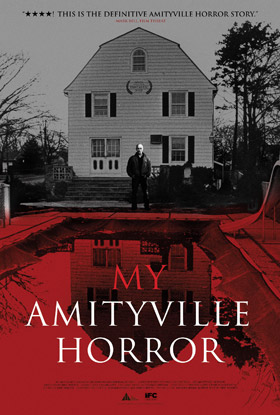
The alleged haunted house at 112 Ocean View Ave. in the Amityville neighborhood on Long Island has remained a pop culture phenomenon for nearly 40 years since the DeFeo murders took place in 1974. The house was purchased by the Lutz family in 1975, and they left after 28 harrowing days of unexplained and relentless paranormal phenomena. That's been the story all these years, through several books and at least ten movies, though the whole thing is largely accepted to be a hoax (none of the five occupants of the house since 1976 have reported any strange happenings). MY AMITYVILLE HORROR is a documentary that focuses on Daniel Lutz, the oldest of the three Lutz children, who was ten years old when they lived in the house. Now in his late 40s, Lutz is still traumatized by his experiences, and he still claims all of the paranormal occurrences really happened. Lutz is an angry man haunted by a painful childhood. He talks at length about his resentment of George marrying his mother Kathy (which he would only do if Kathy allowed him to legally adopt the kids as his own) and severing ties with his biological father. Lutz portrays George as a manipulative, bad-tempered, and often abusive man with an interest in the occult, with books on paranormal phenomena, hypnosis, and various religions. Psychologists and paranormal experts alike question the validity of Lutz's claims, saying that he may be confusing the incidents from the books and the movies and that the negative memories and unaddressed trauma of his childhood have convinced him of things that may not have happened.
Regardless of where one stands on the Amityville story, MY AMITYVILLE HORROR is a film that probably would've worked better as a 20/20 segment. The abrasive Lutz almost seems to be playing "Daniel Lutz" at times, a character that he's seemingly based on Ed Harris from the looks of it. Director and Amityville historian Eric Walter frequently cuts to shots of Lutz jamming and shredding on his guitar, for no apparent reason other than to kill time. Fans of the recent THE CONJURING will be interested to see Lorraine Warren (played by Vera Farmiga in the film) meeting with Lutz. Lorraine and her late husband Ed went through the Amityville house in 1976, during which time an image was allegedly captured of the "demon boy" reputed to be the ghost of the youngest DeFeo child, when it was actually a member of their own investigating team. There's some interesting observations about the power of a manipulative, controlling person on the collective psyche of a family (and it's worth noting that George Lutz died in 2006 and can't defend himself) and how that impacts entire lives (Lutz's two younger siblings declined to take part in this), but MY AMITYVILLE HORROR doesn't really have enough substance to warrant being feature-length. (Unrated, 89 mins)
Some of today's hippest horror scenesters contributed to this found-footage anthology where all of the stories have their moments, but very few, if any, are wholly satisfying. The wraparound story of four small-time criminals hired to break into a house to steal a VHS tape for reasons shrouded in secrecy was handled by A HORRIBLE WAY TO DIE director Adam Wingard. They find a dead body in a recliner that seems to disappear and reappear, and the film consists of some VHS tapes that one guy watches while the others are looking for the specific item in question. The first is from THE SIGNAL co-director David Bruckner, and deals with three hard-partying douchebags who get more than they bargained for when they take a seemingly eager young woman back to their motel room after last call. THE HOUSE OF THE DEVIL's Ti West is next with a married couple on a second honeymoon, unaware that a stranger is filming them while they sleep. I SELL THE DEAD director Glenn McQuaid's segment has four college kids on a camping trip pursued through the woods by a bizarrely technological slasher. Mumblecore filmmaker Joe Swanberg (HANNAH TAKES THE STAIRS), who stars as the husband in Bruckner's story, then presents a haunted apartment tale that plays out as a series of Skype sessions between a troubled young woman and her doctor. The closer is from a four-man collective known as Radio Silence, where four guys go to a Halloween party that gets very serious very quickly.
There's some occasionally effective moments--the first "ghost" appearance in Swanberg's short; the whole "glitch" concept of McQuaid's that doesn't really work but it's an interesting idea; and West, possibly the most overrated figure in modern horror (I love THE HOUSE OF THE DEVIL, but just admit it, people...THE INNKEEPERS is terrible), gets OK results with his patented "slow burn" technique because he's only got 20 minutes to fill instead of 100. Like most anthology horror films, it knows to finish big, and the last segment is probably the best overall, but all of these stories feel like they read better on the page than seen on the screen. Because the film is made up entirely of people filming everything they do, the result is endless YouTube-quality shaky cam visuals that get to be a bit much at nearly two hours, and the almost all of the characters are annoying assholes. And shouldn't the "wraparound" segment of an anthology be...finished? The established set-up with the break-in for the mystery VHS tape is simply abandoned and the film ends with the closing of the last segment. It's called a "wraparound" for a reason. Other than going for some kind of retro hipster cred, the film doesn't really do anything with the VHS format other than give it an excuse for looking crappy. The guys in the wraparound segment could've just as easily been looking for a DVD or a hidden computer file (which also begs the question of why someone possessing enough tech savvy to Skype is saving sessions on a VHS tape). The web site Bloody Disgusting co-produced, which means it and its visitors have likely already declared V/H/S a masterpiece of horror, but there's very little here worth getting excited about. (R, 116 mins)
SILENT NIGHT (US/Canada - 2012)
The controversial 1984 Santa slasher SILENT NIGHT, DEADLY NIGHT was no one's idea of a classic horror film, but even it's better than this miserable and pointlessly vulgar remake. Sure, there's no shortage of splatter with its incredibly gory killings, so if that's all you're after, you won't be disappointed. And fans of the original will find a couple of restaged scenes here (no, they didn't forget the antler impaling), but it's so terribly written, directed, and acted that it's impossible to care. There's no scares, and the many snarky attempts at humor fall flat. Jaime King stars as a small-town Wisconsin deputy sheriff in pursuit of a killer Santa on Christmas Eve, the same night that the town has their annual Santa parade and everyone in town is dressed up like St. Nick. The legendary Malcolm McDowell continues to call the need for his ongoing SAG membership into question as the hard-nosed, British-accented sheriff who gets the film's worst lines. I think most of his dialogue is meant to be funny, like the sheriff is overly gung-ho about finally having a real case, but McDowell is so miscast and out of place that the joke, if indeed that's what it's meant to be, falls flat. It's like the filmmakers are trying to make him some kind of David Caruso/CSI: MIAMI quipster, but maybe that's giving them too much credit. Regarding the on-the-loose serial killer, McDowell growls "He can run...but he can't hide." And later, during the parade, he declares "He's a wolf in sheep's clothing...hiding in plain sight." When told his thoughts on the killer's motives don't make sense, he ominously proclaims "Murder seldom does." All that's missing is this. Everything's calculated well in advance and you know who'll get killed. And when one topless woman runs past a conveniently-positioned wood chipper, is there any doubt she'll soon be sprayed out of it? There's a red herring subplot involving a coke dealer and a porn ring that goes nowhere, and Donal Logue is embarrassingly bad as a cynical Bad Santa type who's the chief suspect. Director Steven C. Miller drenches the climax in garish red and green lighting that gives you an idea of what a Dario Argento Christmas special might look like, but it's far too little, way too late. Under the circumstances, King turns in an acceptable performance that seems to belong in a better movie, but aside from her and the brief Argento shout-out, absolutely nothing works in this holiday fiasco. I realize working actors go where the work is, but after this and SILENT HILL: REVELATION, Malcolm McDowell can't possibly be this desperate for a gig. (R, 94 mins)
RITES OF SPRING (US - 2012)
It's not altogether successful, but there's enough promising ingredients contained within this low-budget Missouri-shot indie fright flick to make debuting writer/director Padraig Reynolds a genre filmmaker to watch. There's a genuine unpredictability to the film and it's interesting to watch it play out and see how the seemingly disparate elements ultimately converge. Sure, there's contrived plot conveniences and a couple of plot holes, and an abrupt ending signifies Reynolds' presumptuous intention of making this a franchise, but taken on its own terms, there's a lot more ingenuity going on here than in most slasher films of this sort. Rachel (Anessa Ramsey) and her friend Alyssa (Hannah Bryan) are abducted outside a small-town bar by a stranger (veteran character actor Marco St. John, a longtime fixture in New Orleans-based films going back to his role as the killer in the 1984 Clint Eastwood film TIGHTROPE) and taken to a farmhouse in the middle of nowhere, where the stranger has newspaper clippings on a wall detailing area disappearances going back 24 years. The stranger ties them up and drains Alyssa's blood, dropping her into a hidden crawlspace under a barn, while babbling something about how "it must be done...it's the rites of Spring." Meanwhile, a quartet of kidnappers led by the violent Paul (Sonny Marinelli) and the hesitant, kindly Ben (AJ Bowen) barge into the home of rich businessman Hayden (James Bartz), taking his daughter (Skyler Page Burke) and her nanny Jessica (Sarah Pachelli) and demanding $2 million in two hours, and Paul kills Mrs. Hayden (Shanna Forrestal) to prove that he's serious. They proceed to hide out at an abandoned school.
Of course, the two plots will eventually come together, but even more intriguing is the way Reynolds establishes connections between the various parties beforehand. And I haven't even mentioned what's in the barn crawlspace: a monstrous, unnamed killer listed in the credits as Worm Face (Amile Wilson and John Evenden share credit), who ceaselessly pursues the tough, resilient Rachel as she flees the farmhouse and makes her way to...you guessed it...the abandoned school where some serious kidnapping shit is going down. What starts as some sort of WICKER MAN-type sacrifice film becomes a kidnapping thriller and eventually a slasher film as Worm Face chases everyone around the darkened corridors of the empty school, offing them one by one. It's a very effective location and Reynolds does a nice job of keeping the audience on its toes and paying attention for its furiously-paced 80-minute run time. Worm Face is a relentless killing machine and unlike a lot of the iconic slashers of the past, he doesn't play games or walk slowly in pursuit. He appears out of nowhere and barrels into a room at full sprint, decapitating and disemboweling people before they even realize what's going on. Anything can happen and anyone can be killed at any moment in RITES OF SPRING. It doesn't totally hang together (these people live in this town and are unaware of 24 years worth of unexplained disappearances?), some of the performances are shaky (Bartz, in particular, is awful), and Reynolds probably should've been more concerned with making a self-contained, stand-alone film rather than going into it as the first in a series (he even deliberately leaves important plot points dangling--a mistake). But there's an inventiveness to this story and an undeniable panache in the way it's told and flaws and all, it's not one to simply dismiss as yet another slasher movie. (Unrated, 80 mins, also streaming on Netflix)
When you subject yourself to enough crappy straight-to-DVD titles (or titles that get released on five screens before being dumped on DVD), it's all made worthwhile when you're rewarded with a genuine overlooked sleeper that manages to sneak in when no one's looking. EXCISION is an audacious and inventive teen horror film that seems destined for a DONNIE DARKO-like cult status. In a bold, uninhibited, and often startling performance, 90210 star Annalynne McCord is 18-year-old Pauline, the kind of gawky, awkward, slouched, pimply, and just plain odd high school outcast who makes Carrie White look like the most popular girl in school. She has vivid sexual fantasies about surgery and mutilation while trying to survive her domineering, religious mother (Traci Lords) and her spineless father (Roger Bart). She does have an almost-normal relationship with her younger sister (Ariel Winter), who's suffering from cystic fibrosis. As her mother tries to make her more "ladylike" by forcing her to go with a bunch of younger girls to a cotillion class, Pauline grows increasingly obsessed with death, disease, self-mutilation, and bodily functions ("I want to lose my virginity while I'm on my period"), while engaging in rebellious acts like guzzling ipecac to vomit on a bitchy classmate and blurting out anything to rile up her uptight mother ("I'm going to marry a black guy!"), until of course, the film takes a dark and horrifying turn.
Written and directed by Richard Bates, Jr., EXCISION is surprisingly ambitious, with some hypnotically beautiful shot compositions, stunning use of color, and some dream sequences that are almost Jodorowsky-esque in their surrealism. The 25-year-old McCord has done a lot of TV work, but I've only seen her in a pair of terrible 50 Cent movies. She turns in a star-making performance here, and even Lords, never mistaken for a good actress, knocks it out of the park. There's a few recognizable faces in some small supporting roles, like Ray Wise as the principal and Marlee Matlin as the cotillion instructor, but if EXCISION has any problems, it's that it's a little distracting and disruptive to the film's mood to see Malcolm McDowell as a high school math teacher and, even more intrusive, John Waters as a minister (though I get his presence here, as a few of the film's more shocking transgressions--one involving a bloody tampon--wouldn't have been out of place in an old-school Waters film, but he still doesn't exactly disappear into a serious role). But overall, EXCISION is dark, disturbing, and frequently uncomfortable and gross, but it's also very funny (Pauline asking the health teacher if you can contract STDs from dead bodies, Matlin signing to an ASL-illiterate Lords that "seeing you and your daughter argue makes me grateful for my hearing loss"), and refreshingly devoid of snarky teen cliches. It's a smart and unique film that sometimes feels like MEAN GIRLS if remade by David Cronenberg, and one of 2012's biggest surprises. Highly recommended, but admittedly not for all tastes. (Unrated, 81 mins)
BRINGING UP BOBBY (US/UK/The Netherlands - 2012)
Milla Jovovich has an engaging screen presence and some legit acting chops, but she hasn't had a lot of luck recently outside of the RESIDENT EVIL franchise. She turned in an Oscar-caliber performance in 2010's barely-released STONE, managing to steal the film from both Robert De Niro and Edward Norton, but nobody saw it or several other disappointing films she's done that got shuffled off to the DVD scrapheap. The appallingly bad BRINGING UP BOBBY is a near-total disaster that marks the writing/directing debut of veteran character actress Famke Janssen. Sure, as far as reliable character actors debuting behind the camera in 2012 go, this isn't nearly as horrid as Vincent D'Onofrio's DON'T GO IN THE WOODS, but there's still nothing to recommend about it. Jovovich is Olive, a Ukrainian con artist in Oklahoma with her 11-year-old son Bobby (Spencer List). Together, the pair steal used cars, shoplift, and try to scam insurance companies. It all catches up to Olive, who gets arrested and loses Bobby to Kent (Bill Pullman) and Mary (Marcia Cross), a rich couple they met after Kent accidentally hit Bobby with his car. Kent and Mary have never recovered from the death of their own son, and grow to genuinely love Bobby and even welcome Olive to be a part of his life after she gets out of jail. But her presence proves disruptive when Bobby starts acting out and Olive faces temptation to restart her old criminal life as numerous heart-tugging montages ensue, set to the likes of Cat Stevens and Jorma Kaukonen.
Everything about BRINGING UP BOBBY comes off as forced and phony, starting with its sitcom-worthy title, the grating performances of Jovovich, List, and Rory Cochrane (incredibly annoying as Olive's not-so-bright partner in crime) and the transparent stabs at precious indie quirk (Olive's retro wardrobe, Bobby's ridiculous habit of wearing two different-colored socks with one pulled all the way up to his knee). The mother's a criminal and the kid is a completely obnoxious, thoroughly unlikable little shit, and Janssen gives us little reason to care about either of them. It starts off like it might be wacky and "fun," but soon turns maudlin and manipulative, and it just doesn't work. The abrupt ending is one of the laziest examples of a quick, convenient wrap-up in recent memory. After "irresponsible mom" roles in two terrible films (this and the equally unseen DIRTY GIRL), it's time for the completely capable Jovovich to start finding better projects to explore her serious side. Janssen based this film on her own childhood experiences as a Dutch immigrant, but I don't see the film having anything at all to do with the immigrant experience other than making Olive from Ukraine and allowing Jovovich to use a hammy accent that's more fitting for Natasha Fatale. Any statement or observation Janssen intended on making got lost somewhere along the way to being a Lifetime movie with intermittent profanity. BRINGING UP BOBBY was shot in 2010 and opened in September 2012 on one screen, ultimately opening wider to...three screens, for a total theatrical take of $4600. (PG-13, 95 mins)