tenebre

tenebre
Showing posts with label Joely Richardson. Show all posts

Friday, February 28, 2020

On Blu-ray/DVD: COLOR OUT OF SPACE (2020), IN FABRIC (2019) and RABID (2019)


COLOR OUT OF SPACE
(Malaysia/US/Portugal - 2020)
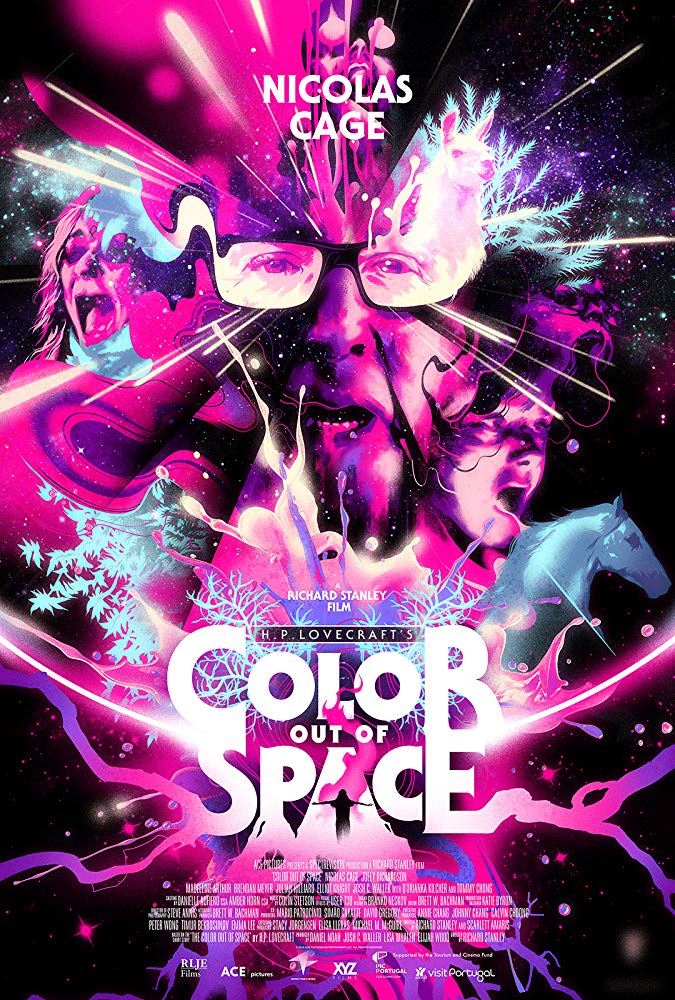

COLOR OUT OF SPACE would've been newsworthy enough on the basis of it being an H.P. Lovecraft adaptation starring Nicolas Cage in MANDY mode, but what really caused some excitement was the long-overdue return of Richard Stanley to narrative features almost 25 years after being fired from THE ISLAND OF DR. MOREAU, effectively ending his Hollywood career. Stanley established some significant cult bona fides with 1990's HARDWARE and 1992's DUST DEVIL, but when he clashed with New Line execs and a particularly dickish Val Kilmer during the first week of shooting on MOREAU, he was shown the door and replaced by John Frankenheimer, the entire clusterfuck of a production covered in the acclaimed 2015 documentary LOST SOUL. Stanley made a few documentaries and short films, got a co-writing credit on Nacho Cerda's 2006 film THE ABANDONED, and helmed a short segment of the 2011 anthology film THE THEATRE BIZARRE, but COLOR OUT OF SPACE is, at long last, his triumphant proper return. Based on Lovecraft's 1927 short story "The Colour Out of Space" and previously filmed in 1965 as DIE, MONSTER, DIE! with Boris Karloff and as the Ovidio G. Assonitis-produced THE CURSE in 1987, COLOR is a frequently surreal bit of phantasmagorical horror that shares some stylistic similarities with MANDY (as well as Cage and some producers, including Elijah Wood), but also seems indebted to the disturbing metamorphosing aspects of ANNIHILATION (not to mention one sequence that's an obvious nod to THE THING) while name-checking various Lovecraft essentials, with several character names and mentions of Arkham and Miskatonic.


When a meteorite crashes on the front lawn of the farmhouse of Massachusetts (but shot in Portugal, of all places) alpaca breeder Nathan Gardner (Cage) and his cancer-stricken wife Theresa (Joely Richardson), strange occurrences become the new normal: the water supply is tainted, their personalities are affected, they blackout as hours pass in an instant, youngest son Jack (Julian Hillard) stands by the well, saying he's "talking to my friends." Nathan suffers from wild mood swings and lashes out at the two older kids, stoner Benny (THE GUEST's Brendan Meyer) and free-spirited Lavinia (Madeleine Arthur). And all the while, inexplicable purple-derived light and color formations manifest themselves and envelop the Gardner property, which grows more isolated from the outside world by the day. There's also hydrologist Ward (Elliot Knight), who's surveying the groundwater at the behest of the do-nothing mayor (THE NEW WORLD's Q'orianka Kilcher), and Ezra (Tommy Chong), an easygoing, harmless squatter living in a shack on the edge of the Gardner property, who records voices of "The people under the floor, man!" that match the creepy garbled gibberish and screams that are heard on the other end of the line ("It's in the static! It's in the moisture!") whenever anyone tries to make a phone call. Stanley establishes an effectively ominous, otherworldly mood amidst the hypnotic, cosmic colorgasms ("It's just a color...but it burns"), and after a too-slow buildup that sometimes overindulges Cage's required-by-law freakouts (resurrecting some of his VAMPIRE'S KISS schtick), COLOR OUT OF SPACE really catches fire in its second half, with some truly unsettling visuals, unexpected emotion, soundtrack appearances by Mayhem and Burzum, and absolutely no mercy in who it's willing to kill off. It also offers some humor, particularly in the way the local media portrays Nathan as a UFO crackpot when they arrive at the farm to cover the meteorite crash. Easily the most noteworthy Lovecraft adaptation since Stuart Gordon's DAGON back in 2001, COLOR OUT OF SPACE is solid horror offering with Cage bringing his A-game in his best film since MANDY, and while it doesn't top the visionary HARDWARE in the Best of Richard Stanley rankings, it sure is great to have him back. (Unrated, 110 mins)


IN FABRIC
(UK - 2019)


IN FABRIC is the latest retro exercise from British filmmaker Peter Strickland, whose obsessively-detailed '70s aesthetic was displayed in the giallo-tinged paranoia thriller BERBERIAN SOUND STUDIO and the BDSM love story THE DUKE OF BURGUNDY. Strickland's films tend to be triumphs of style over substance and to that end, IN FABRIC is no exception, though it did get some buzz in horror circles last fall as "the killer dress movie" when the trailer went online, but A24 opted to keep it confined to arthouses and VOD. After seeing BERBERIAN and DUKE, I've concluded that I like the idea of Strickland's films more than I like the films themselves. Set in the early 1980s, IN FABRIC has some hypnotically stylish visuals and an incredible score by Cavern of Anti-Matter that sounds like it could've come straight from a 1972 fashion giallo with Edwige Fenech and George Hilton. Strickland nails the look and feel, but in terms of story, IN FABRIC is uneven, unfocused, and all over the place. Other than the look and sound, the film's biggest strength is Marianne Jean-Baptiste's performance as Sheila Woodchapel, a lonely bank teller recently left by her husband for a younger woman. She lives with her college-age son Vince (Jaygann Ayeh) and listens to him having sex with his intimidating, older goth model girlfriend Gwen (Gwendoline Christie). She decides to try the personals and treats herself to a new dress prior to her first blind date, purchased during a highly-publicized sale at Dentley & Soper's, a posh department store where she's attended to by eccentric saleswoman Miss Luckmoore (Fatma Mohamed). But after wearing the dress, she develops a rash, the dress destroys her washing machine, and while everyone's asleep, it hovers around the house on its own and even attacks Gwen at one point.


So far, so good, but then Strickland abruptly shifts gears around 70 minutes in, abandoning Jean-Baptiste's character to focus on nerdy washing machine repairman Reg (Leo Bill), who's about to be married to childhood sweetheart Babs (Hayley Squires). Reg's co-workers purchase the same red dress and make him wear it at his bachelor party, and the same strange cycle repeats--rash, wrecked washing machine, dress floating around the house--only with Reg being a little dorky, the second half is played more broadly compared to the ominous and eerie first half. Much of the humor comes from the bureaucratic, OFFICE SPACE-meets-Kafka-style nonsense that both Sheila's and Reg's bosses level at them, with Sheila being reprimanded by supervisors Clive (Steve Oram) and Stash (Julian Barratt of THE MIGHTY BOOSH) over a two-minute bathroom break, her handshakes "not being meaningful enough" and for smiling and waving at the manager's mistress when they bumped into one another on the street. Strickland also includes some scathing, satirical Orwellian jabs at capitalism, retail, and customer service in ways that seem more like he really wanted to make a Terry Gilliam movie but couldn't cut the cord from his Dario Argento/Eurocult/giallo fetishism, and to further muddy the waters, he throws in some HALLOWEEN III-inspired Dentley & Soper's TV spots that lull targeted viewers into a catatonic state. I really wanted to like this, and once again, I love what I see and hear but I'm still left cold by Strickland, who's starting to look like a one-trick pony, but it's admittedly an endlessly watchable trick. He's an extraordinarily gifted stylist, and other than Panos Cosmatos (BEYOND THE BLACK RAINBOW, MANDY) and maybe the team of Helene Cattet & Bruno Forzani (THE STRANGE COLOUR OF YOUR BODY'S TEARS), I can't think of a current filmmaker who's better at taking their influences and using them to craft sequences and set pieces that better convey the dazed sense of half-remembered fragments of a shared dream. Strickland's got that part down, but on a narrative level, IN FABRIC is a complete mess that basically turns into an uninspired BLACK MIRROR episode by the time it's over.  (Unrated, 119 mins)


RABID
(Canada - 2019)


Twin cult horror specialists Jen and Sylvia Soska (collectively billed as "The Soska Sisters") have always cited fellow Canadian David Cronenberg as their major cinematic influence, a sentiment echoed in their breakout body modification cult film AMERICAN MARY. To that end, remaking Cronenberg's 1977 classic RABID probably seemed like a good idea, but RABID '19 is a crushing failure at almost every turn. The central premise--the spread of a new strain of rabies stemming from a woman who's just had experimental surgery following a motorcycle accident--is the same, but none of the other incidental changes do anything to justify the remake's existence. Shy, motorcycle-riding seamstress Rose (Laura Vandervoort) works for pompous and stereotypically flamboyant fashion guru Gunter (McKenzie Gray). She's treated like dirt by his models with the exception of Chelsea (Hanneke Talbot), her childhood foster sister since she was taken in following the death of her parents in a car accident. It's Chelsea who got her the job, and who tries to set her up with Brad (Benjamin Hollingsworth), but when Rose leaves a Gunter event after realizing Brad only asked her out at Chelsea's request and then overhearing two mean girl cokehead models (played by the Soskas) talking shit about her in the ladies room, she leaves the party in a frazzled state and is immediately hit head-on by another car.


Rose wakes up in the ICU after a week (with the attending physician played by Stephen McHattie, probably the first sign that her situation is about to go from bad to worse) to find most of the left side of her face has been ripped off in the accident, with her jaw needing to be sewn back on. She's recommended for treatment at the Burroughs Clinic, an exclusive facility that deals in regenerative medicine and "Transhumanism." Rose is the subject of an experimental stem cell skin graft procedure pioneered by (deep sigh) Dr. William Burroughs (Ted Atherton). She's initially apprehensive, but it proves to be a complete success. She's more beautiful than ever, she gets her job back, is creatively inspired, and Brad seems legitimately interested in her, but...she's a devout vegetarian and suddenly develops a strange craving for raw meat. She wakes up with faint memories of violent dreams where she's attacking men in a flesh-eating fury. Soon, the people with whom she comes into contact (including UFC star CM Punk, cast radically against type as a meat-headed asshole) begin exhibiting even more advanced symptoms of a virulent new form of rabies that becomes a citywide epidemic. RABID '19 devotes a lot of time to lampooning the vapidity of the fashion industry in trite fashion, but at the same time dutifully hitting all of the old-school Cronenberg bullet points of body horror and disease. It also offers shout-outs to a bunch of his other films as well, like NAKED LUNCH with the name-dropping of Burroughs, the clinical surgical horrors of DEAD RINGERS (including the brief presence of Heidi Von Palleske as a member of the Burroughs surgical team), and the shady experimental treatment facility of THE BROOD. The protruding armpit phallus from the original RABID (also notable in its day as the first mainstream crossover attempt of porn star Marilyn Chambers) finally appears in the off-the-rails third act, where RABID '19 completely falls apart, abandoning the Cronenberg worship and turning into a dumb tribute to the late '80s work of Brian Yuzna and Screaming Mad George. The pointless RABID '19 really overstays its welcome at 108 minutes and can't even get the little things right--wouldn't McHattie (PONTYPOOL) have made a more interesting Dr. Burroughs than the bland Atherton? The first line of dialogue heard here is a ranting Gunter asking "Why do we keep remaking old trends?" A valid question, and one asked with little sense of self-awareness by the Soskas, since RABID '19 certainly qualifies as part of the problem. (Unrated, 108 mins)

Monday, January 27, 2020

In Theaters: THE TURNING (2020)


THE TURNING
(US - 2020)

Directed by Floria Sigismondi. Written by Chad Hayes and Carey W. Hayes. Cast: Mackenzie Davis, Finn Wolfhard, Brooklynn Prince, Joely Richardson, Barbara Marten, Niall Gregg Fulton, Denna Thomsen, Kim Adis. (PG-13, 95 mins)

Many of pop culture's most effective and familiar ghost story tropes can be traced back to Henry James' 1898 novella The Turn of the Screw, the chilling tale of a prim, proper, and--through as much suggestion as standards of the period would allow--sexually-repressed governess put in charge of two orphaned children in a gothic mansion which may or may not be haunted by the ghosts of the previous governess and the sinister groundskeeper. The story has inspired an untold number of horror novelists and short story writers and has been been adapted for stage, screen, and television dozens of times. The most famous, of course, is Jack Clayton's 1961 classic THE INNOCENTS, with Deborah Kerr as the governess. That was followed by a 1974 TV-movie from DARK SHADOWS creator Dan Curtis and starring Lynn Redgrave; a 1992 version with Patsy Kensit; 1999's Spanish-made PRESENCE OF MIND with Sadie Frost; as a 2000 PBS production with Jodhi May; 2006's IN A DARK PLACE with Leelee Sobieski; and as a 2009 BBC production with a pre-DOWNTON ABBEY Michelle Dockery (and while not a direct adaptation, Alejandro Amenabar's 2001 film THE OTHERS, with Nicole Kidman, owes a tremendous debt to The Turn of the Screw). Not only is James' story always the source of serious chills down the spine, but the governess role is a strong, complex, and multi-layered one for any actress to tackle, so much so that screen legend Kerr often cited her work in THE INNOCENTS as her best performance, and it wasn't even one of six for which she was Oscar-nominated.


The latest film to tackle James' renowned novella is the misbegotten THE TURNING, which moves the story to 1994--with an early shot of a TV showing breaking news of Kurt Cobain's suicide--apparently for no reasons other than fetishized nostalgia and the idea that even The Turn of the Screw needed to be revamped in order to pander to the AMERICAN HORROR STORY/STRANGER THINGSification of today's horror, right down to the presence of IT and STRANGER THINGS co-star Finn Wolfhard as one of the orphaned children. The 1994 setting probably seemed like a wink-and-a-nudge from director Floria Sigismondi, directing her first feature film since 2010's THE RUNAWAYS and who's best known for her music videos for David Bowie, Marilyn Manson (she directed the video for "The Beautiful People"), Tricky, Bjork, Fiona Apple, and The White Stripes, and in more recent years, Pink, Katy Perry, Justin Timberlake, Rihanna, and Dua Lipa. Sigismondi clearly has stylistic chops and a good reputation in her field in order to land so many high-profile gigs in the music industry, but THE TURNING just doesn't work. The script by twin horror scribes Chad and Carey W. Hayes (still dining out on the two CONJURINGs, while hoping we forgot they penned $3 Big Lots DVD rack fixtures like the Paris Hilton HOUSE OF WAX, THE REAPING, and WHITEOUT) is content to recycle every hoary horror cliche of the modern era, while attempting to give some contemporary subtext that it introduces in a half-assed fashion and almost instantly abandons. There's enough sexual overtones to James' story that a modern update (or modern-ish, if we consider the grunge-era setting, with songs not from that era but rather, current alt-rock throwbacks like Warpaint, The Kills' Alison Mosshart, and Soccer Mommy) could've been an insightful commentary on #MeToo and #TimesUp, but after laying the groundwork for such a topic, the filmmakers don't do anything with it and instead opt to move on to the next tired jump scare, as if Sigismondi suddenly remembers (or was reminded) that she's contractually obligated to deliver a PG-13 film.


Set for release in February 2019 and shelved for nearly a year until a weekend could be found for a slightly more appropriate January dumping, THE TURNING uses enough of James' source work but also tries to split the difference with the little-remembered 1972 film THE NIGHTCOMERS, a prequel to THE INNOCENTS before the term "prequel" entered the moviegoing lexicon. Freed from the cinematic restraints of just a decade earlier, THE NIGHTCOMERS enjoyed the relatively new freedom of the R rating in its INNOCENTS origin story about the previous governess Miss Jessel (Stephanie Beacham) and her sweaty, sadomasochistic sexcapades with groundskeeper Quint, played by Marlon Brando just before his triumphant GODFATHER comeback. THE NIGHTCOMERS is essentially INNOCENTS fan fiction that erases the mystery and ambiguity of the older film's much-debated ending and again, subtly incorporating those sexual aspects could've taken THE TURNING to some intriguing places. In the governess role, Mackenzie Davis is Kate, a college student who takes a job as a live-in teacher for seven-year-old orphan Flora (THE FLORIDA PROJECT's Brooklynn Prince) at a massive gothic estate in an isolated region of the Pacific Northwest. Devoted and judgmental housekeeper Mrs. Grose (Barbara Marten) is an obvious keeper of dark secrets who insists Flora never leave the grounds, and claims to not know what happened with previous teacher Miss Jessel (Denna Thomsen), or how her mysterious "disappearance" relates to the accidental death of Quint (Niall Greig Fulton). It isn't long before Kate starts hearing strange voices, creaks, and moans in the middle of the night and catches glimpses of faces that look like they might be Miss Jessel and Quint. But instead of leaving, she sticks around. She feels a duty to help young Flora, and while she didn't lose her parents in a tragic car accident like the little girl did, she understands the notion of a rough childhood after her father walked out on her and her psychologically-disturbed mother, who's now in a mental institution. In what's really THE TURNING's sole inspired decision, Kate's mother is played in two brief scenes by Joely Richardson, making her yet another member of the Redgrave acting dynasty to appear in an adaptation of the story: her aunt Lynn Redgrave starred in the aforementioned 1974 TV-movie, her uncle Corin Redgrave appeared in the 2009 BBC version, and her grandfather Michael Redgrave played the cold-hearted uncle who hired Kerr's governess to care for his niece and nephew in THE INNOCENTS.


Complicating matters is the unexpected arrival of Flora's older, teenage brother Miles (Wolfhard), who's been expelled from boarding school after violently attacking a classmate (of course, Mrs. Grose refuses to believe it, since both children are "thoroughbreds"). Miles immediately antagonizes Kate and undermines the bond she's formed with Flora, and she even wakes in the middle of the night to find him standing over her and caressing her. One of the main ideas of James' novella and THE INNOCENTS was the governess' belief that the spirits of Miss Jessel and Quint were attempting to possess the children in order to continue their secret relationship. But it's never really a certainty that these ghosts exist and there's significant evidence that the governess is projecting her own neuroses and psychosexual hang-ups on to the children. Having a teenage, hormonal Miles demonstrate some leering designs on Kate--if indeed he's possessed by Quint--is an example of THE TURNING potentially updating James with contemporary relevance. But every time it even flirts with any story element of that sort, it backs off and takes the safe route, with more rote jump scares, extended dream sequence fake-outs that only seem to be there to pad the run time, a brief sojourn into AMITYVILLE HORROR/ "we need to get out of this house!" territory with the enraged ghost of Quint going on an estate-wide rampage, and finally, the lamest non-ending to a horror movie since THE DEVIL INSIDE sent the audience to a web site to see how things panned out. Attempts at ambiguity can't work when there's no subtlety to the story and no underlying themes on which to build it. THE INNOCENTS remains one of the most terrifying of horror films, and those shots of the ghostly Miss Jessel standing on the lake in the distance are still the stuff of nightmares. By contrast, THE TURNING is a film that can't even be bothered to come up with a cliched twist ending and instead just abruptly peaces out, dumbing down THE INNOCENTS and Henry James into a pointless post-Blumhouse jump-scare machine with a fundamental misunderstanding of the source material. Davis essays her role with convincing anguish and emerges unscathed, as does the very promising Prince, one of the most natural and unaffected child actors in recent years, and who was so memorable as Moonee in THE FLORIDA PROJECT. They--and everyone else--deserve better than THE TURNING.


Thursday, June 21, 2018

On Blu-ray/DVD: IN DARKNESS (2018) and FLOWER (2018)


IN DARKNESS
(US/UK - 2018)


IN DARKNESS might be of interest to GAME OF THRONES superfans, as it stars three series alumni--Natalie Dormer, Ed Skrein, and James Cosmo--and is co-written by Dormer with her fiance, veteran British TV director Anthony Byrne (RIPPER STREET, PEAKY BLINDERS). It begins as an intriguing throwback to "blind woman in peril" standard-bearer WAIT UNTIL DARK, but Dormer and Byrne's script starts trying too hard by throwing everything at the wall to see what sticks. Dormer is Sofia McKendrick, a London-based pianist who's been blind since she was five. Self-reliant and a bit of a quiet loner, Sofia's world is turned upside down when she hears some loud thuds above, followed by upstairs neighbor Veronique (Emily Ratajkowski) taking a dive out of her window to her death. Only with the resulting media attention does Sofia learn that Veronique is the estranged daughter of Zoran Radic (Jan Bijvoet as Rade Serbedzija), a powerful Serbian businessman and reputed Bosnian War criminal with a shady charity foundation and ties to (of course) the Russian mob. Radic has a sibling henchmen duo--Marc (Skrein) and Alex (Joely Richardson)--tasked not only with killing Veronique but also with getting an incriminating USB stick out of her apartment. The cops rule Veronique's death a suicide, but Marc was in the building and in her apartment with her and came face to face with Sofia while she was getting on an elevator. Believing Sofia to be a witness, he attempts to befriend her with the intent of killing her, but backs off when he realizes she's blind and couldn't have seen him. That's not good enough for Alex or for Radic, who wants all loose ends tied up and needs whatever vital info is on the USB, with all parties are unaware that Veronique secretly stashed it with Sofia before her death.


The basic set-up of IN DARKNESS might've made for an old-fashioned nailbiter, but then it decides to get "tricky." It's fairly early in the film when it's revealed that Sofia is the only survivor of a Bosnian family brutally slaughtered by Radic 25 years earlier. We also learn that she's spent her entire life plotting to kill Radic and she intentionally sought out Veronique and got an apartment in the same building in the hopes that it would get her closer to her target, all under the watchful eye of caring and now-terminally ill adoptive father figure Niall (Cosmo). But that's just the beginning of IN DARKNESS' wildly improbable twists and turns. It gets more contrived with each passing scene, with some details left frustratingly vague--the film never does establish exactly what Marc and Alex do for Radic, nor does it adequately explore their strange relationship, where it's at least hinted that Alex is jealous when she finds out her brother has slept with Veronique. That's a shame because, while Skrein is bland and forgettable, an invested Richardson seems game for some perverse weirdness that never comes to fruition. Neil Maskell does an alright job as the rumpled, perpetually stubbled detective investigating Veronique's death, getting his inevitable wide-eyed Chazz Palminteri-in-THE USUAL SUSPECTS moment of realization when he finally pieces everything together. And it's a lot to piece together, as Dormer and Byrne can't stop piling up the surprise reveals with reckless abandon in the third act. One is so thuddingly obvious that you'll call it long before Sofia figures it out, and other is one of those that pretty much negates the entire movie and convincingly makes its case for the dumbest twist ending of 2018. (Unrated, 101 mins)


FLOWER
(US - 2018)


You know a movie's trying way too hard to be edgy when it opens with its 17-year-old heroine blowing the local sheriff, who asks "Where'd you learn to give a hummer like that?" and her reply is "Middle school." FIGHT CLUB already did a similarly tacky joke exponentially better (Helena Bonham Carter's immortal "I haven't been fucked like that since grade school"), but everything about FLOWER feels like you've seen and heard it years ago. If you can imagine Gregg Araki making a belated JUNO knockoff, then you'll have an idea what this has to offer. Directed and co-written by Max Winkler (Henry's son) and produced by the EASTBOUND AND DOWN and OBSERVE AND REPORT team of David Gordon Green, Danny McBride, and Jody Hill, FLOWER stars 23-year-old Zoey Deutch (Lea Thompson's lookalike daughter) as Erica Vandross, a teenage sociopath in a small California suburb who has a lucrative secret gig blackmailing local guys by giving them blowjobs in parked cars while her best friends Kayla (Dylan Gelula) and Claudine (Maya Eshet) sneak up and record her finishing them off. Kayla and Claudine spend their cut of the take on clothes, but Erica is stashing hers away to bail her father out of jail, where he's been sitting awaiting trial after trying to rob a casino. Erica's mother Laurie (Kathryn Hahn) has moved on and is dating doofus nice guy Bob, aka "The Sherm" (Tim Heidecker), who's about to move in, much to Erica's disapproval. Coming along as part of the "Sherm" package is his troubled son Luke (Joey Morgan), a withdrawn, overweight outcast who's been in rehab for a year trying to kick an oxy addiction. He has a panic attack his first night out of the facility but rejects Erica's offer for a blowjob to help calm him down. The two later grab a burger at the bowling alley, where Luke has another anxiety attack after spotting Will (Adam Scott), a regular at the lanes who's dubbed "Hot Old Guy" by chronic daddy issues case Erica. It turns out that Will used to be a high school teacher who lost his job three years earlier after allegations that he fondled a 15-year-old boy. The accuser? Luke.


This sets in motion a half-assed scheme to blackmail Will but Erica finds herself falling for him. Unforeseen problems ensue in ways that recall both HARD CANDY and the forgotten PRETTY PERSUASION, and those comparisons, combined with the obvious JUNO influence, end up making FLOWER feel like a 15-year-old Sundance offering that was found frozen in the mountains surrounding Park City and just now thawed. From the various transgressions and would-be shock tactics that fall flat ("If we don't act now, then other little kids might get butt-raped!" Erica says when everyone else wants to back out of their plan to extort Will) to the casting of the appealing Deutch, everything about FLOWER feels forced and affected, and by the time things pan out in a predictably tragic way that culminates in Erica and Luke donning cheap wigs and fleeing to the Mexican border, it's clear that FLOWER doesn't have much to say. Deutch is a tremendously appealing actress, but Winkler tries to make Erica similarly appealing when she's really not, and a film that really wanted to explore the kind of darkness inherent in the story would recognize that turning her into the white trash version of a Manic Pixie Dream Girl (© Nathan Rabin) is the wrong approach. As a result, nothing feels real or believable for a second, not even when Laurie--who's historically been more interested in being Erica's buddy than her mother--finally melts down and tears into Erica for chasing away all of her potential boyfriends and calling her a "selfish twat." There is one legitimately funny line when Erica is asked what she plans to do with her life and boasts "I'm goin' to DeVry, bitch! 98% acceptance rate!" but no film that imagines itself to be an edgy and shocking dark comedy would actually have Erica look at Luke with tears in her eyes and say "I don't wanna run...I don't wanna spend the rest of our lives looking over our shoulders." (R, 94 mins)


Wednesday, March 7, 2018

In Theaters: RED SPARROW (2018)


RED SPARROW
(US - 2018)

Directed by Francis Lawrence. Written by Justin Haythe. Cast: Jennifer Lawrence, Joel Edgerton, Matthias Schoenaerts, Jeremy Irons, Charlotte Rampling, Mary-Louise Parker, Ciarin Hinds, Joely Richardson, Bill Camp, Thekla Reuten, Douglas Hodge, Sakina Jaffrey, Hugh Quarshie, Sebastian Hulk, Sergei Polunin, Kristof Konrad, Sasha Frolova. (R, 140 mins)

To get a feel of what RED SPARROW is like, imagine ATOMIC BLONDE if written by John Le Carre with an uncredited script polish by Joe Eszterhas and directed by 1990s Paul Verhoeven. It's probably not gonna fly with those constantly looking for something to be offended by, but it's nice to see a major-studio movie with A-list star diving unabashedly into hard-R territory with no reservations whatsoever. Sexually frank and often brutally, sickeningly violent, RED SPARROW is based on the 2013 novel by Jason Matthews, the first in a trilogy centered on Dominika Egorova, played here by Jennifer Lawrence, reunited with Francis Lawrence, the director of the last three HUNGER GAMES installments. As RED SPARROW begins in Moscow, Dominika is a rising star in the Bolshoi Ballet, but her career comes to an abrupt end when her dance partner lands on her left leg and shatters it in the middle of a performance. Left with a limp, depressed, and concerned about caring for her terminally ill mother Nina (Joely Richardson), Dominika is approached by her uncle Vanya (Matthias Schoenaerts), a high ranking deputy in Russian intelligence, who requests a favor that can maybe financially help with her mother's care expenses. Having caught the eye of shady businessman Dmitri Ustinov (Kristof Konrad), Dominika is to be the bait to lure him to a hotel room, where she's to switch his phone with another implanted with a tracking device. Vanya assures her there's no danger, but of course, Ustinov gets rapey and assassin Matorin (Sebastian Hulk) is forced to intervene and kill him, whisking Dominika away immediately after.


Vanya's bosses--including intelligence director Zakharov (Ciarin Hinds) and General Korchnoi (Jeremy Irons)--need Dominika to keep quiet by any means necessary. In order to spare her life and to provide care for Nina, Vanya sends Dominika to a "state school" (termed "whore school" by Dominika) where attractive male and female "sparrows" are trained in the ways of seduction, psychological manipulation, and espionage by the ominously-named Matron (Charlotte Rampling). Sparrows are taught to use their bodies to gain advantage, they're put through endless psychological and physical rigors, forced to submit to sexual demands and use their sexuality to gain power over an adversary. Dominika, renamed "Katya," butts heads with Matron, especially after she violently attacks a male sparrow during an attempted rape and then sexually humiliates him in front of the entire class when she intimidates him so much that he can't get it up. Dominika has already established that she has a capacity for extreme violence and uncontrolled rage--she finds out that the ballet accident was intentional and done so in order allow her partner's girlfriend to assume her spot in the ballet, and she promptly beats the shit out of both of them--and despite her strong-willed refusal to bend to Matron's will, Vanya pulls her out to give her a mission: get close to Nate Nash (Joel Edgerton), a CIA agent on thin ice after a botched intel exchange in Gorky Park with a Russian mole who's been feeding info to the Americans. Nash goes off the radar but resurfaces in Budapest, where Dominika is sent to use her skills in order to find the identity of the mole.


The story takes many twists and turns with the obligatory shifting alliances, double-crosses, and people not being who they're thought to be, and while RED SPARROW doesn't really break any new ground as far as spy thrillers go, it's consistently intriguing, very well-acted, and filled with enough gasp-inducing shocks to keep your eyes glued to the screen, or wincing and looking away if Matorin is skinning someone. Sporting a quite convincing Russian accent, a stone-cold Lawrence is excellent and gets solid support from numerous standouts in the supporting cast, including Schoenaerts as the duplicitous Vanya who can barely hide his sexual desire for his late brother's daughter (can't wait to see him as Vladimir Putin in the inevitable Trump miniseries), Mary-Louise Parker as a US senator's corrupt chief of staff who's got plenty of blackmail baggage and is selling secrets to the Russians, and especially Rampling, who almost steals the film in her limited screen time as the stern, brittle Matron, a woman who's dead inside after giving everything she is to Russia and perhaps sees her younger self in the willful, stubborn Dominika (the sexual power games among the Sparrows-in-training also brings to mind the veteran actress' role in 1974's THE NIGHT PORTER). Though there are several uncomfortable scenes throughout, the knee-jerk response of the perpetually outraged seems to miss the point: Dominika is a strong heroine who proves to be several steps ahead of everyone, refusing to allow herself to be a victim and forcing anyone who wrongs her to pay dearly. Maybe it's because we're in an era where teenagers are the target audience and people have forgotten that movies for adults can still be a thing, but RED SPARROW is pretty strong stuff, with levels of sex, nudity, and violence that you really don't often see in mainstream, multiplex entertainment these days. While this is much more commercially accessible at its core, between RED SPARROW and last fall's MOTHER!, a post-Katniss Everdeen Lawrence (like the career choices made by TWILIGHT vets Kristen Stewart and Robert Pattinson and HARRY POTTER's Daniel Radcliffe) continues to demonstrate that she isn't complacent and isn't afraid to challenge herself and take some risks.

Wednesday, September 21, 2016

In Theaters: SNOWDEN (2016)


SNOWDEN
(US/France/Germany - 2016)

Directed by Oliver Stone. Written by Kieran Fitzgerald and Oliver Stone. Cast: Joseph Gordon-Levitt, Shailene Woodley, Melissa Leo, Zachary Quinto, Tom Wilkinson, Nicolas Cage, Rhys Ifans, Scott Eastwood, Logan Marshall-Green, Timothy Olyphant, Ben Schnetzer, Lakeith Lee Stanfield, Joely Richardson, Ben Chaplin, Nicholas Rowe, Basker Patel, Edward Snowden. (R, 134 mins)

It would be nice if Oscar-winning filmmaker and tinfoil-hat fashionista Oliver Stone was back in provocateur mode with SNOWDEN, but the message is lost in the auteur's didactic execution. Told with myopic tunnelvision and with nothing but gushing admiration for its subject, SNOWDEN lumbers along with little in the way of nuance or subtlety, and nothing in the way of questioning the ex-CIA/NSA whistleblower. It's canonizing hagiography of the most one-sided order, with Edward Snowden the sole voice of morality in a world of evil big government surveillance that exists only to piss on the freedoms of Americans and can't possibly have any positive purpose whatsoever. This should be a nailbiting thriller but Stone is so distracted by his Snowden man-crush that it never has a chance to reach the heights of his in-his-prime conspiracy/paranoia triumphs like JFK or NIXON. It's more in line with the hokey, neutered simplicity of something like WORLD TRADE CENTER. Snowden is a complex, complicated figure, but you wouldn't know it by watching SNOWDEN. Stone isn't interesting in getting in Snowden's head, so you're better off checking out Laura Poitras' Oscar-winning 2014 Snowden documentary CITIZENFOUR instead.


That said, Joseph Gordon-Levitt does a terrific job of capturing Snowden's voice and mannerisms with uncanny accuracy. The film opens in 2013 as an on-the-run Snowden is holed up in a Hong Kong hotel preparing to leak secret CIA and NSA files to documentary filmmaker Poitras (Melissa Leo) and Guardian journalists Glenn Greenwald (Zachary Quinto) and Ewen MacAskill (Tom Wilkinson). Jumping back and forth from 2004 to 2013, we follow Snowden through a short stint in the Army, where his goal of joining the Special Forces is stalled by brittle bones and a pair of fragile legs that get him a discharge. Told by his doctor that there's other ways to serve his country, the conservative, Ayn Rand-admiring Snowden is admitted into The Hill, the CIA training facility in Virginia where he becomes the top prospect of (fictional) instructor Corbin O'Brian (a vampiric Rhys Ifans). He also falls in love with liberal Lindsay Mills (Shailene Woodley), who joins him when his new CIA job takes him to places like Switzerland and Japan, where his focus is cybersecurity and designing programs that are ostensibly used to monitor post-9/11 terrorist activities. He leaves the CIA but works for them on a contractual basis later on, and is disturbed to find that much of the US government's surveillance focus is spying on its own citizens and that one of his programs is used for drone strikes in the Middle East. Growing increasingly concerned about the nature of his work and how far the surveillance goes (he's informed at one point that his suspicions about Lindsay having an affair are unfounded, proof that the omnipresent They are watching her and monitoring her computer and phone activity), he decides to blow the whistle, stealing thousands of secret files and fleeing the country before reaching out to activist filmmaker Poitras.


How heavy-handed is SNOWDEN? The surveillance program is called "Prism," and when invoking it, Stone feels the need to frame shots with a prism effect that's also used when epileptic Snowden has seizures. It actually caused snickering in the audience about the 10th or 12th time it's used. How unsubtle is SNOWDEN? Ifans has been directed to play O'Brian in the most ominously sinister fashion possible, making it difficult to tell if he's a top CIA official or the Antichrist. Watch when he's shown speaking with Snowden in a conference room, Snowden physically there, but O'Brian on a giant, theater-sized screen as Ifans' looming, side-eyed visage takes up the entire display, just in case the whole "Big Brother is watching" concept wasn't already clear. The performances are generally solid, though Nicolas Cage is squandered in an intriguing but tiny role as a benched analyst curating antiquated espionage equipment, his sole purpose being to unknowingly supply the Rubik's Cube that Snowden will use years later to stash the SD card with all the files. But it's Ifans' bizarre portrayal that really sticks out, bringing to mind what might happen if PHANTASM's The Tall Man worked for the CIA. There's a nerve-shredding, Alan J. Pakula-type paranoia thriller to made about Snowden's exploits, and less preachy filmmakers could've done wonders with the subject. Remember that incredible Donald Sutherland exposition drop in JFK? That Oliver Stone could've done something with SNOWDEN. So could Michael Mann in INSIDER mode or David Fincher channeling ZODIAC. There's also a nice Mann vibe in some of Anthony Dod Mantle's digital cinematography in locations all over the world that recalls last year's criminally underrated hacker thriller BLACKHAT. Unfortunately, Stone the filmmaker defers to Dr. Stone the lecturing activist with an agenda. The film completely flies off the rails in a catastrophic climax that recalls Professor Steven Seagal's speech at the end of ON DEADLY GROUND, as Gordon-Levitt actually exits the film and Snowden takes over, playing himself being interviewed via internet from Russia, basking in the standing ovation he gets at a TEDTalk event. This drawn-out finale--more like a tacked-on Snowden infomercial--concludes with an inspirational, manipulative score crescendoing as a pensive Snowden finishes the interview, closes his laptop and turns away, in profile, triumphantly staring out the window of his Russian apartment and smiling, looking like he's waiting for Stone to cue up Foo Fighters' "My Hero" for the closing credits.

Friday, May 8, 2015

In Theaters/On VOD: MAGGIE (2015)


MAGGIE
(US/Switzerland - 2015)

Directed by Henry Hobson. Written by John Scott 3. Cast: Arnold Schwarzenegger, Abigail Breslin, Joely Richardson, J.D. Evermore, Douglas M. Griffin, Jodie Moore, Bryce Romero, Raeden Greer. (PG-13, 95 mins)

Once upon a time, the idea of Arnold Schwarzenegger starring in a zombie movie would mean plenty of action, horror, and the expected shouting of "Aim fah da head!" In his bumpy transition back to full-time acting since a decade in politics, Schwarzenegger hasn't enjoyed the box office blockbusters he had in his heyday, with only THE EXPENDABLES 2 and THE EXPENDABLES 3 being big moneymakers, though ESCAPE PLAN was a modest hit, but those were group efforts done with Sylvester Stallone and others. Elsewhere, the enjoyable THE LAST STAND and the dismal SABOTAGE were met with utter disinterest and absolutely tanked, and served as further proof that the geriatric action guys don't do well solo anymore (witness Stallone's fun BULLET TO THE HEAD bombing as well). Perhaps that's why Schwarzenegger chose now, at the age of 67, to take on the most unusual role of his career in MAGGIE, a moving, character-driven drama that happens to take place during a zombie apocalypse.


Shot in Louisiana two years ago, from a script by first-time screenwriter John Scott 3 that's been bouncing around Hollywood for several years, the low-budget MAGGIE opens in the midst of a viral outbreak that's rendered the major cities deserted wastelands. The government has turned the inner cities into quarantine zones for the infected, who have an average of eight weeks from the point of infection before they fully "turn" into flesh-eating zombies. Maggie Vogel (Abigail Breslin) left her home for the city after becoming infected from a bite on the arm, but as the film opens, her father Wade (Schwarzenegger) has spent two weeks trying to find her before locating her in a barely-staffed hospital. Wade's intent is to take her home but the doctor advises him to return her to the quarantine zone when she enters the final stages before her turn. A proud, self-reliant farmer and Christian family man, Wade will not hear of letting Maggie die alone, surrounded by strangers and other infected, instead insisting on having her live out her final weeks at home with him and her stepmother Caroline (Joely Richardson), who sends the couple's two younger children off to stay with her sister while Maggie undergoes her turning.


The grieving process already underway, Maggie is relatively normal for the first few weeks, but as her body slowly decomposes and rots, and her increased sense of smell draws her to human and animal flesh, she has moments where she can still be a normal teenager. She laughs and reminisces with her dad, usually about her late mother. She hangs out with friends, some of whom are infected and in the early stages of turning. Through it all, Wade does his best to keep a stiff upper lip and be the rock that he's always been for his little girl, but it often proves too much to bear. He's already lost his wife (her death predates the outbreak, so while it's never specified and doesn't need to be, she likely died of cancer) and since he refuses to turn Maggie over to the medical teams in quarantine--which gets him into hot water with the local sheriff--he's burdened with the task of killing what was once his daughter when her transformation is complete.


MAGGIE is an extremely dour, downbeat film, shot in dark, muted tones with a grim, funereal mood throughout. The "turning" is a powerful metaphor that will resonate with anyone who's seen a family member or friend face the last stages of a terminal illness. They'll recognize the overwhelming helplessness felt by Wade, who's always been there to protect his family but seems lost facing the realization that there is absolutely nothing he can do to make Maggie better. With his craggy face and his shoulders slumped with age (which didn't work to his advantage in SABOTAGE), the stunt casting of Schwarzenegger is inspired and spot-on. We've always taken leaps and allowed a generous amount of wiggle room when it comes to his acting. Even when he's playing US military guys or Texas sheriffs, his appeal and his screen presence have helped audiences overlook the often cumbersome Austrian accent and his occasionally awkward line deliveries that fans often endearingly quote (think "Get to da choppah!" or "It's not a too-mah!"). Schwarzenegger delivers a low-key performance that's unlike anything he's done before, and the fact that he's playing an Austrian-accented rural farmer never once becomes a distraction. His scenes with an excellent Breslin are often very touching, especially when he tells her how much of her mother's spirit she has in her, or when, on the ride back after an unpleasant checkup with the doctor midway through her turning, he makes her smile by playing a tape of Oscar Brown, Jr's "Maggie," and the shared look between the two conveys the kind of warmth and fond memories that words don't need to express.


Scott 3 and debuting director Henry Hobson (who designed the opening credits for THE WALKING DEAD) never let things get maudlin or sappy. Maggie's decline is treated matter-of-factly and comes as no surprise to anyone, as the outbreak's been ongoing and they've seen it all before (recognizing Wade's staunch refusal to quarantine Maggie, her doctor's last bit of advice to him is "Make it quick"). We see a couple of shambling zombies but the apocalypse has already taken place, with big city highways deserted and fields in the outlying areas seemingly constantly ablaze. MAGGIE turns the focus on an element of zombie lore that's been largely unexplored outside of the slow turning of Scott H. Reiniger's hot-dogging Roger in George Romero's DAWN OF THE DEAD (1979): the time between infection and transformation. But even then, Roger didn't have time to get sentimental ("You got a hell of a lot more to do before you can afford to lose me") and despite the same certain inevitability that Maggie faces, promised "I'm gonna try not to come back." Wade and Maggie face her fate with bravery and her final act demonstrates a level of compassion not usually found in the genre, proof that no matter how sick you become and how much your body degrades and turns against itself before it finally dies, you're still you and that sense of who you are can never be completely taken away. MAGGIE isn't a typical summer horror movie, and it's surprising that everyone involved on the business end didn't force Hobson to turn it into one (Schwarzenegger was one of 21 credited producers, so he obviously believed in the project). It's a small film that Lionsgate recognized wouldn't be a commercial hit, which is likely why they relegated it to their arthouse Roadside Attractions division and released it on VOD. And that's fine, because a thoughtful, offbeat film like MAGGIE will cultivate an audience over time and remain relevant and effective much longer than a by-the-numbers zombie shoot 'em up with a quipping Ah-nuld and shitty Bulgarian CGI ever would.

Wednesday, May 6, 2015

On DVD/Blu-ray: THE COBBLER (2015) and THE DEVIL'S VIOLINIST (2015)


THE COBBLER
(US - 2015)


The 2014 Toronto Film Festival didn't go very well for Adam Sandler. Seemingly in response to criticism about his juvenile and increasingly lazy star vehicles that just give him an excuse to hang out with his buddies, Sandler tried to get serious with two smaller films, both of which were unveiled at Toronto: JUNO director Jason Reitman's dysfunction drama MEN, WOMEN & CHILDREN and Tom McCarthy's THE COBBLER. McCarthy's made some respected and acclaimed indie films, such as THE STATION AGENT (2003), THE VISITOR (2008), and WIN WIN (2011), and Sandler would seem to be in good hands with either director if he was seeking an indie-cred reinvention. But whatever mojo Reitman had circa UP IN THE AIR is gone, as MEN, WOMEN & CHILDREN was a ridiculous CRASH knockoff that got laughed off the screen with its "Old Man Yells at Cloud" attitude about social media and modern technology and eventually opened in theaters to the tune of a $700,000 total gross while asking the tough questions like "What's with all the selfies and the texting and the porn and the jerking off?" THE COBBLER got an even more toxic response. Earnest and schmaltzy to a fault, it plays like an excessively sappy take on the kind of middling, klezmer-scored, high-concept trifle that Woody Allen might churn out to lighten the mood between dramas. Acquired by Image Entertainment and relegated to a few theaters and VOD, THE COBBLER grossed just $24,000 and is somehow worse than any of Sandler's phoned-in Happy Madison joints.


The dumb concept might've provided passable entertainment had McCarthy been able to settle on the right tone. Instead, he veers wildly from comedy to fantasy to drama, with Sandler doing his best to keep up as schlubby Max Simkin, a fourth-generation cobbler in a Lower East Side neighborhood that's struggling to hold off gentrification. Weighed down by Allen-esque Jewish neuroses, deserted by his father (Dustin Hoffman), and living with his dementia-addled mom (Lynn Cohen), Max wishes he'd made different choices in life but just plugs away in his mundane existence. That is, until he discovers an old stitching machine in the basement that enables him to literally walk in someone else's shoes: when he slips on shoes that have been repaired using the antique stitcher, he turns into the person who owns the shoes. At first, he uses his new trick to mess with Jimmy (Steve Buscemi), who owns the barber shop next door, but then he's dining-and-dashing by switching into another pair of shoes in the restaurant's men's room and trying to get in the shower with the hot girlfriend of local DJ Emiliano (THE GUEST's Dan Stevens), and while wearing the shoes of neighborhood gangster Leon (Method Man), he threateningly steals the shoes of another (Joey Slotnick) because he wants to get that guy's sports car out of the parking garage and speed throuogh the streets. There's probably a ton of ways that shoe-stealing scene, relying on Leon being a stereotypical thug, could've been subversive and funny, but McCarthy treats the joke the same way a regular Sandler director would and it lands with the expectedly uncomfortable thud. THE COBBLER gets hopelessly maudlin as Max slips on his dad's shoes to stage a reconciliation with his mom, but he soon decides to use it to stop gentrification in his neighborhood, with Leon in cahoots with a corrupt property developer (Ellen Barkin, who can play this kind of bitch-on-wheels character in her sleep) to run elderly holdout Mr. Solomon (Fritz Weaver) out of his building so they can tear it down. This all leads to a twist ending that, among other things, somehow turns THE COBBLER into a superhero origin story ("You are the Guardian of Soles. You are the Cobbler" is probably the single worst line of dialogue Hoffman's been forced to utter in his 50-year career). In his defense, Sandler really isn't the problem here, nor was he the issue with the overwrought MEN, WOMEN & CHILDREN. It's almost like he's acting out by defiantly choosing the most terrible serious scripts he can find so people stop giving him so much shit about paid vacations like GROWN-UPS 2. (PG-13, 98 mins)


THE DEVIL'S VIOLINIST
(Germany/Austria - 2013; US release 2015)


Though he'll always be the director of 1988's PAPERHOUSE and 1992's CANDYMAN, Bernard Rose's freefall into Roland Joffe depths of irrelevance continues with the laughable Niccolo Paganini biopic THE DEVIL'S VIOLINIST. Rose directed 1994's well-regarded IMMORTAL BELOVED, anchored by a great Gary Oldman performance as Beethoven but here, he's saddled with violinist/PBS crossover sensation David Garrett as the maverick 19th century classical great Paganini. Garrett can obviously play but he can't act and as a result, there's a massive void in the center of the film that's impossible to fill. But really, Garrett is just one of many insurmountable problems with THE DEVIL'S VIOLINIST: Rose wisely offers his inexperienced lead some support with veteran professionals, almost of whom decided to bring their D-game. In the worst performance of his career, Jared Harris is Urbani, a vaguely demonic figure in a ludicrous top hat who has Paganini sign a contract in exchange for fame and fortune. Rose seemingly treats the metaphorical "deal with the devil" as historical fact, and it leads to all manner of self-destructive behavior on Paganini's part. Rose has no interest in exploring Paganini as a character and simply bulldozes through the exposition--in rapid-fire succession, Paganini goes from unknown violinist to superstar to father of a five-year-old boy to hopeless opium addict. That's all in the first 12 minutes. Then the kid disappears, and we see him again 100 or so minutes later, then five minutes after that, he's a decade older. Then Paganini is on opium again after no signs of drug abuse for 90% of the movie. At times, it seems like a long "Previously on..." recap for a TV series that doesn't exist.


Goaded by Urbani, Paganini treats everyone like dog shit, callously bankrupting the London benefactor (Christian McKay gives the only thing resembling a performance) who tries to help him expand his audience, breaks the heart of Charlotte, the benefactor's daughter (Andrea Deck), and demands financial compensation to play for the King of England. He takes the stage hours late like some 19th century Axl Rose, and is targeted by an ever-present group of religious protesters--led by the prudish and perpetually haranguing Primrose Blackstone (Olivia d'Abo)--that also functions as a Greek chorus for the plot. Everything about THE DEVIL'S VIOLINIST is wrong-headed: casting a violinist with no acting experience and a complete inability to correctly pronounce the name "Charlotte" instead of a real actor who could maybe learn to mimic the violin performance scenes; Harris playing Urbani with a Mephistophelian scowl more befitting a silent movie villain, and with a bizarre vocal affect that can best be described as "SLING BLADE starring Peter Lorre"; Joely Richardson as a rough, cigarillo-smoking journalist with Carrot Top's hair, getting catty with Charlotte over Paganini's attention; giving the great Helmut Berger prominent billing but nothing to do...I could go on.  Boasting some nicely ornate interior production design, THE DEVIL'S VIOLINIST is otherwise appallingly bad and just more proof, along with the little-seen 2014 found-footage horror film SX_TAPE, that Rose just has no idea what he's doing anymore. He's made some accomplished films and a couple of his early ones could arguably be called great, but while he keeps busy, he's done nothing noteworthy since his 1997 version of ANNA KARENINA with Sophie Marceau. Rose is prolific but his consistently barely-released or completely unseen films fly so far under the radar that it's easy to forget he's even still around, let alone cranking out six movies in the last five years. In the end, THE DEVIL'S VIOLINIST, released on just ten screens in the US by Freestyle two years after flopping in Europe, seems like as much of vanity project for Garrett as Klaus Kinski's humbly-titled 1989 Paganini chronicle KINSKI PAGANINI. Garrett, also one of 26 credited producers, gets to show off his chops numerous times, his Paganini beds a slew of comely women, and his female fans are always shown fanning themselves as they mob him like he's One Direction, accompanied by sounds of Elvis and Beatlemania crowd shrieking. And in a bizarre onscreen credit worthy of infamously self-aggrandizing neoclassical metal Paganini disciple Yngwie Malmsteen, there's even a special acknowledgment from the producers thanking Garrett for his work on the film. Does that mean he's thanking himself for starring in a movie that he co-produced?  Isn't that like a Malpaso production thanking Clint Eastwood for showing up?  (R, 123 mins, also streaming on Netflix Instant)