DORIAN GRAY aka THE SECRET OF DORIAN GRAY (Italy/West Germany - 1970) Directed by Massimo Dallamano. Written by Marcello Coscia and Massimo Dallamano. Cast: Helmut Berger, Richard Todd, Herbert Lom, Marie Liljedahl, Margaret Lee, Maria Rohm, Beryl Cunningham, Isa Miranda, Eleonora Rossi Drago, Renato Romano, Stewart Black, Giancarlo Badessi, Bobby Rhodes. (Unrated, 101 mins) Calling itself "a modern allegory based on the work of Oscar Wilde," DORIAN GRAY is an adaptation of Wilde's scandalous 1890 novel The Picture of Dorian Gray, updated to the mod, swinging London of its present day 1970. The shift to a then-contemporary setting seems gimmicky, especially with its protagonist becoming a cover-boy centerfold in a gay nudie mag and seen in some garish outfits that Austin Powers wouldn't be caught dead in, but more importantly, it helps allow the film to go to places forbidden in the era of the prestigious 1945 version from MGM. Produced by the well-traveled Harry Alan Towers, who never found a public domain source novel he didn't love, the film is explicit and exploitative, but it's also surprisingly faithful to both Wilde's novel and the 1945 film, and with its supporting cast comprised largely of Towers stock company regulars, it feels very much like a high-end, Towers-produced Jess Franco film of the era, such as VENUS IN FURS, COUNT DRACULA, or THE BLOODY JUDGE. But it's directed by Massimo Dallamano, a veteran cinematographer (A FISTFUL OF DOLLARS, FOR A FEW DOLLARS MORE) who would soon cement his place in Eurocult history with the 1972 giallo/krimi hybrid WHAT HAVE YOU DONE TO SOLANGE? Dallamano is a much more disciplined filmmaker than Franco, and while he doesn't shy away from numerous gratuitous sex scenes, they're handled with a certain degree of eroticism that avoids the inevitable erratically-focused crotch-zooms that Franco would've offered.
DORIAN GRAY was also a showcase for Helmut Berger in the title role, fresh off his star-making turn in Luchino Visconti's controversial, X-rated 1969 film THE DAMNED. Openly bisexual and known for his many conquests and indulgent playboy lifestyle, Berger was involved with the 35-years-older Visconti from 1964 until the director's death in 1976, and while he starred in several other Visconti films like 1973's LUDWIG and 1974's CONVERSATION PIECE, his influence was apparent and his presence felt even when he wasn't in one, such as 1971's DEATH IN VENICE, where Dirk Bogarde's aging composer grows obsessed with the "stunning beauty" of a 14-year-old boy. As he got older, Visconti's films exhibited a fixation on the beauty of youth and the inevitable decay brought by age. Like Visconti, DORIAN GRAY is obsessed with Berger, the camera lingering all over him, its infatuation with him rivaled only by the salivating attention paid to him by every character, female and male, throwing themselves at Dorian. Wilde's novel wasn't exactly subtle in its homoeroticism, and the subtext may have been there between the lines in 1945, but DORIAN GRAY, while not shying away from gratuitous female nudity, fully embraces the gay aspects of Wilde. Presumably, some of the more salacious material was toned down for AIP's US release, which was cut from 101 minutes to 93, but considering the time of its production, the homosexual element of DORIAN GRAY, even with more implied than actually shown, was unusual territory for Towers. The veteran producer obviously saw some of Berger's work with Visconti and, along with Dallamano, co-opted those recurring themes into a film that's still "exploitation" at the end of the day, but nevertheless a bit more classy than what Towers was making with Franco at the time.
Dorian starts out as just a good-looking, 21-year-old Londoner with a penchant for velvet scarves and tight jeans, introduced posing for a portrait painted by his artist friend Basil Hallward (Richard Todd), an older man clearly nursing an unspoken attraction.The finished work haunts Dorian, who says aloud that he'd sell his soul to maintain the perfect vision of beauty captured on the canvas. Dorian falls hard for virginal actress Sybil Vane (Marie Liljedahl, from Franco's EUGENIE: THE STORY OF HER JOURNEY INTO PERVERSION), but is inspired to explore his wild side after a chance meeting where Basil introduces him to wealthy art enthusiast, nobleman, and all-around perv Sir Henry Wotton (Herbert Lom) and his nymphomaniac sister Gwendolyn (Margaret Lee). The hedonistic siblings are both instantly infatuated with Dorian, persistent in persuading him to ditch Sybil, even openly mocking her limited acting abilities when Dorian drags them all to see her performance of Romeo and Juliet at a tiny, sparsely-attended theater. Sir Henry convinces Dorian to indulge in every whim and desire while he's young, before time turns him into "an old and hideous puppet" reflecting on his long-gone days of carefree youth. Dorian takes Sir Henry's advice and runs with it, bedding both Gwendolyn and elderly society matron Mrs. Ruxton (Isa Miranda) before a fight with Sybil ends their relationship. He plans on reconciling until Sir Henry almost joyously informs him that Sybil was so distraught over Dorian leaving her that she committed suicide. Sir Henry consoles his grieving young friend with these comforting words of sympathy like a devil on his shoulder: "Everything is yours. Take it. Enjoy it."
And boy, does he. And with every debauched, perverse transgression--diving into S&M with Gwendolyn and sleeping with wealthy Esther Clouston (Eleonora Rossi Drago) before encouraging them to explore one another; a leering seduction by Sir Henry, who joins Dorian in the shower and lathers him up after helpfully picking up the young man's dropped bar of soap; seducing the new bride (Towers' wife Maria Rohm) of his friend Alan (Renato Romano) and forcing her to fellate him; and cruising the marina for men and picking up a stranger (DEMONS' Bobby Rhodes!) in a public restroom--Basil's portrait of Dorian, hidden in Dorian's attic, ages and grows more grotesque, reflecting both the years and the moral corruption and self-absorbed decadence that he's adopted as a lifestyle. The years go by, and as Sir Henry, Basil, and everyone age, Dorian looks the same and hasn't changed. This ultimately leads to murder, blackmail, and revenge, as Sybil's brother James (Stewart Black) enters the picture, following Dorian on his nightly prowls of houses of ill repute in the red-light district (including a gay bar subtly named "The Black Cock," where Dorian's a regular known by the patrons as "Sir Galahad"), sworn to avenge his sister's suicide after she was cruelly dumped many years ago.
For a sleazy Harry Alan Towers production, DORIAN GRAY is well-made and surprisingly engrossing, though it does bungle the time element. If we're to assume 1970 as a starting or ending point, with the passing of 20 years being a key element, then the characters here were either wearing hip-hugging bell-bottoms in 1950 or were still wearing hilariously dated mod, shagadelic clothing in "the future" of 1990. There's also an interesting but under-explored layer added to the story with Liljedahl playing a different character later in the film, instantly reminding Dorian of the dead Sybil, a development that owes more to Italian horror than Oscar Wilde. Better handled is a framing device involving a bloody murder where the identity of the victim is initially unclear but gives the film somewhat of a giallo vibe, not surprising given Dallamano's interest in the subgenre. Its scenes of sexuality go far but are tastefully handled, though an insane montage of Dorian's conquests on a yacht excursion, accompanied by some Edda dell'Orso-esque "La-la-la-la-la..." Eurolounge vocals, is a gift that never stops giving. DORIAN GRAY played US grindhouses and drive-ins in the fall of 1970 and well into 1971, and was in regular rotation on late-night TV in a version that had to be cut to shreds. It was released on Blu-ray and DVD by Raro in 2011 but was quickly recalled due to some technical glitches and re-released even though the transfer left much to be desired. In late 2018, Raro quietly unveiled a brand-new Blu-ray edition of DORIAN GRAY (because physical media is dead) with a new and much-improved transfer, under its European title THE SECRET OF DORIAN GRAY, and it's unquestionably the best it's ever looked, helping make the case that this is a forgotten gem worthy of rediscovery.
DORIAN GRAY opening in Toledo, OH on 6/2/1971, on an unlikely
drive-in double bill with AIP's G-rated WUTHERING HEIGHTS.
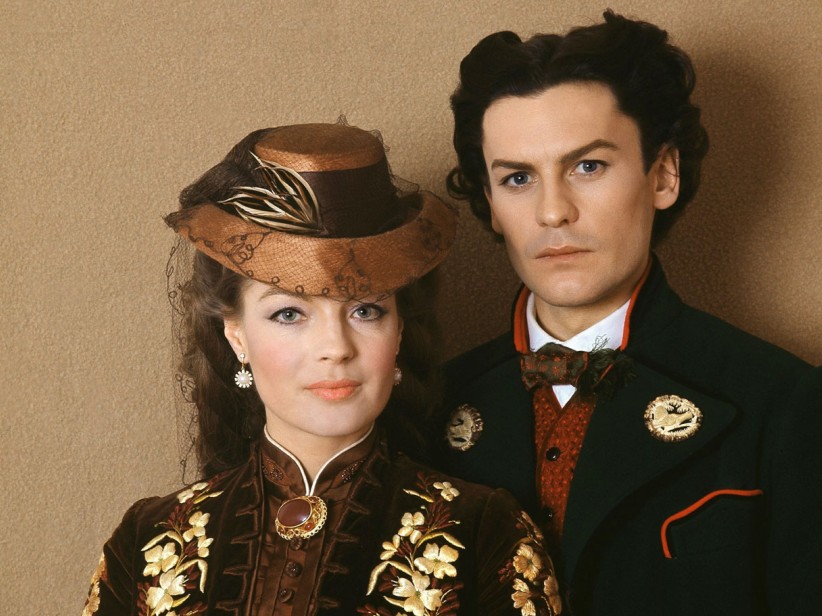
LUDWIG (Italy/France/West Germany - 1973) Directed by Luchino Visconti. Written by Luchino Visconti, Enrico Medioli and Suso Ceccho D'Amico. Cast: Helmut Berger, Romy Schneider, Trevor Howard, Silvana Mangano, Gert Frobe, Helmut Griem, Isabella Telezynska, Umberto Orsini, John Moulder Brown, Sonia Petrova, Folker Bohnet, Heinz Moog, Adriana Asti, Marc Porel, Nora Ricci, Mark Burns, Maurizio Bonuglia, Anne-Marie Hanschke, Gerard Herter, Henning Schluter, Eva Axen. (Unrated, 238 mins)
The most problematic work in the canon of the great Italian filmmaker Luchino Visconti, LUDWIG, an epic chronicle of the 1864-1886 reign of Ludwig II, "the mad king of Bavaria," was regarded as a beautiful but costly and self-indulgent folly upon its release in 1973. With an original running time of just under four hours, distributors all over the world balked at the film's length--so extreme that it seemingly depicted Ludwig's 22-year reign in real time--which led to a plethora of differing versions from country to country. In Italy, it was cut from 238 minutes to 186. US distributor MGM took the 186-minute version and cut it down to 173 for its NYC premiere in March 1973. That R-rated version was quickly withdrawn and LUDWIG was relaunched in Chicago a few months later at 137 minutes and re-rated PG, and that's the version that went into general release in the US over the summer and fall of 1973, running a full 101 minutes shorter than Visconti's intended vision (the PG cut presumably nixed any references toward Ludwig's sexual tendencies and a few scattered instances of male frontal nudity--were they concerned that a Visconti epic needed to bring in a younger demographic?). British audiences got the same 137-minute cut when it finally bowed in the UK in 1978, German moviegoers got a 144-minute version, and the Australian cut was whittled down a bit more to 133 minutes. Visconti apparently oversaw the first initial cut to 186 minutes for Italy and, whether willlingly or under duress, signed off on it, but beyond that, he was not involved in any further tweaks and alterations. Visconti died in 1976--his health worsened by a stroke he suffered midway through the shooting of LUDWIG--and over the years as the film fell into relative obscurity as the black sheep of a legendary auteur's filmography, there were so many different versions prepared for each market around the world, with so many wildly disparate running times that it became a virtual impossibility for anyone to remember what Visconti's intended LUDWIG even looked like.
The complete version of LUDWIG was released on DVD by Koch Lorber Films in 2008, but it was a flawed presentation that only included the Italian dub as an audio option with accompanying English subtitles. Visconti shot the film with the cast speaking English (with the intent of dubbing some of the Italian, French, and German supporting actors who had thicker accents or were speaking phonetically), which is how it played in US theaters, but the English soundtrack was only put in place for the assembly of the 173-minute US cut, and that was presumed lost over the ensuing 35 years or, perhaps more likely, clearing the rights to the English soundtrack and creating an integrated English/Italian audio track required more money and time than Koch Lorber was willing to spend. Arrow Video, under their prestige "Arrow Academy" banner, have released a four-disc Blu-ray/DVD combo set of the complete 238-minute LUDWIG--along with a separate viewing option that breaks it down into a five-part miniseries as it later played on Italian television--that offers the Italian soundtrack as well as the long-MIA English soundtrack for the first time in America since its theatrical release in 1973. There is one caveat: MGM never had the full-length version and were only given the 186-minute Visconti compromise, so they only saved the English track for the footage they used to assemble the 173-minute version for that initial NYC premiere. That means 65 of the restored version's 238 minutes automatically switch to Italian with English subtitles at random times. Some may find it distracting that just over 70% of the film is in English, but it's the best it's ever going to get if you want to hear the main stars and the more fluent-in-English members of the supporting cast speaking with their own voices.
But it's these switches to the Italian soundtrack that tell a bigger story: there's a lot of plot and exposition that gets spelled out in the Italian-language scenes, and if these were nixed for American audiences, it had to be pretty impossible to keep up with the narrative and have even the slightest idea what was going on, and even more so when it was chopped down further from 173 to 137 minutes. By the time Roger Ebert reviewed the 137-minute re-edit for the Chicago Sun-Times in June 1973, awarding it one star out of four, it was apparently an incoherent dumpster fire that lost all but one of the periodic cutaways to Ludwig underlings giving testimony directly to the camera. These bits happen a lot in the complete version and help provide some context as to what was going on in Bavaria during this time. I say "some context" because even at 238 minutes, LUDWIG remains a meandering, unwieldy mess that requires keeping access to Wikipedia at the ready if you want to know how most of the characters relate to one another or what purpose they serve in Ludwig's orbit, because much of that is information that Visconti is simply not interested in providing.
The film opens in 1864, the day that 19-year-old man-child Ludwig (played by Visconti's muse and longtime partner Helmut Berger) assumes the throne with the intent of being a caring and humble leader despite little working knowledge of being a ruler. He's incapable of comprehending how the Bavarian government operates and shows little interest in learning, but he loves the lavish life and all the pomp and circumstance, immediately portending a mix of oblivious naivete and stubbornness that strongly suggests he's in way over his head and that if he had to campaign for the job, his slogan would've been "Make Bavaria Great Again." Ludwig would be termed "The Mad King" as time went on, but Visconti is sympathetic to his subject. Far from being "mad," Ludwig is painted more as a tragic figure, one who was taken advantage of by those closest to him and one who would be continually frustrated by his inability to find true love and happiness. Historians have always questioned the claim that he was "insane," and now generally agree that it was an excuse used by his opponents to remove him from the throne. The conclusion these days is that he was a distant, awkward person who probably never wanted to be king in the first place, and his frequent instances of erratic psychological instability may have been the result of increasing isolation and loneliness and even royal inbreeding. For much of his reign, Ludwig wants nothing more than to marry his cousin, Countess Elisabeth of Austria (Romy Schneider), but she continually rejects him, even unsuccessfully trying to arrange a marriage for him with her younger sister Sophie (Sonia Petrova).
Far from being a "mad" tyrant, he tries to compensate for his ignorance as a leader and the repeated rejections by Elisabeth by pouring himself into the arts, architecture, and other grandiose displays of extravagance. He views art as "the antidote for evil and corruption in society," and becomes the primary benefactor of disgraced composer Richard Wagner (Trevor Howard), who arrives in Bavaria with his conductor Alan von Bulow (Mark Burns) and his wife Cosima (Silvana Mangano), with whom Wagner is having an affair. Wagner and Cosima view Ludwig as a useful idiot, bilking and hustling everything they can out of the young king ("This half-witted boy," Wagner chuckles to Cosima), who is more than happy to give them everything they desire, including a palatial residence and a personal opera house designed exclusively for the staging of Wagner operas. Ludwig drains his personal fortune and exhausts any available credit through the Bavarian treasury to order the construction of one castle after another throughout his kingdom, many of which are exact copies of ones that already exist in France. He's informed by everyone--from Elisabeth to close advisers like Count von Holnstein (Umberto Orsini, who's definitely dubbed) and Count Durckheim (Helmut Griem)--that he's being used, that he's reckless and irresponsible in his spending, that Wagner is squandering taxpayer money, and that the Von Bulows are shameless opportunists looking for a free ride. Elisabeth lays into him most harshly, telling Ludwig point-blank that "Your pathetic friendship with Wagner gives you the illusion of creating something...just as I give you the illusion of love." Ouch.
This all sounds like compelling drama, but Visconti isn't concerned with things like narrative and story construction. Sure, these story elements are there, but it's dramatically inert and told with much emotional distance, as if he wants to make the audience feel as isolated and closed-off as his subject. It's an experiment that doesn't really make for compelling cinematic storytelling, and LUDWIG is often as dry and clinical as those educational history films that one-time fellow neo-realist Roberto Rossellini was making for Italian television around the same time. Granted, LUDWIG is much more opulent and visually stunning, with very few exteriors and almost all of the scenes shot in the actual castles and palaces that Ludwig had constructed during his reign. Even when Bavaria goes to war with Austria against Prussia, we see not a single battle that would seem to be a requirement in such a massive historical epic. Ludwig simply decides to side with Austria and is eventually told that they've lost the war. On one hand, you get what Visconti is doing: by seeing nothing whatsoever of the war, the audience is in the same mindset as Ludwig, who was utterly unconcerned with it and was completely unaffected by it win or lose. But telling the story in this manner gives the film a choppy and incomplete feel even at four hours. Even with Ludwig's interactions with Elisabeth and Wagner and his gradual retreat into proto-Howard Hughes seclusion even to those closest to him (it's also feasible that he suffered from social anxiety disorder), it's still nearly three hours before Visconti gets anything resembling dramatic momentum going, when Count Durckheim is called in for an inquiry with top-ranking Bavarian officials at the behest of the duplicitous Count von Holnstein (the closest thing LUDWIG has to an outright villain). This secret group is conspiring to have Ludwig declared insane, which would force him to abdicate and give power to his uncle Prince Luitpold (Gerard Herter), as the next in line of succession is Ludwig's schizophrenic younger brother Prince Otto (John Moulder Brown), who's already been deemed even less capable of assuming the throne than his elder sibling. This long sequence--where Durckheim angers the rebellious government officials and defiantly professes his loyalty to Ludwig, refusing to have any part in the coup--plays out in Italian, meaning it was completely absent from the US cut. Again, how could anyone watching this movie in an American cinema in 1973 have even a hint of a clue as to what was happening?
LUDWIG was Visconti's most personal and ambitious film, and it's in many ways a summation of all of his obsessions and fixations. You can draw a straight line from Burt Lancaster's Prince of Salina in 1963's THE LEOPARD through Dirk Bogarde's Gustav von Aschenbach in 1971's DEATH IN VENICE and Berger's Ludwig through Lancaster's aging, nameless Professor in 1974's underrated CONVERSATION PIECE: lost men out of their time, living in the past, obsessed with beauty, art, decadence, and decay, sheltering themselves by hiding away in opulent mansions and/or dilapidated palazzi from a changing society they no longer understand in a world that's left them behind. From 1965 until his death in 1976, the openly gay Visconti was romantically involved with the much-younger Berger, who made his mark in Marlene Dietrich drag in Visconti's THE DAMNED but always seemed overtly androgynous even when he was playing tough guys in Eurotrash thrillers like 1975's ORDER TO KILL and 1977's MAD DOG KILLER. Visconti's and Berger's relationship (now 72, the bisexual Berger eventually married Italian actress Francesca Guidata but still refers to Visconti as the one great love of his life) is reflected throughout the director's later years, particularly with von Aschenbach's obsession with a teenage boy in DEATH IN VENICE and in Ludwig's fixations on attractive young men like officer Hornig (Marc Porel) and actor Joseph Kainz (Folker Bohnet). He spies on another young officer skinny-dipping and is also seen in a state of depressed malaise, in a decadent hideaway surrounded by nude young men lounging about the premises (I'm guessing that scene wasn't in the PG version). Watching Ludwig's decline and fall hastened by his commitment to an unattainable artistic vision at odds with everyday practicality, LUDWIG is as much about the Bavarian king as it is about Visconti himself.
But in lieu of anything to really drive the narrative for the first three hours, Visconti instead opts to make LUDWIG one of the most stunningly beautiful films you'll ever see. The location shooting in the castles, coupled with the art direction, the cinematography by Armando Nannuzzi (who would infamously lose his right eye in 1985 in an on-set accident during the making of Stephen King's MAXIMUM OVERDRIVE) and Piero Tosi's Oscar-nominated costume design make it a thoroughly captivating visual experience, especially on Blu-ray. As far as the performances go, Berger commits, looking haggard and thinner by the end, with greasy hair and augmented with convincingly rotted-looking teeth. He gets an enraged outburst every few scenes (if you watch with the Italian track, he's dubbed by Giancarlo Giannini), but when the film never lets you get into the heart and mind of Ludwig, what's the point? Faring much better is Howard, who benefits most from the recovery of the English soundtrack. The veteran British character actor (Visconti's second choice after Laurence Olivier turned it down) is just superb here, a larger-than-life presence stealing every scene he's in as the self-serving and subtly manipulative Wagner, who seems to genuinely like "this half-witted boy" but still puts himself first before all. Howard is so good here that had critical and commercial response to LUDWIG not been so toxic, he probably could've gotten a Best Supporting Actor Oscar nomination.
Berger and Visconti on the set
But man, this is a horse-pill. It's easy to draw comparisons between LUDWIG and another visually intoxicating but impenetrable and alienating epic that was a little further on the horizon: Michael Cimino's 1980 western HEAVEN'S GATE. Like that film, LUDWIG is a breathtaking sight to behold but its storytelling mechanics leave a lot to be desired. Both films were chopped down to more accessible, commercial lengths that rendered them incomprehensible, and now both are available in their intended versions (Visconti's estate gave its approval to Arrow's restoration). And both films essentially destroyed the careers of the filmmakers who lovingly crafted them, auteurs whose single-minded focus is exhaustingly precise, but caused them to lose sight of the bigger picture. Cimino is so concerned with nailing the accuracy of the time period in HEAVEN'S GATE, right down to whatever the most barely visible extra in the background is doing, that he forgets important details that lead to such questions as "Why are Jeff Bridges and John Hurt even in this movie?" Likewise, Visconti was so zeroed in on the atmosphere and the look of Ludwig's era, shooting in as many actual locations as possible, and getting the decor and the sets and the clothing down perfectly that he forgot to write a complete script with a beginning, middle, and end. Characters appear and disappear with baffling suddenness, you don't know who they are, the motivations of some are really fuzzy, and you may find yourself asking such questions as "Why is Gert Frobe even in this movie?" Visconti battled back as best he could after his stroke and would still make two more films--1974's CONVERSATION PIECE and 1976's THE INNOCENT--but LUDWIG would be the last one he'd see released in America in his lifetime. It was a huge flop and made him a pariah to the major studios. Visconti died in March 1976 at the age of 69, and CONVERSATION PIECE, even with a screen legend like Burt Lancaster starring, didn't hit American theaters until it was picked up by a fledgling New Line Cinema in 1977, while THE INNOCENT remained unseen in the US until the small arthouse outfit Analysis Films released it in 1979.
The 137-minute, PG-rated version of LUDWIG
opening in Toledo, OH on September 7, 1973.
It lasted one week.
The 2014 Toronto Film Festival didn't go very well for Adam Sandler. Seemingly in response to criticism about his juvenile and increasingly lazy star vehicles that just give him an excuse to hang out with his buddies, Sandler tried to get serious with two smaller films, both of which were unveiled at Toronto: JUNO director Jason Reitman's dysfunction drama MEN, WOMEN & CHILDREN and Tom McCarthy's THE COBBLER. McCarthy's made some respected and acclaimed indie films, such as THE STATION AGENT (2003), THE VISITOR (2008), and WIN WIN (2011), and Sandler would seem to be in good hands with either director if he was seeking an indie-cred reinvention. But whatever mojo Reitman had circa UP IN THE AIR is gone, as MEN, WOMEN & CHILDREN was a ridiculous CRASH knockoff that got laughed off the screen with its "Old Man Yells at Cloud" attitude about social media and modern technology and eventually opened in theaters to the tune of a $700,000 total gross while asking the tough questions like "What's with all the selfies and the texting and the porn and the jerking off?" THE COBBLER got an even more toxic response. Earnest and schmaltzy to a fault, it plays like an excessively sappy take on the kind of middling, klezmer-scored, high-concept trifle that Woody Allen might churn out to lighten the mood between dramas. Acquired by Image Entertainment and relegated to a few theaters and VOD, THE COBBLER grossed just $24,000 and is somehow worse than any of Sandler's phoned-in Happy Madison joints.
The dumb concept might've provided passable entertainment had McCarthy been able to settle on the right tone. Instead, he veers wildly from comedy to fantasy to drama, with Sandler doing his best to keep up as schlubby Max Simkin, a fourth-generation cobbler in a Lower East Side neighborhood that's struggling to hold off gentrification. Weighed down by Allen-esque Jewish neuroses, deserted by his father (Dustin Hoffman), and living with his dementia-addled mom (Lynn Cohen), Max wishes he'd made different choices in life but just plugs away in his mundane existence. That is, until he discovers an old stitching machine in the basement that enables him to literally walk in someone else's shoes: when he slips on shoes that have been repaired using the antique stitcher, he turns into the person who owns the shoes. At first, he uses his new trick to mess with Jimmy (Steve Buscemi), who owns the barber shop next door, but then he's dining-and-dashing by switching into another pair of shoes in the restaurant's men's room and trying to get in the shower with the hot girlfriend of local DJ Emiliano (THE GUEST's Dan Stevens), and while wearing the shoes of neighborhood gangster Leon (Method Man), he threateningly steals the shoes of another (Joey Slotnick) because he wants to get that guy's sports car out of the parking garage and speed throuogh the streets. There's probably a ton of ways that shoe-stealing scene, relying on Leon being a stereotypical thug, could've been subversive and funny, but McCarthy treats the joke the same way a regular Sandler director would and it lands with the expectedly uncomfortable thud. THE COBBLER gets hopelessly maudlin as Max slips on his dad's shoes to stage a reconciliation with his mom, but he soon decides to use it to stop gentrification in his neighborhood, with Leon in cahoots with a corrupt property developer (Ellen Barkin, who can play this kind of bitch-on-wheels character in her sleep) to run elderly holdout Mr. Solomon (Fritz Weaver) out of his building so they can tear it down. This all leads to a twist ending that, among other things, somehow turns THE COBBLER into a superhero origin story ("You are the Guardian of Soles. You are the Cobbler" is probably the single worst line of dialogue Hoffman's been forced to utter in his 50-year career). In his defense, Sandler really isn't the problem here, nor was he the issue with the overwrought MEN, WOMEN & CHILDREN. It's almost like he's acting out by defiantly choosing the most terrible serious scripts he can find so people stop giving him so much shit about paid vacations like GROWN-UPS 2. (PG-13, 98 mins)
THE DEVIL'S VIOLINIST (Germany/Austria - 2013; US release 2015)
Though he'll always be the director of 1988's PAPERHOUSE and 1992's CANDYMAN, Bernard Rose's freefall into Roland Joffe depths of irrelevance continues with the laughable Niccolo Paganini biopic THE DEVIL'S VIOLINIST. Rose directed 1994's well-regarded IMMORTAL BELOVED, anchored by a great Gary Oldman performance as Beethoven but here, he's saddled with violinist/PBS crossover sensation David Garrett as the maverick 19th century classical great Paganini. Garrett can obviously play but he can't act and as a result, there's a massive void in the center of the film that's impossible to fill. But really, Garrett is just one of many insurmountable problems with THE DEVIL'S VIOLINIST: Rose wisely offers his inexperienced lead some support with veteran professionals, almost of whom decided to bring their D-game. In the worst performance of his career, Jared Harris is Urbani, a vaguely demonic figure in a ludicrous top hat who has Paganini sign a contract in exchange for fame and fortune. Rose seemingly treats the metaphorical "deal with the devil" as historical fact, and it leads to all manner of self-destructive behavior on Paganini's part. Rose has no interest in exploring Paganini as a character and simply bulldozes through the exposition--in rapid-fire succession, Paganini goes from unknown violinist to superstar to father of a five-year-old boy to hopeless opium addict. That's all in the first 12 minutes. Then the kid disappears, and we see him again 100 or so minutes later, then five minutes after that, he's a decade older. Then Paganini is on opium again after no signs of drug abuse for 90% of the movie. At times, it seems like a long "Previously on..." recap for a TV series that doesn't exist.
Goaded by Urbani, Paganini treats everyone like dog shit, callously bankrupting the London benefactor (Christian McKay gives the only thing resembling a performance) who tries to help him expand his audience, breaks the heart of Charlotte, the benefactor's daughter (Andrea Deck), and demands financial compensation to play for the King of England. He takes the stage hours late like some 19th century Axl Rose, and is targeted by an ever-present group of religious protesters--led by the prudish and perpetually haranguing Primrose Blackstone (Olivia d'Abo)--that also functions as a Greek chorus for the plot. Everything about THE DEVIL'S VIOLINIST is wrong-headed: casting a violinist with no acting experience and a complete inability to correctly pronounce the name "Charlotte" instead of a real actor who could maybe learn to mimic the violin performance scenes; Harris playing Urbani with a Mephistophelian scowl more befitting a silent movie villain, and with a bizarre vocal affect that can best be described as "SLING BLADE starring Peter Lorre"; Joely Richardson as a rough, cigarillo-smoking journalist with Carrot Top's hair, getting catty with Charlotte over Paganini's attention; giving the great Helmut Berger prominent billing but nothing to do...I could go on. Boasting some nicely ornate interior production design, THE DEVIL'S VIOLINIST is otherwise appallingly bad and just more proof, along with the little-seen 2014 found-footage horror film SX_TAPE, that Rose just has no idea what he's doing anymore. He's made some accomplished films and a couple of his early ones could arguably be called great, but while he keeps busy, he's done nothing noteworthy since his 1997 version of ANNA KARENINA with Sophie Marceau. Rose is prolific but his consistently barely-released or completely unseen films fly so far under the radar that it's easy to forget he's even still around, let alone cranking out six movies in the last five years. In the end, THE DEVIL'S VIOLINIST, released on just ten screens in the US by Freestyle two years after flopping in Europe, seems like as much of vanity project for Garrett as Klaus Kinski's humbly-titled 1989 Paganini chronicle KINSKI PAGANINI. Garrett, also one of 26 credited producers, gets to show off his chops numerous times, his Paganini beds a slew of comely women, and his female fans are always shown fanning themselves as they mob him like he's One Direction, accompanied by sounds of Elvis and Beatlemania crowd shrieking. And in a bizarre onscreen credit worthy of infamously self-aggrandizing neoclassical metal Paganini disciple Yngwie Malmsteen, there's even a special acknowledgment from the producers thanking Garrett for his work on the film. Does that mean he's thanking himself for starring in a movie that he co-produced? Isn't that like a Malpaso production thanking Clint Eastwood for showing up? (R, 123 mins, also streaming on Netflix Instant)
CONVERSATION PIECE aka GRUPPO DI FAMIGLIA IN UN INTERNO (Italy/France - 1974)
Directed by Luchino Visconti. Written by Suso Cecchi d'Amico, Enrico Medioli, Luchino Visconti. Cast: Burt Lancaster, Helmut Berger, Silvana Mangano, Romolo Valli, Dominique Sanda, Claudia Cardinale, Claudia Marsani, Stefano Patrizi, Elvira Cortese, Guy Trejan, Umberto Raho, Enzo Fiermonte. (Unrated, 121 mins)
The penultimate film by legendary Italian director Luchino Visconti (1906-1976) has been derided as one of his worst and most pretentious works for nearly 40 years. It was shot in English, with much of the Italian supporting cast dubbed, and despite acclaim in Italy, film festival screenings abroad resulted in such bad word-of-mouth that it took three years to find a US distributor. When then-fledgling New Line Cinema released it in the US in 1977, a year after Visconti's death (his final film, 1976's THE INNOCENT, wasn't released in the US until 1979), they released a version dubbed in Italian with English subtitles, which most agreed played a little better. Raro USA's new DVD release only has the original English-language audio, and that was the way Visconti intended it to be shown (Raro's Blu-ray, due out in April, will have both audio options). CONVERSATION PIECE has remained relatively obscure in comparison to Visconti classics like THE LEOPARD (1963), but its reputation has improved since its original release, and the essay in the package's accompanying booklet by film historian Mark Rappaport makes a pretty strong case for it being considered essential Visconti.
1974 Italian poster
Watching the film and with the benefit of perspective, CONVERSATION PIECE is, in hindsight, a hauntingly personal, elegiac baring of Visconti's soul. Visconti suffered a debilitating stroke shortly after completing 1973's LUDWIG and was partially paralyzed from then on. CONVERSATION PIECE was his next film, and it's clearly the work of a man who knows he's facing the end, and it's all there on the screen. Rappaport even goes so far as to write that the film itself is Visconti's Last Will and Testament. Admittedly, it's uneven at times, the English dubbing of the supporting cast is an ill fit, and there's some pointless shoehorning of Italy's then-volatile political situation into the crucial final sequences, but, with the passage of time, and years of film students studying Visconti and others of the Italian neo-realist movement, perhaps it's easier to focus on what does work in CONVERSATION PIECE, which is most of the film. It's not without flaws and problems, but what it gets right is too powerful to simply dismiss.
Poster for the film's 1977 US release
A retired American science professor (Burt Lancaster) lives alone in a grand, opulent Rome palazzo filled with the books, music, and art he's collected over a lifetime. He has a maid and his only acquaintances seem to be art dealers with whom he occasionally does business, collecting "conversation piece" portraits of informal family or group gatherings. The professor's solitary existance is disrupted by the Marchesa Bianca Brumonti (Silvana Mangano), a pushy, demanding woman of high social stature, who wants to rent the upper level of the palazzo for her daughter Lietta (Claudia Marsani) and her fiance Stefano (Stefano Patrizi). The professor repeatedly explains that the upstairs is not for rent and that he planned on moving his library up there at some point in the future. The Marchesa refuses to take no for an answer and before he even realizes what's going on, the Professor has signed a one-year lease for Lietta, Stefano, and a third boarder, the Marchesa's flamboyant, much-younger boy-toy and drug-dealing gigolo Konrad (Helmut Berger). The three tenants invade the Professor's life in a variety of ways, including knocking down walls and causing a water leak, loud music at all hours, barging in unannounced, and not to mention the Professor walking in on them in a threesome (Berger and Patrizi do frontal nudity in this scene, but Visconti is careful with how he films 1973 Miss Teen Italy winner Marsani, who was only 15 at the time), but their presence gives an unexpected spark to the Professor's lonely life. He surprises himself by bonding with Konrad, who loathes being the Marchesa's kept man and demonstrates intelligence and refined musical and literary tastes the Professor didn't think possible. The Professor begins to lament all the lost years spent alone and is soon "adopted" by this bizarre trio as the father in their makeshift dysfunctional "family."
Deciding three's already a crowd, the Professor (Burt
Lancaster) declines an invitation from the
free-spirited Lietta (Claudia Marsani,
who's probably doubled in this shot)
Lancaster's Professor (he's never given a name) is a character cut from the same cloth as the aging prince the actor portrayed 11 years earlier for Visconti in THE LEOPARD. Both are old men nearing the end, both filled with regret over roads not taken and societal changes they can't control, and both feel like relics in their own worlds. But Visconti's declining health adds a different level of poignancy to CONVERSATION PIECE. The Professor essentially is Visconti, and it's no coincidence that Konrad is played by Helmut Berger. No one else could've played this role. Berger became Visconti's lover and protege after working together on 1969's THE DAMNED. So much of their reportedly rocky relationship is incorporated into CONVERSATION PIECE, and though a romantic angle is never consummated, it is mentioned when the Marchesa accuses the Professor of having designs on Konrad. It's possible that the Professor feels a romantic desire for Konrad. He walks into the bathroom while Konrad is showering and seems to be in no rush to leave, only excusing himself when someone knocks at the main door. We know the Professor was married once upon a time (Claudia Cardinale plays his wife in a brief flashback), but all he says is "It didn't work." For what reasons, we never know. Visconti was bisexual, so perhaps the Professor is as well.
Burt Lancaster and Helmut Berger
But beyond any possible romantic scenarios, the Professor and Konrad first and foremost demonstrate a father-son relationship more than anything, which probably has parallels to Visconti and Berger's instructor-protege working relationship. Rappaport's essay cites Berger's memoirs and other information to paint a picture of Visconti as someone who preferred a quiet evening at home and who was often frustrated with the much-younger Berger's hard-partying, stay-out-until-dawn ways, which is what happens with the Professor and Konrad. What keeps CONVERSATION PIECE from reaching the level of Visconti masterpiece is the bizarre political tangent that gets introduced in the last part of the film, almost as if Visconti was obliged to say something simply because he came from the school of neo-realism and there was a lot of political tumult in Italy at the time. It doesn't really gel, and in fact, it's a bit of a momentum killer. But it's something that can be overlooked, and while CONVERSATION PIECE isn't on the level of THE LEOPARD, I think Rappaport's arguments are convincing enough to elevate it to the status of essential Visconti. It's also a very beautiful film (the DVD is remastered, 2.35:1 anamorphic), taking place almost entirely inside the Professor's stunningly-decorated, colorful palazzo, a DePaolis interior that looks like it could've been (and probably was) used for several gialli of the period. And while bleak and mournful most of the way, it also has a lot of dark humor, be it an occasional bit of inspired overacting from Berger or the three tenants giving the Professor a parrot that only says "They're killing me!" with Lietta explaining "It'll remind you of us." With Raro USA's release of CONVERSATION PIECE, the time seems right for a reconsideration of this neglected and very deeply personal late-period Visconti work.
Somewhat misleading artwork for the film's
1980s VHS release in the US.