Nicolas Cage got some of his best reviews in years with 2018's instant cult classic MANDY, but for every MANDY or MOM AND DAD or Richard Stanley's upcoming and much-anticipated THE COLOR OUT OF SPACE, there's a LOOKING GLASS, a HUMANITY BUREAU, a 211, a BETWEEN WORLDS or another utterly generic Redbox-ready clunker to effectively quash any comeback momentum he might accidentally have going. A SCORE TO SETTLE can be lumped in with a dozen other already-forgotten Cage paycheck gigs (raise your hand if you remember him dabbling in faithsploitation with the LEFT BEHIND reboot), a haplessly hokey revenge thriller with a really dumb Shyamalanian twist that anyone should be able to call less than ten minutes into the movie. Cage is Frank Carver, aka "Frankie Triggers," a low-level mob flunky who's spent nearly 20 years in prison after being set-up to take the fall on a hit that was ordered by his boss Max (Dave Kenneth MacKinnon) and carried out by his buddies Jimmy (Mohamed Karim) and Tank (Ian Tracey). Frank is getting a compassionate early release due to a terminal illness--a rare condition known as fatal insomnia that will, in time, cause his motor functions to dramatically diminish and his body to eventually shut down. He uses the time to reconnect with his estranged son Joey (Noah Le Gros, the lookalike son of veteran character actor James Le Gros) while indulging in a lavish lifestyle thanks to the recovery of a stash of Max's money that he left buried in a secret location prior to his incarceration. Widower Frank also treats himself to some fun with high-class prostitute Simone (Karolina Wydra), all the while plotting his revenge on those responsible for his two lost decades, especially once he learns that the presumed-dead Max may have faked his own death years earlier.
Directed and co-written by Shawn Ku, whose little-seen 2010 debut BEAUTIFUL BOY found some acclaim but only led to a Lifetime movie and the Crackle series SEQUESTERED, A SCORE TO SETTLE lugubriously dawdles for a good hour by setting itself up as a maudlin, manipulative man-weepie complete with some really terrible acoustic ballads, just in case you weren't sufficiently getting the feels. Once Ku drops the obvious twist about 2/3 of the way through, things finally pick up a little as Nic gets uncaged and does all sorts of crazy shit for his YouTube highlight reel: dramatically chewing on some jerky while he's interrogating Tank before blowing his head off, shooting another guy in the dick, busting out some seemingly improv impressions of Kurtwood Smith in ROBOCOP and later capping off a threat to a pimp with a Montgomery Burns "Excellent!" and, finally, coming up with several different ways to yell "BEEF?!" in the climactic showdown. The latter is truly a sight to behold, but until then, Cage (one of 22 credited producers) is just sleepily going through the motions, with one eye on the clock and the other presumably on the stack of bills he has to pay, bringing no life whatsoever to a series of awkwardly-played scenes with both Le Gros and Wydra. This is the sort of movie that has a reasonably well-known actor who gets a special "and" credit and is only seen sporadically throughout and has little to do with the plot, thus ensuring that he'll be of some "surprise!" importance later on. Also with Benjamin Bratt as one of Frank's old gangster pals who went straight, became a restaurateur, and keeps trying to talk Frank out of his plans for revenge, A SCORE TO SETTLE is the kind of by-the-numbers throwaway that's typified the bulk of Cage's output in recent years, only lately they've been looking a lot cheaper and much less polished. (R, 104 mins)
PASOLINI (France/Italy/Belgium - 2014; US release 2019)
Belatedly given a stealth summer 2019 arthouse run in the US by Kino Lorber five years after it played everywhere else in the world, Abel Ferrara's PASOLINI is a frustrating chronicle of the last day and a half in the life of controversial Italian filmmaker Pier Paolo Pasolini, who was murdered on November 2, 1975. Masterfully portrayed by Willem Dafoe--whose Oscar-nominated performance as Vincent Van Gogh in AT ETERNITY'S GATE is likely the reason this tough sell finally found a US distributor--Pasolini is introduced giving an interview as he works on post-production of his most notorious film, 1976's posthumously-released SALO, OR THE 120 DAYS OF SODOM. We observe Pasolini go about his day: giving interviews, working on a novel, having lunch with his loving mother (Adriana Asti), his loyal assistant (Giada Colagrande), and his close friend, actress Laura Betti (Maria de Medeiros), and later meeting frequent star and former lover Ninetto Davoli (JOHN WICK 2's Riccardo Scamarcio) for dinner. Pasolini's day is capped off with a fateful night of cruising where he picks up 17-year-old street hustler Pino Pelosi (Damiano Tamilia), drives to the beach, has sex with him, and is then beaten to death by the young man and several of his cohorts who were waiting nearby. Pelosi drove over Pasolini's mutilated corpse and would eventually be arrested several days later when he was caught riding around in the filmmaker's stolen car. Pelosi confessed to the murder and was convicted, though he recanted it nearly 30 years later.
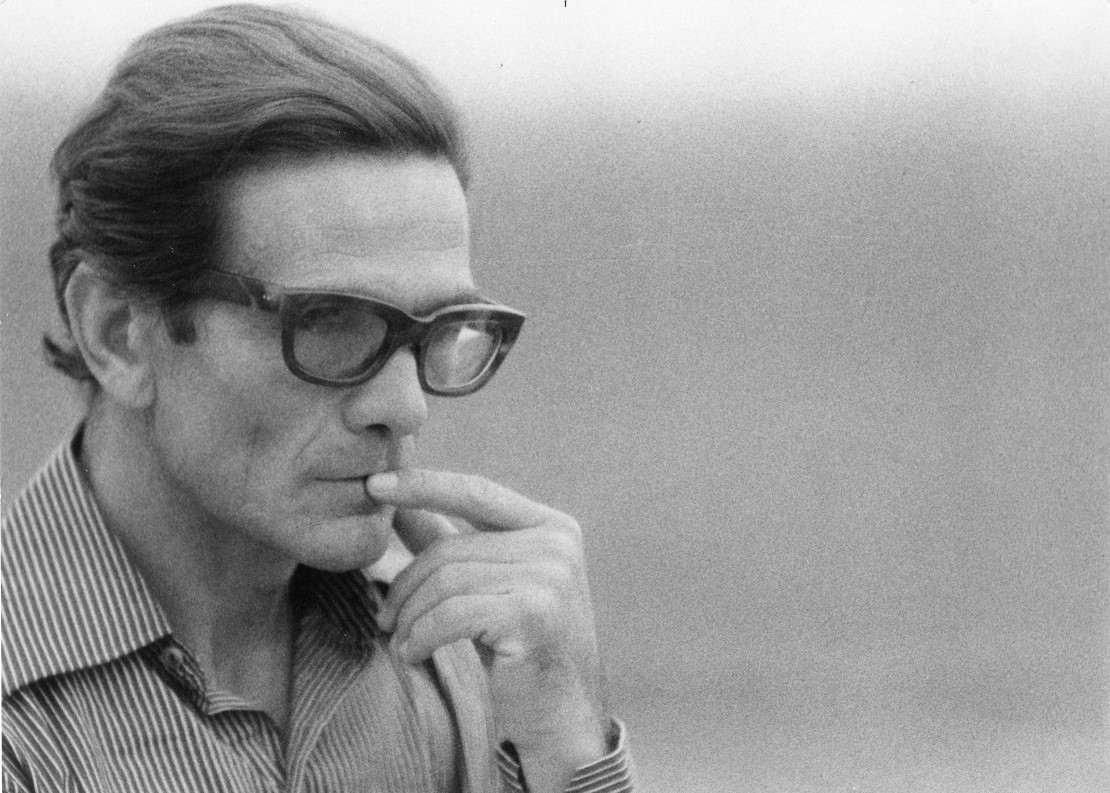
Pier Paolo Pasolini (1922-1975)
Pasolini was an openly gay communist and outspoken cultural figure who made many political enemies, and there were numerous conspiracy theories surrounding his murder, including a possible Mafia hit or an ill-fated meeting with an extortionist after several cans of SALO footage were stolen. Ferrara (KING OF NEW YORK, BAD LIEUTENANT) doesn't go into any of that, and doesn't offer much help for anyone who's not already really up to speed on their Pasolini knowledge. It's less a narrative piece and more of a kaleidoscopic series of snapshots of random, mundane events of a day like any other, except that it turns out to be its subject's last. But with almost nothing in the way of exposition or an establishing of time or place (there's fleeting mention of the incendiary political scene in Italy at the time), there isn't much of a hook here aside from Dafoe's uncanny resemblance to Pasolini. It almost seems like Ferrara realizes this, as roughly half of the film's already brief 84-minute running time consists of scenes from Pasolini's novel as well as the script for his never-filmed intended follow-up to SALO playing out as they might have been. The novel sequences feature Roberto Zibetti as a politically ambitious, closeted bourgeois cipher serving as a Pasolini surrogate, while the scenes from the unmade screenplay have Scamarcio's Davoli as the young sidekick to an eccentric old man named Epifanio, played in an admittedly clever bit of stunt casting by the aged, white-haired Ninetto Davoli, who still has that beaming smile and Chaplin-esque screen presence he displayed in several Pasolini films decades ago. Only in the harrowing finale depicting Pasolini's brutal murder does PASOLINI start to generate any kind of dramatic momentum. Dafoe is a four-time Oscar-nominee and one of our great actors, and it's impossible for him to be uninteresting--though it is odd that his Pasolini and those interacting with him speak English while all scenes not involving Dafoe are in Italian or French. But his inspired casting isn't very well-served by a director who doesn't seem sure about what he's even trying to do with the project. (Unrated, 84 mins) JACOB'S LADDER
(US - 2019)
No one was demanding a remake of Adrian Lyne's disturbing Tim Robbins-starring mindfuck from 1990, and considering it spent three years on the shelf before debuting on DISH Network en route to VOD, no one was in a hurry to release it either. Financially-strapped LD Entertainment intended on opening it wide in theaters in February 2019 before abruptly yanking it from the release schedule and selling it to the lowly Vertical Entertainment. Even as modern-era remakes go, JACOB'S LADDER sets new standards for the perfunctory. It obviously can't replicate the kick-in-the-balls twist ending of the 1990 original, but its solution is just an ambivalent shrug. It wastes a good performance by Michael Ealy as Jacob Singer, an Iraq War vet and trauma surgeon at a VA hospital in Atlanta. He suffers from PTSD but is coping, is happily married to Samantha (Nikki Beharie), and they've recently had a baby boy. Jacob believes his brother Isaac (Jesse Williams) is dead--a casualty of the same war--but he runs into a stranger (Joseph Sikora) from Isaac's unit who informs him that his brother is alive and in Atlanta. The brothers are reunited, with Isaac dealing with paralyzing PTSD, hooked on a drug designed to control it, and still holding a grudge against Jacob since Samantha was his girlfriend first. These soap opera elements do nothing to enhance the JACOB'S LADDER experience, forcing director David M. Rosenthal (who previously worked with Ealy on THE PERFECT GUY) to resort to simply recycling all of the same shock elements from the first film as Isaac, and eventually Jacob, have hallucinatory visions of various monstrous creatures after using the experimental PTSD drug known as "The Ladder." Ealy, also one of the producers, busts his ass to make this work, especially near the end, but he's giving this pointless remake more than he can possibly get from it in return. Put it this way: JACOB's LADDER '19 is written by the guy who wrote the PET SEMATARY remake and the upcoming GRUDGE remake, and it's got a story credit for the guy who wrote the WHEN A STRANGER CALLS remake and the HITCHER remake. C'mon, man. (R, 89 mins)
LUDWIG (Italy/France/West Germany - 1973) Directed by Luchino Visconti. Written by Luchino Visconti, Enrico Medioli and Suso Ceccho D'Amico. Cast: Helmut Berger, Romy Schneider, Trevor Howard, Silvana Mangano, Gert Frobe, Helmut Griem, Isabella Telezynska, Umberto Orsini, John Moulder Brown, Sonia Petrova, Folker Bohnet, Heinz Moog, Adriana Asti, Marc Porel, Nora Ricci, Mark Burns, Maurizio Bonuglia, Anne-Marie Hanschke, Gerard Herter, Henning Schluter, Eva Axen. (Unrated, 238 mins)
The most problematic work in the canon of the great Italian filmmaker Luchino Visconti, LUDWIG, an epic chronicle of the 1864-1886 reign of Ludwig II, "the mad king of Bavaria," was regarded as a beautiful but costly and self-indulgent folly upon its release in 1973. With an original running time of just under four hours, distributors all over the world balked at the film's length--so extreme that it seemingly depicted Ludwig's 22-year reign in real time--which led to a plethora of differing versions from country to country. In Italy, it was cut from 238 minutes to 186. US distributor MGM took the 186-minute version and cut it down to 173 for its NYC premiere in March 1973. That R-rated version was quickly withdrawn and LUDWIG was relaunched in Chicago a few months later at 137 minutes and re-rated PG, and that's the version that went into general release in the US over the summer and fall of 1973, running a full 101 minutes shorter than Visconti's intended vision (the PG cut presumably nixed any references toward Ludwig's sexual tendencies and a few scattered instances of male frontal nudity--were they concerned that a Visconti epic needed to bring in a younger demographic?). British audiences got the same 137-minute cut when it finally bowed in the UK in 1978, German moviegoers got a 144-minute version, and the Australian cut was whittled down a bit more to 133 minutes. Visconti apparently oversaw the first initial cut to 186 minutes for Italy and, whether willlingly or under duress, signed off on it, but beyond that, he was not involved in any further tweaks and alterations. Visconti died in 1976--his health worsened by a stroke he suffered midway through the shooting of LUDWIG--and over the years as the film fell into relative obscurity as the black sheep of a legendary auteur's filmography, there were so many different versions prepared for each market around the world, with so many wildly disparate running times that it became a virtual impossibility for anyone to remember what Visconti's intended LUDWIG even looked like.
The complete version of LUDWIG was released on DVD by Koch Lorber Films in 2008, but it was a flawed presentation that only included the Italian dub as an audio option with accompanying English subtitles. Visconti shot the film with the cast speaking English (with the intent of dubbing some of the Italian, French, and German supporting actors who had thicker accents or were speaking phonetically), which is how it played in US theaters, but the English soundtrack was only put in place for the assembly of the 173-minute US cut, and that was presumed lost over the ensuing 35 years or, perhaps more likely, clearing the rights to the English soundtrack and creating an integrated English/Italian audio track required more money and time than Koch Lorber was willing to spend. Arrow Video, under their prestige "Arrow Academy" banner, have released a four-disc Blu-ray/DVD combo set of the complete 238-minute LUDWIG--along with a separate viewing option that breaks it down into a five-part miniseries as it later played on Italian television--that offers the Italian soundtrack as well as the long-MIA English soundtrack for the first time in America since its theatrical release in 1973. There is one caveat: MGM never had the full-length version and were only given the 186-minute Visconti compromise, so they only saved the English track for the footage they used to assemble the 173-minute version for that initial NYC premiere. That means 65 of the restored version's 238 minutes automatically switch to Italian with English subtitles at random times. Some may find it distracting that just over 70% of the film is in English, but it's the best it's ever going to get if you want to hear the main stars and the more fluent-in-English members of the supporting cast speaking with their own voices.
But it's these switches to the Italian soundtrack that tell a bigger story: there's a lot of plot and exposition that gets spelled out in the Italian-language scenes, and if these were nixed for American audiences, it had to be pretty impossible to keep up with the narrative and have even the slightest idea what was going on, and even more so when it was chopped down further from 173 to 137 minutes. By the time Roger Ebert reviewed the 137-minute re-edit for the Chicago Sun-Times in June 1973, awarding it one star out of four, it was apparently an incoherent dumpster fire that lost all but one of the periodic cutaways to Ludwig underlings giving testimony directly to the camera. These bits happen a lot in the complete version and help provide some context as to what was going on in Bavaria during this time. I say "some context" because even at 238 minutes, LUDWIG remains a meandering, unwieldy mess that requires keeping access to Wikipedia at the ready if you want to know how most of the characters relate to one another or what purpose they serve in Ludwig's orbit, because much of that is information that Visconti is simply not interested in providing.
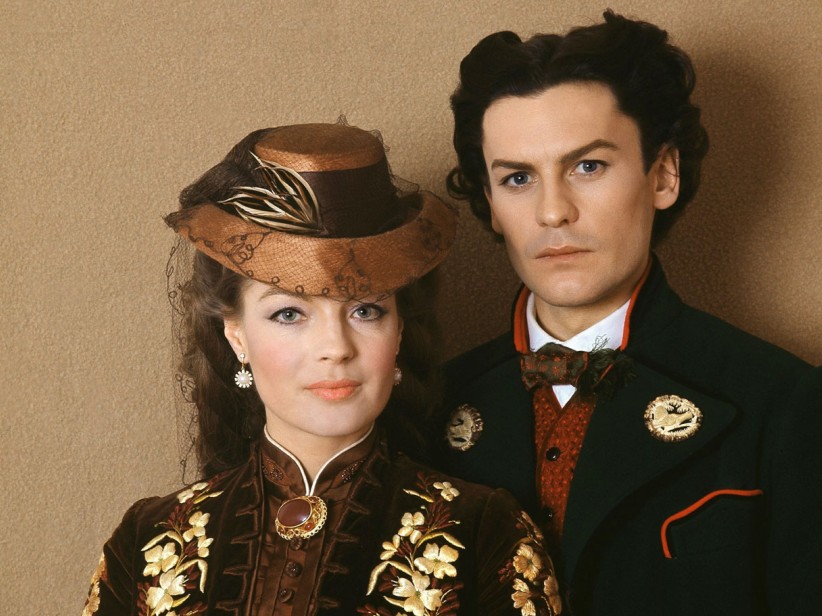
The film opens in 1864, the day that 19-year-old man-child Ludwig (played by Visconti's muse and longtime partner Helmut Berger) assumes the throne with the intent of being a caring and humble leader despite little working knowledge of being a ruler. He's incapable of comprehending how the Bavarian government operates and shows little interest in learning, but he loves the lavish life and all the pomp and circumstance, immediately portending a mix of oblivious naivete and stubbornness that strongly suggests he's in way over his head and that if he had to campaign for the job, his slogan would've been "Make Bavaria Great Again." Ludwig would be termed "The Mad King" as time went on, but Visconti is sympathetic to his subject. Far from being "mad," Ludwig is painted more as a tragic figure, one who was taken advantage of by those closest to him and one who would be continually frustrated by his inability to find true love and happiness. Historians have always questioned the claim that he was "insane," and now generally agree that it was an excuse used by his opponents to remove him from the throne. The conclusion these days is that he was a distant, awkward person who probably never wanted to be king in the first place, and his frequent instances of erratic psychological instability may have been the result of increasing isolation and loneliness and even royal inbreeding. For much of his reign, Ludwig wants nothing more than to marry his cousin, Countess Elisabeth of Austria (Romy Schneider), but she continually rejects him, even unsuccessfully trying to arrange a marriage for him with her younger sister Sophie (Sonia Petrova).
Far from being a "mad" tyrant, he tries to compensate for his ignorance as a leader and the repeated rejections by Elisabeth by pouring himself into the arts, architecture, and other grandiose displays of extravagance. He views art as "the antidote for evil and corruption in society," and becomes the primary benefactor of disgraced composer Richard Wagner (Trevor Howard), who arrives in Bavaria with his conductor Alan von Bulow (Mark Burns) and his wife Cosima (Silvana Mangano), with whom Wagner is having an affair. Wagner and Cosima view Ludwig as a useful idiot, bilking and hustling everything they can out of the young king ("This half-witted boy," Wagner chuckles to Cosima), who is more than happy to give them everything they desire, including a palatial residence and a personal opera house designed exclusively for the staging of Wagner operas. Ludwig drains his personal fortune and exhausts any available credit through the Bavarian treasury to order the construction of one castle after another throughout his kingdom, many of which are exact copies of ones that already exist in France. He's informed by everyone--from Elisabeth to close advisers like Count von Holnstein (Umberto Orsini, who's definitely dubbed) and Count Durckheim (Helmut Griem)--that he's being used, that he's reckless and irresponsible in his spending, that Wagner is squandering taxpayer money, and that the Von Bulows are shameless opportunists looking for a free ride. Elisabeth lays into him most harshly, telling Ludwig point-blank that "Your pathetic friendship with Wagner gives you the illusion of creating something...just as I give you the illusion of love." Ouch.
This all sounds like compelling drama, but Visconti isn't concerned with things like narrative and story construction. Sure, these story elements are there, but it's dramatically inert and told with much emotional distance, as if he wants to make the audience feel as isolated and closed-off as his subject. It's an experiment that doesn't really make for compelling cinematic storytelling, and LUDWIG is often as dry and clinical as those educational history films that one-time fellow neo-realist Roberto Rossellini was making for Italian television around the same time. Granted, LUDWIG is much more opulent and visually stunning, with very few exteriors and almost all of the scenes shot in the actual castles and palaces that Ludwig had constructed during his reign. Even when Bavaria goes to war with Austria against Prussia, we see not a single battle that would seem to be a requirement in such a massive historical epic. Ludwig simply decides to side with Austria and is eventually told that they've lost the war. On one hand, you get what Visconti is doing: by seeing nothing whatsoever of the war, the audience is in the same mindset as Ludwig, who was utterly unconcerned with it and was completely unaffected by it win or lose. But telling the story in this manner gives the film a choppy and incomplete feel even at four hours. Even with Ludwig's interactions with Elisabeth and Wagner and his gradual retreat into proto-Howard Hughes seclusion even to those closest to him (it's also feasible that he suffered from social anxiety disorder), it's still nearly three hours before Visconti gets anything resembling dramatic momentum going, when Count Durckheim is called in for an inquiry with top-ranking Bavarian officials at the behest of the duplicitous Count von Holnstein (the closest thing LUDWIG has to an outright villain). This secret group is conspiring to have Ludwig declared insane, which would force him to abdicate and give power to his uncle Prince Luitpold (Gerard Herter), as the next in line of succession is Ludwig's schizophrenic younger brother Prince Otto (John Moulder Brown), who's already been deemed even less capable of assuming the throne than his elder sibling. This long sequence--where Durckheim angers the rebellious government officials and defiantly professes his loyalty to Ludwig, refusing to have any part in the coup--plays out in Italian, meaning it was completely absent from the US cut. Again, how could anyone watching this movie in an American cinema in 1973 have even a hint of a clue as to what was happening?
LUDWIG was Visconti's most personal and ambitious film, and it's in many ways a summation of all of his obsessions and fixations. You can draw a straight line from Burt Lancaster's Prince of Salina in 1963's THE LEOPARD through Dirk Bogarde's Gustav von Aschenbach in 1971's DEATH IN VENICE and Berger's Ludwig through Lancaster's aging, nameless Professor in 1974's underrated CONVERSATION PIECE: lost men out of their time, living in the past, obsessed with beauty, art, decadence, and decay, sheltering themselves by hiding away in opulent mansions and/or dilapidated palazzi from a changing society they no longer understand in a world that's left them behind. From 1965 until his death in 1976, the openly gay Visconti was romantically involved with the much-younger Berger, who made his mark in Marlene Dietrich drag in Visconti's THE DAMNED but always seemed overtly androgynous even when he was playing tough guys in Eurotrash thrillers like 1975's ORDER TO KILL and 1977's MAD DOG KILLER. Visconti's and Berger's relationship (now 72, the bisexual Berger eventually married Italian actress Francesca Guidata but still refers to Visconti as the one great love of his life) is reflected throughout the director's later years, particularly with von Aschenbach's obsession with a teenage boy in DEATH IN VENICE and in Ludwig's fixations on attractive young men like officer Hornig (Marc Porel) and actor Joseph Kainz (Folker Bohnet). He spies on another young officer skinny-dipping and is also seen in a state of depressed malaise, in a decadent hideaway surrounded by nude young men lounging about the premises (I'm guessing that scene wasn't in the PG version). Watching Ludwig's decline and fall hastened by his commitment to an unattainable artistic vision at odds with everyday practicality, LUDWIG is as much about the Bavarian king as it is about Visconti himself.
But in lieu of anything to really drive the narrative for the first three hours, Visconti instead opts to make LUDWIG one of the most stunningly beautiful films you'll ever see. The location shooting in the castles, coupled with the art direction, the cinematography by Armando Nannuzzi (who would infamously lose his right eye in 1985 in an on-set accident during the making of Stephen King's MAXIMUM OVERDRIVE) and Piero Tosi's Oscar-nominated costume design make it a thoroughly captivating visual experience, especially on Blu-ray. As far as the performances go, Berger commits, looking haggard and thinner by the end, with greasy hair and augmented with convincingly rotted-looking teeth. He gets an enraged outburst every few scenes (if you watch with the Italian track, he's dubbed by Giancarlo Giannini), but when the film never lets you get into the heart and mind of Ludwig, what's the point? Faring much better is Howard, who benefits most from the recovery of the English soundtrack. The veteran British character actor (Visconti's second choice after Laurence Olivier turned it down) is just superb here, a larger-than-life presence stealing every scene he's in as the self-serving and subtly manipulative Wagner, who seems to genuinely like "this half-witted boy" but still puts himself first before all. Howard is so good here that had critical and commercial response to LUDWIG not been so toxic, he probably could've gotten a Best Supporting Actor Oscar nomination.
Berger and Visconti on the set
But man, this is a horse-pill. It's easy to draw comparisons between LUDWIG and another visually intoxicating but impenetrable and alienating epic that was a little further on the horizon: Michael Cimino's 1980 western HEAVEN'S GATE. Like that film, LUDWIG is a breathtaking sight to behold but its storytelling mechanics leave a lot to be desired. Both films were chopped down to more accessible, commercial lengths that rendered them incomprehensible, and now both are available in their intended versions (Visconti's estate gave its approval to Arrow's restoration). And both films essentially destroyed the careers of the filmmakers who lovingly crafted them, auteurs whose single-minded focus is exhaustingly precise, but caused them to lose sight of the bigger picture. Cimino is so concerned with nailing the accuracy of the time period in HEAVEN'S GATE, right down to whatever the most barely visible extra in the background is doing, that he forgets important details that lead to such questions as "Why are Jeff Bridges and John Hurt even in this movie?" Likewise, Visconti was so zeroed in on the atmosphere and the look of Ludwig's era, shooting in as many actual locations as possible, and getting the decor and the sets and the clothing down perfectly that he forgot to write a complete script with a beginning, middle, and end. Characters appear and disappear with baffling suddenness, you don't know who they are, the motivations of some are really fuzzy, and you may find yourself asking such questions as "Why is Gert Frobe even in this movie?" Visconti battled back as best he could after his stroke and would still make two more films--1974's CONVERSATION PIECE and 1976's THE INNOCENT--but LUDWIG would be the last one he'd see released in America in his lifetime. It was a huge flop and made him a pariah to the major studios. Visconti died in March 1976 at the age of 69, and CONVERSATION PIECE, even with a screen legend like Burt Lancaster starring, didn't hit American theaters until it was picked up by a fledgling New Line Cinema in 1977, while THE INNOCENT remained unseen in the US until the small arthouse outfit Analysis Films released it in 1979.
The 137-minute, PG-rated version of LUDWIG
opening in Toledo, OH on September 7, 1973.
It lasted one week.