tenebre

tenebre
Showing posts with label Peter Strickland. Show all posts

Friday, February 28, 2020

On Blu-ray/DVD: COLOR OUT OF SPACE (2020), IN FABRIC (2019) and RABID (2019)


COLOR OUT OF SPACE
(Malaysia/US/Portugal - 2020)
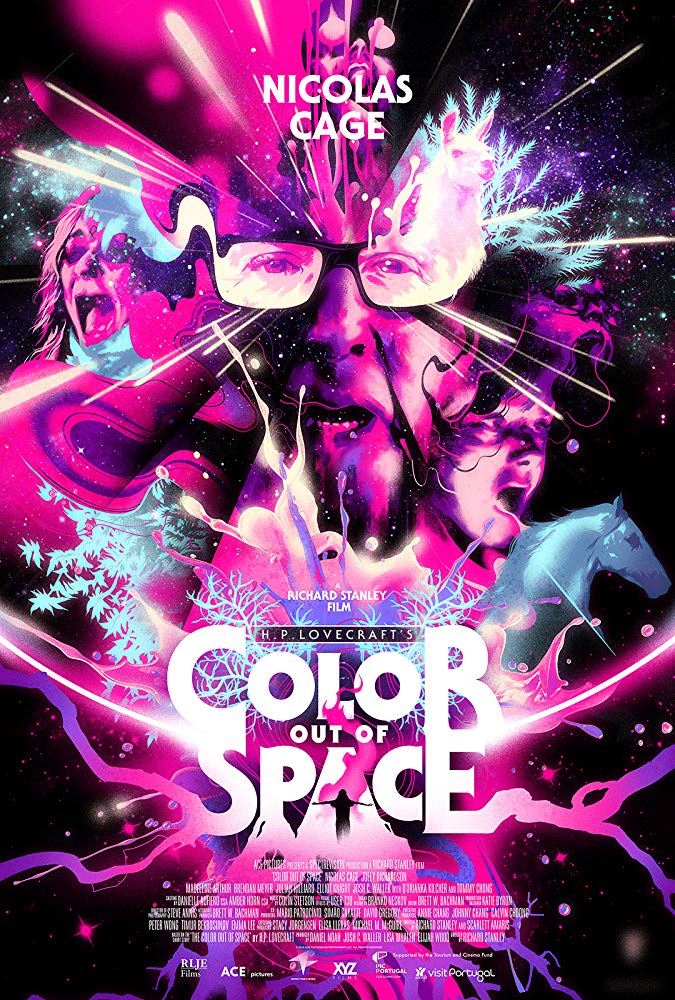

COLOR OUT OF SPACE would've been newsworthy enough on the basis of it being an H.P. Lovecraft adaptation starring Nicolas Cage in MANDY mode, but what really caused some excitement was the long-overdue return of Richard Stanley to narrative features almost 25 years after being fired from THE ISLAND OF DR. MOREAU, effectively ending his Hollywood career. Stanley established some significant cult bona fides with 1990's HARDWARE and 1992's DUST DEVIL, but when he clashed with New Line execs and a particularly dickish Val Kilmer during the first week of shooting on MOREAU, he was shown the door and replaced by John Frankenheimer, the entire clusterfuck of a production covered in the acclaimed 2015 documentary LOST SOUL. Stanley made a few documentaries and short films, got a co-writing credit on Nacho Cerda's 2006 film THE ABANDONED, and helmed a short segment of the 2011 anthology film THE THEATRE BIZARRE, but COLOR OUT OF SPACE is, at long last, his triumphant proper return. Based on Lovecraft's 1927 short story "The Colour Out of Space" and previously filmed in 1965 as DIE, MONSTER, DIE! with Boris Karloff and as the Ovidio G. Assonitis-produced THE CURSE in 1987, COLOR is a frequently surreal bit of phantasmagorical horror that shares some stylistic similarities with MANDY (as well as Cage and some producers, including Elijah Wood), but also seems indebted to the disturbing metamorphosing aspects of ANNIHILATION (not to mention one sequence that's an obvious nod to THE THING) while name-checking various Lovecraft essentials, with several character names and mentions of Arkham and Miskatonic.


When a meteorite crashes on the front lawn of the farmhouse of Massachusetts (but shot in Portugal, of all places) alpaca breeder Nathan Gardner (Cage) and his cancer-stricken wife Theresa (Joely Richardson), strange occurrences become the new normal: the water supply is tainted, their personalities are affected, they blackout as hours pass in an instant, youngest son Jack (Julian Hillard) stands by the well, saying he's "talking to my friends." Nathan suffers from wild mood swings and lashes out at the two older kids, stoner Benny (THE GUEST's Brendan Meyer) and free-spirited Lavinia (Madeleine Arthur). And all the while, inexplicable purple-derived light and color formations manifest themselves and envelop the Gardner property, which grows more isolated from the outside world by the day. There's also hydrologist Ward (Elliot Knight), who's surveying the groundwater at the behest of the do-nothing mayor (THE NEW WORLD's Q'orianka Kilcher), and Ezra (Tommy Chong), an easygoing, harmless squatter living in a shack on the edge of the Gardner property, who records voices of "The people under the floor, man!" that match the creepy garbled gibberish and screams that are heard on the other end of the line ("It's in the static! It's in the moisture!") whenever anyone tries to make a phone call. Stanley establishes an effectively ominous, otherworldly mood amidst the hypnotic, cosmic colorgasms ("It's just a color...but it burns"), and after a too-slow buildup that sometimes overindulges Cage's required-by-law freakouts (resurrecting some of his VAMPIRE'S KISS schtick), COLOR OUT OF SPACE really catches fire in its second half, with some truly unsettling visuals, unexpected emotion, soundtrack appearances by Mayhem and Burzum, and absolutely no mercy in who it's willing to kill off. It also offers some humor, particularly in the way the local media portrays Nathan as a UFO crackpot when they arrive at the farm to cover the meteorite crash. Easily the most noteworthy Lovecraft adaptation since Stuart Gordon's DAGON back in 2001, COLOR OUT OF SPACE is solid horror offering with Cage bringing his A-game in his best film since MANDY, and while it doesn't top the visionary HARDWARE in the Best of Richard Stanley rankings, it sure is great to have him back. (Unrated, 110 mins)


IN FABRIC
(UK - 2019)


IN FABRIC is the latest retro exercise from British filmmaker Peter Strickland, whose obsessively-detailed '70s aesthetic was displayed in the giallo-tinged paranoia thriller BERBERIAN SOUND STUDIO and the BDSM love story THE DUKE OF BURGUNDY. Strickland's films tend to be triumphs of style over substance and to that end, IN FABRIC is no exception, though it did get some buzz in horror circles last fall as "the killer dress movie" when the trailer went online, but A24 opted to keep it confined to arthouses and VOD. After seeing BERBERIAN and DUKE, I've concluded that I like the idea of Strickland's films more than I like the films themselves. Set in the early 1980s, IN FABRIC has some hypnotically stylish visuals and an incredible score by Cavern of Anti-Matter that sounds like it could've come straight from a 1972 fashion giallo with Edwige Fenech and George Hilton. Strickland nails the look and feel, but in terms of story, IN FABRIC is uneven, unfocused, and all over the place. Other than the look and sound, the film's biggest strength is Marianne Jean-Baptiste's performance as Sheila Woodchapel, a lonely bank teller recently left by her husband for a younger woman. She lives with her college-age son Vince (Jaygann Ayeh) and listens to him having sex with his intimidating, older goth model girlfriend Gwen (Gwendoline Christie). She decides to try the personals and treats herself to a new dress prior to her first blind date, purchased during a highly-publicized sale at Dentley & Soper's, a posh department store where she's attended to by eccentric saleswoman Miss Luckmoore (Fatma Mohamed). But after wearing the dress, she develops a rash, the dress destroys her washing machine, and while everyone's asleep, it hovers around the house on its own and even attacks Gwen at one point.


So far, so good, but then Strickland abruptly shifts gears around 70 minutes in, abandoning Jean-Baptiste's character to focus on nerdy washing machine repairman Reg (Leo Bill), who's about to be married to childhood sweetheart Babs (Hayley Squires). Reg's co-workers purchase the same red dress and make him wear it at his bachelor party, and the same strange cycle repeats--rash, wrecked washing machine, dress floating around the house--only with Reg being a little dorky, the second half is played more broadly compared to the ominous and eerie first half. Much of the humor comes from the bureaucratic, OFFICE SPACE-meets-Kafka-style nonsense that both Sheila's and Reg's bosses level at them, with Sheila being reprimanded by supervisors Clive (Steve Oram) and Stash (Julian Barratt of THE MIGHTY BOOSH) over a two-minute bathroom break, her handshakes "not being meaningful enough" and for smiling and waving at the manager's mistress when they bumped into one another on the street. Strickland also includes some scathing, satirical Orwellian jabs at capitalism, retail, and customer service in ways that seem more like he really wanted to make a Terry Gilliam movie but couldn't cut the cord from his Dario Argento/Eurocult/giallo fetishism, and to further muddy the waters, he throws in some HALLOWEEN III-inspired Dentley & Soper's TV spots that lull targeted viewers into a catatonic state. I really wanted to like this, and once again, I love what I see and hear but I'm still left cold by Strickland, who's starting to look like a one-trick pony, but it's admittedly an endlessly watchable trick. He's an extraordinarily gifted stylist, and other than Panos Cosmatos (BEYOND THE BLACK RAINBOW, MANDY) and maybe the team of Helene Cattet & Bruno Forzani (THE STRANGE COLOUR OF YOUR BODY'S TEARS), I can't think of a current filmmaker who's better at taking their influences and using them to craft sequences and set pieces that better convey the dazed sense of half-remembered fragments of a shared dream. Strickland's got that part down, but on a narrative level, IN FABRIC is a complete mess that basically turns into an uninspired BLACK MIRROR episode by the time it's over.  (Unrated, 119 mins)


RABID
(Canada - 2019)


Twin cult horror specialists Jen and Sylvia Soska (collectively billed as "The Soska Sisters") have always cited fellow Canadian David Cronenberg as their major cinematic influence, a sentiment echoed in their breakout body modification cult film AMERICAN MARY. To that end, remaking Cronenberg's 1977 classic RABID probably seemed like a good idea, but RABID '19 is a crushing failure at almost every turn. The central premise--the spread of a new strain of rabies stemming from a woman who's just had experimental surgery following a motorcycle accident--is the same, but none of the other incidental changes do anything to justify the remake's existence. Shy, motorcycle-riding seamstress Rose (Laura Vandervoort) works for pompous and stereotypically flamboyant fashion guru Gunter (McKenzie Gray). She's treated like dirt by his models with the exception of Chelsea (Hanneke Talbot), her childhood foster sister since she was taken in following the death of her parents in a car accident. It's Chelsea who got her the job, and who tries to set her up with Brad (Benjamin Hollingsworth), but when Rose leaves a Gunter event after realizing Brad only asked her out at Chelsea's request and then overhearing two mean girl cokehead models (played by the Soskas) talking shit about her in the ladies room, she leaves the party in a frazzled state and is immediately hit head-on by another car.


Rose wakes up in the ICU after a week (with the attending physician played by Stephen McHattie, probably the first sign that her situation is about to go from bad to worse) to find most of the left side of her face has been ripped off in the accident, with her jaw needing to be sewn back on. She's recommended for treatment at the Burroughs Clinic, an exclusive facility that deals in regenerative medicine and "Transhumanism." Rose is the subject of an experimental stem cell skin graft procedure pioneered by (deep sigh) Dr. William Burroughs (Ted Atherton). She's initially apprehensive, but it proves to be a complete success. She's more beautiful than ever, she gets her job back, is creatively inspired, and Brad seems legitimately interested in her, but...she's a devout vegetarian and suddenly develops a strange craving for raw meat. She wakes up with faint memories of violent dreams where she's attacking men in a flesh-eating fury. Soon, the people with whom she comes into contact (including UFC star CM Punk, cast radically against type as a meat-headed asshole) begin exhibiting even more advanced symptoms of a virulent new form of rabies that becomes a citywide epidemic. RABID '19 devotes a lot of time to lampooning the vapidity of the fashion industry in trite fashion, but at the same time dutifully hitting all of the old-school Cronenberg bullet points of body horror and disease. It also offers shout-outs to a bunch of his other films as well, like NAKED LUNCH with the name-dropping of Burroughs, the clinical surgical horrors of DEAD RINGERS (including the brief presence of Heidi Von Palleske as a member of the Burroughs surgical team), and the shady experimental treatment facility of THE BROOD. The protruding armpit phallus from the original RABID (also notable in its day as the first mainstream crossover attempt of porn star Marilyn Chambers) finally appears in the off-the-rails third act, where RABID '19 completely falls apart, abandoning the Cronenberg worship and turning into a dumb tribute to the late '80s work of Brian Yuzna and Screaming Mad George. The pointless RABID '19 really overstays its welcome at 108 minutes and can't even get the little things right--wouldn't McHattie (PONTYPOOL) have made a more interesting Dr. Burroughs than the bland Atherton? The first line of dialogue heard here is a ranting Gunter asking "Why do we keep remaking old trends?" A valid question, and one asked with little sense of self-awareness by the Soskas, since RABID '19 certainly qualifies as part of the problem. (Unrated, 108 mins)

Sunday, October 4, 2015

On DVD/Blu-ray: THE DUKE OF BURGUNDY (2015); THE CONNECTION (2015); and ALLELUIA (2015)


THE DUKE OF BURGUNDY
(UK - 2015)


When it opened in early 2015, the UK import THE DUKE OF BURGUNDY was the other BDSM film, the art-house counterpart to the more commercial and mega-hyped FIFTY SHADES OF GREY. Written and directed by Peter Strickland, whose BERBERIAN SOUND STUDIO was a paranoia nightmare told in the vein of a 1970s Italian giallo, THE DUKE OF BURGUNDY follows numerous stylistic tropes seen in BERBERIAN, namely an unabashed adoration of the 1970s and an intricate and fascinating sound design. It's also a bit more substantive than the intriguing but empty BERBERIAN, which opened with a terrific set-up and then didn't really go any deeper than the surface. THE DUKE OF BURGUNDY's much-discussed opening credits sequence would appear to portend a softcore '70s sexploitation outing along the lines of a smutty British sex farce or an EMMANUELLE film, complete with a prominent credit for "Perfume by Je Suis Gizella." It's the story of a BDSM relationship between older, erudite lepidopterist Cynthia (Sidse Babett Knudsen) and younger, demure protege Evelyn (Chiara D'Anna). Their role-playing takes on an almost JEANNE DIELMAN sense of precision repetition: Evelyn arrives at Cynthia's house, and Cynthia proceeds to make her clean the house, do the laundry, and be treated in all sorts of demeaning fashions, whether it's being interrupted or Cynthia making a mess where Evelyn just cleaned. Often, Cynthia will demand a foot massage. This repeats until we see that they're a loving couple and this is their intimate routine. But Strickland gradually reveals more: it's Cynthia who's the submissive, giving into Evelyn's domination and her demands to be humiliated. It's ultimately a story of the compromises, concessions, and the give-and-take involved in any committed relationship, whether it's one party acquiescing and allowing the use of an old trunk as a coffin for the other to be bound and held in as punishment, or whether one draws the line at treating the other as a "human toilet."


Considering its subject matter, BURGUNDY, whose creative spark was ignited, oddly enough, when Strickland turned down an offer to remake Jess Franco's 1974 film LORNA THE EXORCIST, is hardly the Skinemax softcore throwback you'd expect from the opening credits (which, as amusing and dead-on retro as they are, end up feeling like a stunt that has little to do with what transpires later) and the butterfly symbolism a tad too heavy-handed an obvious (and reminiscent of the 1995 art film ANGELS & INSECTS), but it manages to convey an overtly explicit feel without being very graphic at all. There's barely any nudity and only some fleeting onscreen sex. Yet Strickland's film is a hazy fever dream of erotica, with plenty of caressed skin, a couple of tastefully-executed sex scenes (he keeps the water sports heard but not seen), two excellent performances (Knudsen, in particular), and enough lingering shots of Knudsen's and D'Anna's feet to send it to the top of Quentin Tarantino's Best of 2015 list. (Unrated, 104 mins, also streaming on Netflix Instant)


THE CONNECTION
(France/Belgium - 2014; US release 2015)


This French crime saga directed and co-written by Cedric Jiminez purports to tell the French side of the drug trade depicted in THE FRENCH CONNECTION. Despite his love of handheld cameras for maximum immediacy, Jiminez never achieves the kind of wired, adrenalized intensity that William Friedkin established 44 years ago, and aside from the immediate art-house cred that comes with being a subtitled, foreign-language film, THE CONNECTION is utterly and frustratingly ordinary in every way. Jiminez borrows some Friedkin here, some Scorsese there, a good-sized portion of Ridley Scott's AMERICAN GANGSTER, and a heaping helping of Michael Mann's HEAT in its mirror-image motif of law enforcer vs. criminal and how they're flip sides of the same coin. Just to hammer it home, Jiminez even casts two actors who look very much alike, almost like you expect him to pull a Bunuel switch at the midpoint and have the stars switch roles. At least that would've been something unpredictable. THE ARTIST Oscar-winner Jean Dujardin busts his ass to enliven the uninspired material, often channeling the pent-up rage of a young De Niro as Pierre Michel, a Juvenile Court magistrate in 1975 Marseilles. He's transferred over to the Organized Crime unit and ordered to do everything at his disposal to bring down drug kingpin Gaetan Zampa (Gilles Lellouche), the key figure in the Marseilles-to-NYC heroin trade.


What follows is over two hours of Michel and his task force of interchangeable, nondescript supporting actors unable to make anything stick to teflon Zampa during an obsessive investigation that lasts from 1975 to 1981, and both men see their private lives suffer as a result of their respective professions: Zampa's wife (Melanie Doutey) is temporarily placated when her husband gives her a disco to run (cue Blondie's "Call Me," which must mean the producers couldn't secure the rights to "Heart of Glass," the mandatory song for every establishing shot of a disco in a movie set in the 1970s), but Mrs. Michel (Celine Sallette) grows weary (as will the viewer) of Michel being called away by work from literally every meal he's able to have at home with the family. You could almost make a drinking game out of it. And of course, just as in HEAT, Michel and Zampa have a mid-film confrontation where they acknowledge they're not much different from one another, but they best stay out of the other's way. Jiminez admirably doesn't get sidetracked by paying too much attention to period detail other than long sideburns, a detour to Manhattan that shows off a badly CGI'd shot of the half-built Twin Towers (which were completed by 1975 anyway), and one character name-dropping John Travolta and SATURDAY NIGHT FEVER. Dujardin and Lellouche are excellent, and Benoit Magimel and Cyril Lecomte have some standout moments as some Zampa criminal associates, but they all deserve more worthy material than this rote, paint-by-numbers non-epic that plays like lukewarm leftovers of too many better movies that inspired it. (R, 135 mins)


ALLELUIA
(Belgium/France - 2014; US release 2015)


With his 2004 feature debut, the rural, backwoods-set CALVAIRE, Belgian filmmaker Fabrice Du Welz became linked with the French "extreme horror" movement popularized by the likes of Alexandre Aja's HIGH TENSION (2003), Alexandre Bustillo and Julien Maury's INSIDE (2007), Xavier Gens' FRONTIER(S) (2008) and Pascal Laugier's MARTYRS (2008). Du Welz followed CALVAIRE with the ambitious but unfocused VINYAN (2008), an English-language "ramshackle-boat-journey-upriver as metaphor for journey-into-madness" horror film that took too long to get to its genuinely unnerving, terrifying finale. VINYAN tanked worldwide before going straight-to-DVD in the US in 2009 and Du Welz vanished. He resurfaced in 2014 with a pair of thrillers, ALLELUIA and COLT 45, though only the former has received a US release (Du Welz's next project will bring him to Hollywood 12 years after he made a splash with CALVAIRE--the Chadwick Boseman action thriller MESSAGE FROM THE KING is due out in early 2016). ALLELUIA is a very loose and aggressively unhinged retelling of the 1940s "Lonely Hearts Murders," where spinster nurse Martha Beck and con-artist/gigolo Raymond Fernandez pursued victims through personal ads and proceeded to rob and murder the women whose ads Fernandez answered, with Beck posing as his sister. The story was previously depicted in the 1969 cult classic THE HONEYMOON KILLERS, with Shirley Stoler and Tony Lo Bianco, the 1996 Mexican film DEEP CRIMSON, and the barely-released 2006 thriller LONELY HEARTS, which focused on the detectives (John Travolta, James Gandolfini) pursuing the Lonely Hearts serial killers (Jared Leto, Salma Hayek). Du Welz's version updates the story to the present-day, with lonely morgue attendant and single mother Gloria (frequent Almodovar star Lola Duenas) meeting Michel (Laurent Lucas) after her friend Madeleine (Stephane Bissot) posts her profile on an online dating site. After falling hard for Michel even knowing he's a scheming con artist, Gloria impulsively leaves her young daughter with Madeleine and hits the road with Michel, finding women on dating sites and often going for the long con, with Michel marrying them and Gloria posting as his sister. The adventure stirs some kind of psychosis in Gloria, who grows insanely jealous when Michel has to sleep with their marks, which usually results in Gloria going off the deep end and brutally murdering the women. Michel becomes her unwitting accomplice, helping her dispose of the bodies--her job experience at the morgue comes in handy--but as their con games go on, Gloria grows increasingly deranged, with Michel unable to control her and her wild impulses.


Du Welz sometimes gets a little too goofy for his own good, such as Gloria getting a somber musical number before taking a saw to the corpse of the couple's latest victim, or a half-baked attempt at putting a vague supernatural spin on things with Raymond's prayer rituals and a bizarre sequence of a naked Michel and Gloria dancing by a raging fire, but ALLELUIA is a grim and disturbing sleeper that sneaks up on you. A lot of it has to do with the almost claustrophobic immediacy of the grainy, 16mm cinematography by Manuel Dacosse (AMER, THE STRANGE COLOUR OF YOUR BODY'S TEARS), but most of it is the thoroughly off-the-chain performance of Duenas. Du Welz and Duenas pull a cunning bait-and-switch with how plain and mousy she's introduced. You question the logic of her going to work the morning after meeting Michel and having him stay the night, then leaving her daughter with him. Once they're a couple and on the road, Michel soon realizes he has no idea what he's gotten himself into, and doesn't enter into his con games with murder in mind until Gloria puts him in that position. Michel is just a scheming heel who's trying to con lonely women out of their money--it's he who becomes an accomplice to murder and it's he who's forced into murder by Gloria, in whom he's awakened a sleeping giant prone to uncontrolled fits of rage and limb-flailing meltdowns. It's a slightly different take on the subject that seems to have been chosen simply because Du Welz wanted Duenas to let it rip with wild abandon, and she obliges. There are some instances where Du Welz is distracted by what he probably perceived to be transgressive shock value, like a scene where Gloria masturbates while Michel sucks on her toes and jerks off, or when he stages one of the most precariously-framed mainstream cinema blowjobs in recent memory, but ALLELUIA is a mostly effective bit of grim bleakness that stumbles here and there, didn't need the dumb musical number and could use a stronger ending, but Duenas' mad, almost possessed performance makes it a must-see. (Unrated, 93 mins)