RELIC (US/Australia - 2020) Directed by Natalie Erika James. Written by Natalie Erika James and Christian White. Cast: Emily Mortimer, Robyn Nevin, Bella Heathcote, Chris Bunton, Catherine Glavicic, Steve Rodgers, Jeremy Stanford. (R, 90 mins) It's easy to take a cursory glance at the poster for RELIC and assume it's a HEREDITARY knockoff. Indeed, it does belong in the same sort of "familial slow burn horror" subgenre, along with something like THE BABADOOK. But RELIC has more similarities to the minor cult film THE TAKING OF DEBORAH LOGAN, which used demonic possession as a metaphor for dementia with its aging title character. DEBORAH LOGAN had some interesting ideas and a couple of genuinely scary moments in its early-going, but once the focus shifted to the usual rote possession histrionics, it lost the thread and completely fell apart. RELIC manages its metaphorical implications with much more assurance, so much so that after all hell breaks loose in a third act that's unrelenting in intensity with its increasing sense of anxiety and claustrophobia, it ends with unexpected poignancy in a haunting final shot. It's a remarkably confident feature debut for US-born, Australia-based director/co-writer Natalie Erika James, who found some serious support for the project with backing from AGBO, the production company of the Marvel sibling team of Joe & Anthony Russo, along with Jake Gyllenhaal, who's credited as one of the producers.
Kay (Emily Mortimer) arrives from Melbourne with her university dropout daughter Sam (Bella Heathcote) at the suburban home of her elderly mother Edna (Australian theater legend Robyn Nevin, probably best known to American audiences as Councillor Dillard in the MATRIX sequels), whose neighbors haven't seen her in several days. Widowed Edna is in her 80s and lives alone, and busy Kay hasn't spoken to her on the phone in several weeks. Kay and Sam arrive and immediately see things don't look right around the house. They're fully expecting to find her dead, bracing themselves as they check each room, but she's nowhere in the house. The house shows signs of disarray: fruit has rotted, Edna is putting food in a dish for a dog that died some time ago, a chair is facing the wrong way, and there are hastily-installed makeshift locks on all the doors. But she seems to be managing to a certain extent, even having the cognizance to leave Post-It notes with simple reminders like "Take pills." There appears to be some degree of hoarding, there's a concerning amount of black mold as a result of a flooding a year earlier when Edna left the bath water running, and there's an occasional, unexplained pounding in the walls. Sam puts on her grandmother's sweater and finds a scribbled note in the pocket reading "Don't follow it." After three days, Kay and Sam awake to the sound of a whistling tea kettle, and Edna is in the kitchen, showing some minor bruising on her chest and her legs and feet dirty, as if she's been outside the whole time. She insists nothing is wrong, but her mood is erratic, she resents Kay butting into her business, and she says she installed extra locks because "people have been in the house." She has moments where she's her old self and she's crystal clear, smiling and dancing with Sam, but that changes out of nowhere with rapidly increasing frequency, whether it's a cruel remark about Kay's divorce or when she sees Sam wearing a ring she'd given her a day earlier, but now angrily accuses her of stealing it and violently yanks it from her finger.
Anyone who's watched the decline of an aging loved one due to dementia will know first-hand the tragic horror of RELIC all too well, and James and co-writer Christian White nail the alternating feelings of anger, sadness, helplessness, and guilt that gradually begin to overwhelm Kay. The third act takes an unexpected turn that can't really be too extensively discussed without spoilers--the house becomes a tangible symbol of Edna's dementia, intent on keeping Kay and Sam from leaving--and it's something that could've easily been disastrous if not handled the right way. James does maybe pound the metaphor into your head one or two times more than is necessary to get the point, but her handling of the finale, the discovery of one final and heartbreaking Post-It note, the last moment of clarity when the inevitable is accepted, and what Sam sees in that moment, is an emotional wrecking ball and devastatingly real to anyone who knows that pain. When you think about the symbolism when the movie's over, you realize RELIC shouldn't work as well as it does, but it speaks to James' discipline and control--and the excellent work of the three stars--that it stays focused and doesn't fly off the rails. There's a mounting sense of dread throughout, with a subtle, omnipresent rumble in the sound design, and on a few fleeting occasions, you catch a quick glimpse of something, a dark figure deep in the background, lingering at the very edge of the frame. There is something in the house, and James wisely avoids the tired genre tropes, as when Edna insists there's something under her bed and tells a dismissive, annoyed Kay to look. She does and what's there is presented in a far more unsettling fashion than any jump scare.
Bella Heathcote, director/co-writer Natalie Erika James,
Robyn Nevin and Emily Mortimer at Sundance in January 2020
THE SISTERS BROTHERS (US/France/Germany/Spain/Romania/Belgium - 2018)
The $40 million revisionist western THE SISTERS BROTHERS was an expensive flop when it opened in theaters in the fall of 2018 and grossed just $3 million. An unmarketable art-house offering that had no business being sold as commercial multplex fare, it's the English-language debut of acclaimed French filmmaker Jacques Audiard (THE BEAT THAT MY HEART SKIPPED, A PROPHET, RUST AND BONE) and is based on a 2011 novel by Patrick deWitt. It was a long-gestating pet project for star John C. Reilly, who acquired the movie rights immediately after the book was published. It took Reilly six years and funding from six countries to finally get the film made, and with picturesque exteriors shot in Romania and the old spaghetti western stomping grounds of Almeria, Spain, cinematography by the great Benoit Debie, a score by Alexandre Desplat, and costume design by the legendary Milena Canonero, the money and the prestige are certainly up there on the screen. But the story is so sluggish and its intent so indecisive that the film never quite catches fire despite some excellent work by Reilly and his co-stars. Opening in 1851 Oregon during the Gold Rush, the story has sibling gunslingers Eli (Reilly) and Charlie Sisters (Joaquin Phoenix) assigned by their powerful robber baron boss The Commodore (Rutger Hauer, wasted in a silent cameo and seen only briefly through a window) to track down Kermit Herman Warm (Riz Ahmed), a chemist he claims has stolen something valuable from him. The Commodore already has another regulator, John Morris (Jake Gyllenhaal), on Warm's trail, but the Sisters brothers are perpetually several days behind, due in large part to Charlie's heavy drinking. Eli is skeptical of the work they do for The Commodore, not really buying that so many people steal from someone so feared. Indeed, Warm has stolen nothing from The Commodore: he's invented a formula for a chemical that illuminates gold deposits when poured into a body of water, and he's got an investor in California ready to buy it from him, while The Commodore simply wants to steal it--and eliminate Warm altogether--for his own plentiful financial gain. The Sisters brothers eventually catch up with Morris and Warm, forming an uneasy alliance brought about largely by their collective loathing of The Commodore, but in particular, it's Eli who wants something different, even suggesting to Charlie that they ditch their outlaw life and "maybe open a store" (Charlie: "A store? What fucking store?!"). The good-hearted Eli longs to better himself, and Reilly really captures that sentiment in a wonderful little moment when he sees that the more sophisticated and erudite Morris also uses a toothbrush, a new and rare commodity in these environs that Eli just acquired but hasn't quite mastered.
THE SISTERS BROTHERS looks great and it's obvious that Reilly put his heart and soul into it, but maybe Audiard just wasn't the right guy for the job. He's made some terrific films, but this one can't really commit to being anything. It's too slow and dour to be a comedy, but it's also too offbeat and quirky with their bickering and brawling to be a serious western, trying to have it both ways and succeeding at neither. Both stars have worked multiple times with Paul Thomas Anderson (Reilly in HARD EIGHT, BOOGIE NIGHTS, and MAGNOLIA, and Phoenix in THE MASTER and INHERENT VICE), and I kept thinking that Anderson might've been more suited to what this seems to be going after as an introspective character piece about brotherly bonds and family trauma that stems from their abusive father. In the end, it's a noble, well-intentioned misfire that never really pulls itself together, and they seriously could've used a cardboard cutout of Rutger Hauer for as little as he's required to do in his scant seconds of screen time. (R, 121 mins)
THE GUILTY (Denmark - 2018)
Thrillers set in one location are always tricky to pull off, largely because the filmmakers often can't wait to get away from that specific location. It's hard to not recall the acclaimed Tom Hardy-in-a-car film LOCKE while watching the Danish thriller THE GUILTY. It's also reminiscent of the Halle Berry 911 thriller THE CALL, but with the patience and the discipline to stay in one place and, more importantly, with one person. Jakob Cedergren is on camera from the beginning to the end as Asger Holm, who's working as an emergency services dispatcher. Debuting director and co-writer Gustav Moller very deliberately fills in the pieces of Asger's back story as the film proceeds, but what we know up front is that he's a Copenhagen cop and he's been temporarily busted down to emergency dispatch for undisclosed disciplinary reasons. He's nearing the end of his shift, and he displays a visible impatience bordering on contempt--for the callers, his colleagues, and generally everything. He scoffs at a guy needing an ambulance because he's tripping on speed, and almost openly mocks a caller who was mugged by a hooker in the red light district. But then a call comes from a woman that caller ID lists as Iben Ostergard (voice of Jessica Dinnage). She's talking to Asger but pretending to talk to her daughter. Asger quickly deduces that she's been abducted and she's in a moving vehicle. He notifies the nearest precinct of her approximate location, then calls her home number to talk to her young daughter Mathilde (voice of Katinka Evers-Jahnsen). She's home alone with her infant brother and tells Asger that her parents had a fight and that Mommy (Iben) left with Daddy. Checking the records of Iben's estranged husband Michael, Asger discovers he's a convicted felon with a history of assault. Despite everyone--from his supervisor to the dispatchers at various precincts--telling him that he's done his job and they'll take it from here, the detective in Asger can't let it go. He calls his partner Rashid (voice of Omar Shargawi) and has him go to Michael's address to look for clues. Cops think they found the vehicle Iben is in, but it's a false alarm. The another team of cops arrive at Iben's house and are met with a shocking discovery. And all of this plays out with Asger listening in on a headset and staying on the line.
About 30 minutes in, Asger moves from his work station into a private office, which allows other developments to come to light. Why is he taking such an intense interest in this? Is he just that dedicated to his job? Will it get him out of the doghouse with his bosses? Is it a distraction from an oft-mentioned court appearance scheduled for the next morning? Why is a reporter calling him on his phone? Moller does an exemplary job with what essentially unfolds in real time, though specific time is never referenced nor a clock ever shown. It just feels like real time without the gimmick of drawing attention to itself. THE GUILTY is the kind of film that you find yourself watching with palpable tension and baited breath to the point where even the sound of vibrating phone is enough to put you on edge. It's like an 85-minute anxiety attack, especially when everything Asger does to help the situation in his take-charge fashion inevitably ends up making it worse. This wouldn't be nearly as effective as it is if not for the sure-handed vision of Moller and the riveting performance of Cedergren, who's logged a lot of time on Scandinavian TV (he co-starred in the original Danish version of the series THE KILLING) and is probably best known to foreign film enthusiasts for the 2008 black comedy TERRIBLY HAPPY. THE GUILTY got a good amount of acclaim during its limited US theatrical run, but nobody saw it. It's waiting to be discovered on Blu-ray and eventually streaming, and it wouldn't be at all surprising if it got a neutered Hollywood remake--which would likely have Asger ditching the dispatch center 15 minutes in and going on a city-wide rampage himself to find Iben--but this under-the-radar gem is a tightly-wound, expertly-constructed, and extremely well-played exercise in stomach-knotting tension. (R, 88 mins)
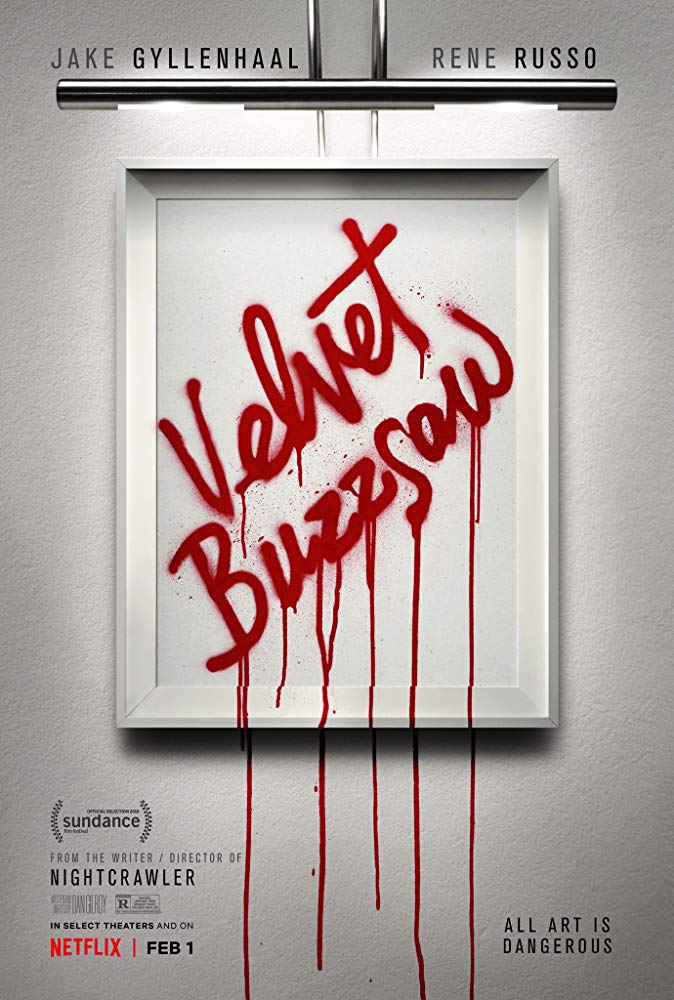
VELVET BUZZSAW (US - 2019) Written and directed by Dan Gilroy. Cast: Jake Gyllenhaal, Rene Russo, Toni Collette, John Malkovich, Zawe Ashton, Tom Sturridge, Natalia Dyer, Daveed Diggs, Billy Magnussen, Marco Rodriguez, Mark Steger, Steven Williams, Alan Mandell, Pat Healy, Nitya Vidyasagar, Mig Macario, Sedale Threatt Jr, Andrea Marcovicci, Christopher Darga, Ian Alda. (R, 112 mins) Since shifting to directing with 2014's acclaimed NIGHTCRAWLER, veteran journeyman screenwriter Dan Gilroy (FREEJACK, CHASERS) has demonstrated a knack for getting top-shelf performances from his actors. Jake Gyllenhaal's work in NIGHTCRAWLER remains his career-best and one of the most egregious Oscar snubs in recent memory. Gilroy guided Denzel Washington to yet another Academy Award nomination for 2017's legal thriller ROMAN J. ISRAEL, ESQ, and while those two films share common themes, they also share similar flaws. Gyllenhaal is so great in NIGHTCRAWLER that he single-handedly allows you to overlook the borderline naivete of the film's core observation that--SPOILER--people in the news media often resort to dubious tactics for a scoop and even--find the nearest fainting couch--sensationalize stories for ratings, something that wasn't even a shocking notion when NETWORK came out in 1976. Likewise, ROMAN J. ISRAEL, ESQ is carried by the exemplary work of Washington in service of a story that blows the doors off the idea that lawyers might become cynical and greedy after years on the job and may make decisions that aren't in the best interest of their clients. There's nothing wrong with the stories of NIGHTCRAWLER and ROMAN J. ISRAEL, ESQ in and of themselves, but while watching them, one gets the feeling that Gilroy thinks he's really on to something that no one's ever considered before. His two directorial efforts up to now are pretty good movies blessed by stars who heroically carry them on their shoulders and take them to the next level.
Gilroy's luck runs out with his latest, the Netflix Original VELVET BUZZSAW. More of an ensemble piece--he's likened it to Robert Altman's THE PLAYER, which is hubristically wishful thinking--VELVET BUZZSAW can't rely on just one actor to carry it, which only magnifies the weaknesses and, again, the obviousness of the points he's attempting to make. A bit outside Gilroy's comfort zone, VELVET BUZZSAW is a supernatural horror film set in the pretentious, self-important L.A. art world, centered mostly on snooty critic Morf Vandewalt (Gyllenhaal), a powerful mover-and-shaker in the scene who enjoys the constant sycophantic ass-kissing he gets from gallery owners, artists, and agents all looking for a good review. Just out of a relationship with Ed (Sedale Threatt, Jr), Morf falls hard for Josephina (Zawe Ashton), an ambitious assistant to top gallery owner and one-time '80s punk rocker Rhodora Haze (Gilroy's wife Rene Russo). Leaving for work one morning, Josephina discovers the dead body of a neighbor (Alan Mandell) in the hallway. The neighbor turns out to be an enigmatic mystery man named Vetril Dease, a janitor who left behind well over a thousand sketches and canvases in his HOARDERS-esque apartment, with specific instructions that they be destroyed upon his death. No one in the art scene has any info on Dease, but Josephina sees something in his work, steals it all from his apartment, and through shady legal machinations, ends up bringing them to Rhodora, who, along with rave blurbs from Morf, turns the late Vetril Dease into the scene's newest star. But those who come into contact with Dease's work start having bizarre hallucinations. Before long, there's a body count as everyone around Morf and Josephina start dying in inexplicable accidents involving Dease's work coming to life, almost as if part of his soul remains trapped in all of the art he's left behind.
Playing like an ill-advised collaboration between Clive Barker and Banksy, VELVET BUZZSAW (the name of Rhodora's old band, with their logo tattooed on the back of her shoulder--a cool title but it has virtually nothing to do with anything that happens) manages some occasionally decent satirical digs at L.A. art scenesters--like Morf showing up at one Dease victim's funeral and harshly critiquing the casket--but when almost every character is either an over-the-top caricature or a ruthless, self-serving asshole, it's kinda like shooting fish in a barrel. Gyllenhaal doesn't recapture his NIGHTCRAWLER mojo here, operating in two modes: incredulously condescending or Nic Cage freakout. Ashton's Josephina goes from the sympathetic moral center to heartlessly cruel viper out of nowhere, while Russo more or less plays her NIGHTCRAWLER character transferred to an art gallery. Gilroy doesn't really know what to do with either Toni Collette, as an art museum director turned buyer for Rhodora's chief rival Jon Dondon (Tom Sturridge), or John Malkovich, cast radically against type as "John Malkovich," playing a cynical recovering alcoholic and L.A. art legend who realizes right away that something is very wrong about Dease's work. There was some potential here, but Gilroy doesn't seem aware of the horror genre's cliches--paintings and art coming to life, Dease's work being painted with his own blood, a robotic exhibit called "Hoboman" (Mark Steger) that's an obvious attempt at creating a new Pinhead-type horror icon--and one attempted jump scare involving a roll of film on a projector might've worked if movies like SINISTER and IT didn't already exist (also, nothing here is as creepy or as unsettling as any random moment Gyllenhaal is onscreen in NIGHTCRAWLER). There's a valid point to VELVET BUZZSAW--that commerce trumps art and all anyone cares about is how much money they can make from it--but in criticizing this world in such a smug and pompous way, whether it's silly character names or a demonstrable lack of familiarity with horror in general (and the CGI splatter is really terrible), VELVET BUZZSAW is ultimately just as empty and vacuous as what it purports to be skewering. Just don't be surprised when "Hoboman" gets his own spinoff franchise.
OKJA (US/South Korea - 2017) Directed by Bong Joon Ho. Written by Bong Joon Ho and Jon Ronson. Cast: Tilda Swinton, Jake Gyllenhaal, Paul Dano, An Seo Hyun, Giancarlo Esposito, Byun Heebong, Steven Yeun, Lily Collins, Yoon Je Moon, Shirley Henderson, Daniel Henshall, Devon Bostick, Woo Shik Choi, voice of Jungeun Lee. (Unrated, 120 mins)
Visionary South Korean auteur Bong Joon Ho (THE HOST) returns with the Netflix Original film OKJA, his first since 2014's word-of-mouth arthouse/VOD hit SNOWPIERCER. Like SNOWPIERCER, OJKA splits its time between English and subtitled Korean, but instead of a grim, dystopian class struggle among the last remnants of humanity aboard a perpetually-moving train, it's a freewheeling, go-for-broke satire on corporate America, genetically modified foods, and idiotic TV personalities, among everything else Bong throws at the wall to see what sticks. Normally, the kitchen sink mentality on display here is a recipe for disaster, and while some of it is far too forced and over-the-top, its barbs hit and hit hard. The wild tonal shifts are by design, but Bong could've tightened the leash on a couple of the film's bigger names. OKJA opens in 2007, as Lucy Mirando (Tilda Swinton, in her second film for the director after SNOWPIERCER) is installed as the CEO of Mirando, an agrochemical biotechnology corporation obviously modeled on Monsanto. Lucy's taken over the post, replacing her twin sister Nancy, a PR nightmare viewed as "too mean" to sell the Mirando brand to the public. Lucy immediately starts a goodwill campaign involving 26 "super pigs"--genetically modified pigs created in a Mirando lab under the guise of maximum profits with a minimal footprint. And, as Lucy also explains, "They need to taste fucking good."
26 piglets are sent to various Mirando branches all over the world for a ten-year contest where farmers from each region raise the piglet from infancy to see who has the best "super pig." It's all a PR stunt to improve Mirando's dubious reputation and unethical practices, but in the rural farmlands outside Seoul, 14-year-old Mija (An Seo Hyun) lives with her simple farmer grandfather Heebong (THE HOST's Byun Heebong) and has grown attached to Okja, the intelligent super pig that Heebong received as a piglet a decade ago and is now the size of a small elephant. Okja is orphaned Mija's only friend, and when a Mirando entourage--including hapless South Korea branch exec Mundo Park (Yoon Je Moon) and asshole TV personality and MAGICAL ANIMALS host Dr. Johnny Wilcox (an out-of-control Jake Gyllenhaal)--plan a visit to check on the pig's progress after ten years, she's unaware that their intent is to take Okja away to show her off at Mirando's "Best Super Pig Fest" in NYC before sending her straight to the slaughterhouse. Angry at her grandfather for not being truthful with her about Mirando's plans, Mija runs away to Seoul in an effort to rescue Okja. She ends up being aided by a coordinated crew of animal rights activists from the ALF-- Animal Liberation Front--led by fiercely devoted Jay (Paul Dano), whose soft-spoken demeanor clashes with his propensity for violence when need be ("I apologize for putting you in a choke-hold...I promise you it is a non-lethal choke-hold," he calmly tells a security guard he's incapacitating). Meanwhile, at Mirando headquarters in NYC, the media attention over the incidents in Seoul are a concern to the company's PR head Frank Dawson (Giancarlo Esposito), with Lucy's standing as CEO on such shaky ground that bitch-on-wheels Nancy is given her old job to get things back on track.
Co-produced by Brad Pitt's Plan B Entertainment, the $50 million OKJA is heavy-handed at times, but for the most part, it does a good job of balancing the very Spielbergian relationship between Mija and Okja with its desire to be the DR. STRANGELOVE of GMO takedowns (in lesser hands, this would probably be called OKJA AND ME). The targets are easy, but the jokes land and the jabs leave some bruising, whether it's the tacit dismissal of US consumers having any qualms about eating genetically modified food ("If it's cheap, they'll eat it," and "It's all edible except the squeal"), or the extreme level of conviction of some of the privileged ALF kids, like rail-thin Silver (Devon Bostick), who goes days without eating to minimize his footprint and chronically passes out (Jay: "I admire your conviction, Silver, but your pallid complexion concerns me"). There's also one laugh-out-loud moment in a Mirando situation room where everyone's watching the events unfold in Seoul and each person present in the room assumes the exact position of a counterpart in the famous shot of President Obama and others watching the raid that took out Bin Laden, complete with Swinton's Lucy with her hand over her mouth just like Hillary Clinton and madman Dr. Johnny taking the Joe Biden spot. There's no reason for it other than a quick sight gag, but it's the best visual joke of its kind since the one-sheet for THE TEXAS CHAINSAW MASSACRE PART 2 copying THE BREAKFAST CLUB or the "everybody rips everybody else off" line in SWINGERS that's immediately followed by the cast recreating the RESERVOIR DOGS opening credits.
Sometimes Bong dampens the mood by going too dark, particularly in a horrifying and truly unsettling scene where a terrified Okja is subjected to a forced mating overseen by a drunk, cackling, rolling-around-on-the-floor Dr. Johnny. Gyllenhaal is clearly enjoying himself here, and his character's screechy, grating, whiny voice turning into Gyllenhaal's regular voice when Dr. Johnny goes in front of the camera is a amusing running gag, but the actor's performance might be a little too broad, frequently crossing the line into the grotesque, leaving zero room for any subtlety or nuance. Both of Swinton's characters are varying degrees of shrieking monsters (Nancy: "Fuck you, we're very proud of our accomplishments!" she yells in a warehouse full of genetically modified carcasses and pig parts, a blistering bit of absurdist humor that's as close as OKJA gets to "Gentlemen, you can't fight in here! This is the War Room!") that seem to spring from her Oscar-winning performance in MICHAEL CLAYTON, but she keeps it in check, even if there's no real reason she has to play twins other than Bong indulging his top-billed star who also has a producer credit on the film. Gyllenhaal, on the other hand, enters the film as Talk Show Robin Williams and just escalates it further from there. There's a couple of riveting action set pieces in Mija's pursuit of Okja, and indeed, the heart and soul of the film is young An, who has a strong resemblance to Bong's now grown-up HOST and SNOWPIERCER co-star Ko Asung. An turns in a remarkable performance as a lonely, sensitive girl willing to go to the ends of the earth to save her only friend. It helps that Okja herself is a convincingly CGI'd creation in a strange, uneven action/horror/comedy/monster movie/corporate satire that tries to be too many things at once, and while it does trip over itself and teeters on the verge of collapsing into a hot mess on a few occasions, it manages to pull pretty much all of them off.
LIFE (US - 2017) Directed by Daniel Espinosa. Written by Rhett Reese and Paul Wernick. Cast: Jake Gyllenhaal, Rebecca Ferguson, Ryan Reynolds, Hiroyuki Sanada, Ariyon Bakare, Olga Dihovichnaya. (R, 104 mins) There's really no way to approach LIFE without labeling it an ALIEN knockoff. To its credit, it doesn't try to disguise that, instead opting to bring enough modern technology to the table that it ends being ALIEN in a post-GRAVITY/THE MARTIAN genre. Visually, LIFE is extraordinarily convincing and with a budget of $60 million--low by today's standards--it manages to look better than a lot of movies that somehow cost $150 million or more and still look like shit. LIFE earns some points for going the extra mile to stick to hard science in its depiction of life on a space station by having its characters spend the entire film floating around in zero gravity. That effort isn't quite tantamount to putting lipstick on a pig, but in the end, LIFE can't really clear the major hurdle of its overwhelming sense of familiarity. Sure, it's an ambitious visual effects triumph, but at the end of the day, it's still just another ALIEN ripoff, and one that compromises its admirably downbeat twist ending by pointlessly segueing to "Spirit in the Sky" played over the closing credits. While it's nice that its inclusion here means Norman Greenbaum keeps the power on for another six months, it has no business being used in this movie, much less sending the audience out humming a catchy classic rock tune after such a bleak wrap-up. Were "Born to Be Wild," "Brown-Eyed Girl," and "Paranoid" also considered? Now, 1990's MIAMI BLUES? Sure, perfect use of "Spirit in the Sky." But by now, in 2017? No. No more. Please, Hollywood, give us a fucking break already with "Spirit in the Sky."
On the International Space Station just outside Earth's atmosphere, the six-person crew intercepts a damaged space probe returning from an eight-month trip to Mars, where it collected soil samples to be studied by British biologist Dr. Hugh Derry (Ariyon Bakire). A tiny organism is discovered in the sample and offers the first irrefutable proof of life beyond Earth. Mission commander Ekaterina Golovkina (Olga Dihovichnaya) alerts NASA to the discovery, and schoolchildren in NYC bestow the name "Calvin" on "the Martian." It's a basic life form kept in quarantine, but begins growing at an alarming rate before going into a temporary hibernation. Derry stirs Calvin with a jolt of electricity, with the clear, translucent organism now demonstrating an increased aggression, wrapping tiny tentacles around Derry's right hand and crushing it even through protective gloves. Golovkina and British quarantine officer Dr. Miranda North (Rebecca Ferguson) put the safety of the crew ahead of rescuing Derry, but maintenance engineer Rory Adams (Ryan Reynolds) breaches the sealed entrance to the lab to get Derry out and ends up being killed by Calvin, now resembling a small starfish/octopus hybrid, who squirms down Rory's throat and devours him from the inside out. Calvin escapes through a vent and can turn up anywhere, with North, Japanese systems engineer Sho Murakami (Hiroyuki Sanada, in a role similar to his turn in Danny Boyle's SUNSHINE a decade ago), and American chief medical officer Dr. David Jordan (Jake Gyllenhaal), a traumatized war vet who's logged more time on the ISS than anyone and is in no hurry to return home, attempting to contain it and prevent it from making its way to Earth.
Director Daniel Espinosa (SAFE HOUSE, CHILD 44) and the screenwriting team of Rhett Reese & Paul Wernick (ZOMBIELAND, DEADPOOL) follow the ALIEN template at least until the climactic twist with the characters being offed mostly by reverse order of billing, with the exception of guest star Reynolds biting it about 35 minutes in. None of the actors are required to stretch all that much, with Gyllenhaal looking glum and dour, Ferguson playing by-the-book and authoritative, and Reynolds cast radically against type as "Ryan Reynolds," with Rory a wisecracking snark machine whose being made an inside-out meal of by Calvin spares us the risk of LIFE turning into DEADPOOL IN SPACE. With limited screen time, Bakare manages to create a well-rounded character in Derry, a paraplegic whose disability isn't a factor in the weightlessness of space. Espinosa manages a few genuinely suspenseful moments and LIFE captures the claustrophobic feel of being in such cramped quarters, but so do a few dozen other movies of this sort. Too many of the plot developments hinge on characters doing stupid things (had Rory not breached the lab, the movie would've ended after 30 minutes). Despite the pre-release online chatter that LIFE was a secret prequel to Marvel's VENOM due in 2018 (it's not), it really just seems to have been given the green light because someone said "Hey, wouldn't it be cool to remake ALIEN with the kind of state-of-the-art CGI they used in GRAVITY?" LIFE isn't bad, and while it's perfectly watchable, looks superb, and has a handful of reasonably solid set pieces, it doesn't do much to justify its existence or distance itself from the pack. The ending works on a gut-punch level and the twist hits you quickly enough that you don't have a chance to question it until the credits start rolling, by which point you're humming "Spirit in the Sky" and already forgetting about what you just watched.
SOUTHPAW (US - 2015) Directed by Antoine Fuqua. Written by Kurt Sutter. Cast: Jake Gyllenhaal, Forest Whitaker, Rachel McAdams, Naomie Harris, Curtis "50 Cent" Jackson, Oona Laurence, Miguel Gomez, Skylan Brooks, Victor Ortiz, Beau Knapp, Dominic Colon. (R, 124 mins)
SOUTHPAW is the first big-screen project scripted by Kurt Sutter, who made a name for himself as a writer and producer on THE SHIELD and went on to become the mastermind behind SONS OF ANARCHY. As any viewer of those classic TV shows is aware, Sutter is drawn to strutting, tough-talking bro-huggers whose macho bravado masks a torrent of pain and anguish, men who play by their own rules and go outside the law if necessary if that's what it takes to get to another day because that's what they do. SOUTHPAW plays a lot like a whittled-down series that Sutter might've produced for FX, and as such, there's jumps in the narrative where things can be easily glossed over but there's no natural flow or feel for how one event leads to another. Plus, if you were to remove a few Eminem songs, the constantly spitting blood, and the plethora of F-bombs, and SOUTHPAW is every bit as hokey and melodramatic as any late 1930s/early 1940s Warner Bros. boxing programmer with James Cagney or Arthur Kennedy as a scrappy, wunderkind pugilist and Humphrey Bogart or Barton MacLane as his unscrupulous manager. SOUTHPAW is certainly watchable and has moments that are fine, but it hits every genre trope and cliche like it's bulldozing through a checklist, and yet it behaves as if it's somehow the first boxing movie with a down-and-out hero, once on top of the world, now kicked to the curb with something to prove, going the distance in the fight of his life.
Jake Gyllenhaal is light heavyweight world champion Billy Hope (Sutter never was one for subtlety), currently holding a 43-0 professional record but being urged to slow down by his Noo Yawk-talking wife Maureen (Rachel McAdams). Billy and Maureen both "came up through the system," and met in a Hell's Kitchen orphanage when they were 12 years old. They've been blessed with fame and fortune and only want the best for their young daughter Leila (Oona Laurence). Maureen, or "Mo," wants Billy to call it a career, but with all of his homeboys on his payroll and his opportunistic manager Jordan Mains (50 Cent, cast radically against type as a piece of shit) always pushing him, Billy has to keep the money rolling in, with a $30 million offer from HBO already on the table for his next fight. All of that goes south when mouthy up-and-comer Miguel Escobar (Miguel Gomez) keeps publicly calling him out to grant him a shot at the title. During one such encounter at a gala benefit for the orphanage, Miguel threatens to "take your title and your bitch," and a brawl ensues that results in Mo being shot and killed. Almost overnight, Billy's lawyer informs he's in serious debt and owes back taxes. When a drunk, depressed Billy crashes his car into a tree on the front lawn, the house goes into foreclosure and Child Protective Services take Leila into custody. Almost all of his friends abandon him and Mains dumps him in favor of Escobar (cue Fiddy with the mandatory "Nothin' personal...it's just business, baby"). Billy moves into a shithole apartment in the projects and when a grieving Leila refuses to see him during one of his supervised visits, he has nowhere to go but the ramshackle gym of Tick Wills (Forest Whitaker), an old-school trainer, blind in one eye from his days in the ring, the kind of taskmaster who charges fifty push-ups for swearing and whose speed and heavy bags are barely held together with duct tape. Through Tick, will Billy learn back-to-the-basics boxing and earn the respect of the kids at the gym, thereby attaining respect for himself? Will he find the fire--the "eye of the tiger," if you will--that once propelled him into the upper echelons of the sport, win back the love of his embittered daughter and symbolically avenge his wife's death by regaining the belt that's has since been won by the ever-boasting Escobar? If you've ever seen a movie before, you'll know where SOUTHPAW is going long before it gets there.
Sutter and director Antoine Fuqua (TRAINING DAY, THE EQUALIZER) leave no cliche untouched throughout SOUTHPAW. They also gloss over subplots that range from undeveloped (the home situation of a kid who hangs out at Tick's gym) to outright abandoned (Escobar's crack-addled wife and the investigation into who shot Maureen). The film seems to think that it can coast by solely on Gyllenhaal's startling physical transformation into the ripped Billy Hope. It's quite a contrast to last year's NIGHTCRAWLER, where the actor lost weight to appear wiry and gaunt as a sleazy, greasy tabloid videographer. Gyllenhaal's lack of an Oscar nomination for NIGHTCRAWLER remains one of the more outrageous Academy snubs in recent years, but his performance in SOUTHPAW reeks of transparent Oscar bait. The role was originally conceived with Eminem in mind, and that seems to be who Gyllenhaal is trying to emulate. As a result, his performance too often feels like mannered posturing and a collection of twitches and flinches. Billy Hope is a man who has a hard time articulating himself to the point where exploding in violence is all he can do, but Gyllenhaal's performance is too much of a performance. Compare his work to that of Channing Tatum in FOXCATCHER--a film I really didn't like, but Tatum is a revelation in it--and you see the difference. Gyllenhaal is simply trying too hard and it ends up backfiring on him. Whitaker makes some good moments out of a stock, cardboard character. Young Laurence does a good job of capturing the sass and fire demonstrated by McAdams in her brief screen time (she's gone by the 30-minute mark), enough that they're both quite believable as mother and daughter, while Naomie Harris can't do much with a superfluous supporting role as Leila's child services case worker (why is she at the final fight between Billy and Escobar?). Fuqua's staging of the fight sequences is mostly well-handled, but occasionally demonstrates an overuse of today's quick-cut, shaky-cam approach--not to the point where it's overwhelming, but enough that you miss the in-the-ring intensity of ROCKY or RAGING BULL. Never boring but instantly forgettable, SOUTHPAW is one of Fuqua's weakest films and as far as recent boxing movies go, it isn't even as interesting as last year's DTV Dominic Purcell B-movie A FIGHTING MAN, with the film's sporadic positive elements negated by a thoroughly predictable and maddeningly formulaic presentation. Regardless of how much time Gyllenhaal spent getting physically prepped for the role, there isn't a single thing here that hasn't been recycled from a hundred other boxing movies before it.
Writer/director David O. Russell has been on a hot streak with THE FIGHTER (2010), SILVER LININGS PLAYBOOK (2012), and AMERICAN HUSTLE (2013), and that's probably what finally got his long-shelved NAILED released as ACCIDENTAL LOVE. NAILED was shot in South Carolina during the summer of 2008 and co-written by, among others, Russell and former Vice Presidential daughter Kristin Gore, based on Gore's 2004 novel Sammy's Hill. The film's primary backer was the financially-strapped Capitol Films, who ran out of money on this and several other films shot at the same time, including Taylor Hackford's LOVE RANCH (ultimately released in 2010) and AMERICAN HISTORY X director Tony Kaye's BLACK WATER TRANSIT (still unreleased). NAILED shut down production on at least eight occasions over that tumultuous summer, despite an initial budget alleged to be in the area of $25 million. One shutdown was caused when the crew revolted over not being paid, and another occurred when stars Jessica Biel and Jake Gyllenhaal followed suit and walked off the set over similar money issues. Production was halted permanently by the end of 2008 with all of the post-work still needing to be done and at least one major scene--one that all parties agreed was completely essential--still unfilmed. By early 2010, Russell ran out of patience and washed his hands of it. He publicly distanced himself from NAILED, moved on to THE FIGHTER, and never looked back. In 2013, co-producer Kia Jam corralled enough funds to cobble as much of the missing scene together as possible and complete post-production, but Russell wanted no part of it. Now carrying the generic title ACCIDENTAL LOVE, the film was acquired by Millennium and given a VOD dumping in February 2015, with the non-existent "Stephen Greene" shouldering the blame after Russell successfully petitioned to have his name removed as both director and co-writer.
It's hardly praise, but as far as abandoned clusterfucks go, ACCIDENTAL LOVE isn't as bad as Alec Baldwin's doomed directorial debut THE DEVIL AND DANIEL WEBSTER, shot in 2001 and ultimately aired on Starz in 2007 as SHORTCUT TO HAPPINESS, with director credit going to one "Harry Kirkpatrick." Biel stars as Alice, a small-town Indiana roller-skating carhop who gets shot in the head with a nail gun at a restaurant just after her cop boyfriend Scott (James Marsden) proposes. Uninsured Alice can't afford the brain surgery required to extract the nail, and it's deemed a pre-existing condition when she tries to get on Scott's insurance. Concerned about future medical issues, Scott bails and Alice goes to Washington to meet with her district representative, freshman Congressional newbie Howard Birdwell (a mannered, bug-eyed Gyllenhaal), to bring attention to her plight and plead the case for health care reform. Birdwell is a nebbishy type with great political ambition but he's kept under the thumb of lobbyists and powerful Rep. Pam Hendrickson (Catherine Keener, cast radically against type as a cold, brittle bitch-on-wheels), a former astronaut whose primary goal is getting the government to fund a military base on the moon. ACCIDENTAL LOVE vacillates between screwball comedy, with Alice's condition frequently causing spontaneous outbursts, speaking in a foreign language, or demonstrating insatiable lust, and political satire, which comes across as forced and rather toothless. It shouldn't come as a surprise or edgy insight to see that politicians are frequently corrupt, self-serving, and beholden to special interest groups.
"Stephen Greene"'s ACCIDENTAL LOVE obviously isn't as polished as David O. Russell's NAILED would've been, but what's here is almost all Russell's work, and it wouldn't have been his finest hour any way you cut it. There's some amusing bits here and there, and Kurt Fuller does a nice job as a priest with Viagra issues, but the more it goes on, the more shrill and heavy-handed it becomes. It's the kind of movie that ends with the whole cast gathered for a feelgood dance number, with the added bonus of closing credits bloopers, as if anyone had a good time making this thing (given the chaotic production, wouldn't footage of the Capitol money men telling a pissed-off crew they aren't being paid make for a much more entertaining blooper reel?). Other familiar faces lost in the quagmire include James Brolin as the Speaker of the House (a last-minute replacement when James Caan quit over "script disagreements," probably the film's liberal bent being at odds with the far-right Caan's politics); Tracy Morgan as Alice's friend Keyshawn, but he's essentially playing himself; Paul Reubens as Hendrickson's aide; Bill Hader as the snide ER doc who shuts down the surgery and grabs a burger when he's told Alice is uninsured; Beverly D'Angelo as Alice's mom (D'Angelo, in what must've been a frustrating summer in 2008, was also in BLACK WATER TRANSIT); and Kirstie Alley (her name misspelled "Kirstey" in the closing credits) as Alice's aunt. Perhaps NAILED could've been a sharp and prescient satire on pre-Obamacare politics, but ACCIDENTAL LOVE is a dated misfire best forgotten by all concerned. (PG-13, 101 mins)
EVERLY (US - 2015)
The idea of Salma Hayek spending an entire movie slicing, dicing, and blowing away a crew of yakuza goons in an apartment building sounds a lot more fun than EVERLY turns out to be. A reverse RAID of sorts, EVERLY has Hayek as the title heroine, a prostitute holed up on the sixth floor of a yakuza-owned slum where other women are pimped out to wealthy Japanese clients and other assorted perverts and sadists. Everly has secretly been working with the cops to bring down crime boss Taiko (Hiroyuki Watanabe), who owns the building and the women who live in it. Taiko knows what she's been up to and has a price on Everly's head as other prostitutes, Taiko flunkies, and her neighbors try to get into Everly's apartment and take her out while she frantically tries to reunite with her estranged mother (Laura Cepeda) and young daughter (Aisha Ayamah). Director Joe Lynch (CHILLERAMA, KNIGHTS OF BADASSDOM) manages to pull off a couple of fairly well-executed sequences involving long tracking shots and uninterrupted takes, but for the most part, EVERLY just never finds its groove and feels significantly longer than 90 minutes. When it was screened at the 2014 Fantastic Fest in Austin, it got an overwhelmingly positive reaction from participation medal-awarding scenesters who no doubt have Lynch among their Facebook friends, but what's here is in many ways reminiscent of Alexandre Aja's atrocious PIRANHA remake, another lazy grindhouse poseur of an exploitation flick that thinks showing up and making the references are good enough. There's a lot of Takashi Miike in the over-the-top bloodshed and a bit of Tarantino, not just in the adoring shots of Hayek's feet as Everly constantly goes from high heels to barefoot, but also in one Japanese john (Akie Kotabe) spending his entire screen time bleeding out from a gunshot wound on Everly's couch, just like Tim Roth in RESERVOIR DOGS right down to his wardrobe. As she demonstrated 20 years ago in DESPERADO (has it been that long?), Hayek, still stunning at 48, is more than game as a kick-ass action heroine, but EVERLY just isn't up to her level. It's an endless fanboy circle jerk that exists in an insulated, prefab cult movie echo chamber. Hayek could use a hit, and in better hands, EVERLY could've easily been her JOHN WICK. Instead, it's her HOBO WITH A SHOTGUN and nobody needs that. (R, 92 mins)
A GIRL WALKS HOME ALONE AT NIGHT (US - 2014)
There's a strong early-Jim Jarmusch vibe to this hypnotic vampire film from writer/director Ana Lily Amirpour, perhaps the most inventive of its kind since LET THE RIGHT ONE IN. Co-produced by Elijah Wood and shot in black & white in and around Bakersfield, CA, GIRL is set in the fictional Bad City, Iran and is in Persian with English subtitles. Amirpour and cinematographer Lyle Vincent do a tremendously effective job with the widescreen framing and using things like smokestacks and pumpjacks to present Bad City as a depressing industrial wasteland where drugs and crime rule above all. Nice-guy Arash (Arash Marandi) is forced into settling the debts of his junkie father Hossein (Marshall Manesh) to ruthless drug lord Saeed (Dominic Rains) when Saeed decides to take the only thing that matters to Arash--his pristine '57 T-Bird--as repayment. Saeed is soon slaughtered by a strange, silent woman (Sheila Vand) who turns out to be a vampire. The remarkably expressive, sad-eyed Vand is one of the most memorable vampires to hit the screens in some time. Portraying The Girl as one those melancholy sorts doomed to a life of loneliness, Vand doesn't even utter a word until nearly 40 minutes in, and almost like a holdover from the silent era, lets her face do much of her acting. When she tells prostitute Atti (Mozhan Marno) "You're sad, you don't remember wanting, and nothing ever changes," she's really talking about herself. GIRL is largely a triumph of style over substance, but there are numerous parallels and dualities at work throughout, like flip sides of a coin--between The Girl and Atti, Arash and Saeed, and The Girl and Hossein, perhaps the biggest monster of all when he shoots Atti full of heroin and prompts The Girl to take on the role of avenger. The Girl longs for love and humanity--watch the small, subtle smile she allows herself in really great scene the first time she's alone with Arash and plays White Lies' "Death"--in a world where empathy and feeling simply have no place with the likes of Saeed and Hossein around. A fascinating thematic companion piece to Jarmusch's recent ONLY LOVERS LEFT ALIVE, A GIRL WALKS HOME ALONE AT NIGHT has its tedious bits that scream "art house pretension," especially with a long scene of Reza Sixo Safai's Rockabilly dancing with a balloon, but overall, it's a unique and visually arresting addition to vampire cinema. (Unrated, 101 mins, also streaming on Netflix Instant)
Written and directed by Dan Gilroy. Cast: Jake Gyllenhaal, Rene Russo, Bill Paxton, Riz Ahmed, Kevin Rahm, Michael Hyatt, Price Carson, Ann Cusack, Chad Guerrero, Jamie McShane. (R, 117 mins)
When it was shown at the 2014 Toronto Film Festival, the buzz on NIGHTCRAWLER was that it was a NETWORK and a TAXI DRIVER for today's media. While it does take place in the high-pressure world of TV news and the central character is twitchy and unstable loner who lives in a tiny apartment and just needs a little nudge to go over the edge, the comparisons were to the wrong films. NIGHTCRAWLER is more of an ACE IN THE HOLE for the TMZ and cable news generation. And Jake Gyllenhaal's wiry, sociopathic Louis Bloom is cut from the same cloth as vintage Robert De Niro, but with his smug and endless recitation of self-help platitudes and self-aggrandizing salesman jargon, he's more akin to THE KING OF COMEDY's Rupert Pupkin than TAXI DRIVER's Travis Bickle. It's a committed performance--he lost 20 lbs for the role and just looks creepy and greasy--and the latest in a series of outside-the-box projects for Gyllenhaal, following his work in PRISONERS (where his detective character was more interesting and complex than Hugh Jackman's central one) and the Cronenberg-esque ENEMY. For an actor who could just as easily keep doing franchise gigs like PRINCE OF PERSIA or romantic comedies like LOVE & OTHER DRUGS, Gyllenhaal seems to be deliberately avoiding formulaic commercial assignments. I'm not saying he's the most gifted actor of his generation, but over the last few years, he's certainly proving himself to be one of the most serious and most interested in challenging himself.
NIGHTCRAWLER opens with skeezy L.A. denizen Bloom stealing some chain-link fencing and copper wire from a railyard and helping himself to a security guard's expensive watch after knocking him out in a scuffle. Denied a job by the scrapyard owner after presenting himself in the most grating and pushy way imaginable ("I don't hire fuckin' thieves," says the guy buying stolen copper wire), Louis heads home but stops by a car accident on the freeway where he observes Joe Loder (Bill Paxton), a freelance videographer, at work. Loder, a "Nightcrawler," arrives at accidents and crime scenes and sells the footage to the highest bidder. Seeing easy money, Louis steals an expensive bike and pawns it for a video camera and a police scanner, and after some initially fumbling attempts, starts honing his skills and eventually sells his first bit of footage--of a battered, bloodied car accident victim dying as paramedics work on him--to Nina Romina (Rene Russo), the graveyard-shift news director at the lowest-rated station in L.A. Pressed by Nina's accolades over his work, Louis gets more ambitious, hiring an assistant, Rick (Riz Ahmed), and earning enough to buy a new car and more expensive recording equipment. Before long, he's beating Loder at his own game and becomes the city's top Nightcrawler, providing Nina with the kind of sensationalistic footage that brings attention and ratings to the station. But that's not enough for Louis, who soon begins arriving at calls before the cops, with enough time to reposition bodies to make for a better visual presentation. When he arrives at a home invasion before the cops and sees the perps leaving, getting a clear shot of them and their license plate, Louis sits on the footage and starts following the men around. This was the latest in a series of similar incidents and Louis' plan is to catch them in the act and call the cops at the last possible moment so he can be both there to record the events as they unfold and be the hero helped nab the bad guys.
Writer/director Dan Gilroy (brother of MICHAEL CLAYTON writer/director Tony Gilroy) provides a sterling showcase for Gyllenhaal, who turns in a mannered yet never overdone performance as the reptilian Louis. It's tough to sell a film centered on someone so repulsive (even the way he laughs at Danny Kaye's THE COURT JESTER on TV is unsettling), but Gyllenhaal is outstanding. NIGHTCRAWLER is, at its core, a black comedy, but Gilroy doesn't do it any favors when he occasionally delves into self-serious statement-making. He seems to think he's blowing the doors off some earnestly antiquated notion that TV news isn't about sensationalism and ratings. "If it bleeds, it leads" is too old-fashioned for these vipers. To Nina, the news is about white, suburban, well-off people. "Nobody cares what happens in poor neighborhoods," she says, adding that her ideal news image is of "a screaming woman running down the street with her throat cut." Nina knows Louis is an unethical shitbag (even dismissing a news editor who points out that Louis got at least one piece of footage by entering someone's home without permission), but she wants the notoriety--she's washed-up, getting old, and TV news is a young person's game. If the film has any NETWORK analogies, it's in imagining Russo's portrayal of Nina as how things might've turned out for Faye Dunaway's Diana Christensen a few decades and several rungs down the ladder later. Nina is so desperate to keep her job that she even allows herself to essentially be sexually extorted when Louis demands more money and threatens to take his footage elsewhere ("My lowest price is what I want to be paid!" he demands after one negotiation, "and I want you to do the things I tell you to do when we're alone in your apartment together!"). The codependent interaction between a pair of pathetic bottom-feeders like Louis and Nina provides some of NIGHTCRAWLER's most interesting and uncomfortable scenes, and it's nice to see the semi-retired Russo (who's married to Gilroy) in her first substantial, non-THOR role in almost a decade.
A lot of NIGHTCRAWLER's points are obvious and the film isn't as substantive as it could or should be. ACE IN THE HOLE was a lot more hard-hitting 63 years ago because media oversaturation wasn't so ubiquitous. And NETWORK was a satire with entirely too many elements that have become alarmingly real over the last four decades. But today, unscrupulous media whores--many of whom are behind a news desk, using it as a pulpit--vie for around-the-clock viewer attention. In an era of partisan hackery and news-as-entertainment, it's hardly shocking to see a "news" figure manipulating a story to give himself an advantage or to suit a narrative, or to witness a desperate news director running with it, ethics-be-damned, so they stick out from the crowd. The world's a bit more cynical than it was when Billy Wilder made ACE IN THE HOLE in 1951 or when Paddy Chayefsky wrote NETWORK in 1976, and as outrageous as Louis' behavior is throughout NIGHTCRAWLER, none of it is very surprising. After an episodic first hour, Gilroy does settle into a groove and NIGHTCRAWLER becomes a solid, nail-biting thriller as Louis and an increasingly reluctant Rick start following the home-invasion perps. While it's uneven and not the media-condemning Truth Bomb that Gilroy probably imagines it to be and likely not something that mainstream multiplexers are going to embrace, the frequently-inspired NIGHTCRAWLER is powered by an intense Gyllenhaal. And it does earn one legitimate TAXI DRIVER comparison in the way cinematographer Robert Elswit (THERE WILL BE BLOOD) captures the foreboding essence of a big city at night. While 2014 Los Angeles after dark isn't quite as flavorful as 1976 NYC, it does have its own unique aura that other films (DRIVE being a great recent example) have presented just as effectively, but in an era with an increasing reliance of greenscreen and digital compositing, the utilization of actual location shooting does make a vital difference in the visual presentation and in establishing the living, breathing mood and feel of a film.
Loosely based on Jose Saramago's novel The Double, but not to be confused with the recent Jesse Eisenberg film THE DOUBLE, Denis Villeneuve's ENEMY is one of those frustrating cinematic puzzles where the set up and the placement of the initial pieces prove much more challenging and engaging than the actual solution. ENEMY excels in its early stages in its depiction of the ennui-drenched L'AVVENTURA, RED DESERT, and THE PASSENGER alienation of vintage Antonioni fused with the cold Cronenbergian chill of Toronto high-rises that recalls everything from SHIVERS to CRASH and even Fernando Mereilles' underappreciated BLINDNESS, itself an adaptation of another Saramago novel. There's also an overt DEAD RINGERS vibe that begins with quiet, withdrawn history professor Adam Bell (Jake Gyllenhaal) suffering through small talk with a colleague, who recommends a movie called WHERE THERE'S A WILL, THERE'S A WAY. Adam rents the movie and it's a run-of-the-mill romantic comedy, but something catches his attention: cast as "Bellhop #3" is one Daniel Saint Claire, who happens to look exactly like Adam. Adam researches the doppelganger's other roles, which are limited similar bit parts in two other forgettable films from a decade earlier, and eventually goes to the office of the agency representing Saint Claire and is mistaken for him, which gets him Saint Claire's phone number and address. Adam calls the actor, whose real name is Anthony Claire, and though Anthony is initially hesitant, they meet. Their features are identical and they even have the same scar. Adam freaks out and regrets meeting, but Anthony, who has a history of cheating on his now-pregnant wife Helen (Sarah Gadon), forces Adam to go along with a swap so he can spend some time with Adam's girlfriend Mary (Melanie Laurent).
There's such an eerie, unsettling, Hitchcockian, De Palma-esque by way of Antonioni and Cronenberg feel to the first hour of ENEMY (at times, you might think it's a horror film) that it's almost enraging when you realize it's gone to such intriguing and fascinating lengths to tell such an ultimately banal story. And I haven't even gotten into the ham-fisted symbolism of spiders and webs, which wasn't part of Saramago's novel. ENEMY is borderline brilliant for 2/3 of its running time, but the back end of the script by Javier Gullon (who also co-wrote the intriguing 2007 thriller KING OF THE HILL) has all the depth and insight of someone's first and quickly-discarded draft in an Intro to Creative Writing course. The film is very well-directed by Villeneuve, who also teamed with Gyllenhaal on last year's more commercial PRISONERS (ENEMY was shot first, but released after). Villeneuve is a director who brings out the best in the actor, who was riveting in PRISONERS in a performance that deserved more attention than it got. Gyllenhaal delivers two strong performances here, even as the film starts collapsing around him in the closing sequences as--you guessed it--the lines between real and fantasy become impossibly blurred, not to mention hopelessly hackneyed. Still worth seeing for that opening hour and the powerfully dread-filled slow build...at least until it starts sabotaging itself. (R, 91 mins)
ROB THE MOB (US - 2014)
There's a slight sense of TRUE ROMANCE redux in this somewhat fictionalized account of Tommy and Rosemarie Uva, a Queens couple trying to stay on the right path after jail stints for armed robbery. Struggling in their 9-5 jobs, they started robbing mob-owned bars and social clubs. In one of their jobs, they managed to obtain a list that thoroughly detailed the Gambino and Bonnano family hierarchy, and as they got increasingly cocky and overconfident, they used it to guarantee their safety which, of course, backfired and the couple were whacked on Christmas Eve 1992. In ROB THE MOB, directed by Raymond De Felitta and written by Jonathan Fernandez, Tommy (Michael Pitt) and Rosie (Nina Arianda) aren't married, for some reason (they're planning to get married on Christmas Day, so perhaps it was a dramatic decision), and some of the names are changed, but otherwise, it mostly sticks to the story. The none-too-bright Tommy has a lifelong grudge against the local gangsters, who strong-armed, shook down, and eventually killed his florist father, so once they get desperate and he starts toying with the idea of ripping them off, Rosie can't talk him out of it, and when the money starts rolling in, she's OK with it as well. During one robbery, they get "the list" from inside the wallet of aged and slightly feeble mobster Joey D (Burt Young), and all hell breaks loose in the family, run by the reclusive Big Al Fiorello (Andy Garcia), a composite of Bonnano boss Joseph Massino and underboss Sal Vitale.
ROB THE MOB does a good job of mixing lighthearted and serious moments, as Tommy's early, haplessly clumsy attempts at pulling a social club stick-up get a reaction from the mobsters that's not unlike Richard Pryor's famous "Mafia Club" bit. But as things get serious and the stakes get higher, the shift to drama is smooth and organic. De Felitta (who previously worked with Garcia on 2009's enjoyable CITY ISLAND) does a superb job with period detail and other than some CGI effects in the closing scene, the whole film has a vivid sense of time and place and feels like it could've been made 20 years ago. The film takes place during the trial of John Gotti, whose 1992 conviction was essentially the beginning of the end for the old-school glory days of the American Mafia, and it deftly ties in an elegiac feeling for that era, though only Big Al seems aware that things are about to change. Most of the goodfellas in ROB THE MOB have seen better days but there's a comfortable complacency that's set in for them. It's a period of Mafia history that isn't glorious and hasn't been covered much in popular culture and ROB THE MOB offers a unique perspective in the "working-stiff gangster" subgenre with films like DONNIE BRASCO (1997) and KILLING THEM SOFTLY (2012). Fine performances all around from Pitt, Garcia, and Ray Romano as NYC crime reporter "Jerry Cardozo," presumably based on Gotti biographer and Mafia historian Jerry Capeci, in addition to colorful supporting turns by familiar faces like Michael Rispoli, Griffin Dunne, Cathy Moriarty, Yul Vazquez, John Tormey, Joseph R. Gannascoli, and Frank Whaley (Aida Turturro is prominently-billed but her role was cut from the film). The standout however, is Tony-winning Broadway actress Arianda in what would be a star-making big-screen breakout had Millennium released ROB THE MOB on more than 30 screens. Arianda is a ball of fire throughout, in her interaction with Tommy ("You bought me flowers!"), chewing people out on the phone at her collection agency job, or overcome with visions of fame and talking way too much when Cardozo wants to interview her. She handles the "tough moll" role in classic fashion and has a very natural, streetwise 1970s presence (these small-time Queens would-be gangsters always seem a little behind the times) that sets her apart from a lot of young actresses today, who probably would've appeared mannered and playing dress-up. It's the kind of showy role that could've easily been turned into a caricature, but Arianda keeps it under control and nails it, and if this movie had gotten any exposure at all, there's a good chance she'd be getting some legitimate Oscar buzz. On the whole, ROB THE MOB wanders a bit and isn't as ambitious or as focused as it should be, but it's a solid little film, and Arianda's performance is a big reason why. (R, 104 mins)
WOLF CREEK 2 (Australia - 2014)
In the horror genre, nine years is an unusually lengthy wait for a sequel, and after that amount of time, you might wonder why writer/director Greg McLean took so long to get to the follow-up to 2005's WOLF CREEK. And after you watch the absurdly tardy WOLF CREEK 2, you'll wonder why he even bothered. When it was released, WOLF CREEK got the attention of hardcore horror fans with its mercilessly bleak vision and its instantly iconic performance by veteran Australian character actor John Jarratt as gregarious Outback serial killer Mick Taylor. As Mick, Jarratt came across as the terrifying doppelganger of Crocodile Dundee, and the grueling film wasn't for horror amateurs. Indeed, it didn't go over with mainstream audiences (earning a rare F from the ludicrous CinemaScore), and was lumped in with the then in-vogue torture porn craze (which, to be fair, it shared some aspects), but horror scenesters embraced it and McLean was hailed as a major new talent in the genre. He returned with 2008's surprisingly good killer crocodile flick ROGUE, buried by Dimension Films after the similar and inferior PRIMEVAL beat it to theaters and bombed. McLean's been off the radar since ROGUE, and the pointless WOLF CREEK 2 isn't likely to re-establish his career momentum.
Jarratt is back, and rather than play Mick in the sinister, unsettling way he did nearly a decade ago, McLean instead has him crank it up to 11 and beyond, turning the character into a relentless killing machine with his endlessly-quipping Freddy Krueger zingers and asides ("Welcome to Australia, cocksucker!"). WOLF CREEK 2 eschews the nightmarish qualities of WOLF CREEK to go for broad horror comedy augmented by over-the-top splatter effects. Shifts in tone in a sequel are nothing new: Sam Raimi did it with 1987's EVIL DEAD 2 and it's the same approach Tobe Hooper took for 1986's THE TEXAS CHAINSAW MASSACRE PART 2. It doesn't work here, nor does McLean's decision to attempt a "shifting of the protagonists" move from the PSYCHO playbook. The first hour is essentially one long chase as we spend a bunch of time with two likable German backpackers, Rutger (Philippe Klaus) and Katarina (Shannyn Ashlyn), only to have them exit as Mick's focus turns to British tourist Paul (Ryan Corr). Mick plays road and head games with Paul, eventually getting him back to his vast HOUSE OF 1000 CORPSES torture dungeon. It's hard to pinpoint exactly where WOLF CREEK 2 implodes beyond repair, but Mick plowing over kangaroos to the tune of "The Lion Sleeps Tonight" is as good a location as any. It doesn't really matter in the end, because this only exists to be THE JOHN JARRATT SHOW, with the actor's overbearing histrionics turning his second interpretation of Mick into an extended tribute to the career of Bill Moseley, whether he's screaming at the top of lungs, shouting Aussie jingles and limericks, or mowing down a friendly old couple to "The Blue Danube Waltz." Some nice cinematography and a tense opening sequence aside, the ill-advised and badly-executed WOLF CREEK 2 is just uninspired, stupid, and lazy. Here's to hoping McLean gets his mojo back before he has to shit out a WOLF CREEK 3 in desperation seven or eight years from now. (Unrated, 106 mins, also available on Netflix Instant)