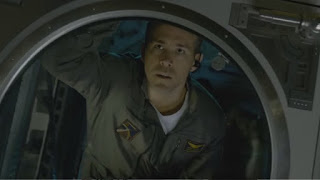
LIFE (US - 2017) Directed by Daniel Espinosa. Written by Rhett Reese and Paul Wernick. Cast: Jake Gyllenhaal, Rebecca Ferguson, Ryan Reynolds, Hiroyuki Sanada, Ariyon Bakare, Olga Dihovichnaya. (R, 104 mins) There's really no way to approach LIFE without labeling it an ALIEN knockoff. To its credit, it doesn't try to disguise that, instead opting to bring enough modern technology to the table that it ends being ALIEN in a post-GRAVITY/THE MARTIAN genre. Visually, LIFE is extraordinarily convincing and with a budget of $60 million--low by today's standards--it manages to look better than a lot of movies that somehow cost $150 million or more and still look like shit. LIFE earns some points for going the extra mile to stick to hard science in its depiction of life on a space station by having its characters spend the entire film floating around in zero gravity. That effort isn't quite tantamount to putting lipstick on a pig, but in the end, LIFE can't really clear the major hurdle of its overwhelming sense of familiarity. Sure, it's an ambitious visual effects triumph, but at the end of the day, it's still just another ALIEN ripoff, and one that compromises its admirably downbeat twist ending by pointlessly segueing to "Spirit in the Sky" played over the closing credits. While it's nice that its inclusion here means Norman Greenbaum keeps the power on for another six months, it has no business being used in this movie, much less sending the audience out humming a catchy classic rock tune after such a bleak wrap-up. Were "Born to Be Wild," "Brown-Eyed Girl," and "Paranoid" also considered? Now, 1990's MIAMI BLUES? Sure, perfect use of "Spirit in the Sky." But by now, in 2017? No. No more. Please, Hollywood, give us a fucking break already with "Spirit in the Sky."
On the International Space Station just outside Earth's atmosphere, the six-person crew intercepts a damaged space probe returning from an eight-month trip to Mars, where it collected soil samples to be studied by British biologist Dr. Hugh Derry (Ariyon Bakire). A tiny organism is discovered in the sample and offers the first irrefutable proof of life beyond Earth. Mission commander Ekaterina Golovkina (Olga Dihovichnaya) alerts NASA to the discovery, and schoolchildren in NYC bestow the name "Calvin" on "the Martian." It's a basic life form kept in quarantine, but begins growing at an alarming rate before going into a temporary hibernation. Derry stirs Calvin with a jolt of electricity, with the clear, translucent organism now demonstrating an increased aggression, wrapping tiny tentacles around Derry's right hand and crushing it even through protective gloves. Golovkina and British quarantine officer Dr. Miranda North (Rebecca Ferguson) put the safety of the crew ahead of rescuing Derry, but maintenance engineer Rory Adams (Ryan Reynolds) breaches the sealed entrance to the lab to get Derry out and ends up being killed by Calvin, now resembling a small starfish/octopus hybrid, who squirms down Rory's throat and devours him from the inside out. Calvin escapes through a vent and can turn up anywhere, with North, Japanese systems engineer Sho Murakami (Hiroyuki Sanada, in a role similar to his turn in Danny Boyle's SUNSHINE a decade ago), and American chief medical officer Dr. David Jordan (Jake Gyllenhaal), a traumatized war vet who's logged more time on the ISS than anyone and is in no hurry to return home, attempting to contain it and prevent it from making its way to Earth.
Director Daniel Espinosa (SAFE HOUSE, CHILD 44) and the screenwriting team of Rhett Reese & Paul Wernick (ZOMBIELAND, DEADPOOL) follow the ALIEN template at least until the climactic twist with the characters being offed mostly by reverse order of billing, with the exception of guest star Reynolds biting it about 35 minutes in. None of the actors are required to stretch all that much, with Gyllenhaal looking glum and dour, Ferguson playing by-the-book and authoritative, and Reynolds cast radically against type as "Ryan Reynolds," with Rory a wisecracking snark machine whose being made an inside-out meal of by Calvin spares us the risk of LIFE turning into DEADPOOL IN SPACE. With limited screen time, Bakare manages to create a well-rounded character in Derry, a paraplegic whose disability isn't a factor in the weightlessness of space. Espinosa manages a few genuinely suspenseful moments and LIFE captures the claustrophobic feel of being in such cramped quarters, but so do a few dozen other movies of this sort. Too many of the plot developments hinge on characters doing stupid things (had Rory not breached the lab, the movie would've ended after 30 minutes). Despite the pre-release online chatter that LIFE was a secret prequel to Marvel's VENOM due in 2018 (it's not), it really just seems to have been given the green light because someone said "Hey, wouldn't it be cool to remake ALIEN with the kind of state-of-the-art CGI they used in GRAVITY?" LIFE isn't bad, and while it's perfectly watchable, looks superb, and has a handful of reasonably solid set pieces, it doesn't do much to justify its existence or distance itself from the pack. The ending works on a gut-punch level and the twist hits you quickly enough that you don't have a chance to question it until the credits start rolling, by which point you're humming "Spirit in the Sky" and already forgetting about what you just watched.
THE RAILWAY MAN (Australia/UK - 2013; US release 2014) Directed by Jonathan Teplitzky. Written by Frank Cottrell Boyce and Andy Paterson. Cast: Colin Firth, Nicole Kidman, Hiroyuki Sanada, Stellan Skarsgard, Jeremy Irvine, Sam Reid, Tanroh Ishida. (R, 107 mins)
Based on Eric Lomax's acclaimed memoir of his time spent in a Japanese prison camp after the fall of Singapore during WWII and his later efforts to track down the officer who tortured him, THE RAILWAY MAN offers fine performances and harrowing depictions of war crimes, but sometimes suffers from hokey dialogue and too often emits a "Weinstein Company awards bait" vibe. The script by frequent Michael Winterbottom collaborator Frank Cottrell Boyce and Andy Paterson takes some occasionally questionable liberties with Lomax's story, but overall, it's a solid film that succeeds more often than it stumbles, and gets an immense boost from a quietly powerful performance by Colin Firth as Lomax.
Set in 1980, the film presents Lomax as a milquetoast railway enthusiast with an almost savant-like knowledge of trains and rail schedules. He meets Patti (Nicole Kidman) during a train ride home and, in a bit of rushed storytelling, they hit it off and soon marry. Only then does Patti become aware of Lomax's PTSD in the form of nightmares, mood swings, periods of aloof silence, and attacking a bill collector with a box cutter. He refuses to discuss his war experiences, prompting Patti to turn to Lomax's war buddy Finlay (Stellan Skarsgard), who also believes in the stiff upper lip, keep-calm-and-carry-on mentality but can see how much Patti wants to help his friend. Flashing back to 1942, young Lomax (Jeremy Irvine) and Finlay (Sam Reid) were engineers taken prisoner by the Japanese and forced to help build the Burma Railway (part of this railroad was the centerpiece of the 1957 classic THE BRIDGE ON THE RIVER KWAI). All the men were tortured and treated with barbaric cruelty by the captors, none more than Lomax, who was caught with a secretly-built radio used for listening to British broadcasts. His captors insist it was an instrument for secret communication, and though he endures extensive beatings and all manner of torture overseen by Kempeitai officer Nagase (Tanroh Ishida), Lomax never gives in. Back in 1980, Lomax's psychological torment threatens his marriage and his sanity until Finlay alerts him to a Kempetai historical museum located at the very camp where they were prisoners, and the museum is run by none other than Nagase (Hiroyuki Sanada).
THE RAILWAY MAN then sends Lomax off on a mission of vengeance against Nagase that becomes a journey of healing for both men. The remorseful Nagase is just as haunted by his actions during the war, and runs the museum as a way of setting things right and dealing with the past. It takes Nagase a few minutes to realize he's talking to Lomax. In reality, Lomax never considered revenge, their reunion took place in 1993, and Nagase knew he was coming. From the outset, the meeting was an effort to turn the page on that chapter of their lives. Of course, film is a different medium and THE RAILWAY MAN is not a documentary. Dramatic developments must be expressed in their own way, but initially portraying Lomax as a nebbishy vigilante seems a bit disingenuous, no matter how good Firth is in the role. The inaccurate 1980 setting seems to have been chosen perhaps because it's the latest year that the filmmakers could possibly ask the audience to buy Firth in the role of a WWII vet, considering the two men, both born in 1919, were 74 when they reunited. The film also does some pre-emptive damage control to maximize audience sympathy, completely eliminating the fact that Lomax was married for 37 years and had two adult children who wanted nothing more to do with him when he left his wife for the younger Patti in the early '80s, and he wasn't quite the stammering, socially-awkward Rain Man he is in the early scenes. Nevertheless, taken in its own context and on its own terms, THE RAILWAY MAN is compelling, with outstanding performances by Firth and Sanada, even if both look too young for their roles at 52, when Lomax and Nagase would've been 61 even if they met in 1980. As for the rest of the cast, Kidman has little to do after the midway point, but Irvine (WAR HORSE) does a remarkable job of channeling a young Firth and bears an uncanny resemblance to the young Lomax. As far as a "true story" is concerned, to say THE RAILWAY MAN plays fast and loose with the facts is an understatement, but the essential message of forgiveness and healing is key and in that respect, the film gets the job done. This story was also adapted into the 1995 British TV movie PRISONERS IN TIME, with John Hurt as Lomax.