1917 (US/UK/Spain - 2019) Directed by Sam Mendes. Written by Sam Mendes and Krysty Wilson-Cairns. Cast: George MacKay, Dean-Charles Chapman, Benedict Cumberbatch, Colin Firth, Mark Strong, Andrew Scott, Richard Madden, Claire Duburcq, Adrian Scarborough, Daniel Mays, Pip Carter, Richard McCabe, Billy Postlethwaite, Robert Maaser. (R, 119 mins) A WWI epic inspired by a story that director/co-writer Sam Mendes was told by his Lance Corporal grandfather, 1917 is an impressive technical achievement that's so devoted to its--for lack of a better word--gimmick, that it's pulled off at the expense of telling the story in the most beneficial way. Drawing from older classics like ALL QUIET ON THE WESTERN FRONT and Stanley Kubrick's PATHS OF GLORY with the more visceral, you-are-there immediacy of SAVING PRIVATE RYAN and DUNKIRK, 1917 attempts to convey its entire run time as one continuous shot, a la Hitchcock's ROPE or Alejandro G. Inarritu's BIRDMAN. Of course, if you go into any exercise of this type knowing that, you start getting distracted by trying to spot where the usually seamless cuts are, and here, the spell is momentarily broken by a huge mid-film cut to black when a character is knocked unconscious. Mendes, who has the distinction of directing the both strongest (SKYFALL) and weakest (SPECTRE) of the Daniel Craig 007 outings, makes a valiant effort to go for those Kubrick long takes and uses the legendary auteur's old standby of natural light with the great cinematographer Roger Deakins, but once its plot is set in motion, it strangely lacks the emotion or the urgency that the situation requires, primarily because Mendes' overriding concern is the single-take illusion.
Set over one day and into the morning of the next, 1917 has Lance Corporals Schofield (George MacKay) and Blake (Dean-Charles Chapman) sent by Gen. Erinmore (Colin Firth) to hand-deliver a message to a battalion several miles away with orders to halt a planned attack on German forces. Aerial intel reveals that the Germans have set a trap or them, and the 1600 men under the command of Col. McKenzie (Benedict Cumberbatch)--including Blake's older brother (Richard Madden)--will most likely be wiped out. All lines of communication have been cut by the Germans, leaving no alternative but for Schofield and Blake to go on foot, crossing the abandoned German front and getting through the town of Ecoust and finding McKenzie's battalion. It's a simple set-up with an intricately choreographed execution, albeit with significant digital assistance. For a while, the technique dazzles, especially as Schofield and Blake make their way across a harrowing wasteland of mud, blood, dead soldiers and horse carcasses. A trek through the vacated German trenches leads to an explosion when a rat crosses a tripwire. A dogfight between two British planes and a German pilot ends up having serious consequences to the mission.
The more 1917 goes on, the more gimmicky it looks. Because there's hardly any time to learn about these characters, the emotional stakes aren't there, and all that's left is the single-take concept. That works to a point, but eventually, you may question why Mendes was so concerned with that as opposed to developing the narrative and fleshing out the characters beyond a one-dimensional level. When it's able to focus on the immediacy of the situation--the tripwire explosion, the German plane crashing after the dogfight, a sniper attack, a stunning trip through a bombed-out town engulfed in flames that looks like something out of APOCALYPSE NOW--1917 is firing on all cylinders and has moments of undeniable brilliance. But the pseudo-"real time," single take illusion also means there's a lot of walking and talking. And walking. And more walking. And the sense of urgency is never really properly conveyed--beyond "we need to get to Col. McKenzie"--because the time element is never made clear. If the movie runs two hours, then tell them "You have two hours." The cut-to-black when a character is knocked out cold seems to serve the dual purpose of maintaining the one-shot ruse while also allowing Mendes to explain away some of that real-time issue, in a sense negating the whole single-take idea in the process. In the end, it all boils down to this: yes, it's technically impressive and it's obvious that a lot of intricate planning went into it, but why? Why tell this story this way?
MacKay (CAPTAIN FANTASTIC) and Chapman (GAME OF THRONES) are fine, as good as they're permitted to be since they seem like little more than players in a WWI video game (the sequence where MacKay's Schofield gets caught in some DELIVERANCE-style rapids after going over huge waterfall that appears out of nowhere seems to belong in another movie, as does his shoddy-looking avatar that jumps in the water). Brief support is provided by continuous big-name cameos just like the WWII movies of the 1960s--in addition to Cumberbatch, Madden, and Firth, Mark Strong also appears, perhaps part of a package deal with Firth as they've seemingly appeared in more movies together than Abbott & Costello. Even with numerous standout moments and earnest performances by the leads, 1917 still doesn't even have the power of a 90-year-old relic like 1930's ALL QUIET ON THE WESTERN FRONT. And forget comparisons to PATHS OF GLORY, a film whose anti-war rage still has a seething resonance over 60 years later. I may sound like I didn't like 1917. It's a good movie, but it could've--and should've--been a much better one. Make no mistake, it's gonna clean up at the Oscars because it's a safe pick that everybody can get behind. But it'll be one of those Best Picture winners that just doesn't stick in the memory. When's the last time you heard anyone mention GREEN BOOK?
Originally titled KURSK, the Luc Besson-produced THE COMMAND is a strangely inert dramatization of the Kursk disaster in 2000, when two explosions--one small, followed by a second large enough to register on the Richter scale--sank a nuclear-powered Russian submarine that was part of a training exercise on the Barents Sea. Of the 118 officers onboard, 23 initially survived the explosions but all perished within the next couple of days due in large part to the inexcusably slow response of a Russian government desperate to save face and avoid national humiliation. The Russian Navy even stubbornly refused offers of rescue assistance from both England and Norway, who had ships in the vicinity that could be there in a matter of hours. The Kursk disaster was a huge embarrassment for Vladimir Putin, who became president just four months earlier and was roundly criticized for his handling of the tragedy. Adapted from Robert Moore's 2002 book A Time to Die: The Untold Story of the Kursk Tragedy by screenwriter Robert Rodat (SAVING PRIVATE RYAN), THE COMMAND doesn't have the courage of its convictions--or the 118 men who died--in its decision to make no mention of Putin at all, instead letting faulty, outdated equipment take the blame and the fictional composite Admiral Petrenko (Max von Sydow) serve as the villain, an old guard, bureaucratic company man overruling fleet commander Admiral Grudzinsky (TONI ERDMANN's Peter Simonischek), refusing help from British Commodore Russell (Colin Firth), and holding press conferences where he's forced to shout down angry wives and order them removed from the room when they start making a scene. Despite the kid-gloves treatment of Putin, it's these scenes that are the strongest in THE COMMAND, with the mutual respect between Russell and Grudzinsky tossed aside when Grudzinsky is removed from the situation after he goes rogue and takes England and Norway up on their offers to assist with a rescue. That rescue never happens because Petrenko decides Russia's honor--and the guarding any potential military secrets the rescuers might encounter--takes precedence over human lives ("They know what they signed up for," an unknown voice is heard saying over the phone). That voice is as close as THE COMMAND gets to a Putin appearance, as all scenes involving the president, reportedly a major supporting character in Rodat's script, were tossed in the shredder before shooting even began.
The submarine sequences aren't exactly the second coming of DAS BOOT, largely because we already know the outcome. There's some rudimentary characterization in the early going with a rushed wedding sequence that evokes memories of THE DEER HUNTER while showing the relative poverty of the Russian military in the way the officers make so little money that they have to pawn their watches to pay for champagne for the reception. Once on the sub, actors like Matthias Schoenaerts and August Diehl do solid work as men displaying valor and fighting to stay alive (and Schoenaerts goes above and beyond, holding his breath in a long scene underwater), but it's the scenes above water, with Schoenaerts' pregnant wife (Lea Seydoux) being coldly stonewalled at every turn in her search for news, that have a more dramatic impact. With an abundance of dodgy greenscreen and video-gamey CGI, it's clear that director Thomas Vinterberg (who worked with Schoenaerts on 2015's FAR FROM THE MADDING CROWD) has ventured as far as he can from the minimalist "Dogme '95" movement he co-founded with his much more controversial friend Lars von Trier. But he still indulges in pointless wankery like the first 20 minutes of the film being in a windowboxed 1.66 aspect ratio, then opening up to 2.35 for the next 80 minutes before returning to the windowboxing for the last act. It might make artistic sense if there was a rhyme or reason to it--like one aspect ratio for the submarine scenes and another for above water--but that's not the case. Filmed in 2017, THE COMMAND also suffers from inadvertent bad timing in its eventual straight-to-VOD US release, as the harrowing HBO miniseries CHERNOBYL did an infinitely more effective job of depicting the indifference of the Russian government to the suffering of its people in a devastating tragedy. The late Michael Nyqvist (THE GIRL WITH THE DRAGON TATTOO, JOHN WICK) succumbed to cancer during production, and while Vinterberg said the actor completed his scenes before his death and initial festival screenings mentioned him being in it, he appears to have been cut from the final release despite his name remaining at the very end of the closing credits cast crawl. (PG-13, 119 mins)
EL CHICANO (US - 2019)
Advertised as the first Latino superhero movie, EL CHICANO attracted some attention during its brief theatrical run when producer/co-writer/internet tough guy Joe Carnahan (NARC, SMOKIN' ACES, THE GREY) read some negative reviews and promptly began attacking those critics on social media. He ended up deleting his Twitter account and eventually admitted he was "punching down" to generate publicity for the movie. A dick move that's pretty much on-brand, but it didn't help, as it opened in 11th place and topped out at 605 screens, grossing just over $1 million. In the end, EL CHICANO is hardly a barrio BLACK PANTHER, as Carnahan and director/co-writer Ben Hernandez Bray (a veteran stuntman and the second unit director on several Carnahan films) don't really do anything interesting beyond setting their story in East L.A. In a prologue set 20 years ago, twins Diego and Pedro and their friend Jose witness masked avenger El Chicano brutally murder Jose's father, crime lord Shadow (Emilio Rivera). In the present day, Diego (Raul Castillo) is a dedicated cop long-estranged from Pedro, who chose a life of crime and has just committed suicide shortly after being paroled. Diego and his hothead partner Martinez (Jose Pablo Cantillo) are told by an informer (Noel Gugliemi) that Pedro didn't kill himself, but rather, was part of a massacre orchestrated by Jose, who took over his father's East L.A. empire and now goes by Shotgun (David Castaneda). Diego discovers a trail of clues that Pedro has left for him, revealing a storage unit where Pedro kept everything he needed for his plan to resurrect the long-dormant legend of "El Chicano" and rid the area of the likes of Shotgun once and for all. Unable to nail Shadow by the book and watched over by his no-bullshit captain (George Lopez), Diego is inspired to pick up with Pedro left off and become the new El Chicano, especially when Shadow partners with Mexican cartel boss El Gallo (Sal Lopez) and his son Jaws (Roberto Fabian Garcia, aka Chicano rap star Mr. Criminal, who also performs the theme song) to tighten his stranglehold on the area.
The hard-R EL CHICANO, which also counts Carnahan bro Frank Grillo as a co-producer, gets off to a decent start, but soon becomes a rote checklist of genre cliches and imagery swiped from other comic book and graphic novel films. It leans heavily on THE PUNISHER and especially THE DARK KNIGHT by the end, which sets up a sequel that looks pretty doubtful given the tepid response from critics and audiences. Castillo does a decent Christian Bale impression in his stoical performance, but Castaneda doesn't get the space to create a complex character like he did in the JCVD thriller WE DIE YOUNG. The familiar faces in the supporting cast aren't put to good use--Rivera and Gugliemi are killed off shortly after they appear, Aimee Garcia (GEORGE LOPEZ, DEXTER) is wasted in a thankless role as Diego's wife, and Mexican telenovela star and El Chapo bestie Kate del Castillo turns up at the end to set up that unlikely sequel. (R, 108 mins)
BODY AT BRIGHTON ROCK (US - 2019)
Having cut her teeth on horror anthologies starting with a producer credit on V/H/S, writer/director Roxanne Benjamin helmed one of strongest segments of SOUTHBOUND and the weakest of XX. She splits the difference with her feature-length debut BODY AT BRIGHTON ROCK, which takes a terrific premise and doesn't really do anything interesting with it. Relative newcomer Karina Fontes is well-cast as Wendy, a part-time summer guide at the fictional Brighton Rock National Park (the film was shot in Idyllwild, CA). Wendy doesn't take the job as seriously as she should--she's always late for work and is considered a lightweight "indoor kid" by her more experienced colleagues--and as the season's winding down into fall, she decides to prove to the naysayers, namely her friend Maya (Emily Althaus), that she can hack it by offering to take Maya's assignment for the day: switching out seasonal signs and postings along one of the park's rougher trails. Wendy is absent-minded and easily-distracted, so of course she misplaces her map, gets lost, and wanders off the trail. She sends a selfie to Maya from the peak of a rock formation, to which Maya replies "Who's behind you in the pic?" Wendy sees what she's talking about in a nearby ravine: a dead body. She tries to call for help but killed her phone battery taking selfies and playing '80s music (Oingo Boingo and Expose on the soundtrack) while she danced along the trails all day, and she's in a remote area where radio reception is poor. What she manages to ascertain is that it's getting dark, they don't know where she is, and she's to stand guard over what might be a crime scene until the authorities can start looking for her in the morning. Then affable but vaguely sinister hiker Red (Casey Adams) shows up.
The initial set-up of BODY AT BRIGHTON ROCK seems primed for an effective survivalist B-movie where "indoor kid" Wendy grows up and sees what she's made of. While it's no fault of Fontes, who does a good job in what's effectively a solo show after the first ten minutes (the only established cast member is veteran character actor John Getz, seen briefly as a local sheriff), Wendy's hard to root for as she makes one dumb decision after another. Offended that her co-workers think she can't handle the trail--and they're absolutely right--she proceeds to do everything possible to make her predicament worse, with the low point being when she freaks out and thinks something's behind her and ends up misting herself with capsaicin bear spray. Benjamin wrings some suspense out of shadows, breezes, and other random nature sounds and uses some effective editing techniques, but once the premise is established, BODY AT BRIGHTON ROCK just spins its wheels to an unsatisfying conclusion. (R, 87 mins)
KINGSMAN: THE SECRET SERVICE (US/UK - 2015) Directed by Matthew Vaughn. Written by Jane Goldman and Matthew Vaughn. Cast: Colin Firth, Samuel L. Jackson, Michael Caine, Mark Strong, Taron Egerton, Sofia Boutella, Sophie Cookson, Mark Hamill, Jack Davenport, Samantha Womack, Hanna Alstrom, Bjorn Floberg, Geoff Bell, Ralph Ineson, Richard Brake. (R, 129 mins)
Like 2010's KICK-ASS, director Matthew Vaughn's last adaptation of a Mark Millar comic book series, KINGSMAN: THE SECRET SERVICE (which Millar co-created with Dave Gibbons) takes unbridled joy in pushing the envelope and poking people with sticks. Without a little girl dropping countless F-and-C-bombs, KINGSMAN isn't going to attract quite the same level of controversy. Nevertheless, some are taking umbrage with the hilarious final shot, essentially a very hard-R riff on all of those quips and double entendres that would close out a James Bond movie as 007 wraps up the adventure and canoodles with the Bond girl while M or Q or Moneypenny listen or observe with their disapproving "Really, 007!" facial expressions. The entire film is an homage to the more lighthearted spy films of old, particularly Roger Moore's tenure as 007, while also functioning as a meta commentary on spy movies in general, with characters lamenting that today's genre items are much too serious and downbeat. That's an especially amusing aside, considering two of this film's stars--Colin Firth and Mark Strong--appeared in 2011's low-key and magnificently somber TINKER TAILOR SOLDIER SPY. The connection to spy films past extends to the presence of the legendary Michael Caine, who played British agent Harry Palmer in a series of five films from 1965 to 1996. Vaughn and regular co-writer Jane Goldman play these meta elements just enough that they remain amusing, wisely resisting the urge to make it too self-consciously cute. For the most part, KINGSMAN is bit on the longish side and, like so many of its present-day counterparts, suffers from some blasts of dubious CGI that's distracting in its cartoonish artifice, though I tend to be a little more lenient on that when it's a comic book adaptation. Overall, KINGSMEN is generally witty and wildly entertaining, deftly mixing thrilling action, big laughs, and shocking violence, aided by a fine cast of serious actors obviously enjoying themselves and having a good time.
Unemployed London troublemaker Eggsy Unwin (Taron Egerton) gets into a row at a pub and retaliates by taking the guy's car for a joyride. Arrested, Eggsy resorts to an emergency number on the back of a medal given to him 17 years earlier by Harry Hart (Firth), a co-worker of his late father, who died on the job. He was told to call that number if he ever needed anything, and 17 years later, he calls in that favor and is sprung from jail by Hart with all charges dropped. Hart tells Eggsy that he's a Kingsman--like his father--an agent in a top-secret government intelligence agency. Hart, codename Galahad, feels responsible for Eggsy, as Eggsy's father saved the lives of Galahad and other Kingsman agents by diving on top of an Iraqi suicide bomber, sacrificing himself for the greater good of the team. It so happens that there's a vacancy in the Kingsman agency--which Galahad would like filled by Eggsy-- after Lancelot (Jack Davenport) is killed by Gazelle (Sofia Boutella), a legless assassin with prosthetic, sharpened Oscar Pistorius-like running blades. Gazelle is the chief henchman to eccentric, billionaire internet mogul Richmond Valentine (Samuel L. Jackson), a philanthropist whose supposed concern with climate change is a cover for a far more nefarious master plan. Valentine orchestrates a global giveaway of SIM cards that provide free phone and internet service for everyone, for life. As evidenced during a trial run at a Kentucky church, whose congregation is filled with hatemongering racists, gun nuts, and homophobes, the internet signal received by those with Valentine's SIM cards causes its users to behave in uncontrollably violent, destructive fashion. The SIM card is a mind and impulse control/manipulation signal, and Valentine has been meeting with and occasionally kidnapping the world's more important dignitaries and luminaries--including prominent climate change expert Prof. Arnold (Mark Hamill in some in-joke casting, playing a character who was originally named "Mark Hamill" in the comic book)--and implanting a chip behind their ears to make them immune from the signal, thereby giving an overcrowded, global warming-damaged world a much-needed do-over, where the lesser, more gullible people of society remove themselves from the equation and the rich and privileged one-percenters reign supreme. As Eggsy and others are trained in the ways of the Kingsman by their mentor Merlin (Strong), Galahad conducts an investigation of Valentine at the behest of the agency's leader Arthur (Caine), one that will put the entire organization to a test in order to save the planet from the megalomaniacal madman.
As goofy as KINGSMAN is, its plot isn't any more ludicrous than something like MOONRAKER (some of the climax even takes place in space!). From the various Kingsman gadgets to Valentine's insane plot and his lethal right-hand (wo)man with some kind of gimmicky physical attribute to Jackson's loud and hammy performance, KINGSMAN frequently resembles a lighthearted 007 entry if Bond was paired up with a street-smart soccer hooligan for a sidekick. Egerton does a fine job as Eggsy, with his cocky exterior masking smarts and sensitivity on which Galahad is willing to stake his reputation. The relationship that forms between the two men--one who never knew his father and the other who blames himself for it--is portrayed very nicely by Egerton and Firth. But it's really Jackson, acting like a mash-up between Spike Lee, Mark Cuban, and Auric Goldfinger, who steals the show. KINGSMAN also offers a lot in the way of ballsy, subversive jabs, not only at the massacre of a bunch of brainless Kentucky yokels who gather at the very Westboro Baptist-esque church to spread their hate and intolerance, but in the corrupt politicians in Valentine's pocket--there's digs at the left and the right here--and the way they sell everyone out to save their own asses, not to mention what Sweden's Princess Tilde (Hanna Alstrom) is willing to do if the world is saved. KINGSMAN: THE SECRET SERVICE takes the PUNISHER: WAR ZONE approach to older spy movies, but is a bit like a more refined KICK-ASS. It's still got something to offend everyone, but does so in the classiest way possible. It's a film that sets out to entertain while occasionally making your jaw drop and wondering "Did it really go there?" Yes, it does, and that's exactly why it's such great fun, and it's Vaughn's best film since his directing debut with 2004's LAYER CAKE.
MAGIC IN THE MOONLIGHT (US - 2014) Written and directed by Woody Allen. Cast: Colin Firth, Emma Stone, Eileen Atkins, Marcia Gay Hardin, Hamish Linklater, Simon McBurney, Jacki Weaver, Catherine McCormack, Erica Leerhsen, Jeremy Shamos, Ute Lemper. (PG-13, 97 mins)
The annual visit from Woody Allen finds the great filmmaker firmly in "pleasant trifle" mode with MAGIC IN THE MOONLIGHT. A year after directing Cate Blanchett to an Oscar for the devastating BLUE JASMINE, Allen goes light and breezy in another attempt to recapture the unexpected blockbuster success of 2011's out-of-nowhere MIDNIGHT IN PARIS. MAGIC is certainly enjoyable but is yet another effort that falls squarely in the middle, along with other diverting-at-the-time-but-forgettable-after trifles like SCOOP (2006), the overrated VICKY CRISTINA BARCELONA (2008), WHATEVER WORKS (2009), and YOU WILL MEET A TALL DARK STRANGER (2010). Aside from the occasional MATCH POINT (2005) or BLUE JASMINE, Allen's work at this point more or less functions as comfort food, a reminder than even with the ever-shifting and unpredictable ways of cinematic finance and distribution, those Windsor font opening credits with the alphabetically-listed cast, accompanied by a scratchy old jazz or big band standard (in this case, Leo Reisman & His Orchestra's 1929 version of Cole Porter's "You Do Something to Me") are always there to remind us that some things haven't changed if Woody's still cranking them out year after year (incredibly, 1981 was the last year without a new Allen film). Even when he's coasting and repeating himself, a new Woody Allen movie is--almost, other than, say, 2012's TO ROME WITH LOVE, one of his worst films--always welcome.
In 1928 Berlin, world-famous, mysterious Oriental magician Wei Ling Soo astounds a captive audience with his repertoire of tricks and illusions. Backstage, he's revealed to be disguised Brit Stanley Crawford (Colin Firth), a snobbish misanthrope who considers most of his fan base to be uncultured rubes. An expert medium and spirit world-debunker outside of his Wei Ling Soo persona, Stanley is persuaded by his friend and fellow magician Howard Burkan (Simon McBurney, the Roddy McDowall of his generation) to accompany him to the French Riviera to investigate an American medium who's enthralled the region with her uncanny abilities. The medium is Kalamazoo, MI native Sophie Baker (Emma Stone), who's captured the hearts of the wealthy Catledge family and is engaged to be married to scion Brice (Hamish Linklater), a ukulele-strumming romantic who serenades her regularly and promises her all that money can buy. Stanley is suspicious from the start, but as Sophie's ability to know some of Stanley's most private secrets as well as those of his beloved Aunt Vanessa (Eileen Atkins) becomes apparent, Stanley goes from sneering and dismissive to a smitten believer, even after rebuffing Sophie's advances since he's engaged to Olivia (Catherine McCormack), who's back home in London.
Magic, mysticism and fantasy are not new subjects to Allen. He's covered them in various ways in films like THE PURPLE ROSE OF CAIRO (1985), the "Oedipus Wrecks" segment of NEW YORK STORIES (1989), ALICE (1990), THE CURSE OF THE JADE SCORPION (2001), SCOOP, MIDNIGHT IN PARIS and TO ROME WITH LOVE, to name a few. To that end, there's not really anything particularly new or noteworthy about MAGIC IN THE MOONLIGHT. As expected, Stone is as appealing a presence as ever, and while she initially seems miscast, Allen wisely takes that and uses it to her character's advantage as a transplanted Midwesterner who doesn't really belong with the high society on the Cote d'Azur, but is lovingly accepted anyway by the smothering Brice and his mother Grace (Jacki Weaver). Firth has a good time playing a droll, acid-tongued grouch, and just when you think Allen is going too schmaltzy with his character, he has something happen that pulls him back into being the bitter crank he's been for the previous hour. But these are characters and situations we've seen in any number of Allen's previous 45 films as a writer/director. For its first half, MAGIC IN THE MOONLIGHT is witty and often quite amusing, but then I was reminded of his surprise 2000 hit SMALL TIME CROOKS (about once a decade in the years since his commercial heyday ended in the mid '80s, Allen has a breakout smash that gets embraced by more moviegoers than usual), which spent half of its running time as a hilarious comedy of errors about an ineptly-plotted heist only to switch gears and morph into another sappy, analytical relationship comedy between Allen and Tracey Ullman. Similarly, MAGIC IN THE MOONLIGHT bogs down considerably once Stanley believes in Sophie's abilities and she expresses her feelings for him. Do we need another Woody Allen movie with a younger woman falling for a man 30 years her senior? I suppose it could be worse--Allen could've cast himself as Stanley--and Firth doesn't look 53 years old, but Allen's older man/younger woman motif has been one of the more blatantly self-referential and increasingly peculiar tropes of his filmography. MAGIC IN THE MOONLIGHT is diverting late summer entertainment, Firth and Stone are fine, the locations, production design, and period detail are terrific, and Atkins is a delight as Aunt Vanessa, but like most of Allen's output over the last decade or two, there's an unavoidable sense of familiarity, like he's just shuffling pages of random older scripts together and cobbling new movies out of previously explored ideas.
The story of the West Memphis Three, accused of the ritualistic murder of three little boys in West Memphis, AR, has been told in many ways since the horrific events of the summer of 1993. Books, countless investigative pieces, TV news profiles, and most notably, four documentaries--Bruce Sinofsky and Joe Berlinger's PARADISE LOST trilogy and the Peter Jackson-produced WEST OF MEMPHIS--seem to have covered the story from every possible angle. With that in mind, it seems odd to make a dramatization of the events now and odder still that it's directed by the great Egyptian-born Canadian filmmaker Atom Egoyan (EXOTICA). Egoyan's been in a slump for going on a decade now, with only 2008's ADORATION showing signs of the Egoyan of old: 2005's WHERE THE TRUTH LIES and 2009's CHLOE are easily his weakest films, with CHLOE in particular looking like a laughably dated erotic thriller that was found sealed in a film canister marked "1995." Egoyan's been spending a lot of his time in recent years making short films and documentaries, so it's likely that TRUTH and CHLOE were just mercenary director-for-hire gigs that provided a financial cushion. Unfortunately, DEVIL'S KNOT, based on Mara Leveritt's 2002 true-crime account of the same name, falls into the same category. Other than some familiar Egoyan actors like Bruce Greenwood and Elias Koteas, and some shots early on that recall the remorseful sense of melancholy of Egoyan's 1997 masterpiece THE SWEET HEREAFTER, DEVIL'S KNOT takes the story of the West Memphis Three and turns it into a perfunctory, workmanlike courtroom drama that offers no new perspective on the case other than to belatedly suggest that the father of one victim and the stepfather of another may have been involved in the murders. Despite some early signs that Egoyan might take a David Fincher/ZODIAC approach to examining the story, it doesn't take long to devolve into rote storytelling that anyone familiar with the case already knows, laid out in thoroughly by-the-numbers fashion by the screenwriting team of Paul Harris Boardman and SINISTER director Scott Derrickson, whose previous credits together include HELLRAISER: INFERNO, URBAN LEGENDS: FINAL CUT and THE EXORCISM OF EMILY ROSE. With that pedigree, it's pretty obvious Egoyan's just punching a clock on this one.
All the expected story elements are here: the parents demanding revenge, the town, the lazy police, and a stone-walling judge going into full-on, witch-hunt, "Satanic panic" mode. They're all in a frothing-at-the-mouth quest to pin the murders on a trio of social outcasts who had an interest in the heavy metal and the occult and a ringleader in Damien Echols (played here by James Hamrick) who was a loner from a broken home who dressed in black and was simply deemed "weird." The police work in this case was horribly shoddy, with one suspect, Jessie Misskelley, Jr (Kristopher Higgins), obviously mentally incompetent and thought to be "mildly retarded," coerced into confessing to the murders with wrong timelines and details completely inconsistent with the crime scene, but the cops ran with it anyway. Since these details, and the eventual Alford Plea release of the three convicted murderers in 2011 are old news, a lot of DEVIL'S KNOT focuses on the grieving Pam Hobbs (Reese Witherspoon), the mother of victim Stevie Branch, and her late discovery of Stevie's pocket knife in a box kept by her husband Terry (Alessandro Nivola). This, along with another knife that was given to Sinofsky and Berlinger (who briefly appear as themselves) by John Mark Byers (a hammy Kevin Durand), the father of victim Christopher Byers, and the police department's botched handling of a bloodied African-American man who was found in the ladies' room of a fast-food restaurant the night of the murders, would appear to indicate DEVIL'S KNOT's agenda in probing deeper into the case. If Egoyan was really interested in that, why not pursue Terry Hobbs and John Mark Byers for a documentary? Why devote time to defense team investigator Ron Lax (a miscast Colin Firth, struggling with a Southern accent) moping around after his wife (a one-scene drop-in by Amy Ryan) serves him with divorce papers? Who gives a shit about Ron Lax's failed marriage? This is the kind of film where the judge decrees to a packed courtroom that Misskelley will be tried separately from the others, but Lax still has to immediately lean over to his assistant and whisper "Separate trials...Jessie's gonna be tried on his own" just in case the audience is having trouble keeping up. With Oscar-winners Firth and Witherspoon onboard, and with justice for the West Memphis Three a longtime cause for many in the entertainment industry, DEVIL'S KNOT looks suspiciously like transparent Weinstein Company awards bait, but this time it backfired. The film got such a unanimously negative response at the 2013 Toronto Film Festival that Harvey Weinstein unloaded it on RLJ Entertainment, who rolled it out on VOD and a handful of screens a month before its DVD/Blu-ray debut. It's a strangely appropriate burial for such a shallow endeavor that barely scratches the surface as it treads down a path that's already been explored in much more insightful detail by others. (Unrated, 114 mins) IN THE BLOOD (US/UK - 2014)
Steven Soderbergh's HAYWIRE arrived with much publicity and positive reviews in early 2012 as the starring debut of former MMA sensation Gina Carano. It had a unusually highbrow supporting cast for such action fare and promised old-school fight scenes and delivered, but mainstream audiences weren't especially taken with Carano or with Soderbergh's directing style, which turned HAYWIRE into more or less an MMA arthouse film. Nevertheless, while it's a fixture in DVD bargain bins at a retailer near you and already little more than a footnote in Soderbergh's filmography, it has a minor cult following and Carano's future as a B-level DTV action star seemed inevitable. After a supporting role in last year's FAST & FURIOUS 6, she's back with the rather pedestrian IN THE BLOOD. For all the complaints action fans had about Soderbergh's artsy-fartsy pretensions with HAYWIRE, at least he made the action sequences count. Here, sometime hack actor-turned-fulltime hack director John Stockwell weighs things down with too many characters with too many subplots and not enough Carano ass-kicking. Shot in Puerto Rico, the first half-hour of IN THE BLOOD looks like a typical Stockwell effort, demonstrating his endless fascination with exotic, scenic tourist destinations (since 2002, he's also made BLUE CRUSH, INTO THE BLUE, TURISTAS, and DARK TIDE) as recovering heroin addicts and newlyweds Ava (Carano) and Derek Grant (Cam Gigandet) honeymoon in the Caribbean. They met in rehab--she came from the wrong side of the tracks and saw her father (Stephen Lang in flashbacks) murdered by drug dealers, he's the scion of a wealthy family whose asshole father (Treat Willliams) disapproves of Ava and tries to bully Derek into signing a pre-nup. While at a restaurant, Ava and Derek meet affable local Manny (Ismael Cruz Cordova) who talks them into a zip-lining excursion. While careening down the aptly-named "Widowmaker," Derek's line snaps and he plummets into the forest below. The medics won't let Ava ride in the ambulance and no hospital in town has any record of Derek being brought in. The local cops, led by the predictably useless chief (Luis Guzman), and her sneering father-in-law think she staged a kidnapping, or even killed him to gain access to the family's wealth. So, of course, under the tutelage of her father, she's been schooled in the ways of MMA (much to the surprise of Derek during an early nightclub skirmish), and she becomes an inevitable one-woman wrecking crew in the quest to find her missing husband.
Once Stockwell finally gets to the action, IN THE BLOOD has its moments, but they're few and far between. This should be a tight, fast B-movie, but at 108 minutes, it's at least 20 minutes too long and the pacing is laborious. Did we really need clunky subplots about Guzman's police chief or the feud between island crime lords Lugo (Amaury Nolasco) and Big Biz (Danny Trejo)? At least Nolasco's character eventually figures into the increasingly ludicrous plot, but Trejo has almost nothing to do until the script (written by Farrelly Brothers collaborator Bennett Yellin and THE HOWLING: REBORN screenwriter James Robert Johnston) clumsily has him turn up at the end and somehow be the hero, which seems completely counterproductive considering that this is supposed to be a Gina Carano vehicle. Carano would do better to work with an Isaac Florentine or a John Hyams, both the kind of low-budget action auteur who can really bring out the best in action stars like Jean-Claude Van Damme, Scott Adkins, and Dolph Lundgren. Carano's niche is practically pre-carved, but ponderous duds like IN THE BLOOD aren't going to do much to help her make her case. You're better off watching HAYWIRE again. (R, 108 mins) SMALL TIME (US - 2014)
Since his acrimonious departure from LAW & ORDER: SPECIAL VICTIMS UNIT in 2011 over a salary dispute, Christopher Meloni has been jobbing around from gig to gig, with an acclaimed but short-lived recurring role on TRUE BLOOD, supporting roles in 42 and MAN OF STEEL, and, more recently, the Fox sitcom SURVIVING JACK, which survived four episodes before being cancelled, and a hilarious arc as Julia Louis-Dreyfus' personal trainer/secret paramour on VEEP. In 2012, Meloni shot the low-budget SMALL TIME, written, directed, and self-financed by 24 creator Joel Surnow. It gives the veteran TV actor a rare big-screen lead, but it's also the kind of small, personal film that just doesn't generate much interest outside of film festivals. It opens strongly and succumbs to cliche and formula in its second half, but a decade ago, a film like SMALL TIME probably would've become a minor, word-of-mouth sleeper hit instead of getting the VOD dump-job from distributor Anchor Bay Films. Meloni is Al Klein, a master used-car salesman and co-owner of Diamond Motors, along with his best friend Ash Martini (Dean Norris). Al is going through a midlife crisis and can't commit to girlfriend Linda (Garcelle Beauvais), and as his son Freddy (Devon Bostick) is graduating from high school, Al fears the years have slipped away. Despite the protestations of his ex-wife Barbara (Bridget Moynahan) and her wealthy investment broker husband Chick (Xander Berkeley, the go-to actor for "asshole second husbands"), Freddy wants to skip college and work as a salesman with his dad. Wanting some father-son bonding time, Al welcomes Freddy onboard as he and Ash school him in the ways of wheeling and dealing.
Despite some funny scenes of car-lot hustling, SMALL TIME isn't another USED CARS-type comedy. The focus remains on Al and the realization that maybe this isn't the life he wants for his son, especially since his gift for closing deals almost immediately gives the impressionable Freddy a swelled head, which isn't helped by the encouragement of Ash, a well-meaning guy who loves Freddy but often comes off as a bad-influence uncle, and some cynical salesman friends who teach Freddy that "people are shit and they'll believe anything." Al and Ash may be fast-talking salesmen, but they're generally honest, and Al worries about the side of Freddy that the job is bringing out. SMALL TIME is a small labor of love for all involved, but once Freddy starts getting a shitty attitude, Surnow's script devolves into too many standard-issue tropes and conventions, culminating in a really bad moment when Bostick gets in Meloni's face and yells--what else?--"You're so...small-time!" There's also too many whimsical elements that film fest folks love: set in an undetermined period that would appear to be the early '80s, the film opens with an older Freddy narrating "It was the summer that changed my life"; montages set to soul and/or Latin music; gregarious ethnic supporting characters; and a kooky and improbably Scottish secretary (EXTRAS' Ashley Jensen) who has no idea how to make coffee. There's a lot in SMALL TIME that should completely derail it, but the consistently-underrated Meloni is the glue that holds it together. He's terrific here and his rapport with both Bostick and Norris (as well as in the seemingly improvised scenes with their lunch group of crass, old-school salesmen buddies played by Kevin Nealon, Ken Davitian, and Barry Primus) really manages to redeem the film's many inherently self-destructive elements. SMALL TIME is slight and predictable, but it's enjoyable enough, moves very briskly, and is a must-see if you're a Meloni fan. (R, 94 mins)
Veteran Andrew Bergman producer Mike Lobell (THE FRESHMAN, HONEYMOON IN VEGAS) began attempting to assemble a remake of the 1966 Shirley MacLaine/Michael Caine caper comedy GAMBIT as far back as 1997. Countless creative personnel were officially and unofficially attached to the new GAMBIT at various times over the next decade plus--directors Robert Altman, Mike Nichols, Alexander Payne, Anand Tucker, Bo Welch, Richard LaGravenese, and Doug Liman, writers Aaron Sorkin, Frank Cottrell Boyce, and Joel & Ethan Coen--and time and again, the project would stall and collapse. When LaGravenese was onboard around 2009, he rewrote much of the script, and again, it didn't make it out of pre-production. By the time filming finally started in 2011, Lobell had Michael Hoffman (ONE FINE DAY) directing, and LaGravenese's revisions were tossed in favor of the Coen Bros.' draft, which they penned during some down time between films a decade earlier. The Coens would probably prefer to forget they were ever involved in this doomed production, which bombed everywhere else in the world in 2012, prompting CBS Films to abruptly cancel the US release and shelve it for a couple of years in the hopes that everyone would forget about it. In a move of stealth deception that almost rivaled the Baltimore Colts sneaking away to Indianapolis in the middle of the night when no one was looking, CBS swiftly and silently released GAMBIT on VOD and on just nine screens in the US in late April 2014 with virtually zero publicity--probably not the desired end result of 15 years of work on Lobell's part.
It's often said that no one sets out to make a bad movie, that they sometimes just happen. Almost nothing goes right in the stunningly DOA GAMBIT, which tries to evoke the classic '60s caper aesthetic in a modern setting, but joke after joke after joke lands with such a dead thud that it actually feels uncomfortable watching a cast of pros flailing so helplessly. Considering the talent involved, there's no reason GAMBIT shouldn't be an enjoyable farce, but it's just a miserably dull misfire. Art appraiser Harry Deane (Colin Firth) is fed up with his venal boss, media baron Lionel Shabandar (Alan Rickman), and concocts a scheme with an art forger known as The Major (Tom Courtenay) to bilk him out of a fortune with a fake Monet. Helping them in the scam is hard-partying, trailer-park Texas rodeo gal P.J. Puznowski (Cameron Diaz), who lives with her senile grandmother (Cloris Leachman). Diaz plays it as broadly as possible (as does Stanley Tucci as Harry's German appraising rival), while Firth tries to be Michael Caine by way of Peter Sellers, whether he's losing his trousers or stuck on a ledge or repeatedly getting punched in the face or all manner of slapstick. This is the kind of stuff that should be funny, but everything is just off--the performances, the timing--everyone just seems lost and confused, with a "let's just get this over with" look on their faces. Everyone, that is, except for Rickman, who plays smug pricks as well as anybody and relishes the opportunity to do it again here. When Rickman is dismissively sneering at pretty much everything around him--it's possible he wasn't acting--GAMBIT has some spark. But Rickman's pomposity and the chance to hear Courtenay say "shitbag" aren't nearly enough to carry this all the way through. By the time GAMBIT resorts to fart jokes, it's a safe bet that everyone involved has officially given up. (PG-13, 89 mins) PATRICK (Australia/UK - 2013; US release 2014)
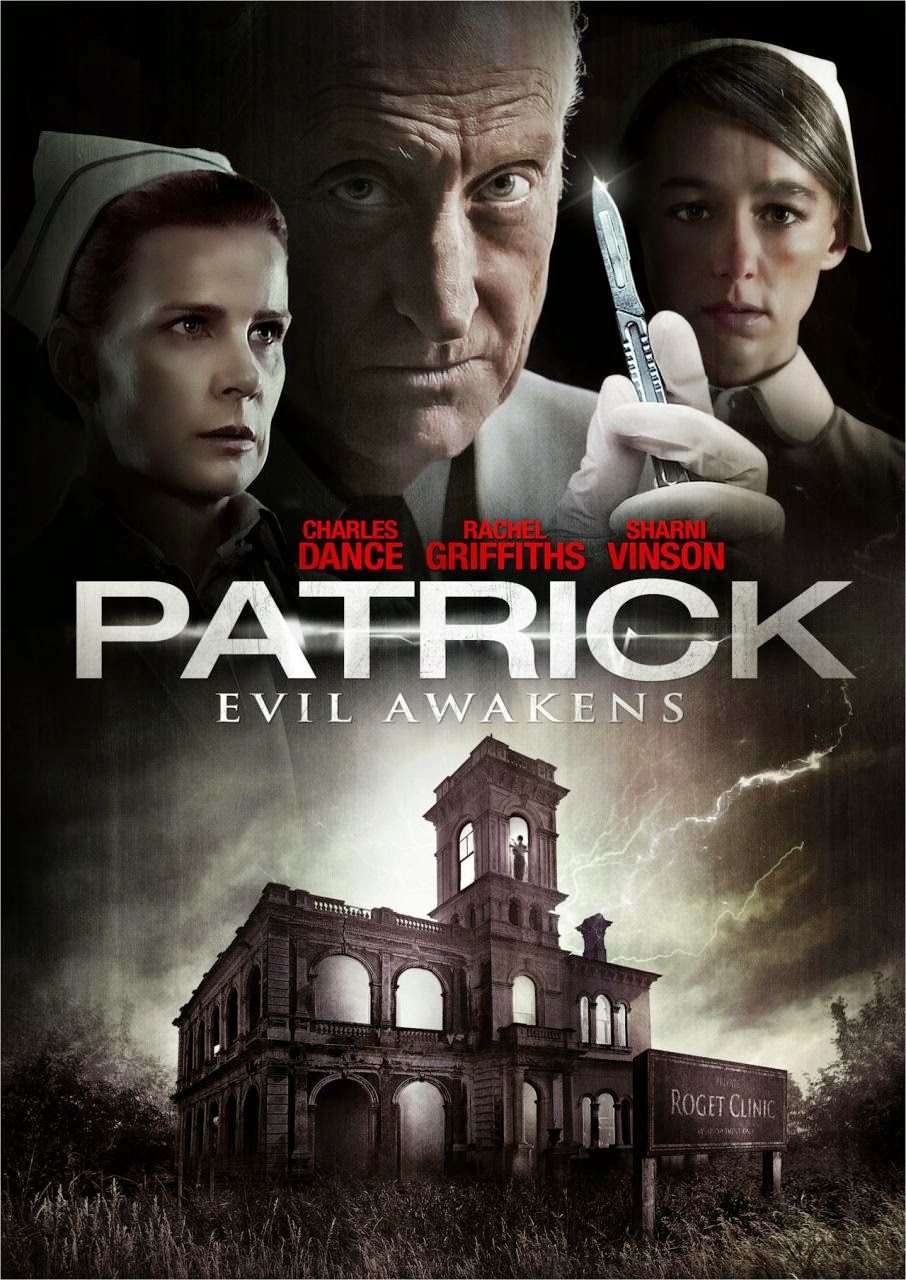
Hitchcock disciple and future PSYCHO II director Richard Franklin's PATRICK (1978) is one of the cornerstones of the Ozploitation scene. Written by the venerable Everett De Roche (LONG WEEKEND, ROAD GAMES, RAZORBACK), PATRICK dealt with a comatose young man wreaking telekinetic havoc in a hospital in a twisted display of obsessive love for a new nurse. It's rather slow and dry by today's standards, but the sight of Patrick lying in bed, eyes wide open, is one of the iconic horror images of the 1970s. The film did only modest business in Australia, but became a surprise hit in Italy, where its original score was wiped in favor of one by Goblin and was successful enough to generate its own Italian ripoff/fake sequel with Mario Landi's PATRICK STILL LIVES (1980), which turned Franklin's comparatively restrained little horror film a sleazy gorefest best known for its infamous "fireplace poker in the vagina" scene. PATRICK was acquired by Vanguard/Monarch for its 1979 US release, where it lost nearly 20 minutes of material to neuter it down to a PG rating and, as AIP did with MAD MAX a year later, the Australian cast was dubbed over by American voice actors. PATRICK remains a cult classic to this day, and exploitation superfan Mark Hartley, a native Australian behind such hugely enjoyable and infectiously fun documentaries as the Ozploitation love letter NOT QUITE HOLLYWOOD (2008) and the Filipino exploitation tribute MACHETE MAIDENS UNLEASHED (2010), as well as the upcoming ELECTRIC BOOGALOO: THE WILD, UNTOLD STORY OF CANNON FILMS, makes his narrative feature debut with this remake. NOT QUITE HOLLYWOOD jump-started the recent resurgence of interest in Australian cult cinema and it's very probable that a PATRICK remake wouldn't have happened were it not for NOT QUITE HOLLYWOOD. Hartley's love of '70s and '80s B-movies rivals that of Quentin Tarantino, but unfortunately, the comparisons end there: no matter how much his heart is in the right place by affectionately remaking one of his favorite films, Hartley's PATRICK is just not good, and it does no favors for vintage Ozploitation, PATRICK fans, or Hartley himself.
The plot is essentially the same: nurse Kathy Jacquard (Sharni Vinson of YOU'RE NEXT) gets a job at a hospital run by the stern Dr. Roget (Charles Dance) and his uptight head nurse daughter Matron Cassidy (Rachel Griffiths). Kathy is intrigued by comatose Patrick (Jackson Gallagher), who's been lying still and unresponsive since killing his mother and her boyfriend years earlier. Patrick seems to respond to Kathy in the form of reflexive spitting and transferring his thoughts to a computer monitor or via text to her phone (the lack of such technology forced him to communicate via typewriter in the original version). Of course, in true "One Froggy Evening" fashion, only Kathy sees this. Patrick is also able to control the minds and bodies of others, particularly those close to Kathy, whether it's her estranged boyfriend Ed (Damon Gameau) or doctor/potential suitor Brian (Martin Crewes). Kathy can't convince anyone of Patrick's brain activity, and as Dr. Roget's unethical, electro-shock treatments on Patrick increase, so do Patrick's violent tendencies and his drive to control Kathy and the people around her. Hartley is sure to pay homage to Franklin's film by giving the new Patrick the surname of the actor who played him in 1978 (Robert Thompson), giving Ed the surname Penhaligon, after the 1978 film's Kathy (British actress Susan Penhaligon), naming a hospital "The Royal Helpmann" after the 1978 Dr. Roget (Robert Helpmann), and in casting Ozploitation fixture Rod Mullinar (the 1978 Ed) in a small role as an asshole hospital administrator. He even pays brief tribute to PATRICK STILL LIVES (Italian title: PATRICK VIVE ANCORA) in the form of an end credits stinger. Hartley frames a lot of shots in the fashion of Hitchcock and De Palma, and has a score by regular De Palma collaborator Pino Donaggio, but it's so grating and over-the-top that it annoys more than enhances. Hartley also relies too much on cheap jump scares and some really bush-league, cheap-looking CGI that makes the whole project look like an Asylum ripoff of PATRICK. PATRICK '13 is a plodding, slowly-paced bore, with only Dance's acid-tongued villainy providing any entertainment (the way he spits "And you are prissy, meddling little bitch who's wasting my precious time, and I would dearly love for you to fuck off!" at Vinson is the highlight). He gave it a shot, but Hartley's first foray outside of the documentary realm is a resounding failure, though I have no doubt that ELECTRIC BOOGALOO will be his magnum opus. He's doing great things to preserve the memory of the B-movies that many of us hold so dear. But if PATRICK '13 is any indication, he just doesn't need to be making his own. (Unrated, 96 mins)
THE RAILWAY MAN (Australia/UK - 2013; US release 2014) Directed by Jonathan Teplitzky. Written by Frank Cottrell Boyce and Andy Paterson. Cast: Colin Firth, Nicole Kidman, Hiroyuki Sanada, Stellan Skarsgard, Jeremy Irvine, Sam Reid, Tanroh Ishida. (R, 107 mins)
Based on Eric Lomax's acclaimed memoir of his time spent in a Japanese prison camp after the fall of Singapore during WWII and his later efforts to track down the officer who tortured him, THE RAILWAY MAN offers fine performances and harrowing depictions of war crimes, but sometimes suffers from hokey dialogue and too often emits a "Weinstein Company awards bait" vibe. The script by frequent Michael Winterbottom collaborator Frank Cottrell Boyce and Andy Paterson takes some occasionally questionable liberties with Lomax's story, but overall, it's a solid film that succeeds more often than it stumbles, and gets an immense boost from a quietly powerful performance by Colin Firth as Lomax.
Set in 1980, the film presents Lomax as a milquetoast railway enthusiast with an almost savant-like knowledge of trains and rail schedules. He meets Patti (Nicole Kidman) during a train ride home and, in a bit of rushed storytelling, they hit it off and soon marry. Only then does Patti become aware of Lomax's PTSD in the form of nightmares, mood swings, periods of aloof silence, and attacking a bill collector with a box cutter. He refuses to discuss his war experiences, prompting Patti to turn to Lomax's war buddy Finlay (Stellan Skarsgard), who also believes in the stiff upper lip, keep-calm-and-carry-on mentality but can see how much Patti wants to help his friend. Flashing back to 1942, young Lomax (Jeremy Irvine) and Finlay (Sam Reid) were engineers taken prisoner by the Japanese and forced to help build the Burma Railway (part of this railroad was the centerpiece of the 1957 classic THE BRIDGE ON THE RIVER KWAI). All the men were tortured and treated with barbaric cruelty by the captors, none more than Lomax, who was caught with a secretly-built radio used for listening to British broadcasts. His captors insist it was an instrument for secret communication, and though he endures extensive beatings and all manner of torture overseen by Kempeitai officer Nagase (Tanroh Ishida), Lomax never gives in. Back in 1980, Lomax's psychological torment threatens his marriage and his sanity until Finlay alerts him to a Kempetai historical museum located at the very camp where they were prisoners, and the museum is run by none other than Nagase (Hiroyuki Sanada).
THE RAILWAY MAN then sends Lomax off on a mission of vengeance against Nagase that becomes a journey of healing for both men. The remorseful Nagase is just as haunted by his actions during the war, and runs the museum as a way of setting things right and dealing with the past. It takes Nagase a few minutes to realize he's talking to Lomax. In reality, Lomax never considered revenge, their reunion took place in 1993, and Nagase knew he was coming. From the outset, the meeting was an effort to turn the page on that chapter of their lives. Of course, film is a different medium and THE RAILWAY MAN is not a documentary. Dramatic developments must be expressed in their own way, but initially portraying Lomax as a nebbishy vigilante seems a bit disingenuous, no matter how good Firth is in the role. The inaccurate 1980 setting seems to have been chosen perhaps because it's the latest year that the filmmakers could possibly ask the audience to buy Firth in the role of a WWII vet, considering the two men, both born in 1919, were 74 when they reunited. The film also does some pre-emptive damage control to maximize audience sympathy, completely eliminating the fact that Lomax was married for 37 years and had two adult children who wanted nothing more to do with him when he left his wife for the younger Patti in the early '80s, and he wasn't quite the stammering, socially-awkward Rain Man he is in the early scenes. Nevertheless, taken in its own context and on its own terms, THE RAILWAY MAN is compelling, with outstanding performances by Firth and Sanada, even if both look too young for their roles at 52, when Lomax and Nagase would've been 61 even if they met in 1980. As for the rest of the cast, Kidman has little to do after the midway point, but Irvine (WAR HORSE) does a remarkable job of channeling a young Firth and bears an uncanny resemblance to the young Lomax. As far as a "true story" is concerned, to say THE RAILWAY MAN plays fast and loose with the facts is an understatement, but the essential message of forgiveness and healing is key and in that respect, the film gets the job done. This story was also adapted into the 1995 British TV movie PRISONERS IN TIME, with John Hurt as Lomax.