An ambitious but inert chronicle of the 1880s "War of the Currents" between Thomas Edison (Team DC: direct current) and George Westinghouse (Team AC: alternating current), THE CURRENT WAR has a behind-the-scenes backstory that's ultimately more interesting than the one it presents onscreen. Originally shown at the Toronto Film Festival in September 2017 and set to be released that November by the Weinstein Company (you can already see where this is going), it was one of many films pulled from the release schedule and shelved indefinitely when HarveyGate broke in the October interim. Weinstein had been supervising some last-minute editing, and with the film in limbo and Weinstein out, director Alfonso Gomez-Rejon (THE TOWN THAT DREADED SUNDOWN, ME AND EARL AND THE DYING GIRL, and several episodes of AMERICAN HORROR STORY) appealed to co-executive producer Martin Scorsese to allow him to re-edit the film to his own--and not Weinstein's--specifications as well as arrange some additional reshoots. Gomez-Rejon also tossed the original score heard in the 2017 Toronto version and replaced it with a new one. The end result--sold to the upstart 101 Studios and advertised as THE CURRENT WAR: THE DIRECTOR'S CUT for its theatrical run in October 2019--is a rarity in that, at 102 minutes, it's actually ten minutes shorter than what the notorious Harvey Scissorhands was going to release in 2017. Despite a relentless blitz of TV spots, THE CURRENT WAR died at the box office, though it will no doubt find its proper audience once schools reopen, playing over four class periods to bored junior high science students while the teacher gets caught up on grading papers.
Written by Michael Mitnick, who originally pitched the idea as a musical production over a decade ago (Weinstein's name has been removed from the released version, but other credited producers like Scorsese, Steven Zaillan, Bob Yari, and Timur Bekmambetov should give you an idea of how many people were involved at various points over the long development period), THE CURRENT WAR opens in 1880 as Edison (Benedict Cumberbatch, also one of the producers) obtains a patent on an invention "whose purpose is simple: to give light." It involves lighting by direct current and he attracts the attention of both powerful financier J.P. Morgan (Matthew Macfadyen) and President Chester A. Arthur (Corey Johnson), the latter already impressed with Edison's invention of the phonograph. His work also intrigues engineer and entrepreneur Westinghouse (Michael Shannon), who invites Edison to dinner but is stood up with no explanation. It's this personal slight that begins the "War of the Currents," as Westinghouse and his friend Franklin Pope (Stanley Townsend) tout their method of electric illumination with alternating current, which covers longer distances than direct current. Edison is made aware of this by contract worker and "futurist" Nikola Tesla (Nicholas Hoult), who warns him that most of the country is empty space and that focusing on direct current isn't thinking about the long-term. This leads to a back-and-forth game of one-upmanship that will see tragedies for both men--Edison's wife Mary (Tuppence Middleton) dies from a degenerative disease assumed by historians to be a brain tumor that wasn't helped by that era's all-purpose quick fix of laudanum, and Westinghouse loses his right-hand man Pope to an accidental electrocution--and a frustrated Tesla eventually joining forces with Westinghouse when he can no longer deal with the stubborn and egomaniacal Edison.
Original 2017 poster
THE CURRENT WAR covers the details, but does so in a dry, educational fashion that isn't far removed from those historical films that Roberto Rossellini made in the last years of his career, and Gomez-Rejon's frequent indulgence in fish-eye lenses, Dutch angles, and other flashy moves only serves as a transparent attempt to liven things up. It doesn't handle the time element very well--after captions reading "1880" and "1882," it's pretty much abandoned until the coda at the 1893 Chicago World's Fair, so the years are a blur in terms of what happens when. This is especially bungled with the illness of Mary Edison, who's given a diagnosis in one scene, and the next shows the closed casket at her funeral. When did she die? A month later? A year later? Later that same day? Who knows? And we can only surmise a few years have passed when Edison's secretary-turned-partner Samuel Insull (Tom Holland) suddenly shows up in one scene with a glued-on mustache. The actors are fine, especially Katherine Waterston, who provides a spark whenever she turns up as Westinghouse's loving and unexpectedly shrewd wife, and Cumberbatch and Shannon finally meet in passing at the 1893 World's Fair, and while it might not exactly be the diner scene in HEAT, it's the best moment here for both stars. There's nothing really wrong with THE CURRENT WAR, but it's just very slow-moving and the constant tech talk doesn't make for very riveting drama. Fans of Cumberbatch and Shannon should see it, but if you want the gist of the story in a much shorter lesson, just stick with Tesla's video for their minor 1991 hit "Edison's Medicine." (PG-13, 102 mins)
ESCAPE FROM PRETORIA (Australia/UK - 2020)
Based on the true story of three anti-apartheid activists who pulled off a daring escape from a South African prison in 1979, ESCAPE FROM PRETORIA makes sure to cross everything off the prison break movie checklist. After setting off a series of leaflet bombings in Cape Town in 1978, African National Congress activists Tim Jenkin (Daniel Radcliffe) and Stephen Lee (Daniel Webber) are found guilty and thrown into the Pretoria political prison for white males, where Jenkin immediately begins plotting an escape. They find a mentor in legendary ANC member and close Nelson Mandela associate Denis Goldberg (Ian Hart), who's serving four life sentences for trying to overthrow the government. Goldberg warns Jenkin to calm down ("Everybody thinks they're gonna break out next week"), but he wants out, and a photographic memory allows him to draw a detailed sketch of the key used by the guards to unlock the cells. He's able to construct a makeshift wooden key in the prison shop and eventually gets it to work, then methodically creates numerous duplicates, obsessively testing them in the middle of the night while spending his days devising an escape plan and creating keys to all the doors that will eventually allow them to simply walk out when no one is looking. Goldberg ends up sitting out the escape to run interference with the block's least competent guard on duty, and Jenkin and Lee are instead joined by Frenchman Leonard (Mark Leonard Winter), a fictionalized version of the third escapee, Alex Moumbaris.
It took a lot of work and planning, and it's in these scenes that director/co-writer Francis Annan generates the most stomach-knotting tension. But the biggest assist the three men got during their escape was some extremely lax security in that section of the prison complex, subsequently stepped up significantly after the embarrassment of three prisoners getting through a half dozen locked doors and simply walking out of a front gate that was carelessly left unlocked and wide open, which even they find shocking ("The gate's open?!"). ESCAPE FROM PRETORIA takes some liberties beyond not mentioning Moumbaris by name, a big one being its depiction of Jenkin and Lee caught in the act of series of leaflet bombings on a busy street. It makes for a tension-filled opening sequence, but in reality, they were quietly apprehended without incident moving some printing equipment into their residence, which had been under surveillance for some time. Lee almost pulled off his own escape while the pair were awaiting trial, but that's never mentioned here, and it's strange that Lee is more or less relegated to being Jenkin's loyal sidekick, with Webber (best known as Lee Harvey Oswald in the Hulu series 11.22.63 and as Vince Neil in the Motley Crue biopic THE DIRT) given little to do. It does clear the way for a committed performance by Radcliffe, who's never not going to be Harry Potter, but does an excellent job of projecting some genuine grittiness and disappearing into this role. The specificities of the plot aside, ESCAPE FROM PRETORIA is generally routine as far as prison break thrillers go, right down to Jenkin's chief nemesis being a guard nicknamed Mongo (Nathan Page), who's cartoonishly sadistic even by apartheid standards. There's nothing new here, but it's well-made and compelling, like a politically-driven ESCAPE FROM ALCATRAZ. (PG-13, 106 mins)
1917 (US/UK/Spain - 2019) Directed by Sam Mendes. Written by Sam Mendes and Krysty Wilson-Cairns. Cast: George MacKay, Dean-Charles Chapman, Benedict Cumberbatch, Colin Firth, Mark Strong, Andrew Scott, Richard Madden, Claire Duburcq, Adrian Scarborough, Daniel Mays, Pip Carter, Richard McCabe, Billy Postlethwaite, Robert Maaser. (R, 119 mins) A WWI epic inspired by a story that director/co-writer Sam Mendes was told by his Lance Corporal grandfather, 1917 is an impressive technical achievement that's so devoted to its--for lack of a better word--gimmick, that it's pulled off at the expense of telling the story in the most beneficial way. Drawing from older classics like ALL QUIET ON THE WESTERN FRONT and Stanley Kubrick's PATHS OF GLORY with the more visceral, you-are-there immediacy of SAVING PRIVATE RYAN and DUNKIRK, 1917 attempts to convey its entire run time as one continuous shot, a la Hitchcock's ROPE or Alejandro G. Inarritu's BIRDMAN. Of course, if you go into any exercise of this type knowing that, you start getting distracted by trying to spot where the usually seamless cuts are, and here, the spell is momentarily broken by a huge mid-film cut to black when a character is knocked unconscious. Mendes, who has the distinction of directing the both strongest (SKYFALL) and weakest (SPECTRE) of the Daniel Craig 007 outings, makes a valiant effort to go for those Kubrick long takes and uses the legendary auteur's old standby of natural light with the great cinematographer Roger Deakins, but once its plot is set in motion, it strangely lacks the emotion or the urgency that the situation requires, primarily because Mendes' overriding concern is the single-take illusion.
Set over one day and into the morning of the next, 1917 has Lance Corporals Schofield (George MacKay) and Blake (Dean-Charles Chapman) sent by Gen. Erinmore (Colin Firth) to hand-deliver a message to a battalion several miles away with orders to halt a planned attack on German forces. Aerial intel reveals that the Germans have set a trap or them, and the 1600 men under the command of Col. McKenzie (Benedict Cumberbatch)--including Blake's older brother (Richard Madden)--will most likely be wiped out. All lines of communication have been cut by the Germans, leaving no alternative but for Schofield and Blake to go on foot, crossing the abandoned German front and getting through the town of Ecoust and finding McKenzie's battalion. It's a simple set-up with an intricately choreographed execution, albeit with significant digital assistance. For a while, the technique dazzles, especially as Schofield and Blake make their way across a harrowing wasteland of mud, blood, dead soldiers and horse carcasses. A trek through the vacated German trenches leads to an explosion when a rat crosses a tripwire. A dogfight between two British planes and a German pilot ends up having serious consequences to the mission.
The more 1917 goes on, the more gimmicky it looks. Because there's hardly any time to learn about these characters, the emotional stakes aren't there, and all that's left is the single-take concept. That works to a point, but eventually, you may question why Mendes was so concerned with that as opposed to developing the narrative and fleshing out the characters beyond a one-dimensional level. When it's able to focus on the immediacy of the situation--the tripwire explosion, the German plane crashing after the dogfight, a sniper attack, a stunning trip through a bombed-out town engulfed in flames that looks like something out of APOCALYPSE NOW--1917 is firing on all cylinders and has moments of undeniable brilliance. But the pseudo-"real time," single take illusion also means there's a lot of walking and talking. And walking. And more walking. And the sense of urgency is never really properly conveyed--beyond "we need to get to Col. McKenzie"--because the time element is never made clear. If the movie runs two hours, then tell them "You have two hours." The cut-to-black when a character is knocked out cold seems to serve the dual purpose of maintaining the one-shot ruse while also allowing Mendes to explain away some of that real-time issue, in a sense negating the whole single-take idea in the process. In the end, it all boils down to this: yes, it's technically impressive and it's obvious that a lot of intricate planning went into it, but why? Why tell this story this way?
MacKay (CAPTAIN FANTASTIC) and Chapman (GAME OF THRONES) are fine, as good as they're permitted to be since they seem like little more than players in a WWI video game (the sequence where MacKay's Schofield gets caught in some DELIVERANCE-style rapids after going over huge waterfall that appears out of nowhere seems to belong in another movie, as does his shoddy-looking avatar that jumps in the water). Brief support is provided by continuous big-name cameos just like the WWII movies of the 1960s--in addition to Cumberbatch, Madden, and Firth, Mark Strong also appears, perhaps part of a package deal with Firth as they've seemingly appeared in more movies together than Abbott & Costello. Even with numerous standout moments and earnest performances by the leads, 1917 still doesn't even have the power of a 90-year-old relic like 1930's ALL QUIET ON THE WESTERN FRONT. And forget comparisons to PATHS OF GLORY, a film whose anti-war rage still has a seething resonance over 60 years later. I may sound like I didn't like 1917. It's a good movie, but it could've--and should've--been a much better one. Make no mistake, it's gonna clean up at the Oscars because it's a safe pick that everybody can get behind. But it'll be one of those Best Picture winners that just doesn't stick in the memory. When's the last time you heard anyone mention GREEN BOOK?
BLACK MASS (US/UK - 2015) Directed by Scott Cooper. Written by Mark Mallouk and Jez Butterworth. Cast: Johnny Depp, Joel Edgerton, Benedict Cumberbatch, Kevin Bacon, Jesse Plemons, Peter Sarsgaard, Dakota Johnson, Corey Stoll, Rory Cochrane, David Harbour, Adam Scott, Julianne Nicholson, Juno Temple, W. Earl Brown, Bill Camp. (R, 122 mins)
If you listen closely in the theater, as the lights go down and BLACK MASS starts, you can almost hear CRAZY HEART and OUT OF THE FURNACE director Scott Cooper say "As far back as I can remember, I always wanted to make a Scorsese movie." So it is with the much-anticipated BLACK MASS, touted as a return to form following a surplus of whimsical dress-up and endless self-indulgent eccentricities from former actor Johnny Depp. Even the most devoted Depp apologists turned on him after the loathsome MORTDECAI and to that end, BLACK MASS does showcase Depp's best performance in years, even if it's by default. Though he's not as "Depp"-y, it's still more of the same to some extent: as infamous South Boston gangster James "Whitey" Bulger, he's again buried under a ton of caked-on makeup, a combination bald cap/receded hairline, and a pair of ice-blue contact lenses that look not unlike those used on Bill Bixby at the beginning of a Hulk-out into Lou Ferrigno on THE INCREDIBLE HULK. Taking place from 1975 to 1991, BLACK MASS covers a lot of ground with a lot of characters, but it has all the depth and insight of Bulger's Wikipedia page. There was probably a longer, more epic film here at some point--even shortly before the film's release, it was still being tweaked, with Sienna Miller's entire role as a Bulger girlfriend ending up on the cutting room floor due to what Cooper termed "narrative choices."
Though Depp is front and center as Bulger, it almost feels as though the film should be about FBI agent John Connolly, played here by Joel Edgerton (THE GIFT). A childhood friend of Bulger and his state senator brother Billy (Benedict Cumberbatch), Connolly approaches Bulger in 1975 with an offer to become an FBI informant in an effort not to take down Southie crime operations, but rather, the Irish mob's Mafia competition. As the years go on, Bulger's Winter Hill Gang empire grows as he gives nothing to Connolly, who becomes complicit in Bulger's crimes by alerting him to FBI operations and falsifying reports under the guise of Bulger cooperation. Bulger is the devil on Connolly's shoulder, but their relationship really isn't explored, nor is there much in the way of escalating tension as Connolly gets in way over his head in his labyrinthine machinations to steer the FBI away from Bulger. We see him and co-conspirator agent John Morris (David Harbour) getting into shouting matches with incredulous colleagues played by Kevin Bacon and Adam Scott in superfluous extended cameos, and we see Connolly's new-found flashy sartorial choices not going over well with his wife (Julianne Nicholson), but nothing really happens with him until a new special agent (Corey Stoll) takes charge and starts holding him accountable as he still struts around the bureau office with a "What? Me Worry?" demeanor.
Connolly is a man obliviously drowning in his immoral and unethical choices and his pure hubris, but Cooper and screenwriters Jez Butterworth (EDGE OF TOMORROW) and Mark Mallouk are much more interested in Depp's feature-length Whitey Bulger impression. Depp is fine in the role, but at the end of the day, it's still not very far removed from what he's been doing for the last several years. He's using an intimidating monotone voice but letting the hairline and the contact lenses do almost all of the heavy lifting, and there's numerous scenes--the "family recipe" bit with Harbour's Morris, in particular--where he's just riffing on Joe Pesci and the "Funny how?" scene from GOODFELLAS. Cooper wants the entire film to be a Scorsese love letter, whether it's to GOODFELLAS or THE DEPARTED with its Baahston accents and Bulger being the prime inspiration for Jack Nicholson's Frank Costello in the latter film. Cooper doesn't have the style or the sense of energy to pull off Scorsese beyond a basic homage, and as a result, his film often keeps you at a distance.
BLACK MASS is a pretty decent movie, but it's hard to shake the feeling that it could've been an exceptional one. There's a great cast and a fascinating story here and all we really get when it's over is a Whitey Bulger Greatest Hits package that gets into a comfortable and too-familiar groove and never tries to go further than scratching the surface. Everyone loves a good Scorsese-style crime saga, but why not just watch a real one instead of a pretend one? For all the presence Depp has as Bulger, his performance is still pretty one-dimensional in execution, with very little known about him other than his skills as a master manipulator and feared killer. Other than Edgerton, everyone else just drops by on occasion. Dakota Johnson has a brief role as the mother of Bulger's young son, but when the son dies from Reyes' Syndrome, she's never seen or mentioned again. We also see a lot of Bulger soldiers, but with the exception of hapless schlub Steve Flemmi (Rory Cochrane), we learn little about them, other than they all eventually turn on Bulger to save their own asses. BLACK MASS is compelling from start to finish, but you've seen it all before. Overt Scorsese worship is fine when you can master the style and give it your own spin (like David O. Russell with AMERICAN HUSTLE), but Cooper's direction is workmanlike at best. Without a Thelma Schoonmaker by his side to help him find those distinct patterns and rhythms, Cooper is only capable of delivering Scorsese-lite. And Scorsese-lite works if you're looking for a two-hour, empty calories crime story to watch when nothing else is on. Just don't expect anything substantive.
THE HOBBIT: THE BATTLE OF THE FIVE ARMIES (US/New Zealand - 2014) Directed by Peter Jackson. Written by Fran Walsh, Philippa Boyens, Peter Jackson and Guillermo del Toro. Cast: Ian McKellen, Martin Freeman, Richard Armitage, Orlando Bloom, Evangeline Lilly, Luke Evans, Lee Pace, Benedict Cumberbatch, Cate Blanchett, Christopher Lee, Hugo Weaving, Ian Holm, Ken Stott, Graham McTavish, Aidan Turner, Stephen Fry, Billy Connolly, Sylvester McCoy, James Nesbitt, Jed Brophy, Stephen Hunter, Ryan Gage, Manu Bennett, John Tui, Mikael Persbrandt. (PG-13, 143 mins)
"One Last Time" seems to be the resounding theme throughout this final chapter in the HOBBIT trilogy as well as in its advertising. The films in Peter Jackson's original 2001-2003 LORD OF THE RINGS trilogy stand--especially in their extended editions--among the most monumental achievements in all of cinema. But by splitting J.R.R. Tolkien's relatively light and quick-reading Hobbit into another colossal, epic trilogy and insisting on shooting them in the absurd 48 fps "high frame rate," a format that makes everything look like a live TV broadcast, really only works for expansive exterior shots and is preferred by no one with a name other than "Peter Jackson," Jackson seems guided more by hubris and self-indulgence than anything. The Hobbit isn't meant to be as huge as The Lord of the Rings. It's a smaller, more brisk story and by importing elements of Tolkien's The Silmarillion and Unfinished Tales, bringing Orlando Bloom back to play Legolas, a character not even present in Tolkien's novel, and even going so far as to invent his own entirely new character--the elf Tauriel, played by Evangeline Lilly--and granting her as much, if not more plot and screen time than the key principals, Jackson is only demonstrating that he doesn't know when or where to stop. It's great that Jackson loves Tolkien so much, but where his LOTR trilogy ranks with the original 1977-1983 STAR WARS trilogy, his bloated, three-part HOBBIT, while well-acted and enjoyable on its own terms, is his STAR WARS: EPISODE I-III, and like George Lucas, he's surrounded by yes-men and basically at the point where he's too rich and powerful for anyone to tell him "no." When Jackson made the original LOTR trilogy, he had an insane ambition and something to prove. Remove that and the HOBBIT trilogy feels like little more than an extended victory lap.
At least the third part of the HOBBIT trilogy, THE BATTLE OF THE FIVE ARMIES, is the shortest at a mere 143 minutes. Roughly half of the running time is devoted to the epic battle at Erebor, where Thorin Oakenshield (Richard Armitage) has reclaimed the Dwarven birthright following the dragon Smaug's (motion captured by Benedict Cumberbatch) rampage on Laketown and its subsequent death courtesy of the black arrow fired by Bard (Luke Evans). Thorin has been driven mad with power and is obsessively hunting for the Arkenstone, which has been stolen by Bilbo Baggins (Martin Freeman), who knows that it's dangerous for Thorin to possess. Meanwhile, Bard has led a large band of Laketown refugees to Dale, where he's formed a tentative alliance with elf king Thanduil (Lee Pace), who wants elven jewels being kept in Smaug's former stronghold. Legolas and Tauriel also turn up, with Tauriel still dealing with her forbidden love for the dwarf Kili (Aidan Turner) as Orcs launch an offensive and Gandalf (Ian McKellen) dispenses sage advice.
With FIVE ARMIES, Jackson attempts to send the trilogy off with multiple extended battle sequences that play like a bunch of Helm's Deeps strung together. There's some occasionally inspired bits of action and some dazzling visuals that look fine in standard, 24 fps 3D (though the waxy sheen and gauzy Barbara Walters soft focus on some of the actors, particularly Bloom, can be distracting), but after a while, it's hard for it not to become an exhausting, eye-glazing CGI blur, quite often looking more like a video game than a movie. FIVE ARMIES works best in its few small-scale and quieter moments, be it a smiling nod from Gandalf (again, McKellen has little to do here aside from "show up and be Ian McKellen," but he owns this role so thoroughly that even watching him phone it in is a pleasure) or Thorin coming to his senses and realizing that he's been treating his friends horribly. There's so many characters and intertwining subplots that Freeman's Bilbo more or less disappears into the ensemble until it's time for him to say goodbye to the dwarves and head back to his home at Bag End. Despite some good performances by Evans and Armitage, there's too little of the sense of emotional connection that worked so brilliantly in the LOTR trilogy, where its many scenes of friendship and camaraderie never fail to get the waterworks going for fans. It's not like the magic is gone, but the freshness definitely is, even with brief, shoehorned-in appearances by other LOTR alumni like Cate Blanchett as Galadriel, Christopher Lee as Saruman, and Hugo Weaving as Elrond (their bits were intended for THE DESOLATION OF SMAUG but cut from it and edited into this film instead), and in using more CGI than ever in this closing installment (the shot of Legolas running along a bridge as it collapses is dreadful), there's a very diminished sense of humanity compared to before.
In his LOTR trilogy, Jackson paid loving tribute to Tolkien and captured the writer's voice and spirit with nothing less than absolute perfection. But by stretching THE HOBBIT from a 300-page breeze of a read to three films totaling around eight hours--even longer once you factor in the DVD/Blu-ray extended editions--Jackson is only paying tribute to Peter Jackson, capturing the voice and spirit of a gifted visionary who can no longer do anything without completely overdoing it, like a three-hour-plus KING KONG. I probably sound like I hate the three HOBBIT films, but I don't. They're entertaining and demonstrate flashes of past LOTR greatness (Cumberbatch's Smaug in the second film is probably the highlight), but the overall feeling is one of shrugging ambivalence. The LOTR trilogy is one that vividly entertains and still richly rewards. The nice-enough-while-you're-watching-it but forgettable HOBBIT trilogy is just there. People still talk about LOTR in reverent tones, but do you know anyone who really loves the HOBBIT movies and speaks of them as highly as the LOTR films? Everybody's gone to see the HOBBIT movies but it seems like we've approached this new trilogy more out of a feeling of obligation than out of the feverish excitement we collectively had a decade ago. I'm actually sort-of glad that it's done.
THE HOBBIT: THE DESOLATION OF SMAUG (US/New Zealand - 2013)
Directed by Peter Jackson. Written by Fran Walsh, Philippa Boyens, Peter Jackson, Guillermo del Toro. Cast: Ian McKellen, Martin Freeman, Richard Armitage, Orlando Bloom, Benedict Cumberbatch, Luke Evans, Evangeline Lilly, Cate Blanchett, Lee Pace, Stephen Fry, Ken Stott, James Nesbitt, Aidan Turner, Sylvester McCoy, Graham McTavish, Jed Brophy, Mikael Persbrandt, Ryan Gage, Manu Bennett, Lawrence Makoare. (PG-13, 161 mins)
The second installment of Peter Jackson's HOBBIT trilogy is a no-expense-spared visual stunner, but again suffers from the bloat of Jackson and his writing team padding a 300-page book into what will amount to somewhere around nine hours of cinema. I'm not saying there's an etched-in-stone rule for film adaptations of books, but if you can read the book in less time than it takes to watch the movie, you might be overdoing it. Jackson was able to convey the entire epic LORD OF THE RINGS trilogy in three films, but the recurring--and justified--criticism of this latest venture is that The Hobbit is a comparatively smaller-scale, less grandiose novel, but it's still taking him three overlong films to tell the story thanks to the addition of material from Tolkien's The Silmarillion and Unfinished Tales. There's simply no reason other than the greed of getting fans to pay for three movies that this couldn't have been one three-hour film. This frequently becomes a problem when a visionary filmmaker unveils a game-changer and is then granted carte blanche to do whatever they want. He may not be the insufferable asshole that James Cameron is, but that doesn't make Jackson's self-indulgence any less problematic and off-putting.
Harsh words, perhaps, but I didn't dislike THE DESOLATION OF SMAUG. It looks terrific (I saw this in regular 3-D instead of the stagy-looking High Frame Rate 3-D, which is Jackson's preferred vision), the performances are excellent, and there's some inspired set pieces, most notably the barrel escape from the castle of Elvenking Thranduil (Lee Pace). That's just one stop on the journey of Bilbo Baggins (Martin Freeman), who's accompanying a group of dwarves led by the heroic Thorin Oakenshield (Richard Armitage) to obtain the Arkenstone from the dragon Smaug, who long ago took control of Lonely Mountain from Oakenshied's ancestors. SMAUG really consists of a handful of set pieces stretched out to extreme lengths. Whatever spectacle is achieved--the giant spiders, the barrel escape, and eventually, the showdown with Smaug (wonderfully voiced and the face motion-captured by Benedict Cumberbatch)--each goes on forever. Before the heroes end up imprisoned in Thranduil's castle, they cross paths with elves Legolas (Orlando Bloom) and Tauriel (Evangeline Lilly). Legolas, a fan favorite of the LOTR books and films, is the son of Thranduil but was not in Tolkien's The Hobbit, and is only here to make Bloom part of this trilogy as well (he's also been given that distracting, waxy CGI sheen that the original trilogy's returning actors got in AN UNEXPECTED JOURNEY to make him look younger, though considering Legolas is already several hundred years old, it hardly seems necessary). Tauriel is a character completely invented by Jackson, and much time is devoted to her mutual crush on dwarf Kili (Aidan Turner), a subplot that the audience will find almost as irritating as Legolas does. So, it's not enough that he's bloating the novel into three films by incorporating material from other Tolkien works, but now he's creating additional characters and plotlines? Just adapt the book, Mr. Jackson. I'm no Tolkien purist and it's been years since I've read it, but you're fixing something that isn't broken.
Amidst the endless and eventually exhausting action sequences--yes, Jackson resorts to that zoomy, circling video-game look with characters pinballing around the frame--there's a lot to appreciate in the performances. Freeman is spot-on as Bilbo and Armitage is again a strong Oakenshield. The camaraderie among the dwarves is nicely-handled, Luke Evans does some good work as Bard, a widowed, down-on-his-luck boatman who helps smuggle the crew into Esgaroth, and Stephen Fry is amusingly hammy as the callous Master of Lake-town, a sort-of Middle-Earth one-percenter prone to bitching that the commoners want food, shelter, and work. Jackson made some late-in-the-game editing decisions and bumped some scenes to next year's THERE AND BACK AGAIN, resulting in Hugo Weaving (Elrond), Andy Serkis (Gollum), and Christopher Lee (Saruman) getting cut from SMAUG, and Cate Blanchett (Galadriel) reduced to one shot. Presumably, these changes affected Ian McKellen's Gandalf as well. McKellen gets top-billing here but only has a few scenes. After leaving Bilbo and the dwarves to attend to other business, he runs into Radagast (Sylvester McCoy) and has a confrontation with the Necromancer (also Cumberbatch), and...that's it. Absent for long stretches of time, McKellen's got maybe 10-12 minutes of screen time here, and it's one of the film's major letdowns. He owns this character and it's an absolute joy watching him relish playing it. But hey, at least we've got a budding romance between Kili and Tauriel to look forward to in the next film.
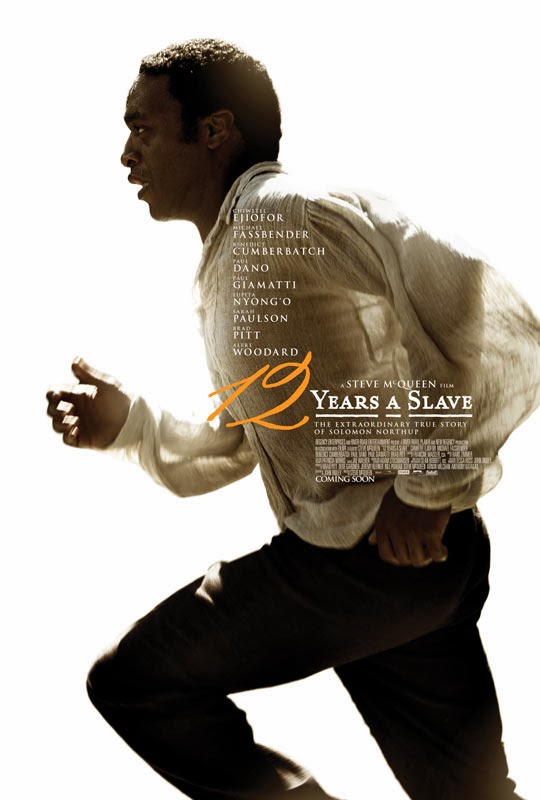
Directed by Steve McQueen. Written by John Ridley. Cast: Chiwetel Ejiofor, Michael Fassbender, Benedict Cumberbatch, Brad Pitt, Paul Dano, Paul Giamatti, Alfre Woodard, Sarah Paulson, Lupita Nyong'o, Scoot McNairy, Taran Killam, Garret Dillahunt, Adepero Oduye, Michael Kenneth Williams, J.D. Evermore, Andy Dylan, Kelsey Scott, Quevenzhane Wallis, Bill Camp, Chris Chalk, Tony Bentley, Christopher Berry, Liza J. Bennett. (R, 134 mins)
Solomon Northrup's 1853 memoir is adapted into a typically brutal and unflinching offering from British filmmaker Steve McQueen, who previously gave us the similarly harrowing hunger-strike chronicle HUNGER (2008) and the NC-17 sex addiction drama SHAME (2011). McQueen has already made his mark as a noteworthy modern filmmaker, but 12 YEARS A SLAVE shows he can make a commercial, mainstream film without watering down his pursuit of graphic and ugly realism. This is a gut-wrenching, upsetting, and horrifying film, and arguably the most unblinking, in-your-face depiction of slavery that you're likely to see. It's not hyperbole to compare it to SCHINDLER'S LIST as the final cinematic word on a specific subject.
Chiwetel Ejiofor stars as Northrup, a free black man in 1841 Saratoga, known and respected throughout the community as a violinist, artist, and family man. When his wife is out of town with their two children, Solomon meets two circus performers (Scoot McNairy, Taran Killam), who talk him into taking a lucrative gig in Washington, D.C. They get him drunk and he wakes up chained in a room. Rechristened Platt, Solomon is taken to Louisiana and sold to plantation owner William Ford (Benedict Cumberbatch). Ford is a slave owner, but is relatively kindly, and respects "Platt" for his obvious intelligence and his construction skills after he takes charge of devising a more efficient waterway transport for him. This angers Tibeats (Paul Dano), a sadistic Ford plantation overseer who tries to lynch Platt after starting a fight with him and embarrassingly losing. Realizing he can't have Platt and Tibeats working together, Ford transfers the debt of Platt's acquisition to cotton plantation owner Edwin Epps (Michael Fassbender, who starred in HUNGER and SHAME). Epps and his wife (Sarah Paulson) are a monstrous couple, abusive to their slaves, whipping them if they fall short of the 200 lb/day cotton quota. Epps has also been forcing himself on slave Patsey (Lupita Nyong'o), which causes her to be a constant target of Mistress Epps' jealous rages. Before arriving at Epps' plantation, Solomon/Platt repeatedly tries to explain that he's a free man, but it only gets him into trouble, as does his inability to stand idly by while those around him are being treated so unjustly.
Working from a script by John Ridley (THREE KINGS, UNDERCOVER BROTHER, RED TAILS), McQueen pulls no punches with 12 YEARS A SLAVE. The language and imagery are harsh, as they should be (Patsey is given the most vicious whipping this side of THE PASSION OF THE CHRIST). It's hard not to get angry as Solomon is let down by nearly everyone: the circus performers (it's odd to see SNL standout Taran Killam as one of the film's chief villains), people in positions of power who won't listen to him, even the kindly Ford, who cares about Platt to some extent but still puts profits before the slave's well-being. When Platt pleads with Ford to not give him to Epps and starts to explain that he's a free man from Saratoga, Ford can only say "I don't want to know." When Solomon/Platt is sold to the Fords along with Eliza (Adepero Oduye), a single mother who has her two children taken away from her by a cruel slave trader (Paul Giamatti), Eliza can't stop crying, and Ford's wife (Liza J. Bennett) brushes her off with "Get some sleep and some food and you'll forget those children soon enough."
12 YEARS A SLAVE features career-best work from Ejiofor, and Fassbender, who should've gotten Oscar nods for both HUNGER and SHAME, turns in yet another performance that demonstrates he's one of the best actors at work today. Where most directors handling a subject like this would have the villains played as cackling moustache-twirlers, McQueen makes them ugly and real. Fassbender and Paulson create one of the most loathsome screen couples in ages. I also liked what McQueen did with Cumberbatch's Ford, presenting him as conflicted about his feelings but still cynically putting himself and his money first. There's a number of familiar faces in smaller roles: Alfre Woodard as a former slave who pragmatically became a plantation mistress; Michael Kenneth Williams (BOARDWALK EMPIRE's Chalky White) as a too-small bit as a rebellious slave; and Brad Pitt as Bass, a Canadian carpenter who warns Epps that the slave owner's day of reckoning is coming. Difficult to watch and impossible to forget, 12 YEARS A SLAVE suffers from occasionally stilted dialogue but is otherwise masterful moviemaking and one of the year's best films.
Directed by J.J. Abrams. Written by Roberto Orci, Alex Kurtzman, and Damon Lindelof. Cast: Chris Pine, Zachary Quinto, Zoe Saldana, Karl Urban, Simon Pegg, John Cho, Benedict Cumberbatch, Anton Yelchin, Bruce Greenwood, Peter Weller, Alice Eve, Leonard Nimoy, Noel Clarke, Nazneen Contractor, Aisha Hinds, Deep Roy. (PG-13, 132 mins)
I'm not a Trekkie by any stretch of the imagination. I've enjoyed the 1966-69 TV series but never felt a real devotion to it. I've always been a much bigger fan of the movies, particularly that incredible three-film run of STAR TREK II: THE WRATH OF KHAN (1982), STAR TREK III: THE SEARCH FOR SPOCK (1984), and STAR TREK IV: THE VOYAGE HOME (1986). I really liked J.J. Abrams' terrific 2009 reboot STAR TREK and thought it did an excellent job of going back to the younger days of these iconic characters and updating the story and the visuals for a modern audience. Abrams and that film's two screenwriters (Roberto Orci and Alex Kurtzman) are back for STAR TREK: INTO DARKNESS, joined by Abrams' LOST co-creator Damon Lindelof, and the results are much less successful. Abrams and the writers seem to forget that the key to STAR TREK has always been the characters, and instead go for a "bigger is better" mentality more akin to Michael Bay and Jerry Bruckheimer. Everything about ST:ID is bigger and louder. Characterization and creativity are sacrified and despite some positive elements, in the end it's just a lot of noise.
After ignoring protocol on a mission and continuing his arrogant, hot-dogging ways, young Capt. Kirk (Chris Pine) is relieved of his command of the Enterprise and sent back to the Academy. The demotion doesn't last long, as a bombing in London staged by renegade Starfleet Commander John Harrison (Benedict Cumberbatch) leads to another attack at Starfleet command that kills Kirk's mentor Adm. Christopher Pike (Bruce Greenwood). Admiral Marcus (Peter Weller) reinstates Kirk's command of the Enterprise and sends him and his crew--Spock (Zachary Quinto), Dr. McCoy (Karl Urban), Uhura (Zoe Saldana), Sulu (John Cho), Chekov (Anton Yelchin), and Dr. Carol Marcus (Alice Eve), a last minute replacement for an irate Scotty (Simon Pegg), who disagrees with the mission and refuses to go along but returns in a heroic capacity much later--to Kronos, the home of the Klingons, where Harrison is reportedly in hiding.
(MAJOR SPOILERS in the unlikely event you don't already know)
This is where I'd normally stop and say something like "to say anything more would involve spoilers," but considering the biggest spoiler is already the worst-kept secret of the summer and IMDb's page for ST:ID has Cumberbatch's character named as his true identity, there seems to be little point in carrying on with the charade: yes, Harrison is really genetically-engineered superhuman and future Kirk arch-nemesis Khan, and he's playing everyone--the Klingons, Starfleet, Marcus, and Kirk--against each other in order to rescue 72 cryogenically-frozen friends and colleagues being held in stasis by Marcus in exchange for Khan's scientific and biological expertise in helping him wage war on the Klingons.
After a pretty good first hour, ST:ID becomes one big action sequence after another. Some of these are nicely done, particularly one where Kirk and Khan (who briefly become, yes, allies) have to dodge space debris and then fit into a small airlock to board another ship, but each one seems to ramp up the sense of overkill. With the revelation that Harrison is Khan, easily the greatest of all villains in the STAR TREK universe, the film becomes more concerned with restaging vital moments of STAR TREK II: THE WRATH OF KHAN, frequently to its own detriment. Yes, we get a "needs of the many outweigh the needs of the few" invocation, a sacrifice for those needs, and the expected bellowing of "KHAAAAAN!" The filmmakers' idea of shaking things up is to have these moments involve different characters and it just feels gimmicky. There's no heart to it and it doesn't have the same effect because we aren't as invested in these characters. That's not a knock on the actors--Quinto is an excellent Spock, and while he's a dastardly Khan, even the Cult of Cumberbatch must concede that Ricardo Montalban simply raised the bar too high for anyone else to meet, let alone top--but it's the weakness of the writing. There's a reason STAR TREK II: THE WRATH OF KHAN was a huge hit with Trekkies and non-Trekkies alike and has endured and become a timeless cinematic classic over the last 31 years, and it's not because of how big and flashy and over-the-top the action sequences were. It's the characters. It's the writing. And yes, the actors, but without all of those elements working in tandem, it's inevitably going to fall short even if the new ensemble does a decent job, and if the filmmakers insist on using so much of KHAN in ST:ID's plot, then they can't be surprised that fans resort to comparing the two.
Also not helping at all is the lens-flaring, jerky shaky-cam directing style that Abrams utilizes, making this feel like STAR TREK for the TRANSFORMERS crowd. There's really no reason for a climactic Spock/Khan fist fight, especially one that looks like the actors were CGI'd into outtakes from THE FIFTH ELEMENT. ST:ID is the kind of formulaic product that thinks it can be Taken Seriously by throwing in thinly-veiled references to topical events. Christopher Nolan's THE DARK KNIGHT and THE DARK KNIGHT RISES handled this effectively, but the inclusion of a suicide bombing, a Dick Cheney-esque warmongering military figure, and some 9/11-inspired imagery with a Starfleet ship commandeered by Khan crashing into a bustling metropolis seems contrived and offensive not for its inclusion but for the transparent obviousness of it. This is a junk movie conceived by a committee (even resorting to the now-standard "nefarious villain detained or standing in a cell while glaring at and/or taunting the hero" scene; see also Heath Ledger in THE DARK KNIGHT and Javier Bardem in SKYFALL). It's not an artistic vision or a serious statement. It's just loud and disorienting (and I didn't even see it in 3D) and at the risk of sounding like an old man telling J.J. Abrams to get off my lawn, I generally find it hard to enjoy a movie when it's giving me a pounding headache. Coming after such a successful reboot four years ago, STAR TREK: INTO DARKNESS has its moments, but overall, it's a mostly empty and disappointing experience.