THE INVISIBLE MAN (US/Australia - 2020) Written and directed by Leigh Whannell. Cast: Elisabeth Moss, Aldis Hodge, Storm Reid, Oliver Jackson-Cohen, Harriet Dyer, Michael Dorman, Benedict Hardie, Nicholas Hope, Renee Lim, Nash Edgerton. (R, 124 mins) With Universal finally--for now--throwing in the towel with their attempted Marvelization of the studio's classic monsters in the ill-conceived "Dark Universe" that they tried their damnedest to make a thing (have you met anyone who actually likes the Tom Cruise MUMMY?), THE INVISIBLE MAN serves as a stand-alone, modern-day re-imagining from writer/director Leigh Whannell. Best known for co-writing and starring in the first SAW and then the INSIDIOUS franchise, Whannell seems to be sticking with relatively smaller-scale genre fare while his former creative partner James Wan has helmed the CONJURING films and blockbusters like FURIOUS 7 and AQUAMAN. Whannell's 2018 sci-fi actioner UPGRADE was an entertaining, imaginative, low-cost B-movie that should've gotten a lot more attention than it did, but with the Blumhouse production THE INVISIBLE MAN--budgeted at less than $10 million, or pocket change by today's standards--he establishes himself as a serious horror craftsman, very conservatively doling out the kind of jump scares that INSIDIOUS helped make overly familiar and instead using the Invisible Man trope in service of an intense, harrowing chronicle of abuse and gaslighting. And it's all in the guise of a nail-biting, pulse-pounding fright flick that's also--somehow, given the potentially triggering subject matter--a cathartic crowd-pleaser at the same time.
As effectively as Whannell uses uncomfortable silences in the sound design and makes every bit of empty space in the widescreen framing seem ominous and threatening, THE INVISIBLE MAN wouldn't work at all if not for the powerhouse performance by Elisabeth Moss, the latest example in a growing line of stellar work by exemplary actresses (think Toni Collette in HEREDITARY and Florence Pugh in MIDSOMMAR) that will go unrewarded because horror movies just aren't given serious awards consideration. Moss has been putting together an acclaimed body of work going back to AMC's MAD MEN, and more recently on Hulu's THE HANDMAID'S TALE, a memorable supporting turn in US, and the indie drama HER SMELL, and she just knocks it out of the park in THE INVISIBLE MAN. She plays Cecilia Kass, who's introduced pulling off a daring, intricately-planned 3:45 am escape from the oceanside mansion of her wealthy boyfriend Adrian Griffin (Oliver Jackson-Cohen). Adrian is a brilliant, groundbreaking optics scientist, and he's also a manipulative psychopath, a psychologically and physically abusive control freak, and Cecilia has reached her breaking point. She drugs Adrian and still barely manages to escape with her sister Emily (Harriet Dyer) in a waiting car nearby, and she hides out with her old friend, cop James (Aldis Hodge) and his teenage daughter Sydney (Storm Reid). Two weeks go by, and she's afraid to even walk outside for fear that Adrian has found out where she is, until Emily brings tragic, albeit relieving news: Adrian has committed suicide, and his younger brother and attorney Tom (Michael Dorman) informs Cecilia that Adrian has left her $5 million, payable in tax-free monthly installments of $100,000, contingent on her not being arrested for a crime or being declared mentally incompetent.
It seems too good to be true, and because it's a horror movie, it is. Cecilia cautiously begins building a new life and has a strong support system in Emily, James, and Sydney, but little things start happening. A knife disappears, a door is left ajar, a skillet catches fire when the burner is cranked too high. She starts feeling like someone is in the room with her even when she's alone. She goes to a job interview and finds her portfolio empty. She passes out and blood work reveals a dangerously high level of Diazepam, which she stopped taking when she lost the prescription bottle during her escape from Adrian's. That missing bottle suddenly turns up on the bathroom sink. Emily cuts off contact with her after receiving a cruel and harshly-worded e-mail that Cecilia swears she never sent. She confronts Tom and accuses him of helping fake Adrian's suicide, and that Adrian's work in optics and physics--possibly having something to do with a strange machine she observed in his high-tech lab during her escape--has resulted in the ability to somehow make himself invisible. Of course, no one believes her and she sounds insane, and she's soon terrifying Sydney to the point where James wants her out of the house. But she's not crazy. She can't prove it, but Adrian is very much alive, and even more of a domineering, narcissistic sociopath than when he was visible, and he's determined to destroy Cecilia's life as revenge for leaving him.
It doesn't quite qualify as a "#MeToo"-ification of H.G. Wells (though R-rated, there is one plot point later on with which a more exploitative film would've taken a much grosser path), but THE INVISIBLE MAN is frequently a very unsettling depiction of the PTSD suffered by abuse victims. Though she's given plenty of opportunities to go full-throttle, Moss often lets her eyes, forever sad and surveying everywhere in almost paralyzed fear that Adrian could be anywhere, speak volumes. Almost everyone knows someone who's been the victim in an abusive situation, and Moss (who, at Whannell's insistence, was asked to go over his script to make whatever tweaks were necessary to avoid any unintentional mansplaining and ensure its accuracy from a woman's perspective) absolutely nails the trauma, the terror, and the rage. It's a remarkable performance in a very well-done genre outing, albeit one where the plot holes do get a little too big to ignore. But the film is so intense, so good at playing the audience (if you see this in a theater, there's a guaranteed collective gasp at the restaurant scene), and so inspired in the way it shifts into unpredictable directions at which the trailer never even hinted that it's a case where griping about the logic lapses is just petty nit-picking. It is, after all, a movie about an invisible man.
THE DEADLY TRAP (France/Italy - 1971; US release 1972) Directed by Rene Clement. Written by Sidney Buchman, Eleanor Perry, Daniel Boulanger and Rene Clement. Cast: Faye Dunaway, Frank Langella, Barbara Parkins, Maurice Ronet, Karen Blanguernon, Raymond Gerome, Michele Lourie, Patrick Vincent, Gerard Buhr, Massimo Farinelli, Robert Lussac, Franco Ressel. (PG, 97 mins) French filmmaker Rene Clement (1913-1996) dabbled in various genres over his career, achieving notoriety for some WWII-themed films like 1952's Oscar-winning FORBIDDEN GAMES, 1963's THE WAY AND THE HOUR, and 1966's all-star epic IS PARIS BURNING? But beginning with 1960's PURPLE NOON--from the same Patricia Highsmith novel that was the basis for 1999's THE TALENTED MR. RIPLEY--and especially with 1970's RIDER ON THE RAIN, he carved a niche for himself as a sort-of French Hitchcock. After RIDER, Clement would maintain that image by focusing exclusively on mystery and suspense thrillers for the remainder of his career until his retirement after 1975's WANTED: BABYSITTER, generally considered his worst film. After the worldwide success of RIDER ON THE RAIN, which was also the key film in establishing Charles Bronson as an international superstar (much like PURPLE NOON did for Alain Delon), Clement followed in rapid succession with 1971's THE DEADLY TRAP, and 1972's AND HOPE DIE. Both films have just been released on Blu-ray by Kino Lorber, because physical media is dead.
Based on the 1966 Arthur Cavanaugh novel The Children Are Gone, THE DEADLY TRAP's script is credited to four writers, among them Clement, Eleanor Perry (who wrote several of her husband Frank Perry's films, including DAVID AND LISA, LAST SUMMER, and DIARY OF A MAD HOUSEWIFE), as well as a Hollywood old-timer in Sidney Buchman, whose long list of credits included 1939's MR. SMITH GOES TO WASHINGTON, 1941's HERE COMES MR. JORDAN (which won him an Oscar), and 1963's CLEOPATRA. There was also an uncredited fifth writer, with contributions from then-recent M*A*S*H Oscar-winner Ring Lardner, Jr. With all of those cooks in the kitchen, it's little wonder THE DEADLY TRAP is a muddled and curiously uninvolving mess with disparate plot elements that never quite come together. Expat American couple Jill (Faye Dunaway) and Philip (Frank Langella, who had just co-starred in the Perrys' DIARY OF A MAD HOUSEWIFE) live in Paris with their two young children Cathy (Michele Lourie) and Patrick (Patrick Vincent). Jill seems preoccupied and has been plagued of late with memory lapses, which have been prevalent enough that it's beginning to cause a rift in their marriage (Jill, defending her recurring distractions and her wandering mind: "Have you done always done exactly what you're supposed to do?" Philip: "Yes. When you got pregnant, I married you. Isn't that what I was supposed to do?"). Philip works as an editor for a publisher of mathematics textbooks, and he's got his own distractions to worry about: he's been summoned by a sinister former employer (Maurice Ronet) to fulfill one final "contract" in his past life of corporate espionage. It was a shady and often dangerous business and it's hinted that it's the reason he and Jill fled to Paris. But the past has caught up with Philip, and they won't take no for answer, going so far as to follow Jill and the kids around. They even use an associate (Karen Blanguernon) posing as an employee from the couple's regular babysitting service to pull off the abduction during one of Jill's frequent easily-distracted moments on a busy street outside a crowded department store at Christmastime.
The cops suspect Jill of negligent parenting at best and outright murder at worst, with lead investigator Chameille (Raymond Gerome) straight-up accusing her of killing the children as a way to get her husband's attention, even interrogating her with humiliating questions like "You and your husband haven't had sexual relations in some time, yes? So, he has a mistress, then?" Jill has the support of her best friend, downstairs neighbor Cynthia (Barbara Parkins), who may or may not have a thing for Philip, while Philip knows that the kids have been kidnapped but can't say anything without divulging his own past as a corporate spy and putting them in even greater danger. THE DEADLY TRAP certainly has the makings of a solid thriller with some pieces that foreshadow the non-supernatural aspects of DON'T LOOK NOW, but its lugubriously slow pace (it's a good 45 minutes before the kids are even taken) and the meandering story are handled with little sense of urgency by Clement, who seems to be having somewhat of an off-day after RIDER ON THE RAIN. The story has two potentially interesting threads--Jill's almost Leonard Shelby-like memory issues and Philip and the kids being threatened by his previous employers--but doesn't follow either to a wholly satisfying conclusion. There's no suspense in the kidnapping angle, and the big reveal about one supporting character is something you'll see coming the moment they're introduced.
THE DEADLY TRAP opening in Toledo, OH on 11/15/1972
It's interesting to see the two stars in an early '70s Eurothriller, with the often-difficult Dunaway already in a post-BONNIE AND CLYDE/THOMAS CROWN AFFAIR slump from which she'd emerge after 1974's CHINATOWN (Langella recounted a story in his memoir about Dunaway wasting an entire day of shooting deciding which pair of shoes she wanted for a particular shot). THE DEADLY TRAP opened in Europe in June 1971 but didn't hit the US until October 1972, courtesy of then-struggling National General Pictures, which would be defunct by the beginning of 1974. It aired in prime-time on CBS in August of 1978 and occasionally ran on late-night TV into the 1980s, but aside from a 1988 VHS release, absurdly retitled DEATH SCREAM and shortened by several minutes--that same crummy DEATH SCREAM print is what's streaming on Amazon Prime--THE DEADLY TRAP has been tough to see in its proper form until now and is probably the least-remembered film from Dunaway's heyday (even 1969's notorious bomb THE EXTRAORDINARY SEAMAN turns up on TCM with some degree of regularity). Fans of Dunaway, Langella (in just his third film, maybe hoping Clement could do for him what he did for Delon and Bronson), and VALLEY OF THE DOLLS star Parkins will find completist curio value here, but given that roster of talent and with Clement coming off RIDER ON THE RAIN, this was regarded as a big disappointment then and the passage of time hasn't made it any better.
THE DEADLY TRAP airing in prime time on CBS on 8/15/1978
AND HOPE TO DIE (France - 1972) Directed by Rene Clement. Written by Sebastian Japrisot. Cast: Jean-Louis Trintignant, Robert Ryan, Lea Massari, Aldo Ray, Jean Gaven, Tisa Farrow, Andre Lawrence, Nadine Nabakov, Daniel Breton, Louis Aubert, Beatrice Belthoise, Don Arres, Mario Verdon, Emmanuelle Beart. (PG, 141 mins) After the middling THE DEADLY TRAP was greeted with shrugging indifference by critics and moviegoers, Rene Clement quickly returned with 1972's AND HOPE TO DIE, a loose adaptation of David Goodis' 1954 novel Black Friday that also reunited him with RIDER ON THE RAIN screenwriter Sebastian Japrisot. The end result is even more eccentric than RIDER, and one of the most unusual and offbeat European crime films of its day. Loaded with references to Lewis Carroll and Alice's Adventures in Wonderland and Alice Through the Looking Glass from the opening shot of a mirror and a bookstore window adorned with the grinning visage of the Cheshire Cat, AND HOPE TO DIE is a fascinating, metaphorically oblique puzzle that's never quite solved, starting with a shy child being taunted by some other kids (including a very young Emmanuelle Beart, 15 years before MANON OF THE SPRING) and an onscreen quote "My love, we're simply overgrown children running around before we go to sleep." Clement cuts to a train arriving at a Montreal station in almost spaghetti western fashion, as three members of a gypsy clan are waiting for Antoine "Tony" Cardot (Jean-Louis Trintignant), a French fugitive who manages to get away, hitching a ride and hiding out in the abandoned American Pavilion (later turned into the Montreal Biosphere) at the Expo 67 World's Fair site. Tony's luck doesn't get any better, as he happens to stumble into a shootout where corrupt ex-cop Renner (Louis Aubert) is whacked by cohorts Rizzio (Jean Gaven) and Paul (Daniel Breton). Just before he dies, Renner hands Tony a wallet and an envelope with $15,000, but after stuffing the money down his pants, he's caught by Rizzio and Paul before he can get away. They handcuff him and take him by car (where he manages to push Paul out of the vehicle, causing a serious head injury), then by boat to a vacant inn being used as a hideout for their gang of criminals led by the fearsome Charley (Robert Ryan), with the gypsy mystery men following close behind and not letting Tony out of their sight.
It soon becomes apparent to Tony that he's traded in one deadly predicament for another. Charley wants the $15,000 that Rizzio and Paul were supposed to get--Tony initially claims he doesn't have it--and in addition to Charley's threats, he also has to deal with his brutish, hapless flunky Mattone (Aldo Ray). Derisively rechristened "Froggy" by Charley, Tony tells a story about how he's on the run because he killed a cop, which gets him enough cache to be kept alive for a while, but he remains on thin ice with Charley throughout, the situation growing even more volatile when he starts sleeping with Charley's free-spirited, open-relationship girlfriend Sugar (Lea Massari). Tony also unexpectedly bonds with Pepper (Tisa Farrow, Mia's younger sister and later the star of Lucio Fulci's ZOMBIE), Paul's younger sister (they were "adopted" by Charley as kids, when their father--a member of Charley's crew--was killed on a job), who feels drawn to him even though she knows he's responsible when Paul eventually dies from his head injury. With Paul out of the picture and already down another man in dead traitor Renner, Charley decides to include Tony as an impromptu fill-in for a bizarre heist he's been commissioned to pull off by an incarcerated mobster (Mario Verdon).
The what and why of the heist ("Toboggan?") would be revealing too much, but it's perfectly in line with this remarkably unconventional crime thriller that's on Blu-ray in its original 141-minute French-language version. It's easy to see why US distributor 20th Century Fox didn't know what the hell to do with AND HOPE TO DIE, cutting it by 42 minutes (!) when it hit American theaters in November 1972 and puttered across the country well into the next year (it opened in Cleveland, OH as late as August 1973). The 99-minute, English-language US cut occasionally aired on late-night TV and had a VHS release through Monterey Home Video, but has since completely disappeared from circulation. It would've been an interesting bonus feature on the Blu, but one can assume the American version eliminates much of the character-building, the slow-burn tension, the Lewis Carroll allusions, and does what it can to offset the general sense of the strange, dreamy melancholy of the entire situation to instead focus on the more action-oriented heist and its aftermath. The reviews were predictably brutal (New York Times film critic Vincent Canby put it on his ten-worst list for 1972), but even European audiences experiencing Clement's intended vision may have been left baffled and scratching their heads. It's filled with nail-biting suspense, but it's not really interested in being a straightforward thriller (there's even some absurdist humor in the way Charley makes Tony sleep in a child's bed), and it's book-ended by scenes of children playing that may even indicate that it's all being imagined. You're never sure if a character is being truthful about their background, starting with Tony, whose reasons for being on the run--hinted at in almost William Friedkin-esque subliminal flash cuts--are eventually revealed to be quite different than what he's telling everyone. Even a whiny, dim-witted meathead like Mattone has layers to his character, and his weird and seemingly out-of-nowhere encounter with a psychic majorette (Nadine Nabokov) will have disastrous consequences later on. That's just one example of how everything that seems random and nonsensical in AND HOPE TO DIE is there for a reason, probably an important aspect of the film's construction that was likely lost on 20th Century Fox when they hacked it down and sold it as action-packed caper.
AND HOPE TO DIE is easily the most peculiarly idiosyncratic film of Clement's career. With its genuinely unpredictable story, character development and arcs, and some effective use of Montreal locations, it's a unique, forgotten gem and a buried treasure of a cult item that's been patiently waiting to be rediscovered, even if it takes a while to adjust to a dubbed-in-French Robert Ryan, who's absolutely terrific in one of his last films (he gets a great intro, putting a cigarette out in Tony's coffee, kicking off a running gag where they don't let him eat or drink). Already terminally ill with lung cancer, Ryan spent the final year of his life working nonstop (he made four more movies after this--LOLLY-MADONNA XXX, THE OUTFIT, EXECUTIVE ACTION, and THE ICEMAN COMETH, the last three being posthumously released in the months after his death in July 1973 at 64). He doesn't look well here, but he doesn't allow cancer to hinder him in the slightest (that would especially be the case with his brilliant final performance in THE ICEMAN COMETH), participating in a few action sequences and getting into rough scuffles with Trintignant and Ray throughout. Though they're revoiced in French (with the American cut seemingly lost and no clips of it on YouTube to verify--not even a US trailer--it's possible Clement shot two versions of the all dialogue scenes, one in French and one in English, like he did with RIDER ON THE RAIN), Americans Ryan and Farrow are phonetically speaking/mouthing the language, and Ray, who previously worked with Ryan in 1957's MEN OF WAR and 1958's GOD'S LITTLE ACRE, goes one step further by delivering his entire performance in French with his actual voice. Aldo Ray fluent in French? Who knew? It's a jarring sight and sound, and an unexpected level of commitment from a guy who was notoriously difficult in his prime, was a couple years away from slumming in Al Adamson movies, who would cap off the decade by appearing in a non-sexual co-starring role in the 1979 Carol Connors hardcore porn western SWEET SAVAGE, and would later have his SAG membership temporarily revoked in the mid '80s for taking quick cash in non-union projects. AND HOPE TO DIE has totally fallen off the radar in the decades since its release, but this new Blu-ray will hopefully be the start of a long-overdue resurrection and reappraisal. It's an often impenetrable, strangely haunting, one-of-a-kind film that stays with you for days after seeing it, and deserves to be mentioned in the same breath as revered Clement essentials like FORBIDDEN GAMES, PURPLE NOON, and RIDER ON THE RAIN.
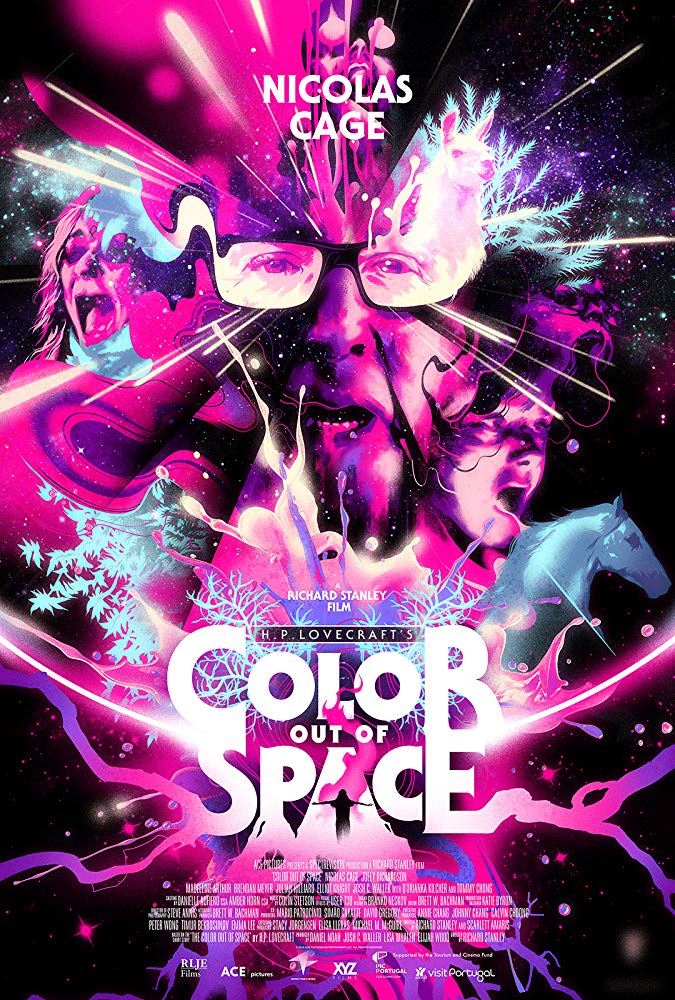
COLOR OUT OF SPACE would've been newsworthy enough on the basis of it being an H.P. Lovecraft adaptation starring Nicolas Cage in MANDY mode, but what really caused some excitement was the long-overdue return of Richard Stanley to narrative features almost 25 years after being fired from THE ISLAND OF DR. MOREAU, effectively ending his Hollywood career. Stanley established some significant cult bona fides with 1990's HARDWARE and 1992's DUST DEVIL, but when he clashed with New Line execs and a particularly dickish Val Kilmer during the first week of shooting on MOREAU, he was shown the door and replaced by John Frankenheimer, the entire clusterfuck of a production covered in the acclaimed 2015 documentary LOST SOUL. Stanley made a few documentaries and short films, got a co-writing credit on Nacho Cerda's 2006 film THE ABANDONED, and helmed a short segment of the 2011 anthology film THE THEATRE BIZARRE, but COLOR OUT OF SPACE is, at long last, his triumphant proper return. Based on Lovecraft's 1927 short story "The Colour Out of Space" and previously filmed in 1965 as DIE, MONSTER, DIE! with Boris Karloff and as the Ovidio G. Assonitis-produced THE CURSE in 1987, COLOR is a frequently surreal bit of phantasmagorical horror that shares some stylistic similarities with MANDY (as well as Cage and some producers, including Elijah Wood), but also seems indebted to the disturbing metamorphosing aspects of ANNIHILATION (not to mention one sequence that's an obvious nod to THE THING) while name-checking various Lovecraft essentials, with several character names and mentions of Arkham and Miskatonic.
When a meteorite crashes on the front lawn of the farmhouse of Massachusetts (but shot in Portugal, of all places) alpaca breeder Nathan Gardner (Cage) and his cancer-stricken wife Theresa (Joely Richardson), strange occurrences become the new normal: the water supply is tainted, their personalities are affected, they blackout as hours pass in an instant, youngest son Jack (Julian Hillard) stands by the well, saying he's "talking to my friends." Nathan suffers from wild mood swings and lashes out at the two older kids, stoner Benny (THE GUEST's Brendan Meyer) and free-spirited Lavinia (Madeleine Arthur). And all the while, inexplicable purple-derived light and color formations manifest themselves and envelop the Gardner property, which grows more isolated from the outside world by the day. There's also hydrologist Ward (Elliot Knight), who's surveying the groundwater at the behest of the do-nothing mayor (THE NEW WORLD's Q'orianka Kilcher), and Ezra (Tommy Chong), an easygoing, harmless squatter living in a shack on the edge of the Gardner property, who records voices of "The people under the floor, man!" that match the creepy garbled gibberish and screams that are heard on the other end of the line ("It's in the static! It's in the moisture!") whenever anyone tries to make a phone call. Stanley establishes an effectively ominous, otherworldly mood amidst the hypnotic, cosmic colorgasms ("It's just a color...but it burns"), and after a too-slow buildup that sometimes overindulges Cage's required-by-law freakouts (resurrecting some of his VAMPIRE'S KISS schtick), COLOR OUT OF SPACE really catches fire in its second half, with some truly unsettling visuals, unexpected emotion, soundtrack appearances by Mayhem and Burzum, and absolutely no mercy in who it's willing to kill off. It also offers some humor, particularly in the way the local media portrays Nathan as a UFO crackpot when they arrive at the farm to cover the meteorite crash. Easily the most noteworthy Lovecraft adaptation since Stuart Gordon's DAGON back in 2001, COLOR OUT OF SPACE is solid horror offering with Cage bringing his A-game in his best film since MANDY, and while it doesn't top the visionary HARDWARE in the Best of Richard Stanley rankings, it sure is great to have him back. (Unrated, 110 mins)
IN FABRIC (UK - 2019)
IN FABRIC is the latest retro exercise from British filmmaker Peter Strickland, whose obsessively-detailed '70s aesthetic was displayed in the giallo-tinged paranoia thriller BERBERIAN SOUND STUDIO and the BDSM love story THE DUKE OF BURGUNDY. Strickland's films tend to be triumphs of style over substance and to that end, IN FABRIC is no exception, though it did get some buzz in horror circles last fall as "the killer dress movie" when the trailer went online, but A24 opted to keep it confined to arthouses and VOD. After seeing BERBERIAN and DUKE, I've concluded that I like the idea of Strickland's films more than I like the films themselves. Set in the early 1980s, IN FABRIC has some hypnotically stylish visuals and an incredible score by Cavern of Anti-Matter that sounds like it could've come straight from a 1972 fashion giallo with Edwige Fenech and George Hilton. Strickland nails the look and feel, but in terms of story, IN FABRIC is uneven, unfocused, and all over the place. Other than the look and sound, the film's biggest strength is Marianne Jean-Baptiste's performance as Sheila Woodchapel, a lonely bank teller recently left by her husband for a younger woman. She lives with her college-age son Vince (Jaygann Ayeh) and listens to him having sex with his intimidating, older goth model girlfriend Gwen (Gwendoline Christie). She decides to try the personals and treats herself to a new dress prior to her first blind date, purchased during a highly-publicized sale at Dentley & Soper's, a posh department store where she's attended to by eccentric saleswoman Miss Luckmoore (Fatma Mohamed). But after wearing the dress, she develops a rash, the dress destroys her washing machine, and while everyone's asleep, it hovers around the house on its own and even attacks Gwen at one point.
So far, so good, but then Strickland abruptly shifts gears around 70 minutes in, abandoning Jean-Baptiste's character to focus on nerdy washing machine repairman Reg (Leo Bill), who's about to be married to childhood sweetheart Babs (Hayley Squires). Reg's co-workers purchase the same red dress and make him wear it at his bachelor party, and the same strange cycle repeats--rash, wrecked washing machine, dress floating around the house--only with Reg being a little dorky, the second half is played more broadly compared to the ominous and eerie first half. Much of the humor comes from the bureaucratic, OFFICE SPACE-meets-Kafka-style nonsense that both Sheila's and Reg's bosses level at them, with Sheila being reprimanded by supervisors Clive (Steve Oram) and Stash (Julian Barratt of THE MIGHTY BOOSH) over a two-minute bathroom break, her handshakes "not being meaningful enough" and for smiling and waving at the manager's mistress when they bumped into one another on the street. Strickland also includes some scathing, satirical Orwellian jabs at capitalism, retail, and customer service in ways that seem more like he really wanted to make a Terry Gilliam movie but couldn't cut the cord from his Dario Argento/Eurocult/giallo fetishism, and to further muddy the waters, he throws in some HALLOWEEN III-inspired Dentley & Soper's TV spots that lull targeted viewers into a catatonic state. I really wanted to like this, and once again, I love what I see and hear but I'm still left cold by Strickland, who's starting to look like a one-trick pony, but it's admittedly an endlessly watchable trick. He's an extraordinarily gifted stylist, and other than Panos Cosmatos (BEYOND THE BLACK RAINBOW, MANDY) and maybe the team of Helene Cattet & Bruno Forzani (THE STRANGE COLOUR OF YOUR BODY'S TEARS), I can't think of a current filmmaker who's better at taking their influences and using them to craft sequences and set pieces that better convey the dazed sense of half-remembered fragments of a shared dream. Strickland's got that part down, but on a narrative level, IN FABRIC is a complete mess that basically turns into an uninspired BLACK MIRROR episode by the time it's over. (Unrated, 119 mins) RABID (Canada - 2019)
Twin cult horror specialists Jen and Sylvia Soska (collectively billed as "The Soska Sisters") have always cited fellow Canadian David Cronenberg as their major cinematic influence, a sentiment echoed in their breakout body modification cult film AMERICAN MARY. To that end, remaking Cronenberg's 1977 classic RABID probably seemed like a good idea, but RABID '19 is a crushing failure at almost every turn. The central premise--the spread of a new strain of rabies stemming from a woman who's just had experimental surgery following a motorcycle accident--is the same, but none of the other incidental changes do anything to justify the remake's existence. Shy, motorcycle-riding seamstress Rose (Laura Vandervoort) works for pompous and stereotypically flamboyant fashion guru Gunter (McKenzie Gray). She's treated like dirt by his models with the exception of Chelsea (Hanneke Talbot), her childhood foster sister since she was taken in following the death of her parents in a car accident. It's Chelsea who got her the job, and who tries to set her up with Brad (Benjamin Hollingsworth), but when Rose leaves a Gunter event after realizing Brad only asked her out at Chelsea's request and then overhearing two mean girl cokehead models (played by the Soskas) talking shit about her in the ladies room, she leaves the party in a frazzled state and is immediately hit head-on by another car.
Rose wakes up in the ICU after a week (with the attending physician played by Stephen McHattie, probably the first sign that her situation is about to go from bad to worse) to find most of the left side of her face has been ripped off in the accident, with her jaw needing to be sewn back on. She's recommended for treatment at the Burroughs Clinic, an exclusive facility that deals in regenerative medicine and "Transhumanism." Rose is the subject of an experimental stem cell skin graft procedure pioneered by (deep sigh) Dr. William Burroughs (Ted Atherton). She's initially apprehensive, but it proves to be a complete success. She's more beautiful than ever, she gets her job back, is creatively inspired, and Brad seems legitimately interested in her, but...she's a devout vegetarian and suddenly develops a strange craving for raw meat. She wakes up with faint memories of violent dreams where she's attacking men in a flesh-eating fury. Soon, the people with whom she comes into contact (including UFC star CM Punk, cast radically against type as a meat-headed asshole) begin exhibiting even more advanced symptoms of a virulent new form of rabies that becomes a citywide epidemic. RABID '19 devotes a lot of time to lampooning the vapidity of the fashion industry in trite fashion, but at the same time dutifully hitting all of the old-school Cronenberg bullet points of body horror and disease. It also offers shout-outs to a bunch of his other films as well, like NAKED LUNCH with the name-dropping of Burroughs, the clinical surgical horrors of DEAD RINGERS (including the brief presence of Heidi Von Palleske as a member of the Burroughs surgical team), and the shady experimental treatment facility of THE BROOD. The protruding armpit phallus from the original RABID (also notable in its day as the first mainstream crossover attempt of porn star Marilyn Chambers) finally appears in the off-the-rails third act, where RABID '19 completely falls apart, abandoning the Cronenberg worship and turning into a dumb tribute to the late '80s work of Brian Yuzna and Screaming Mad George. The pointless RABID '19 really overstays its welcome at 108 minutes and can't even get the little things right--wouldn't McHattie (PONTYPOOL) have made a more interesting Dr. Burroughs than the bland Atherton? The first line of dialogue heard here is a ranting Gunter asking "Why do we keep remaking old trends?" A valid question, and one asked with little sense of self-awareness by the Soskas, since RABID '19 certainly qualifies as part of the problem. (Unrated, 108 mins)
THE LIGHT AT THE EDGE OF THE WORLD (US/Spain/Liechtenstein - 1971) Directed by Kevin Billington. Written by Tom Rowe and Rachel Billington. Cast: Kirk Douglas, Yul Brynner, Samantha Eggar, Renato Salvatori, Jean-Claude Drouot, Fernando Rey, Massimo Ranieri, Aldo Sambrell, Tito Garcia, Victor Israel, Tony Skios, Luis Barboo, Tony Cyrus, Raul Castro, Maria Borge. (PG, 128 mins) Kino's new Blu-ray edition of 1971's THE LIGHT AT THE EDGE OF THE WORLD was already announced several months before the legendary Kirk Douglas died just prior to its release at the age of 103. Unfortunately, it's not one of the iconic actor's better films, but of course, in a storied career as long as his, there will be inevitable ups and downs. LIGHT was made at a time when Douglas found himself in a major slump following a trio of costly big-studio duds with 1968's THE BROTHERHOOD, 1969's THE ARRANGEMENT, and 1970's THERE WAS A CROOKED MAN. His box-office misfortune probably wasn't helped by the youth-driven "New Hollywood" era being ushered in by the likes of BONNIE AND CLYDE, THE GRADUATE, and EASY RIDER, so there was little chance Douglas was going to secure the Hollywood studio funding he needed for THE LIGHT AT THE EDGE OF THE WORLD, a passion project that he'd been trying to get off the ground since 1965.
Kirk Douglas (1916-2020)
THE LIGHT AT THE EDGE OF THE WORLD was based on Jules Verne's posthumously-published 1905 adventure novel The Lighthouse at the End of the World, and Douglas had a history with the author's work, having starred with James Mason in Disney's 1954 live-action Verne adaptation 20,000 LEAGUES UNDER THE SEA. It was a hugely popular box-office smash, kickstarting a Verneassaince in Hollywood that led to the likes of 1956's Oscar-winning AROUND THE WORLD IN 80 DAYS, 1958's FROM THE EARTH TO THE MOON, and 1959's JOURNEY TO THE CENTER OF THE EARTH among several others. Douglas' own production company Bryna was able to front some of the budget for LIGHT, but he had to secure the remainder of the funding through European sources, namely producer Alexander Salkind, who would soon go on to oversee THE THREE MUSKETEERS, THE FOUR MUSKETEERS, and the SUPERMAN franchise. Salkind had been a minor player in the European film scene for some time, and, at least until his attempted "make two movies but only pay the actors for one" chicancery on the THREE/FOUR MUSKETEERS and SUPERMAN/SUPERMAN II, had a reputation as a hands-off producer who put up the money and let directors make the films they wanted to make. Salkind produced Orson Welles' 1962 Franz Kafka adaptation THE TRIAL and while the money ran out before the end of the shoot, it was one of the very few instances in his directing career that the mercurial Welles was able to work without meddling financiers looking over his shoulder and questioning every decision he made, and he always remained grateful to Salkind for demonstrating that trust and respect.
Similar money issues are apparent in much of THE LIGHT AT THE EDGE OF THE WORLD, particularly some almost Antonio Margheriti-worthy miniatures and one embarrassing shot where a ship's crew is obviously just tiny, immobile action figures on a model vessel that could very well be floating in the bathtub in Douglas' hotel room. With its mostly European supporting cast (including spaghetti western stalwart Aldo Sambrell and Spanish genre vet Victor Israel) dubbed by numerous familiar voices, and some shocking violence that flirts with grindhouse brutality (surprising, considering that Verne adaptations were typically family-oriented fare), LIGHT frequently resembles a cost-cutting Harry Alan Towers production of the time despite some class brought to the proceedings by Douglas and Yul Brynner, which is probably where a good chunk of the money went. Douglas is Denton, an assistant lighthouse keeper at the southernmost tip of Argentina in 1865. An American Gold Rush prospector on the run from a checkered past and a broken heart, Denton butts heads with head lighthouse operator Capt. Moritz (Fernando Rey, right before his memorable turn as the villain in THE FRENCH CONNECTION), but gets along fine with affable young apprentice Felipe (Massimo Ranieri), who has a cute capuchin monkey sidekick named Mario. Mario is about as kiddie-friendly as LIGHT ever gets, as the monkey, Moritz, and Felipe will soon be murdered by a crew of slobbering pirates led by the sadistic Kongre (Brynner), who takes over the island and has a testy exchange with Denton ("Do I detect an American accent? I used to have dealings with your countrymen during the happy days of the slave trade!" Kongre sneers), as a cat-and-mouse game unfolds between his psycho crew and the sole surviving lighthouse keeper, who escapes and spends the rest of the film running around the island trying to stay out of sight and stay alive.
Shot on some treacherous, rocky terrain on the coast of Spain, surrounded by some intimidatingly rough waters, THE LIGHT AT THE EDGE OF THE WORLD is buoyed by some often breathtaking location work, and it's undeniably impressive watching a 55-year-old Douglas doing a lot of his own stunts, sprinting around the island, climbing rocks, and putting himself in harm's way as the waves violently crash on the shore. But that's also a LIGHT stumbling block as it suffers from erratic pacing and numerous shots that seem drawn-out and repetitive (how much of this movie is just people walking around?), and after a while, you realize it's by design so middle-aged Kirk can show off his spry athleticism and make sure we see that it's really him doing all this dangerous shit. British TV director Kevin Billington is at the helm, and his wife Rachel has an "additional dialogue" credit (along with an "additional ideas" credit for Salkind's wife Berta Dominguez D, the driving force behind the later Salkind fiasco WHERE IS PARSIFAL?), but make no mistake--this, like SPARTACUS, is Kirk's baby all the way. But it's not 1960, it's not a mega-budget Hollywood epic, and Kevin Billington is not Stanley Kubrick. The pacing issues improve somewhat at the midpoint when a ship en route from San Francisco to England wrecks and Kongre's men slaughter all of the survivors except Montefiore (Renato Salvatori), who's rescued by Denton, and high society matron Arabella (Samantha Eggar), who is held prisoner by Kongre for obvious assumed reasons.
There's an unconvincing subplot involving Kongre's attempt to trick Denton into believing that Arabella is really his long-lost love Emily Jane (Maria Borge in flashbacks), but it doesn't work at all--either as a Kongre plan or a LIGHT plot device. The film takes numerous liberties with the source material, and the finale gets dangerously close to turning into THE LAST LIGHTHOUSE ON THE LEFT, as Kongre has Montefiore strung up and flayed alive and Arabella gang-raped by his subhuman flunkies. The former is pretty tough to watch even now, and the latter mostly implied, and with the downbeat, nihilistic ending (not to mention a still-controversial instance of animal cruelty where a galloping horse is tripped), LIGHT is decidedly not the kind of film one generally associates with the idea of "Jules Verne." National General Pictures cut nearly 30 minutes from THE LIGHT AT THE EDGE OF THE WORLD for its US release in the summer of 1971. The US cut ran 101 minutes and carried an all-ages "GP" rating, obviously losing the more graphic material but likely tightening up some of the extremely slack pacing. Regardless, it was another flop for Douglas, but Brynner and Eggar would reteam in 1972 on the short-lived CBS series ANNA AND THE KING, an ill-advised period sitcom that was canceled mid-season, with Brynner reprising his Oscar-winning role from 1956's THE KING AND I. Kino's LIGHT AT THE EDGE OF THE WORLD Blu-ray (because physical media is dead) is the uncut--and entirely too long--128-minute European version, still sporting a PG rating on the packaging but with all of the hard-R violence intact.
THE LIGHT AT THE EDGE OF THE WORLD
opening in Toledo, OH on 8/25/1971
BRAHMS: THE BOY II (US - 2020) Directed by William Brent Bell. Written by Stacey Menear. Cast: Katie Holmes, Owain Yeoman, Ralph Ineson, Christopher Convery, Anjali Jay, Oliver Rice, Joely Collins, Natalie Moon. (PG-13, 86 mins) The modestly-budgeted "creepy doll" horror film THE BOY grossed $35 million back in 2016, making it a profitable enough minor hit in the January dead zone to warrant a sequel four years later. That's a long time, so you can be forgiven if you don't recall much about THE BOY. And that's OK, because the returning creative core behind it--director William Brent Bell and screenwriter Stacey Menear--doesn't seem to either. The kind of disposable, assembly-line fright flick that's sufficiently engaging while you're watching but instantly forgotten the moment the credits start rolling at the 80-minute mark, BRAHMS: THE BOY II's biggest shock is that it's actually making a quick stop in multiplexes on the way to its intended destination: elbow-deep in the $5 Blu-ray bin at Walmart. THE BOY's supernatural shenanigans involving well-dressed, toddler-sized porcelain doll Brahms were rather improbably explained away by a late-film twist that owed a significant debt to the 2014 New Zealand import HOUSEBOUND. But with BRAHMS: THE BOY II, a rare example of a sequel that probably plays better if you never saw Part I, Bell (worst-known for directing THE DEVIL INSIDE, the Nigerian prince e-mail of demonic possession movies) and Menear opt for the HIGHLANDER 2: THE QUICKENING route, ret-conning half of their first movie by making Brahms a legitimately supernatural entity (thankfully not from the planet Zeist) that's instilling a possession-like hold on young Jude (Christopher Convery), who's stopped speaking since burglars broke into his family's London home in the middle of the night and attacked his American expat mom Liza (Katie Holmes) while his dad Sean (Owain Yeoman) was away for work. Liza's been suffering from nightmares since and Jude will only communicate by note pad, but their child psychologist (Anjali Jay) says he just needs time.
Sean and Liza decide they all need to get away, renting a guest house that's on the outskirts of the property of the now-shuttered Heelshire Estate, where the events of the first film took place. While exploring the woods around the stately manor, Jude sees a porcelain hand sticking out of the dirt and unearths a buried Brahms, immediately growing attached to it and always having it by his side. At first, Liza finds it strange (especially when Jude unveils a list of "rules" he claims were dictated by the doll), but when she and Sean overhear Jude talking to it in his room, they believe Brahms is therapeutic for him. But it isn't long before the doll exhibits a strange hold on Jude, who starts acting out against his parents, with Liza discovering a series of violent drawings in his sketch book that show him toting a shotgun and standing over their dead bodies while Brahms looks on approvingly. Heelshire groundskeeper Joseph (Ralph Ineson) knows something is up as well, especially when his dog gets all skittish and growly when Jude and the doll are together. It's not surprising Liza feels like Brahms is always watching her, since he turns his head or moves his eyes when no one is looking, and he even starts playing games like turning on the TV when Liza is in the next room and no one else is around.
Dead-eyed horror movie dolls like Brahms are almost always creepily effective, especially ones that look like they've been motion-captured by Jared Kushner. And once the action moves to the Heelshire mansion, the film takes on a reasonably atmospheric 1970s Hammer/Amicus vibe. There are some scattered pleasures to be had here if one approaches it with low expectations: one eerie moment involves a door creaking open to reveal Jude in the Brahms mask staring at Liza, and one particularly obnoxious character gets a cathartic comeuppance that shuts him up pretty quickly, plus Bell offers one striking dissolve that shows he knows his Kubrick. But it's all quite silly, especially when Sean rushes that obnoxious character to the hospital and takes a seat near an affable stranger in the waiting room who says "The Heelshire mansion?" in the same tone as Charlton Heston's "Gordon Street?" from WAYNE'S WORLD 2 before pulling a full-on Basil Exposition info dump. Likewise, the newly-created history of evil surrounding the Heelshire house of horrors and Brahms' reign of supernatural terror on generations of unsuspecting little boys could've been uncovered much sooner if the film didn't make the otherwise intelligent Liza (Holmes puts forth some effort, admirably taking this paycheck gig seriously as she works her way through a career lull) clueless for the sake of delaying the reveal. She learns that most doll manufacturers put a doll's specific mold number on the hand or the foot, finds the mold number "606H" on Brahms' foot, scribbles it on a piece of scrap paper, and keys it into an online database. She gets a "no matches found" and dismissively tosses the scrap paper into the trash. It takes Liza another 45 minutes of screen time and a dozen other strange occurrences to glance in the trashcan and see the piece of paper with "606H" to realize what any seasoned moviegoer picked up instantly: that the mold number is actually "H909." Of course, this ingeniously tricky plot development--concocted by someone who clearly never punched "01134" into a calculator and turned it upside down--leads her to endless news stories about decades of tragedies and deaths all tied to the Heelshire Estate and the doll with Brahms' mold number.
THE LODGE (US/UK - 2020) Directed by Veronika Franz & Severin Fiala. Written by Sergio Casci, Veronika Franz and Severin Fiala. Cast: Riley Keough, Jaeden Martell, Richard Armitage, Alicia Silverstone, Lia McHugh, Daniel Keough. (R, 108 mins) If you're a fan of the so-called "elevated horror" trend and like it uncompromisingly grim and relentlessly downbeat, then be sure to check out THE LODGE, a film so dark and depressing that it makes HEREDITARY and MIDSOMMAR look like the feel-good crowd-pleasers of their years. The English-language debut of Austrian writers/directors and aunt/nephew filmmaking team Veronika Franz and Severin Fiala, THE LODGE shares some superficial similarities with their acclaimed--and wildly overrated--2015 film GOODNIGHT MOMMY, namely that it traps a woman and two children in an isolated house of psychological horrors. While THE LODGE is a superior--and meaner--film in every way, Franz and Fiala still can't help tripping over their own feet in the way overly contrived and illogical things have to happen in order to advance the plot. There almost always has to be a suspension of disbelief to a certain degree, and for a while, you aren't sure what kind of horror you're dealing with in THE LODGE. That's when it works best, when it hasn't shown all of its cards. And even after that, it's still got its hooks in you, but the hoops it has to jump through to accomplish that do diminish it somewhat. Without spoiling anything (and if you've seen it, you'll know what I'm talking about), some immediate questions I had were "Why even show her the gun?" and "Does that even look like a real newspaper?"
Or better yet, don't. THE LODGE is the kind of psychological chiller where it's best to just roll with it and--enjoy, if that's the appropriate word--the way the filmmakers string you along in effective slow-burner fashion. Laura (Alicia Silverstone) doesn't handle it well when her estranged psychologist husband Richard (Richard Armitage) breaks the news that he wants to proceed with their divorce so he can marry his younger girlfriend Grace (Riley Keough). With Laura soon out of the picture in a abrupt and jarring fashion, Richard is left with two grief-stricken children--17-year-old Aidan (Jaeden Martell from the IT movies and KNIVES OUT) and 12-year-old Mia (Lia McHugh)--and even after jumping ahead six months, they aren't ready to accept perceived homewrecker Grace in any capacity, let alone as their potential stepmother. In the first of several displays of his terrible decision-making skills, Richard thinks the four of them spending Christmas at the family's isolated mountain lodge in a remote area of Massachusetts would be a good chance for Grace and the kids to bond. Of course, he's wrong (he gets a curt "Fuck you" from Aidan for even suggesting it), and on top of that, he won't even be there since he has to drive several hours back to the city for two days for work and won't be rejoining the three of them until Christmas Day. The kids dismiss the shy, quiet Grace as a "psycho," and admittedly, she has some heavy baggage: when she was 12, she was the sole survivor of the mass suicide of 39 members of a cult led by her religious fanatic father (Keough's own father Daniel Keough in news footage flashbacks), all of them poisoning themselves after putting duct tape with the word "Sin" over their mouth. Years later, Richard studied the cult, wrote a book about it, and treated Grace before leaving his wife for her. Grace still suffers from PTSD and social anxiety, but has made great strides in putting her past behind her and trying to live a normal life. But when left alone with the kids, there's little else but tension and discomfort. Aidan wants nothing to do with her and won't even acknowledge her when she addresses him, but Mia seems to warm up a little, at least until showing her some old home movie footage of happier times with Mom and Dad at the lodge, which sends Grace into her room scrambling for her pills.
To say anything more would probably be saying too much, but things get more unsettling by the hour, especially with a blizzard rolling through, followed by the loss of electricity and running water, all of the food, coats, Christmas decorations, Grace's meds, and her little dog Grady disappearing, and Grace looking out the window to see the disturbing sight of 39 snow angels as she keeps hearing her dead father's voice commanding her to "repent." Obviously, there's more than one twist by the time it's over, and the big one is a shocker when it lands, especially since it plays out to an even greater tragedy. The Plot Convenience Playhouse elements can be frustrating (the gun!), but this is a terrific showcase for a never-better Keough, who's not quite Toni Collette or Florence Pugh here but still generates sympathy throughout (especially with Grace's story about how Grady was a gift she gave herself since her father never allowed her to have a dog), especially once things go south and her eyes take on an aura of dead, despairing emptiness. The kids probably never take the time to realize it, but if there's any villain in this story, it's Richard, whose selfish narcissism is so subtle that it takes a while to register. But watch how he seems almost inconvenienced by his children needing to grieve the loss of their mother (the kids well-played by Martell and McHugh, especially in the ways Martell shows how fiercely protective Aidan is of his little sister). Richard probably thinks he's a good dad, but he's aggressively trying to force the kids to get over their mom (it's also worth noting the resemblance between Silverstone and Keough, indicating that Richard is trading in his approaching-middle-aged wife for a younger version), and doesn't think anything of having inconsiderately loud sex with Grace during the family's first night in the lodge--Aidan and Mia lie in their beds, listening to all of it--before he heads back to the city for two days the next morning. It might take a second viewing to sift through some of what's going on here, and even as I'm writing this, I'm already thinking the clumsy way the gun is introduced almost has to be intentional in a subconscious ulterior motive kind-of way on Richard's part, though that might be reading too much into it.
It's also hard to ignore some of the similarities between THE LODGE and Ari Aster's HEREDITARY (the big one being a dollhouse diorama that Franz and Fiala utilize as a kind of visual commentary on the proceedings) and MIDSOMMAR (the story kicked off by an inconceivable tragedy), which may be happy accidents considering THE LODGE was shot in early 2018, several months before HEREDITARY even opened (it screened at Sundance in January 2019, but Neon sat on it for another year after bumping it from November 2019 to February 2020, possibly to create some distance from the inevitable Aster comparisons). With its brutally cold, snowy setting over the Christmas holiday, it also joins the ranks of essential wintertime horror movies, a sentiment that it even addresses when Grace, Aidan, and Mia watch John Carpenter's THE THING on TV. It's also the first production in five years from the relaunched, in-name-only Hammer, though it has little stylistic connection with the legendary house of horror aside from a quick shout-out to 1961's SCREAM OF FEAR. THE LODGE has some structural flaws for sure (Mia seems devoutly religious early on, until that character trait is more or less abandoned), but with its disquieting score by Danny Bensi and Saunder Jurriaans, the unnerving sound design, and strong performances by Keough, Martell, and McHugh, THE LODGE is a finely-crafted, claustrophobic day-ruiner of a fright flick that gets under your skin. And while her screen time is brief, it's worth mentioning that between her appearances in KING COBRA, THE KILLING OF A SACRED DEER, and this, along with some other under-the-radar indies, '90s icon Alicia Silverstone has very quietly been establishing some character actor bona fides 25 years removed from CLUELESS.
THE LAST THING HE WANTED (US/UK - 2020) Directed by Dee Rees. Written by Marco Villalobos and Dee Rees. Cast: Anne Hathaway, Ben Affleck, Rosie Perez, Willem Dafoe, Toby Jones, Edi Gathegi, Mel Rodriguez, Onata Aprile, Carlos Leal, Ben Chase, Julian Gamble, Rob Sedgwick, Billy Kelly, David Vadim. (R, 115 mins) "You wanna see how a monkey drives? Buckle up. Follow the bananas." That's an actual line of dialogue from the new Netflix Original film THE LAST THING HE WANTED, and relatively speaking, it's one of its better ones. Based on a 1996 novel by Joan Didion, perhaps best known for scripting films like 1971's THE PANIC IN NEEDLE PARK, 1976's A STAR IS BORN, and 1996's UP CLOSE & PERSONAL, THE LAST THING HE WANTED utilizes much of the florid, purple prose coming directly from the source, which only serves to demonstrate just how Didion's acclaimed novel fails to translate to the screen in every possible way. We're talking unfilmable on a level of Alan Rudolph's catastrophic 1999 Kurt Vonnegut adaptation BREAKFAST OF CHAMPIONS. Think I'm exaggerating? Then take a spin with this voiceover monologue delivered in a hard-boiled, staccato fashion by Anne Hathaway like a vocal-fried HIS GIRL FRIDAY five minutes into the movie:
"For a while, we thought time was money. Find the time, the money comes with it. Moving fast. Get the suite, the multi-line telephones. Get room service on one, get valet on two, premium service, out by nine, back by one. Download all data, uplink Prague, get some conference calls going. Sell Allied Signal, buy Cyprus Minerals, work the management plays. Plug into the news cycle, get the wires raw, nod out on the noise. Somewhere in the nod, we were dropping cargo. Somewhere in the nod, we were losing infrastructure, losing redundant systems, losing specific gravity."
Is that a monologue from a serious geopolitical thriller or a rejected Geoff Tate spoken word section from the most pretentious outtake in the Queensryche songbook? I'm gonna memorize it and just blurt it out at random times to see how people react. Hathaway stars as Elena McMahon, a reporter for the fictional Atlantic Post, and as the film opens in 1982, she's embedded with the FMLN, covering the civil war in El Salvador with her photographer colleague Alma (Rosie Perez). She's getting wind of some secret deals going on with the Contras in Nicaragua that she traces back to D.C. only to get stone-walled by Secretary of State George Shultz (Julian Gamble). That gets her shitlisted in politico circles and when the paper caves to pressure and shuts down their Central American field office, she's reassigned to cover the 1984 Reagan/Bush re-election campaign. At the same time, her shady father Richard (Willem Dafoe, who puts forth some valiant effort in his few scenes) is suffering from the early stages of dementia and ends up in the hospital, at which point he clues her in that she needs to take care of some "business" for him, namely his secret gig as a gunrunner for the Contras.
What follows is an incoherent mishmash of Oliver Stone's SALVADOR and Michelangelo Antonioni's THE PASSENGER, with Elena taking a leave from her job to act in her ailing father's stead, which leads to unintentionally hilarious scenes of her making a gun drop on a Nicaraguan air strip and shouting "Is this the payment?" as guys in Jeeps with guns swarm around her. She travels from Florida to Salvadors El and San, Costa Rica, and eventually Antigua, where she ends up taking a job as a housekeeper for wealthy and flamboyant Paul (Toby Jones), who made his fortune in gay Costa Rican bathhouse getaways for rich, closeted American one-percenters. This somehow gets her close to...whatever it is she's searching for? Ben Affleck, looking alternately catatonic and confused, appears sporadically as Treat Morrison, a sinister Shultz State Department flunky who happens upon a despondent Elena eating chocolate ice cream and a plate full of bacon strips at a St. John's bar before they hop into bed and slog through some painfully arduous post-coital pillow talk (he talks about his dead wife, she quotes poetry). Hathaway is an excellent actress but she's just hopelessly miscast here, mistaking chain-smoking and a gravelly vocal affect for grit and toughness. The awful dialogue doesn't do anyone any favors--Hathaway is completely wrong for the part, but in her defense, how could anyone do anything with nonsensical, sub-James Ellroy word salads like "I covered many interesting things before my desk got froze and I was relegated to following around the circus filing white propaganda about all the elephant shit!" Suddenly, last year's SERENITY isn't looking so bad.
If this review seems all over the place, that's just because it's impossible to really discuss THE LAST THING HE WANTED. It feels like it's either unfinished or huge sections of it have been removed willy-nilly with no thought given to how it would impact the narrative. People appear then disappear before we can find out who they are. Elena just turns up in places with no explanation why she's there. Why does she take a job running errands for the bathhouse guy? Who is Jones (Edi Gathegi), some guy who just shows up after a weapons drop and gets ordered out of a car at gunpoint by Elena, only to turn up again much later and save her during a hotel shootout? There's endless talk about a gunrunning mystery man code-named "Bob Weir," and not only does no one make a Grateful Dead joke, but the ultimate revelation of his identity is tied to a sudden flashback that the film just pulls out of its ass very late in the game in maybe the laziest deus ex machina in recent memory, all leading up to what was clearly intended to be a devastating twist ending that just fails to land or tie together any loose ends because you have no clue what's even led up to it. Somehow, this dumpster fire was directed and co-written by Dee Rees, who earned significant acclaim and an Adapted Screenplay Oscar nomination for her 2017 Netflix film MUDBOUND, so it's obvious Netflix attached themselves to this sight unseen before filming even began. The buzz at Sundance in early 2020 was utterly toxic, so it's little wonder the streaming giant snuck this one online with little fanfare despite the prestigious cast. THE LAST THING HE WANTED is bound to go down as a cautionary tale of what happens when aggressively unfilmable novels are adapted to the wrong medium. Still think I'm exaggerating? Well, here's the rest of that early Hathaway monologue:
"Weightlessness seemed, at the time, the safer mode. Weightlessness seemed, at the time, the mode in which we could beat the clock and the affect itself. But I see now that it was not. I see now that the clock was ticking. I see now that we were experiencing not weightlessness, but what is interestingly described on page 1513 of the Merck Manual, 15th edition, as a sustained reactive depression, a bereavement reaction to the leaving of familiar environments. I see now that the environment we were leaving was that of feeling rich. I did not see it then."