tenebre

tenebre
Showing posts with label Richard Stanley. Show all posts

Friday, February 28, 2020

On Blu-ray/DVD: COLOR OUT OF SPACE (2020), IN FABRIC (2019) and RABID (2019)


COLOR OUT OF SPACE
(Malaysia/US/Portugal - 2020)
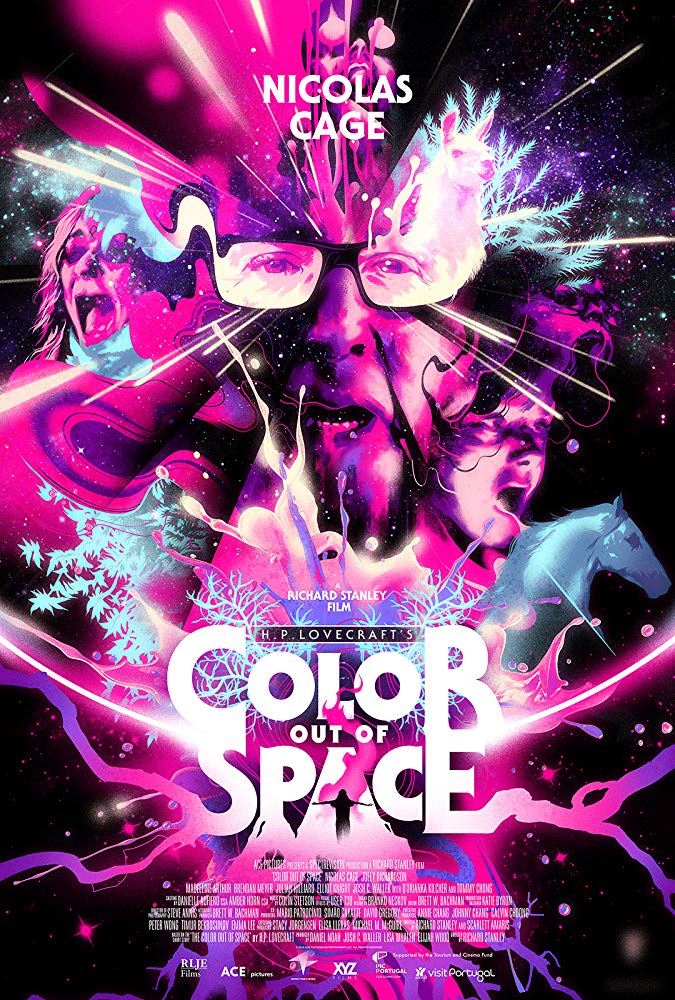

COLOR OUT OF SPACE would've been newsworthy enough on the basis of it being an H.P. Lovecraft adaptation starring Nicolas Cage in MANDY mode, but what really caused some excitement was the long-overdue return of Richard Stanley to narrative features almost 25 years after being fired from THE ISLAND OF DR. MOREAU, effectively ending his Hollywood career. Stanley established some significant cult bona fides with 1990's HARDWARE and 1992's DUST DEVIL, but when he clashed with New Line execs and a particularly dickish Val Kilmer during the first week of shooting on MOREAU, he was shown the door and replaced by John Frankenheimer, the entire clusterfuck of a production covered in the acclaimed 2015 documentary LOST SOUL. Stanley made a few documentaries and short films, got a co-writing credit on Nacho Cerda's 2006 film THE ABANDONED, and helmed a short segment of the 2011 anthology film THE THEATRE BIZARRE, but COLOR OUT OF SPACE is, at long last, his triumphant proper return. Based on Lovecraft's 1927 short story "The Colour Out of Space" and previously filmed in 1965 as DIE, MONSTER, DIE! with Boris Karloff and as the Ovidio G. Assonitis-produced THE CURSE in 1987, COLOR is a frequently surreal bit of phantasmagorical horror that shares some stylistic similarities with MANDY (as well as Cage and some producers, including Elijah Wood), but also seems indebted to the disturbing metamorphosing aspects of ANNIHILATION (not to mention one sequence that's an obvious nod to THE THING) while name-checking various Lovecraft essentials, with several character names and mentions of Arkham and Miskatonic.


When a meteorite crashes on the front lawn of the farmhouse of Massachusetts (but shot in Portugal, of all places) alpaca breeder Nathan Gardner (Cage) and his cancer-stricken wife Theresa (Joely Richardson), strange occurrences become the new normal: the water supply is tainted, their personalities are affected, they blackout as hours pass in an instant, youngest son Jack (Julian Hillard) stands by the well, saying he's "talking to my friends." Nathan suffers from wild mood swings and lashes out at the two older kids, stoner Benny (THE GUEST's Brendan Meyer) and free-spirited Lavinia (Madeleine Arthur). And all the while, inexplicable purple-derived light and color formations manifest themselves and envelop the Gardner property, which grows more isolated from the outside world by the day. There's also hydrologist Ward (Elliot Knight), who's surveying the groundwater at the behest of the do-nothing mayor (THE NEW WORLD's Q'orianka Kilcher), and Ezra (Tommy Chong), an easygoing, harmless squatter living in a shack on the edge of the Gardner property, who records voices of "The people under the floor, man!" that match the creepy garbled gibberish and screams that are heard on the other end of the line ("It's in the static! It's in the moisture!") whenever anyone tries to make a phone call. Stanley establishes an effectively ominous, otherworldly mood amidst the hypnotic, cosmic colorgasms ("It's just a color...but it burns"), and after a too-slow buildup that sometimes overindulges Cage's required-by-law freakouts (resurrecting some of his VAMPIRE'S KISS schtick), COLOR OUT OF SPACE really catches fire in its second half, with some truly unsettling visuals, unexpected emotion, soundtrack appearances by Mayhem and Burzum, and absolutely no mercy in who it's willing to kill off. It also offers some humor, particularly in the way the local media portrays Nathan as a UFO crackpot when they arrive at the farm to cover the meteorite crash. Easily the most noteworthy Lovecraft adaptation since Stuart Gordon's DAGON back in 2001, COLOR OUT OF SPACE is solid horror offering with Cage bringing his A-game in his best film since MANDY, and while it doesn't top the visionary HARDWARE in the Best of Richard Stanley rankings, it sure is great to have him back. (Unrated, 110 mins)


IN FABRIC
(UK - 2019)


IN FABRIC is the latest retro exercise from British filmmaker Peter Strickland, whose obsessively-detailed '70s aesthetic was displayed in the giallo-tinged paranoia thriller BERBERIAN SOUND STUDIO and the BDSM love story THE DUKE OF BURGUNDY. Strickland's films tend to be triumphs of style over substance and to that end, IN FABRIC is no exception, though it did get some buzz in horror circles last fall as "the killer dress movie" when the trailer went online, but A24 opted to keep it confined to arthouses and VOD. After seeing BERBERIAN and DUKE, I've concluded that I like the idea of Strickland's films more than I like the films themselves. Set in the early 1980s, IN FABRIC has some hypnotically stylish visuals and an incredible score by Cavern of Anti-Matter that sounds like it could've come straight from a 1972 fashion giallo with Edwige Fenech and George Hilton. Strickland nails the look and feel, but in terms of story, IN FABRIC is uneven, unfocused, and all over the place. Other than the look and sound, the film's biggest strength is Marianne Jean-Baptiste's performance as Sheila Woodchapel, a lonely bank teller recently left by her husband for a younger woman. She lives with her college-age son Vince (Jaygann Ayeh) and listens to him having sex with his intimidating, older goth model girlfriend Gwen (Gwendoline Christie). She decides to try the personals and treats herself to a new dress prior to her first blind date, purchased during a highly-publicized sale at Dentley & Soper's, a posh department store where she's attended to by eccentric saleswoman Miss Luckmoore (Fatma Mohamed). But after wearing the dress, she develops a rash, the dress destroys her washing machine, and while everyone's asleep, it hovers around the house on its own and even attacks Gwen at one point.


So far, so good, but then Strickland abruptly shifts gears around 70 minutes in, abandoning Jean-Baptiste's character to focus on nerdy washing machine repairman Reg (Leo Bill), who's about to be married to childhood sweetheart Babs (Hayley Squires). Reg's co-workers purchase the same red dress and make him wear it at his bachelor party, and the same strange cycle repeats--rash, wrecked washing machine, dress floating around the house--only with Reg being a little dorky, the second half is played more broadly compared to the ominous and eerie first half. Much of the humor comes from the bureaucratic, OFFICE SPACE-meets-Kafka-style nonsense that both Sheila's and Reg's bosses level at them, with Sheila being reprimanded by supervisors Clive (Steve Oram) and Stash (Julian Barratt of THE MIGHTY BOOSH) over a two-minute bathroom break, her handshakes "not being meaningful enough" and for smiling and waving at the manager's mistress when they bumped into one another on the street. Strickland also includes some scathing, satirical Orwellian jabs at capitalism, retail, and customer service in ways that seem more like he really wanted to make a Terry Gilliam movie but couldn't cut the cord from his Dario Argento/Eurocult/giallo fetishism, and to further muddy the waters, he throws in some HALLOWEEN III-inspired Dentley & Soper's TV spots that lull targeted viewers into a catatonic state. I really wanted to like this, and once again, I love what I see and hear but I'm still left cold by Strickland, who's starting to look like a one-trick pony, but it's admittedly an endlessly watchable trick. He's an extraordinarily gifted stylist, and other than Panos Cosmatos (BEYOND THE BLACK RAINBOW, MANDY) and maybe the team of Helene Cattet & Bruno Forzani (THE STRANGE COLOUR OF YOUR BODY'S TEARS), I can't think of a current filmmaker who's better at taking their influences and using them to craft sequences and set pieces that better convey the dazed sense of half-remembered fragments of a shared dream. Strickland's got that part down, but on a narrative level, IN FABRIC is a complete mess that basically turns into an uninspired BLACK MIRROR episode by the time it's over.  (Unrated, 119 mins)


RABID
(Canada - 2019)


Twin cult horror specialists Jen and Sylvia Soska (collectively billed as "The Soska Sisters") have always cited fellow Canadian David Cronenberg as their major cinematic influence, a sentiment echoed in their breakout body modification cult film AMERICAN MARY. To that end, remaking Cronenberg's 1977 classic RABID probably seemed like a good idea, but RABID '19 is a crushing failure at almost every turn. The central premise--the spread of a new strain of rabies stemming from a woman who's just had experimental surgery following a motorcycle accident--is the same, but none of the other incidental changes do anything to justify the remake's existence. Shy, motorcycle-riding seamstress Rose (Laura Vandervoort) works for pompous and stereotypically flamboyant fashion guru Gunter (McKenzie Gray). She's treated like dirt by his models with the exception of Chelsea (Hanneke Talbot), her childhood foster sister since she was taken in following the death of her parents in a car accident. It's Chelsea who got her the job, and who tries to set her up with Brad (Benjamin Hollingsworth), but when Rose leaves a Gunter event after realizing Brad only asked her out at Chelsea's request and then overhearing two mean girl cokehead models (played by the Soskas) talking shit about her in the ladies room, she leaves the party in a frazzled state and is immediately hit head-on by another car.


Rose wakes up in the ICU after a week (with the attending physician played by Stephen McHattie, probably the first sign that her situation is about to go from bad to worse) to find most of the left side of her face has been ripped off in the accident, with her jaw needing to be sewn back on. She's recommended for treatment at the Burroughs Clinic, an exclusive facility that deals in regenerative medicine and "Transhumanism." Rose is the subject of an experimental stem cell skin graft procedure pioneered by (deep sigh) Dr. William Burroughs (Ted Atherton). She's initially apprehensive, but it proves to be a complete success. She's more beautiful than ever, she gets her job back, is creatively inspired, and Brad seems legitimately interested in her, but...she's a devout vegetarian and suddenly develops a strange craving for raw meat. She wakes up with faint memories of violent dreams where she's attacking men in a flesh-eating fury. Soon, the people with whom she comes into contact (including UFC star CM Punk, cast radically against type as a meat-headed asshole) begin exhibiting even more advanced symptoms of a virulent new form of rabies that becomes a citywide epidemic. RABID '19 devotes a lot of time to lampooning the vapidity of the fashion industry in trite fashion, but at the same time dutifully hitting all of the old-school Cronenberg bullet points of body horror and disease. It also offers shout-outs to a bunch of his other films as well, like NAKED LUNCH with the name-dropping of Burroughs, the clinical surgical horrors of DEAD RINGERS (including the brief presence of Heidi Von Palleske as a member of the Burroughs surgical team), and the shady experimental treatment facility of THE BROOD. The protruding armpit phallus from the original RABID (also notable in its day as the first mainstream crossover attempt of porn star Marilyn Chambers) finally appears in the off-the-rails third act, where RABID '19 completely falls apart, abandoning the Cronenberg worship and turning into a dumb tribute to the late '80s work of Brian Yuzna and Screaming Mad George. The pointless RABID '19 really overstays its welcome at 108 minutes and can't even get the little things right--wouldn't McHattie (PONTYPOOL) have made a more interesting Dr. Burroughs than the bland Atherton? The first line of dialogue heard here is a ranting Gunter asking "Why do we keep remaking old trends?" A valid question, and one asked with little sense of self-awareness by the Soskas, since RABID '19 certainly qualifies as part of the problem. (Unrated, 108 mins)

Thursday, July 16, 2015

On DVD/Blu-ray: LOST SOUL: THE DOOMED JOURNEY OF RICHARD STANLEY'S ISLAND OF DR. MOREAU (2015); CLOUDS OF SILS MARIA (2015) and LET US PREY (2015)


LOST SOUL: THE DOOMED JOURNEY OF 
RICHARD STANLEY'S ISLAND OF DR. MOREAU
(US - 2015)


On the heels of JODOROWSKY'S DUNE comes another LOST IN LA MANCHA-style documentary about a film that never was, Richard Stanley's THE ISLAND OF DR. MOREAU. Stanley, the eccentric visionary behind the cult classics HARDWARE (1990) and DUST DEVIL (1992), had a lifelong fascination with the H.G. Wells novel about an island of man-beasts created by the mad Dr. Moreau that had already been filmed as ISLAND OF LOST SOULS (1932) and THE ISLAND OF DR. MOREAU (1977), and got the greenlight from New Line Cinema as his MOREAU entered pre-production in 1994. Of course, the film was ultimately released in 1996, directed not by Stanley, who was fired less than a week into shooting, but by veteran journeyman John Frankenheimer, bombed with critics and audiences, and is universally considered one of cinema's all-time great camp classics. LOST SOUL isn't a particularly cinematic documentary in the hands of director David Gregory, the head of cult Blu-ray/DVD outfit Severin Films and an old hand in the world of DVD extras--LOST SOUL often feels less like a movie and more like a long bonus feature on a deluxe Blu-ray edition of MOREAU. While Gregory drops the ball in some areas--it's understandable that co-star David Thewlis probably didn't want to be interviewed, but his name never even comes up when he actually has the film's main role--the stories told are fascinating. Fairuza Balk and Marco Hofschneider are the only two stars who take part, though you also get Rob Morrow, who quit a few days into production and was replaced by Thewlis. Stanley envisioned DAS BOOT's Jurgen Prochnow as Dr. Moreau but when New Line executive Michael DeLuca got involved, the role suddenly went to Marlon Brando, which turned the modestly-budgeted $8 million film into something more expensive. Bruce Willis agreed to play the central character, Edward Douglas, a shipwreck victim trapped on Moreau's island of horrors, and James Woods signed on to play Montgomery, Moreau's psychotic assistant. Even in pre-production, chaos reigned: execs started demanding changes to the script. Brando almost dropped out when his daughter Cheyenne committed suicide, and when he finally committed, he wanted Roman Polanski brought in to direct. Then Willis bailed upon his split from Demi Moore, saying it wasn't a good time to head off to Australia for several months. Stanley went along with some uncredited script revisions by Walon Green (THE WILD BUNCH), had a meeting with Brando and managed to win him over, but cites his biggest strategic error as "meeting Val Kilmer."

Ousted MOREAU director Richard Stanley
The first half of LOST SOUL deals with Stanley and his vision, but Gregory knows you're watching for the much-talked-about Kilmer horror stories (the late Frankenheimer once said of Kilmer: "Will Rogers never met Val Kilmer") that begin with him burning a crew member's sideburns with a lit cigarette and escalate from there. Kilmer's behavior on the set of MOREAU has become the stuff of legend, and several lament that with him onboard and red-hot after BATMAN FOREVER, using his newfound A-list clout to upstage, second-guess, and overrule Stanley, the project was no longer about Stanley's serious, thoughtful $8 million Wells adaptation but rather, a $40 million commercial horror movie with Marlon Brando and blockbuster expectations thanks to the presence of Kilmer. Just before filming began, Kilmer announced that he was too busy to play Douglas and demanded 40% less shooting time while keeping his salary. He decided that he wanted to play Montgomery instead of Douglas (the Morrow role that ultimately went to Thewlis), which bounced Woods from the production. He then proceeded to slow down shooting by questioning every one of Stanley's directorial decisions and grill him about his editing choices ("Tell me how you're gonna do this, Richard," and "That's not gonna cut together...that won't work"). Hofschneider, who does a perfect Kilmer impression and obviously has no love for the actor, states that Kilmer's treatment of Stanley "wasn't about the shoot anymore. This was a power game."


Things were so bad less than a week into filming that Morrow called New Line head Robert Shaye personally and begged to be let out of his contract ("There's just a bad vibe...I just want to go home"), and when a hurricane struck the Cairns location on the Australian coast and caused a several-week production delay, New Line took the opportunity to make a change, firing Stanley and bringing in Frankenheimer, who only took the job to work with Brando. Frankenheimer barely managed to complete the film with both Brando's insane ideas (like playing one scene with an ice bucket on his head) and Kilmer being abrasive and uncooperative (Frankenheimer was once quoted as saying "If I was making THE LIFE OF VAL KILMER, I wouldn't cast Val Kilmer"). Stan Winston makeup assistant Paul Katte remarks that "Marlon showed his legendary contempt for what he did for a living, but he was at least nice and respectful of other people. Val Kilmer just acted like a classic prep school bully." Morbid curiosity about what was going on got the better of him, and Stanley (who still retained a co-writing credit on the released version of MOREAU) would eventually be snuck back on the set by a pair of rebellious production drivers, hiding under a dog mask--he's actually visible in some fleeting shots and production personnel heard rumors of Stanley returning to sabotage the shoot, one even noting in hindsight that "there was always one extra who wouldn't take his mask off during lunch." Stanley's done some documentaries and some short films, and co-wrote Nacho Cerda's THE ABANDONED (2006), but thus far, he has yet to make another feature film. With two mishandled masterpieces to his credit as the cult of HARDWARE and DUST DEVIL grew, Stanley is revered among genre fans as a bold visionary stifled by suits and in way over his head with the big money expectations of New Line Cinema, with Balk, Hofschneider, Morrow, and producer Edward R. Pressman speaking very highly of him. One wishes Gregory could've dug a little further (Kilmer is unsurprisingly absent, as are Thewlis, Ron Perlman, Temuera Morrison, and Mark Dacascos among the film's surviving stars), and while the extras and the production assistants are willing to talk about what they observed, Gregory seems a little too easily detoured by their reminiscing about the drugs, sex, and goofing off during all the down time. Still, LOST SOUL serves as a fascinating document of a tumultuous clusterfuck of a production, riddled with big egos, rotten behavior, and just plain bad luck combining to derail the career of a promising filmmaker who was perhaps too much of an oddball to be playing the Hollywood game anyway (Stanley credits his friend, a "warlock chappy" named Skip, with casting a spell to help him win over Brando). Still, there's no denying that footage of late Mini-Me inspiration Nelson de la Rosa tearing up the dance floor at a Cairns nightclub is absolutely priceless. (Unrated, 98 mins, also streaming on Netflix Instant)


CLOUDS OF SILS MARIA
(France/Germany/Switzerland - 2014; US release 2015)


The latest film from French auteur Olivier Assayas (BOARDING GATE, CARLOS) is one of those smug "industry insider" pieces about movies and acting that critics usually trip over themselves to laud with praise and adulation. Yes, Assayas takes some cheap shots at the vapidity of Hollywood, but like his script, it's labored, heavy-handed, and obvious. Veteran European actress Maria Enders (Juliette Binoche) wants to get back to her serious roots after selling out to Hollywood blockbusters for several years. After walking away from her recurring role in the X-MEN franchise, she heads to Europe with her personal assistant Valentine (Kristen Stewart) to speak at a ceremony honoring her mentor, a playwright from whom she got her first break two decades earlier. The playwright dies before the ceremony, and his widow (former Fassbinder regular Angela Winkler) and a stage director (Lars Eidinger) offer Maria a role in a new version of the play: The Maloja Snake, about the DEVIL WEARS PRADA relationship between middle-aged executive Helena and her young, naive assistant Sigrid. Maria became a star playing Sigrid 20 years ago, but now she's aged into the Helena role, with Sigrid to be played by American actress Jo-Ann Ellis (Chloe Grace Moretz), a talented but self-destructive, Lindsay Lohan-like trainwreck who's constant fodder for tabloids and paparazzi, and has even broken up the marriage of a famous writer (shades of Stewart's fling with her married SNOW WHITE AND THE HUNTSMAN director?). As Maria comes to terms with aging in an industry where good roles dwindle with each passing year, she and Valentine role-play the script, which starts showing strange similarities between their relationship and the codependent one between Helena and Sigrid in the play.


Like Abel Ferrara's somewhat similar and equally pretentious 1993 film DANGEROUS GAME (which at least had a palpable energy and handheld immediacy to it), the lines between life and art blur throughout, because of course they do. Assayas has made some terrific films, and there's fleeting moments of inspiration here that recall his brilliant 1996 breakthrough IRMA VEP, but he just gets lost up his own ass here, and by the end CLOUDS OF SILS MARIA is little more than Assayas jacking himself off in a one-man writer's workshop. It's too bad, because Binoche and Stewart have a very natural, unaffected chemistry together (Stewart is very good here) that deserves a better showcase than Assayas gives them. Binoche has worked with Assayas before (2008's SUMMER HOURS, and she first gained notice in Andre Techine's 1985 Assayas-scripted RENDEZ-VOUS) and this role was obviously created specifically for the Oscar-winning actress. There's nothing smart or edgy in the presentation of Moretz's tabloid bad girl, and while she's fine, the character is the kind of one-dimensional caricature we've seen before. Binoche is a great actress and Stewart is a revelation (she won the Cesar--the French Oscar--for Best Supporting Actress), but CLOUDS OF SILS MARIA is one of those relentlessly talky, self-indulgent, life-imitates-art looks at "the biz" that are apparently enjoyed only by film festival attendees. Why not just call it JULIETTE BINOCHE IS 50: THE MOVIE and be done with it? (R, 124 mins)


LET US PREY
(UK/Ireland - 2014; US release 2015)


Do filmmakers think it's OK to rip off a terrible movie that nobody saw? Do they think no one will find out? LET US PREY is a convoluted slow-burner that borrows elements of the Stephen King-scripted TV miniseries STORM OF THE CENTURY and a Stuart Gordon-directed FEAR ITSELF episode titled "Eater." But for the bulk of its length, it shamelessly swipes from 2010's THE TRAVELER, a straight-to-DVD Canadian horror film with Val Kilmer--see where his ISLAND OF DR. MOREAU power-tripping got him?--as Mr. Nobody, a supernatural stranger who mysteriously appears at a small-town police station to exact ghostly, HIGH PLAINS DRIFTER-style revenge on the squad of six cops who falsely accused him of a crime and tortured him to death. LET US PREY switches up some details but again, we have a supernatural mystery man, in this case Six (GAME OF THRONES' Liam Cunningham) who appears at a police station in the middle of nowhere in Ireland to exact--wait for it--vengeance on a squad of cops. Instead of being the victim, Six is a soul collector, his job to journey from beyond to collect the sinners, and there's plenty among these cops and criminals, including adulterers, drunk drivers, and a serial killer. The moral center is outcast Sgt. Rachel Heggie (Pollyanna McIntosh of OFFSPRING and THE WOMAN), a new transfer who doesn't get along with her co-workers and is a quiet loner with scars both emotional and physical after a traumatic childhood where she was subjected to horrible sexual abuse by her father. Director Brian O'Malley and screenwriters David Cairns and Fiona Watson also throw in a late-in-the-game ASSAULT ON PRECINCT 13 riff and there's a synthy, John Carpenter-like score, but this is another one of those new horror movies that gets all sorts of accolades from sycophantic publications and fanboys when all it really does is show up and make references. Cribbing most of the plot from a crummy Val Kilmer movie is one thing, but keeping the always-interesting Cunningham locked up and glowering in a jail cell for 90% of his screen time is an even bigger offense. I'll give it credit for some enthusiastically no-holds-barred splatter late in the game, but it's too little, too late. (Unrated, 92 mins)