Though it's anchored by two of the year's top performances, the noir-inspired THOROUGHBREDS never quite gels together like you hope, or at the very least, it's never quite as clever as it thinks it is. It's the directing and screenwriting debut of playwright Cory Finley, and though its talky script contains some insight and some often lacerating dialogue, the film never seems to shake the notion that it might've been a better fit for the stage. Lily (THE WITCH's Anya Taylor-Joy) and Amanda (READY PLAYER ONE's Olivia Cooke) were once best friends in high school but have grown distant in the years since. Now in college, they awkwardly reconnect when Lily agrees to tutor Amanda, who's awaiting trial for animal cruelty in the killing of her horse. As they spend more time together, the dynamic of their relationship undergoes subtle shifts and Amanda, who's been "diagnosed with everything" in the DSM-V ("I don't have any feelings. Ever.") brings out the sociopath within Lily, who's grown intolerant of her boorish, asshole stepfather Mark (Paul Sparks) and doesn't need much prodding when Amanda suggests killing him. The murder plot involves securing the services of a fall guy in the form of Tim (the late Anton Yelchin in his last film; production wrapped just two weeks before his tragic death in June 2016), a none-too-bright local drug dealer and registered sex offender following a fling with a high school student ("I wasn't 25, I was 23!" he tries to explain). Amanda records Tim agreeing to the plan to kill Mark and the girls prepare their alibi, but since this is that kind of film, things don't quite go according to plan.
THOROUGHBREDS only made it to 500 or so screens during its spring 2018 release, but it was one of those films that managed to develop a cult following while it was still in theaters. Many people went for the easy description of "HEATHERS meets AMERICAN PSYCHO," which is pretty much meaningless as far as what the film is all about. It's more of a cerebral mood piece in the guise of a Hitchcockian thriller, but its strengths come not from suspense but from the outstanding performances by Cooke (also great in the recent THE LIMEHOUSE GOLEM) and Taylor-Joy. They manage to create multi-dimensional characterizations even though Finley's insistence on withholding details often works against building any kind of flow or momentum. That works when the film plays more cinematically, but for a film that most often has the feel of a play, it too frequently comes off as forced and trying too hard, with characters referencing things they already know but having to stop and backtrack to shoehorn vital info in to get the audience caught up, leaving them to realize "Oh, Lily's father died?" or "Oh, she was expelled." Cooke and Taylor-Joy are terrific, and with limited screen time, Yelchin creates a memorably hapless sketchball with entrepreneurial pipe dreams that are clearly going nowhere fast, but THOROUGHBREDS is a film where the end result is a bit less than the sum of its parts. (R, 92 mins)
DELIRIUM (US - 2018)
Hot on the heels of STEPHANIE comes another long-shelved Blumhouse production, this one from director Dennis Iliadis and screenwriter Adam Alleca, the team behind the surprisingly not-terrible 2009 LAST HOUSE ON THE LEFT remake. Shot in 2015 under the title HOME and quietly dumped on DVD two weeks after its gala VOD premiere, DELIRIUM is marginally better than the obviously unfinished and abandoned STEPHANIE, but that's not exactly a glowing recommendation. Released from a mental institution where he's been held since he was 12 years old, Tom Walker (Topher Grace) is placed under house arrest and left alone for 30 days at the family mansion where his disgraced politician father (Robin Thomas) has recently committed suicide. Tom is regularly badgered by his chain-smoking, flask-swilling, bitch-on-wheels parole officer Brody (Patricia Clarkson), but things get worse when he starts hearing noises and catching glimpses of his father's decaying corpse. He finds a tentative friend in grocery delivery driver Lynn (Genesis Rodriguez), but then his psychotic older brother Alex (Callan Mulvey) shows up and periodically vanishes as Tom is no longer sure what is real and what's in his imagination. 20 years earlier, 12-year-old Tom was rejected and humiliated by a girl and Alex talked him into getting back at her with a prank. Instead, Alex forced his little brother to watch as he beat the girl to a pulp and drowned her. Alex was sent to prison and Tom to a mental institution, and their shell-shocked mother vanished, leaving their domineering and impossible-to-please father behind. As the possibly paranormal hacktivity continues, Brody isn't buying Tom's stories of the house being haunted and doesn't believe that Alex has been visiting him because he was recently killed in prison fire.
Even on a rudimentary jump-scare level, DELIRIUM is a dull, unfocused mess. Iliadis drops the ball early on by never really getting the audience acclimated with the house, so when we hear noises and see Tom exploring, we really have no clue where he is in relation to the other areas or how he gets from one place to another. There's missed opportunities with the handling of Clarkson's character, who vacillates between sympathizing with Tom and openly expressing her desire to send him back to the institution for good. She even tries to seduce him at one point in what could've been an intriguingly perverse plot development, but then it's just dropped, which is a shame because Clarkson gives this thing its biggest jolts of life. The film spends a lot of time trying to convince you that Lily and Alex are figments of Tom's imagination, which is the only way those characters can possibly make any sense. Grace is cast radically against type as Topher Grace, and the film attempts to mine some easy humor from Tom being 20 years behind on pop culture and rocking out to The Presidents of the United States of America's "Lump" while wearing a Gin Blossoms concert tee and not knowing what Wikipedia is. DELIRIUM is bad, and while it's not quite engulfed in the dumpster fire flames of STEPHANIE, it's still easy to see why Universal sat on it for three years before a borderline covert release. Co-producer Leonardo DiCaprio took his name off of the movie, probably around the time that REVENANT Oscar buzz was picking up some heat. (R, 96 mins)
I KILL GIANTS (US/Belgium/China/UK - 2018)
Adapted from Joe Kelly and Ken Niimura's 2008 graphic novel and counting Chris Columbus among its boatload of producers, I KILL GIANTS is an earnest and sincere examination of a child coping with the grieving process that's frequently too heavy-handed for its own good. It's also a victim of bad timing. J.A. Bayona's A MONSTER CALLS explored very similar territory two years ago, and while the I Kill Giants graphic novel preceded both the book A Monster Calls and its eventual film version, the impact of I KILL GIANTS can't help but be diminished. In a small town on the coast of Long Island (but shot in Ireland and Belgium), young Barbara (Madison Wolfe of THE CONJURING 2) is living with her adult sister Karen (Imogen Poots) and teenage brother Dave (Art Parkinson). Karen is struggling to keep up with her own job and taking care of her siblings, and while Dave is engrossed in his video games, Barbara is acting out, seemingly spending her time with 20-sided die role-playing games but quietly prepping the town for an inevitable giant attack that she's certain she can ward off with traps and an all-powerful weapon she dubs "Covaleski," named after early 20th century Phillies pitcher Harry Covaleski. Derided as "the nerd queen" by Dave and relentlessly bullied at school by imposing mean girl Taylor (Rory Jackson), Barbara is frequently visited by "harbingers" warning of the pending attack. At the same time, she reluctantly befriends shy, lonely British transfer student Sophia (Sydney Wade) and gradually opens up to her and school psychologist Mrs. Molle (Zoe Saldana) about her plot to take on the giants.
Of course, the absence of a visible paternal figure in the house and Barbara's head-first dive into a complicated fantasy world is too big of a tip-off as to where I KILL GIANTS is ultimately headed, especially if you've seen A MONSTER CALLS. Making his feature debut, Danish director Anders Walter (an Oscar-winner for 2013's Best Live Action Short HELIUM), gets a marvelous performance out of Wolfe, who's so good that you'll wish her dedication was in service of a more consistently strong film. The ultimate reveal may result in more questions than answers--such as "How did this family situation never come up in conversation?" and "Is Dave even a member of this family?"--but it has some convincing visual effects and some genuinely heartfelt moments that may make it therapeutic for younger children coping with similar circumstances. Some strong parts but it never quite comes together as a whole. (Unrated, 106 mins)
So to that end, yes, there's familiar tropes in HEREDITARY. Yes, there's shout-outs to THE EXORCIST and ROSEMARY'S BABY. And yes, Aster has clearly seen THE SHINING several times (and other Kubrick classics, judging from some shot compositions and several nicely-done match cuts). But HEREDITARY takes those elements and uses them to fashion a devastating metaphor about the pain of a family in turmoil and hanging on by a thread, a family overwhelmed by grief, dysfunction, a history of mental illness, and other things always there but left unspoken. It's about things passed down, genetically and otherwise. No film in recent memory has offered more disturbing evidence that you don't get to choose your parents and that nothing is in your control. In what is unquestionably her career performance thus far, Toni Collette is Annie Graham, an artist who creates obsessively detailed miniature dioramas of her life. She's mourning the death of her estranged mother Ellen. To say their relationship was frayed and perpetually at a breaking point is an understatement. A domineering, controlling woman who suffered from depression and dissociative personality disorder, Ellen dealt with a lot in her life beyond her own psychological problems: a clinically depressed husband who starved himself to death when Annie was a baby, and a schizophrenic son named Charles who hanged himself when he was 16, leaving a note for his mother blaming her for putting the voices in his head. Annie has a seemingly "normal," upper-middle class suburban life with her doctor husband Steve (Gabriel Byrne), stoner teenage son Peter (Alex Wolff), and odd, withdrawn 13-year-old daughter Charlie (Milly Shapiro). Ellen's passing stirs all sorts of trauma that's been bubbling under the surface in the Graham household--unresolved issues, long-buried resentments, things that should never be spoken aloud, and habitual secrets and lies (Annie attends a weekly grief support group but covers it with a lie about "going to see a movie," and Steve is notified by the cemetery that Ellen's grave has been desecrated but keeps it to himself). HEREDITARY is the kind of movie where going in knowing as little as possible is really the only possible way to approach it. But in the midst of the grief over Ellen and everyone handling it in their own way, something happens around the 40-minute mark that is so unexpected and so traumatizing (to the Grahams and to the audience) that Aster instantly sends the message that the screws are tightening and that no one--onscreen or in the theater--is safe going forward.
Everything that unfolds over the next 90 minutes is a direct result of what happens at the 40-minute mark, so it's impossible to discuss without spoiling everything. What can be discussed is the ensemble cast. The unique-looking Shapiro creates an instant impression as Charlie, the Graham family member who was closest to Ellen and the most outwardly affected by her death. Her appearance and her bizarre "clucking" tic (which gets extremely creepy as the film goes on) will probably guarantee her a spot on the roster at any horror con of her choosing for the rest of her life. Wolff is superb in what becomes an unexpectedly complex and difficult role, Ann Dowd (THE HANDMAID'S TALE's Aunt Lydia) has a small but important role as a support group acquaintance of Annie's, and Byrne brings a stoical standoffishness to Steve, who loves his family but is convinced that ignoring the increasingly bizarre mayhem going on around him is for the best and everything will just work itself out. In any other scenario, Wolff's performance would be HEREDITARY's secret weapon, but this is Toni Collette's movie from start to finish. Horror films typically aren't known for containing gut-wrenching performances that exhaustively run the gamut of emotions, but Collette throws herself into this role and into Annie's indescribable pain with a commitment bordering on feral. You don't often see performances on this level in films that don't contain Daniel Day-Lewis.
At 127 minutes, HEREDITARY is long and takes its time building its multi-layered story. It demands patience and attention but it's never dull and there's never a wasted moment, even from the start with a brief glimpse of a creepily-grinning onlooker at Ellen's funeral. It's not a perfect film. Astor is a little too ham-fisted in making sure we know that Charlie has a nut allergy and one significant plot turn doesn't really pass the smell test: as a point of comparison, it would be tantamount to Minnie and Roman Castevet and all of their neighbors taking pictures of their activities and leaving them in a photo album for Rosemary to discover later on. I guess it's HEREDITARY's "All of them witches" moment but this particular variant seems forced. And the final scene has the distinct feeling of a producer pleading with Astor to explicitly spell out what would be best left ambiguous. That said, this is a bold, terrifying, and profoundly unsettling film with numerous moments and images that will haunt you for days. And Collette's performance will likely go down as the best in any movie in 2018.
SHOCKING DARK aka TERMINATOR 2 (Italy - 1989) Directed by Vincent Dawn (Bruno Mattei). Written by Clayde Anderson (Claudio Fragasso). Cast: Cristofer Ahrens, Haven Tyler, Geretta Giancarlo Field (Geretta Geretta), Tony Lombardo (Fausto Lombardi), Mark Steinborn, Dominica Coulson, Clive Ricke, Paul Norman Allen, Cortland Reilly, Richard Ross, Bruce McFarland, Al McFarland. (Unrated, 90 mins)
For fans of Eurocult cinema, Italian ripoffs are among the most essential and endearing offerings. The flood of imitations in the wake of huge hits like THE GODFATHER, THE EXORCIST, STAR WARS, DAWN OF THE DEAD, ALIEN, CONAN THE BARBARIAN, THE ROAD WARRIOR, and RAMBO: FIRST BLOOD PART II only gained momentum in the 1980s when video stores needed product and Italy was offering a seemingly endless supply. Perhaps no other genre-hopping journeyman epitomized the concept of the shameless Italian ripoff more than Bruno Mattei, or, as he's known under his most frequently-employed pseudonym, "Vincent Dawn." Born in 1931, Mattei began his career as an editor in the late 1950s, usually on undistinguished and instantly obscure post-HERCULES peplum, and later, third-tier spaghetti westerns and 007 knockoffs. He's the credited editor on Jess Franco's COUNT DRACULA (1970) and would later work for Joe D'Amato on 1976's BLACK COBRA. By the late '70s, Mattei shifted into directing, with a couple of 1977 Nazisploitation outings with SS GIRLS and WOMEN'S CAMP 119, followed by some dalliances with nunsploitation (THE TRUE STORY OF THE NUN OF MONZA, THE OTHER HELL), zombies (HELL OF THE LIVING DEAD aka NIGHT OF THE ZOMBIES), post-nuke (RATS: NIGHT OF TERROR), women-in-prison (CAGED WOMEN, WOMEN'S PRISON MASSACRE), and even a Lou Ferrigno vehicle for Cannon (THE SEVEN MAGNIFICENT GLADIATORS). Mattei had a collaborative partnership with writer and future TROLL 2 auteur Claudio Fragasso, and the pair would frequently work as a team behind the camera, sometimes sharing credit with a pseudonym like "Stefan Oblowsky" on the nunsploitation films. In 1987, Mattei directed and Fragasso scripted the RAMBO ripoff STRIKE COMMANDO, their first effort for Italian producer Franco Gaudenzi. Gaudenzi's career in movies began with Mattei as part of the Joe D'Amato stock company, working as a set decorator, art director, and eventually assistant director on BLACK COBRA and the 1979 cannibal/necrophilia classic BEYOND THE DARKNESS. Mattei and Gaudenzi went way back, and when Gaudenzi formed his company Flora Film and became a producer based primarily in the Philippines, he had plenty of work for Mattei and Fragasso.
In his films for Gaudenzi, most of which were shot in and around Manila, Mattei really found his true calling as Italy's premier ripoff artist. He wasn't exactly new to the notion of swiping other people's ideas--HELL OF THE LIVING DEAD stole huge chunks of Goblin's DAWN OF THE DEAD score--but STRIKE COMMANDO really set the template for what the Three Stooges in the Gaudenzi/Mattei/Fragasso team would accomplish (with occasional uncredited script contributions from Fragasso's wife Rossella Drudi). STRIKE COMMANDO completely restages the finale of RAMBO: FIRST BLOOD PART II, while 1987's DOUBLE TARGET was a somewhat less obvious take on the same material. Gaudenzi kept Mattei occupied during a busy 1988: STRIKE COMMANDO 2 is a Namsploitation outing that's also an unexpected riff on ROMANCING THE STONE, with Mattei and Gaudenzi somehow corralling a seriously slumming Richard Harris (who would later claim to be retired at the time the film was made) for a supporting role; ROBOWAR is an almost scene-for-scene copy of PREDATOR; and so enamored of the Namsploitation craze were Gaudenzi, Mattei, and Fragasso that they even cranked out COP GAME, a quickie imitation of the Saigon-set Willem Dafoe/Gregory Hines non-hit OFF LIMITS. As if Mattei's 1988 schedule wasn't already packed enough in the sweltering Filipino heat (everyone in these movies is profusely sweating at all times), he was even called in from the nearby set of STRIKE COMMANDO 2 by a desperate Gaudenzi to take over for a surly and ailing Lucio Fulci, who had just walked off of ZOMBI 3 with only 50 minutes of usable footage in the can. Mattei and Fragasso finished the film, which feels more Mattei than Fulci, even though the latter retains sole credit. But it's 1989's SHOCKING DARK that is perhaps the most jaw-droppingly audacious of Mattei's ripoffs from his furiously productive Gaudenzi era.
Set not in Gaudenzi's usual Manila stomping grounds but in a toxic Venice "after 2000," SHOCKING DARK has an elite Marine unit called "Megaforce" venturing beneath the city's canals to investigate the disappearance of another group of soldiers offed by mutant creatures. It doesn't take long to recognize that this is a blatant ALIENS ripoff. Not only are entire scenes completely recreated and played out verbatim (including one where a meter shows the creatures closing in on them and somebody yells "That's impossible, they'd already be here!" and another where two people are seen on a monitor silently waving for help but the mission's saboteur stealthily turns it off) but the characters themselves are exact replicas. There's the team of military badasses led by the hysterically raging Koster (Geretta Geretta, best known as the doomed Rosemary from DEMONS and credited here as "Geretta Giancarlo Field"), who's a composite of ALIENS' Vasquez and Apone; Sarah (Haven Tyler), a scientist and the Ripley-like outsider sent along as a consultant; young orphan and Newt stand-in Samantha (Dominica Coulson); and special ops badass Samuel Fuller (Cristofer Ahrens), an operative from "The Tubular Corporation," which sounds about as believable as Vandelay Industries, who eventually functions as SHOCKING DARK's Burke but in a completely different way. You see--and SPOILERS follow--SHOCKING DARK isn't content to just rip off one classic James Cameron film. It's also a knockoff of THE TERMINATOR, a mid-film twist hinted at by naming Tyler's character "Sarah." The mutant creatures eventually take a backseat once "Samuel Fuller" is exposed as a cyborg hellbent on sabotaging the mission. Though the film was made as SHOCKING DARK, it was eventually retitled by Gaudenzi and sold as...wait for it..TERMINATOR 2 (!), flashing back to the practice of Italian ripoffs being passed off as sequels to blockbuster American movies.
The real TERMINATOR 2 was still a couple of years away, but Gaudenzi's rechristening of SHOCKING DARK certainly did it no favors in finding US distribution, where it would've likely gone straight-to-court instead of straight-to-video. Long available on the bootleg circuit, SHOCKING DARK has finally received an official US release nearly 30 years after it was made, thanks to Severin's new Blu-ray, along with two other Gaudenzi productions, ZOMBI 3 and 1989's AFTER DEATH, directed by Fragasso and now commonly known as ZOMBIE 4: AFTER DEATH. SHOCKING DARK comes barrelling out of the gate and seems poised to become a new MIAMI CONNECTION or NIGHTMARE WEEKEND-level bad movie discovery of WTF? proportions. The ridiculous dialogue works beautifully in conjunction with the cast, comprised mostly of one-and-done American non-actors who were never seen or heard from again. Portland, OR-born model Geretta Geretta is probably the most experienced cast member (now a convention regular, she spent a significant amount of time in Italy in the '80s and also acted in Mattei's RATS under the name "Janna Ryann"), but she's killed off 35 minutes in. Fausto Lombardi appeared in several Italian B-movies from the early '80s on (RATS, HANNA D: THE GIRL FROM VONDEL PARK, the TOP GUN ripoff BLUE TORNADO). And Ahrens had some small parts in Italian genre fare but seems to have left the industry after 1999.
But as for the bulk of the remaining cast members--Tyler, Coulson, Cortland Reilly as the rad surfer-dude soldier Caine, and Bruce McFarland as the colonel at the command center--they all seem to be American college students who may have been in an exchange program or were just partying in Italy when they answered a casting call to be in a low-budget horror movie (even Coulson, who's supposed to a child but is probably in her late teens and is almost as tall as Tyler). Their inexperience as actors is only highlighted by the fact that this is one of the rare instances in Italian exploitation where the filmmakers are using live sound and not dubbing everyone over. None of the usual suspects in the dubbing world are present here. Nope, these deer-in-the-headlights newbies are bellowing their lines in an overwrought fashion and standing around looking confused (Tyler never seems comfortable and looks directly into the camera twice in one scene), with Mattei doing little to hide their obvious inexperience. Most of Mattei's films for Gaudenzi had some established name actors to provide even the slightest modicum of credibility--Reb Brown and Christopher Connelly in STRIKE COMMANDO, Brown in ROBOWAR, Richard Harris (Richard Harris?!?!) in STRIKE COMMANDO 2, Miles O'Keeffe, Donald Pleasence and Bo Svenson in DOUBLE TARGET--but there's no such voice of experience for the neophyte actors to look to here, only the performances of Sigourney Weaver and everyone else on a VHS copy of ALIENS that they probably had to share.
Eventually, SHOCKING DARK settles into a bunch of repetitive scenes of people walking down long corridors in the maintenance area under Rome's Termini Station, standing in for the Venice underground, with the possibility of playing a great drinking game for every time Coulson's character shouts "Sarah!" It's got some dull stretches, but the sheer chutzballs of its straight-up plagiarism of early James Cameron (what, no flying piranha?), and its final ridiculous twist in the closing minutes, is at times truly astonishing. It's also the kind of film that's so sloppy that it misspells Fragasso's usual "Clyde Anderson" pseudonym as "Clayde Anderson." Before long, stealing plots wouldn't be enough for Mattei. By 1995's belated JAWS ripoff CRUEL JAWS, he was swiping footage wholesale from JAWS, JAWS 2, and the slightly less-belated 1982 ripoff GREAT WHITE. This blew open new doors of duplicity for the veteran director. By the time of his final films--zero-budget, shot-on-video drek like 2004's THE TOMB and 2007's ZOMBIES: THE BEGINNING--Mattei was pilfering unlicensed footage from the likes of RAIDERS OF THE LOST ARK, INDIANA JONES AND THE TEMPLE OF DOOM, ARMY OF DARKNESS, the 1999 version of THE MUMMY, and CRIMSON TIDE. Mattei died in 2007 at the age of 75, but the recent Blu-ray releases of SHOCKING DARK and WOMEN'S PRISON MASSACRE are doing their part to keep his dubious legend alive. Now all we need is a deluxe Blu-ray edition of STRIKE COMMANDO.
THE REINCARNATION OF PETER PROUD (US - 1975) Directed by J. Lee Thompson. Written by Max Ehrlich. Cast: Michael Sarrazin, Jennifer O'Neill, Margot Kidder, Cornelia Sharpe, Paul Hecht, Tony Stephano, Normann Burton, Anne Ives, Debralee Scott, Steve Franken, Fred Stuthman, Addison Powell. (R, 105 mins) Gifted with a vividly distinctive title that's ultimately more memorable than the film itself, THE REINCARNATION OF PETER PROUD has become one of those horror movies from a bygone era whose scarce availability has led to somewhat of an inflated reputation that it's some mythical, lost masterpiece. Rarely seen since its 1980s VHS release and its long-ago days in regular rotation on late-night TV in what had to be a drastically-cut version, PETER PROUD was never released on DVD but is now reincarnated on Blu-ray courtesy of Kino Lorber (because physical media is dead). It's likely that some may find it a little too dry and too skimpy with the shocks, considering its contemporaries were the likes of THE EXORCIST and THE OMEN. In its own way, THE REINCARNATION OF PETER PROUD, from the masters of erotica-infused horror at Bing Crosby Productions, carved its own niche for hard-R notoriety with its then-copious amounts of nudity and occasionally explicit sex, particularly an extended Margot Kidder bathtub masturbation scene that's usually the first and only thing anyone who's seen the film can recall whenever it's mentioned. "The Bathtub Scene" is also the subject of two different extras on the Blu-ray, which may further contribute to the legend that it's the 1970s horror geek equivalent of the LAST TANGO IN PARIS butter scene. But while Kidder leaves little to the imagination, it's still not the quite the teenage spank bank fodder that time and three decades of limited accessibility have made it out to be.
Adapted by veteran TV writer Max Ehrlich (THE DEFENDERS, THE UNTOUCHABLES, STAR TREK) from his 1973 novel, THE REINCARNATION OF PETER PROUD managed to be modest hit in the summer of 1975, though it's almost certain that some of those movie tickets were purchased by people who couldn't get into a sold-out JAWS and were already at the theater anyway. Haunted by recurring dreams where he's someone he's never met being murdered by a woman he doesn't know, college professor Peter Proud (Michael Sarrazin) is referred to parapsychologist Dr. Goodman (Paul Hecht), who puts him in a dream study only to discover that his dream activity isn't even registering and that they may be psychic visions showing him events that took place 30 years earlier. Peter eventually concludes the town he sees in his visions is in Massachusetts, and with his skeptical and eventually unsympathetic girlfriend Nora (Cornelia Sharpe) in tow, Peter travels across the country and eventually finds the town, Crystal Lake (!). He seeks out Marcia Curtis (Kidder), the woman in his visions who he repeatedly sees kill her husband Jeff (Tony Stephano), and in time, he becomes increasingly unable to differentiate between his own memories and the memories of the dead Jeff, feeling certain that Jeff's spirit has been reborn in his body. To get to Marcia, Peter befriends her 30-year-old daughter Ann (Jennifer O'Neill), though Marcia rightly assumes that something is off about Peter, disturbed by the overwhelming sense that she's met him before.
With a bored Nora heading back to California, Peter is freed up, which inevitably leads to a romance with Ann, thus establishing an undeniable ick factor in the sense that Peter, his body slowly becoming the vessel for the murdered and reborn Jeff, is essentially sleeping with his own daughter, who was only three months old when her father was killed. With Jeff inside his head, Peter comes to sympathize with why Marcia did what she did (Jeff was abusive and a serial adulterer) and as his love for Ann grows (even though he occasionally slips and refers to her as "my daughter"), he doesn't want to return to his old life. It wouldn't take a whole lot of tweaking to turn this into a maudlin, supernaturally-skewed Nicholas Sparks story if it were made today. Of course, you'd have to factor out the incestous elements, along with the fact that the masturbation scene is intercut with Marcia fantasizing about a time when Jeff violently raped her, a juxtaposition that, coupled with the incest, would launch at least two weeks' worth of AV Club and Vulture thinkpieces.
Even without her showstopping bathtub scene, Kidder gives the showiest performance, even though half of it is under aging makeup that's passable but doesn't quite stand up in the age of high-definition. Quebec-born Sarrazin, best known for 1969's THEY SHOOT HORSES, DON'T THEY? and in the midst of his run as a '70s Hollywood leading man before heading back to Canada in the mid '80s (he was big enough in his day to host SNL in 1978), is fine as the troubled Proud, though his performance requires more reacting than acting and a lot of driving, as the first hour offers so much of Peter behind the wheel that it threatens to become a supernatural road movie. THE REINCARNATION OF PETER PROUD is a middling effort from journeyman director J. Lee Thompson, whose career ran that gamut from revered classics like 1961's THE GUNS OF NAVARONE and 1962's CAPE FEAR to later Cannon essentials like 1983's 10 TO MIDNIGHT and 1989's KINJITE: FORBIDDEN SUBJECTS. There isn't much in the way of suspense or scares as the story plays out, requiring Thompson offer a little more skin than usual for this sort of thing, but there is one of Jerry Goldsmith's most unusual scores, one that eventually turns distinctively Goldsmithian near the end but for the most part, is a lot of eeric electronically-based sounds and effects. The most effective scene isn't Kidder's much-ballyhooed adult bathtime, but an emotional and heartbreaking one where Ann introduces Peter to her dementia-addled grandmother (Anne Ives), whose mind immediately returns from wherever it was as she sees her long-dead son Jeff in Peter and asks where he's been all this time. Most horror fans satisfying their curiosity about PETER PROUD won't be asking that when this reaches its conclusion, but for cult movie connoisseurs and fans of the recently deceased Kidder and the somewhat forgotten Sarrazin (who died in 2011), it's at least worth a look.
UPGRADE (US/Australia - 2018) Written and directed by Leigh Whannell. Cast: Logan Marshall-Green, Betty Gabriel, Harrison Gilbertson, Melanie Vallejo, Benedict Hardie, Linda Cropper, Richard Cawthorne, Christopher Kirby, Clayton Jacobson, voice of Simon Maiden. (R, 100 mins)
An imaginative take on the revenge thriller, the high-concept UPGRADE wouldn't have been out of place as Vidmark Entertainment title in the new release section of your favorite video store in the early '90s. That's meant as a compliment, as it's a fast, mean, and cynical indictment of our reliance on technology that has a message but doesn't take itself so seriously that it forgets to be entertaining. In other words, it's a B-movie like they used to make. In a vaguely-defined near-future America with self-driving cars, omnipresent surveillance drones, and MINORITY REPORT touch-screens everywhere, proudly blue-collar and stubbornly Luddite mechanic Grey Trace (Logan Marshall-Green) is a man out of his time. He hates technology, still listens to music on vinyl, drinks Budweiser, and refuses to use his wife Asha's (Melanie Vallejo) self-driving, autonomous car. Asha's the primary breadwinner, working for a robotics corporation called Cobalt, but Grey makes some decent money restoring old muscle cars for rich guys with money to burn. Asha is stunned to learn that Grey's latest client is Eron Keen (Harrison Gilbertson), a brilliant and reclusive young tech mogul who owns Vessel, a groundbreaking company whose achievements have far surpassed Cobalt. On the way home from delivering Keen's car, Asha's malfunctions and goes offline, speeding up and crashing until a rescue unit arrives and proceeds to kill Asha and shoot Grey in the back of the neck, leaving him to die.
Awakening after a three-month coma to find he's paralyzed from the neck down, Grey has no interest in being taken care of by machines or his mother (Linda Cropper), which leads to an attempted painkiller overdose. While recovering in the hospital, Grey is visited by Eron, who offers to make him a test subject in a secret experiment involving "STEM," his latest biomechanical creation. It's a small, insect-sized implant that will fuse with his spine and serve as the missing "bridge" between his brain and body, allowing him to walk again. The catch: it's still experimental and top-secret, so when he's not alone, he still has to be in the wheelchair and appear to be quadriplegic to everyone, including his mother. Once he learns to walk again, Grey is in for another surprise: STEM is alive, existing as a HAL 9000-like voice (Simon Maiden) that only he can hear. STEM not only assists in Grey's mobility but also with the investigation into Asha's murder, which is at a dead-end with Cortez (Betty Gabriel), the lone wolf cop who caught the case. Watching drone surveillance footage through Grey's eyes, STEM is able to identify one of the killers--all of whom have surgically implanted shotguns embedded in their arms that fire out of the palms of their hands--and directs Grey to his address. A scuffle ensues and Grey is getting his ass handed to him, at which point STEM informs him "I need your permission to operate independently." With permission granted, Grey becomes a one-man killing machine, reborn and unstoppable thanks to STEM's all-knowing, all-seeing technology, especially once STEM warns him that a concerned Eron is trying to take him offline and has him visit a hacker with specific directions to override its creator's capabilities.
Written and directed by SAW and INSIDIOUS writer/co-star Leigh Whannell, UPGRADE has its share of jokey, crowd-pleasing moments, with some insanely over-the-top splatter kills and one very nicely-done car chase. Whannell's script does let Grey's transformation from "everyman who can't fathom ending someone's life" to "wisecracking vigilante smartass" happen a little too abruptly, as he's only offing the second guy responsible for Asha's death before he's already dropping bon mots like "Don't you know I'm a fucking ninja?" The technophobic chip on Grey's shoulder is a little overplayed early on, with Whannell working too hard to present him as a working class hero of the future, but the message gets less ham-fisted the more UPGRADE goes on, with a pair of late revelations and an unexpected ending that's downbeat enough that you have to wonder if Whannell had to fight to keep it. It's a potentially star-making role for Marshall-Green (PROMETHEUS, THE INVITATION), whose performance is both gritty and funny, whether he's interacting with the voice of STEM to create a back-and-forth buddy movie that exists only in his head, or in some of his inspired, Buster Keaton-like physical acting when Grey cedes control of himself to STEM, pulling off the effect that his entire body is a puppet on a hardwired string. And after making a memorable impression in the second and best PURGE installment, her unforgettable work as Georgina in GET OUT, and with her tough, incredulous Cortez here, it's time for Gabriel to be rewarded with her own movie. Goofy, fast-moving, and ultraviolent, UPGRADE pulls off a lot with a pretty low budget. There's definitely some word-of-mouth sleeper hit potential, not to mention a very probable cult following once it hits streaming and then lands in cable rotation for the next few decades.
FUTURE WORLD (US/Italy/France/UK - 2018) Directed by James Franco and Bruce Thierry Cheung. Written by Bruce Thierry Cheung, Jeremy Craig Cheung and Jay Davis. Cast: James Franco, Milla Jovovich, Lucy Liu, Suki Waterhouse, Jeffrey Wahlberg, Margareta Levieva, Snoop Dogg, George Lewis Jr, Cliff "Method Man" Smith, Carmen Argenziano, Scott Haze, Rumer Willis, Ben Youcef. (R, 88 mins) Last year, THE DISASTER ARTIST showed that director James Franco was maturing as a filmmaker and was ready to move toward the commercially viable and finally leave his self-indulgent, home-movie vanity projects behind.
FUTURE WORLD: "Hold my beer."
His entire career is shaping up to be one long display of bizarre performance art, but as a filmmaker, Franco has historically been a poster boy for misbegotten ambition. Prior to THE DISASTER ARTIST, his efforts behind the camera have been typified by a series of classic American literature adaptations--the works of William Faulkner (AS I LAY DYING and THE SOUND AND THE FURY), Cormac McCarthy (CHILD OF GOD) and John Steinbeck (IN DUBIOUS BATTLE)--projects whose primary reason for being seemed to be their utter unfilmability to the point of being unwatchable by design. Franco's directed over 20 feature films, and has another four set for release this year, including the long-shelved ZEROVILLE, completed in 2014 and co-starring Franco, Seth Rogen, Megan Fox, and Will Ferrell. Right after finishing THE DISASTER ARTIST, which sat around for about a year and half before it was released, Franco dove into FUTURE WORLD, apparently after finding a couple of hours to watch MAD MAX: FURY ROAD and rounding up some of his buddies to quickly shit out their own DIY version of it. Franco co-directs with his longtime cinematographer Bruce Thierry Cheung and called in some favors from some pals, including his frequent star Scott Haze, whose biggest contribution to the Franco legacy thus far is taking an on-camera shit and wiping his ass with a stick at the beginning of CHILD OF GOD. It should tell you everything you need to know about CHILD OF GOD that it was all downhill from there.
A throwback to the kind of post-nuke actioners that came out of Italy and the Philippines and flooded video stores and cable in the wake of THE ROAD WARRIOR back in the early-to-mid '80s is a fun idea, but where most of Franco's work as a filmmaker can be charitably described as self-indulgent home movies made for an audience of one, FUTURE WORLD doesn't even seem to interest its own director. Say what you will about his endurance test literary adaptations, but at least Franco committed to them (and to be fair, IN DUBIOUS BATTLE was a step up in many ways and, at the very least, looks and feels like a real movie). FUTURE WORLD opens in a post-apocalyptic America, after the world's been destroyed following an era of prosperous technological advancement of robotics and artificial intelligence that proved too lethal in the hands of stupid, greedy, self-serving, and self-destructive humanity. "Synthetic" sex android Ash (Suki Waterhouse) is found in an abandoned factory and revived by Warlord (Franco), the despotic leader of a marauding desert biker gang called The Raiders. He keeps her as a slave for sex and murder, and eventually they cross paths with Prince (Jeffrey Wahlberg, Mark and Donnie's nephew), a teenager from the isolated utopian community "The Oasis." Prince is journeying through the "Neon Forest" to reach "The Temple" at "Paradise Beach" or some such nonsense, in the hopes of finding a miracle cure for his deathly ill mother Queen (Lucy Liu, spending almost all of her limited screen time bedridden). At a desert titty bar called Love Town, overseen by wisecracking host Love Lord (Snoop Dogg), Warlord programs Ash to kill Prince, but she starts displaying traces of a conscience and independent thought, defying Warlord and going on the run with Prince. They eventually end up in Drug Town, ruled by the ruthless Drug Lord (Milla Jovovich), with Warlord and his goons in hot pursuit.
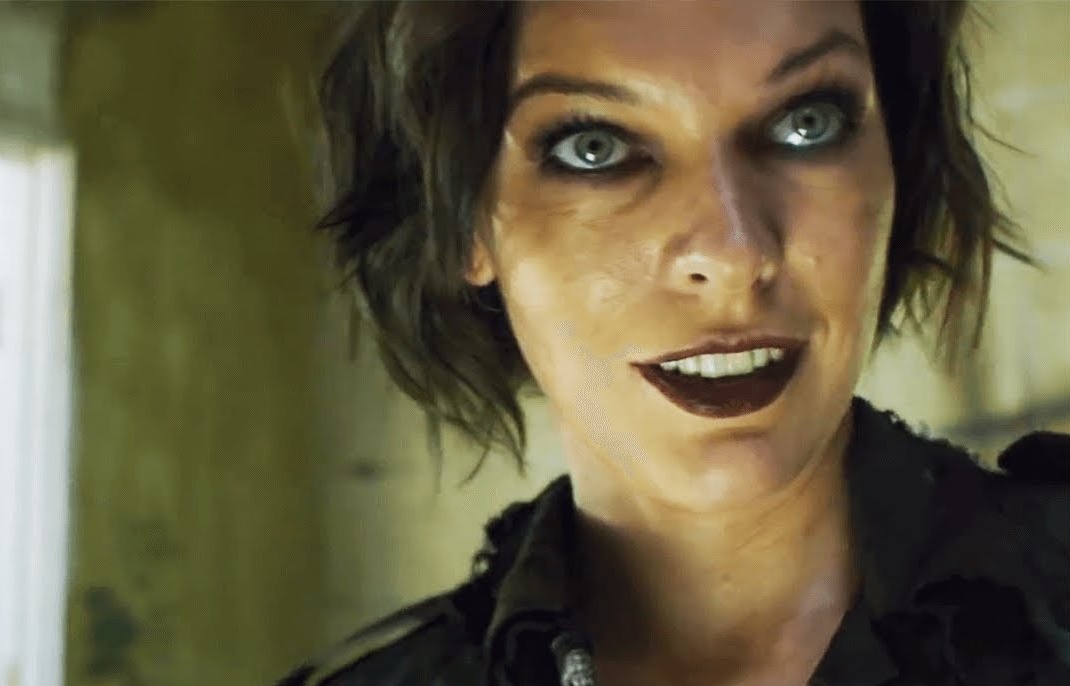
You know the writers really put in the time and effort with the script when you've got "Love Town" run by a guy named "Love Lord" and "Drug Town" ruled by someone named "Drug Lord." One could argue that it's a cynical, Terry Gilliam-esque dystopian commentary on people being defined by their work, but that's probably giving FUTURE WORLD a little too much credit. Jovovich doesn't turn up until the midway point, and she provides FUTURE WORLD's only spark of life with what seems to be a largely improvised performance. Her character is completely despicable--and gets naive, innocent Prince hooked on drugs--but while a little of her manic, bug-eyed overacting and general smartassery goes a long way, it shows Jovovich is at least trying to make something out of nothing. Waterhouse, who tread similar ground in last year's dismal-but-suddenly-looking-better-now THE BAD BATCH, doesn't have much to do other than look like she's Pearl Prophet in a 2018 riff on the old Van Damme sci-fi favorite CYBORG. Top-billed Franco is absent for long stretches--probably the case behind the camera as well--and can't help but come off as a poseur Toecutter and Immortan Joe, turning in the kind of performance that makes one wonder whether he was perhaps spending too much time with Tommy Wiseau while prepping THE DISASTER ARTIST (how is a walking freakshow like Wiseau not in this?) Wahlberg doesn't quite have the presence of his uncle Mark or even his uncle Donnie, and it's gotta be an ominous sign that his acting coach gets an onscreen credit. Like most of his "hanging out and dicking off with his buddies" auteur endeavors, Franco corralled a potentially interesting and eclectic cast--there's also Method Man, Rumer Willis, and veteran character actor Carmen Argenziano, who gets killed by Warlord after about ten seconds of screen time--but, as usual, he abandons them, this time in a dull post-nuke flick that's not even up to the level of late-career Cirio H. Santiago.
James Franco in one of Warlord's more pensive moments.
There's an attempt at an intriguing subplot involving Ash discovering her emotions and falling for Lei (Margarita Levieva), Drug Lord's techie mechanic, but it leads to nothing but a tame sex scene, as Franco can't even be bothered to make something like that look exciting. Other than Jovovich's inexplicably spirited and wildly gesticulating performance, the only other positive is Franco managing to secure the services of acclaimed cinematographer Peter Zeitlinger, who's been Werner Herzog's go-to D.P. for the last 25 or so years (including the great documentaries GRIZZLY MAN, ENCOUNTERS AT THE END OF THE WORLD, and CAVE OF FORGOTTEN DREAMS). He likely met Zeitlinger while starring in Herzog's globally-panned QUEEN OF THE DESERT, one of approximately 258 movies Franco's been in over the last five years. Zeitlinger does a nice job with some of the desert footage and some long Steadicam takes, but overall, the film has the same ugly, cheaply digital look you'll see in any random clunker on the straight-to-VOD scrap heap. Only Franco could follow the universally-acclaimed THE DISASTER ARTIST with a project that makes him look like he's chucking it all to become the next Albert Pyun.
THE VAMPIRE DOLL (Japan - 1970; US release 1971) Directed by Michio Yamamoto. Written by Ei Ogawa and Hiroshi Nagano. Cast: Kayo Matsuo, Akira Nakao, Yukiko Kobayashi, Yoko Minamikaze, Kaku Takashina, Junya Usami, Atsuo Nakamura, Jun Hamamura. (Unrated, 71 mins) Japan's Toho Co, Ltd. will forever be inextricably linked with GODZILLA and the entire kaiju universe that it spawned nearly 65 years ago. A close second would be the classic films of Akira Kurosawa, but prompted by the success of the Poe series being churned out by AIP and the Hammer frightfests of the day, Toho briefly dabbled in classic horror in the early 1970s. That type of classical "western" horror was unusual for Toho or any Japanese production company, as most instances of Japanese horror (1965's KWAIDAN being a good example) were based in Japanese and "eastern" myths, customs, and styles. The so-called "Bloodthirsty Trilogy" is a loose collection of mostly classically traditional vampire films produced by Toho from 1970 to 1974, all of them directed by Michio Yamamoto, a former assistant to Kurosawa (1957's THRONE OF BLOOD) who never really broke out and established himself beyond the "Bloodthirsty Trilogy." Born in 1933, Yamamoto was only 43 when he quit the movie industry and became a minor footnote in the grand Toho story, never heard from again before his death in 2004. Just out on Blu-ray in a three-film set from Arrow Video, the titles in the "Bloodthirsty Trilogy" are available in their intended versions for the first time in years (the second film in the series, LAKE OF DRACULA, had the most exposure on American TV back in the day and was released on VHS by Paramount in 1994), hopefully rescuing the forgotten Yamamoto from oblivion.
1970's THE VAMPIRE DOLL is a stylish and eerie contemporary tale with ominous goings-on that begin on a dark and stormy night in a cursed, Usher-like house of the damned in the middle of nowhere. After working in America for six months, Kazuhiko Sagawa (Atsuo Nakamura) arrives at the family home of his girlfriend Yuko (Yukiko Kobayashi) only to be told by her grieving mother Mrs. Nonomura (Yoko Minamikaze) that she was killed in a car accident two weeks earlier. Kazuhiko is devastated and ultimately skeptical, especially when he keeps seeing Yuko in the house and on the grounds, confronting her at her own grave where her pale visage greets him and begs "Please kill me." Back home, Kazuhiko's younger sister Keiko (Kayo Matsuo) senses he's in danger and drags her fiance Hiroshi (Akira Nakao) to the Nonomura house to investigate. They arrive only to be told by Mrs. Nonomura that Kazuhiko left, but car trouble forces them to stay the night, and it isn't long before Keiko starts seeing Yuko as well. Yamamoto fills THE VAMPIRE DOLL with memorably creepy imagery, whether it's the appearance of the undead Yuko with her bloodied arms and glowing yellow eyes, Hiroshi exhuming Yuko's corpse and finding a lifeless doll in her coffin, an untraceable sound of weeping that faintly echoes through the house ("It's the wind blowing through the skylight window," Mrs. Nonomura claims), or Hiroshi's discovery of Kazuhiko's bloodstained cufflink at Yuko's grave, proof that he never left the grounds and that Mrs. Nonomura and her loyal, mute manservant Genzo (Kaku Takashina) are hiding something. THE VAMPIRE DOLL does stumble a bit when it tries to explain too much in regards to the tragic Nonomura family backstory as it ventures down a path that prefigures the later JU-ON films and J-Horror tropes as the town doctor (Junya Usami) shows up to function as a Japanese Basil Exposition. But it gets back on track fairly quickly, with Yamamoto fashioning the film as an almost identical replica of AIP, Hammer, and Amicus (Hiroshi even compliments his host's "splendid Western-style house") and despite the cultural differences, the universal language of classic horror translates beautifully. This is a moody, vividly atmospheric, and scary little gem with well-done jolts, wonderful set design and shot compositions and it benefits greatly from a brief 71-minute running time that relentlessly cuts through the bullshit.
LAKE OF DRACULA (Japan - 1971; US release 1973) Directed by Michio Yamamoto. Written by Ei Ogawa and Masaru Takesue. Cast: Choei Takahashi, Sanae Emi, Midori Fujita, Shin Kishida, Kaku Takashina, Hideji Otaki, Michiyo Yamazoe, Fusako Tachibana. (Unrated, 82 mins)
Yamamoto and VAMPIRE DOLL co-writer Ei Ogawa were back the next year with LAKE OF DRACULA, a peculiarly uneven vampire outing that gets off to a terrific start but stumbles and bumbles when it starts trying to pretend it's not a vampire movie. On a seasonal leave from her studies, Akiko (Midori Fujita) is spending her break at a cabin in a lakeside village with her younger sister Natsuko (Sanae Emi). She's haunted by a childhood memory 18 years earlier when her dog Leo wandered into a strange house and she encountered what appeared to be a vampire. A strange cargo delivery dropped off for local handyman Kyusaku (Kaku Takashina) is revealed to contain the coffin of Dracula (Shin Kishida). Dracula immediately puts the bite on Renfield...er, I mean, Kyusaku, who proceeds to kill Leo (who's pretty spry and energetic for a dog who must be at least 18 years old by this point) and attack Akiko. She gets away, but as Natsuko falls under Dracula's spell, Akiko and her doctor boyfriend Saeki (Choei Takahashi) attempt to get to the bottom of the strange occurrences.
Kishida is a terrifying Dracula, complete with a guttural, gurgling growl that makes him sound possessed. When LAKE OF DRACULA focuses on him--which isn't nearly enough--it's great stuff. But the film makes the bizarre decision to go off on a psychological tangent, with Saeki, who functions as whatever the plot needs him to be at any given moment (hard-working ER doc, vampire expert, psychologist, hypnotist), convinced that Akiko's problems lie with her repressed memories of sibling jealousy and that "Dracula" is just a mortal madman hypnotizing everyone into believing he's a vampire. It's an absurd bit of misdirection that only serves to pointlessly pad the story, since a) it's obvious from the supernatural shenanigans that this is a purely evil agent of the undead wreaking havoc, and b) the already short movie would only be about an hour long without it. The script tries to draw parallels between Akiko's family issues and a curse affecting the family of the vampire--who may be Dracula or just a present incarnation of him--but it's all psychological smoke and mirrors that works to the film's detriment. It's so preoccupied with bending over backwards to not be a Dracula movie that it ends up sabotaging itself, especially since Kishida is so great in the role. LAKE OF DRACULA has been the easiest of the "Bloodthirsty Trilogy" to see over the years. In addition to its surprise VHS appearance in 1994, it got a subtitled theatrical release in the US in 1973 before turning up in a dubbed version in a TV syndication package in 1980, along with its follow-up, EVIL OF DRACULA.
EVIL OF DRACULA (Japan - 1974; US release 1975) Directed by Michio Yamamoto. Written by Ei Ogawa and Masaru Takesue. Cast: Toshio Kurosawa, Kunie Tanaka, Katsuhiko Sasaki, Shin Kishida, Mariko Mochizuki, Mio Ota, Mika Katsuragi, Keiko Aramaki, Yunosuke Ito. (Unrated, 83 mins) The final installment in the "Bloodthirsty Trilogy" rights the ship after the erratic and uneven LAKE OF DRACULA. Shin Kishida is back as, if not Dracula, then a very similar vampire, this time in the guise of a principal at an isolated girls school in northern Japan. Prof. Shiraki (Toshia Kurosawa), a young instructor from Tokyo, arrives for a new teaching post and is shocked to walk into an already grief-filled situation: the professor's wife died two days earlier and her body is being kept in coffin in the basement per "local custom," and one of the students has gone missing. It doesn't take long for Shiraki to find both of them when they attack him in his room after he's been drinking, which causes him to dismiss it as a bad dream. Then next morning, the principal tells Shiraki that he's ill and wants him to take over his job. He's apprehensive, especially after meeting superstitious colleague Dr. Shimomura (Kunie Tanaka), an expert in local folklore, who informs him of a well-known area legend involving a European shipwreck survivor from two centuries earlier who was forced to drink his own blood to survive. He met a local woman and they continued feasting on one another's blood, thus perpetrating a curse that has haunted the region since. Doing some further digging and finding evidence of a string of long-missing "principals" who ran the school (which is a front for the vampire to procure slavishly-devoted "brides"), Shiraki and Shimamura discover that the vampiric "spirit" lives on, assuming the shape its latest victim and requiring a new body when its host is about to die.
Again drenched in atmosphere and showcasing numerous chilling moments (few more haunting than a student nearing the completion of her turn into the undead and using her last traces of humanity to make the conscious decision to fling herself to her death), EVIL OF DRACULA is also an interesting, almost HORROR EXPRESS-meets-THE THING-like take on vampire lore, with Kishida once again crushing it as one of the most ferocious of all cinematic "Dracula"s, for all intents and purposes. Like LAKE OF DRACULA, EVIL OF DRACULA doesn't use Kishida as much as it should, but it's a much more consistent and straightforward film with some inventive ideas and several solid jump scares. Yamamoto directed a couple more TV projects before calling it a career in 1976, while Kishida stayed busy as a character actor (he turned up in SHOGUN ASSASSIN in scenes culled from the first two LONE WOLF AND CUB movies) until he succumbed to lung cancer in 1982 at the far-too-young age of 42. If Arrow's release of this trilogy can lead to a renewed appreciation of the obscure Yamamoto as a sort-of Japanese Mario Bava, then let's hope it also serves to show horror fans that they've been missing one of the great screen Draculas in the form of Shin Kishida.