NO RETREAT NO SURRENDER (Hong Kong/US - 1986) Directed by Corey Yuen. Written by Keith W. Strandberg. Cast: Kurt McKinney, Jean-Claude Van Damme, J.W. Fails, Kathie Sileno, Kim Tai Chong, Kent Lipham, Ron Pohnel, Dale Jacoby, Peter "Sugarfoot" Cunningham, Tim Baker, Joe Vance, John Andes, Dennis Park. Ruckins McKinley, Roz McKinley. (PG, 84 mins/99 mins) A minor cult classic for 12-year-old boys who saw it in the 1980s, NO RETREAT NO SURRENDER is an ingratiatingly goofy KARATE KID ripoff produced by Hong Kong's Seasonal Films and helmed by veteran martial arts coordinator and future Jet Li collaborator and TRANSPORTER director Corey Yuen. NO RETREAT NO SURRENDER was significantly retooled by New World for its US release over the spring and summer of 1986. The running time was chopped from 99 minutes to 84, a few scenes were juggled around, and a major character was redubbed. In addition, Frank Harris' score was tossed and a new one was composed by Paul Gilreath, who also penned a new theme song, "Stand On Your Own," performed by Joe Torono, that was commissioned to replace "Hold On to the Vision," performed by ex-707 and future The Storm frontman Kevin Chalfant and a then-little-known Joe Satriani on guitar. Filled with enough WTF? elements and bad acting that I'm surprised it never became a fixture on the midnight movie circuit with movies like TROLL 2, THE ROOM, and MIAMI CONNECTION, NO RETREAT NO SURRENDER was a modest success in theaters, grossing a then-OK $4 million (it had the second highest per-screen average the week of its release, bested only by Richard Pryor's autobiographical JO JO DANCER: YOUR LIFE IS CALLING), and was a big hit in video stores and in heavy rotation on cable. It also spawned two in-name-only Loren Avedon-starring sequels--1989's NO RETREAT NO SURRENDER II and 1991's NO RETREAT NO SURRENDER 3: BLOOD BROTHERS--the only common thread being that all three were written by Keith W. Strandberg. But 30-plus years later, the original, recently released on Blu-ray by Kino Lorber with both the US theatrical cut and the original international version, is an enjoyably dated '80s museum piece (caution: gratuitous breakdancing) usually remembered today thanks to the presence of a pre-BLOODSPORT Jean-Claude Van Damme as "Ivan, the Russian," a character in no way modeled on Dolph Lundgren's Ivan Drago in ROCKY IV. "Ivan, the Russian" is a maniacal henchman for a crew of dojo-acquiring New York mobsters who's repeatedly referred to throughout as either "Ivan," "the Russian," or "Ivan Kruschinsky," but the closing credits show JCVD playing a character named "Karl Brezdin." Yeah, NO RETREAT NO SURRENDER is that kind of movie.
Karate-obsessed Jason Stillwell (Kurt McKinney) trains at a Sherman Oaks dojo owned by his father Tom (Tim Baker). After Tom's leg is broken in a throwdown with Ivan after he refuses to sell out to the NYC gangsters who are trying to take over the apparently lucrative Sherman Oaks dojo market, Tom caves and the Stillwell family relocates to Seattle (yeah, this is also the kind of movie that features an establishing shot of the Space Needle yet still feels the need to include the caption "Seattle"). Tom takes a menial job as a bartender, while Jason tries to join a local dojo owned by karate champ Ian Reilly (Ron Pohnel), but is picked on by the douchebags Reilly's hired to run the place in his absence. That includes acting sensai and William Zabka stand-in Dean (Dale Jacoby) and the dojo's most unlikely student, Scott (Kent Lipham), an obnoxious Bluto Blutarsky-type who eats cheeseburgers by the fistful and makes it his mission to ensure the lives of Jason and his new best friend, breakdancing and moonwalking R.J. (J.W. Fails), are miserable. There's also some conflict between Jason and Dean over Kelly (Kathie Sileno), a girl Jason dated a year ago, even though the Stillwells just moved to Seattle and she's Ian's sister. First, how could they have known each other a year ago? And second, if they've been dating for a year, how does he not know that she's Ian's sister? Yeah, NO RETREAT NO SURRENDER is that kind of movie.
If you think that set-up is improbable, then wait until Jason, at his wit's end and ready to quit karate, is visited by the ghost of Bruce Lee, who decides to spend some of his infinite free time in the afterlife to inspire Jason and become his ghostly sensai. The "Bruce Lee" seen here is played by a dubbed Kim Tai Chong, who doesn't look any more like Lee here than he did several years earlier when he doubled the martial arts legend in new scenes shot for 1979's GAME OF DEATH, a film haphazardly constructed around roughly 30 minutes of footage Lee had in the can at the time of his death in 1973. In true KARATE KID fashion, "Sensai Lee" is the Mr. Miyagi to Jason's Daniel LaRusso, with some added help from the wisecracking R.J., who looks like he just wandered in off the set of BREAKIN' 2: ELECTRIC BOOGALOO. All of this leads to a showdown at a high-profile martial arts tournament taking place in what looks like a high school gym, where the same New York mob outfit is trying to strongarm Reilly into giving up his dojo and selling out to them, which begs the question: what exactly is the endgame for these powerful NYC gangsters establishing a monopoly on the strip-mall martial-arts education industry by incessantly hoarding small, privately-owned dojos on the west coast? Ivan ends up beating the shit out of everyone in Reilly's dojo at the tournament, prompting spectator Jason to leap into the ring and take down "Ivan, the Russian" (or, if you go by the closing credits, "Karl Brezdin") himself, using all the karate skills taught to him by the spectral Sensai Lee. Van Damme doesn't get a lot of screen time, but you can already see in his moves and his confident screen presence that he was a star in the making. Indeed, he was the only cast member who went on to any significant success afterwards, though McKinney did enjoy a long run on GUIDING LIGHT starting in the late '90s. NO RETREAT NO SURRENDER is so dumb that's impossible to dislike. Nothing makes sense (why are 1980s karate kids constantly being picked on by everyone? And is everyone in Seattle taking karate classes?), and some of the more head-scratching elements--no doubt brought about by a cultural disconnect between the American setting and the Asian filmmakers--were cut by New World, including a YouTube favorite that shows an extended Jason/R.J. workout montage (seen in full in the 99-minute international version) that gets way more unintentionally homoerotic than anyone was looking for in a cheaply-made KARATE KID ripoff. Yeah, NO RETREAT NO SURRENDER is that kind of movie.
GHOST IN THE SHELL (US/China - 2017) Directed by Rupert Sanders. Written by Jamie Moss, William Wheeler and Ehren Kruger. Cast: Scarlett Johansson, Juliette Binoche, "Beat" Takeshi Kitano, Michael Carmen Pitt, Pilou Asbaek, Peter Ferdinando, Chin Han, Michael Wincott, Danusia Samal, Kaori Mamoi, Lasarus Ratuere, Yutaka Izumihara, Anamaria Marinca, Daniel Henshall. (PG-13, 107 mins) Based on Masamune Shirow's legendary manga and previously filmed as a classic 1995 anime directed by Mamuro Oshii, the live-action--relatively speaking--Hollywood version of GHOST IN THE SHELL was a long time coming, being in development as far back as 2008. The end result feels like it could've been made in 2000 on the heels of THE MATRIX, and it might've seemed dated even then. Director Rupert Sanders (SNOW WHITE AND THE HUNTSMAN) hits all the dystopia/cyberpunk tropes: the dark BLADE RUNNER cityscapes with images projected on skyscrapers mixed with the garishness of THE FIFTH ELEMENT; the action choreography of THE MATRIX and RESIDENT EVIL; and a badass hero in Scarlett Johansson, playing the kind of role that's been owned by Milla Jovovich for at least the last 15 years. The ideas and the look of Shirow's influential manga have been co-opted by so many other pop culture offerings over the years that this fashionably late big-studio take on the subject can't help but come off like the JOHNNY MNEMONIC or AEON FLUX of its decade. That's ultimately a much bigger problem for it than any SJW "whitewashing" outrage over Johansson being cast in the lead.
In the aforementioned dystopian future, almost all humans are cybernetically enhanced to a certain degree thanks to the groundbreaking technological work done by Hanka Robotics, run by unscrupulous CEO Cutter (Peter Ferdinando). Under Cutter's direction, Hanka scientists led by Dr. Ouelet (Juliette Binoche) have successfully accomplished the first transplant of a human brain, taken from a survivor of a terrorist attack, into a synthetically created being, christened Mira Killian (Johansson). A year later, under Ouelet's objections, Killian is a major with a government-run anti-terrorism bureau overseen by Chief Daisuke Aramaki (the great "Beat" Takeshi), partnered with enhanced human military vet Batou (Pilou Asbaek). A number of Hanka scientists, including Dr. Osmund (Michael Wincott) and Dr. Dahlin (Anamaria Marinca) have been killed in intricately planned terrorist assaults, with Ouelet presumed to be the next target. Cutter orders Aramaki's team to find and kill the leader of the cell, who turns out to be Kuze (Michael Pitt, now going by "Michael Carmen Pitt" for some reason), a discarded Hanka project from years earlier who informs Mira that she's not the first of her kind and that Cutter and the Hanka scientists have been experimenting with brain transplants into synthetic bodies for years, all for the purpose of engineering the perfect military killing machine. When Mira rebels against Hanka and Aramaki takes her side ("I answer to the Prime Minister, not to you," Aramaki tells Cutter), Cutter orders Mira's termination.
TAKESHI!
GHOST IN THE SHELL makes for nice eye candy, even if the imagery is something you've seen hundreds of times before. Johansson is well-cast, looks terrific in a flesh-colored body suit, and she has a nice rapport with Asbaek, but there's just nothing new, fresh, or innovative here, with the third act feeling more like a cyberpunk Jason Bourne outing once Mira dives into her past as she discovers her brain belonged to a woman named Motoko Kusanagi, even going so far as meet Motoko's mother (Kaori Mamoi), who's still grieving over her daughter running away from home and allegedly committing suicide. Ultimately, the film can't overcome its stagnant familiarity (note how much Johansson looks like Alicia Vikander in EX MACHINA in the scenes where she's A.I. natural) and some occasionally rushed-looking CGI, with Johansson looking a lot like a FINAL FANTASY: THE SPIRITS WITHIN character in some shots. The best moment in GHOST IN THE SHELL is when Sanders finally gives Takeshi something to do other than sit behind a desk looking solemn and concerned. When Aramaki is ambushed by three Cutter goons and immediately turns the tables on them, quipping "Don't send a rabbit to hunt a fox," blowing all of them away as Takeshi gets his signature twitch going on the right side of his face (a partial facial paralysis resulting from a 1994 motorcycle accident), it's practically a stand-up-and-cheer moment for fans of the Japanese cult icon.
THE DISCOVERY (US/UK - 2017) Directed by Charlie McDowell. Written by Charlie McDowell and Justin Lader. Cast: Jason Segel, Rooney Mara, Robert Redford, Jesse Plemons, Riley Keough, Ron Canada, Mary Steenburgen, Wendy Makkena, MJ Karmi. (Unrated, 102 mins) Watching the Netflix Original film THE DISCOVERY, it seems completely feasible than director/co-writer Charlie McDowell (son of Malcolm McDowell and Mary Steenburgen) and writing partner Justin Lader (they previously worked together on the 2014 Mark Duplass indie THE ONE I LOVE) came up with a killer opening sequence and struggled to build a story around it. The first five minutes of THE DISCOVERY would make a great short film. A few years in the future, controversial physicist Dr. Thomas Harbor (Robert Redford) is being interviewed by a TV news journalist (Steenburgen) on the one-year anniversary of what's come to be known as "The Discovery." Harbor is a household name the world over for finding irrefutable, scientific proof of the afterlife, demonstrating that the spirit breaks down measurable brain waves to a subatomic level as those particles venture to another plane of existence beyond our reality. Upon his presenting The Discovery to the world, death became the ultimate reward. People with terminal illnesses welcomed their diagnosis. The global suicide rate skyrocketed, as people had proof of what they now "know" is a better world waiting for them and they voluntarily check out to expedite their journey to that better place. Everyone from the homeless to the depressed to Hollywood celebrities and sports heroes started taking their own lives, with over a million suicides in the first year. As the interview goes along, one of the news crew's production assistants interrupts to say "Thank you, Dr. Harbor, for my fresh start," turns a gun on himself and blows his brains out on camera.
A year after that, Harbor is running a research facility in an isolated, gothic-looking compound in a remote Rhode Island seaside town, and is visited by his estranged son Will Stevenson (Jason Segel), a neurologist who started using his late mother's maiden name to distance himself from The Discovery. Harbor is working with his other son Toby (Jesse Plemons) and longtime research assistant Cooper (Ron Canada), with the compound staffed by Harbor acolytes, all failed suicides who now view Harbor as some kind of messiah. Will is visiting in a hapless attempt to persuade his father to stop experimenting with the afterlife, feeling tremendous guilt about the whole situation because the incident that inspired Harbor's research--a near-death experience Will had as a child--was embellished by a young and mischievous Will, who told his parents he "saw things" while he was flatlined. Harbor entertains no thoughts of abandoning his research. He's actually had a new breakthrough: a machine that can record the images seen by the recently deceased. Harbor needs a cadaver, which leads to Will, Toby, and Isla (Rooney Mara), a woman Will met on the ferry and later saved from a suicide attempt, stealing a corpse from a local hospital. Hooking the body up to the machine yields no results, but while dismantling the wires and electrodes alone, Will sees blurred images on a monitor that must be what the dead man is seeing in his afterlife. Keeping this secret from his father, Will and Isla, both damaged souls (he blames his mother's suicide on Harbor, she fell asleep and her five-year-old son vanished, never to be seen again), begin a tentative, hesitant romance while getting to the truth of the images seen in the video of the dead man's afterlife.
THE DISCOVERY falls apart right around the time Will, Isla, and Toby decide to steal a corpse from the morgue, with the lone attendant complaining "I'm doing the work of five people!" as if that's sufficient excuse for making it look that easy to wheel a dead body out of a hospital. With a premise that's crying out for someone like PRIMER and UPSTREAM COLOR auteur Shane Carruth, there's numerous directions THE DISCOVERY could've gone: a philosophical, existential FOUNTAIN mode Darren Aronofsky-meets-circa TREE OF LIFE Terrence Malick mind-bender; a love story that traverses Heaven and Earth in a more scientific take on Wim Wenders' WINGS OF DESIRE and FARAWAY, SO CLOSE; a sci-fi variant on Paul Thomas Anderson's THE MASTER; a post-Duplass mumblecore drama; and even a horror route, with the inherent creepiness of the garbled video transmissions of the afterlife having an undeniable John Carpenter/PRINCE OF DARKNESS aura about them. But in McDowell's hands, the film doesn't take any of these paths. It just stands there, confused, until a cliched twist ending that plays out like Charlie Brooker adapting Robert Frost's "The Road Not Taken" as an episode of BLACK MIRROR. Segel and Mara do what they can with their mopey characters (judging from her appearance here, it looks a lot like Mara's Isla was written with ANOTHER EARTH's Brit Marling in mind--this seems like the kind of project in which Marling would script and star). In one of the least-engaged performances of his career, Redford seems to have dropped by for a few days of shooting and is stuck with the film's most impenetrable and inconsistent character. Initially presented as a committed, principled man of science, Harbor isn't interested in God or religion and just looks at the hard facts, but by the second anniversary of The Discovery, he's either a manipulative cult leader or a mad scientist--the movie can't seem to decide, but Redford never adjusts his performance either way. It's a role that seems more fitting for McDowell's dad Malcolm, and Redford just looks bored, fidgety and uncomfortable throughout, like he realized after his first day on the set that this was a dud and it was too late to back out of it. For a star of his magnitude, Redford's onscreen appearances were relatively sparse from the 1980s to the 2000s as he focused his creative energies on directing and Sundance, but in the last seven years, he's been more visible than in past decades, even having fun in big-budget special effects movies like CAPTAIN AMERICA: THE WINTER SOLDIER and PETE'S DRAGON, the kind of tentpole projects he would never do in his heyday. A living legend at 80, Redford has nothing to prove to anyone, but if THE DISCOVERY is any indication, it would perhaps behoove him to go back to being a little more picky about his acting gigs in his emeritus years. McDowell concocts an intriguing premise with THE DISCOVERY but just doesn't know what to do with it, leading to a dull, dreary misfire that does little to combat the stigma that most Netflix Original films debut there for a reason.
THE BLACKCOAT'S DAUGHTER (US/Canada - 2017) Written and directed by Osgood Perkins. Cast: Emma Roberts, Kiernan Shipka, Lucy Boynton, James Remar, Lauren Holly, Greg Ellwand, Elena Krausz, Heather Tod Mitchell, Peter James Haworth, Emma Holzer. (R, 94 mins) Filmed in early 2015 and screened at that year's Toronto Film Festival under its original title FEBRUARY, THE BLACKCOAT'S DAUGHTER has been held up in distribution limbo by A24, who bounced it all over the release schedule from late 2015 and throughout 2016 before pushing it to spring 2017, where it's now bowed on VOD and received a limited theatrical run. While BLACKCOAT gathered dust on the shelf, debuting writer/director Osgood Perkins (son of legendary PSYCHO star Anthony) made another film, the Netflix Original slow-burner I AM THE PRETTY THING THAT LIVES IN THE HOUSE, which ended up being released first. PRETTY THING remains a love-hate proposition: moving at roughly the speed of plate tectonics, it's the absolute slowest of the crop of post-Ti West slow-burner fright flicks over the last several years, and while I appreciated what Perkins was going for, its almost experimental austerity set a land-speed record for going from intriguing to off-putting. Watching BLACKCOAT does enhance PRETTY THING to an extent, but what's odd is that though he made it first, BLACKCOAT feels like the kind of polished and assured sophomore effort of a young director who's gained significant confidence after getting the experience of a flawed debut under their belt. That's not to say PRETTY THING is a step back per se, but it's a step somewhere, a detour in an unexpected direction. There's enough similarities and thematic and stylistic overlap that the films could easily be examined as flip sides of the same coin, but it's PRETTY THING that, in retrospect, ends up coming across like the not-quite-there-yet test run for THE BLACKCOAT'S DAUGHTER. They're unquestionably the work of the same filmmaker but watching them in the order of release rather than the order they were produced actually seems like the more naturally progressive flow.
That doesn't mean THE BLACKCOAT'S DAUGHTER is a multiplex-ready commercial horror flick for the mainstream masses. It's only slight less slow-going than PRETTY THING, but with more characters and more story, so it doesn't have quite the "still life with narration" aura that's a natural byproduct of a movie with essentially two characters with one who's senile and pretty much catatonic. BLACKCOAT is also the most unsettling example of supernatural horror that the genre has offered since THE WITCH from a year ago, which could explain why shared distributor A24 might've wanted some distance between the two. Like PRETTY THING, BLACKCOAT's central characters are female and there are two stories (that element is more pronounced here) that eventually coalesce. At Bramford, an isolated Catholic girls school in upstate New York, the students are leaving for winter break at the end of February. Naive freshman Kat's (MAD MEN's Kiernan Shipka) parents are supposed to pick her up but are nowhere to be found. Older, cynical Rose (Lucy Boynton) deliberately told her parents to pick her up on the wrong day later in the week so she can deal with an unwanted pregnancy. They're the only two girls left at school, and headmaster Mr. Gordon (Peter James Haworth) tells them to stay out of trouble and check in with two prim, proper custodians, Ms. Prescott (Elena Krausz) and Ms. Drake (Heather Tod Mitchell) if they need anything, but otherwise, Rose is instructed to keep an eye on the younger Kat. Rose puts Kat through a bit of a hazing ritual, telling her a creepy fictional story of a girl who was killed on the school grounds when she discovered the Bramford nuns were part of a cult of devil worshipers. Rose sneaks out and spends the evening with her boyfriend but returns to find Kat trance-like in the basement, kneeling before the boiler, an event Kat writes off as sleepwalking.
In the first of what becomes a series of cutaways to a separate storyline, Joan (Emma Roberts) is a young woman who gets off a bus several towns away. She's wearing a hospital bracelet that she quickly removes. Seeing Joan walking along the road, kindly Bill (James Remar) and his cold, stand-offish wife Linda (Lauren Holly), pull over and offer her a ride. She tells them she's going to Portsmith, which is the town right after their destination--Bramford--where they're going to pick their daughter up at school for winter break. While Linda wants nothing to do with Joan, Bill tells her that they've been tested and they find God in the little things that happen--"the little coincidences"--and that she reminds him of someone he knew a long time ago. Meanwhile, back at Bramford, Kat believes her parents are dead and are never coming to get her. Her behavior grows increasingly erratic, with a concerned Rose asking if there's anything she can do. "No," Kat replies. "You had your chance."
It's hard to discuss THE BLACKCOAT'S DAUGHTER's story any further without spoiling it or divulging too much information about exactly how these two seemingly unrelated plot threads come together. Perkins cleverly misdirects you into thinking one thing, but it's all a distraction from what he's really setting up (it's the kind of film where you immediately want to watch it again to see how you were tricked and manipulated). Aside from one well-crafted jump scare where the staging has a striking similarity to the staircase murder of private eye Arbogast in PSYCHO (an affectionate nod to the filmmaker's father), Perkins is more concerned with establishing a mood, slowly and methodically tightening the screws and ratcheting up the tension with a lot of help from a persistently droning, rumbling, ambient score by his brother Elvis Perkins, whose haunting "Blackcoat's Daughter" lullaby will chill you and make your hair stand on end. All of this, in conjunction with the slow pace, makes the sense of dread and doom not just unsettling but downright suffocating. Joan, Kat, and Rose are extremely well-rounded and thoroughly fleshed-out characters whose arcs go in completely the opposite direction than you expect as you get to know them after their initial intros: mean girl Rose ends up being the most sympathetic, especially after completely underestimating Kat, who's not the naive innocent she seems. And Joan...well, you'll just have to see.
Perkins has constructed THE BLACKCOAT'S DAUGHTER in such a way that everything you think you know is up-ended with each shift from Kat & Rose back to Joan, Bill & Linda. Each revelation ends up altering your perspective on everything that happened in the early stages. There's some terrifying moments here and with rare exception, they're the kind that sneak up on you, unease turning to discomfort before escalating to anxiety and terror. THE BLACKCOAT'S DAUGHTER will rattle even the most jaded, seen-it-all horror fan (one character picking up a phone to hear a gurgling voice ordering "Kill all the cunts" is particularly unnerving). Like a lot of genre fans, I'm old enough and I've seen enough over the last 40 years that, aside from an occasional WITCH, BABADOOK, or IT FOLLOWS to cite just three recent examples, it's hard to be surprised in a big way by new horror films anymore. But when this got firing on all cylinders and the pieces began falling into place, it was really getting under my skin and by its emotional end, left me shaken in a way that I haven't experienced with a horror movie in a long time. Possibly the scariest film to take place at a girls school since Dario Argento's SUSPIRIA, THE BLACKCOAT'S DAUGHTER is that most welcome of surprises--a disturbing, stomach-in-knots fright flick that quietly burrows its way into your head and will fuck you up for days after seeing it. Well done, Perkins. Your dad would be proud.
A passion project that Martin Scorsese's had in various stages of development since acquiring the rights to Shusako Endo's 1966 novel in the late '80s, SILENCE completes the legendary filmmaker's unofficial religious trilogy that began with 1988's THE LAST TEMPTATION OF CHRIST and 1997's KUNDUN. SILENCE was already made into a movie once with a 1971 Japanese adaptation, but SILENCE '16 again demonstrates Scorsese's recurring obsessions with faith and religion, themes that go back as far as his earliest films like 1968's WHO'S THAT KNOCKING AT MY DOOR? and 1973's MEAN STREETS. Make no mistake--SILENCE is a horse pill. It's slow-moving and sometimes punishingly long at 161 minutes, which almost seems by design to put you in the mindset of his central character. It's the kind of visually stunning epic that you rarely see any more, equal parts Werner Herzog, Terrence Malick, and Francis Ford Coppola, but filtered through the uniquely singular vision of arguably the greatest living American filmmaker. It's the reality of getting movies made today, but it's hard to believe that a director of Scorsese's reputation and stature has to get funding from a truckload of production companies (including the unlikely involvement of VOD and Redbox B-movie dealmakers Emmett/Furla Films, taking a break from being a half-assed Golan & Globus for a rare bid at respectability) from four countries with 40 (!) credited producers. C'mon, Hollywood studios. This is Martin Fucking Scorsese. If he comes to you with a project, give him the money. His films tend to stand the test of time, if that even matters anymore. Sure, they can't all be TAXI DRIVER, RAGING BULL, and GOODFELLAS, but can you name a terrible Martin Scorsese film?
In 17th century Macau, two Portuguese Jesuit missionaries, Father Sebastiao Rodrigues (Andrew Garfield, having a breakout 2016 and even better here than he was in his Oscar-nominated turn in HACKSAW RIDGE) and Father Francisco Garupe (Adam Driver) journey to Japan in search of their mentor Father Cristovao Ferreira (Liam Neeson). Ferreira's been missing for seven years, and a letter turns up in the hands of Bishop Valignano (Ciarin Hinds)--a letter the rogue Ferreira sent years earlier, indicating that he's apostasized, renouncing Christianity, leaving the priesthood and has no intention of returning from a missionary trip to Japan, where he's taken a wife and wishes to live a normal life. Instinctively concluding that this letter doesn't sound like the words of Ferreira, Rodrigues and Garupe insist on finding their teacher and embark on a trip that will draw obvious comparisons to Heart of Darkness and APOCALYPSE NOW, but also the grueling sort of quest that recalls Herzog's AGUIRRE: THE WRATH OF GOD and FITZCARRALDO, as well as Roland Joffe's THE MISSION. The missionaries will be double-crossed by guide Kichijiro (Yosuke Kubozoka), will eventually be separated, and the story will focus primarily on Rodrigues. Rodrigues clashes with Inquisitor Inoue (a scene-stealing Issey Ogata), a powerful official hellbent on stopping the spread of Christianity in Japan, and willing to torture, crucify, and kill to do so (one harrowing scene has converted Japanese Christians crucified at sea, drowned by the incoming tide, then having their bodies set ablaze so they can't be given a Christian burial). Rodrigues will eventually find Ferreira and he isn't quite the Col. Kurtz-like madman you might be expecting. SILENCE is a difficult and challenging film that has definite slow stretches but it rewards the patient viewer. The script by Scorsese and Jay Cocks unfolds like a richly-textured novel, taking its time to build and establish the characters and get you in their heads, which makes the complete experience all the more powerful. Pitched by distributor Paramount as a major awards-season contender, SILENCE played well in NYC and Los Angeles but bombed hard when it expanded into wide release, relegated to one 9:55 pm showing per day when it finally made it to my area. It was almost shut out of the Oscars, earning just one nomination for Rodrigo Prieto's cinematography. It's not the kind of film that will appeal to casual moviegoers or even to casual Scorsese fans (though it explores recurring themes in his work, its style is more Terrence Malick than Scorsese). It's an often profoundly moving film about deeply committed faith, one that's philosophical without being preachy, and if you've followed Scorsese through the years, you'll recognize his passion and his concerns, his voice coming through even though it's somewhat of a stylistic departure for him. (R, 161 mins)
PATRIOTS DAY (US/China - 2016)
You might think it takes a special breed of asshole to bag on a movie that honors the victims and heroes of the 2013 Boston Marathon bombing, but it takes a special breed of asshole to create a bullshit composite character and make almost the whole thing about him. Composite characters are dramatic necessities in narrative chronicles of true events but here, it's a clumsy distraction that's alternately insulting and unintentionally hilarious. The last and by far the least of director/co-writer Peter Berg's unofficial "Mark Wahlberg: American Hero" trilogy (after LONE SURVIVOR and the underrated DEEPWATER HORIZON), PATRIOTS DAY has Wahlberg playing Tommy Saunders, a composite character created specifically for the film. Tommy, or as he'll be known from here on, "Tawmy," is a plays-by-his-own-rules homicide sergeant who played by his own rules one too many times and got temporarily busted down to patrolman. But he's free and clear and out of the doghouse after one more day--you guessed it--Patriots Day. Tawmy's got a bum knee but puts on a brace, plays through the pain, and does his jawb, and he's right there when the bombs set by the Tsarnaev brothers--Tamerlan (Themo Melikidze) and Dzhokhar (Alex Wolff)--go off. He immediately calls for backup and oversees the triage unit, and when FBI Special Agent Rick DesLauriers (Kevin Bacon) and Gov. Deval Patrick (Michael Beach) show up at the scene, they know that the only person they need to consult is, of course, Tawmy.
Tawmy's right there at the center of the action at the command center, taking charge and making sure everyone's on the same page, and thank Gawd he's there to inform DesLauriers how investigations work, imploring "Hey! Listen! I was hawmicide! Witnesses! We should talk to witnesses! Maybe somebody saw somethin'!" as everyone within earshot nods in agreement. Yeah, because I'm sure veteran FBI Special Agent Rick DesLauriers who, according to his FBI bio, has been an agent since 1987, has no fucking idea how to do his job, so props to Tawmy for being there to show him how it's done. Police Commissioner Ed Davis (John Goodman) also holds back on making any decisions until he runs things by Tawmy, who's given a special role in the investigation when DesLauriers asks "Hey, you know this area pretty well, right?" because obviously there's no way any other cawp knows more about Boston than Tawmy Saunders, Super Cawp! Because Tawmy can't be there for every break in the investigation without turning the film into outright fiction, when an FBI agent spots a possible suspect in Dzhokhar in surveillance footage, the first person DesLauriers alerts to this discovery is Tawmy. Later on, Tawmy's also the cop who first spots Dzhokhar hiding in a boat in a Watertown resident's backyard, and that's not long after a shootout between Watertown cops and the Tsarnaev brothers where one Watertown cop opens fire, shouting "Welcome to Watertown, motherfucker!" It's telling that the two best sequences in the film--Chinese college student Dun Meng's (Jimmy O. Yang) carjacking by and subsequent escape from the Tsarnaevs, and Tamerlan's American wife (Melissa Benoist) being interrogated by a sinister black ops agent (Khandi Alexander, killing it in just a few minutes of screen time)--are nail-biting set pieces that don't involve Wahlberg, at least until the Zelig-like Tawmy is the one who responds to Dun's 911 call, because of course he does. Why not just make an Altman-esque ensemble piece showing how all of these people worked together in pursuit of the suspects? PATRIOTS DAY pays a lot of lip service to the notion of a community coming together but in execution, it's almost all about Tawmy. I get that Tawmy is a symbol of "Boston Strong," but it just gets silly. Why clumsily straddle the line between paying reverent tribute and making a formulaic Mark Wahlberg vehicle, especially when the usually reliable actor responds by turning in what might be his career-worst performance (Tawmy sobbing on his couch and yelling "We're gonna get these motherfuckers!" is embarrassing)? It's hard to take the film seriously when Tawmy seems to be the only cawp who knows what he's doing, and one with enough juice to get lippy and bark "Who the fuck are you?" to an FBI guy. The real question is "Who the fuck is Tawmy?" (R, 133 mins)
EVOLUTION (France/Spain/Belgium - 2016)
The first film in over a decade by acclaimed INNOCENCE director Lucile Hadzihalilovic (she's married to IRREVERSIBLE director Gaspar Noe, edited his 1998 film I STAND ALONE and co-wrote his 2009 film ENTER THE VOID) is an impenetrable arthouse sci-fi/horror mood piece that feels like an aquatic UNDER THE SKIN and can best be described as what might've transpired if David Cronenberg remade THE LITTLE MERMAID. There's some memorable visuals (this was shot on Lanzarote in the Canary Islands) and a pervasive sense of ominous dread throughout, but it all seems to be an aimless, meandering voyage that doesn't really have anything in mind other than low-key and extremely slow-burning squeamishness. In a remote seaside village that seems to be frozen in time, young Nicolas (Max Brebant) is swimming and sees the body of a drowned boy with a bright red starfish attached to his navel. He tells his mother (Julie-Marie Parmentier), who dives in the area where he was swimming and only finds the starfish. There are no adult males in the village, which is populated only by young boys and their mothers, all plain and unemotional, with white eyebrows and their hair pulled back in tight librarian buns. The boys are fed a gruel-ish concoction of goop and worms and given a strange medicine in between visits to a local "hospital" where they're kept for observation and given ultrasounds by the female doctors and nurses. Nicolas becomes convinced that the village mothers are up to something and spies on them as the writhe naked in star-shaped formations, covered in a slimy film along the shore in the dead of night. Convinced his "mother," who has six suction-cup-like growths on her back, is not his mother, Nicolas is given an extended stay at the hospital, where he befriends strange nurse Stella (Roxane Duran), who decides to show him who--or more accurately, what--he really is. It's a lugubriously slow buildup to very little, but there's some effectively unsettling imagery along the way, with a droning score that really contributes to the escalating sense of unease. But mood and style aren't enough to get the job done with EVOLUTION, which ends up being some kind of asexual nightmare with a predictably ambiguous, hackneyed ending suggesting these creatures are about to walk among us. Some interesting ideas here, but EVOLUTION never comes together. (Unrated, 82 mins, also streaming on Netflix)
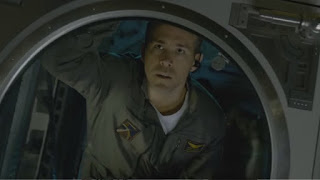
LIFE (US - 2017) Directed by Daniel Espinosa. Written by Rhett Reese and Paul Wernick. Cast: Jake Gyllenhaal, Rebecca Ferguson, Ryan Reynolds, Hiroyuki Sanada, Ariyon Bakare, Olga Dihovichnaya. (R, 104 mins) There's really no way to approach LIFE without labeling it an ALIEN knockoff. To its credit, it doesn't try to disguise that, instead opting to bring enough modern technology to the table that it ends being ALIEN in a post-GRAVITY/THE MARTIAN genre. Visually, LIFE is extraordinarily convincing and with a budget of $60 million--low by today's standards--it manages to look better than a lot of movies that somehow cost $150 million or more and still look like shit. LIFE earns some points for going the extra mile to stick to hard science in its depiction of life on a space station by having its characters spend the entire film floating around in zero gravity. That effort isn't quite tantamount to putting lipstick on a pig, but in the end, LIFE can't really clear the major hurdle of its overwhelming sense of familiarity. Sure, it's an ambitious visual effects triumph, but at the end of the day, it's still just another ALIEN ripoff, and one that compromises its admirably downbeat twist ending by pointlessly segueing to "Spirit in the Sky" played over the closing credits. While it's nice that its inclusion here means Norman Greenbaum keeps the power on for another six months, it has no business being used in this movie, much less sending the audience out humming a catchy classic rock tune after such a bleak wrap-up. Were "Born to Be Wild," "Brown-Eyed Girl," and "Paranoid" also considered? Now, 1990's MIAMI BLUES? Sure, perfect use of "Spirit in the Sky." But by now, in 2017? No. No more. Please, Hollywood, give us a fucking break already with "Spirit in the Sky."
On the International Space Station just outside Earth's atmosphere, the six-person crew intercepts a damaged space probe returning from an eight-month trip to Mars, where it collected soil samples to be studied by British biologist Dr. Hugh Derry (Ariyon Bakire). A tiny organism is discovered in the sample and offers the first irrefutable proof of life beyond Earth. Mission commander Ekaterina Golovkina (Olga Dihovichnaya) alerts NASA to the discovery, and schoolchildren in NYC bestow the name "Calvin" on "the Martian." It's a basic life form kept in quarantine, but begins growing at an alarming rate before going into a temporary hibernation. Derry stirs Calvin with a jolt of electricity, with the clear, translucent organism now demonstrating an increased aggression, wrapping tiny tentacles around Derry's right hand and crushing it even through protective gloves. Golovkina and British quarantine officer Dr. Miranda North (Rebecca Ferguson) put the safety of the crew ahead of rescuing Derry, but maintenance engineer Rory Adams (Ryan Reynolds) breaches the sealed entrance to the lab to get Derry out and ends up being killed by Calvin, now resembling a small starfish/octopus hybrid, who squirms down Rory's throat and devours him from the inside out. Calvin escapes through a vent and can turn up anywhere, with North, Japanese systems engineer Sho Murakami (Hiroyuki Sanada, in a role similar to his turn in Danny Boyle's SUNSHINE a decade ago), and American chief medical officer Dr. David Jordan (Jake Gyllenhaal), a traumatized war vet who's logged more time on the ISS than anyone and is in no hurry to return home, attempting to contain it and prevent it from making its way to Earth.
Director Daniel Espinosa (SAFE HOUSE, CHILD 44) and the screenwriting team of Rhett Reese & Paul Wernick (ZOMBIELAND, DEADPOOL) follow the ALIEN template at least until the climactic twist with the characters being offed mostly by reverse order of billing, with the exception of guest star Reynolds biting it about 35 minutes in. None of the actors are required to stretch all that much, with Gyllenhaal looking glum and dour, Ferguson playing by-the-book and authoritative, and Reynolds cast radically against type as "Ryan Reynolds," with Rory a wisecracking snark machine whose being made an inside-out meal of by Calvin spares us the risk of LIFE turning into DEADPOOL IN SPACE. With limited screen time, Bakare manages to create a well-rounded character in Derry, a paraplegic whose disability isn't a factor in the weightlessness of space. Espinosa manages a few genuinely suspenseful moments and LIFE captures the claustrophobic feel of being in such cramped quarters, but so do a few dozen other movies of this sort. Too many of the plot developments hinge on characters doing stupid things (had Rory not breached the lab, the movie would've ended after 30 minutes). Despite the pre-release online chatter that LIFE was a secret prequel to Marvel's VENOM due in 2018 (it's not), it really just seems to have been given the green light because someone said "Hey, wouldn't it be cool to remake ALIEN with the kind of state-of-the-art CGI they used in GRAVITY?" LIFE isn't bad, and while it's perfectly watchable, looks superb, and has a handful of reasonably solid set pieces, it doesn't do much to justify its existence or distance itself from the pack. The ending works on a gut-punch level and the twist hits you quickly enough that you don't have a chance to question it until the credits start rolling, by which point you're humming "Spirit in the Sky" and already forgetting about what you just watched.
THE STUD (UK - 1978) Directed by Quentin Masters. Written by Jackie Collins, Dave Humphries and Christopher Stagg. Cast: Joan Collins, Oliver Tobias, Sue Lloyd, Mark Burns, Doug Fisher, Walter Gotell, Tony Allyn, Emma Jacobs, Peter Lukas, Natalie Ogle, Constantin De Goguel, Sarah Lawson, Franco De Rosa, Chris Jagger, Peter Bourke. (R, 96 mins) In constant rotation in Showtime's late night "After Hours" block in the early-to-mid '80s, the softcore porn cult classics THE STUD (1978) and its sequel THE BITCH (1979) were the first film projects of UK brewery and pub company Brent Walker as well as the first big-screen adaptations of legendary trashy romance novelist Jackie Collins. Co-scripted by Collins and conceived as a starring vehicle for her older sister Joan, THE STUD was a big hit in the UK and it proved to be the first step in reviving 45-year-old Joan's stagnant career, which began in the early 1950s but by 1978 found her slumming in Eurotrash crime movies and drive-in fare like EMPIRE OF THE ANTS. That would all change in 1981 when she enjoyed a major comeback with the zeitgeisty success of the ABC series DYNASTY. A resurgent Collins became so synonymous with the DYNASTY phenomenon that it's easy to forget that she didn't even join the show until its second season. THE STUD gave the actress a chance to give her Alexis Carrington/bitch-on-wheels act a test drive as Fontaine Khaled, owner of the posh, members-only disco Hobo and trophy wife to wealthy businessman Ben Khaled (Walter Gotell, best known as General Gogol in the Roger Moore-era 007 movies). Fontaine is a sexually voracious nympho with a ton of studs on standby, but her favorite is Tony Blake (Oliver Tobias), Hobo manager and insatiable player. Tony beds a different woman every night but is growing disillusioned with ennui and the excess of the night life and being at Fontaine's beck-and-call, and he's even planning on quitting Hobo and opening his own nightclub with unscrupulous investment broker Ian Thane (Peter Lukas).
Despite the film ostensibly being a showcase for Collins, the real focus of THE STUD is Tobias, who has a sort-of second-string Warren Beatty quality here, especially once Tony's SHAMPOO-esque character arc is complete. Though he doesn't change his ways immediately, he falls hard for Alex (Emma Jacobs), Fontaine's barely-legal stepdaughter. Alex is stuck in a boring relationship and wants revenge on serial adulteress Fontaine for cheating on her father, so she throws herself at Tony, who declares his love for her after one night of passion. He finally seems ready to settle down after a drug-fueled night at a hotel where he, Fontaine, her best friend Vanessa (Sue Lloyd) and Vanessa's husband Leonard (Mark Burns) have a foursome in the pool. Vanessa and Leonard are swingers, and Fontaine is "gifting" Tony to Vanessa for her birthday. While they're getting it on, Fontaine and Leonard ride a giant fuck-swing over the pool before the four-way, which comes to an abrupt end when a dazed Tony gathers his senses and realizes he's being blown by an adventurous Leonard. He finally lays it on the line for Alex, who flatly rejects him, cruelly informing him that she was just using him to get off and get back at Fontaine. This culminates in a New Year's Eve bash at Hobo where he finds out he's losing his job and his partnership with Thane is off, and he encounters a conga line of all of his conquests over the course of the film, almost as if his life is flashing before his eyes. THE STUD is totally unabashed trash, but there's some genuinely effective drama and ambition in this final sequence, which blurs the line between fantasy and reality to such a degree that you wouldn't be surprised if Tony started belting out "Bye Bye Life" from ALL THAT JAZZ. It's almost like director Quentin Masters stages it as a mini-homage to the legendary, one-hour banquet sequence in Luchino Visconti's THE LEOPARD, where Burt Lancaster's aristocratic nobleman goes from room to room witnessing the downfall of the upper class, essentially bidding farewell to the world of privilege he's always known. Tony faces the harsh reality of his situation and realizes that a change must be made. He races toward the exit as the New Year's countdown ticks away, finally getting out the door at "zero" and taking a deep breath, the weight of the world and Fontaine Khaled finally off his shoulders.
It's an unexpectedly serious and ingeniously constructed finish to an otherwise tawdry and campy affair. A frequently nude Collins has a blast as the vamping, strutting Fontaine, dropping bon mots like "When I first met Tony, he thought 69 was a bottle of scotch," and "Old Ben gets his cock sucked once a month, in the dark." There's some unexpected humor in a prophetic throwaway line by the frontman of a rock band who's warned about his hard-partying lifestyle and smirks "Who ever heard of a 70-year-old rock star anyway?" The line is funny now because the actor playing the rock star is Chris Jagger, the younger, lookalike brother of Mick. With its dated fashions and its plethora of disco tunes and cheesy, pre-Skinemax sex scenes, it's easy to laugh at THE STUD, but it really steps up its game in the home stretch, demonstrating some unexpected depth and thoughtfulness that one doesn't usually associate with the work of Jackie Collins. Dave Humphries and Christopher Stagg are credited with "additional material and dialogue," so it's possible they brought that out in some rewrites (Humphries' writing credits also include such respected titles as the 1977 cult horror film THE HAUNTING OF JULIA and the 1979 Who rock opera QUADROPHENIA). There's occasional hints of that drama here and there--there's just something haunting and sublimely melancholy about last call at a dimly-lit '70s nightclub with the remaining desperate stragglers either facedown drunk or hooking up to the tune of 10cc's 1975 hit "I'm Not in Love."
THE BITCH (UK - 1979) Written and directed by Gerry O'Hara. Cast: Joan Collins, Michael Coby (Antonio Cantafora), Kenneth Haigh, Ian Hendry, Mark Burns, Sue Lloyd, Carolyn Seymour, Doug Fisher, John Ratzenberger, Pamela Salem, Peter Wight, George Sweeney, Chris Jagger, Peter Burton, Maurice Thorogood, Bill Mitchell, Jill Melford. (R, 93 mins) THE STUD did a great job of capturing the UK perspective of the kind of Studio 54 debauchery that defined the excess of late '70s nightlife. It was such a smash in England--as well as a minor grindhouse and drive-in hit when Trans-American Films released it in the US in 1979--that it spawned an immediate sequel with 1979's THE BITCH, bringing back Joan Collins and much of THE STUD's supporting cast. Though it was based on her novel, Jackie Collins didn't return for THE BITCH, nor did director Quentin Masters, so the Brent Walker guys assigned writing and directing duties to veteran British journeyman Gerry O'Hara, whose career as an assistant and second unit director dated back to the 1940s before he moved into making his own films in the 1960s. Though he worked as an assistant on prestigious fare like RICHARD III (1955), ANASTASIA (1956), and CLEOPATRA (1963), O'Hara never really distinguished himself as his own director, jumping from genre to genre, finding a niche after THE BITCH with 1983's bawdy Brent Walker/Harry Alan Towers co-production FANNY HILL, and eventually ending his career with Cannon during their life support years, when he replaced Ken Russell during pre-production on the dire THE MUMMY LIVES, a horror movie with Tony Curtis that spent three years on the shelf before going straight to video in 1996. O'Hara sticks to the STUD formula with THE BITCH, but the results are less successful. The continuing chronicle of Fontaine Khaled's sexcapades is dull and plodding, even with a surplus of skin and sex scenes, and the action is bogged down by an uninteresting plot about Fontaine tangling with gangsters over an expensive diamond ring that inadvertently comes into her possession.
Fontaine gets the ring from mob-connected Nico Cantafora (BARON BLOOD's Antonio Cantafora, a Robert Goulet lookalike going by his "Michael Coby" pseudonym that he used in several TRINITY knockoffs with Paul Smith) on a flight from NYC to London, where the in-flight movie is...wait for it...THE STUD. He needs to get the ring through customs and knows he'll be stopped, so he plants it on Fontaine, hoping to catch up with her later. He needs the ring because its value will get him out of debt with a British crime organization led by ruthless mobster Thrush Feather (an ill-looking Ian Hendry), who's respected and feared by all despite being named "Thrush Feather." What follows is a convoluted chain of events with double-crosses and tons of sex, sort-of like O'Hara wanted to make a softcore porn version of THE LONG GOOD FRIDAY. There's also boring subplots about Fontaine being warned by her attorney (Kenneth Haigh) that her club Hobo is facing bankruptcy since she still insists on living the kind of jet-setting lifestyle she can't afford since Ben Khaled divorced her after the events of THE STUD. She finds herself in the Tony role here, falling for Nico even though he's just using her, though she eventually turns the tables and uses the ring to get herself out of debt. THE BITCH delivers when it comes to the kind of softcore action that made these two films so well-known to late-night cable viewers and hopeless insomniacs in the 1980s, but it really drags when people aren't bumping and grinding in quintessential 1979 soft focus.
Other than The Olympic Brothers' amazingly catchy earworm of a theme song that will stick with you for days, the most fascinating part of THE BITCH today is the sight of a young John Ratzenberger, then an American expat living and working in the UK a few years before moving back to the States and landing his signature role as Cliff Claven on CHEERS, as a New York mob guy who becomes Nico's contact in London. It's pretty surreal seeing the future Pixar voice mainstay in this bit of softcore sleaze, sharing scenes with Italian cult star Cantafora and tearing up the dance floor at a London disco with a chick on each arm (tragically, O'Hara deprives us of any J-Ratz sex action that talk show hosts could've ambushed him with forever). Ratzenberger gets a lot of scenes in the middle of the film, but then completely vanishes from the story, which is indicative of how sloppy and careless THE BITCH can be. Character motivations and behavior change from scene to scene with little regard for story continuity. People can be furious with someone in one scene and then walking arm in arm with them in the next like nothing happened. But hey, you aren't watching THE BITCH for the story, right? 1978-79 seemed to be a breakout period for Jackie Collins on the big screen: THE STUD and THE BITCH, both recently released on Blu-ray by Kino Lorber in defiant objection to the "physical media is dead" narrative (both have commentary tracks by film historians David Del Valle and Nick Redman, and THE BITCH features an interview with 92-year-old Gerry O'Hara) were two of four Jackie Collins-derived works over that two-year period, which also included another After Hours favorite with 1979's THE WORLD IS FULL OF MARRIED MEN, with Anthony Franciosa and Carroll Baker, and 1979's YESTERDAY'S HERO, an original Collins script about a hard-drinking, washed up soccer star (Ian McShane) that represented a bit of a departure from her signature romance trash. The British-made YESTERDAY'S HERO was never released theatrically in the US, despite McShane's love interest being played by Suzanne Somers, riding high at the time thanks to the enormously popular THREE'S COMPANY. From then on, Jackie Collins' novels were adapted for the small screen with miniseries like HOLLYWOOD WIVES and LUCKY CHANCES. THE STUD and THE BITCH did find a fan in Aaron Spelling, who saw both and hired Collins to add some catty, vindictive bitchiness to DYNASTY, which gave the veteran actress' stalled American career a powerfully gusting second wind that turned her into a TV icon.