Directed by Bernardo Bertolucci. Written by Franco Arcalli, Giuseppe Bertolucci, Bernardo Bertolucci. Cast: Robert De Niro, Gerard Depardieu, Dominique Sanda, Burt Lancaster, Donald Sutherland, Stefania Sandrelli, Francesca Bertini, Laura Betti, Werner Bruhns, Stefania Casini, Sterling Hayden, Anna Henkel, Ellen Schwiers, Alida Valli, Romolo Valli, Giacomo Rizzo, Paolo Pavesi, Roberto Maccanti, Maria Monti, Jose Quaglio, Pietro Longari Ponzoni, Piero Vida. (Unrated, 315 mins)
In recent years, Paramount hasn't been known for showing an interest in making its back catalog available, so they've been licensing titles out to the upstart Olive Films label (recent releases include a batch of Jerry Lewis comedies and the '70s cop thrillers HIT! and BADGE 373). Back in 2006, Paramount listened to fan requests and made the surprise decision to release the uncut version of Bernardo Bertolucci's European political epic 1900 on DVD. It wasn't in print very long and now they've farmed it out to Olive Films for a DVD re-release (minus the bonus features on the 2006 DVD but with a 2002 documentary on Bertolucci that wasn't on the previous release) and a debut on Blu-ray. It looks mostly good on Blu-ray, framed at 1.78:1, a change from the DVD's 1.85:1 (IMDb claims the original aspect ratio is 1.66:1, so who knows?). The difference is pretty minor, and I only noticed one shot where the change made a difference and something seemed oddly-framed (we should just be thankful that cinematographer Vittorio "2.00:1" Storaro wasn't put in charge of the Blu-ray transfer) There's some scenes where there's a bit too much saturation and the caked makeup and wig-cap glue lines on the actors' heads are plainly obvious, but overall, the colors are bolder and the textures better-defined than the occasionally washed-out DVD. Probably worth the upgrade for fans of this long-neglected masterpiece, but the transfer is not perfect. If ever a film deserved to be rescued by a Criterion restoration, it's this one, but the Blu-ray's visual inconsistencies may be inherent in the film itself. You know how sometimes the higher-resolution of Blu-ray doesn't help? This might be the case here, depending on one's tolerance for grain. Still, this Blu-ray is probably as good as it'll ever get for a film that may come to be regarded as either Bertolucci's finest work or his ultimate act of madness.
De Niro and Depardieu as best friends torn
apart by political upheaval in 1900
I do think it's Bertolucci's masterpiece and it's also one of the great epics in all of cinema. It never ceases to amaze me that a film this mind-bogglingly expansive and ambitious even got made, let alone distributed by a major Hollywood studio, but after LAST TANGO IN PARIS, Bertolucci clearly had enough clout to do what he wanted. It's a densely-plotted, graphically violent, sexually explicit film with major Hollywood stars and a pro-Communist agenda and it's over five hours long and took over a year to shoot. Of course, the US release was cut down from 315 minutes to 243 minutes, losing a little over an hour but still running four (a 255-minute version also exists). Bertolucci didn't cut any scene in its entirety--he just shortened them or toned down some of the more graphic material to avoid an X rating. The 2006 DVD and this new Blu-ray have the director's complete 315-minute version, restored and shown in the US for the first time in the mid 1990s and given an NC-17 rating, which was dropped in favor of simply going without a rating. How graphic is this film's content? I don't know what necessarily constitutes an abundance of nudity, but even Sterling Hayden's dick gets some screen time.
Burt Lancaster as the padrone
Beginning in 1901 on the day of Verdi's death, the film chronicles the following 44 years of political turmoil in Italy, centered on the wealthy, landowning Berlingheri family and the peasant Dalco family who work their wheat fields and their farm. The patriarchs--padrone Alfredo Berlingheri (Burt Lancaster) and peasant leader Leo Dalco (Hayden) have grandsons born on this very day. As youths, the boys, the Berlingheri child also named Alfredo (Paolo Pavesi) and Olmo Dalco (Roberto Maccanti) are close friends and despite his bourgeois upbringing, Alfredo feels more at home with the field workers than with his family, especially his cold father Giovanni (Romolo Valli). The boys grow, and Alfredo (Robert De Niro) and Olmo (Gerard Depardieu) eventually find themselves at the center of a Fascist uprising, started by greedy Giovanni, who uses religion and patriotism to rope in the rich in his quest to keep profits high and the peasants under their thumbs. Giovanni hires a sadistic foreman, Attila (a demonic Donald Sutherland) to lord over the Dalco clan, who see jobs eliminated and wages reduced while the Berlingheris get richer and more decadent by the year. All the while, the politically active Olmo fights the Fascist movement while Alfredo passively steps aside and looks the other way while Attila's power grows.
Donald Sutherland as the sadistic Attila
Many characters weave in and out of the story, which unfolds and progresses like a great novel. With Storaro's stunning cinematography and a majestic score by Ennio Morricone, 1900 looks and sounds incredible. And rarely has a film this long been so consistently engrossing. It's truly a film like no other. It's remarkably ambitious, grandiose, operatic, overwrought, and profoundly moving in equal measures. Every few minutes, there's some beautifully-staged sequence or some inspired bit of crazed acting or some unexpected transgression happening. The sexual content is surprising at times: young Alfredo and Olmo compare erections in a controversial scene; as young adults, they visit a prostitute (Stefania Casini) who gives them simultaneous handjobs and there's no effects or camera trickery...she's really stroking both De Niro and Depardieu; there's a weird scene where De Niro's Alfredo uses the butt of a shotgun to masturbate his horny cousin Regina (Laura Betti), who's also seen going down on Sutherland while he rants about Fascist ideals. There's also some almost-Pasolini levels of scatology: Lancaster buries his feet in cow shit before asking a peasant girl to feel his impotent penis; Bertolucci gives us a close-up of a horse taking a steaming dump and the piles of manure get thrown at Sutherland. The violence is also very disturbing at times, especially the fate of a little boy raped and killed by Attila and Regina, and a rough, non-faked scene where Depardieu kills and guts a large pig.
Sterling Hayden as peasant leader Leo Dalco
There are shocking elements in 1900, but it's never exploitative. The film is not just a political history of Italy, but it also functions as a history of cinema. Rarely has such an eclectic group of actors been brought together on the same film. Young breakout stars like De Niro and Depardieu, an established box office star in Sutherland, Hollywood legends Lancaster and Hayden, acclaimed European stars Dominique Sanda (as De Niro's wife), Romolo Valli, Alida Valli, and Stefania Sandrelli (as Depardieu's wife), and perhaps most interesting, the inclusion of Francesca Bertini in a rare screen appearance as Lancaster's older sister. Bertini, born in 1892, was the first major star in Italian cinema, with a screen career dating back to 1907. In her 80s and long retired by this point, Bertolucci talked her into taking a small role, and in a film with history as its central theme, Bertini's appearance, limited to maybe three scenes, really does feel special. Bertolucci also establishes a connection to his own inspirations in Lancaster again being cast in an Italian film as an aging patriarch lamenting the passage of time and the changing of values, which he'd portrayed so masterfully in Luchino Visconti's THE LEOPARD (1963). With a mix of actors speaking English, Italian, French, and German (mostly English), the English-dubbed option is probably the way to go, as you get the voices of De Niro, Sutherland, Lancaster, Hayden, and a few others. Depardieu is dubbed by someone else for the English version, but his voice can be heard on the French track.
De Niro's Alfredo, the landowner put
on trial by his field workers
1900 took over a year to film. Shooting began in May 1974 and ended in September 1975. De Niro had finished THE GODFATHER PART II but it hadn't been released when he started shooting 1900. He made TAXI DRIVER immediately after 1900 (and late in 1900's shoot, he would fly from Rome to NYC on weekends to drive a cab to prep for his role as Travis Bickle), but TAXI DRIVER ended up coming out a full year before 1900's US release in late 1977, in its truncated 243-minute version. It obviously didn't do well and vanished from sight for years until the 255-minute cut got released on VHS in the late '80s. Even though the uncensored version was ultimately given a brief release in the '90s, it wasn't until the 2006 DVD that Bertolucci's full version was made widely available in the US. It's an incredible, one-of-a kind film the likes of which we'll never see again, and one that still resonates today. Decidedly not for all tastes, but adventurous cinema fans who have yet to tackle it should consider it essential viewing. You've never seen anything like it.
Directed by Larry Charles. Written by Sacha Baron Cohen, Alec Berg, David Mandel, Jeff Schaffer. Cast: Sacha Baron Cohen, Ben Kingsley, Anna Faris, Jason Mantzoukas, Adeel Akhtar, John C. Reilly, Megan Fox, Kevin Corrigan, Fred Armisen, Kathryn Hahn, Seth Morris, J.B. Smoove, Chris Parnell. (R, 83 mins)
The jokes fly fast and furious in the latest outrageous comedy from fearless BORAT provocateur Sacha Baron Cohen and director Larry Charles. Baron Cohen, who co-wrote the script with veteran CURB YOUR ENTHUSIASM writers Alec Berg, David Mandel, and Jeff Schaffer (also the team behind the 2004 cult comedy EUROTRIP), is Admiral General Aladeen, the supreme ruler of Wadiya, a fictional country in North Africa, just east of Sudan. A longtime champion of oppression (the film is dedicated "in loving memory of Kim Jong Il"), Aladeen finds himself sanctioned by the UN for his attempts at building a nuclear bomb and must head to NYC to address the United Nations. Aladeen is abducted by the head of his hotel security team (John C. Reilly), but manages to escape, but not before having his trademark beard cut off. Aladeen is now stuck in New York City and unrecognizable while his treacherous aide Tamir (Ben Kingsley) uses a dim-witted double (also Baron Cohen) to bring so-called "democracy" to Wadiya if only to appease the oil companies who will give him a huge payout (which Tamir will use to "buy a house next to George Clooney's") in exchange for control of the country's energy resources. Aladeen then meets and slowly falls for activist vegan food co-op manager Zoey (Anna Faris), who he first mistakes for a boy and then a "lesbian hobbit," and tries to outwit Tamir and regain his dictatorial control of Wadiya. But...will Zoey convince him to change his ways?
When THE DICTATOR is on, it's almost as hilarious as anything in BORAT. But that's not as often as it should be, as Baron Cohen seems too concerned with making Admiral General Aladeen endearing. Early in the film, he's trying to convince Megan Fox (playing herself), who's been flown to Wadiya to sexually service the dictator for a huge fee, to stay over because he wants to "cuddle." The idea that the vicious dictator, even played for laughs, really just wants to settle down and find love doesn't really gel, especially since, upon ejaculating into Fox, he triumphantly boasts "You now have herpes!" The jokes have about a 55%-to-45% ratio of clunkers to zingers. It works best when Baron Cohen is being as boldly offensive as possible, whether Aladeen is mocking China and insisting he's not being "lacist," playing a 1972 Munich first-person-shooter video game, or going to extreme methods to obtain real hair to make a fake beard ("Plan B!"). There's plenty of laugh-out-loud bits throughout THE DICTATOR, but just as much, if not more, of the humor lands with a thud: Aladeen (calling himself "Alyson Burgers" for reasons to complicated to go into) getting a job in Zoey's food co-op and delivering a baby when a customer goes into labor in an endless scene that has him losing his cell phone in the mother's vagina, or being suspended in mid-air and taking a huge dump on a pedestrian, or a painfully unfunny (and unending) scene where he's incognito and using one posted sign after another to supply his fake names ("Employees Mustwashhands"), and entirely too many jokes about Zoey's hairy armpits.
But Baron Cohen working at half-capacity is still funnier than most of what's out there, and when THE DICTATOR scores, it's screamingly funny. Just not as consistently funny as it should be. BORAT was endearing because he was so clueless, but that was truly a lightning-in-a-bottle film that only works once, as the intermittently funny BRUNO demonstrated. Baron Cohen clearly knew that going back to that mixing-with-reality well again wouldn't have worked (mainly because he's too well-known by this point, although THE DAILY SHOW still manages to find some people completely unaware of its existence), but he tries to have it both ways here. He uses Admiral General Aladeen to reflect relevant world situations (he gets a great monologue near the end about why Americans should be glad they don't live in a dictatorship: "The top 1% would own all the wealth! Politicians would give tax breaks to their rich friends!"), but turns the character into a well-meaning, misunderstood, lovestruck sad sack who just wants a soulmate. It's hard to reconcile those two vastly different elements, and as a result, THE DICTATOR is wildly uneven. The supporting cast seems to be having a good time, with a couple of surprise cameos, including a hilarious one by an actor not generally known for having a sense of humor. THE DICTATOR has some big laughs, but it's a huge step down from BORAT and feels really padded even at just 83 minutes. It's probably about on the level of BRUNO, a film that felt disappointing in theaters but seems to play better when you catch it on HBO. Call it "worth a discounted matinee."
Unbelievably awful faux-documentary possession film that made headlines after its opening weekend for its abrupt, borderline audience-contempt ending. The action just stops and directs you to a web site for "more on the ongoing investigation." Going to that site (www.therossifiles.com) reveals...fake newspaper articles, character bios, and scenes from the film. Budgeted at $1 million, enough suckers got roped into this that it grossed $33 million in its opening weekend, and even after the terrible word of mouth, still managed to rake in another $20 million. In a just world, director/co-writer William Brent Bell would be run out of Hollywood by a torch-wielding mob of angry fanboy conventioneers, but now he's got a sleeper hit on his resume that made back its budget 53 times over despite being a complete pile of dog shit and in today's world of horror fandom, people with much less box office success have been anointed a "Master of Horror." The predictable story follows a young American woman (Fernanda Andrade) to Rome, where her mother (Suzan Crowley) has been held in a mental hospital since 1989. Why Rome? She was transferred there because she committed three murders during an exorcism. Andrade is accompanied by a documentary filmmaker (Ionut Grama) who's investigating the phenomenon of possession. While attending a Vatican exorcism class (which they apparently allow people to film?), Andrade meets two rogue priests (Simon Quaterman, Evan Helmuth) who conduct off-the-record exorcisms in their free time. An attempt to exorcise Crowley reveals that she's possessed by four different demons, and maybe, just maybe there's a chance that all that unsubtle talk of "soul transference" might have an effect on the four protagonists.
There's some interesting possibilities here, but it's never scary and the whole demonic possession thing is more played-out than the zombie genre. This comes nearly 40 years after THE EXORCIST, which still hasn't been topped and never will be. How many more of these do we need? Does it stop when every horror concept is redone as a mock documentary or as "found footage"? And then there's that ending. I think Bell might've been going for a kick-in-the-balls shocker of a close, but to say he bungled it is an understatement. Instead, it comes across as a cheap, insulting cop-out, so much so that a paying audience could be forgiven if they thought the projector broke. THE DEVIL INSIDE, the cinematic equivalent of a deposed Nigerian prince e-mail, is barely tolerable at home and must've been an enraging experience theatrically. You've been warned. All the shit you've heard about this thing is true. (R, 83 mins)
THE VETERAN (UK, 2011)
A misleading trailer makes this out to be another UK vigilante flick in the mold of the recent Michael Caine drama HARRY BROWN (it's even shot at the same Heygate Estate housing project in south London). That eventually does come into play, but ultimately, THE VETERAN is one of the angriest and most cynical films to come down the pike in quite some time. Depressed military vet Robert Miller (a strong performance by Toby Kebbell, perhaps best known for Guy Ritchie's ROCKNROLLA) finds it hard to adjust once he's back from Afghanistan. Combat pal Danny (Tom Brooke) introduces him to his older brother Chris (Tony Curran) who works with powerful mystery man Gerry (Brian Cox). Chris informs Robert that he's part of a government surveillance operation, monitoring terrorist cells in London, and its connection to everything from the CIA to the drug pushers who have taken over the housing project where Robert lives. Being the exceptional soldier he was trained to be, Robert takes some liberties with his assignment--to watch an informant named Alayna (Adi Bielski), who has access to vital Al-Qaeda intel--which gets him into some hot water in ways he never sees coming...but unfortunately, you will.
A draggy midsection slows it down considerably, and the script--co-written by director Matthew Hope--is prone to implausibilities and cliches (an on-the-edge Robert staring into the mirror and punching the wall; or holding his shaking hand in front of him, trying to stabilize it), but THE VETERAN really steps it up in the home stretch with a jawdropping climax that astonishes with its utter lack of concern for pleasing the crowd. The films are otherwise unrelated, but with THE DEVIL INSIDE in the above review, I mentioned that the filmmakers wanted to go for a gutpunch of an ending that really knocks you on your ass...and they failed miserably. THE VETERAN goes for that same kind of finish and does it right. It's inevitable that Robert would be driven to do what he does, finding that he's once again being a good soldier and paying the price while the puppet masters skip away unscathed, but it still doesn't prepare you for how it pans out. The ironically-named Hope has a message and eventually, after some mid-film putzing about, gets it across loud and clear. Flaws and all, it's pretty powerful stuff, and Cox gets one of those memorable movie speeches that will likely end up on YouTube if it isn't already. (R, 98 mins). Also available on Netflix streaming
With numerous classic genre films released over a four-month period, the summer of 1982 is generally regarded as a benchmark year for summer movies. 30 years today, the summer movie season kicked off with its first blockbuster, John Milius' CONAN THE BARBARIAN. Not only did a make a movie star out of five-time Mr. Universe Arnold Schwarzenegger, but it also broke the floodgates on an endless series of ripoffs, imitations, in addition to official sequels, spinoffs, and, 29 years later, a remake. Based on the influential series of books by Robert E. Howard, CONAN THE BARBARIAN reveled in its much-deserved R-rating, as Milius (who co-wrote the script with Oliver Stone) gave us an unforgettable villain in James Earl Jones' Thulsa Doom, a memorably sexy heroine in Sandahl Bergman's Valeria, but also filled the screen with all manner of blood, gore, and skin. The nine-year-old version of me found it to be, at least for 129 minutes, the single greatest movie ever. Of the week. And the summer of my dad taking me to a ton of movies that a nine-year-old had no business seeing was just getting started. Thanks, Dad!
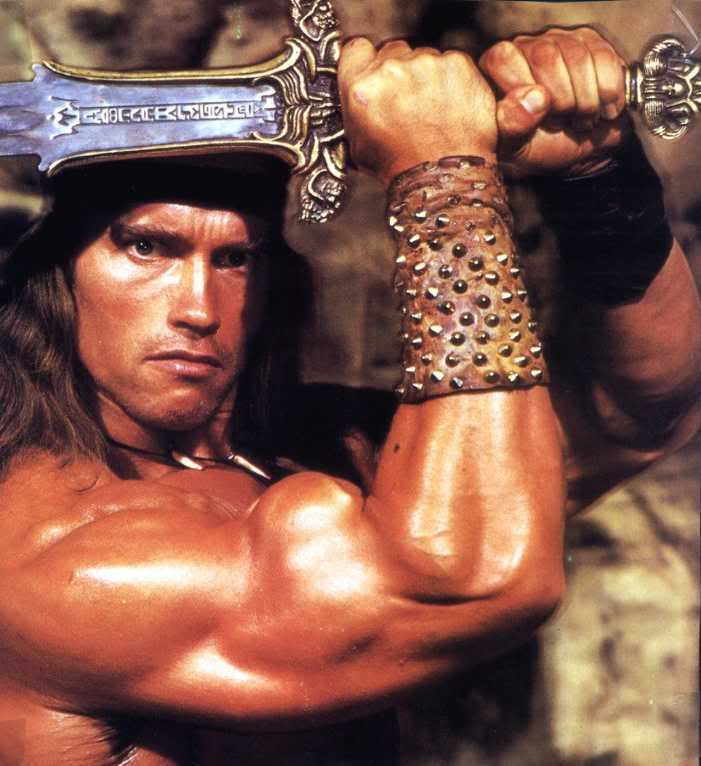
Arnold Schwarzenegger in his star-making performance as Conan the Barbarian
James Earl Jones as the nefarious Thulsa Doom
Sandahl Bergman as Valeria.
The 1984 sequel was geared toward teenage boys and younger, with the gore
and sex significantly toned down, completely missing the point of
what we found so appealing about the original film in the first place.
In 1985's RED SONJA, another Howard adaptation, Schwarzenegger plays Kalidor, but
might as well be named Conan. It was supposed to be a cameo, but
his role got increased after production began.
The success of CONAN THE BARBARIAN resurrected a
forgotten 1970 Arnold Stang comedy that featured
Schwarzenegger, under the name "Arnold Strong."
The impact of CONAN THE BARBARIAN was seen at drive-ins and in video stores for several years to come.
If you walked into a video store at any point in the 1980s and into the early 1990s,
chances are you saw the boxes for all of these. Some were better than others, and some
(THE BEASTMASTER, ATOR, DEATHSTALKER) spawned their own series of sequels.
YOR: THE HUNTER FROM THE FUTURE (Italy/Turkey, 1983)
Directed by Anthony M. Dawson (Antonio Margheriti). Written by Robert Bailey and Anthony M. Dawson. Cast: Reb Brown, Corinne Clery, John Steiner, Carole Andre, Alan Collins (Luciano Pigozzi), Ayshe Gul, Marina Rocchi, Sergio Nicolai, Paul Costello, Nello Pazzafini. (PG, 88 mins)
In a summer movie season ruled by RETURN OF THE JEDI, it's hard to believe that Columbia Pictures put YOR: THE HUNTER FROM THE FUTURE on 1400 screens nationwide on August 19, 1983. Much like THE ROAD WARRIOR gave birth to an endless parade of Italian post-nuke ripoffs, CONAN THE BARBARIAN was a huge hit in 1982 and kickstarted a string of muscleman and musclewoman barbarian movies (a few came from Roger Corman, but most came from Italy), each new one cheaper than the last, that flooded theaters, drive-ins, and video stores for the next couple of years. Likely a relatively inexpensive bid by Columbia to beat the highly-publicized Lou Ferrigno take on HERCULES, which opened a week later, YOR began life as IL MONDO DI YOR (THE WORLD OF YOR), a four-part, four-hour miniseries for Italian TV, directed by veteran journeyman Antonio Margheriti under his "Anthony M. Dawson" pseudonym. Originally running 200 minutes, the miniseries was re-edited into an 88-minute feature and an English dub was prepared for US export. Normally, this kind of venture would be picked up by an indie or grindhouse outfit and dumped in drive-ins, but for some reason--maybe a lack of their own in-house barbarian movie--Columbia thought this had potential, picked it up, and decided to make it a major theatrical release in late summer. It opened in 7th place at the box office but disappeared quickly once HERCULES opened a week later, and by that point, audiences got wise to the fact that these were cheesy, low-budget, badly-dubbed affairs, and by the time big-budget, major-studio Hollywood offerings like CONAN THE DESTROYER (1984) and RED SONJA (1985) rolled around, interest had waned and most of the Italian knockoffs either got very small releases or went straight to video. But YOR: THE HUNTER FROM THE FUTURE has held on to become an endearingly bad, undeniably entertaining cult film over the years, even airing once at 2:00 am ET on Turner Classic Movies (!). YOR! On TCM! I'm not making that up.
Yor, Ka-Laa, and Pag!
Opening with the Razzie-nominated anthem "Yor's World" by Guido & Maurizio De Angelis (a duo that also went by "Oliver Onions," and were responsible for numerous catchy, English-as-second-language ditties in many Italian cult movies), YOR finds the affable barbarian hero (Reb Brown, formerly TV's CAPTAIN AMERICA in the late '70s) rescuing Ka-Laa (Corinne Clery) and Pag (Luciano Pigozzi/"Alan Collins") from a dinosaur attack. A tribal elder (Nello Pazzafini) tells Yor that his medallion matches one worn by the "Daughter of the Gods," who lives among the desert people. After battling some cavemen, Yor, Ka-Laa, and Pag go off in search of this Daughter of the Gods, much to the consternation of the catty Ka-Laa, who immediately gets all clingy like Yor's her man. They run afoul of more cavemen, one of whom steals Yor's medallion, but Yor manages to rescue Ka-Laa by hang-gliding from the carcass of a giant bat.
In a sign of continuity errors that are bound to happen when you cut a 200-minute miniseries down to an 88-minute feature, Yor is suddenly and without explanation sporting his medallion once more, and they finally meet the Daughter of the Gods, Roa (Ayshe Gul), when Yor rescues her from a pack of angry mummies. Roa's presence, and Yor's clear attraction to her, as evidenced by one of Margheriti's many cuts to Reb Brown's stupid grin, immediately makes Ka-Laa jealous and she starts acting like a kid showing off to show Yor how hot she is. The scowling Ka-Laa challenges Roa to a duel to the death, but then they're both attacked by (the same?) cavemen. Roa dies as a result of her wounds, but more importantly, Ka-Laa now has Yor all to herself.
US opening credits
Italian opening credits
After burying Roa, the heroes are lounging on a beach when they rescue some children from another attacking dinosaur. As a show of gratitude, the head of the village (Sergio Nicolai) announces "The women have prepared a feast in your honor!" Really? How? They just got there. How did the women know that their children would be saved by Yor? Or do they usually just not pay attention to their children and prepare feasts for passing strangers who risk their lives to save them? And how did Yor and his friends not see this village? It's on the same beach! This is also the kind of film where villages consistently appear out of nowhere and rampaging dinosaurs manage to sneak up on people. The villagers keep watch on the skies because of a "god" that periodically appears. This "god" is a spaceship, and soon, androids appear and take Yor to another dimension ruled by the maniacal Overlord (an expectedly hammy John Steiner), who wants to use Yor's genetic design to create a master race of super-intelligent androids to help him rule the world. Some space rebels appear and take Ka-Laa and Pag to Overlord's realm to find Yor, and Yor leads the rebels in a battle to take down the malevolent Overlord, whose stronghold appears to be the same abandoned factory that's used in most Italian post-nuke films of the era.
John Steiner as Overlord
I can't imagine YOR making a whole lot of sense even in its IL MONDO DI YOR incarnation, but the nonsensical stupidity is indeed a lot of its charm. In its quest to rip off everything, YOR is a standard barbarian adventure, a prehistoric monster movie, and an outer space sci-fi epic with spaceships, a Darth Vader-inspired villain and an army of androids. Surprisingly, despite the choppy editing and some obviously mismatched, cobbled-together scenes in the theatrical YOR (when Ka-Laa and Pag are attacked by a dinosaur in a forest, Yor's reaction shot shows him standing in a desert, clearly taken from another, unrelated section of IL MONDO DI YOR), whoever put it together and dubbed it managed to keep (or perhaps instill) a vague sense of coherence. It's a ridiculous story, but it makes some kind of sense as long as you don't examine it too closely.
If only we could hear Reb doing this "YAAAAAAH!!"
Reb Brown became a bit of a B-movie star in the '80s after his two-TV movie stint as Captain America ended. He did some TV and co-starred in a couple of serious films (1983's UNCOMMON VALOR and 1986's DEATH OF A SOLDIER), but after YOR and 1985's disastrous HOWLING II, he found himself in another Italian actioner, Bruno Mattei's hilariously awful RAMBO ripoff STRIKE COMMANDO (1987) and the die was cast. For the next several years, Brown bounced back and forth between straight-to-video Italian and South African action movies, and in them, patented his own hyper-macho persona where he was constantly barking orders or emitting some shrieking battle cry. The cult of Brown didn't really happen until MST3K aired his 1988 sci-fi film SPACE MUTINY ("Crunch Buttsteak!" "Big McLargeHuge!"), and then it took off. Now there's a ton of fan-made Reb Brown highlight reels all over YouTube. Now 64, Brown quit acting in the late '90s, but recently began appearing on the convention circuit, indicating that he seems to be a good sport about things. He also just completed the low-budget DTV horror film NIGHT CLAWS, his first starring role in a film since 1994's CAGE II. Brown fans who go back to YOR are invariably disappointed--not in the film, but in that Brown's performance is dubbed by Gregory Snegoff, so you don't get to hear his voice or the signature battle cry made famous in STRIKE COMMANDO and SPACE MUTINY. The choice to dub YOR in English was probably made well after filming ended and the dubbed-in-Italian version aired on TV, and it's likely that they didn't want to pay Brown to fly back to Rome to record his dialogue, as Italian films were still being shot without direct sound, the intention always being to dub them later on. Judging from some of YOR's publicity shots, it certainly appears as if Columbia had Brown put his YOR loincloth back on, but on the US theatrical poster and in this shot below, it's Brown's own hair and not his YOR wig.
Margheriti was an endlessly busy genre-hopper and special effects craftsman with a career going back to the late 1950s. He was best known in the 1960's for his sci-fi space operas, but he also made various peplum, 007 ripoffs, and gothic horrors, followed in the '70s by several westerns and crime thrillers, but it was in the '80s that he found a niche with a string of junglesploitation potboilers inspired by films as varied as THE WILD GEESE, APOCALYPSE NOW, RAIDERS OF THE LOST ARK, and the RAMBO films. Margheriti died in 2002, and a few years before his death, he mentioned in an interview with Video Watchdog that he more or less felt YOR was junk and didn't really care for it. But oddly, it's YOR that's become one of his most recognized films. Known as much for his special effects and miniature construction as he was for directing, Margheriti uses his signature methods on YOR, often embarrassingly so as in this scene where a Yor action figure is clearly subbed in for Reb Brown during a stunt shot. You can't really miss it.
Margheriti's use of miniatures worked in the '50s and '60s, but was getting pretty stale by the '70s (a badly-designed tornado destroying a miniature dam in 1979's KILLER FISH was particularly laughable). While miniatures were still being used by the likes of George Lucas in the STAR WARS films and Ridley Scott in ALIEN and BLADE RUNNER, both took painstaking efforts to make them look as believable as possible. I'm pretty sure Margheriti just used a Conan doll for the above clip. Margheriti continued making films into the late 1990s, at which point Italian cinema was largely in decline and older, experienced directors were having a hard time finding work. That may very well be the case, but with Margheriti, it's also possible that his (and other aged, old-school Italian directors who are still with us but haven't worked in years) was a situation of a set-in-his-ways craftsman who was unwilling--or unable--to change with the times. Margheriti could stage a huge explosion as well as any director who ever stepped on a movie set, but even his most ardent supporters and/or CGI-haters would be hard-pressed to defend his use of toy cars and models on what looks like a Hot Wheels tabletop racetrack in his last film, 1997's VIRTUAL WEAPON.
YOR: THE HUNTER FROM THE FUTURE is a bad movie. But it's a gloriously fun bad movie. And for all his talk of not really caring for it, Margheriti's style is too apparent throughout for him to have not cared what was going on. He loved his models and miniatures, and he stuck with them until the bitter end. Margheriti didn't live long enough to see the rejuvenated interest in Italian cult cinema that started just a year or two after his passing (I'm glad guys like Enzo G. Castellari, Sergio Martino, Ruggero Deodato, and Umberto Lenzi, to name just a few, are still with us to see how revered their films have become to cult fans). He'd probably be shocked to find that YOR aired on TCM. The cult of YOR was strong enough to prompt Sony to release it as part of their "Columbia Classics" made-to-order DVD line, available online or from Warner Archive in a surprisingly pristine anamorphic widescreen transfer.
Directed by Tim Burton. Written by Seth Grahame-Smith. Cast: Johnny Depp, Michelle Pfeiffer, Helena Bonham Carter, Eva Green, Jackie Earle Haley, Jonny Lee Miller, Chloe Grace Moretz, Bella Heathcote, Gully McGrath, Christopher Lee, Alice Cooper, Ivan Kaye, Shane Rimmer. (PG-13, 113 mins).
A big-screen revamp of the legendary 1966-1971 afternoon soap opera has been a longtime pet project of producer/star Johnny Depp, but the end result is a real mixed bag. Depp and director Tim Burton team for the eighth time since 1990, and DARK SHADOWS is easily their least-satisfying collaboration (of which I'd probably rank 1994's ED WOOD as my favorite) thus far, not helped by a script by Pride and Prejudice and Zombies and Abraham Lincoln: Vampire Hunter author Seth Grahame-Smith that can't seem to settle on what exactly it wishes to accomplish and, comedy aside, takes great liberties with the Dan Curtis soap, especially in the construction and origin of some of the major characters.
In the 1770s, Barnabas Collins (Depp), dashing scion of the Maine-based Collins family, founders of the fishing town of Collinsport, professes his love for Josette du Pres (Bella Heathcote), breaking the heart of servant girl Angelique Bouchard (Eva Green). Angelique turns out to be a witch who puts a curse on the Collins family and Collinwood, their 200-room mansion. Collins' parents are killed, Josette leaps from a cliff, and Barnabas is turned into a vampire and buried alive by the vengeful Angelique.
Johnny Depp as Edward Scissorhands as Willy Wonka
as Sweeney Todd as The Mad Hatter as
Barnabas Collins in DARK SHADOWS
Cut to 1972, and the Collins dynasty has fallen on hard times. Their fish cannery is long shuttered, the money is almost gone, and Collinwood is in dusty shambles. It houses current matriarch Elizabeth (Michelle Pfeiffer) and her sullen teenage daughter Carolyn (Chloe Grace Moretz), along with Elizabeth's brother Roger (Jonny Lee Miller), his troubled son David (Gully McGrath), David's boozy shrink Dr. Julia Hoffman (Helena Bonham Carter), and caretaker Willie Loomis (Jackie Earle Haley). Into this dysfunctional family comes Maggie Evans, who calls herself Victoria Winters (Heathcote again), recently hired as young David's governess (Maggie Evans and Victoria Winters were two different characters on the TV show, but here Maggie invents the assumed name to hide from a tragic past). Around this time, construction workers accidentally unearth Barnabas, who returns to Collinwood and has a hard time dealing with life in 1972. Barnabas' reappearance gets the attention of the head of the Bouchard family's rival--and now reigning--canning factory (Green again), who's actually the still-living witch Angelique, who keeps passing herself off as her own descendants with each new generation. She still wants Barnabas, who finds himself drawn to Victoria, as she bears an uncanny resemblence to his long-dead love Josette.
Michelle Pfeiffer as Elizabeth Collins Stoddard
There's an awful lot of plot in DARK SHADOWS, so much so that it feels like a season-long reboot whittled down to two hours. But it still doesn't get much accomplished. After the magnificently gothic 18th century prologue, Burton seems to lose interest. Instead, the bulk of the film focuses on stale period humor and Barnabas being a fish out of water. Whether he's mistaking the golden arches of the McDonald's sign as a symbol of Mephistopheles, watching Karen Carpenter on television and ripping off the back of the TV set demanding "reveal yourself, tiny songstress!", mistaking a lava lamp for "an urn of blood," or sitting around a campfire with some stoned hippies, it's just one tired joke after another, almost all of them landing with a thud. And even the period detail is lazy. A wacky montage set to the Carpenters' "Top of the World"? And can we just outlaw the use of Black Sabbath's "Paranoid" as a cinematic signifier of the early 1970s? And all the other usual suspects can be heard: Deep Purple's "Highway Star," T. Rex's "Bang a Gong (Get it On)," and the Moody Blues' "Nights in White Satin." All great songs, yes, but we've heard them in enough movies. At one point, Barnabas is trying to convey his feelings and says "I'm a picker, I'm a grinner, I'm a lover, and I'm a sinner." Again, thud. Nevermind that Steve Miller's "The Joker" didn't come out until 1973.
Bella Heathcote as Victoria Winters
DARK SHADOWS struggles to find an identity. It works best when it's played relatively straight. The opening 15 minutes or so are very promising, but then it takes a dip and just flatlines, with too much time spent on Barnabas' clueless, clownish inability to handle 1972 and too much time spent on the cutthroat fish cannery rivalry. Who cares? It picks up a bit for the climax which, again, is played fairly straight, even if it's just a tired parade of visual effects. Depp is a great actor but he's a major part of the problem. For him, Barnabas Collins is another chance to apply some white makeup and put on a funny wig and use a wildly eccentric accent. Between his repetitive performances in recent years--both for Burton and in the PIRATES OF THE CARIBBEAN films--and his adopting of a bizarre Hunter S. Thompson affect offscreen, it's entirely possible that the real Johnny Depp has ceased to exist. There's a similar feeling of frustation with Burton, who seems to have lost the goodwill of at least some of his base over the last few years (though it probably started back with his PLANET OF THE APES remake in 2001), at least judging from the harsh reaction to 2010's ALICE IN WONDERLAND (which I actually liked). When the DARK SHADOWS trailer first appeared a few months ago, emphasizing the spoofy comedic "He's stuck in 1972!!" wackiness, fan reaction was positively toxic. DARK SHADOWS wants to emulate the campy elements of the TV show, but too often succumbs to hip and/or snarky references. That's not the same thing, and the Tim Burton of 20 years ago would've known the difference.
Eva Green as the evil Angelique Brouchard
DARK SHADOWS isn't as bad as the trailer would've indicated, but it's still not very good. With too much ground to cover in two hours, many story elements are thrown in and out at random and glossed over with a one-line explanation, then forgotten (oh, this character's suddenly a werewolf? Uh, OK), and a lot of the cast members get lost in the shuffle. We don't see nearly enough of Michelle Pfeiffer these days, so she's always a welcome presence, but she doesn't get a whole lot to do other than observe the other actors. The same goes for Carter (resurrecting her smoke-ravaged Marla Singer croak from FIGHT CLUB), Haley, Miller, and Moretz. Green easily comes off the best, vamping and strutting across the screen and the only one who seems to be sticking to the daytime soap acting style. While the other actors are shortchanged and Depp is lost in his own playland, Green plays the spurned, bitchy witch to the hilt and is a delight to watch. Alice Cooper also appears as himself (and Barnabas doesn't understand that he's not a woman! Hyuk!), and Christopher Lee has an amusing bit as a crusty old sea salt who falls under Barnabas' spell after telling him to "take a long walk off a short pier," a line spat out in a way that only Christopher Lee could do. DARK SHADOWS probably isn't as bad as I've made it sound, but it's just lazy and forgettable. Its biggest crime is its complacency. Perhaps Burton and Depp need some time apart to see other people, or at the very least, Depp needs to give the costume and makeup people a break and find a project that will once again inspire and challenge him as an actor.
And I doubt playing Tonto in THE LONE RANGER is that project.