VFW (US/UK - 2020) Directed by Joe Begos. Written by Max Brallier and Matthew McArdle. Cast: Stephen Lang, William Sadler, Fred Williamson, Martin Kove, George Wendt, David Patrick Kelly, Sierra McCormick, Tom Williamson, Travis Hammer, Dora Madison, Josh Ethier, Graham Skipper, Linnea Wilson. (Unrated, 91 mins) Since his micro-budgeted 2014 debut ALMOST HUMAN, indie horror filmmaker Joe Begos hasn't exactly been subtle in his worship of the VHS glory days. Even his production company is named "Channel 83," a loud shout-out to David Cronenberg's VIDEODROME. Like a lot of today's young genre figures, Begos has a particular affinity for the work of John Carpenter, and if VFW was any more fanatical in its obsessive devotion, Carpenter would have to get a restraining order. In an era where the Carpenter influence is all over modern horror and cult fare, VFW is arguably the most slobbering tribute yet, with a hard-on for the legendary director that's as relentlessly throbbing as the incessant synth score by Zombi's Steve Moore. It's done out of unabashed love, and since Carpenter appears to have moved on from filmmaking, spot-on replicas like VFW are likely as close as we're gonna get to experiencing new ones. That's fine if they're done right, which VFW is for the most part (the mood is set with PRINCE OF DARKNESS-inspired opening credits that play out over the first 12 minutes). Begos followed ALMOST HUMAN with THE MIND'S EYE and the recent BLISS, but VFW is his first time working from a script he didn't write, which may help explain why it's his most accomplished directing effort to date.
It also helps that he's been gifted with a great cast of Character Actor Hall of Famers, recruiting a supergroup of grizzled old B-movie vets and some familiar TV faces for what's basically ASSAULT ON VFW POST 13 with the ferocity of GREEN ROOM. It's set in a near-future urban dystopia that could be two weeks from now, where the opioid epidemic has completely spiraled out of control and major cities have become war zones where cops don't even bother to go, and the new drug on the streets is Hype. Addicts known as "Hypers" wander the ESCAPE FROM NEW YORK-like terrain in a strung-out daze, all looking for the next dose provided by ruthless dealer and crime lord Boz (Travis Hammer), who operates out of an abandoned six-screen multiplex. When Boz throws a vial of Hype off a balcony and convinces sore-covered junkie Lucy (Linnea Wilson) to go after it--jumping to her splattery death below--her enraged sister Lizard (Sierra McCormick) makes off with the remainder of his Hype inventory and hides out at the dilapidated VFW post across the road. It's there where gruff bartender Fred (Stephen Lang, also one of a truckload of producers), his Vietnam buddies Walter Reed (William Sadler), Doug (David Patrick Kelly), Zabriski (George Wendt), and slick used car salesman Lou (Martin Kove), along with elderly Korean War vet Abe (Fred Williamson) and young Shawn (Tom Williamson, no relation), who's just back from Afghanistan, are celebrating Fred's birthday and planning on closing early to take him to a nearby strip joint. Boz knows Lizard is in the bar and sends a couple of goons after her, led by his younger brother Roadie (Graham Skipper), who instantly takes a shotgun blast from Fred in one of the more exuberant exploding head kills that cinema has offered of late. But Doug also takes a machete in his shoulder, and his arm is barely hanging on. And now with two of Boz's guys dead, the stage is set for a "survive the night" gorefest with the mostly geriatric VFW regulars using their long-dormant but innate military skills ("We set a perimeter...we make our stand!") to fashion makeshift weapons out of nail-spiked barstool legs and pool cues, barricading themselves in the bar as Boz's gang tries to get in, kill everyone, and recover the Hype.
It's too bad this is getting banished to VOD, because it's a terrific rowdy crowd movie. The siege scenario is the major trope in the Carpenter playbook, one he borrowed time and again from his favorite movie, the classic 1959 western RIO BRAVO. VFW gets far gorier than anything Carpenter ever did--heads are blown apart, skulls are stomped into raw hamburger, throats are slit, people are disemboweled, offed by axe, machete, circular saw, pool cue through the mouth and out the back of the head. It's the kind of movie where gunshot wounds and opened arteries are hastily bandaged with duct tape. It's also aware that it's not exactly original (has there ever been an instance in a siege or hostage scenario in a movie where someone doesn't go Full Ellis, fancying themselves a skilled negotiator and saying something like "Relax, trust me, I can handle these guys" and actually makes it to the next scene alive?), but it also has fun with it (of course George Wendt is seated at the corner of the bar). The one big detriment of VFW is that once the power gets cut, many of the scenes take place in almost total darkness, and coupled with an occasional indulgence of quick-cut shaky-cam, some of the mayhem gets a little hard to discern on a handful of occasions.
But holy shit, what a cast of great character actors! Lang! Sadler! Luther from THE WARRIORS! Asshole Cobra Kai sensei Kreese! NORM! And 81-year-old Fred Williamson can still kick your ass (don't miss a wild-eyed Hammer breaking open a brick of Hype and snorting it by the fistful to make himself impervious to pain before the final showdown). Most pre-fab cult films of this sort--even some directed by Joe Begos--are too self-consciously hip and fall victim to becoming an endless series of snarky references and knowing winks--not quite the SHARKNADO element but certainly in the ballpark. The closest VFW gets to that is Wendt's corner seat at the bar, but Begos doesn't even draw attention to it. He doesn't have Kove say something like "Fear does not exist in this VFW post." He doesn't have Kelly screech "Hyyyyperrrrs...come out to plaaaaaay!" Dumber filmmakers couldn't have stopped themselves, but Begos plays it a little smarter with VFW. Yes, the gore is absurdly over-the-top, but it's otherwise played completely straight and the cast of veteran pros gives it much in the way of credibility and gravitas. Props to Begos for realizing that making them a joke would negatively impact the film.
From the moment an Italian journalist had his credentials revoked after shouting "Whore!" as writer/director Jennifer Kent's name appeared in the end credits of its screening at the 2018 Venice Film Festival, it was clear that THE NIGHTINGALE was guaranteed to provoke a reaction. Making her first film since the acclaimed THE BABADOOK, Kent pulls absolutely no punches with this visceral, harrowing, and often horrifying period western set in the 1820s during the Black War and the British Army's genocidal colonization of Van Diemen's Land, which later became Tasmania. Irish-born Clare (Aisling Franciosi) has served several years in prison on a theft charge but has been allowed to finish her sentence as as indentured servant at an Army outpost, where she works during the day and lives in a small shack with her husband Aidan (Michael Sheasby) and infant daughter. The outpost's sadistic commander, Hawkins (Sam Claflin), regularly has Clare--"the nightingale"--sing for the leering troops, and when she reminds him that her time served was over three months ago and he still hasn't signed off on her release, he attacks and rapes her in a violent rage. When a visiting commander (Ewen Leslie) is unimpressed with Hawkins' attitude and his drunken regiment, and witnesses Aidan confronting him about his refusal to release Clare, he informs him that he's being turned down for the promotion that he was expecting. Still stuck at the outpost and blaming Aidan, Hawkins and two sycophantic flunkies--Ruse (Damon Herriman) and Jago (Harry Greenwood)--barge into the couple's shack and what transpires is almost too unspeakable to even detail here.
Hawkins decides to override his commander and go to headquarters in Launceston to lobby for the promotion himself. It's a several-day journey, and he takes Ruse, Jago, and three convicts (including a ten-year-old boy, played by ELI's Charlie Shotwell), with elderly aboriginal tracker Charlie (Charlie Jampijimpa Brown) leading the way. Upon hearing they're venturing to Launceston, Clare offers what little she has to Charlie's nephew Billy (Baykali Ganambarr) to track the group through the harsh terrain. After an opening half hour that's almost too grueling to endure (this is never exploitative, but be aware--this is rough-going and very upsetting at times), THE NIGHTINGALE settles into somewhat more conventional revenge western mode (as conventional as brutal Australian westerns can get), with Clare and Billy slowly establishing a grudging bond after she initially reveals herself to be just as racist and prejudicial as the British she so strongly professes to despise (she keeps her gun pointed at Billy at all times and even makes a comment about him being a cannibal). The character arcs for Clare and Billy (who also ends up with his own reasons for revenge on Hawkins and his crew) may be a tad predictable, but the strong performances from Franciosi and Ganambarr make up for it, and I really can't recall the last time I encountered villains as thoroughly despicable as Hawkins and Ruse, with Claflin (THE HUNGER GAMES) and Herriman (who played Charles Manson in both Netflix's MINDHUNTERS and briefly in Quentin Tarantino's ONCE UPON A TIME IN HOLLYWOOD) never going cartoonish and over the top, which makes the actions of their characters even more disturbing. Harsh, ferocious, and absolutely unflinching in its portrayal of the worst that humanity has to offer (and yes, there's a modern allegory at play here involving race, class, and patriarchy that wisely avoids the heavy hand), THE NIGHTINGALE is also a film about redemption in the best UNFORGIVEN sense, with a subversion of expectations and taking to heart that old Confucius quote about digging two graves before embarking on a mission of revenge. As if it needs to be said at this point, THE NIGHTINGALE isn't for everyone, but it's a riveting and exhausting experience that isn't easily shaken. (R, 136 mins) GRAND ISLE (US - 2019)
GRAND ISLE feels like one seriously uneven film that's been made from three wildly different scripts, all of which seem tailored to allow for gratuitous Nic Cage freakouts. Yes, GRAND ISLE is another straight-to-VOD Cage clunker, but for a while, it's actually not bad. It opens as an overbaked Southern gothic that seems to be heading toward a Louisiana noir with a big Tennessee Williams influence. And it ends an overwrought PTSD drama complete with a dedication to "our brave troops." And somehow, in the middle, is a Blumhouse-style horror movie. The script is credited to Iver William Jallah and Rich Ronat, but may have been subjected to rewrites by...anyone who happened to be walking by the set? Set in Grand Isle in 1988, the film opens with a framing device where aimless Buddy (Luke Benward, best known for his days as a child actor, playing Mel Gibson's young son in WE WERE SOLDIERS and starring in HOW TO EAT FRIED WORMS) is under arrest and being interrogated by a dogged detective (Kelsey Grammer, chewing on a jambalaya-soaked accent that lands somewhere between Fred Thompson and SNL's "Maine Justice"), who's about to nail his balls to the wall for the murder of a victim to be named later. Buddy is a Navy vet who's married to his high school sweetheart (Emily Marie Palmer) and has an infant daughter. Money's tight and he takes handyman gigs where he can. He's called to fix a picket fence at the remote mansion of unstable, gun-toting, alcoholic Vietnam vet Walter (Cage, with his CON AIR mullet) and his sultry, sex-starved wife Fancy (KaDee Strickland). While Buddy is badgered and harangued by Walter, Fancy barely hides her desire to get in his pants. Things get even more uncomfortable for Buddy when an approaching hurricane picks up intensity and forces him to take refuge with the dysfunctional couple, who spend the night playing passive-aggressive head games with one another and their guest, with Fancy also being deliberately evasive about why there's a bunch of locks on the basement door.
Things happen--Walter drinks until he passes out, Fancy seduces Buddy, Walter wakes up and offers Buddy $20,000 to kill Fancy, and Buddy really wants to know what's in the basement--and to this point, GRAND ISLE is no great shakes, but it's moderately engaging and reasonably entertaining trash with a typically over-the-top Cage matched by the femme fatale histrionics of a game Strickland. Then it takes a sudden turn into straight-up horror once Buddy discovers their secret. Even this abrupt tonal shift is handled relatively well until MOMENTUM director Stephen S. Campanelli (a veteran camera operator and member of Clint Eastwood's Malpaso stock company since THE BRIDGES OF MADISON COUNTY), seemingly losing interest in his own movie, wraps up the horror storyline in the most perfunctory fashion with no punch at all, then changes the focus to Walter's PTSD and his guilt over an injury that got him sent home while the rest of his platoon perished in battle. Wait, what? What the fuck does that have to with the previous 80 minutes? What happened to the not-bad Southern gothic/noir/horror mash-up that we were watching? Is this the same movie? And then to cap it off with a dedication to the "brave troops" like the whole movie was about them and bringing awareness to their concerns? (Unrated, 97 mins)
THE RHYTHM SECTION (UK/US - 2020) Directed by Reed Morano. Written by Mark Burnell. Cast: Blake Lively, Jude Law, Sterling K. Brown, Max Casella, Geoff Bell, Raza Jaffrey, Richard Brake, Nasser Memarzia, Amira Ghazalla, Tawfeek Barhom. (R, 109 mins) One of the rare non-James Bond projects for Eon Productions (along with recent and little-seen titles like 2017's FILM STARS DON'T DIE IN LIVERPOOL and 2018's NANCY), THE RHYTHM SECTION would appear to be an attempt by producers Barbara Broccoli and Michael G. Wilson (the daughter and stepson of Eon co-founder Albert R. "Cubby" Broccoli) to start another franchise in the 007 vein, this one based on the initial 1999 entry in author Mark Burnell's series of "Stephanie Patrick" espionage novels. But this was a troubled production that started shooting in late 2017 and had to be suspended for six months after star Blake Lively suffered a serious hand injury while working on an action sequence. A disastrous test screening in November 2018 led to a round of re-editing and it was bumped from February 2019 to November 2019, then again to the multiplex netherworld of January 2020, where the $50 million film grossed just under $3 million, giving it the dubious distinction of having the worst-ever opening weekend for a movie bowing on more than 3000 screens. Though it's based on a novel that's over two decades old, it can't help but feel a little familiar after similar ground was recently covered in ATOMIC BLONDE, RED SPARROW, and Luc Besson's ANNA, not to mention Besson's 1990 classic LA FEMME NIKITA, the template for this sort of thing.
This probably shouldn't have opened that wide, and there's been some chatter that Eon, Lively, and cinematographer-turned-director Reed Morano (who won an Emmy for helming the debut episode of THE HANDMAID'S TALE) never could get on the same page in terms of exactly what THE RHYTHM SECTION should be--a commercial action movie or a grim, downbeat revenge thriller--and that indecisiveness is apparent in the released film. It feels like big chunks of it are missing (indeed, Morano said in an interview that she ended up cutting co-star Daniel Mays' entire performance--he's still credited on the IMDb page, along with several others who are no longer in the movie) and it's been whittled down to the bare bones. Logic is tossed out the window almost immediately, and Lively's Stephanie Patrick is put in situations that might fly in a comic-book style scenario like LA FEMME NIKITA or ATOMIC BLONDE but not in something that starts gravely serious and involves the aftermath of a terrorist attack. The globetrotting story opens in Tangier as Stephanie is about to take out her latest target, but then cuts back to eight months earlier, when she was calling herself "Lisa," and was a junkie working in a skeezy brothel in London. Freelance journalist Keith Proctor (Raza Jaffrey) has discovered her true identity and knows her past and what sent her on this path of self-destruction: her mother, father, sister, and brother were killed in a plane crash three years earlier in what was officially declared "mechanical failure." But that was a cover-up and Proctor knows the truth: a bomb took it down, a grandiose radical Islam message sent as part of a plot to assassinate one passenger: the anti-terrorism activist son of wealthy Suleiman Kaif (Nasser Memarzia), who suspected the official story was bullshit and has been funding Proctor's secret investigation.
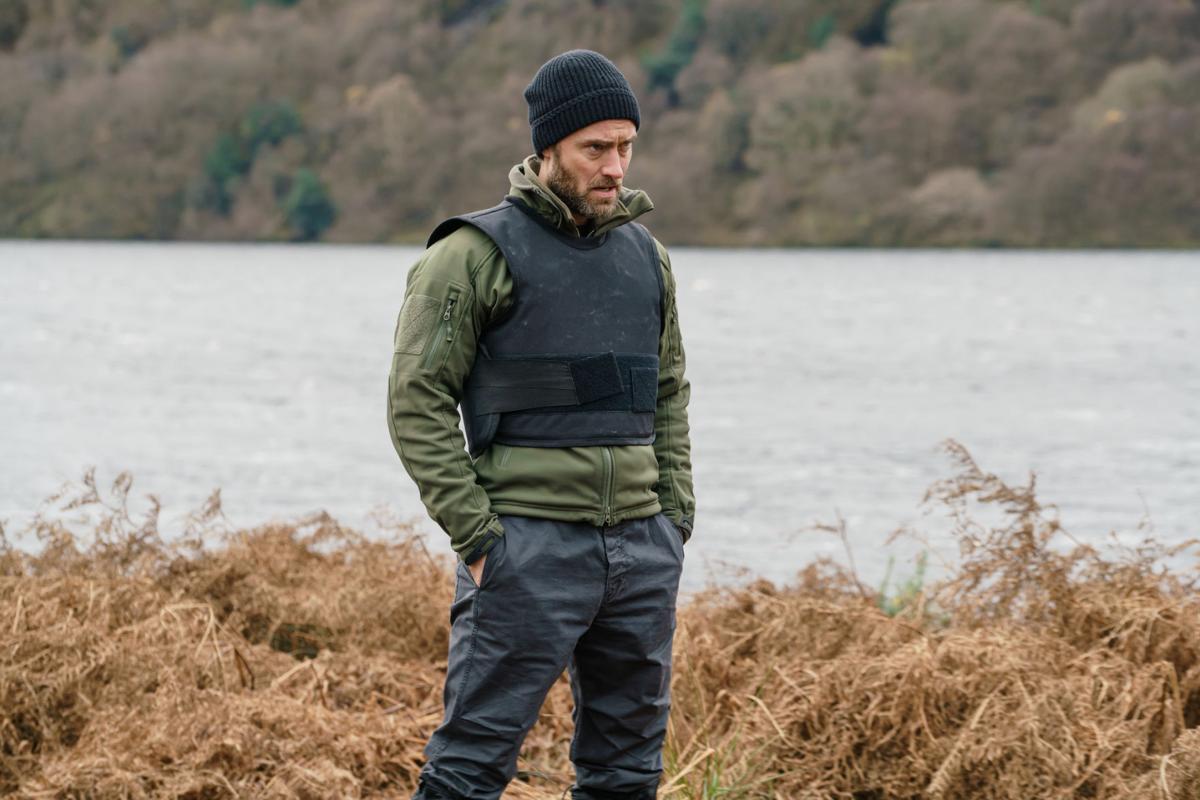
Proctor lets Stephanie crash at his flat, where she researches all of his findings while he's out and sees the bomb maker was a currently-enrolled college student named Mohamed Reza (Tawfeek Barhom). She buys a gun (along with some heroin), goes to the university, looks around for a few seconds, finds him in the student union and stares him down, but she's unable to pull the trigger. A spooked Reza and his two associates walk off with her backpack, and by the time she gets back to Proctor's flat, his research is destroyed and he's lying on the bathroom floor with a bullet in his head. After a quick glance at Google Maps on her phone, she manages to pinpoint the exact location of "B" (Jude Law), the mysterious ex-MI6 agent who's been doing the intel for Proctor. She travels by bus and then hoofs it to B's isolated cottage in the middle of Scottish nowhere, where he's been living off the grid since a botched operation got him bounced from the agency. But he's not so off the grid that he doesn't already know that she foolishly confronted Reza and that Proctor is dead as a result. At this point, THE RHYTHM SECTION turns into an espionage and counter-terrorism KILL BILL, with B as a scowling Pai Mei putting Stephanie through a course of tough-love training after some quick FRENCH CONNECTION II detoxing, after which she's ready to be an assassin once she finds her "rhythm section," as B calls it, explaining "Your heart is the drums, your breathing is the bass." This training involves a few laps around the hills, a swim across an ice-cold lake, firing a couple of shots at a practice target and at B while he wears a bulletproof vest, and an impromptu brawl in B's kitchen, after which she knees him in the balls and asks him if wants some tea.
THE RHYTHM SECTION cuts a lot of corners, especially once B informs her that Reza was employed by an elusive terrorist mastermind known as "U-17," and puts her in touch with Marc Serra (Sterling K. Brown), an ex-CIA agent-turned-international assassination broker. Serra believes she's a presumed-dead freelance German hit woman named Petra Reuter, and he has the names of all the people even tangentially-connected to the airplane bombing, sending "Petra" everywhere from Madrid to Tangier to NYC to Marseilles to wipe them all out. The ultimate target is the mysterious "U-17," whose surprise reveal is anything but. It's never plausible for one second that Stephanie can handle herself in this dangerous world, or why Proctor would leave a sketchy, erratically-behaving drug addict in his flat all day while he's out working, even after he catches her taking money from his wallet. It only happens because there's no movie he doesn't leave her alone to raid his files. Also, every time she shows up somewhere, she manages to already be in someone's residence, leaving it a mystery as to how she acquired the necessary stealth skills to break into everything from Kaif's presumably heavily-guarded palace (she's just already there in his dining room) to the second-story Tangier apartment of Lehmans (Richard Brake), the U-17 associate who planted the bomb on the plane, and who's got guys standing outside at the building's only entrance. The film moves fast enough that it hopes you don't ask any questions like this, or like why, in one phone call to B, Stephanie calls him "Boyd," when she--and we--have never been informed of his real name, which he must've told her in a scene that's been cut. There are some OK action sequences, and Morano does pull off a decent CHILDREN OF MEN-style car chase with a bunch of whip-pans to hide the edit points in the "single take" illusion. At the end of the day--and yes, the door is left open for a sequel that's all but certain to never happen unless this ends up being a surprise blockbuster in the Asian market--all THE RHYTHM SECTION really has going for it is a convincingly gritty and extremely committed performance by Lively, who gives it exponentially more than she'll ever get in return, and she had the scrapes, bruises, and broken bones to prove it. There's even three medical professionals credited in the end credits crawl as "Ms. Lively's injury physiotherapists."
THE LAST FULL MEASURE (US - 2020) Written and directed by Todd Robinson. Cast: Sebastian Stan, Christopher Plummer, Samuel L. Jackson, Ed Harris, William Hurt, Peter Fonda, LisaGay Hamilton, Jeremy Irvine, Diane Ladd, Amy Madigan, Linus Roache, John Savage, Alison Sudol, Bradley Whitford, Dale Dye, Ser'Darius Blain, Zachary Roerig, Cody Walker, James Jagger, Richard Cawthorne, Ethan Russell, Bruce MacVittie, Asher Miles Fallica, Travis Aaron Wade, Rachel Harker. (R, 116 mins) An extremely earnest and well-meaning chronicle of the efforts to award a posthumous Medal of Honor to a fallen Vietnam War hero, THE LAST FULL MEASURE wears its heart on its sleeve and you can't fault the nobility of its intentions. Jumping between 1999 and flashbacks to the botched Operation Abilene in the ill-fated 1966 Battle of Xa Cam My on a rubber plantation roughly 30 klicks outside of Saigon, the film doesn't shy away from a deep dive into hagiography in the story of Air Force pararescueman William "Pits" Pitsenbarger (played here by Jeremy Irvine), a Piqua, OH native who was killed in action on April 11, 1966 while treating and rescuing 60 Army infantrymen, then refusing evacuation and staying behind to help the unit defend their position against VC snipers. Because it was an Army operation, the request for a Medal of Honor citation was denied and Pitsenbarger was instead awarded the Air Force Cross. But the men saved by Pitsenbarger, along with retired Air Force Sgt. and fellow pararescueman Tom Tulley (William Hurt) have never given up the fight for his heroism to be properly recognized. The MOH inquiry lands in the lap of ambitious (and, like almost everyone else here, fictional) mid-level Pentagon staffer Scott Huffman (Sebastian Stan), who has loftier goals than sifting through boring paperwork for info about a 33-year-old battle that nobody remembers, and he's practically encouraged by his smarmy boss Carlton Stanton (Bradley Whitford, cast radically against type as "Bradley Whitford") to blow it off and bide his time before pawning it off on someone else.
But Huffman proceeds with at least pretending to give a shit, his obvious ambivalence to the assignment earning the derisive scorn of Tulley as well as the Cam My survivors he tracks down to half-heartedly interview (their stories are intercut with combat flashbacks to that fateful day), all of them embittered and shattered from the horrors they experienced and witnessed: Jimmy Takoda (Samuel L. Jackson), Ray Mott (Ed Harris), and Jimmy Burr (the late Peter Fonda, in his last film), the latter with a bullet still lodged in his head and suffering from PTSD so intensely debilitating that he carries a loaded shotgun at all times and sleeps during the day because he remains terrified of the darkness of night. A pencil pusher and company man who seems to demonstrate no understanding of the sacrifice these men have made, Sanford inevitably comes around to seeing the light, feeling their pain, and legitimately caring about the legacy of Pitsenbarger, especially after he meets his elderly parents, Alice (Diane Ladd) and Frank Pitsenbarger (Christopher Plummer), who's terminally ill with cancer and wants nothing more than to see his son properly honored before he dies.
It's doubtful you'll find a film in 2020 with more honorable intent. This was a longtime passion project for writer/director Todd Robinson (who previously directed Harris in the instantly-forgotten, low-budget submarine thriller PHANTOM), who spent 20 years trying to get it made before production finally began in 2017 (Roadside Attractions, Lionsgate's art house division, has been sitting on this for a while). Pitsenbarger's story could've been told without resorting to melodramatic embellishment, like the invoking of an actual friendly fire incident during the two-day battle that the film uses to lend credence to a generally debunked conspiracy theory that Pitsenbarger was denied the Medal of Honor because of potential embarrassment it would inflict on the US Army, not to mention the presidential aspirations of a fictional senator (Dale Dye) who, in the context of the film, was one of the architects of Operation Abilene. The dramatic license taken with this plot tangent certainly necessitates nearly everyone--the exceptions being Pitsenbarger, his parents, and Linus Roache as Clinton-era Air Force Secretary Whit Peters--being composite characters or whole cloth fictional creations "inspired" by actual participants. The best parts of THE LAST FULL MEASURE are provided by a stacked cast of national treasures and one ageless living legend in the always-magnificent Plummer, who's just heartbreaking when Mr. Pitsenbarger looks out of his son's bedroom window, recalling when he was just a boy, and saying "Sometimes I can still see him out there mowing the lawn." Jackson, Harris, Hurt, and Fonda are all granted time in the spotlight to work their magic, their characters haunted by memories of war and the sacrifice Pitsenbarger made to save them. When these guys are onscreen, as opposed to the bland Stan's uninteresting Sanford, THE LAST FULL MEASURE is often gut-wrenchingly powerful. That's especially true for Jackson, who gets a great monologue about coming home from Vietnam only to have the locals call him a "baby-killer," and Fonda, who goes out with a marvelous farewell performance as a broken man who's been absolutely unable to psychologically function in any capacity since the day Pitsenbarger saved his life.
Peter Fonda (1940-2019)
There's enough real drama in this story that it shouldn't have been difficult to avoid the fictionalization and the unfortunate second half turn toward the maudlin and overwrought. That begins right around the time Sanford travels to Vietnam to find another Cam My survivor (THE DEER HUNTER's John Savage), who stayed behind and turned the battle site into a CGI butterfly-filled memorial of prayer and reflection in a ridiculously long sequence that looks like an outtake from an apparent John Savage self-help meditation video. It's not long after that when Hurt's otherwise solid performance is completely derailed by a ludicrously melodramatic, saliva-spewing survivor's guilt breakdown that has him slobbering all over the Vietnam Veterans Memorial. Characters start giving speeches as the inspirational score swells and tugs at the heartstrings, and no matter how sincerely it's delivered, not even a great actress like three-time Oscar-nominee Diane Ladd is capable of selling florid dialogue like "Talking about Bill is one of the greatest joys of our life...keeping him alive keeps us strong...it's how we balance our grief and live a happy life without him." And around the time Pitsenbarger gets his posthumous Medal of Honor and Whitford's loathsome prick character has his come-to-Jesus moment and is shown leading the ovation with a slow clap (are we still doing this, Hollywood?), you might ask yourself why Robinson is so determined to sabotage a generally credible movie with this kind of mawkish, pandering horseshit. For most of its duration, THE LAST FULL MEASURE is a terrific showcase for some great actors, and if you're a fan of Peter Fonda, you'll be hard-pressed to not get a little choked-up at his last scene (fittingly, the film is dedicated to him). In the end, even with the second-half stumbling and bumbling (it was nice to see Savage on the big screen again, but his whole section is a momentum-killer that should've been left on the cutting room floor), it's a suitably effective--and refreshingly non-jingoistic--man-weepie that dads and grandpas will love, and I can't help but wonder if it's in theaters now so the Blu-ray will make a great Father's Day gift in June.
GRETEL & HANSEL (Canada/US - 2020) Directed by Osgood Perkins. Written by Rob Hayes. Cast: Sophia Lillis, Alice Krige, Samuel J. Leakey, Jessica De Gouw, Charles Babalola, Beatrix Perkins. (PG-13, 87 mins) With a comfortable enough distance from the movie industry's inexplicable fixation on all things Hansel & Gretel back in 2013 (the big-budget bomb HANSEL & GRETEL: WITCH HUNTERS, the Asylum knockoff HANSEL & GRETEL, and the stoner-themed HANSEL & GRETEL GET BAKED), the Brothers Grimm fairy tale has returned to the big screen in GRETEL & HANSEL, a revisionist take from director Osgood Perkins. The son of PSYCHO star Anthony Perkins and photographer Berry Berenson, the LEGALLY BLONDE actor-turned-filmmaker specializes in the slowest of slow-burn horror, and over the course of his two previous films--the 2016 Netflix original I AM THE PRETTY THING THAT LIVES IN THE HOUSE and 2017's THE BLACKCOAT'S DAUGHTER--he's carved his own niche in the genre, much like HEREDITARY and MIDSOMMAR director Ari Aster. But that comes with a caveat: the term "slow-burn" really doesn't appropriately convey just how glacially-paced an Osgood Perkins film can be. PRETTY THING's biggest coup was Perkins coaxing longtime family friend Paula Prentiss out of retirement, but the film is almost too slow for its own good, with shots so static and quiet that, at times, it comes off like a series of still-life portraits with intermittent narration. It's almost as slow and almost as quiet, but THE BLACKCOAT'S DAUGHTER, on the other hand, is a profoundly unnerving experience that, to quote myself, "will fuck you up for days after seeing it," and is one of the very few horror movies of recent years that I found legitimately scary and disturbing. But while PRETTY THING is technically Perkins' chronological "debut" as a director, BLACKCOAT was actually made first (under the title FEBRUARY), with A24 leaving it on the shelf for a couple of years while they figured out how to market it. Oddly, it's BLACKCOAT that plays more like the work of an assured filmmaker who's gained some confidence in what he's trying to accomplish, while PRETTY THING feels like more of a stunt that borders on the experimental.
Though he didn't write GRETEL & HANSEL (the script is by British screenwriter Rob Hayes), it's very much in Perkins' wheelhouse with its focus on a female protagonist and its extremely deliberate pacing that emphasizes atmosphere and mood over in-your-face scares. The switching of the name placement in the title is the obvious giveaway that this is going to be a significantly different interpretation of the Brothers Grimm, and in it, we get 16-year-old Gretel (Sophia Lillis of IT and HBO's SHARP OBJECTS) forced to take care of her tag-along younger brother, eight-year-old Hansel (Samuel J. Leakey). Plague and pestilence have ravaged the land, their father has disappeared, and their desperate, distraught mother is losing her mind. Independent-minded Gretel has trouble accepting things that are expected of her as a young woman--she refuses her mother's demand to join a convent, and her attempt to find employment at the manor of a leering, drunkard nobleman quickly goes south when the first question in the extremely uncomfortable job interview is if her "maidenhood is still intact." Starving and with no hope, their mother sends them off on their own, but not before imploring Gretel to dig a grave for her. They're briefly tutored in the ways of survival by a stern but sympathetic huntsman (Charles Babalola), and soon happen upon a lonely house deep in the foreboding forest, with a glance through a window revealing a seemingly boundless feast waiting inside. Also inside is the mysterious Hilda (great to see Alice Krige once again getting a showy role that's up there with her work in 1981's GHOST STORY and as the Borg Queen in 1996's STAR TREK: FIRST CONTACT), who possesses supernatural abilities and sees a kindred spirit in Gretel.
Lillis' IT notoriety is probably the main reason GRETEL & HANSEL is getting a nationwide rollout in a move that might cause you to incorrectly assume it's another multiplex audience-alienating A24 release rather than one from the reactivated Orion, now a niche division of MGM under the United Artists banner. Yes, the jump-scare horror crowd and IT superfans are probably gonna hate this (and yes, I'm linking film critic Jason Coffman's essential 2016 "gatekeepers" piece once again, because it still holds true), but those going into it possessing a familiarity with Perkins' work will find it to be ambitious, highly symbolic, metaphorically rich, and visually intoxicating. Working with cinematographer Galo Olivares (a camera operator on Alfonso Cuaron's ROMA) and production designer Jeremy Reed (a collaborator on I AM THE PRETTY THING THAT LIVES IN THE HOUSE), Perkins creates a world of folk horror that's hypnotic on an almost Panos Cosmatos level throughout. The Kubrickian shot compositions in the rarely-utilized 1.55:1 aspect ratio (after a prologue in 2.35), the emphasis on triangular shapes, disorienting camera angles, eerie glimpses of robed figures in the fog, giallo-inspired colorgasms, recurring Perkins motifs like mirrors and insidiously subtle rumblings in the sound mix, and the synth-driven electronic score by "Rob" (French composer Robin Caudert, who worked on the MANIAC remake and REVENGE) that invokes the sounds of Goblin, Tangerine Dream, John Carpenter, and Sinoia Caves, all combine to make GRETEL & HANSEL an often vividly surreal experience. Granted, it's one that will try the patience of viewers whose tastes lean more toward the mainstream but will certainly appeal to those who have logged significant time off the beaten path with eccentric genre outliers. And while it might not fall under the parameters of a modern-era "jump scare," Hilda's first appearance is a near pants-shitter.
The Panos Cosmatos comparison is an important one, and even beyond the sequence where Gretel and Hansel eat some special mushrooms, there are several bits here that recall that sort-of trippy, otherworldly, almost out-of-body feel of BEYOND THE BLACK RAINBOW and MANDY, with some imagery looking like it could've conjured from the lyrics of a black metal concept album by Jethro Tull. And with a setting that's more than slightly reminiscent of Robert Eggers' THE WITCH, it's debatable that the obvious influences here might work to Perkins' slight detriment (I'm also willing to bet he's an EYES OF FIRE fan). Sometimes, the film feels like his auteurist designs are being filtered through some movies he's seen and liked over the last few years. And the abrupt third act--which manages to make the film seem both too long and too short at the same time--has the faint whiff of compromise to it, like somebody at MGM told the minimalist filmmaker "You need some special effects here." Mind you, these are, at most, very minor gripes. There's been some chatter that this is a "woke" take on the Brothers Grimm, but that's a tired buzzword that does the film a disservice. It has a decidedly feminist point of view, and Lillis does a great job of conveying Gretel's fury with all of the bullshit women have had to deal with forever, like the sexual harassment by the creepy, lip-smacking nobleman, or being told she should "smile more," offering biting social commentary in the guise of a surreal and unsettling period horror tale. You'll either connect with GRETEL & HANSEL or you won't--as with PRETTY THING and BLACKCOAT'S DAUGHTER, there's no middle ground. But if you've been intrigued by Perkins' work thus far, this is one that you really should see on a big screen. And you should probably do so sooner rather than later because it's not gonna be there very long.
Drably-shot and about as polished as someone's first DIY effort funded by successfully talking their dad into cashing out his 401k, the dreary, amateurish, and cheap-looking BEYOND THE LAW marks a reunion of sorts for Steven Seagal and DMX, the duo previously headlining 2001's EXIT WOUNDS, one of Seagal's last gasps of box office success. "Reunion" might be stretching it, since they don't have any scenes together here, making it quite possible that Seagal has no idea that DMX--or for that matter, Steven Seagal--is even in BEYOND THE LAW. Both have supporting roles, with the real star being Johnny Messner (returning for more Seagal duty after 2016's THE PERFECT WEAPON) as Frank Wilson, an alcoholic ex-cop who we can assume played by his own rules. He goes on a rampage of revenge after his son falls in with the wrong crowd and is killed by Desmond Packard (one-time Uwe Boll semi-regular Zack Ward, further away than ever from A CHRISTMAS STORY's Scut Farkus), the sniveling, dirtbag son of former crime boss-turned-legit businessman--and lemme check and make sure I get this name right--Augustino Finn Adair, played by a cigar-sucking Seagal with his usual N'awlins accent and total indifference to the proceedings. BEYOND THE LAW then turns into a DIPSHIT JOHN WICK--only with a slovenly drunk as its vigilante killing machine--as Wilson goes after Desmond, who's also mounting a challenge to topple his father and restart his old criminal empire (and we know Desmond is intense because he constantly flicks his Zippo while glaring menacingly), a plan probably egged on by his old man trying to tell him to straight up his act and muttering "I feel like I'm talking to a retarded child."
In his first film since spending a year in prison for tax fraud, DMX periodically turns up as Munce, the detective supposedly investigating the murder of Wilson's son (of course admonishing the enraged father with "Look, you're not a cop anymore!") but secretly on Desmond's payroll before he gets the clumsiest death scene since Michael Madsen in BLOODRAYNE. Written by DTV vet Chad Law (DRIVE HARD, CLOSE RANGE, JARHEAD 3) and director James Cullen Bressack (13/13/13 and some other very low-budget Asylum and Unearthed Films horror indies), who also throws in some incongruous jump scares when Wilson keeps imagining seeing his dead son, BEYOND THE LAW leaves no cliche untouched. You get B-movie drinking game staples like Wilson yelling "This ends tonight!" and Munce telling Wilson "You're not an easy man to find," to which Wilson mutters "Sometimes when you can't find a man, it's because he don't wanna be found," a philosophy that must explain Johnny Messner continuing to appear in modern-era Steven Seagal movies. But there's also some real head-scratchers, like Munce getting angry with Desmond because he's never seen GREMLINS ("It's a classic!") and--again, lemme make sure I get this name right--Augustino Finn Adair mumbling to his chief flunky that a meeting with a new "supplier" has to be postponed a day because "I gotta clean up my house." The kind of movie where someone in a bar orders a vodka shot and gets it in a regular-sized red plastic Solo cup because real shot glasses apparently weren't in the budget, BEYOND THE LAW might succeed in fooling some casual Seagal fans who haven't seen anything he's done since HALF PAST DEAD into thinking it's a belated sequel to ABOVE THE LAW upon a cursory glance at the Redbox kiosk. It also shamefully wastes veteran character actor Bill Cobbs as Wilson's fatherly friend, and DEATH WARRANT's Patrick Kilpatrick appears in a thankless role as a bouncer. (Unrated, 90 mins)
I SEE YOU (UK/US/UAE - 2019)
It's surprising that Saban Films didn't give I SEE YOU any kind of a push beyond an ambivalent VOD release. Maybe it's a little too much of a slow-burner for the multiplex, but it's filled with so many twists and turns and rugs being pulled out from under the viewer that you just know it's desperately hoping you don't question its implausibilities until it's over. It's best to go into this knowing as little as possible, but the basic set-up goes like this: in a greater Cleveland suburb, two young boys have gone missing in the woods, with the opening scene showing the second kid seemingly yanked off his bike by an unseen force. The focus shifts to an upper-class neighborhood and the Harpers, a well-to-do family fraught with the kind of simmering tension we haven't seen since HEREDITARY. Therapist mom Jackie (Helen Hunt) is popping pills and trying to repair the damage caused by a brief recent affair. Teenage son Connor (Judah Lewis) is bitter and resentful and wants nothing to do with her, and husband Greg (Jon Tenney) is dividing his time between the couch and the guest room and isn't quite ready to forgive her. Greg's preoccupied, however, since he's the lead detective in the disappearance of the two kids. Evidence is found in the woods that indicates a copycat of a case several years earlier where local boys were targeted by a now-incarcerated pedophile whose victims described him living in "a magic house that disappears." Strange things have been happening in the Harper house: the TV turns itself on, all of their silverware disappears, photos are missing from frames, and when Jackie returns home to find a repairman in the house, he claims a very polite young girl let him in.
At just around the midpoint, director Adam Randall (the British Netflix acquisition iBOY) and first-time screenwriter Devon Graye (an actor probably best known for playing the teenage DEXTER in flashbacks during the show's first two seasons and was later The Trickster on The CW's THE FLASH) deploy their first major twist, and from then on, you never know what to expect with I SEE YOU. It seems like it's not going to stand up under scrutiny, but there's always something happening that shifts your loyalties or puts things in a new perspective that you never saw coming. Yeah, maybe that one bit hinges on a garage door taking an improbably long time to close, but these are hiccups that you just have to roll with, because every time Randall and Graye make a decision that seems like too big of a leap, they manage to steady the ship, almost like they sense your incredulity and are saying "No, wait...just hear us out!" I SEE YOU doesn't go for jump scares and its bigger concern is a slowly mounting sense of eerie dread and unease, but at the same time, it's surprising that Saban didn't even try to sell it. It might've had potential to be a small word-of-mouth sleeper hit like SEARCHING, and it's got an Oscar-winning headliner in Hunt. I SEE YOU is a film that has to be taken on its own terms, and no matter how preposterous it gets on occasion, it's surprisingly effective and often genuinely chilling. (R, 98 mins)
THE COURIER (US/UK - 2019)
THE COURIER is the kind of dumb thriller that feels the need to accompany an aerial shot of an illuminated Tower Bridge at night with the caption "London, United Kingdom," and soon follows it with an establishing shot of the Washington Monument with the caption "Washington D.C." The opening credits play over quick shots of newspaper headlines that can't settle on whether its main villain is named "Manning" or "Mannings." It's also apparently the kind of movie that Gary Oldman does now, despite winning an Oscar for 2017's DARKEST HOUR, a title that, in retrospect, seems depressingly prophetic considering his 2019 had him in the unwatchable "support group for assassins" comedy KILLERS ANONYMOUS, the possessed yacht horror trifle MARY, and now THE COURIER, a straight-to-VOD DIPSHIT DIE HARD IN A PARKING GARAGE. Sporting a scarred face and an eye-patch like he took a wrong turn on his way to playing the bad guy in a JOHNNY ENGLISH sequel, Oldman puts in a couple of days work as powerful and bizarrely-accented NYC real estate mogul Ezekial Manning(s), who's under house arrest in his luxury penthouse overlooking Central Park while facing charges of fraud and murder, the latter witnessed by lowly office worker Nick Murch (Amit Shah) during Manning(s)'s last trip to London. Murch is under Interpol witness protection and en route to a secret location in London to give video testimony to a hearing in DC when the independently-contracted courier (Olga Kurylenko) hired to deliver the video link is ambushed by the agents, who are secretly on Manning(s)'s payroll with a plot to kill Murch and frame The Courier.
Or, make that "Courier? COUUURRRRRIIIIERRRR?!!!" as psycho Interpol agent Bryant (THE CHRONICLES OF NARNIA's William Moseley, who's matured into an unbelievably terrible actor) keeps tauntingly calling her Luther-from-THE WARRIORS-style, adding other creative bon mots like "Run, rabbit, run!," "Come out, come out, wherever you are!" and "FFFFUUUUUUUCCK!" when the Courier gets the upper hand and takes it upon herself to keep Murch alive and take out the rogue agents one by one in a closed-off parking structure (it somehow took four screenwriters to come up with this shit), forcing Bryant to repeatedly call Manning(s) and inform him the job still isn't done. THE COURIER is just dull, predictable, and brain-dead from the start, and Kurylenko is a capable action star who deserves better material than the leftover table scraps of Milla Jovovich and Noomi Rapace. Dermot Mulroney also pulls some Bruce Willis duty, glowering and pacing around an office as a CIA honcho who may or may not be trustworthy (SPOILER: he's not). And then there's Oldman, who spends almost all of his screen time in one or two rooms of Manning(s)'s posh apartment, ordering the hapless Bryant to "Finish this!" while periodically doing some PROFESSIONAL-inspired shouting at his Ivanka-like daughter (Calli Taylor) and looking at his phone, perhaps waiting for his agent to call with something better than THE COURIER. (R, 100 mins)
THE TURNING (US - 2020) Directed by Floria Sigismondi. Written by Chad Hayes and Carey W. Hayes. Cast: Mackenzie Davis, Finn Wolfhard, Brooklynn Prince, Joely Richardson, Barbara Marten, Niall Gregg Fulton, Denna Thomsen, Kim Adis. (PG-13, 95 mins) Many of pop culture's most effective and familiar ghost story tropes can be traced back to Henry James' 1898 novella The Turn of the Screw, the chilling tale of a prim, proper, and--through as much suggestion as standards of the period would allow--sexually-repressed governess put in charge of two orphaned children in a gothic mansion which may or may not be haunted by the ghosts of the previous governess and the sinister groundskeeper. The story has inspired an untold number of horror novelists and short story writers and has been been adapted for stage, screen, and television dozens of times. The most famous, of course, is Jack Clayton's 1961 classic THE INNOCENTS, with Deborah Kerr as the governess. That was followed by a 1974 TV-movie from DARK SHADOWS creator Dan Curtis and starring Lynn Redgrave; a 1992 version with Patsy Kensit; 1999's Spanish-made PRESENCE OF MIND with Sadie Frost; as a 2000 PBS production with Jodhi May; 2006's IN A DARK PLACE with Leelee Sobieski; and as a 2009 BBC production with a pre-DOWNTON ABBEY Michelle Dockery (and while not a direct adaptation, Alejandro Amenabar's 2001 film THE OTHERS, with Nicole Kidman, owes a tremendous debt to The Turn of the Screw). Not only is James' story always the source of serious chills down the spine, but the governess role is a strong, complex, and multi-layered one for any actress to tackle, so much so that screen legend Kerr often cited her work in THE INNOCENTS as her best performance, and it wasn't even one of six for which she was Oscar-nominated.
The latest film to tackle James' renowned novella is the misbegotten THE TURNING, which moves the story to 1994--with an early shot of a TV showing breaking news of Kurt Cobain's suicide--apparently for no reasons other than fetishized nostalgia and the idea that even The Turn of the Screw needed to be revamped in order to pander to the AMERICAN HORROR STORY/STRANGER THINGSification of today's horror, right down to the presence of IT and STRANGER THINGS co-star Finn Wolfhard as one of the orphaned children. The 1994 setting probably seemed like a wink-and-a-nudge from director Floria Sigismondi, directing her first feature film since 2010's THE RUNAWAYS and who's best known for her music videos for David Bowie, Marilyn Manson (she directed the video for "The Beautiful People"), Tricky, Bjork, Fiona Apple, and The White Stripes, and in more recent years, Pink, Katy Perry, Justin Timberlake, Rihanna, and Dua Lipa. Sigismondi clearly has stylistic chops and a good reputation in her field in order to land so many high-profile gigs in the music industry, but THE TURNING just doesn't work. The script by twin horror scribes Chad and Carey W. Hayes (still dining out on the two CONJURINGs, while hoping we forgot they penned $3 Big Lots DVD rack fixtures like the Paris Hilton HOUSE OF WAX, THE REAPING, and WHITEOUT) is content to recycle every hoary horror cliche of the modern era, while attempting to give some contemporary subtext that it introduces in a half-assed fashion and almost instantly abandons. There's enough sexual overtones to James' story that a modern update (or modern-ish, if we consider the grunge-era setting, with songs not from that era but rather, current alt-rock throwbacks like Warpaint, The Kills' Alison Mosshart, and Soccer Mommy) could've been an insightful commentary on #MeToo and #TimesUp, but after laying the groundwork for such a topic, the filmmakers don't do anything with it and instead opt to move on to the next tired jump scare, as if Sigismondi suddenly remembers (or was reminded) that she's contractually obligated to deliver a PG-13 film.
Set for release in February 2019 and shelved for nearly a year until a weekend could be found for a slightly more appropriate January dumping, THE TURNING uses enough of James' source work but also tries to split the difference with the little-remembered 1972 film THE NIGHTCOMERS, a prequel to THE INNOCENTS before the term "prequel" entered the moviegoing lexicon. Freed from the cinematic restraints of just a decade earlier, THE NIGHTCOMERS enjoyed the relatively new freedom of the R rating in its INNOCENTS origin story about the previous governess Miss Jessel (Stephanie Beacham) and her sweaty, sadomasochistic sexcapades with groundskeeper Quint, played by Marlon Brando just before his triumphant GODFATHER comeback. THE NIGHTCOMERS is essentially INNOCENTS fan fiction that erases the mystery and ambiguity of the older film's much-debated ending and again, subtly incorporating those sexual aspects could've taken THE TURNING to some intriguing places. In the governess role, Mackenzie Davis is Kate, a college student who takes a job as a live-in teacher for seven-year-old orphan Flora (THE FLORIDA PROJECT's Brooklynn Prince) at a massive gothic estate in an isolated region of the Pacific Northwest. Devoted and judgmental housekeeper Mrs. Grose (Barbara Marten) is an obvious keeper of dark secrets who insists Flora never leave the grounds, and claims to not know what happened with previous teacher Miss Jessel (Denna Thomsen), or how her mysterious "disappearance" relates to the accidental death of Quint (Niall Greig Fulton). It isn't long before Kate starts hearing strange voices, creaks, and moans in the middle of the night and catches glimpses of faces that look like they might be Miss Jessel and Quint. But instead of leaving, she sticks around. She feels a duty to help young Flora, and while she didn't lose her parents in a tragic car accident like the little girl did, she understands the notion of a rough childhood after her father walked out on her and her psychologically-disturbed mother, who's now in a mental institution. In what's really THE TURNING's sole inspired decision, Kate's mother is played in two brief scenes by Joely Richardson, making her yet another member of the Redgrave acting dynasty to appear in an adaptation of the story: her aunt Lynn Redgrave starred in the aforementioned 1974 TV-movie, her uncle Corin Redgrave appeared in the 2009 BBC version, and her grandfather Michael Redgrave played the cold-hearted uncle who hired Kerr's governess to care for his niece and nephew in THE INNOCENTS.
Complicating matters is the unexpected arrival of Flora's older, teenage brother Miles (Wolfhard), who's been expelled from boarding school after violently attacking a classmate (of course, Mrs. Grose refuses to believe it, since both children are "thoroughbreds"). Miles immediately antagonizes Kate and undermines the bond she's formed with Flora, and she even wakes in the middle of the night to find him standing over her and caressing her. One of the main ideas of James' novella and THE INNOCENTS was the governess' belief that the spirits of Miss Jessel and Quint were attempting to possess the children in order to continue their secret relationship. But it's never really a certainty that these ghosts exist and there's significant evidence that the governess is projecting her own neuroses and psychosexual hang-ups on to the children. Having a teenage, hormonal Miles demonstrate some leering designs on Kate--if indeed he's possessed by Quint--is an example of THE TURNING potentially updating James with contemporary relevance. But every time it even flirts with any story element of that sort, it backs off and takes the safe route, with more rote jump scares, extended dream sequence fake-outs that only seem to be there to pad the run time, a brief sojourn into AMITYVILLE HORROR/ "we need to get out of this house!" territory with the enraged ghost of Quint going on an estate-wide rampage, and finally, the lamest non-ending to a horror movie since THE DEVIL INSIDE sent the audience to a web site to see how things panned out. Attempts at ambiguity can't work when there's no subtlety to the story and no underlying themes on which to build it. THE INNOCENTS remains one of the most terrifying of horror films, and those shots of the ghostly Miss Jessel standing on the lake in the distance are still the stuff of nightmares. By contrast, THE TURNING is a film that can't even be bothered to come up with a cliched twist ending and instead just abruptly peaces out, dumbing down THE INNOCENTS and Henry James into a pointless post-Blumhouse jump-scare machine with a fundamental misunderstanding of the source material. Davis essays her role with convincing anguish and emerges unscathed, as does the very promising Prince, one of the most natural and unaffected child actors in recent years, and who was so memorable as Moonee in THE FLORIDA PROJECT. They--and everyone else--deserve better than THE TURNING.