THE RHYTHM SECTION (UK/US - 2020) Directed by Reed Morano. Written by Mark Burnell. Cast: Blake Lively, Jude Law, Sterling K. Brown, Max Casella, Geoff Bell, Raza Jaffrey, Richard Brake, Nasser Memarzia, Amira Ghazalla, Tawfeek Barhom. (R, 109 mins) One of the rare non-James Bond projects for Eon Productions (along with recent and little-seen titles like 2017's FILM STARS DON'T DIE IN LIVERPOOL and 2018's NANCY), THE RHYTHM SECTION would appear to be an attempt by producers Barbara Broccoli and Michael G. Wilson (the daughter and stepson of Eon co-founder Albert R. "Cubby" Broccoli) to start another franchise in the 007 vein, this one based on the initial 1999 entry in author Mark Burnell's series of "Stephanie Patrick" espionage novels. But this was a troubled production that started shooting in late 2017 and had to be suspended for six months after star Blake Lively suffered a serious hand injury while working on an action sequence. A disastrous test screening in November 2018 led to a round of re-editing and it was bumped from February 2019 to November 2019, then again to the multiplex netherworld of January 2020, where the $50 million film grossed just under $3 million, giving it the dubious distinction of having the worst-ever opening weekend for a movie bowing on more than 3000 screens. Though it's based on a novel that's over two decades old, it can't help but feel a little familiar after similar ground was recently covered in ATOMIC BLONDE, RED SPARROW, and Luc Besson's ANNA, not to mention Besson's 1990 classic LA FEMME NIKITA, the template for this sort of thing.
This probably shouldn't have opened that wide, and there's been some chatter that Eon, Lively, and cinematographer-turned-director Reed Morano (who won an Emmy for helming the debut episode of THE HANDMAID'S TALE) never could get on the same page in terms of exactly what THE RHYTHM SECTION should be--a commercial action movie or a grim, downbeat revenge thriller--and that indecisiveness is apparent in the released film. It feels like big chunks of it are missing (indeed, Morano said in an interview that she ended up cutting co-star Daniel Mays' entire performance--he's still credited on the IMDb page, along with several others who are no longer in the movie) and it's been whittled down to the bare bones. Logic is tossed out the window almost immediately, and Lively's Stephanie Patrick is put in situations that might fly in a comic-book style scenario like LA FEMME NIKITA or ATOMIC BLONDE but not in something that starts gravely serious and involves the aftermath of a terrorist attack. The globetrotting story opens in Tangier as Stephanie is about to take out her latest target, but then cuts back to eight months earlier, when she was calling herself "Lisa," and was a junkie working in a skeezy brothel in London. Freelance journalist Keith Proctor (Raza Jaffrey) has discovered her true identity and knows her past and what sent her on this path of self-destruction: her mother, father, sister, and brother were killed in a plane crash three years earlier in what was officially declared "mechanical failure." But that was a cover-up and Proctor knows the truth: a bomb took it down, a grandiose radical Islam message sent as part of a plot to assassinate one passenger: the anti-terrorism activist son of wealthy Suleiman Kaif (Nasser Memarzia), who suspected the official story was bullshit and has been funding Proctor's secret investigation.
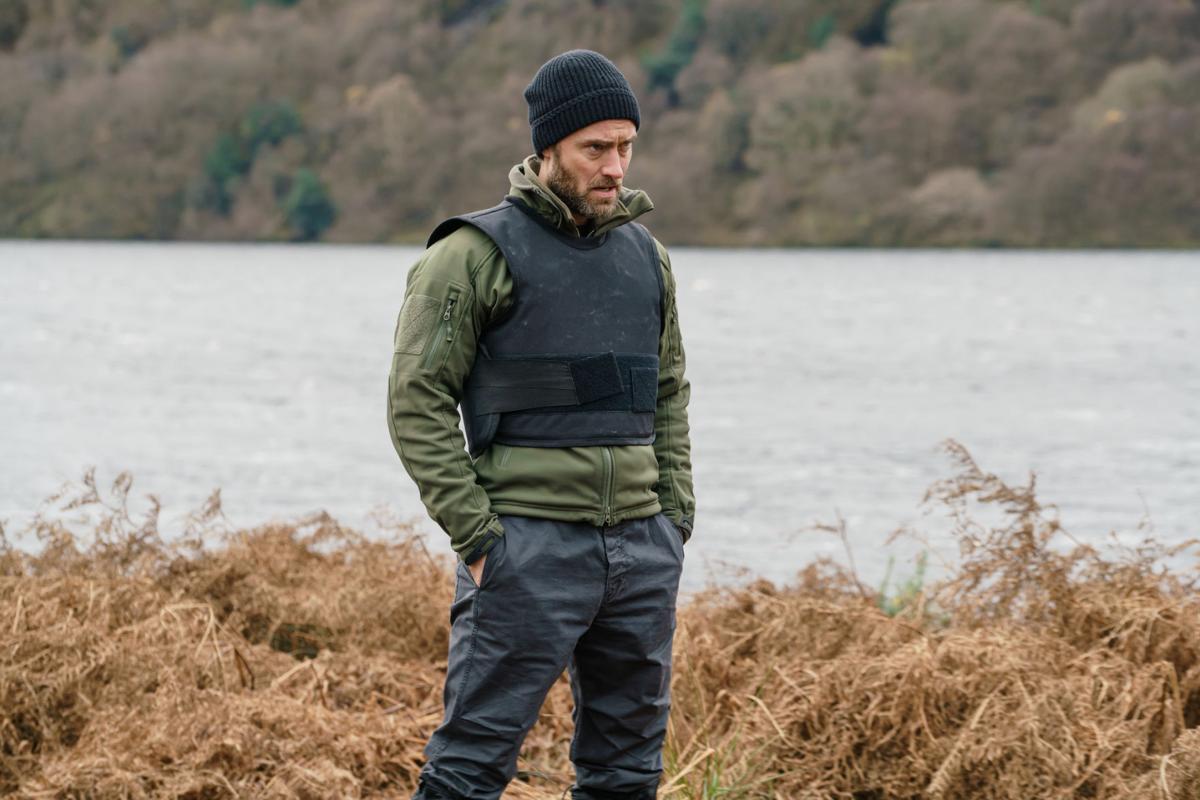
Proctor lets Stephanie crash at his flat, where she researches all of his findings while he's out and sees the bomb maker was a currently-enrolled college student named Mohamed Reza (Tawfeek Barhom). She buys a gun (along with some heroin), goes to the university, looks around for a few seconds, finds him in the student union and stares him down, but she's unable to pull the trigger. A spooked Reza and his two associates walk off with her backpack, and by the time she gets back to Proctor's flat, his research is destroyed and he's lying on the bathroom floor with a bullet in his head. After a quick glance at Google Maps on her phone, she manages to pinpoint the exact location of "B" (Jude Law), the mysterious ex-MI6 agent who's been doing the intel for Proctor. She travels by bus and then hoofs it to B's isolated cottage in the middle of Scottish nowhere, where he's been living off the grid since a botched operation got him bounced from the agency. But he's not so off the grid that he doesn't already know that she foolishly confronted Reza and that Proctor is dead as a result. At this point, THE RHYTHM SECTION turns into an espionage and counter-terrorism KILL BILL, with B as a scowling Pai Mei putting Stephanie through a course of tough-love training after some quick FRENCH CONNECTION II detoxing, after which she's ready to be an assassin once she finds her "rhythm section," as B calls it, explaining "Your heart is the drums, your breathing is the bass." This training involves a few laps around the hills, a swim across an ice-cold lake, firing a couple of shots at a practice target and at B while he wears a bulletproof vest, and an impromptu brawl in B's kitchen, after which she knees him in the balls and asks him if wants some tea.
THE RHYTHM SECTION cuts a lot of corners, especially once B informs her that Reza was employed by an elusive terrorist mastermind known as "U-17," and puts her in touch with Marc Serra (Sterling K. Brown), an ex-CIA agent-turned-international assassination broker. Serra believes she's a presumed-dead freelance German hit woman named Petra Reuter, and he has the names of all the people even tangentially-connected to the airplane bombing, sending "Petra" everywhere from Madrid to Tangier to NYC to Marseilles to wipe them all out. The ultimate target is the mysterious "U-17," whose surprise reveal is anything but. It's never plausible for one second that Stephanie can handle herself in this dangerous world, or why Proctor would leave a sketchy, erratically-behaving drug addict in his flat all day while he's out working, even after he catches her taking money from his wallet. It only happens because there's no movie he doesn't leave her alone to raid his files. Also, every time she shows up somewhere, she manages to already be in someone's residence, leaving it a mystery as to how she acquired the necessary stealth skills to break into everything from Kaif's presumably heavily-guarded palace (she's just already there in his dining room) to the second-story Tangier apartment of Lehmans (Richard Brake), the U-17 associate who planted the bomb on the plane, and who's got guys standing outside at the building's only entrance. The film moves fast enough that it hopes you don't ask any questions like this, or like why, in one phone call to B, Stephanie calls him "Boyd," when she--and we--have never been informed of his real name, which he must've told her in a scene that's been cut. There are some OK action sequences, and Morano does pull off a decent CHILDREN OF MEN-style car chase with a bunch of whip-pans to hide the edit points in the "single take" illusion. At the end of the day--and yes, the door is left open for a sequel that's all but certain to never happen unless this ends up being a surprise blockbuster in the Asian market--all THE RHYTHM SECTION really has going for it is a convincingly gritty and extremely committed performance by Lively, who gives it exponentially more than she'll ever get in return, and she had the scrapes, bruises, and broken bones to prove it. There's even three medical professionals credited in the end credits crawl as "Ms. Lively's injury physiotherapists."
After the perfectly acceptable HUNTER KILLER tanked in theaters last fall, I said to a friend "Other than the next entry in the HAS FALLEN series, Gerard Butler's probably headed to VOD going forward." Cut to a little over two months later, and not only was Butler's next movie bowing on VOD, but it was also given an ignominious first-weekend-of-January dumping on top of it. Shot in 2017 as KEEPERS, THE VANISHING (not to be confused with two previous George Sluizer thrillers with the same title) isn't one of Butler's formulaic action vehicles, but it does find the star (and one of 28 credited producers) in Serious Actor mode in the vein of the underseen MACHINE GUN PREACHER. Inspired by the 1900 "Flannan Isle Mystery," where three lighthouse keepers disappeared without a trace from a distant island off the coast of Scotland, THE VANISHING moves the setting to the 1930s and proceeds on pure speculation. The film could've gone in any number of directions--theories of the disappearance range from one of the three men going insane and killing the other two; a sea serpent; and an even an alien abduction--but it opts for a character-driven mash-up of THE TREASURE OF THE SIERRA MADRE and Danny Boyle's breakthrough SHALLOW GRAVE with a bit of a John Carpenter siege scenario for a little while.
Arriving on Flannan Isle for a six-week stint of running the lighthouse and other various maintenance duties, boss Thomas Marshall (Peter Mullan), James Ducat (Butler), and young apprentice/good-natured hazing target Donald McArthur (newcomer Connor Swindells, currently on Netflix's SEX EDUCATION) find their dull routine broken up one morning by the appearance a crashed boat and a body washed ashore on the rocks below. Donald is lowered down to check him and even though he says the man (Gary Kane) isn't breathing, he comes to and attacks Donald, who then bashes his head in with a rock in self-defense. In the crashed boat is a locked trunk that Thomas opens to discover it's filled with an untold fortune in gold bars. James and Donald think they've struck it rich, but Thomas urges caution, reminding them "Somebody's gonna come looking for this guy." Sure enough, two men, Locke (Soren Malling) and Boor (GAME OF THRONES' Olafur Darri Olafsson), show up on the island and start asking questions. It isn't long before there's two more dead bodies and increasing paranoia over more people coming and a growing mistrust of one another over concerns about making off with the gold and who'll keep their mouth shut about it. Given the speculation about what could've gone down on Flannan Isle in 1900--and to this day, no one knows for sure--THE VANISHING certainly takes an unexpected approach when it could've been just as easy to get a movie about a sea monster or aliens made. It benefits from three strong performances by its stars, particularly Mullan as the conflicted Thomas--considered the likely killer by historians who support the "one man went insane killed the other two" theory--still grieving over the deaths of his wife and daughters (and he won't say how they died). But in the context of the film, it's Butler's James who really cracks up and folds under pressure, which allows the actor to stretch a bit when he's usually the hero. THE VANISHING is worth a look for fans of Butler and the great character actor Mullan (SESSION 9), but the pace is a bit too slow (probably why Lionsgate relegated it to VOD), and it starts stumbling in the home stretch when it really matters most, leading to an abrupt and not-very-satisfying conclusion. (R, 107 mins) VOX LUX (US - 2018)
If Lars von Trier attempted to make his own warped version of A STAR IS BORN and was completely in over his head and absolutely terrible at his job, it would probably come out looking a lot like VOX LUX, the latest from actor-turned-filmmaker Brady Corbet. In his acting days, Corbet paid his dues with stints on 24 and with guest spots in the LAW & ORDER universe, but instead of going the mainstream route, he was driven to take roles in films by provocateurs like von Trier (MELANCHOLIA), Gregg Araki (MYSTERIOUS SKIN), Michael Haneke (the remake of FUNNY GAMES), and Olivier Assayas (CLOUDS OF SILS MARIA). I've not seen Corbet's 2016 directing debut THE CHILDHOOD OF A LEADER, but VOX LUX is a film that thinks it's deep and meaningful, but is really just shallow, exploitative, self-indulgent drivel that feels like the kind of nonsense that VELVET BUZZSAW was trying to lampoon. Corbet may have spent time observing and picking the brains of his auteur heroes, but he doesn't seem to have learned anything from them beyond surface imitation. You know you're in for an ordeal when the film opens with von Trier-esque title cards like "Prelude: 1999" followed by "Act I: Genesis (2000-01)." There's also wry and sardonic narration by frequent von Trier star Willem Dafoe, just like the kind John Hurt provided in von Trier's DOGVILLE and MANDERLAY. In an effectively harrowing opening sequence set in 1999, Staten Island teenager Celeste Montgomery (Raffey Cassidy of THE KILLING OF A SACRED DEER) gets a bullet lodged in her spine when she's the sole survivor of a shooting rampage by troubled outcast and character-name-that-could-only-exist-in-a-shitty-movie-like-this, Cullen Active (Logan Riley Bruner), who mows down her entire classroom, and it's all downhill from there. During her long recovery, after which she's still able to walk as long as the bullet doesn't dislodge, she attends a candlelight vigil and performs a song written by her older sister Ellie (Stacy Martin, who played the young Charlotte Gainsbourg in von Trier's NYMPHOMANIAC) that captures the nation's attention and draws interest from various record companies. She gets a manager (Jude Law), a publicist (Jennifer Ehle), and a choreographer, and soon enough, she's about to become teen pop sensation "Celeste," recording songs in NYC and Europe, and then the sisters are partying hard and hooking up with guys in L.A. in the early morning hours of 9/11, when narrator Dafoe gravely intones "Celeste's loss of innocence curiously mirrored that of the nation."
I would pay to see the look on Willem Dafoe's face when he was standing in the recording booth and was handed that line. It's impossible to take anything VOX LUX offers seriously after that, but at about the midway point, there's a 16-year time jump or, as Corbet (who probably now pronounces it "Cor-bay") puts it, "Act II: Regenesis 2017," where we're introduced to 31-year-old Celeste, and the film achieves the unthinkable and somehow gets even worse. Much of that is due to a career-worst performance by Natalie Portman, who takes over the role while Cassidy now plays her teenage daughter Albertine. Adult Celeste is now a Madonna/Lady Gaga-esque pop culture icon, constantly stalked by the tabloids and addled by booze, drugs, public meltdowns, and other scandals. As she prepares for a sold-out comeback concert at a Staten Island arena, her always-enabling manager (still played by Law, who's pretty much Alan Bates in THE ROSE) informs her that terrorists dressed as the dancers in the music video of one of her early hits have just committed a horrific mass shooting on a beach in Croatia. She has nothing but resentment and scorn for the long-suffering Ellie, who's done most of the heavy lifting both writing her songs for her and raising Albertine. It all culminates in a triumphant performance by Celeste in front of her hometown "angels" in an interminable finale featuring songs by Sia that sound like they came from the bottom of her slush pile. Corbet's ham-fisted, would-be commentary on everything from school shootings to 9/11 to the Price of Fame while feebly trying to emulate von Trier and others borders on outright poseurdom, and while Martin and Cassidy manage to emerge generally unscathed (though Cassidy's British accent slips through quite a bit in the first half), a shrill and over-the-top Portman, stuck playing one of the most grating, off-putting, and aggressively unlikable characters in any movie from last year, is just embarrassingly bad. Check out her overly-affected Noo Yawk screech when she's ranting at Ellie or at restaurant managers or at a journalist (Christopher Abbott), or waxing philosophic over society's ills and "ultra mega triple hi-def TVs" and "our intimate knowledge of the commitment to the lowest common denominator." Barely released by Neon and grossing just $730,000, VOX LUX isn't a serious artistic statement by a bold new voice in filmmaking. It's smug, self-impressed, vacuous bullshit. Can someone tell Brady Corbet that masturbation is usually something done in private? (R, 114 mins)
KING ARTHUR: LEGEND OF THE SWORD (US - 2017) Directed by Guy Ritchie. Written by Joby Harold, Guy Ritchie and Lionel Wigram. Cast: Charlie Hunnam, Jude Law, Eric Bana, Astrid Berges-Frisbey, Djimon Hounsou, Aidan Gillan, Mikael Persbrandt, Neil Maskell, Freddie Fox, Greg McGinlay, Tom Wu, Kingsley Ben-Adir, Peter Ferdinando, Bleu Landau, Annabelle Wallis, Geoff Bell, Poppy Delevingne, Jacqui Ainsley. (PG-13, 125 mins) Already a costly flop and the first bomb of the summer, Guy Ritchie's extremely revisionist, $175 million KING ARTHUR: LEGEND OF THE SWORD is reasonably entertaining if taken strictly--and I do mean strictly--on its own terms. It's an approach not unlike his excellent, steampunkish take on SHERLOCK HOLMES, though not as consistently solid as that or his underrated THE MAN FROM U.N.C.L.E. a couple years back (but it's better than that second SHERLOCK HOLMES movie, which was pretty terrible). Ritchie throws everything but the kitchen sink into his Arthurian world, which is bound to not go over well with purists--indeed, the Three Stooges short SQUAREHEADS OF THE ROUND TABLE might be more faithful to the legend--but it's perfectly acceptable escapism that probably would've done better if released in March or September. John Boorman's EXCALIBUR remains the last word on this subject as far as big screen adaptations go, and I really feel sorry for any corner-cutting junior high and high school students who watch this instead of doing their assigned reading, because giant elephants, snakes, rats, and bats and an Asian martial arts master named "Kung Fu George" are certainly not elements discarded from rough drafts of T.H. White's The Once and Future King or Sir Thomas Malory's Le Morte d'Arthur.
Equal parts early Ritchie crime movies, LORD OF THE RINGS, and GAME OF THRONES, KING ARTHUR: LEGEND OF THE SWORD has King Uther Pendragon (Eric Bana) and Queen Igraine (Poppy Delevingne) being killed in a supernatural, Mordred-abetted uprising instigated by Uther's treacherous younger brother Vortigern (Jude Law). Their toddler son Arthur is put on a small boat and sails into the night, where he's found by the denizens of a brothel and raised in the red light district of Londinium, where he grows into adulthood and is played by SONS OF ANARCHY's Charlie Hunnam. Arthur is unaware of his heritage and lives as a disreputable but affable con man and peacekeeper at the brothel, making sure the prostitutes who raised him aren't abused by the clientele. One such abusive customer is sinister Viking warrior Greybeard (Mikael Persbrandt) who's humiliated by Arthur, the future hero unaware that Greybeard and his soldiers are under the protection of King Vortigern. Vortigern has been rounding up age-appropriate young men all over England and having them herded to his castle to attempt to pull Uther's sword Excalibur from the stone so he can find his nephew. Once Arthur's true nature is discovered, Vortigern tries to have him executed, but he's rescued by a band of rebels led by Bedivere (Djimon Hounsou) and Goosefat Bill (GAME OF THRONES' Aidan Gillan), who have enlisted the help of a nameless mage and protegee of Merlin (Astrid Berges-Frisbey) to defeat the tyrannical and despised Vortigern and enable Arthur to assume his rightful place on the throne.
Fast-moving and frequently amusing, KING ARTHUR: LEGEND OF THE SWORD looks terrific most of the way, with some eye-popping 3-D visuals and the kind of hyperkinetic, flash-forward/flash-back structure that Ritchie used in LOCK, STOCK AND TWO SMOKING BARRELS and SNATCH. He's more or less a big-budget journeyman at this point, but this is the first of Ritchie's hired-gun assignments that actually has significant stretches that, for better or worse depending on whether you're a fan, feel like vintage Ritchie. While mileage may vary as far as one's acceptance of a King Arthur being given snake venom to enhance his vision and perception, or stranded on a de facto Skull Island where he's forced to battle giant snakes and bats to prove his mettle after being trained in combat by the aforementioned Kung Fu George (Tom Wu), the film works as mindless fun most of the way. That is, until Ritchie lets the blurry, quick-cutting shaky-cam take over for the mess of a climactic battle where Arthur finally takes on Vortigern, who's transformed into a demon knight and starts sounding like Dr. Claw from INSPECTOR GADGET. Law is enjoying himself as an appropriately hissable villain, while Hunnam doesn't really have to stretch much outside of his Jax Teller persona, getting to use his natural British accent but faring much better in James Gray's recent THE LOST CITY OF Z. The mage, an obvious reinterpretation of the sorceress Morgan Le Fay (Morgana in EXCALIBUR), functions as a stand-in for the barely-seen Merlin, who here is credited with the forging of Excalibur. Spanish-French actress Berges-Frisbey (ANGELS OF SEX) has an intriguing presence that's reminiscent of a young Isabelle Adjani, while two-time Oscar nominee Hounsou, once again cast in a thankless sidekick role, continues to be arguably the most insufficiently-utilized great actor in Hollywood. The origin story (the Round Table is seen under construction at the end) in what was planned as a six-film series in a Warner Bros. King Arthurverse that's most likely now joined the ranks of THE GOLDEN COMPASS in being whittled down to a series of one, KING ARTHUR: LEGEND OF THE SWORD will exit theaters very quickly but should play well on streaming and on cable for the next decade or more. It's enjoyable and filled with rousing action, but it can't stop itself from stumbling when it matters most. And as entertaining as it is most of the time, the $175 million price tag does seem a tad excessive.
If you're a sucker for claustrophobic submarine white-knucklers, you're gonna love BLACK SEA, a riveting thriller more or less abandoned by Focus, who only rolled it out on 350 screens nationwide in the January dead zone. Directed by Kevin Macdonald (TOUCHING THE VOID, THE LAST KING OF SCOTLAND), BLACK SEA is anchored by an arguably career-best performance by a Scottish-brogued Jude Law as Robinson, an embittered ex-Naval sub commander just handed a paltry severance check after 11 years with a salvage company that's decided it no longer requires his services. Tired of soft guys in suits getting rich off the labor of hard men like himself, Robinson gets drawn into a shady plot where he's promised total autonomy by wealthy benefactor Lewis (Tobias Menzies). The job: venture--undetected and off-radar--deep into the Black Sea in Russian waters to extract millions in gold bars from a Nazi sub that sank in 1941--a sub that Robinson's former employers know about but were unable to salvage because of maritime laws and established boundaries. Seeing the secret operation as the perfect way to get back at his old bosses, Robinson assembles a ragtag crew consisting of Brits and Russians who take an immediate dislike to each other, especially with the increasing paranoia about each screwing the other out its share. There's also Tobin (Bobby Schofield), an 18-year-old who Robinson takes under his wing, and Daniels (Scoot McNairy), a sniveling American pencil-pusher and Lewis flunky who seems overly concerned that Robinson has promised every man onboard an equal share of the take. The operation itself is as ramshackle and rickety as the ancient, rustbucket sub that Lewis supplies, and when tensions rise to the point where hotheaded Brit Fraser (Ben Mendelsohn) stabs and kills Blackie (NIGHT WATCH's Konstantin Khabenskiy)--the only Russian who speaks English--which leads to a brawl that causes an explosion, knocking multiple crew members unconscious and costing them the vessel's drive shaft. Tempers reach a boil and rampant mistrust takes over, leaving them stranded in Russian waters, no one knowing they're down there, and Robinson having knocked out the radio in a earlier fit of rage.
Macdonald's handling of the intense sense of claustrophobia is terrific, and one extended sequence where three of the crew obtain the preserved drive shaft of the Nazi sub and try to take it on a precarious ridge back to their own sub while maneuvering the heavy gold with a tow-line that's about to snap--because they only have enough oxygen for one trip to the Nazi sub and back--could almost be a stand-alone short film and a master class in sustaining suspense in a set piece. Macdonald and screenwriter Dennis Kelly owe a tremendous debt to Clouzot's THE WAGES OF FEAR in this sequence and DAS BOOT--the reference point for submarine thrillers--in many others. You could perhaps term BLACK SEA as a DAS SORCERER of sorts. In a gritty performance that channels Sean Connery or Robert Shaw at their surliest, Law has never been better, creating a well-rounded character who's an honest man and a hard worker, driven to support his estranged young son who he regrets throwing on the backburner for his job. He sees his good qualities reflected in Tobin, who's got a baby on the way with a hook-up he barely knows but is on the job because supporting his kid is the right thing to do. But Robinson is also so blinded by rage about losing his job and his sense of self-worth and he's so overcome by his need to stick it to the rich that he's willing to risk the lives of everyone onboard if it means getting the gold. BLACK SEA is the kind of dark, brooding, edge-of-your-seat, manly-man adventure thriller that they just don't make much of anymore. This never would've been a blockbuster, but it definitely could've been a word-of-mouth sleeper hit. (R, 114 mins) SPRING (US/Italy - 2015)
The directing team of Justin Benson and Aaron Moorhead (Benson also scripts and Moorhead serves as cinematographer) earned some accolades in cult circles for their 2013 meth withdrawal horror film RESOLUTION, which got them a spot with the helmet-cam "Bonestorm" segment of 2014's unwatchable V/H/S: VIRAL. SPRING finds the duo capturing some lovely imagery throughout Italy in a film that looks much more grand and magnificent than its budget would indicate, and Moorhead engineers some impressive aerial tracking shots going from the city to the sea and back again. While SPRING is a huge technical step forward, Benson's script is on the half-baked side, though they admirably demonstrate some patience in holding back the big reveal that this isn't the kind of movie you think it's going to be. Lou Taylor Pucci, a Next Big Thing in indie circles about a decade ago with THUMBSUCKER, THE CHUMSCRUBBER, FAST FOOD NATION, and SOUTHLAND TALES, stars as Evan Russell, a sullen 20-something who dropped out of college to care for his cancer-stricken mother just a few months after losing his father to a sudden heart attack. Needing to get away after his mom's death to clear his head and because the cops are looking to press assault charges on him after a post-funeral bar fight that costs him his bartending job, Evan impulsively takes off to Italy to decompress. He parties with some British tourists and helps out on a farm run by wise old widower Angelo (Francesco Carnelluti), but soon falls head over heels for Louise (Nadia Hilker) who, putting it mildly, has a secret and is not entirely what she seems to be.
I guess if there had to be a reworking of BEFORE SUNRISE with a heaping helping of the supernatural, evolutionary anomalies, Roman mythology, a splash of Lovecraft and a dash of Andrzej Zulawski's POSSESSION, then SPRING is probably as good as it gets. Benson and Moorhead's decision to use mostly practical effects is a welcome one, and the film works best when it's being enigmatic. Once the big shock reveal happens--and it's a great effects moment--SPRING has nowhere else to go and becomes a gabfest with facile metaphors about fear of commitment and loving someone despite their flaws. It wouldn't take much tweaking to turn it into a ridiculous, SPLASH-inspired mumblecore romantic comedy (just imagine "He's looking for the perfect girl. She's half-octopus and needs human DNA. Sometimes you have to catch love before it slithers away!" on the poster art, with their backs against one another with "Get a load of this one here!" expressions on their faces, his thumb aimed at her and her tentacle aimed at him). SPRING isn't nearly as profound and observational as it thinks it is, but there's no denying that it has a pair of excellent performances from Hilker and Pucci, who's matured into a promising second-string Ryan Gosling. SPRING looks great and serves as a wonderful travelogue of Rome and the surrounding area, but the angst mixed with the horror and the fantasy elements and the banality of the central conceit just never really gel. An interesting idea, but not enough to sustain a nearly two-hour film. (Unrated, 110 mins)
This visually striking adaptation of Dostoyevsky's 1846 novella uses the title and the concept of the self, but really ventures off into its own dystopian nightmare black comedy scenario more akin to the likes of George Orwell and Franz Kafka. The retro-futurist production design recalls the drab and bleak worlds of Terry Gilliam's classic BRAZIL (1985) and Orson Welles' Kafka adaptation THE TRIAL (1962). There's also a lot of THE TRIAL in one of two performances by Jesse Eisenberg, who does a remarkable job of channeling Anthony Perkins' Josef K. in his portrayal of meek office drone Simon James. Afraid of his own shadow, Simon is employed by a bureaucratic company called ColLoc and works in a dreary, gray, overcrowded, and oppressively hot office building. He gets hassled by the security guard, who still doesn't recognize him after seven years of employment. His co-workers and his demanding boss Mr. Papadopoulos (Wallace Shawn) rarely seem to notice him and if they do, they get his name wrong ("Stanley!"). Simon would rather keep quiet and look down, and on the rare occasions he considers speaking, he can't get a word out, especially around his cold mother (Phyllis Somerville), who can't even point him out when he's clearly visible in an improbably upbeat ColLoc TV commercial. He secretly pines for co-worker Hannah (Mia Wasikowska), finding excuses to visit her department for painfully awkward interaction or just spying on her through his telescope, as her apartment building is adjacent to his own. Simon's tenuous grip on his world is jeopardized when Mr. Papadopoulous hires James Simon (also Eisenberg), a doppelganger who looks just like Simon but is his opposite in every other way: brash and egotistical where Simon is quiet and withdrawn, James is Simon's id run rampant. His gregarious personality wins over the office. He coasts by on Simon's hard work. He bullies a waitress (Cathy Moriarty) into bringing him breakfast after they've stopped serving while she can't even be bothered to bring Simon a Coke. He seduces Hannah and the boss' daughter (Yasmin Paige) and demands a copy of Simon's apartment key so he can arrange other trysts he wants to keep secret from Hannah ("I'll also be taking other women up there, in case you start noticing different smells"). Obviously, Simon can only be pushed so far.
A cursory glance at some of the names associated with THE DOUBLE guarantees it'll at the very least be an interesting experience. Directed and co-written by comedian, music video director, and THE IT CROWD co-star Richard Ayoade, the film also lists Michael Caine and Harmony Korine among its producers, it's co-written by Korine's younger brother Avi, and in addition to Shawn and Moriarty, its eclectic supporting cast features, among others, James Fox, Noah Taylor, Rade Serbedzija, Chris O'Dowd, and Dinosaur Jr's J Mascis as an irate janitor. THE DOUBLE obviously owes a huge debt to Terry Gilliam and Orson Welles, but it still manages to be a unique and very well-executed bit of paranoia, dark comedy, and bleak misanthropy, anchored by two brilliant Eisenberg performances that play to both of his screen personas and allow him to take them into some dark places. Only released on 16 screens and VOD, THE DOUBLE didn't get much of a push from Magnolia and grossed just $200,000, but it shouldn't take very long for it to become a word-of-mouth cult item. (R, 93 mins)
A GOOD MAN (US - 2014)
For most casual moviegoers, Steven Seagal probably fell off the pop culture radar around 2002, the last time one of his own headlining vehicles (HALF PAST DEAD) made it into theaters. In the years since, his A&E reality series STEVEN SEAGAL: LAWMAN and his jokey supporting turn as a villain in Robert Rodriguez's MACHETE (2010) have alerted the general public to his continued existence, but only hardcore denizens of the DTV gutter know that Seagal's been consistently cranking out a ton of low-budget and mostly terrible actioners, starring in no less than 25 nearly interchangeable straight-to-DVD titles in the 12 years since HALF PAST DEAD served as an unintentionally prophetic description of his big-screen career. Seagal doesn't seem to be well-liked by his peers--he was never invited to take part in any EXPENDABLES entries--and the only time he makes the news now is when he releases a hilariously awful blues album or is seen hanging out with his close personal friend Vladimir Putin. Most of Seagal's DTV titles are thoroughly worthless, with the once-engaging action icon setting new benchmarks in apathy by letting his obvious double handle everything from strenuous fight scenes to simple shots where his back is to the camera and he answers questions by nodding. If you see enough of these, you start to notice that it's frequently only really Seagal if he has a close-up or if it's a two-shot and he's talking, and even then, sometimes the co-star is much shorter and "Seagal"'s head is out of the frame. There were even a few instances in the mid-2000s where his performance was badly dubbed over by someone else for some unexplained reason. Seagal puts the bare minimum amount of work into most of these productions but, like a broken clock being right twice a day, a couple of them have been accidentally decent, like 2009's THE KEEPER and 2010's A DANGEROUS MAN, the latter being better than most of what he had in theaters during his late '90s decline before 2001's EXIT WOUNDS gave him a very brief comeback.
A GOOD MAN is typical of Seagal's straight-to-DVD output. It's hardly the worst of the lot, but that doesn't exactly merit a recommendation. Rather than being aggressively shitty, it's merely predictable and boring, with Seagal as Alexander, codename "Ghost," an ex-covert ops guy living off the grid in "Eastern Europe" (like many of Seagal's movies these days, this was shot on-the-cheap in Romania) after a raid on a Middle East terrorist compound went south two years earlier. Ghost involves himself in the troubles of attractive neighbor Lena (Iulia Verdes) and her kid sister Mya (Sofia Nicolaescu), whose safety is jeopardized by their American half-brother Sasha's (Victor Webster) involvement with Russian mobster Vladimir (Claudiu Bleont). Sasha owes Vladimir a ton of money via a debt accrued by his late father, and Ghost sees this as the perfect opportunity to start a war between Vladimir and terror cell financier Mr. Chen (Tzi Ma, best known for the Coen Bros. remake of THE LADYKILLERS), who was responsible for what went down in the Middle East two years earlier. A GOOD MAN offers everything you expect from modern-day Seagal: the star using a ridiculously affected and completely inappropriate accent, thankfully abandoning his N'awlins drawl of recent years but resorting to an even more ludicrous-sounding hip-hop dialect that sounds like Drexl Spivey after a root canal. This leads to a mush-mouthed Seagal shouting things like "All y'all muthafuckaz," and "I wondah how much pussy he get?" proving that at no point during filming did director Keoni Waxman pull his star aside and remind him that he's 62 years old. There's also the now-standard Seagal fighting style, which consists of being there for the close-ups and sticking his arm out so a bad guy can run into it while Waxman shakes the camera around to simulate "fighting action" before cutting to actual fighting with "Seagal" shot from behind as his younger and more svelte double does the heavy lifting. Finally, about an hour or so in, we get another signature move in the modern Seagal repertoire: the mid-film sabbatical where he disappears for 20 or more minutes while a co-star--in this case, Webster--advances the plot and gets a bunch of action scenes. Seagal stars in a lot of movies, but he's one of the laziest actors in the business and A GOOD MAN does nothing to counter that reputation and halt his ongoing free-fall into irrelevance. (R, 103 mins) DOM HEMINGWAY (UK - 2013; US release 2014)
Writer/director Richard Shepard scored an acclaimed indie sleeper hit with 2005's THE MATADOR, with Pierce Brosnan as a lethal assassin and all-around bad guy having a crisis of conscience when he befriends nice-guy salesman Greg Kinnear. Shepard explores somewhat similar territory--at least the redemption aspect--in DOM HEMINGWAY, which opens as strong as any film this year with an introductory rant by the title character (Jude Law) and a punchline that won't soon be forgotten and sets the tone right from the start that it's not going to be playing things safe. Law is all maniacal bluster, fusing elements of Dennis Hopper in BLUE VELVET, Ben Kingsley in SEXY BEAST, and Lee Marvin in POINT BLANK into one memorable madman. Safecracker Dom is released from a British prison, where he's been locked up for 12 years after refusing to rat on crime boss Ivan Fontaine (Demian Bichir). Teaming up with his best friend/handler Dickie (Richard E. Grant), Dom heads to St. Tropez to collect the money he feels Fontaine owes him for his work and his silence. Unfortunately, Dom can't keep his volcanic temper in check and ends up endlessly insulting Fontaine, his girlfriend Paolina (Madalena Ghenea), and Dickie. He succeeds in making amends, and Fontaine gives him more money than he ever expected. After a drunken car wreck results in Paolina running off with his money, Dom makes his way back to London and tries reconnecting with his estranged daughter Evelyn (GAME OF THRONES' Emilia Clarke), who resents him for spending 12 years behind bars and not being there when her mother--Dom's wife--was dying of cancer. Evelyn has a young son with whom Dom tries to get acquainted, and while he wants to go straight, he shoots his mouth off and ends up tangling with Lestor (Jumayn Hunter), Fontaine's chief rival and a man who has a score to settle with Dom.
DOM HEMINGWAY starts off so darkly hilarous and gloriously foul and profane that it's dispiriting when it veers off into the realm of feelgood redemption dramedy at its midpoint. Law's performance--one of his best--keeps things afloat but the shift in tone is cumbersome, to say the least. It's hard not to laugh at Dom incorporating James Taylor lyrics into a bile-soaked tirade that also has him threatening to "throat-fuck" Fontaine, but it's awfully difficult to buy him getting all misty over the grandson he never knew shortly after. It's not that a sociopath like Dom can't find genuine emotions of that sort deep within himself--it's that the film doesn't feel genuine in the journey of its central character. Dom is whatever the plot needs him to be at any given time, and even Evelyn's change of heart about her dad doesn't really ring true. The first half of DOM HEMINGWAY is outrageously entertaining, but it fizzles once Evelyn enters the story and never regains its footing. It's too bad because until the film starts stumbling and bumbling, it features some of the finest work of Law's career, and he gets some excellent support from Grant as his perpetually suffering yet always loyal sidekick. It's not always successful, but they make it worth seeing. (R, 93 mins)
Directed by Steven Soderbergh. Written by Scott Z. Burns. Cast: Jude Law, Rooney Mara, Catherine Zeta-Jones, Channing Tatum, Vinessa Shaw, Ann Dowd, Polly Draper, Mamie Gummer, David Costabile, Peter Friedman, Laila Robins, Michael Nathanson, Sheila Tapia. (R, 106 mins)
Steven Soderbergh has been announcing his retirement from feature films for several years now, and SIDE EFFECTS feels like what must be his seventh or eighth "last" film. For a guy on the verge of retirement, he's been highly prolific: SIDE EFFECTS is his third directorial feature in the last 13 months (after HAYWIRE and MAGIC MIKE), plus his upcoming HBO Michael Douglas-as-Liberace biopic BEHIND THE CANDELABRA is set to air later this year. Whether he means it or if he just needs some time away from Hollywood remains to be seen, but SIDE EFFECTS finds Soderbergh in top form, working from a script by frequent collaborator Scott Z. Burns (who also wrote Soderbergh's 2009 film THE INFORMANT! and 2011's CONTAGION), and fashioning a cleverly-constructed puzzler that starts out as one thing and very seamlessly and organically becomes another, all the while frequently misdirecting the audience but never cheating.
In a performance demonstrating the same intensity she brought to David Fincher's THE GIRL WITH THE DRAGON TATTOO, Rooney Mara is Emily Taylor, a young NYC ad agency staffer who's been on her own after her Wall Street husband Martin (Channing Tatum) was busted by the Feds for insider trading. After serving four years in a minimum-security facility, Martin is paroled and Emily finds the adjustment difficult. She's battled depression in the past and it rears its ugly head once more when she's hospitalized after intentionally driving her car into a parking garage wall at full speed. In the hospital, she's consulted by attending psychiatrist Dr. Jonathan Banks (Jude Law), who agrees to take her on as a patient and prescribes Zoloft, but the side effects leave Emily fatigued, moody, and withdrawn. After discussing Emily's situation with her former psychiatrist Dr. Victoria Siebert (Catherine Zeta-Jones), Banks decides to prescribe the relatively new (and fictional) Ablixa. Emily responds well to Ablixa, with more energy, better moods, and a hyperactive sex drive, but even it has side effects, such as prolonged episodes of sleepwalking where Emily spends the day on the subway and forgets to go to work, or wanders the apartment, blasting music and preparing elaborate meals with no memory of it the next morning.
It's during one of these sleepwalking episodes that Emily unknowingly kills someone and completely blacks out afterward. It's here that Soderbergh and Burns shift the focus to Law's Dr. Banks, who finds himself a toxic pariah under fire by the cops, the lawyers, his colleagues, the ethics board, and the media when Emily blames the medication for her actions. He's thrown under the bus by the partners in his practice, cut loose from a $50,000 contract for an experimental sleep med (which he also prescribed to Emily), has a professional transgression from his past drudged up, and his wife (Vinessa Shaw) is sent photos that seem to reveal an affair with Emily. Banks' personal and professional lives come crashing down around him, and he starts getting the paranoid feeling that this is something much bigger than Emily's Ablixa side effects.
SIDE EFFECTS initially seems like it'll be an indictment of the pharmaceutical industry done with the clinical, point-by-point approach Soderbergh brought to the 2000 drug-trade chronicle TRAFFIC and the global contamination thriller CONTAGION. But Soderbergh has always been a filmmaker who can deftly balance numerous styles and approaches to his work, whether tackling environmental issues in the form of a crowd-pleaser like 2000's ERIN BROCKOVICH, or using imaginative non-linear directorial and editing techniques on genre fare like HAYWIRE, 1998's OUT OF SIGHT, or 1999's THE LIMEY. SIDE EFFECTS finds Soderbergh on his more straightforward, commercial, OCEAN'S ELEVEN side, and though it goes in unpredictable directions, it really displays no more depth than a vintage LAW & ORDER episode and would likely be made-for-TV movie material in lesser hands (there's even a humorous bit where Emily is describing the pre-prison era of her marriage to Banks and Soderbergh films the flashback in the same style as a prescription drug TV commercial). The term "Hitchcockian" will be bandied about until the end of time, but it applies here, not just in the way the story switches gears and cleverly misdirects (think PSYCHO), but also in the construction. SIDE EFFECTS is almost quaintly old-fashioned in the way it draws you in, manipulates you, then pulls the rug out on you. When most films attempt this, it feels cheap and forced, and many filmmakers find that they have to cheat by negating earlier elements of the plot and unsuccessfully cramming pieces that don't fit into the plot holes left behind. Soderbergh and Burns are smarter than that--they don't overshoot and don't go so far as to back themselves into a corner where they have to fudge it and force things to work that don't. In our post-USUAL SUSPECTS and post-Shyamalan world of suspense thrillers, everything has to have a crazy twist or ten, and more often than not, they collapse because they're trying too hard to outdo everything else. SIDE EFFECTS plays it a lot cooler, offering twists, but they're plausible and restrained twists. That's the kind of expertise that someone like Soderbergh brings to the table.
Is SIDE EFFECTS a "great" film? Is it going to be a "classic"? Probably not, and it isn't aspiring to be. But it's smart, well-written, tightly-constructed, excellently-acted (even by Soderbergh man-crush Tatum), masterfully-directed, and above all, extremely entertaining. It's refreshing proof that commercially-geared popcorn movies can be fun and intelligent and made for grown-ups without pandering to the lowest common denominator and dumbing everything down. It expects you to turn your phone off, pay attention and keep up, and it generously rewards those simple actions accordingly. Remember when that wasn't asking much from an audience?