tenebre

tenebre

Thursday, May 8, 2014

On DVD/Blu-ray: THE ART OF THE STEAL (2014) and 47 RONIN (2013)

THE ART OF THE STEAL
(Canada - 2013; US release 2014)

Is there anybody who doesn't like Kurt Russell?  Over his 50-year career, he's managed to become a beloved movie icon without actually having many blockbusters at the box office.  1991's BACKDRAFT and 1994's STARGATE were his biggest hits, and they never broke $80 million in 1990s dollars. Russell's best films tend to cultivate their bases over time, which is a trait he shares with his old friend John Carpenter.  None of their collaborations performed spectacularly on their initial theatrical releases, but 1981's ESCAPE FROM NEW YORK, 1982's THE THING, and 1986's BIG TROUBLE IN LITTLE CHINA are frequently cited as essential films of their decade.  They found their audience on video and cable and they've remained popular over the years as they've been discovered by new generations of fans. Even TOMBSTONE wasn't that massive a hit in 1993.  But it has such a fervent following today that it's hard to believe it topped out at $56 million and never got higher than third place at the box office.  The typical Russell vehicle has been one that did modest business in theaters and became popular video rentals on their way to constant rotation on cable. Russell's filmography reads like TNT's and AMC's weekend schedule over the last 20 years: USED CARS, OVERBOARD, TEQUILA SUNRISE, TANGO & CASH, UNLAWFUL ENTRY, CAPTAIN RON, EXECUTIVE DECISION, ESCAPE FROM L.A., BREAKDOWN, DARK BLUE, POSEIDON, etc. Russell may be the patron saint of "Movie you end up watching until it's over if you find it while channel-surfing."


Now 63, Russell's slowed down in recent years and took a five-year break after his turn as Stuntman Mike in the DEATH PROOF half of GRINDHOUSE before returning in a supporting role as a coach in the barely-released 2012 football drama TOUCHBACK.  It's no surprise that, with today's "$100 million on the opening weekend or it's a bomb" mindset, a new Kurt Russell movie only managed to get released on 60 screens for a $64,000 gross, but THE ART OF THE STEAL is a fun heist comedy that finds the man in vintage "Kurt Russell" form.  Russell is Crunch Calhoun, a veteran wheelman who just spent over five years in a Polish prison after taking the fall for his younger brother Nicky (Matt Dillon) when their last job went south.  Nicky is a slick con artist who's just made off with a priceless Georges Seurat painting but did so by cutting out his partner (Dax Ravina) who demands compensation from Crunch. Crunch touches base with Nicky and they reassemble the old crew--French forger Guy (Chris Diamantopoulos) and Paddy the Rolodex (Kenneth Welsh), with new additions Francie (Jay Baruchel), and Crunch's greedy wife Lola (Katheryn Winnick), on a $20 million plan to get a rare Gutenberg-printed Gospel According to James out of a Montreal customs house and smuggle it over the US border into Detroit, all with an incompetent Interpol agent (THE DAILY SHOW's Jason Jones) and a reluctant informant (Terence Stamp) on their tail. Of course, double and triple-crosses transpire and there's really nothing here plot-wise you haven't seen in a ton of other caper movies, but the Russell-led ensemble works very well together and writer/director Jonathan Sobol throws in some offbeat touches (like Ravina's brawny goon being a Seurat connoisseur), and numerous snappy exchanges and bits of quotable dialogue (Crunch and Nicky referring to lecherous Paddy as "Uncle Fucks-a-lot" and "Sloppy Balls McCarthy"; Francie putting on a fake Amish beard and telling a border officer that he's starring in a Broadway musical version of WITNESS! "with an exclamation point").  The heist itself is fairly routine and the story rather slight, but THE ART OF THE STEAL is an enjoyable little movie that doesn't overstay its welcome and gets a lot of mileage out of Russell's engaging presence and genuinely funny performance. It's the kind of film you'll stop on and end up watching if you come across it on TV some lazy Saturday afternoon--in other words, it's a quintessential Kurt Russell movie, and you can always use one of those.  Also, "Crunch Calhoun" is right up there with "Snake Plissken," "R.J. MacReady," "Reno Hightower," "Jack Burton," "Gabriel Cash," and "Bull McCaffrey" on the list of Awesome Kurt Russell Character Names.  (R, 90 mins)


47 RONIN
(US - 2013)


In the coming years, the long-delayed 47 RONIN is likely to be regarded less as just a bad movie and more as a case study for meddlesome production mismanagement and apocalyptically out-to-lunch decision-making.  It's not just a case of too many cooks in the kitchen--it's also a case of everyone just assuming someone else has got the cooking covered.  Every problem that the production encountered got worse when simply throwing more money at it failed to magically solve anything.  The legendary Japanese tale of the 47 Ronin has been told before and referenced many times in Japanese cinema:  in the 18th century, 47 outcast former samurai seek to avenge the death of their master, driven to suicide after being shamed in a dispute with a rival lord who insulted him.  It's a story that's influenced everything from Japanese folklore to the classic samurai films of Akira Kurosawa or Kenji Mizoguchi, who made the original 1941 version of 47 RONIN (Kon Ichikawa directed the 1994 remake).  The 2013 47 RONIN may share a title and the setting, but it ends there.  Why?  Because the people behind the latest 47 RONIN offer what the other versions lack and they felt we've been missing all this time:  a first-time director (Carl Rinsch) working with a $175 million budget; a shape-shifting witch disguising herself as a demonic fox and casting spells on samurai warriors; and absurdly inappropriate creatures like ogres, orcs, dragons, something called "the Lovecraftian Samurai," and Keanu Reeves. It's the famous story filtered through LORD OF THE RINGS and coming out as something akin to IN THE NAME OF THE RONIN. Who thought any of this was a good idea? Reeves has done some fine work over his career, but after DANGEROUS LIAISONS and BRAM STOKER'S DRACULA, how does anyone willingly cast him in a serious period piece?


Universal knew they were in trouble when they announced a writedown before the film even opened.  It grossed just $38 million domestically and bombed overseas. Of course, it was Rinsch who got thrown under the bus, but things only got ridiculous when the suits didn't like the rough cut he submitted as far back as the fall of 2011. They complained that it felt like "a samurai art film" and demanded more special effects and more Reeves. Reeves plays Kai, a Japanese/British half-breed adopted by the benevolent samurai leader Lord Asano (Min Tanaka). Kai is a character invented for the film, and it constantly struggles to find a use for him.  The real star is veteran Japanese actor Hiroyuki Sanada as Oishi, the leader of the late Lord Asano's disgraced ronin, who's plotting vengeance against Lord Kira (Tadanobu Asano), who's under the control of the aforementioned shapeshifting witch (Rinko Kikuchi). Kikuchi was added to the film after Rinsch's original cut was rejected and DRIVE screenwriter Hossein Amini was brought on to reconstruct Chris Morgan's script.  Amini added the supernatural elements as well as more scenes for Reeves, whose Kai was so secondary to the crux of the plot that he initially wasn't even involved in the climax of the film.  Production was delayed since they had to wait until Reeves was finished with MAN OF TAI CHI so he could return to shoot the new scenes, causing the fall 2012 release date to get bumped to over a year later, when the film finally opened on Christmas Day 2013. It already felt like Reeves was in another movie altogether, but it's never more glaring than in the climax, where Oishi and Kira fight it out while Kai battles the witch, who has shape-shifted into a snake-like, fire-breathing dragon.  Not since hastily-shot footage of Eddie Murphy goofing off in a tank was shoehorned into the two-years-on-the-shelf Dudley Moore comedy BEST DEFENSE in 1984 has post-production stitching looked so cumbersome and desperate. How does a beloved, culture-defining story of the samurai code of honor end up with Keanu Reeves discovering his CROUCHING TIGER-meets-THE MATRIX flying powers while battlling a dragon?


Actual shot from 47 RONIN
You want to know the extent of the cluelessness of everyone involved?  It wasn't discovered until shooting began that many of the Japanese actors weren't fluent in English and had to speak their dialogue phonetically (some of them are quite clearly dubbed or they at least looped it in post).  Who was in charge here?  Sure, some of this probably lies on Rinsch, but this stopped being his vision once the rough cut was shot down.  From that point on, he was simply an employee on his way to becoming a convenient scapegoat.  The majority of the blame should rest with the producers and studio execs who insisted on abandoning the source story with the lethal combo of Reeves and CGI monsters and let the budget bloat without ever really settling on or communicating to Rinsch exactly what it was they wanted.  Sanada and Asano give it their best effort and try to bring some sense of dignity to the grease fire spreading around them, and the film would work a lot better if it stayed focused on them instead of Reeves and orcs and dragons.  The visual effects are subpar for such an obscene budget and where's the sense of spirit that vital to any samurai film? These things are supposed to be rousing and alive! Where's the camaraderie among the ronin? There's 47 of them but we meet something like five, tops. This whole catastrophe might've been more palatable with the right kind of tongue-in-cheek attitude, but 47 RONIN is dour, dull, and takes itself far too seriously for a film that has little use and even less respect for its source story.  Its only accomplishment is in the way it effectively demonstrates everything wrong with Hollywood in just under two hours.  (PG-13, 119 mins)


Tuesday, May 6, 2014

Cult Classics Revisited: KING OF THE GYPSIES (1978)

KING OF THE GYPSIES
(US - 1978)

Written and directed by Frank Pierson. Cast: Sterling Hayden, Shelley Winters, Susan Sarandon, Judd Hirsch, Eric Roberts, Brooke Shields, Annette O'Toole, Annie Potts, Michael V. Gazzo, Antonia Rey, Stephen Mendillo, Roy Brocksmith, Matthew Labyorteaux, Danielle Brisebois. (R, 112 mins)

It's easy to forget that there was once a time in the early 1980s when critics were routinely hailing Eric Roberts as one of the greatest actors of his generation.  His performances as tragic Playboy Playmate Dorothy Stratten's estranged, possessive husband and eventual murderer Paul Snider in Bob Fosse's STAR 80 (1983) and as a dim-witted, small-time criminal in Stuart Rosenberg's THE POPE OF GREENWICH VILLAGE (1984) showed a raw, intense talent unlike any other leading men of the time, with the possible exception of his POPE co-star Mickey Rourke. Roberts wasn't generating big box office numbers but there was no denying that he was the real deal and an actor's actor. He received international acclaim for Yugoslav auteur Dusan Makavejev's offbeat comedy THE COCA-COLA KID (1985) and in just his sixth film, scored a Best Supporting Actor Oscar nomination for Andrei Konchalovsky's RUNAWAY TRAIN (also 1985).  He lost to Don Ameche in COCOON, and that Oscar nod would prove to be his career pinnacle.  Word of his being "difficult" along with drug abuse and instances of assaulting a police officer and domestic violence would tarnish his image over the next decade, the same decade that saw his younger sister Julia, from whom he would soon be estranged for many years, skyrocket to the kind of worldwide fame and fan adoration that he would never receive.  Roberts wasn't exactly blackballed out of Hollywood, but the accolades that culminated in a potential Oscar for RUNAWAY TRAIN led to nothing more than the little-seen romantic comedy NOBODY'S FOOL (1986), the period drama BLOOD RED (where he used his clout to get Julia a small role in her first acting job), which was filmed in 1986 and went straight-to-video three years later, and some made-for-TV movies. By 1989, Roberts was playing a replacement Tommy Chong to Cheech Marin in RUDE AWAKENING and starring in the kickboxing actioner BEST OF THE BEST, while Julia was getting her first Oscar nod for STEEL MAGNOLIAS and was about to star in PRETTY WOMAN.  In just a decade, Roberts went from being the Marlon Brando of his day to the misbehaving, troublemaking older brother of America's Sweetheart and one of the signature faces of straight-to-VHS in the 1990s.


But back in 1978, 22-year-old Roberts came storming out of the gate, earning a Golden Globe nomination for Best Motion Picture Acting Debut for his performance in KING OF THE GYPSIES, written and directed by Frank Pierson.  Pierson got his start writing for TV shows like HAVE GUN, WILL TRAVEL and NAKED CITY, and created the acclaimed but short-lived 1971 James Garner TV series NICHOLS.  He received Oscar nominations for his CAT BALLOU (1965) and COOL HAND LUKE (1967) screenplays and also wrote the Sidney Lumet apartment heist favorite THE ANDERSON TAPES (1971).  Pierson won a Screenplay Oscar for Lumet's DOG DAY AFTERNOON (1975), which got him enough clout to tackle the 1976 remake of A STAR IS BORN with Barbra Streisand and Kris Kristofferson. That was his second directing effort, the first being 1970's THE LOOKING GLASS WAR, his strangely inert adaptation of the John Le Carre spy novel that's best known for a brawl-for-the-ages between Christopher Jones and Anthony Hopkins, but stumbles badly in the second half when Pierson turns it into his own tedious version of an ennui-drenched Antonioni film.  But after blockbusters like DOG DAY AFTERNOON and A STAR IS BORN, he was essentially able to make whatever he wanted, which led him to KING OF THE GYPSIES, a very loose adaptation of the non-fiction book by Serpico and The Valachi Papers author Peter Maas (the credits read "Suggested by the book..." rather than "Based on the book..."), and by "very loose," I mean "uses the title and little else." What Pierson's film does is basically take the concept of the modern-day gypsy--and all the stereotypes that come with it--and fashion it into a de facto reworking of THE GODFATHER with gypsies in place of gangsters.  It's not a bad idea as far as commercial entertainment goes, but, like THE LOOKING GLASS WAR, KING OF THE GYPSIES starts out strong and and loses its way.


Shot in NYC in early 1978 in the snowy aftermath of the legendary blizzard that dumped on the midwest and moved east, KING OF THE GYPSIES tells the story of a gypsy tribe led by the fierce and ruthless King Zharko Stepanowicz (Sterling Hayden) and his wife Queen Rachel (Shelley Winters).  Years earlier, Zharko abducted Rose, the teenage daughter of rival tribe leader Spiro Giorgio (Michael V. Gazzo), when Giorgio tried to back out of a deal that would've seen Rose marry Zharko's despicable son Groffo (when Giorgio justifies his actions by saying "She hates him!" old world Zharko replies "Since when did 'like' or 'not like' have anything to do with marriage?").  When a tribal council rules against Zharko, the old man refuses to be "fucked like a $3 whore" and takes what he believes is his.  Eventually, Rose (Susan Sarandon) enters a loveless marriage with drunken, abusive Groffo (Judd Hirsch, right around the time TAXI was taking off) and they have a son, Dave. Growing up, young Dave assists his mother in scams and thefts as Groffo continues to be an drunken lout earning the perpetual disdain of his father, who sees in Dave everything Groffo is not.  As a young adult (Roberts appears 40 minutes in), Dave gets by on insurance money he scams from staging car accidents and slip-and-falls in grocery stores, but he has bigger dreams outside of the sheltered gypsy world. He gets a job as a singing waiter in a restaurant and starts dating pretty Sharon (Annette O'Toole), but King Zharko is determined to pull him back into the family and marry Persa (Annie Potts, who gets the film's most 1978 bit of dialogue with "His family's got a Betamax!"). Zharko is dying, and recognizing that Groffo would be the Joffrey Baratheon of gypsy kings, wants Dave to be his successor. When the old man passes and Dave holds the medallion and ring signifying his kingship, Groffo is so enraged that he hires two men to kill his son.  They fail, and Dave gets back at his father by attempting a daring rescue of his 12-year-old sister Tita (Brooke Shields), who Groffo's just sold for $6000 (that he's already lost at the track) in a hastily-brokered deal with another tribe leader (Roy Brocksmith) who's arranging a marriage for his own very Groffo-like son.  The story then turns into an almost TAXI DRIVER redux as a shotgun-toting Dave goes full vigilante against his father.


David Grisman's score has cues that recall the work of Nino Rota, but the GODFATHER parallels throughout KING OF THE GYPSIES go beyond that:  Zharko is Vito Corleone, Dave is Michael (though he's even more reluctant to get involved, he eventually fulfills that role), and Groffo displays some characteristics of Sonny, though Sonny's worst offense is that he was impulsive and bad-tempered, even though he thought he was doing the right thing for the family. Groffo puts himself first and has no redeeming qualities, whether he's selling his daughter, gambling away his money, or beating Rose, ripping her shirt off and violently shoving Dave's face against her bare breasts in some imagined Oedipal outrage. The very presence of Hayden and Gazzo is another nod, with Hayden's role as corrupt cop McCluskey in THE GODFATHER and Gazzo's Oscar-nominated performance as Frankie Pentangeli in THE GODFATHER PART II. The back end of KING OF THE GYPSIES reeks of either Pierson dropping the ball or Paramount and/or producer Dino De Laurentiis demanding a big, crowd-pleasing finale.  This is a rare instance of a film that would probably be much stronger if it was an hour longer.  Pierson wants this to be an epic, but once Zharko dies, it seems as if he started panicking and realized he only had 30 minutes to wrap this thing up.  When Hayden exits the film, everything after feels rushed and incomplete and the ending is terrible, with Roberts' voiceover--never a good sign--not very confidently mumbling "Maybe I can lead them into the 20th century," demonstrating all the craft, forethought and emotional resonance of a "Poochie died on his way back to his home planet" quick fix.  KING OF THE GYPSIES also has no idea what to do with its female characters--only Sarandon's Rose is given any significant screen time, while the rest are underwritten or simply vanish from the movie (Winters has nothing to do).  Even in the case of Shields' Tita, whose fate should change the course of the story, it's like she was never even there.  It's difficult to tell if this is deliberate, as in the context of this film's depiction of gypsy women as a commodity, or if Pierson simply forgot about her and assumed audiences would too as he turned Dave into a gypsy Charles Bronson.  All of this goes to illustrate that Pierson was a much better screenwriter than a director. Pierson's writing in the hands of a guy like Lumet produces celluloid magic.  Pierson's writing in the hands of Pierson the director seems to show him at odds with himself.  By the time Pierson died in 2012 at the age of 87, he went out on top as a producer on hugely popular TV shows like THE GOOD WIFE and MAD MEN.  He also served as the President of the Academy of Motion Picture Arts and Sciences from 2001 to 2005, and before that, directed acclaimed Showtime and HBO films like SOMEBODY HAS TO SHOOT THE PICTURE (1990), CITIZEN COHN (1992), TRUMAN (1995), DIRTY PICTURES (2000), and CONSPIRACY (2001).  It's also worth noting that he didn't write any of those cable films, which again supports the notion that Pierson was at his best when he didn't have to make directorial decisions that undermined and compromised his own scripts.


If you've seen Roberts in enough shitty movies over the last 25 years, going back to his early days as an ambitious, rising star is a revelation.  Roberts was doing the kind of acting that made Brando and James Dean legends.  He has such an unusual presence in films like this, STAR 80, and THE POPE OF GREENWICH VILLAGE that it's easy to see why some may have found him off-putting in the era of post-JAWS, post-STAR WARS blockbusters.  Young Roberts was the kind of actor who would've flourished in the late '60s and early '70s.  He's terrific as the conflicted would-be king, torn between family (mainly his respect for his grandfather and his concern for his baby sister) and his own dreams ("I'd kinda like to be a surgeon, you know...help people" he haplessly tells Zharko in a scene Roberts and Hayden improvised that's almost an homage to the "I coulda been a contender!" speech in ON THE WATERFRONT).  There are numerous instances where he recalls both Brando and Dean in the way he seems uncomfortable in his own skin and lashes out because of an inability to articulate his emotions, whether he just starts punching a wall or hurling multiple coffee cups across the room.  He's occasionally mannered and jumpy, but it's an extremely impressive debut.  A look at Roberts' IMDb page is a thoroughly depressing experience. His '90s decline still included supporting roles in hit movies like FINAL ANALYSIS (1992) and THE SPECIALIST (1994), with a good lead every now and again (1996's IT'S MY PARTY got him some acclaim but led nowhere), and in recent years, he occasionally turned up in a major film like THE DARK KNIGHT (2008) or THE EXPENDABLES (2010), but these days, apart from sporadic one-shot guest spots on TV shows like CSI, JUSTIFIED, and GLEE, Tom Six's upcoming THE HUMAN CENTIPEDE III is about as high-profile as he gets. He seems incapable of turning down an offer, resulting in bit parts in scores of films that probably won't even get released and probably shouldn't.  How else does one explain Roberts having 66 credits for 2014 alone? And 42 in 2013?  Those are the kinds of cameo gigs where you're on the set for half a day, tops, or where you can literally phone in your performance as the voice of A TALKING CAT!?!  Roberts gave up years ago and is simply taking advantage of name recognition for quick cash (of course, he managed to squeeze in a season on CELEBRITY REHAB, and he and his wife Eliza just appeared on a CELEBRITY WIFE-SWAP episode that also served to alert the world to the continued existence of Robin Leach and Joan Severance).  There's no shame in that and he knows the stuff he's doing is garbage, but it's sad that it's come to that when you see the dynamic, hungry young man in KING OF THE GYPSIES.  Hollywood doesn't know what to do with unconventional actors like Roberts and Rourke.  Their star vehicles bomb and execs usually have them play villains and psychos and the actors get frustrated, sometimes acting out by deliberately sabotaging themselves and their implosions become self-fulfilling prophecies. Obviously, Roberts' career didn't pan out the way he'd hoped, he's burned every bridge along the way and, like Rourke, he'd very likely squander another chance if he got it, but guys like Roberts and Rourke are survivors. Roberts is pushing 60 and shouldn't have to schlep this hard, appearing in so many Z-grade turds that a cameo in Uwe Boll's ASSAULT ON WALL STREET actually qualifies as one of his better recent assignments. Sure, he's always working and he probably lives comfortably, but there must be a serious filmmaker out there with a late-career-defining role for Eric Roberts.  Everybody loves a comeback. Wouldn't it be nice to see him in the kind of WRESTLER-type triumph worthy of his talents?


Monday, May 5, 2014

Cult Classics Revisited: CONTAMINATION (1980)


CONTAMINATION
aka ALIEN CONTAMINATION
(Italy/West Germany - 1980; US release 1981)

Directed by Lewis Coates (Luigi Cozzi). Written by Lewis Coates (Luigi Cozzi) and Erich Tomek. Cast: Ian McCulloch, Louise Marleau, Marino Mase, Siegfried Rauch, Gisela Hahn, Carlo De Mejo, Carlo Monni, Martin Sorrentino, Mike Morris, Brigitte Wagner. (Unrated, 95 mins/R-rated US theatrical version, 84 mins).

Given its box-office popularity and groundbreaking special effects, it couldn't have been much of a surprise when Ridley Scott's 1979 classic ALIEN spawned its own subgenre of B-grade ripoffs over the next few years.  And it's also no surprise that the Italians climbed aboard the bandwagon, even though the most prominent of the ALIEN imitations were from the US with the Roger Corman productions GALAXY OF TERROR (1981) and FORBIDDEN WORLD (1982), plus the non-Corman CREATURE (1985), and the UK, with  HORROR PLANET, aka INSEMINOID (1982) finding fans in drive-ins and on late-night cable.  The Italian exploitation scene inevitably got into the act, but they must've been too busy with zombie and cannibal films and getting prepped for the flood of post-nuke and barbarian ripoffs coming down the pike because they didn't contribute much to the post-ALIEN cash-in cycle other than two films from 1980:  Ciro Ippolito's misleadingly-titled ALIEN 2: ON EARTH and Luigi Cozzi's CONTAMINATION.  What differentiates the Italian ALIEN clones from their American and British counterparts is spelled out in the title of Ippolito's film:  they primarily took place on Earth instead of space, and they only used the Scott film as a starting point for stories that went into generally different directions.  ALIEN 2: ON EARTH, which came out on Blu-ray in 2011 as the first and last release of Midnight Legacy, was considered a long-lost Holy Grail of obscure Eurotrash, allegedly never given an official US release, though Cinema Shares acquired it and it's listed under the title STRANGERS in John Stanley's Revenge of the Creature Features Movie Guide, published in 1988, so it must've gotten some kind of exposure somewhere in America, either theatrically or perhaps on TV.  It's a mind-numbing bore with Belinda Mayne as a psychic spelunker that has some occasional bits of inspired splatter caused by some alien rocks but is killed by a plethora of padding, with endless tracking shots inside the caves, Mayne standing at a marina while a boat docks in real time, and Ippolito's bizarre idea of how Americans hang out...with its group of heroes (among them is future CEMETERY MAN director Michele Soavi) heading to the local bowling alley to share a big can of pineapple juice.  ALIEN 2: ON EARTH is worth seeing for Italian ripoff completists, but it's a chore to sit through.  Fortunately, the news is better with CONTAMINATION, which is no less idiotic but is filled with some genuinely lively splatter, so much so that it landed itself a spot on the infamous British "video nasties" list in the early '80s.


CONTAMINATION was directed by genre vet and Dario Argento associate Luigi Cozzi under his usual "Lewis Coates" pseudonym. Cozzi was coming off of his highly entertaining STAR WARS ripoff STARCRASH (1979) and would go on to make two HERCULES movies with Lou Ferrigno for Cannon, who acquired CONTAMINATION in the early days of the Golan-Globus empire, cut 11 minutes out of it, and retitled it ALIEN CONTAMINATION to make sure everyone knew it was ALIEN ripoff.  But Cozzi and co-writer Erich Tomek, who worked under a variety of pseudonyms and spent most of his career penning screenplays for German softcore porn films, are less interested in an alien of the H.R. Giger variety and more concerned with constantly replicating that film's unforgettable chestbursting moment.  In an opening remarkably similar to Lucio Fulci's ZOMBIE (1979), a ship careens into New York Harbor, and police find the crew gruesomely slaughtered. Following one of the most awkward introductory handshakes you'll ever see, sarcastic NYPD Lt. Tony Aris (Marino Mase) and Dr. Turner (Carlo Monni) investigate the cargo hold and find countless crates of coffee filled with strange green, football-sized eggs. One of the eggs rolls under a pipe and, from the warmth, "ripens" and explodes, spraying a toxic goo all over Dr. Turner and an assistant, causing their torsos to explode.  Aris flees the scene and is detained by the military, led by brittle Col. Stella Holmes (Louise Marleau), who's from "Special Division #5," and prone to barking numerically-based orders like "Put emergency plan #7 into effect!" and "Call in the Special Section, Squad 2!" Military scientists determine that the eggs are filled with an alien bacteria, and then, almost as an afterthought, Holmes remembers she headed an inquiry into a disastrous space mission to Mars two years earlier where Hubbard (Ian McCulloch) claimed he and fellow astronaut Hamilton (Siegfried Rauch, Steve McQueen's racing nemesis in the 1971 vanity project LE MANS) found a cave filled with the same mysterious eggs, with Hamilton being drawn in by a strange power and never making it back home. Hubbard was written off as a delusional madman and is now a disheveled, self-pitying, alcoholic wreck when Holmes finds him and tells him he was right all along.  Hubbard joins Holmes and Aris, and they trace the ship to a Colombian coffee plantation where the presumed-dead Hamilton, taken over by an alien force known as "the Cyclops," is enacting a plan for the alien domination of Earth by spreading a chestbursting virus housed inside these Mars-based eggs that are to be distributed all over the planet.  Yes, that's right--the primary side effect of the alien bacteria is that it causes your chest and gut to explode: the perfect excuse to recreate ALIEN's signature move over and over and over again.


Of course, that was enough to make gorehounds happy, and the gleefully explosive splatter throughout CONTAMINATION is what's endeared it so much to Eurotrash fans over the years even though it really drags in the middle and almost turns Rauch's Hamilton into a Bond villain at times, right down to his Blofeld suit.  It also has an infectiously goofy main theme by "The Goblin" (when the band was led by Fabio Pignatelli and Agostino Marangolo and without Claudio Simonetti), which boasts a synth cue that sounds like Cozzi's hoping he doesn't land on the Whammy. CONTAMINATION was made during the period when British actor McCulloch found himself an unexpected witness to the Italian gore revolution:  he had just finished shooting both Fulci's ZOMBIE and Marino Girolami's ZOMBIE HOLOCAUST, which would be infamously released in the US in 1982, with additional Roy Frumkes footage, as the legendary DOCTOR BUTCHER M.D.  All three films were banned in the UK as part of the Video Nasty controversy. McCulloch didn't make any more Italian horror films after CONTAMINATION, opting instead for regular work on British TV until the mid '90s, when he seemed to retire from acting.  Now 74, McCulloch appeared in the 2013 British horror spoof BEHIND THE SCENES OF TOTAL HELL, but in recent years, has found a following on the cult horror convention circuit, usually as part of Italian horror panels discussing the career of Lucio Fulci and the Video Nasty era.


CONTAMINATION found Cozzi in the prime of his filmmaking career.  He co-wrote Argento's 1972 giallo FOUR FLIES ON GREY VELVET, had a hand in his four-part 1973 Italian TV series DOOR INTO DARKNESS, and directed his own giallo with 1975's impressive THE KILLER MUST KILL AGAIN. But it was the run from STARCRASH to 1983's HERCULES for which Cozzi is best remembered and there isn't much of note after 1985's hilariously bad THE ADVENTURES OF HERCULES.  Cozzi was often called upon for uncredited clean-up duty to fix the messes left by fired directors.  In what must've been a purely money gig, he finished LA GEMELLA EROTICA, a 1980 hardcore porno started by BLUE MOVIE director Alberto Cavallone.  He was one of five (!) directors cycled through the notoriously troubled NOSFERATU IN VENICE, the barely-released 1988 semi-sequel to Werner Herzog's NOSFERATU THE VAMPYRE (1979).  Producer Augusto Caminito is the credited director and helmed most of the picture, but Cozzi, Mario Caiano, and Maurizio Lucidi were onboard at various times and were either fired or driven away by the unstable nature of volatile star Klaus Kinski, who even took his own turn behind the camera.  In 1986, Cozzi reunited with Lou Ferrigno and Cannon when he wrote and planned on directing SINBAD OF THE SEVEN SEAS, which was intended to be a mini-series for Italian TV.  Cozzi was fired during pre-production and replaced by Enzo G. Castellari (THE INGLORIOUS BASTARDS, 1990: THE BRONX WARRIORS), who rewrote most of Cozzi's script. Castellari's footage was deemed unusable and Cannon shelved the entire project until 1989, when they rehired Cozzi and had him take the six hours of Castellari footage, shoot new wraparound sequences framing the plot as a thoroughly confusing bedtime story being read by a mom (Daria Nicolodi) to her daughter (Cozzi's daughter Giada) and edit it all down to a 90-minute feature. The result was understandably an incoherent hodgepodge and went straight-to-video in 1990, though Cozzi did manage to salvage John Steiner's gloriously hammy performance as evil wizard Jaffar from the wreckage.

Cozzi's career in narrative cinema has been on hold since two films he made in 1989:  THE BLACK CAT, an oddity marketed as a Poe movie but really Cozzi's unofficial attempt at completing Argento's "Three Mothers" trilogy, following 1977's SUSPIRIA and 1980's INFERNO (Argento officially completed the trilogy himself with 2007's MOTHER OF TEARS), and the bizarre PAGANINI HORROR, about a possessed Paganini composition unleashing hell on an all-female rock band--whose hit singles sound suspiciously like ELO and Bon Jovi--shooting a video in an old dark manor.  Cozzi made two documentaries about Argento in the 1990s and since then, has managed Profondo Rosso, the Argento and Italian horror memorabilia store and horror-fan tourist destination in Rome, named after Argento's 1975 classic DEEP RED.  These days, the now-67-year-old Cozzi can usually be found behind the counter at the store, a museum curator of sorts, preserving the memory of the glory days of Italian horror and genre cinema.  Like his former star McCulloch, Cozzi is also a fixture at horror conventions and has taken part in several interviews for DVD releases of his films.  Never the visionary auteur that many of his contemporaries were, Cozzi was at least proactive enough to see the writing on the wall concerning the decline of Italian horror (and, it should be added, his own films), and got out early. Perhaps his mentor Argento would've been wise to follow his lead.

This 1981 Florida newspaper ad, archived by horrorpedia.com, strongly suggests that
Cannon was trying to attract fans of SCANNERS as well as ALIEN.


Thursday, May 1, 2014

On DVD/Blu-ray: BAD COUNTRY (2014); THE LEGEND OF HERCULES (2014); and ODD THOMAS (2014)

BAD COUNTRY
(US - 2014)

Fans of Troy Duffy's cult classic THE BOONDOCK SAINTS should recognize producer Chris Brinker's name.  Brinker made his directing debut with this "inspired by true events" crime thriller shot in the fall of 2012 and it unfortunately proved to be his only film:  the 42-year-old Brinker died unexpectedly from an aortic aneurysm in February 2013 while BAD COUNTRY was in post-production. While the film wasn't 100% finished when Brinker died, he did have it in the can and must shoulder the bulk of the blame for the utterly mediocre results. The elements are here for a solid crime thriller, but lethargic pacing, veteran actors often being outperformed by their facial hair, and some truly amateurish filmmaking, particularly in the botched climax, do it absolutely no favors. It does give Brinker a chance to work with his old BOONDOCK SAINTS pal Willem Dafoe, who turns in a typically intense performance as on-the-edge cop Bud Carter, who leads a squad of plays-by-their-own-rules badasses looking to up-end all manner of criminal lowlifes in their neck of the woods in 1983 Baton Rouge. A diamond bust results in Carter getting the name of Jesse Weiland (Matt Dillon), a jack-of-all-trades shitheel who dabbles in contract killing, drug-dealing, gun-running, and white supremacy. Weiland's got limitless connections to the Baton Rouge underworld, and he's also got a wife (Amy Smart) and a newborn son, and Carter, forced to work with an incompetent, wet-behind-the-ears FBI newbie (Chris Marquette), offers him a chance to stay out of prison and be with his family by becoming a snitch and leading them to the bigger fish, namely wealthy businessman and Ayran brotherhood crime lord Lutin Adams (Tom Berenger). Of course, loyalties are tested, lines are crossed, tables are turned, etc, etc, blah blah blah.


BAD COUNTRY features a generically predictable plot you've seen a hundred times before. Perhaps Brinker and screenwriter Jonathan Hirschbein should've kept the focus on Dafoe's Carter, a character based on the exploits of cop Don "Bud" Connor, one of the film's 23 credited producers. When Dafoe is onscreen doing his thing, BAD COUNTRY feels alive, but too much time is spent with a sulking Dillon, who can't do much with the role since we never care about the redemption of this unrepentant scumbag, and Smart is stuck with a role so woefully underwritten that she barely registers.  There's sporadic appearances by other familiar faces, like IN PLAIN SIGHT's Frederick Weller; loathed Cadillac pitchman and I KNOW WHO KILLED ME/88 MINUTES/STREET FIGHTER: THE LEGEND OF CHUN-LI bomb magnet Neal McDonough, cast radically against type as an smirking, asshole lawyer; Kevin Chapman, best known as BLACK DYNAMITE's traitorous O'Leary; ARGO's Christopher Denham as Weiland's even bigger loser brother; veteran New Orleans-based character actor Don Yesso, also one of the producers; and the always-awesome Bill Duke as an irate fed, but top acting dishonors have to go to an embarrassing Berenger, who can't decide what he wants to do from word-to-word, let alone line-to-line.  He'll start a sentence in his usual voice and finish it with a hammy drawl that sounds like he's playing tribute to Adam Sandler's Cajun Man by way of Alicia Bridges' "I Love the Nightlife" (listen to him say "Where did he get that information?" with  "Where did he get that..." in his usual Berenger voice, but finishing the sentence with a garishly cartoonish "info-may-shaaaaawn?"). Berenger is hilariously awful throughout, but never more so than in the climax, where his one-on-one brawl with Dillon is staged so badly by Brinker that it doesn't even take coverage into consideration, with Berenger only doing some Seagal-esque closeups while his completely unconcealed double--with noticeably darker hair and his face visible--dukes it out with Dillon.  And if you're expecting a reunion of PLATOON Oscar nominees Berenger and Dafoe, this ain't it:  they have two brief scenes together, but they're shot in a way that the actors are never sharing the frame, making it obvious that they either weren't there at the same time or if they were, Brinker just shot it in the most awkward, cumbersome way possible. BAD COUNTRY seems like it was made with good intentions, and sure, perhaps some of its rough edges could've been smoothed over had Brinker lived to completely finish it, but what's here is just by-the-numbers stuff and the very definition of "straight-to-DVD."  It's almost like the film's been released in the exact condition Brinker left it in the editing room at the time of his death.  (R, 104 mins)


THE LEGEND OF HERCULES
(US - 2014)

I'm not saying Kellan Lutz is the worst Hercules ever, but he does bring something to the role that famed predecessors like Steve Reeves and Lou Ferrigno lacked.  Of course, I'm talking about frosted tips.  Rushed into production by Millennium Films honcho Avi Lerner in the classic fashion befitting his Cannon cover band in order to beat Dwayne Johnson's upcoming HERCULES to theaters, the origin story THE LEGEND OF HERCULES allegedly cost $70 million to produce, but you'd never know it by the shoddy results.  Shot in 3D at Lerner's Sofia-based Nu Boyana Studios and loaded with CGI courtesy of his usual Bulgarian clown crew at Worldwide FX, THE LEGEND OF HERCULES is dull and plodding, and seems to have been created by people who aren't even vaguely aware of the Hercules mythos. For the most part, this is yet another 300 ripoff, filled with stop/start slo-mo and the usual speed-ramping battle scenes. There's even a BEN-HUR slave galley detour and a section that blatantly cribs from SPARTACUS and GLADIATOR, with Hercules and friend Sotiris (Liam McIntyre, who replaced the late Andy Whitfield on the Starz series SPARTACUS) forced to fight for their lives in an arena.  Lutz's Hercules doesn't even get to display his strength until 75 minutes in, and even then he just swings some bricks around before a sword fight with his vengeful stepfather King Amphitryon (Scott Adkins), who's spent the entire film trying to have him killed. Other than fighting the Nemean Lion, this is pretty much a standard-issue sword-and-sandal opus about a bland pretty boy who happens to be named Hercules.  They don't even bother making Chiron a centaur; here he's just a doddering but wise elder played by Rade Serbedzija. Say what you will about director Renny Harlin, but he used to make entertaining movies once upon a time. THE LEGEND OF HERCULES isn't one of them.  A barely-there Harlin sets himself to hack mode and is so content to just let the FX crew and the Almost Basil Poledouris score carry the load that it doesn't take long before you're wishing Lerner sent Lutz packing to the nearest TWILIGHT convention so the overacting Adkins could play Hercules and second unit director Isaac Florentine (WHY isn't he getting better gigs?) could relieve Harlin of whatever it is he's doing.  Feeling twice as long as it is and exhibiting a laziness that borders on audience contempt, THE LEGEND OF HERCULES is saddled with an unengaging story, a complete blank of a leading man, Johnathan Schaech in corn-rows, and astonishingly bad visual effects that look like an already-outdated video game, in addition to wasting great character actors like Serbedzija and Kenneth Cranham. This is probably the cheapest-looking, wide-release would-be "blockbuster" you'll see in 2014. Is there any reason that 50-year-old muscleman epics look better than THE LEGEND OF HERCULES does now? I skipped this in theaters, but I have to believe that even the most ardent CGI apologists would've had to laugh this off the screen, right?  (PG-13, 99 mins)


ODD THOMAS
(US - 2014)

The first in Dean Koontz's best-selling series of novels had a tumultuous journey to its release after being shot back in 2011, with lawsuits between disputing production companies and a brief period where filming was suspended because money ran out. A labor of love for writer/producer/director Stephen Sommers, working with a relatively low--for him, at least--budget of $25 million after the bloated nothingness of 2004's reviled VAN HELSING and 2009's forgettable G.I. JOE: RISE OF THE COBRA, ODD THOMAS still has all the usual Sommers touches of whooshing camera movements and an overload of CGI. The biggest difference is that now it's all a bit less convincing and the whole film looks and plays less like a $25 million feature and more like the pilot to a CBS TV series.  The story unfolds in a manner that makes it seem more at home on TV than on the big screen, which could at least partially be the reason it was practially smuggled into just a few theaters and on VOD earlier this year with absolutely no publicity. Another more likely one is that the central plot of the film's antagonists involves a mass shooting at a crowded shopping mall, which everyone involved perhaps felt was too touchy a subject.  Anton Yelchin is Odd Thomas, whose first name came about because "Todd" was misspelled on his birth certificate.  Odd can see dead people, and murder victims frequently come to him seeking justice against their still-free killers. Odd's gift comes in handy to small-town Pico Mundo police chief Porter (Willem Dafoe), who usually devises a way to entrap the guilty based on info provided by Odd.  When Odd starts seeing "bodachs"--harbingers of evil who look like sinewy, ectoplasmic versions of H.R. Giger's ALIEN design--hovering around town, specifically around strange newcomer Fungus Bob (Shuler Hensley), he knows something horrible is about to happen that may obliterate Pico Mundo.


Yelchin is very well-cast as Odd, an affable guy who didn't ask for his "gift" but knows he must use it for the common good.  He really just wants to work his simple job as a diner cook and hang out with his impossibly wholesome girlfriend Stormy (Addison Timlin), but duty frequently calls.  Early on, the quaintly old-fashioned back-and-forth between the couple, Porter's head-shaking but fatherly "Oh, Odd!  Why, I oughta..." admonishings, and the cozy, Spielbergian small-town atmosphere comes off as more than a little hokey, the charming Timlin is stuck with some irritatingly cutesy dialogue that seems to belong in an '80s sitcom ("That's some plan, Odd one!" she often chirps, almost pausing for the laugh track to kick in), and Sommers' script has a definite "TV show exposition" style to the plot set-up.  That, coupled with the B-level visual effects, creates some hiccups and stumbles along the way, but once the main plot commences and Odd, Stormy, and Porter figure out what's going on, ODD THOMAS gets much better, leading to a legitimately surprising twist ending (if you haven't read the book) that probably would've been the first thing to go had Sommers made this for a major studio.  Sommers makes some significant changes--he completely eliminates Stormy's backstory of being sexually abused by a foster father, and Little Ozzie, a major character in the book, is played by Patton Oswalt in just one scene here--but knew that the story wouldn't work without sticking with its original ending.  Sommers deserves some credit for pulling off this ending and, considering most of his output, making a film that isn't terrible (though I will cop to being a big DEEP RISING fan), but ODD THOMAS is too blandly shot and just feels too much like a workmanlike television show to work as effective cinema.  Put this on prime-time TV as a weekly series, and Sommers has a winner, but there's no way this is leading to a big-screen ODD THOMAS franchise. (Unrated, 97 mins, also streaming on Netflix)

Wednesday, April 30, 2014

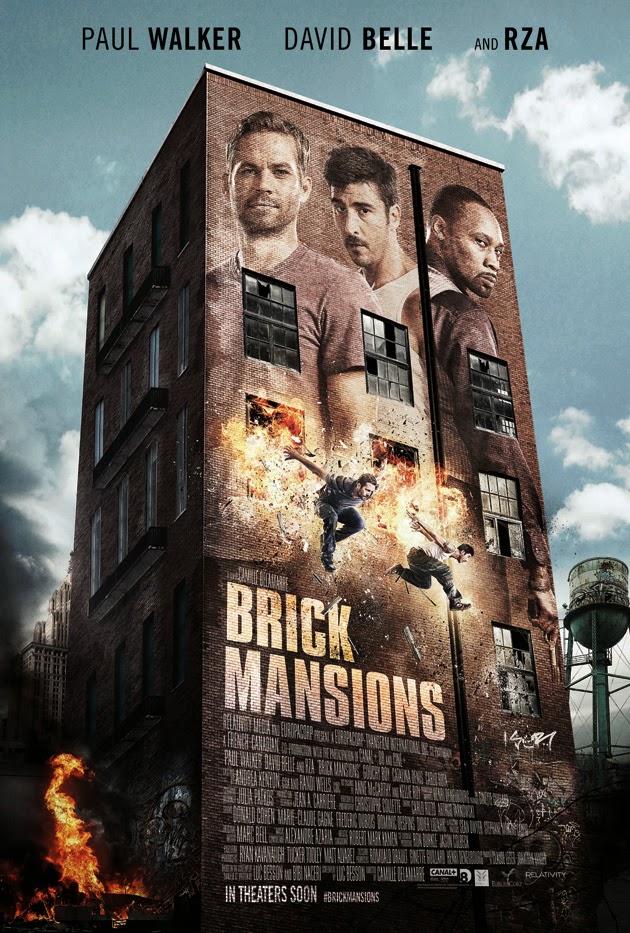
In Theaters: BRICK MANSIONS (2014)


BRICK MANSIONS
(France/Canada - 2014)

Directed by Camille Delamarre.  Written by Luc Besson. Cast: Paul Walker, David Belle, RZA, Gouchy Boy, Catalina Denis, Ayisha Issa, Carlo Rota, Bruce Ramsay, Andreas Apergis, Frank Fontaine, Richard Zeman, Robert Maillet, Ron Lea, Mark Camacho. (PG-13, 90 mins)

The 2004 French-language Luc Besson production BANLIEUE 13 became a blockbuster hit in Europe before its 2006 US release as DISTRICT B13 (which led to the 2009 sequel DISTRICT B13: ULTIMATUM) and succeeded in both the mainstreaming of parkour and putting Besson protege and future TAKEN director Pierre Morel on the map.  Given the ubiquitousness of parkour over the subsequent years--including a memorable action sequence in 2006's 007 reboot CASINO ROYALE--it seems odd that Besson would not only fashion a belated, demanded-by-no-one English-language remake now but also that he would utilize one of BANLIEUE's stars, French parkour master David Belle, in the same role he played a decade ago. Again scripted by Besson (with regular collaborator Robert Mark Kamen credited as "artistic consultant") and directed by another in the seemingly endless line of Besson disciples--in this case, his frequent editor Camille Delamarre, making his feature directing debut--BRICK MANSIONS moves the action from the slums of Paris to a walled-off housing project in the near-future war zone of Detroit in 2018.


Brick Mansions is controlled by Tremaine (RZA), a ruthless drug lord and red pepper culinary enthusiast who's enraged over a drug shipment jacked and destroyed by Lino (Belle), a do-gooder who's lived in Brick Mansions his whole life and is sick of Tremaine and his goons running things.  Brick Mansions is under constant guard by police and military personnel, all of whom are on Tremaine's payroll, which Lino finds out the hard way when he brings Tremaine to them only to be tossed in prison himself for killing a cop in the ensuing melee.  Enter undercover Detroit narcotics detective Damien Collier (the late Paul Walker), who just nabbed high-ranking gangster George the Greek (Carlo Rota, the Canadian Stanley Tucci, playing yet another variation on his Yakavetta character from THE BOONDOCK SAINTS), and has had his eyes on Tremaine for a while:  Collier's dad was a legendary Detroit cop killed by Tremaine during a botched raid on Brick Mansions years earlier.  The mayor (Bruce Ramsay) and the top Detroit brass send Collier into Brick Mansions in classic Snake Plissken-style when Tremaine gains possession of a neutron bomb that's set to go off in ten hours.  Posing as a prisoner, Collier finds himself in a transport with Lino, who's determined to rescue his ex (Catalina Denis), who's being held captive by Tremaine, who's also demanding $30 million in his Hawaiian bank account (?) to not launch the neutron bomb right at downtown Detroit.  Amidst bickering and constant disagreement, Collier and Lino team up to take out Tremaine and his Brick Mansions army and stop the bomb from going off...

...if they don't kill each other first!


As far as empty calories entertainment goes, you could do a lot worse than BRICK MANSIONS. It moves fast and there's some entertaining action sequences when Delamarre can keep the camera somewhat still.  Yes, most of the action is of the dizzying, quick-cut shaky-cam variety, with bonus pointless stutter zooms (even with all of Belle's by-now familiar parkour antics, the highlight is Collier's extended pursuit of George the Greek). Cliches and silliness abound:  every shitbag in Detroit is a parkour expert, George the Greek acts like he's the first crime boss to use a shark tank as a ham-fisted metaphor, and it's a wonder Tremaine has any empire at all with incompetent flunkies like the hapless K2 (Gouchy Boy) and psycho-bitch Rayzah (Ayisha Issa) in his employ. Besson does take things in an unexpected--and dumber--direction than BANLIEUE in his handling of Tremaine, who faced a much different fate in the original film (that film's co-writer Bibi Naceri played the same character, then called Taha Bemamud).  Here, RZA plays Tremaine as someone equally cold-blooded as Taha, but Tremaine's eleventh-hour transformation into not just a good guy (which is what happened to K2 in the original film), but a noble hero who doesn't have to pay for his crimes reeks of fast and furious post-production revision, as if Besson wanted him along for the ride in case there's a sequel. Another decision clearly made after the fact is the distracting dubbing of many of the French and Quebecois supporting players (only some second-unit establishing shots were done in Detroit; the rest of the film was shot in Montreal).  The dubbing is most obvious with Belle, whose thick accent has been completely revoiced, making the constant references to his nationality--like calling him "Frenchy" or "French asshole"--meaningless. There's an unsubstantiated rumor making the rounds that it's Vin Diesel dubbing Belle, but as of this writing, nothing's been confirmed.


Paul Walker (1973-2013)
In his last completed role before his tragic death in a car crash in November 2013 (CGI and his two brothers serving as doubles will be used to finish his performance in FAST & FURIOUS 7, due out in April 2015), Walker is game for the intense action and his fans will certainly want to check this out.  While it's not really a stretch for him, BRICK MANSIONS provides a better showcase for the actor than recent junk like VEHICLE 19 and the unwatchable PAWN SHOP CHRONICLES. Much like the planned English-language remake of Gareth Evans' Indonesian THE RAID, a film with which BRICK MANSIONS shares some "high-rise mayhem" similarities, there's little reason to rework a foreign-language film that's not only better but was already embraced by action enthusiasts and didn't feel the need to dub over a French lead actor's performance as a French guy to ensure that he didn't sound French, a decision that fully summarizes the inherent pointlessness of BRICK MANSIONS.


Saturday, April 26, 2014

On DVD/Blu-ray: BIG BAD WOLVES (2014); A FAREWELL TO FOOLS (2014); and WELCOME TO THE JUNGLE (2014)

BIG BAD WOLVES
(Israel - 2013; US release 2014)


Quentin Tarantino cited this Israeli import as his favorite film of 2013, and it's no wonder.  It's not only the work of a directing team (Aharon Keshales and Navot Papushado) that obviously loves movies, but it's also frequently a slobbering fan letter to Tarantino himself. Not only is there a foot chase that replicates some shots of the Marcellus/Butch chase in PULP FICTION, but the second half of the film is essentially an extended homage to the RESERVOIR DOGS torture scene. Despite no hard evidence, loose cannon cop Micki (Lior Ashkenazi) is convinced that mild-mannered schoolteacher Dror (Rotem Keinan) is the pedophile serial killer who's been raping and killing young girls, decapitating them, leaving the bodies for the cops, and burying the heads in a secret place. Micki and some thuggish cops take Dror to an abandoned warehouse to beat a confession out of him, but a kid hanging around films them and posts the video on YouTube.  After he's read the riot act and busted down to traffic--burly captain Tsvika (Dvir Benedek) actually says "I'm gonna bust you down to traffic"--Micki starts tailing Dror on his own time, and is given a wink and silent approval by Tsvika to "deal with" Dror in any way he sees fit.  Micki's plan is derailed by Gidi (Tzahi Grad), the enraged father of the latest victim, who has his own plans for Dror and won't let Micki get in the way.  Gidi follows Micki following Dror, incapacitates both men and takes them to a house in the woods in the middle of nowhere, a house he bought for the sole purpose of taking Dror there to torture him and put him through what all of the dead girls have gone through.  He agrees to split the duties with Micki, at least until Micki realizes Gidi is a madman and instead forms a shaky alliance with Dror, the man he was going to kill on his own in the first place. Then things go from bad to worse when Gidi's aging father Yoram (Dov Glickman) unexpectedly shows up.


The filmmakers want to invoke a sense of Israel's history, and the occasional appearances by an affable Arab man on horseback ("Why do you Jews always think that we all want to kill you?") pay lip service to that, but really, BIG BAD WOLVES is just another vigilante movie, complete with broken and smashed appendages, cutting and slicing, yanked fingernails and toenails, and various blowtorchings, and while it's better than most, being in Israeli with English subtitles doesn't add a layer of arthouse cred or meaningful depth. There's no denying it's a very well-made film anchored by four terrific performances, and the directors get things off to a hypnotically powerful start with a hauntingly graceful De Palma-esque sequence of kids playing hide-and-seek.  There's also some amusing bits of dark humor throughout--the Arab stranger, circumstances forcing Micki to ride a kids bicycle, Tsvika and his young son ("It's take-your-child-to-work day") tearing into Micki over his initial handling of Dror (Benedek is a real scene-stealer)--and while some will decry it as little more than torture porn, it's a bit above that.  I don't think there's as much substance here as the filmmakers believe there to be, but enthusiastic filmmaking, an unabashed love of cinema, top-notch performances, and many instances of genuine suspense give BIG BAD WOLVES much credibility just as a solid, straightforward thriller, albeit one that's quite wince-inducing.  (Unrated, 110 mins)


A FAREWELL TO FOOLS
(US/Romania/Belgium/Germany/France - 2013; US release 2014)


Based on the novel The Death of Ipu by Titus Popovici, who scripted the original 1971 Romanian film version THEN I SENTENCED THEM ALL TO DEATH, A FAREWELL TO FOOLS is a heavy-handed WWII-set morality tale that has too many mood swings to work effectively. The grim subject matter doesn't really mesh with the frequently comic presentation, complete with a bouncy, lighthearted score that sounds a lot like the sequence in THE GODFATHER PART II when young Vito Corleone and Clemenza broke into a house to steal an expensive rug. In a relentlessly hammy performance, Gerard Depardieu is Ipu, the idiot in a Nazi-occupied Romanian village who lives with a bullet from WWI lodged in his head and is regarded as a genial goof by the rest of the citizens. Ipu farms and does fix-it jobs and spends his free time playing war with lonely, mischievous orphan Alex (Bogdan Iancu), who lives with his aunt Margherita (Laura Morante) and minister uncle Johannes (a seriously miscast Harvey Keitel).  On the edges of the village, a friendly German soldier (Andrei Seusan) lets Alex ride his motorcycle, and when Alex finishes taking it for a brief spin, he finds the soldier lying dead with his throat slit.  The Germans in charge demand a confession from the guilty party or ten of the village's top authority figures and their wives will be executed at 5:00 the next morning. Rather than investigate the murder, Johannes and the rest--Margherita, the mayor, the police chief, the doctor, the notary public, etc., hatch a plan to invite Ipu over for dinner, butter him up, fill him with food and drink and convince him to take the fall, even though Johannes admits "Ipu was working with me all afternoon" when the soldier was murdered.


Johannes and the others are a reprehensible lot, and it's rather amusing watching them realize that Ipu isn't as dumb as he seems, but that's another problem with the film: Depardieu has been directed to play Ipu as whatever a particular scene needs him to be: lovable oaf, mischievous scamp, shell-shocked battle vet, or sly, duplicitous manipulator. Given significant latitude by director Bogdan Dreyer, the actor is all too happy to oblige and chew the scenery throughout, and Depardieu's gregarious presence is enjoyable even when it doesn't always make sense. It's possible that Ipu has been playing them to some extent all along, but 30 years is a long time to keep a ruse going (it also doesn't help that, at just 84 minutes, the film feels like it's been hacked down).  Morante does little more than shriek and act hysterical, while Keitel just looks tired, sounds hoarse, and has no business playing a Bronx-accented Romanian priest (Keitel has never been good with accents).  A FAREWELL TO FOOLS isn't a bad film, it's just a confused one that never finds a balance between its wildly varying tones of downbeat drama, biting satire, and borderline slapstick. Filmed in 2011, this bombed in its European release and only made it to a few theaters and VOD during its US dumping in early 2014. (PG-13, 84 mins)


WELCOME TO THE JUNGLE
(UK/US - 2014)


An overbearing would-be satire of office politics, WELCOME TO THE JUNGLE is noteworthy only for the presence of a self-deprecating Jean-Claude Van Damme. JCVD plays Storm, a survivalist hired by an advertising CEO (Dennis Haysbert) to take the underlings in his firm to a distant island for a weekend team-building retreat in the wilderness.  The pilot keels over after they land, and Storm is mauled by a tiger, which prompts a battle of wills between nice-guy Chris (Adam Brody) and asshole Phil (Rob Huebel) as the staff splits into LORD OF THE FLIES factions. Phil rechristens himself "Orco" and turns the island into an orgiastic SURVIVOR nightmare that makes the Kurtz compound in APOCALYPSE NOW look cozy and inviting, while Chris, office hottie crush Lisa (THE BLACKLIST's Megan Boone), bunny-obsessed quirky girl Brenda (Kristen Schaal), and stoner Jared (Eric Edelstein) try to figure out how to get off the island. That description sounds a lot darker than the film really is, as director Rob Meltzer and writer Jeff Kauffman consistently go for the cheapest laughs, usually involving orifices and things that come out of them. The comparisons between cut-throat world of the workplace and "the jungle" are forced and obvious, and the early office scenes play like a tired retread of HORRIBLE BOSSES or OFFICE SPACE. There's nothing here other than the novelty of seeing Van Damme in a comedy, but the movie isn't that funny and doesn't make very good use of him as he's absent for long stretches--Storm survives the tiger mauling and turns up again later, only to disappear once more until the climax--which probably has more to do with the filmmakers only having him for a limited time (of course, as per his usual package deal, he's brought along the dead weight duo of son Kristopher Van Varenberg--one of the film's 29 credited producers--and stunningly untalented daughter Bianca Bree).  The Chris vs. Phil plot line is bland and predictable, and WELCOME TO THE JUNGLE feels a lot like a rambling SNL skit that won't end. (Unrated, 94 mins)


Friday, April 25, 2014

In Theaters: THE QUIET ONES (2014)


THE QUIET ONES
(US/UK - 2014)

Directed by John Pogue.  Written by Craig Rosenberg, Oren Moverman, and John Pogue.  Cast: Jared Harris, Sam Claflin, Olivia Cooke, Erin Richards, Rory Fleck-Byrne, Laurie Calvert, Aldo Maland. (PG-13, 98 mins)

The 2007 revival of the legendary Hammer Films was much-hyped in horror circles, but in the ensuing seven years, it's only resulted in five films and BEYOND THE RAVE, a 20-part serial that debuted on MySpace in 2008.  Of those five films, LET ME IN, the 2010 remake of the Swedish vampire hit LET THE RIGHT ONE IN, and 2012's THE WOMAN IN BLACK were the undisputed standouts, with the Hilary Swank stalker thriller THE RESIDENT (which featured Hammer icon Christopher Lee in a prominent supporting role) and the subpar WAKE WOOD not doing much to herald Hammer as a force in today's horror. Two years after their last production and two years after it was shot, Hammer's latest offering, THE QUIET ONES, has finally arrived and it seems to encapsulate every doubt I've had about this new "Hammer."  Specifically, it's not Hammer. Sure, it's the name "Hammer," but that's all it is.  These aren't being made by the same talents that gave us all of those old classics with Lee and Peter Cushing and the rest.  Of course, most of those people are no longer with us, but this new Hammer is simply coasting on nostalgia and brand recognition, much like its barely reanimated rival Amicus, which has only managed to churn out two films since its 2005 rebirth.  There's no continuity or sense of tradition with the current Hammer, though THE WOMAN IN BLACK was a thoroughly enjoyable throwback chiller that has thus far come closest to being worthy of the name by replicating what a vintage Hammer production should be. THE QUIET ONES is, for lack of a better term, poseur Hammer, a film that thinks it's being old-school just because it has a British cast and is set in 1974, but it doesn't do anything with that setting.  In fact, it seems to go out of its way to placate today's audiences with a 2014 assembly-line product. And unless you're part of a focus group, that's not a good thing.


Arrogant Oxford psychology prof Joseph Coupland (Jared Harris) is trying to prove that ghosts and supernatural occurrences are simply manifestations of psychological and emotional trauma.  His case study is Jane (Olivia Cooke), a troubled young woman who's been shuffled from one foster home to another.  Jane believes she's possessed by the spirit of a child named Evey.  When the university cuts his funding, Coupland moves the study to a middle-of-nowhere country estate, taking along two student researchers, Harry (Rory Fleck-Byrne), and Krissi (Erin Richards, doing a decent job of channeling a coquettish Judy Geeson), who spend their free time having rambunctious, bed-breaking sex, as well as cameraman-for-hire Brian (Sam Claflin).  Coupland blasts glam rock at high volume to keep Jane awake (Slade's "Cum on Feel the Noize" and T. Rex's "Telegram Sam" get some airplay) in the hopes that it will prompt Evey to show herself.  It doesn't take Jane long to cast a spell of sorts on Brian, who finds himself not exactly falling for her, but certainly wishing to save her from the increasingly unethical "treatment" of Coupland and his assistants.  Of course, it's inevitable that Evey will eventually make her presence known and her true intentions revealed, and rest assured, it's nothing you haven't seen a hundred times before.


Familiarity is the least of THE QUIET ONES' problems.  It succumbs to stupidity on too many occasions (if Coupland is concerned about Jane manipulating Brian, then why does he allow Brian to sit in and film her while she's bathing?), and when Coupland's ultimate goal behind his experiment is revealed, it lands with a thud because we're just done caring about him by that point.  But the film's biggest issue, and one that makes its 1974 setting nothing more than retro-cool window dressing, is that the bulk of the film is seen through the lens of Brian's camera while he's filming, a terrible decision that seems to have been made simply to appease the found-footage crowd.  So, of course, a good chunk of the horror histrionics are presented in de rigeur shaky-cam, and the attached light allows for an extended sequence of running through the dark house in a 1970s approximation of night-vision.  Gussying things up with a faded color palette, wide lapels, hot pants, gaudy wallpaper, and having people chain-smoking in now-inappropriate settings are only cosmetic elements. Hammer was about blazing trails, and even when they followed trends and added more sex and gore to films like THE VAMPIRE LOVERS, they were still distinctly Hammer.  There's nothing Hammer here. There's no reason other than commercial pandering to set the film up in this fashion, which negates the whole sense of nostalgia that Hammer and director/co-writer John Pogue (QUARANTINE 2: TERMINAL, which oddly enough, abandoned the found-footage angle of its predecessor) are ostensibly pursuing even more than recycling the vomiting CGI ectoplasm effect from THE HAUNTING IN CONNECTICUT, which is really where THE QUIET ONES jumps the shark. Maybe the vintage 1970s aura is something that existed in the original script by Tom De Ville, which was apparently rewritten by the committee of Pogue, Craig Rosenberg (LOST, THE UNINVITED), and the unlikely Oren Moverman, whose past credits for films like I'M NOT THERE, THE MESSENGER, and RAMPART don't exactly make him the go-to guy for Hammer horror.  I can only assume that an odd credit like "Based on the original screenplay by Tom De Ville" means that none of De Ville's script made it to the completed version.  The film is also "inspired by actual events," which means it was vaguely influenced by what's known as the "Phillip Experiment," where Canadian researchers tried to conjure a ghost on their own.  It was ultimately revealed to be a hoax, not unlike the current incarnation of "Hammer," which will henceforth be accompanied by quote marks when referenced.


Cooke does some solid work as the haunted Jane, and in many ways reminds you of a younger Eva Green, but the best thing about THE QUIET ONES is easily the performance of Harris. The veteran character actor gets a rare lead role here and sinks his teeth into it, turning Dr. Coupland into an extended tribute to his father, the late, great Richard Harris.  Jared Harris sounds so much like his old man and has inherited so many of his vocal inflections, that even though he doesn't have the strongest physical resemblance, you can absolutely see his dad in his mannerisms and hear him in his words. As the spiritual shit hits the fan later on, Harris also throws a little Oliver Reed and Patrick Magee into the mix, and whatever fun THE QUIET ONES offers largely comes from watching him.  It's too bad his efforts are wasted on something so blandly unworthy.  THE QUIET ONES is little more than background noise, atmospheric to an extent and filled with predictable jump scares punctuated by loud music cues.  If you're looking for some legitimate chills of the old-fashioned variety in a film that doesn't feel the need to cop to stale trends that refuse to die, give OCULUS a look if hasn't already left your area theaters.  That's a film set in the present day that could've been made in the 1970s. If you're watching THE QUIET ONES for some sense of 1970s eerieness, you're better off just watching any random Hammer production from 1974. Or maybe 1973's THE LEGEND OF HELL HOUSE.  Or hell, just watch Edgar Wright's DON'T trailer. In under 90 seconds, that perfectly nails the concept of "1974 British horror" better than all 98 minutes of "Hammer"'s THE QUIET ONES.