MAD MAX: FURY ROAD (US/Australia - 2015) Directed by George Miller. Written by George Miller, Brendan McCarthy and Nico Lathouris. Cast: Tom Hardy, Charlize Theron, Nicholas Hoult, Hugh Keays-Byrne, Nathan Jones, Zoe Kravitz, Rosie Huntington-Whiteley, Riley Keough, Abbey Lee, Courtney Eaton, Josh Helman, John Howard, Richard Carter, Megan Gale, Melissa Jaffer, Angus Sampson, Richard Norton, iOTA. (R, 120 mins)
Australian auteur George Miller has worked only sporadically in the 30 years since 1985's MAD MAX BEYOND THUNDERDOME, but when he does reappear, he makes it count. He produced the beloved BABE in 1995 and directed 1998's BABE: PIG IN THE CITY, a dark and bizarre curveball of a sequel that baffled everyone but has become a major cult film. In the years since, he's become synonymous with the hugely popular HAPPY FEET films, but MAD MAX: FURY ROAD marks his triumphant return to the franchise he started in 1979 with MAD MAX, one that made Mel Gibson a star and spawned an entire subgenre of post-nuke action films after its sequel THE ROAD WARRIOR opened in the US in the legendary summer of 1982. THE ROAD WARRIOR (released a year earlier in its native Australia as MAD MAX 2) remains one of the most influential action films ever made and one that BEYOND THUNDERDOME probably couldn't have topped even if Miller's mind wasn't elsewhere following the 1983 death of his friend and producing partner Byron Kennedy in a helicopter crash while location-scouting (his name remains on their production company Kennedy Miller Mitchell to this day), prompting a grieving Miller to delegate enough of the film to Australian TV vet George Ogilvie that both Georges shared directing credit. For 30 years, the disappointing-but-OK-on-its-own-terms BEYOND THUNDERDOME, despite such memorable characters as Master Blaster and Tina Turner's Aunty Entity, has remained a lesser conclusion to an otherwise exemplary trilogy.
Miller's had the basic concept of FURY ROAD churning in his head since the late '90s, and tried to get it off the ground in the early 2000s with Gibson returning to his iconic role. But it never materialized into anything more than the idea stage until Miller finally got all the pieces in place with Tom Hardy taking over the Mad Max role from Gibson, who by then was either too old or too much of a tabloid distraction or both. FURY ROAD isn't a reboot, it's not a prequel, and it's not an origin story. It's not even necessarily a sequel as much as it's another Mad Max adventure. It functions as a stand-alone, self-contained piece, much like the old James Bond movies used to do. There's references to things from the earlier films, mainly winking nods to longtime fans (the music box given to The Feral Kid in THE ROAD WARRIOR; a near-subliminal shot of bulging eyeballs from MAD MAX), and 67-year-old Hugh Keays-Byrne, who played MAD MAX's chief villain Toecutter 36 years ago, is onboard as a different villain this time. Much the way THE ROAD WARRIOR blazed trails in the action genre, so does FURY ROAD, with the now-70-year-old Miller unveiling what's likely the best action movie in a generation, effectively showing an entire demographic weaned on CGI and video games and hyper, incoherent, shaky-cam editing how it should be done. Much was made of FURY ROAD's reliance on practical effects and old-school stunt work, though it obviously utilizes CGI to a certain degree. Yes, a couple of shots look a little on the cartoony side, but the other 98% of the time, Miller uses CGI how it should be used: as an enhancement as opposed to a crutch. Even by the standards he set 34 years ago with THE ROAD WARRIOR, the veteran filmmaker outdoes himself with MAD MAX: FURY ROAD, proof positive that underneath his soft-spoken, milquetoast exterior, George Miller is a fucking madman perpetually straddling the fine line between genius and insanity.
Hardy's Max Rockatansky is introduced being abducted by the War Boys, the albino-like minions of wasteland despot Immortan Joe (Keays-Byrne), who sports a plastic casing over his boil-ravaged body and a breathing apparatus permanently attached to his face. Max is kept prisoner as the human blood bag of Nux (Nicholas Hoult), a sickly War Boy who needs frequent transfusions. Immortan Joe is viewed as a deity by his followers, who are kept in line by a very conservatively doled-out water supply and promises of being carried into Valhalla. Not everyone is happy under his rule, particularly one-armed War Rig driver Imperator Furiosa (a terrific Charlize Theron), a buzz-cut, battle-scarred warrior in charge of getting a supply of "guzzoline" from nearby Gastown. Instead, she's stowed away Immortan Joe's five young wives--the very pregnant Splendid Angharad (Rosie Huntington-Whiteley), Toast the Knowing (Zoe Kravitz), Capable (Riley Keough), The Dag (Abbey Lee), and Cheedo the Fragile (Courtney Eaton), all enslaved and kept under lock and key for breeding and sexual purposes--with the intent of taking them to their freedom to a mythical promised land known as "The Green Place." Once Immortan Joe realizes they've gone off the road to Gastown, he and his hulking son Rictus Erectus (Nathan Jones) unleash an army of warriors and War Boys for what's essentially a feature-length, extended chase sequence with a couple of breaks for character development. Max begins the pursuit chained to the front of Nux's car, intravenously connected to him until an epic dust storm separates them from the rest of Immortan Joe's forces and Max forms an unholy alliance with Furiosa. Dialogue is relatively minimal, often with nods or facial expressions often speaking volumes (note Max's only smile--a half-hearted one at that--and the exhausted thumbs-up he gives The Splendid Angharad when she steps up and disposes of a War Boy), and there's little in the way of subtlety: when Max asks Furiosa what she's after, the answer is "Redemption." Well, duh.
But that's not the main concern with FURY ROAD. Miller has fashioned this as a jawdropping epic, with himself the conductor of a batshit symphony of destruction. With a $150 million budget, Warner Bros. has given Miller an astounding amount of leeway in the creation of his latest masterpiece. Filmed in the summer and fall of 2012 in the Namib Desert and Namibia, with other shooting in South Africa and Australia, with some additional reshoots and second-unit work in November 2013, Miller took a Kubrickian amount of time getting FURY ROAD just right, from the action choreography to the vehicles and the costumes to the locations and the production design. I've never seen a film with so many credited assistant directors, assistant editors, and stunt personnel. From the car wrecks to the stunt professionals being hurled through the air or pole-vaulting onto big rigs barreling through the Namib Desert at high speeds, or the flashy Doof Warrior (iOTA), who heads into battle perched atop a War Rig with a flamethrowing double-necked guitar backed by a wall of amps and eight drummers on the trailer behind, MAD MAX: FURY ROAD presents bombastic, skullcrushing action as a work of lunatic art. Describing it not only risks spoiling it, but it in no way does it justice. You've seen films like this before--you just haven't seen them done this way before. Miller, his co-writers Brendan McCarthy and Nico Lathouris, Oscar-winning cinematographer John Seale, and all the technical personnel have achieved a new benchmark in action cinema, and a blistering example of just how placated we've become with what passes for such in most of today's big movies. Miller has bestowed MAD MAX: FURY ROAD on the moviegoing public to remind us of the possibilities and to save the Big Summer Movie from itself. It can be done, because Miller and his cast and crew did it. People still remember the formative experience of seeing THE ROAD WARRIOR for the first time. That's how you'll feel leaving the theater after MAD MAX: FURY ROAD. Can you remember the last time you felt that way? The term "game-changer" gets tossed around a little too liberally these days, but believe the hype. This is the new standard-bearer.
LEFT BEHIND (US - 2014) Directed by Vic Armstrong. Written by Paul Lalonde and John Patus. Cast: Nicolas Cage, Chad Michael Murray, Cassi Thomson, Nicky Whelan, Jordin Sparks, Lea Thompson, Gary Grubbs, Martin Klebba, Georgina Rawlings, Quinton Aaron, William Ragsdale, Alec Rayme, Lolo Jones, Lance E. Nichols, Han Soto, Stephanie Honore, Major Dodson. (PG-13, 110 mins)
Since the surprise success of THE OMEGA CODE back in 1999, the release of grass-roots, evangelical, faith-based titles has been a semi-regular occurrence in American multiplexes. Usually released with little or no secular fanfare, these titles are heavily promoted through Christian and right-wing media outlets and many congregations bus their members to the theater in what's essentially a big-screen sermon. The existence of these films, often referred to by secular smartasses as "faithsploitation" or "Christsploitation," isn't a bad thing in and of itself. Like any genre, they have a target audience and there's even been some mainstream crossover with the likes of SOUL SURFER (2011) and HEAVEN IS FOR REAL (2014). These films preach to the converted and their audiences are happy as long as they hear the message they came to hear. And from a working actor standpoint, they keep C-listers and past-their-prime character actors like Kevin Sorbo, John Schneider, Lee Majors, Eric Roberts, Dean Cain, Bruce Davison, Craig Sheffer, and James Remar employed. The problem with these films is that they're almost always cheap and shoddy-looking, almost as if the creative forces behind them know that it doesn't matter anyway because the message is the important thing. Costly religious films were made in the Cecil B. DeMille days of old but there's no need for that level of expense and craftsmanship in these kinds of modern faithsploitation offerings where you can just imagine the producers saying "Whatever, that's as good as it needs to be." They know it won't matter. The movie gets released, the congregation says it's uplifting and has a positive message, and Kevin Sorbo's kids eat.
LEFT BEHIND (2000) was one of the films released in the wake of the mainstream success of THE OMEGA CODE. Based on the bestselling series of books by Tim LaHaye and Jerry Jenkins, it told of The Rapture, the event where those who truly believe in God leave Earth and ascend into Heaven, and the sinners Left Behind must combat the forces of darkness until they accept and believe. The Kirk Cameron-starring LEFT BEHIND was an apocalyptic look at the End Times and spawned two sequels, LEFT BEHIND II: TRIBULATION FORCE (2002), and LEFT BEHIND: WORLD AT WAR (2005). From the moment it was announced, there was an incredulous sense that the reboot of LEFT BEHIND was some kind of elaborate prank. But as time went on and updates were routinely posted by internet news outlets, and as snippets of scenes and a trailer eventually made their way online, it became a painful reality that, yes, there's a new LEFT BEHIND. And somehow, it stars Academy Award winner and former actor Nicolas Cage.
Cage is airline pilot Capt. Rayford Steele (played by Brad Johnson in the original films), a fallen sinner who's cheating on his born-again, Bible-thumping wife Irene (Lea Thompson) with flight attendant Hattie Durham (Nicky Whelan). He lies to his visiting-from-college daughter Chloe (Cassi Thomson) when he says he was just called in for a flight to London just as she gets home--he and Hattie had the trip planned for several weeks, even securing tickets to see U2 while they were there. Chloe heads to the family home to visit Irene and entirely too wholesome younger brother Raymie (Major Dodson), while Steele begins what should be a routine flight from JFK to Heathrow. Midway through the flight, several passengers, including all of the children, vanish into thin air, their clothes just lying in a pile where the person once was. At the same time, Chloe is at the mall with Raymie and Raymie disappears while she's hugging him, his clothing falling to the floor. Chloe frantically heads home and finds the shower running, with Irene's earrings and necklace lying over the drain. Chaos ensues on the ground and in the air, as Steele, after losing his co-pilot (FRIGHT NIGHT's William Ragsdale) and turning the plane around to head back to JFK, teams up with passenger and intrepid celebrity TV news reporter Cameron "Buck" Williams (Chad Michael Murray, in Cameron's role) to ensure the safety of the hysterical passengers after a mid-air collision with a pilotless jet causes a massive fuel leak. As you might expect, it doesn't take long for the previously dismissive Steele to realize the error of his ways and accept God as his co-pilot.
Those who are Left Behind were left as such in order to believe and therefore earn their chance at salvation, but one thing that has no chance of salvation at this point is Cage's career. I expect to find people like Chad Michael Murray and William Ragsdale in a LEFT BEHIND movie. Even if he's only doing B-grade actioners that go straight to VOD, Cage has still been steadily employed even as his big-screen career has taken a nosedive. For an actor in a major career lull, the faithsploitation genre is usually a desperate last resort, something that only requires a couple of days' work and they get their check and move on to the next job. Cage is a willing participant in this and seems unaware of the amateur-night fiasco around him. Everything about LEFT BEHIND '14 screams "sub-Lifetime" in its standards of filmmaking, from the hilariously unconvincing job Baton Rouge does passing itself off as NYC to the intrusive score that vacillates between soaring, inspirational, would-be John Williams to sax-heavy smooth jazz at ludicrously inappropriate moments. It's the kind of film where complete strangers break out into intense theological debates at random moments as screenwriters Paul Lalonde and John Patus, who wrote the original LEFT BEHIND, aggressively shoehorn their talking points into the already-stilted dialogue.
Where LEFT BEHIND '14 differs from LEFT BEHIND '00 is that it drastically scales down its focus to Chloe and the chaos in her immediate vicinity (of course, people of various non-white ethnicities are seen looting plasma TVs and stealing money from left behind wallets in the immediate aftermath of the Rapture) and Steele and Williams dealing with the situation in the air. The Satan surrogate Nicolae Carpathia, played by Gordon Currie in the original films, isn't even seen here. Lalonde, Patus, and director Vic Armstrong instead whittle this LEFT BEHIND down to a sermonizing disaster movie (those who have read the book say this new version only covers approximately the first 40 pages), with a heroic Cage doing his best Robert Hays to get the plane down on the ground as it's running on fumes. Cage is surprisingly restrained--or half-asleep--throughout much of the film, only cranking up the Cageness when Steele has his Come to Jesus moment, looking at his ascended co-pilot's left-behind watch and seeing "John 3:16" engraved on it, then frantically perusing a departed flight attendant's day planner and having a blubbering breakdown when he sees "Bible Study" on the next day's date, with those two items being all he needs to conclude that his wife was right all along.
Veteran stuntman and stunt coordinator Armstrong worked on many 007 films between YOU ONLY LIVE TWICE (1967) and DIE ANOTHER DAY (2002), and served as the stunt double for George Lazenby in the Bond entry ON HER MAJESTY'S SECRET SERVICE (1969), Christopher Reeve in SUPERMAN (1978) and Harrison Ford in RAIDERS OF THE LOST ARK (1981). In recent years, the now 68-year-old Armstrong has handled second unit directing duties on major Hollywood films like I AM LEGEND (2007), THOR (2011), and JACK RYAN: SHADOW RECRUIT (2014) among many others. He's an odd choice to helm LEFT BEHIND, not just for the kind of movie it is or that it calls on none of his skills as a stunt expert but because it's just his second film as a director and the first since the 1993 Dolph Lundgren actioner ARMY OF ONE, aka JOSHUA TREE. Armstrong's effort here is undistinguished for the most part, with unconvincing CGI and greenscreen, and some oddly antiquated use of mattes and miniatures for a good chunk of the climactic crash landing. That sequence is almost charmingly Antonio Margheriti-esque in its dated execution, and as laughable as it looks, the miniatures may still be preferable to the whole thing being CGI'd as the airborne mayhem was in this year's earlier NON-STOP. So, if nothing else, while the shaky matte work is total bush league and the NYC skyline looks like Armstrong just projected the Troma intro onto a screen in front of the actors, LEFT BEHIND might make you a believer in the use of practical miniatures like they used to do.
True to disaster movie form, LEFT BEHIND '14's passengers are played by an odd grouping of actors beyond the inexplicable participation of Cage (I'd call this the STRIKE COMMANDO 2 of his career, but it's obviously too early to make that call) and BACK TO THE FUTURE's Thompson: you get 2007 AMERICAN IDOL winner Jordin Sparks, who also sings the closing credits song, blaming the event on her estranged pro quarterback husband; PIRATES OF THE CARIBBEAN's Martin Klebba as a surly little person with a huge chip on his shoulder; Olympic athlete and DANCING WITH THE STARS contestant Lolo Jones; folksy character actor Gary Grubbs; and Quinton Aaron, who you probably haven't thought of since THE BLIND SIDE. But the real story here is the once-unstoppable Nicolas Cage, a daring actor who blazed trails and lived on the edge but who's now teetered off beyond self-parody and past the point of no return with LEFT BEHIND. Earlier this year, JOE looked like it might revitalize his stagnant career until Lionsgate buried it. It's still a terrific film and it was his best performance in years, but hey, what's the point when he's already got this lined up? I get that actors need to work, but Cage can't possibly need the money badly enough to humiliate himself in an endeavor this beneath him. But maybe it's not beneath him. He's fully self-aware and has become his own punchline, a trained monkey in a carnival of "Nic Cage Freaks Out!" YouTube clips. At what point does someone close to him stage an intervention? This is a film that looks positively embarrassing on the big screen, from its terrible visual effects to the clunky dialogue forced on its actors. Even someone like Chad Michael Murray, the former ONE TREE HILL teen idol and current journeyman actor who very likely has no Oscars in his future, has to know this is garbage, and he's actually been in something as nonsensical as the cartographically-challenged THE HAUNTING IN CONNECTICUT 2: GHOSTS OF GEORGIA. The characters in LEFT BEHIND are nothing more than puppets mouthing the message, and it doesn't matter how awkwardly such proclamations are worked in as long as the audience hears them. Films like this have no subtlely or nuance, and while LEFT BEHIND '14 tones down the proselytizing a bit in order to appeal to the commercial audience they presume Cage will draw by turning it into AIRPORT '14: THE RAPTURE, that only heightens the cynicism of the whole thing. In short, there is no reason for this film to exist, and there's no excuse for Cage agreeing to be in it.
Though it lacks zombies, there's a major WALKING DEAD influence on this pointless apocalyptic horror film from WWE Studios. In a desolate rural wasteland, a ragtag group of bickering survivors led by Dominic "Still Coasting on LORD OF THE RINGS" Monaghan (as Rick, oddly enough, also the name of Andrew Lincoln's character on THE WALKING DEAD) take refuge in an abandoned house, with much talk about it not being safe. Turns out the world's been overrun by marauding cannibals for ten or so years and the house is a trap, set up to procure food. When co-producer Monaghan is granted an early exit courtesy of one of cinema's least-convincing impalings, it's up to Shannyn Sossamon, Shawn Ashmore, Cory Hardrict and group outsider Ashley Bell to take on the flesh eaters. Soon, a cannibal family led by THE DIVIDE's Michael Eklund is outside as the film becomes your basic RIO BRAVO/NIGHT OF THE LIVING DEAD/John Carpenter siege scenario.
Even a slumming Carpenter could've done more with this than HIGHLANDER: ENDGAME director Doug Aarniokoski, who utilizes the de rigeur jerky cam and quick edits, with a dreary, desaturated look that's practically black & white, which adds nothing atmospherically other than making it impossible to tell what's going on in some later scenes. Luke Passmore's script tries to make some points about the importance of family and how the heroes barricaded in the house aren't all that different from the cannibals outside, but they're obvious and ultimately abandoned. The cannibals aren't rampaging monsters or anything of the sort. They're quite civilized, despite eating their own if need be, and Eklund is even shown to be a doting father (and they're about to concede defeat until Eklund's son is killed by Sossamon). We never get an explanation for why most of the world has resorted to cannibalism or really why any of this is happening. And the heroes aren't particularly likable, though the promising Bell (THE LAST EXORCISM) makes a convincing badass of few words as Michonne, er, I mean, Mary. THE DAY might've worked as a harmless time-killing splatter flick if the visual effects weren't so godawful. We're talking really primitive CGI that wouldn't even pass on a video game. Some of the gore and fire effects are so terrible that they almost look unfinished, like temporary FX shots still in place when the film was screened for test audiences or potential distributors. I really can't stress enough how shitty they look. Even in today's cinema where the new generation of audiences has seemingly just accepted, and may even prefer, bad video-game-inspired CGI as a fact of moviegoing, the visual effects in THE DAY are flat-out pathetic. (R, 84 mins)
THE APPARITION (US/Germany/France - 2012)
A decade and counting and the RINGU and JU-ON and other J-Horror-craze ripoffs are still coming. Dumped in theaters by Warner Bros. at the tail end of summer with no fanfare after two years on the shelf, THE APPARITION isn't the worst horror film of 2012, but it could be the blandest and most uninspired. TWILIGHT series co-star Ashley Greene gets her own headlining vehicle as Kelly, a veterinary assistant who moves into a parental-owned rental property in an upscale but mostly vacant, still-under-construction subdivision with her boyfriend Ben (Sebastian Stan). Faster than you can say PARANORMAL ACTIVITY, strange things start happening (doors open themselves, furniture moves, scratches appear on a wall, a cactus and a neighbor's dog die, and extensive mold appears on the floors and ceiling). It turns out that years earlier, Ben was involved in a research project headed by his buddy Patrick (Tom Felton, HARRY POTTER's Draco Malfoy), who was attempting to bring a spirit into the material world. Ben has to fess up to what's happening, which leads to, well, mostly pouting from Kelly. Patrick informs Ben that--wait for it--it's not the house that's haunted...it's him! Writer-director Todd Lincoln never shifts this thing out of first, allowing it to amble along to feature length with not very much happening, and certainly nothing scary. It drags badly despite a brief running time, with the closing credits starting at the 73-minute mark and moving extra slowly just to pad the film to 82 minutes. When we finally get a glimpse of the "apparition," it's essentially the same grimacing, contorted, ghostly figure crawling across a room, which admittedly was a terrifying image the first or second of the 17 times Hideo Nakata or Takashi Shimizu presented it over the course of several Japanese RINGU or JU-ON films and the American remakes THE RING or THE GRUDGE and their sequels. Of course there's a twist ending involving the apparition's real intentions, but this is just far too stale and too far past its sell-by date to have any relevance in 2012. Warner Bros. apparently recognized that, not even bothering to give this much of a push with teenage audiences despite a PG-13 rating and the presence of Greene and Felton. THE APPARITION isn't so much terrible as it's just...there, and even while you're watching, it seems to just completely and utterly evaporate from your mem (PG-13, 82 mins)
Directed by Albert Pyun. Written by Kitty Chalmers. Cast: Jean-Claude Van Damme, Deborah Richter, Vincent Klyn, Dayle Haddon, Alex Daniels, Ralf Muller, Haley Peterson, Terrie Batson, Jackson "Rock" Pinckney. (R, 86 mins)
The making of CYBORG was apparently an arduous process. The budget was low, the project thrown together, and the director was fired during post-production. One of the cast members--Jackson "Rock" Pinckney--lost an eye in a mishap with a prop knife. According to legend, Cannon honchos Menahem Golan and Yoram Globus had deals in place to with Marvel to produce SPIDER-MAN and with Mattel on a sequel to 1987's MASTERS OF THE UNIVERSE, and both were to be shot simultaneously by journeyman director Albert Pyun (THE SWORD AND THE SORCERER) in North Carolina at the deserted DEG Studios. DEG Studios was constructed by Dino De Laurentiis for his short-lived DeLaurentiis Entertainment Group, which released a bunch of movies in 1986 and 1987 before going bankrupt by the end of 1987 (many DEG titles were held in limbo for years, such as BILL & TED'S EXCELLENT ADVENTURE, acquired by Orion and released in 1989, and William Friedkin's RAMPAGE, completed in 1987 but unreleased until Miramax picked it up in 1992). By 1989, Cannon was on life support from a string of costly, high-profile box office duds borne of Golan & Globus' quest to be respectable, high-rolling, Oscar-baiting A-listers; a bunch of standard-issue B-movies that were no longer making money (including many cheaply produced at their Apartheid-era South African branch that they denied existed); the ill-advised purchase of Thorn-EMI's movie division; and far too many dubious and impulsive business deals drawn up on cocktail napkins. Golan would leave the partnership and form 21st Century Film Corporation later in 1989, though Cannon would wheeze on until 1993 with Globus and, briefly, Italian schlock king Ovidio G. Assonitis (BEYOND THE DOOR, TENTACLES) running things, with occasional desperation Hail Mary's like 1990's LAMBADA that inevitably tanked and became industry punchlines. In short, Cannon's best days were clearly in the past, and they simply didn't have the cash flow to be dealing with big-budget superhero movies, as clearly evidenced by 1987's pitiful SUPERMAN IV: THE QUEST FOR PEACE.
In order to recoup some of the money already spent on their never-to-be SPIDER-MAN and MASTERS OF THE UNIVERSE 2, and to spotlight rising star and "Muscles from Brussels" Jean-Claude Van Damme, whose 1988 breakthrough BLOODSPORT provided Cannon with one of their very few recent successes, Golan & Globus had Pyun use some costumes and some sets that were constructed for the abandoned projects and, with screenwriter Kitty Chalmers (apparently a real person), hastily assemble the post-apocalyptic sci-fi thriller SLINGER, which ended up being retitled CYBORG by the time it was released in April 1989.
Dayle Haddon in the title role as the cyborg Pearl Prophet
The story takes place in the early 21st century, after a plague has wiped out most of mankind. Nomadic, vicious pirates roam the land. Cyborg Pearl Prophet (Dayle Haddon, a French-Canadian model who had a busy career in European softcore porn in the '70s--including the title role in 1976's SPERMULA--before playing Nick Nolte's girlfriend in the 1979 football classic NORTH DALLAS FORTY) has the key to a cure for the plague implanted in her brain and needs a "slinger"--a mercenary guide--to guard her on her trip from New York to the CDC in Atlanta. Enter "slinger" Gibson Rickenbacker (Van Damme), who takes the job but quickly loses Pearl when they're ambushed by a marauding band of pirates led by the ruthless Fender Tremolo (Vincent Klyn). Gibson and Fender have a past: Gibson is haunted by memories of a previous slinging job where he fell in love with Mary (Terrie Batson), the woman he was protecting and was helpless to stop her from being killed by Fender (Van Damme is not helped in these scenes by a hilariously awful flashback wig). Fender's gang also includes Mary's now-grown sister Haley (Haley Petersen), who's torn between her loyalties to the two men. Gibson joins forces with another lone traveler, Nady Simmons (Deborah Richter), and ventures to Atlanta to find Pearl and get his revenge on the nefarious Fender.
Vincent Klyn as Fender Tremolo
Cheap, disjointed, derivative (the most creative element is that all the characters are named after some kind of musical equipment brand or music term) but strangely entertaining, CYBORG also feels oddly retro for 1989, with a look and feel that seems more fitting for the string of post-ROAD WARRIOR ripoffs that petered out around 1985. And, despite being an American film shot in English, it almost feels like an Italian post-nuke since everyone but Van Damme appears to be dubbed. Pyun had CYBORG taken away from him during post-production, but he began selling his "director's cut" DVD, culled from a VHS workprint copy, on his web site in 2011, with more violence (CYBORG was apparently cut to secure an R rating), a completely different score, and without some of the reshoots he did back in 1989 (Fender's demise is different in each version). In Pyun's director's cut, Klyn (or the guy dubbing him) dubs every male character except for Van Damme, which was probably intended as a "placeholder" dubbing track until a final mix could be arranged. I haven't seen Pyun's cut, but by all accounts, the theatrical version supervised and edited by Cannon is the much more polished and professional film (and if Pyun's post-1980s output is any indication, I believe it). Pyun had worked with Cannon before on 1986's DANGEROUSLY CLOSE, 1987's DOWN TWISTED, 1988's ALIEN FROM L.A., and he directed most of 1989's JOURNEY TO THE CENTER OF THE EARTH (shot mostly in 1986) even though Rusty Lemorande gets sole credit. And there must've been no hard feelings over CYBORG with Golan, since Pyun's next project would be CAPTAIN AMERICA for Golan's 21st Century. MGM just released CYBORG--in its 86-minute theatrical version--on Blu-ray in a surprisingly solid HD transfer at a low price, so fans of this cult classic--yes, it has a devoted fan base--will definitely find that worthwhile.
CYBORG opened in theaters the same day as MAJOR LEAGUE, THE DREAM TEAM, and DEAD CALM, and it's a testament to how popular Van Damme was at the time that the film landed in fourth place. Van Damme was making a name for himself while still essentially a B-movie figure on the fringes of the mainstream, and was in a relentlessly busy period (with BLOODSPORT, BLACK EAGLE, CYBORG, KICKBOXER, DEATH WARRANT, LIONHEART, and DOUBLE IMPACT hitting theaters from 1988 to 1991) of building a grass-roots, word-of-mouth following and establishing his action bona fides before graduating to the A-list with 1992's UNIVERSAL SOLDIER and 1993's HARD TARGET. 20-plus years and countless straight-to-DVD titles later, with his recent turn in THE EXPENDABLES 2 reminding everyone that he's indeed still around, it's easy to forget how popular Van Damme was in his heyday, and he achieved it the old-fashioned way: by paying his dues and working his ass off.
CYBORG was a moderate box-office success and arguably Cannon's last hit (though Chuck Norris' THE HITMAN grossed a few million in 1991), and proved popular enough in video stores and on cable to spawn two non-Cannon sequels. 1993's CYBORG 2 had little relation to Pyun's film other than cyborgs and a brief stock footage shot of Van Damme in a dream sequence. Directed by former Cannon production assistant Michael Schroeder, CYBORG 2 was notable at the time for the appearance of a slumming Jack Palance--a year after his CITY SLICKERS Oscar--bellowing dialogue like "If you want to dine with the devil, you'll need a loooooong spoon!" as a cyborg named "Mercy," but back in 1993, no one knew much about second-billed, 18-year-old newcomer Angelina Jolie as "almost human" cyborg Cash Reese. Schroeder also helmed 1995's CYBORG 3: THE RECYCLER, which brought back the Cash Reese character but replaced Jolie with Khrystyne Haje from the ABC sitcom HEAD OF THE CLASS (1986-91). CYBORG 3 featured a cast that screams "1995 straight to video," including Malcolm McDowell as "Lord Talon," Richard Lynch, Zach Galligan (GREMLINS), William Katt as "Decaf," Margaret Avery (THE COLOR PURPLE), and Kato Kaelin, credited as "Beggar" in what must've been a real stretch.
SEEKING A FRIEND FOR THE END OF THE WORLD (US, 2012)
Written and directed by Lorene Scafaria. Cast: Steve Carell, Keira Knightley, Connie Britton, Adam Brody, Rob Corddry, Derek Luke, Melanie Lynskey, Patton Oswalt, William Petersen, Martin Sheen, T.J. Miller, Gillian Jacobs, Bob Stephenson. (R, 100 mins)
The apocalypse has been a recurring theme in recent films like ANOTHER EARTH, TAKE SHELTER, MELANCHOLIA, and 4:44: LAST DAY ON EARTH. SEEKING A FRIEND FOR THE END OF THE WORLD is a more mainstream, audience-friendly look at the same subject from writer/director Lorene Scafaria, who wrote 2008's NICK AND NORAH'S INFINITE PLAYLIST. Trailers for SEEKING made it look awfully similar to Don McKellar's 1998 Canadian cult classic LAST NIGHT, which followed various characters on the last night before the end of the world. No reason is given...it's just a known fact. SEEKING follows the LAST NIGHT template very closely in the early going but soon establishes its own plot and purpose. It's a mixed-bag overall, but there are some intermittently moving and powerful scenes.
Improbably-named insurance salesman Dodge Petersen (Steve Carell) is ditched by his wife (Carell's wife Nancy Walls) after a news update announces the failure of the space shuttle Deliverance to blow up a 70-mile-wide asteroid dubbed "Matilda" that's headed straight for Earth. Deliverance is destroyed and Matilda will collide with the planet in three weeks. Despondent Dodge tries going about his daily routine and starts entertaining the notion of tracking down Olivia, his high school girlfriend and the "one that got away." He befriends his upstairs neighbor Penny (Keira Knightley), who's upset that she missed the last flight back to England to be with her family before the airports closed. Dodge knows someone with a plane, so they, and a cute dog that someone just left for Dodge to care for, set out on a road trip to find Olivia and get Penny on a flight back home.
As LAST NIGHT showed over a decade ago, this is an intriguing premise and for a while, Scafaria does an excellent job of exploring this new "we've all got three weeks to live" scenario. Dodge witnesses a horrifying suicide that's a shocking jolt to the audience. He later goes to a party hosted by his friends Warren (Rob Corddry) and Diane (Connie Britton), where it's essentially anything goes: Warren is letting little kids guzzle hard liquor ("Work through the burn!") and one partygoer cheerfully announces "Sarah & Dave brought heroin!" prompting one guest to yell "Oh, yes! Bucket list!" Another friend (Patton Oswalt) goes into great detail about his extensive sexual escapades since the announcement of Earth's imminent destruction ("I've been with a different woman every day! The playing field is leveled! They don't care about diseases or if your dick's too small or if you're related..."). There's an edgy darkness to the opening act of SEEKING, but once Scafaria introduces Penny, it essentially becomes an apocalypse rom-com and it's likely that Knightley will be unfairly blamed for the relatively conventional direction the film takes. The one-time critical darling has become a bit of a cineaste punching bag recently with her unjustly criticized performance in David Cronenberg's A DANGEROUS METHOD, which was mannered and over-the-top at times, but if she's delivering that performance in a Cronenberg film, then I'm inclined to believe that's what Cronenberg wanted from her.
In SEEKING, Scafaria seems intent on making Knightley's Penny into yet another Manic Pixie Dream Girl (a term coined by the AV Club's Nathan Rabin in response to Kirsten Dunst's performance in ELIZABETHTOWN, defined as "that bubbly, shallow cinematic creature that exists solely in the fevered imaginations of sensitive writer-directors to teach broodingly soulful young men to embrace life and its infinite mysteries and adventures"), but to her credit, Knightley tries hard to not play it that way. Yes, Penny's irresponsible and immature and eccentric and doesn't seem to have a job yet still can afford a nice NYC apartment and put up with a deadbeat boyfriend (Adam Brody) and calls her vinyl collection her "friends," and has a hip, thrift-shop wardrobe, but Knightley somehow manages to keep Penny bearable. Knightley is not what's wrong with SEEKING. The problems just happen to coincide with her first appearance.
Scafaria's apocalyptic world only looks apocalyptic when it's convenient for the plot. There's looting, shooting, fires, and rioting when the film needs to get Dodge and Penny out of NYC. But once they're out, it's calm and tranquil everywhere. And where does everyone go? They're in Trenton, NJ and the streets are empty. The airports are all closed. Where is everyone? We're talking NYC and New Jersey, here. It's not like it's rural or sparsely-populated. They didn't all commit suicide unless there's the stench of rotting flesh that the characters don't mention. And when the action moves back to NYC, there's no sign of the destruction that forced them out of the city in the first place. There's also a strangely unsettling detour with Speck (Derek Luke), an ex of Penny's who's a military vet and survivalist with a fortified bunker underneath his house. Speck is probably the most poorly-defined of the film's characters and it doesn't seem plausible for a second that a guy this no-nonsense would put up with a flighty flake like Penny. As the film progresses, Scafaria starts piling on the classic rock golden oldies as Dodge and Penny inevitably fall in love (though she does utilize The Hollies' "The Air That I Breathe" very effectively). There's nothing bad about SEEKING A FRIEND FOR THE END OF THE WORLD, but after its dark-humored opening act, it just becomes too safe and too nice. It starts with suicides and suburbanites shooting heroin but then wants to present the end of the world as a feel-good crowd-pleaser with a catchy soundtrack. There's some really good performances throughout, and some moments of genuine emotion near the end with the revelation of where Dodge is really heading and who he wants to see, but it's ultimately too contrived and too eager-to-please for its own good.
In the end, I suppose SEEKING A FRIEND FOR THE END OF THE WORLD is about what you'd expect from an apocalypse film released nationwide in the middle of summer. Fortunately, it isn't a straight comedic ripoff of LAST NIGHT, as the trailers certainly went out of their way to convey, and it has some surprising strengths and an admirable darkness...for a while, at least.
One of the most influential action films of the 1980s, George Miller's THE ROAD WARRIOR is also one of the prime examples of the golden age of Australian cinema. From the mid-1970s through the early 1980s, films like PICNIC AT HANGING ROCK, THE CHANT OF JIMMIE BLACKSMITH, MY BRILLIANT CAREER, BREAKER MORANT, GALLIPOLI, THE MAN FROM SNOWY RIVER, and CAREFUL, HE MIGHT HEAR YOU among many others, achieved critical and commercial success worldwide. Another of the top Australian imports of the time was 1979's MAD MAX, released in the US in 1980 with the Australian-accented actors redubbed by Americans. MAD MAX proved to be a decent-sized hit in the US and gave American audiences their first exposure to Mel Gibson. Gibson returned to the role for MAD MAX 2, released in Australia in late 1981 and retitled THE ROAD WARRIOR for its US release on May 21, 1982, this time keeping the real voices of its cast. Australian exploitation films, dubbed "Ozsploitation" by fans, had been renowned for some time for their innovative action sequences and hair-raising, death-defying stunt work. THE ROAD WARRIOR took this to new levels with its many inventive set pieces and chase sequences set in post-apocalyptic wasteland where Max (Gibson) repeatedly tangles with iconic bad guys Wez (Vernon Wells) and The Humungus (Kjell Nilsson).
US trailer
THE ROAD WARRIOR was an even bigger success than MAD MAX, and resulted in an entirely new post-nuke subgenre--mainly from Italy--films that became fixtures at US drive-ins, in video stores and on late-night cable for the rest of the decade. Even today, virtually any dystopian film with a post-nuke setting owes something to THE ROAD WARRIOR (which itself borrows elements from its contemporaries, namely the STAR WARS wipe transitions), from the desolate locations to the costumes, cars, and weaponry. One look at Wez and you see nearly every villain in any one of these. Portions of the film were even restaged almost wholesale in Neil Marshall's DOOMSDAY (2008), an affectionate tribute to this unique genre that fans, for whatever reason, didn't get. THE ROAD WARRIOR wasn't the first film of this type, but it set a template that countless films followed. Gibson returned once more for 1985's MAD MAX BEYOND THUNDERDOME, and Miller, who most recently directed the two HAPPY FEET films, has tentative plans to reboot the MAD MAX franchise with Tom Hardy in the lead role.
Mel Gibson returns to his star-making role as Max
Vernon Wells as Wez
Kjell Nilsson as the Warrior of the Wasteland, the Ayatollah of Rock n' Rolla: The Humungus!
Bruce Spence as the Gyro Captain
Emil Minty as the lethal boomerang-throwing Feral Kid
Virginia Hey as the Warrior Woman
Also in theaters on this same weekend was Lewis Teague's vigilante thriller FIGHTING BACK, an occasionally ludicrous but much less exploitative take on similar territory explored by DEATH WISH II a few months earlier. It suffered from familiarity not just with the recently-released Charles Bronson hit but also with the similarly-plotted WE'RE FIGHTING BACK, a nearly identically-titled made-for-TV movie from a year earlier, not to mention an Australian "angry young man" drama titled (wait for it)...FIGHTING BACK, that was also released in 1982. The May 21, 1982 FIGHTING BACK disappeared from theaters after a couple of weeks but it's acquired a following over the years thanks mainly to the outstanding performance by Tom Skerritt as a fed-up Philly deli owner who decides to take back his Italian-American neighborhood that's been overrun by pimps and pushers. His pregnant wife (Patti LuPone) mouths off to a pimp and miscarries in the resulting car chase, and his mother walks into a drug store robbery and gets her finger cut off when the creep can't remove her diamond ring from it. Skerritt and reluctant cop buddy Michael Sarrazin form a Guardian Angels-type neighborhood watch group, which results in various political and legal (and marital) scuffles when Skerritt repeatedly takes the law into his own hands. The film rather ham-fistedly speaks to societal concerns of urban crime and decay, and the sensationalizing of violence by the media (it opens with a documentary crew in a news studio using creative editing for a news piece when they're disappointed to discover there's no actual clear footage of Pope John Paul II being shot). It gets pretty silly at times, especially when Skerritt drops a grenade-in-a-water-balloon through the convertible top of a pimp's Cadillac, and with the unlikely casting of Josh Mostel as a drug pusher getting junior-high kids hooked on heroin. Nevertheless, Skerritt's committed, believable performance really sells it, and thus far, it's the only film to ever feature a credit as awesome as "and Yaphet Kotto as Ivanhoe Washington." It's available on Netflix streaming in a cropped, but decent-looking 1.33 print.
Also released May 21, 1982:
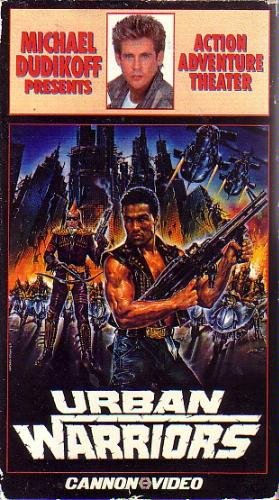
Just some of the countless imitiations spawned by the success of THE ROAD WARRIOR, released throughout the 1980s: