MAD MAX: FURY ROAD (US/Australia - 2015) Directed by George Miller. Written by George Miller, Brendan McCarthy and Nico Lathouris. Cast: Tom Hardy, Charlize Theron, Nicholas Hoult, Hugh Keays-Byrne, Nathan Jones, Zoe Kravitz, Rosie Huntington-Whiteley, Riley Keough, Abbey Lee, Courtney Eaton, Josh Helman, John Howard, Richard Carter, Megan Gale, Melissa Jaffer, Angus Sampson, Richard Norton, iOTA. (R, 120 mins)
Australian auteur George Miller has worked only sporadically in the 30 years since 1985's MAD MAX BEYOND THUNDERDOME, but when he does reappear, he makes it count. He produced the beloved BABE in 1995 and directed 1998's BABE: PIG IN THE CITY, a dark and bizarre curveball of a sequel that baffled everyone but has become a major cult film. In the years since, he's become synonymous with the hugely popular HAPPY FEET films, but MAD MAX: FURY ROAD marks his triumphant return to the franchise he started in 1979 with MAD MAX, one that made Mel Gibson a star and spawned an entire subgenre of post-nuke action films after its sequel THE ROAD WARRIOR opened in the US in the legendary summer of 1982. THE ROAD WARRIOR (released a year earlier in its native Australia as MAD MAX 2) remains one of the most influential action films ever made and one that BEYOND THUNDERDOME probably couldn't have topped even if Miller's mind wasn't elsewhere following the 1983 death of his friend and producing partner Byron Kennedy in a helicopter crash while location-scouting (his name remains on their production company Kennedy Miller Mitchell to this day), prompting a grieving Miller to delegate enough of the film to Australian TV vet George Ogilvie that both Georges shared directing credit. For 30 years, the disappointing-but-OK-on-its-own-terms BEYOND THUNDERDOME, despite such memorable characters as Master Blaster and Tina Turner's Aunty Entity, has remained a lesser conclusion to an otherwise exemplary trilogy.
Miller's had the basic concept of FURY ROAD churning in his head since the late '90s, and tried to get it off the ground in the early 2000s with Gibson returning to his iconic role. But it never materialized into anything more than the idea stage until Miller finally got all the pieces in place with Tom Hardy taking over the Mad Max role from Gibson, who by then was either too old or too much of a tabloid distraction or both. FURY ROAD isn't a reboot, it's not a prequel, and it's not an origin story. It's not even necessarily a sequel as much as it's another Mad Max adventure. It functions as a stand-alone, self-contained piece, much like the old James Bond movies used to do. There's references to things from the earlier films, mainly winking nods to longtime fans (the music box given to The Feral Kid in THE ROAD WARRIOR; a near-subliminal shot of bulging eyeballs from MAD MAX), and 67-year-old Hugh Keays-Byrne, who played MAD MAX's chief villain Toecutter 36 years ago, is onboard as a different villain this time. Much the way THE ROAD WARRIOR blazed trails in the action genre, so does FURY ROAD, with the now-70-year-old Miller unveiling what's likely the best action movie in a generation, effectively showing an entire demographic weaned on CGI and video games and hyper, incoherent, shaky-cam editing how it should be done. Much was made of FURY ROAD's reliance on practical effects and old-school stunt work, though it obviously utilizes CGI to a certain degree. Yes, a couple of shots look a little on the cartoony side, but the other 98% of the time, Miller uses CGI how it should be used: as an enhancement as opposed to a crutch. Even by the standards he set 34 years ago with THE ROAD WARRIOR, the veteran filmmaker outdoes himself with MAD MAX: FURY ROAD, proof positive that underneath his soft-spoken, milquetoast exterior, George Miller is a fucking madman perpetually straddling the fine line between genius and insanity.
Hardy's Max Rockatansky is introduced being abducted by the War Boys, the albino-like minions of wasteland despot Immortan Joe (Keays-Byrne), who sports a plastic casing over his boil-ravaged body and a breathing apparatus permanently attached to his face. Max is kept prisoner as the human blood bag of Nux (Nicholas Hoult), a sickly War Boy who needs frequent transfusions. Immortan Joe is viewed as a deity by his followers, who are kept in line by a very conservatively doled-out water supply and promises of being carried into Valhalla. Not everyone is happy under his rule, particularly one-armed War Rig driver Imperator Furiosa (a terrific Charlize Theron), a buzz-cut, battle-scarred warrior in charge of getting a supply of "guzzoline" from nearby Gastown. Instead, she's stowed away Immortan Joe's five young wives--the very pregnant Splendid Angharad (Rosie Huntington-Whiteley), Toast the Knowing (Zoe Kravitz), Capable (Riley Keough), The Dag (Abbey Lee), and Cheedo the Fragile (Courtney Eaton), all enslaved and kept under lock and key for breeding and sexual purposes--with the intent of taking them to their freedom to a mythical promised land known as "The Green Place." Once Immortan Joe realizes they've gone off the road to Gastown, he and his hulking son Rictus Erectus (Nathan Jones) unleash an army of warriors and War Boys for what's essentially a feature-length, extended chase sequence with a couple of breaks for character development. Max begins the pursuit chained to the front of Nux's car, intravenously connected to him until an epic dust storm separates them from the rest of Immortan Joe's forces and Max forms an unholy alliance with Furiosa. Dialogue is relatively minimal, often with nods or facial expressions often speaking volumes (note Max's only smile--a half-hearted one at that--and the exhausted thumbs-up he gives The Splendid Angharad when she steps up and disposes of a War Boy), and there's little in the way of subtlety: when Max asks Furiosa what she's after, the answer is "Redemption." Well, duh.
But that's not the main concern with FURY ROAD. Miller has fashioned this as a jawdropping epic, with himself the conductor of a batshit symphony of destruction. With a $150 million budget, Warner Bros. has given Miller an astounding amount of leeway in the creation of his latest masterpiece. Filmed in the summer and fall of 2012 in the Namib Desert and Namibia, with other shooting in South Africa and Australia, with some additional reshoots and second-unit work in November 2013, Miller took a Kubrickian amount of time getting FURY ROAD just right, from the action choreography to the vehicles and the costumes to the locations and the production design. I've never seen a film with so many credited assistant directors, assistant editors, and stunt personnel. From the car wrecks to the stunt professionals being hurled through the air or pole-vaulting onto big rigs barreling through the Namib Desert at high speeds, or the flashy Doof Warrior (iOTA), who heads into battle perched atop a War Rig with a flamethrowing double-necked guitar backed by a wall of amps and eight drummers on the trailer behind, MAD MAX: FURY ROAD presents bombastic, skullcrushing action as a work of lunatic art. Describing it not only risks spoiling it, but it in no way does it justice. You've seen films like this before--you just haven't seen them done this way before. Miller, his co-writers Brendan McCarthy and Nico Lathouris, Oscar-winning cinematographer John Seale, and all the technical personnel have achieved a new benchmark in action cinema, and a blistering example of just how placated we've become with what passes for such in most of today's big movies. Miller has bestowed MAD MAX: FURY ROAD on the moviegoing public to remind us of the possibilities and to save the Big Summer Movie from itself. It can be done, because Miller and his cast and crew did it. People still remember the formative experience of seeing THE ROAD WARRIOR for the first time. That's how you'll feel leaving the theater after MAD MAX: FURY ROAD. Can you remember the last time you felt that way? The term "game-changer" gets tossed around a little too liberally these days, but believe the hype. This is the new standard-bearer.
One of the most influential action films of the 1980s, George Miller's THE ROAD WARRIOR is also one of the prime examples of the golden age of Australian cinema. From the mid-1970s through the early 1980s, films like PICNIC AT HANGING ROCK, THE CHANT OF JIMMIE BLACKSMITH, MY BRILLIANT CAREER, BREAKER MORANT, GALLIPOLI, THE MAN FROM SNOWY RIVER, and CAREFUL, HE MIGHT HEAR YOU among many others, achieved critical and commercial success worldwide. Another of the top Australian imports of the time was 1979's MAD MAX, released in the US in 1980 with the Australian-accented actors redubbed by Americans. MAD MAX proved to be a decent-sized hit in the US and gave American audiences their first exposure to Mel Gibson. Gibson returned to the role for MAD MAX 2, released in Australia in late 1981 and retitled THE ROAD WARRIOR for its US release on May 21, 1982, this time keeping the real voices of its cast. Australian exploitation films, dubbed "Ozsploitation" by fans, had been renowned for some time for their innovative action sequences and hair-raising, death-defying stunt work. THE ROAD WARRIOR took this to new levels with its many inventive set pieces and chase sequences set in post-apocalyptic wasteland where Max (Gibson) repeatedly tangles with iconic bad guys Wez (Vernon Wells) and The Humungus (Kjell Nilsson).
US trailer
THE ROAD WARRIOR was an even bigger success than MAD MAX, and resulted in an entirely new post-nuke subgenre--mainly from Italy--films that became fixtures at US drive-ins, in video stores and on late-night cable for the rest of the decade. Even today, virtually any dystopian film with a post-nuke setting owes something to THE ROAD WARRIOR (which itself borrows elements from its contemporaries, namely the STAR WARS wipe transitions), from the desolate locations to the costumes, cars, and weaponry. One look at Wez and you see nearly every villain in any one of these. Portions of the film were even restaged almost wholesale in Neil Marshall's DOOMSDAY (2008), an affectionate tribute to this unique genre that fans, for whatever reason, didn't get. THE ROAD WARRIOR wasn't the first film of this type, but it set a template that countless films followed. Gibson returned once more for 1985's MAD MAX BEYOND THUNDERDOME, and Miller, who most recently directed the two HAPPY FEET films, has tentative plans to reboot the MAD MAX franchise with Tom Hardy in the lead role.
Mel Gibson returns to his star-making role as Max
Vernon Wells as Wez
Kjell Nilsson as the Warrior of the Wasteland, the Ayatollah of Rock n' Rolla: The Humungus!
Bruce Spence as the Gyro Captain
Emil Minty as the lethal boomerang-throwing Feral Kid
Virginia Hey as the Warrior Woman
Also in theaters on this same weekend was Lewis Teague's vigilante thriller FIGHTING BACK, an occasionally ludicrous but much less exploitative take on similar territory explored by DEATH WISH II a few months earlier. It suffered from familiarity not just with the recently-released Charles Bronson hit but also with the similarly-plotted WE'RE FIGHTING BACK, a nearly identically-titled made-for-TV movie from a year earlier, not to mention an Australian "angry young man" drama titled (wait for it)...FIGHTING BACK, that was also released in 1982. The May 21, 1982 FIGHTING BACK disappeared from theaters after a couple of weeks but it's acquired a following over the years thanks mainly to the outstanding performance by Tom Skerritt as a fed-up Philly deli owner who decides to take back his Italian-American neighborhood that's been overrun by pimps and pushers. His pregnant wife (Patti LuPone) mouths off to a pimp and miscarries in the resulting car chase, and his mother walks into a drug store robbery and gets her finger cut off when the creep can't remove her diamond ring from it. Skerritt and reluctant cop buddy Michael Sarrazin form a Guardian Angels-type neighborhood watch group, which results in various political and legal (and marital) scuffles when Skerritt repeatedly takes the law into his own hands. The film rather ham-fistedly speaks to societal concerns of urban crime and decay, and the sensationalizing of violence by the media (it opens with a documentary crew in a news studio using creative editing for a news piece when they're disappointed to discover there's no actual clear footage of Pope John Paul II being shot). It gets pretty silly at times, especially when Skerritt drops a grenade-in-a-water-balloon through the convertible top of a pimp's Cadillac, and with the unlikely casting of Josh Mostel as a drug pusher getting junior-high kids hooked on heroin. Nevertheless, Skerritt's committed, believable performance really sells it, and thus far, it's the only film to ever feature a credit as awesome as "and Yaphet Kotto as Ivanhoe Washington." It's available on Netflix streaming in a cropped, but decent-looking 1.33 print.
Also released May 21, 1982:
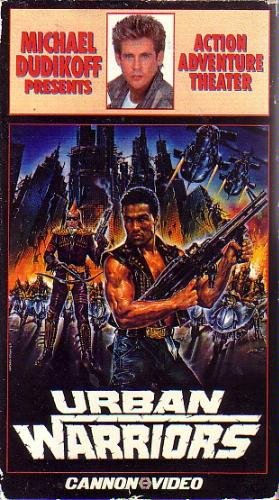
Just some of the countless imitiations spawned by the success of THE ROAD WARRIOR, released throughout the 1980s: