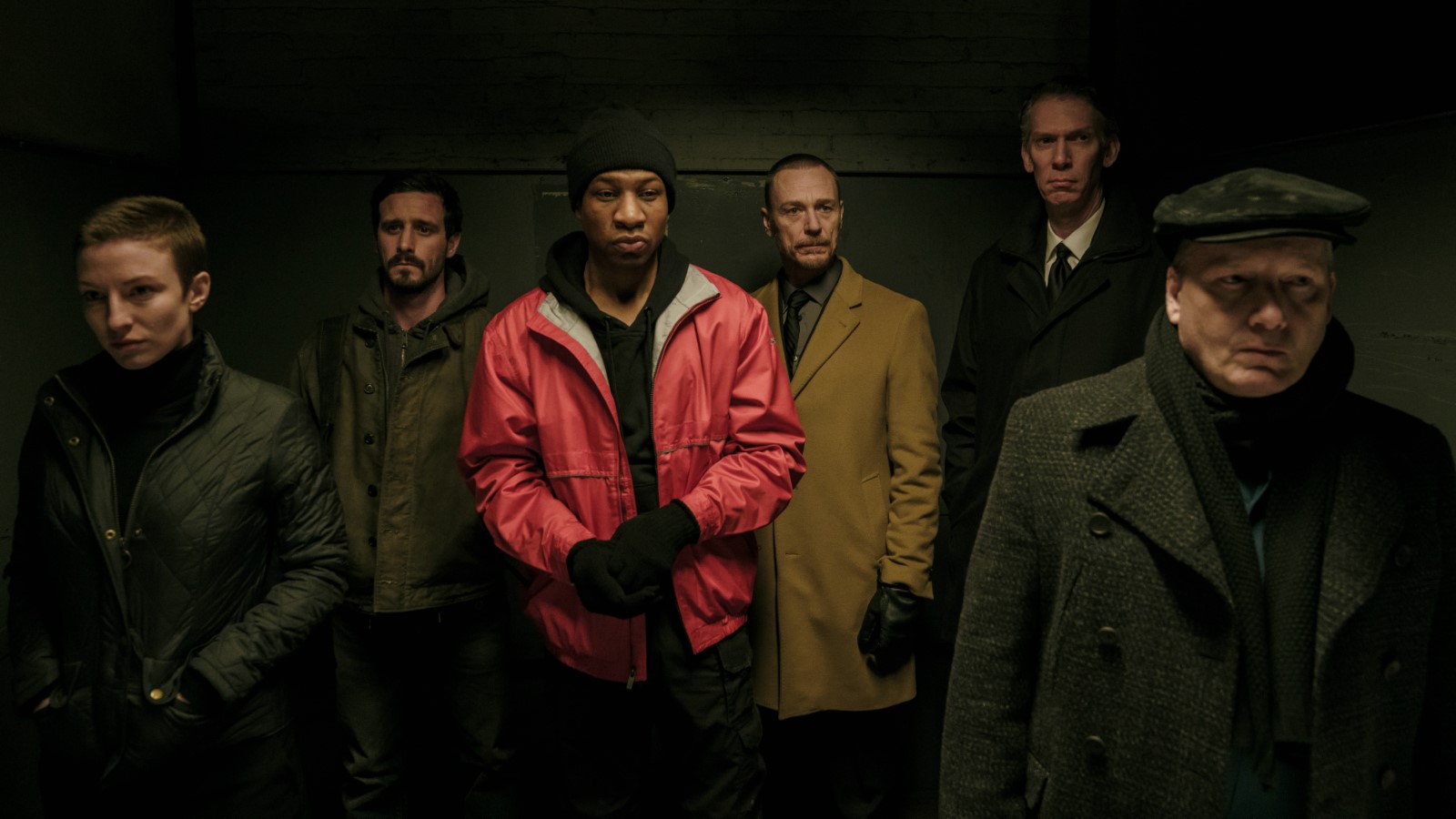
CAPTIVE STATE (US - 2019) Directed by Rupert Wyatt. Written by Erica Beeney and Rupert Wyatt. Cast: John Goodman, Ashton Sanders, Vera Farmiga, Jonathan Majors, Kevin Dunn, James Ransone, Alan Ruck, Kevin J. O'Connor, Colson Baker, Madeline Brewer, Ben Daniels, D.B. Sweeney, Caitlin Ewald, KiKi Layne, Lawrence Grimm, Guy Van Swearingen, Rene Moreno, Michael Collins, Marc Grapey. (PG-13, 109 mins) Sometimes, flawed films that don't quite knock it out of the park end up being more interesting and more worthy of study than those we deem "great." CAPTIVE STATE is the kind of film that--let's just be honest here--is gonna tank in theaters. It's gonna tank hard. It's not what the ads make it look like, it's messy, it's a little disorienting in the way it throws out a lot of exposition in the early going, and it bites off a lot more than it can chew. But there's something here--it's politically and sociologically-loaded with historical metaphors, and takes a unique approach to its subject matter that almost guarantee it'll be the kind of film that has a serious cult following before it even leaves multiplexes in, well, probably a week. Shot two years ago, CAPTIVE STATE's release date was shuffled around multiple times--originally due out in summer 2018--as distributor Focus Features clearly had no idea what to do with it (I mean, what is that poster selling? The other one isn't any better). As a result, they're taking the easiest route possible and pushing it as a rote, run-of-the-mill alien invasion sci-fi actioner like it's another SKYLINE, and that does it a major disservice. Given the state of distribution today, it's a small victory that something like this even got made at all, let alone dumped on 2500 screens to certain doom. It's directed and co-written by Rupert Wyatt, best known for 2011's terrific RISE OF THE PLANET OF THE APES. He directed 2014's THE GAMBLER in the interim, and while it looks like he had to make a few compromises, one can sense that CAPTIVE STATE is a pet project and something he's been ruminating on for quite some time.
In a prologue set in 2019, Earth is the target of an alien invasion. All of the world's major cities are seized by what are initially termed "roaches," alien beings of fluctuating, shape-shifting structure with a porcupine-like exterior. A cop and his wife are killed trying to flee Chicago, making orphans of their two young sons Rafael and Gabriel. Cut to a decade later, and the world remains under control of the "roaches," now known as their preferred title, "The Legislators." All of the governments of the planet acquiesced and ceded control to The Legislators. Everyone is tracked via implant, their actions monitored. Crime has gone down and jobs have increased. Income inequality is greater than ever--the rich have never been richer and the living conditions of the poor are atrocious. Criminals and non-conformists are taken "off-planet," and forced into slave labor, never given any thought by a population that, overall, has it pretty good since the takeover. The Legislators have stuck around and remain underground in major cities beneath "Closed Zones" off limits to humans without special access, usually limited to high-ranking government or police officials who are periodically summoned by The Legislators to receive their marching orders.
Gabriel (Ashton Sanders of MOONLIGHT) lives in the slums of Pilsen and scrapes by working in a factory downloading and cataloging the SIM cards of confiscated cell phones and mobile devices for inspection by The Legislators. He lives in the shadow cast by his big brother Rafael, a legendary resistance leader who was killed a few years earlier when he helped orchestrate a failed uprising that resulted in the complete destruction of Wicker Park at the hands of the outraged Legislators. There's a new insurgent group calling themselves Phoenix, and Chicago cop William Mulligan (John Goodman, in his second teaming with Wyatt after THE GAMBLER) is convinced they're about to strike and further incur the wrath of their extraterrestrial rulers, who have established a near-totalitarian society but remain generally hands-off as long as the ostensible leaders do what they're told and the population behaves itself. He's also watchful of Gabriel, whose father was his old partner back in the day. Sensing that Gabriel has something to do with Phoenix, he monitors his activities and finds out shortly after Gabriel does that Rafael (Jonathan Majors) is alive in the ruins of Wicker Park, having successfully faked his death, removed his tracking device and gone completely off the grid to regroup and lead another revolt to take back the planet. There's a planned 10th anniversary "Unity Rally" celebration for The Legislators at Soldier Field, and Rafael and the members of Phoenix plot an elaborate infiltration of the event that could mean the end of Chicago--and other cities if The Legislators are angry enough--if they fail.
Wyatt and his wife/co-writer Erica Beeney (THE BATTLE OF SHAKER HEIGHTS) aren't really interested in a standard-issue alien invasion chronicle. We've seen INDEPENDENCE DAY and a hundred other movies of that sort, so they take it from a different angle, instead focusing on the insurgency and the dogged attempts of the weary Mulligan--who has conflicts of interest, to put it mildly--to stop it. The best stretch of CAPTIVE STATE is the riveting middle, which deals with Phoenix's planning and executing the Soldier Field "Unity Rally" plot. It's got an almost MISSION: IMPOSSIBLE quality to it, but taken as a whole, the entire film feels like DISTRICT 9 if written by John Le Carre. This is an alien invasion story told in the style of classic nuts-and-bolts espionage. Phoenix uses the personals of the newspaper to communicate to its members; a radio DJ relays coded messages over the air; resistance members have clandestine conversations on still-functioning pay phones; walls barricading Chicago neighborhoods from Closed Zones have a very distinct Cold War-era Berlin look to them; debriefing rooms at the Legislator compounds are filled with interpreters on headsets and look like the drab, chilly offices of the spymasters in TINKER, TAILOR, SOLDIER, SPY; and Goodman even gets to monitor some activities in what looks like a low-tech version of a Bourne crisis suite. There's other, more contemporary jabs at the world's uncomfortable willingness to cave to autocratic rule without question, and the Chicago P.D. engaging in what looks very similar to all manner of "enhanced interrogation" in the style of Gitmo.
Propelled by a killer electronic score by Rob Simonsen, CAPTIVE STATE balances a large number of characters and their locations and unfolds like a compelling page-turner of a novel. It's admirable in its ambition, but yeah, it's not perfect. It doesn't handle Vera Farmiga's character very well, barely utilizing her in what seems to be a nothing role, virtually guaranteeing to the seasoned moviegoer that she'll be the center of any any third act "surprise." And what is intended as a twist ending doesn't play out as well as Wyatt planned, with a reveal that ends up feeling like an unsatisfying deus ex machina that might negate much of what came before. It may not follow through 100%, and it wouldn't be incorrect to say that it collapses when it matters most, but there's a lot of good stuff here that's smart, densely-plotted, thoughtfully-constructed, politically-charged with historical and literary inspiration (Gabriel's oppressive workplace is positively Kafka-esque). You can nit-pick why so many pay phones still exist in 2029 or why The Legislators still allow newspapers, but goddamn, this thing aims for the fences and goes for broke, and there's something to be said for that. It succeeds a lot more often that it fails, and in an era of endless sequels, franchises, remakes, reboots, and soulless, assembly-line, focus-grouped product, something this brazenly original and ambitious deserves to be recognized even if, in the big picture with all things considered, it maybe only rates a "B" instead of an "A+." Shortcomings and stumbles be damned, if a fervent cult following forms around CAPTIVE STATE, count me in.
THE GAMBLER (US - 2014) Directed by Rupert Wyatt. Written by William Monahan. Cast: Mark Wahlberg, John Goodman, Jessica Lange, Brie Larson, Michael Kenneth Williams, George Kennedy, Andre Braugher, Anthony Kelley, Emory Cohen, Alvin Ing, Domenick Lombardozzi, Richard Schiff, Simon Rhee. (R, 111 mins)
In remaking the Dostoevsky-inspired, James Toback-scripted, Karel Reisz-directed 1974 cult film THE GAMBLER, screenwriter William Monahan (THE DEPARTED) and director Rupert Wyatt (RISE OF THE PLANET OF THE APES) initially make a sincere effort to stick to the gritty, character-driven ideals of the source. Many scenes in the early-going are almost defiant in the way they let dialogue-heavy interactions and conversations go on with little concern for audience restlessness and in no hurry at all to move at the quick-cut, short-attention-span pace of most of today's multiplex offerings. In many ways, it's part of a current throwback movement to the 1970s as seen in recent films like THE DROP and A WALK AMONG THE TOMBSTONES. THE GAMBLER '74 had the rock-solid foundation of James Caan entering the post-GODFATHER pinnacle of his career, all cocksure swagger and Sonny Corleone rage as Ivy League-educated, NYU literature prof Axel Freed, who's in debt to loan sharks to the tune of $44,000. Toback's script was largely autobiographical and THE GAMBLER '14 lacks that personal touch and its '70s aesthetic has a certain artificiality to it as the film goes on (gifted prodigies acting out against suffocating family expectations would be a theme Toback explored further in his brilliant 1978 directorial debut FINGERS). While films like THE DROP and A WALK AMONG THE TOMBSTONES have a '70s mindset in the present day, THE GAMBLER '14 strays from its source as it progresses, becoming more beholden to commercial expectations and predictable character arcs, and despite drastically higher stakes thanks to inflation, it never really feels like L.A.-based literature prof and one-and-done novelist Jim Bennett (Mark Wahlberg) is in any serious danger.
Hailed as a bold new voice in fiction in 2007, Bennett never got around to writing that second novel and instead berates his students for their lack of inspiration and effort and not possessing the talent to do so anyway. Amy (Brie Larson), his one student with potential, knows his secret life: she's a waitress at a seedy gambling den owned by Korean mobster Mr. Lee (Alvin Ing), who staked over $100,000 to Jim, who promptly lost it all in one doomed spin of a roulette wheel. These early scenes establish the purely suicidal self-destruction of the character in the same way as the 1974 film, and both Axel Freed and Jim Bennett seem to be rebelling against their family wealth and privileged upbringing. Wyatt wrings considerable suspense out of intensely stomach-turning scenes of an addicted Jim at a blackjack table, $80,000 on the line, angrily demanding another card when he's already at 18. Of course he loses it all--Jim's only really satisfied when he loses it all, and he seeks out the most dangerously shady people imaginable for extra cash, whether it's powerful crime lord Neville Baraka (Michael Kenneth Williams) or God-like loan shark Frank (John Goodman, who's terrific). The film opens with Jim visiting his dying grandfather (George Kennedy sighting!), the 17th-richest man in California, who refuses to leave him any money because he needs to build his character. Once Jim is $260,000 in debt to both Mr. Lee and Neville, and turns down a stake from Frank because he refuses to meet Frank's demand of admitting "I am a piece of shit gambler," and "I am not a man," he hits up his wealthy mother (Jessica Lange), who gives him the money, after which he drives to Vegas with Amy and almost immediately blows it all at a blackjack table.
The relationship that develops between Jim and Amy is one of the more problematic elements of Monahan's script. Monahan tries to draw a parallel between Jim and Amy's alcoholic mother by showing that she's inherently drawn to the addicted and the damaged, but at the same time, her actions and decisions never really feel plausible. She knows what kind of guy Jim is and the sorts of people with whom he's entangled--she even works at an illegal casino--but the character as shown is too level-headed and smart to so easily fall for a shit magnet like Jim. It doesn't help that the film loses track of her as it goes on, and Larson (robbed of an Oscar nomination for last year's SHORT TERM 12) is too good for such a muddled and sketchily-written role. Her attraction to Jim would make a lot more sense if Wahlberg was playing the part like Caan played Axel Freed. Where Axel publicly possessed a magnetic sense of indestructible, self-confident bravado no matter how much money he lost, Wahlberg's Jim is disheveled, glum and glowering, with a constant Joe Btfsplk dark cloud hovering over him from the moment he's introduced. Axel Freed tried to make it rain, it blew up in his face, and he defiantly asked for more, while Jim Bennett just shrugs and places another five-figure bet on one hand. Both are committing slow suicide, but Wahlberg's characterization doesn't have the same sense of consequences-be-damned kamikaze fervor, regardless of how good he is in the role. Caan's Axel Freed came off like a dumbass, but he was a dumbass with balls. Wahlberg's Jim Bennett just comes off like a dumbass.
The change in the main character's mindset probably has more to do with Wyatt and Monahan needing to do something different in order to avoid a straight scene-for-scene remake, but all the changes do is put a spotlight on what worked so well in 1974. Nowhere is this more apparent than in the climax, after which Jim has talked one of his students, a star basketball player and guaranteed NBA prospect (Anthony Kelley) to shave points in a game in order to settle his debt with Neville. Reisz and Toback had Axel Freed celebrate by going to the wrong side of town looking for a fight, getting one, and ending the film in an ambiguous, nihilistic fashion that shows there's no limit to his mad quest to take increasingly dangerous risks, essentially gambling himself to death. Wyatt and Monahan, in accordance with THE GAMBLER '14 being a major-studio movie released at Christmas, have to give Jim a crowd-pleasing happy ending. It doesn't gel with the tone of what came before, and Jim's done nothing to really make the audience care about his shot at redemption. On top of that, too much of the film feels like Scorsese-lite, from the DEPARTED-style soliloquizing of the characters to the classic rock soundtrack, with incongruous reggae covers of Pink Floyd's "Time," and "Money," a Billy Bragg version of Bob Dylan's "Don't Think Twice, It's Alright," and Scala & Kolacny Brothers' take on Radiohead's "Creep."
Whatever the extent of THE GAMBLER '14's problems, the performances aren't among them. A scrawny-looking and obviously committed Wahlberg reportedly dropped 60 lbs and does a solid job with an often unplayable role, and while Amy is a woefully underwritten character, the promising Larson still shines--Wyatt gives her a great and very odd little scene where she's doing this strange walk/dance in slo-mo while heading to class and the actress' goofy facial expressions are guaranteed to turn you into a Brie Larson fan; it's a throwaway moment that almost looks like it's edited together from a set of outtakes, but turns into her best moment in the film. THE GAMBLER '14's biggest strengths come from its supporting cast, with Lange getting a couple of devastating scenes as Jim's mother, torn between her disgust with her son and the hole into which he's dug himself, but also remorseful that maybe his upbringing, her shrewdness, and her obsession with wealth are what drove him to be the fuck-up that he is. Goodman sinks his teeth into his role, frequently seen holding court in a steamroom, telling Jim how to play it smart and get himself to a "Fuck you" position in life, and unable to comprehend Jim's story about how he was once up $2.5 million and lost it all on one hand. It's great seeing 89-year-old Kennedy, an Oscar-winner for 1967's COOL HAND LUKE, back on the big screen again, though his prominent billing and his one minute or so of screen time probably indicate he had a larger role at some point. It's also worth noting that veteran character actor Leland Orser's name turns up in the credits but he's never seen--he was cast as a rival lit professor in a subplot that appears to have been completely excised, along with most of Andre Braugher's scenes as the college dean (he has one brief bit talking to Jim in a hallway), all of which point to some eleventh-hour editing still going on shortly before the film's release (Orser is briefly seen in the trailer). As far as remakes go, you can do a lot worse. THE GAMBLER '14 has its strong points, but ultimately, it pales in comparison to THE GAMBLER '74, which still held up beautifully as of a revisit a month or so ago. The original GAMBLER came out 40 years ago and is still held in high regard today. Will people even remember the remake of THE GAMBLER 40 days from now?