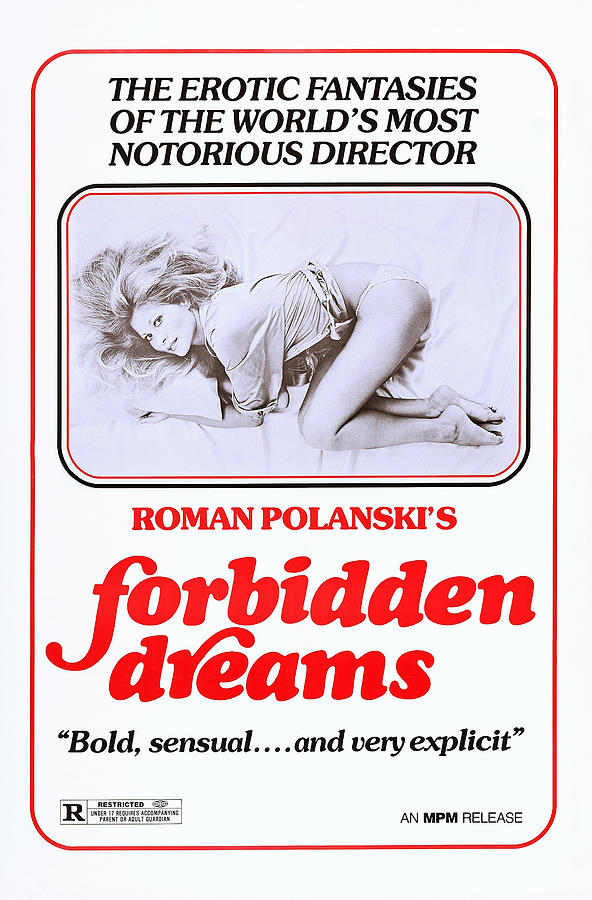
WHAT? aka DIARY OF FORBIDDEN DREAMS aka FORBIDDEN DREAMS
(Italy/France/West Germany - 1972; US releases 1973, 1976, 1979) Directed by Roman Polanski. Written by Gerard Brach and Roman Polanski. Cast: Marcello Mastroianni, Sydne Rome, Hugh Griffith, Romolo Valli, Roman Polanski, Guido Alberti, Roger Middleton, Cicely Browne, John Karlsen, Richard McNamara, Henning Schlueter, Gianfranco Piacentini, Elisabeth Witte. (Unrated, 114 mins) Roman Polanski's most obscure film as a director was made between a pair of masterpieces: his brilliant 1971 adaptation of MACBETH, probably the best screen version of that particular Shakespeare play, and his 1974 classic CHINATOWN, one of the essential films of its decade. To say that Polanski lost his way in between those triumphs is an understatement. WHAT? is a semi-improvised and self-indulgent fiasco, trying to be an exercise in comedic erotica with bawdy and absurdist humor, but testing the patience of even the most devoted Polanskiphile. 21-year-old Sydne Rome, an Akron, OH native who's still active on Italian and German television and whose entire career has been spent in Europe, stars as Nancy, an American hitchhiking through Italy, narrowly escaping a gang rape (played for laughs, as one of the rapists, waiting his turn on Nancy, tries to have his way with one of the other guys) and hiding out at a posh, seaside villa inhabited by all manner of wealthy, high society perverts. After one night in the villa, Nancy's shirt disappears, thereby allowing Rome to spend much of the film topless, wearing only bellbottoms and a dinner napkin tied around her neck. Most of Nancy's time is spent with Alex (the legendary Marcello Mastroianni, in possibly the worst performance of his career), also known as "Coco the Mashed Potato," a syphilitic and possibly gay ex-pimp and sadomasochist prone to dressing in a tiger costume and asking Nancy to whip him before she finally gives into his open-sored charms. Nothing much happens other than Nancy walking around the villa in various states of undress and interacting with other guests, including Polanski as a creep named "Mosquito" talking about his "big stinger," and Romolo Valli as the lecherous Giovanni, who introduces himself to Nancy by going down on her while she's asleep. Eventually, Nancy meets their host, the villa's gravely-ill owner Noblart (Oscar-winner Hugh Griffith, who had just done another Eurosmut film with Pier Paolo Pasolini's THE CANTERBURY TALES), who begs her to bare her body to him before he dies.
Shot mostly at an Amalfi villa owned by producer Carlo Ponti, WHAT? must rank as the second worst thing Polanski's ever done in the home of a celebrity friend. It's one of those films where it's obvious that the actors are having a much better time than the audience, who can't help but get the feeling that the entire film is a long private joke that they're just not being let in on. Polanski and frequent screenwriting partner Gerard Brach seem to be going for a naughty, Bunuel-meets-Pasolini-like spin on Alice in Wonderland, sans Bunuel's mastery of the absurd and Pasolini's predilection for scatological loaf-pinching. After a set piece that finds Alex dressing as Napoleon, slapping Nancy around, and talking to a tree, the film finally, mercifully ends, with a half-assed, Buddy Bizarre breaking of the fourth wall as Nancy escapes from the would-be EXTERMINATING ANGEL bullshit at Noblart's villa and revealing to Alex that "We're in a movie!" as if the inhabitants of the house are trapped in a movie and only she can break free.
Viewers of WHAT? will know how they feel. WHAT? was greeted with respectful reactions from European audiences in 1972 but it took a year to get released by Embassy in the US, where it got an X rating. It also got such a toxic response from critics and audiences that it was quickly withdrawn and shelved after playing in NYC and Chicago. While Polanski went on to accolades with CHINATOWN, WHAT? languished, completely forgotten until it was picked up by the small United National Films in 1976, re-edited without Polanski's involvement from 114 minutes to 94, re-rated R, and retitled DIARY OF FORBIDDEN DREAMS, with a misleading ad campaign that called it "the kinkiest caper of the year" and of course, name-dropping ROSEMARY'S BABY and CHINATOWN. The DIARY version was later acquired by grindhouse outfit Motion Picture Marketing (a company co-owned by mobster Michael Franzese that found a niche in the '80s with vigilante scuzz like SAVAGE STREETS and Italian horror films like Lucio Fulci's THE GATES OF HELL and Bruno Mattei's NIGHT OF THE ZOMBIES) and relaunched once more on the drive-in circuit in 1979 as the shortened FORBIDDEN DREAMS. MPM's poster art sported the tag line "The erotic fantasies of the world's most notorious director," taking queasy advantage of Polanski by then being a fugitive from US authorities for unlawful sexual intercourse with a 13-year-old girl. The 1976 re-edit would later be released on VHS in 1986 by Trans-World Entertainment under its DIARY OF FORBIDDEN DREAMS title, but until now, Polanski's original, 114-minute WHAT? has been almost impossible to see in the US since that aborted rollout in 1973. Severin Films released it on Blu-ray in the UK in 2008 and eight long--but not long enough--years later, they've just recently restored and released it for the US market. Other than the lovely Rome's many nude scenes, WHAT? is an unwatchable home movie, a justifiably buried footnote to a great filmmaker's career that will only appeal to the most fanatical Polanski completist, with only the most delusional apologist finding anything of value in it. That is, unless you've got "seeing Marcello Mastroianni's sagging ballsack" on your bucket list.
VENUS IN FUR (France/Poland - 2013; US release 2014)
In adapting David Ives' play, shifting its location from Manhattan to Paris, and casting his wife Emmanuelle Seigner as one of the two leads, Roman Polanski turns Venus in Fur into an often very personal look at his own obsessions. Perhaps too personal, as the other lead, QUANTUM OF SOLACE Bond villain Mathieu Amalric, looks almost exactly like a younger Polanski. The legendary and always controversial filmmaker, still going strong at 81, tosses in some callbacks to several of his past works, from CUL-DE-SAC (1966) to BITTER MOON (1992) to DEATH AND THE MAIDEN (1994) and even THE TENANT (1976), as playwright and first-time director Thomas Novachek (Amalric) adapts Leopold Von Sacher-Masoch's scandalous 1870 novel as a modern stage production and gets a late audition in Vanda Jourdain (Seigner) that goes places he never expected. Vanda, conveniently named after the dominating mistress of the book, is brash, rude, and pushy, and seems ill-prepared and not very articulate ("I'm like, demure and shit"). But when she starts reading, something clicks and Thomas is transfixed. Soon, the dialogue of the play starts mirroring the developing situation between them as Vanda, who somehow knows the play front to back even though Thomas hasn't given the complete script to anyone, slowly peels away at Thomas' exterior and forces him to reveal his true submissive nature while his fiancee keeps calling to see why he's so late getting home. Polanski plays visual tricks throughout, like an increase of shots staged in a way that Seigner towers over Amalric, and indulging in some cruelly sick humor like a spotlight on a large phallic cactus prop with two bushes on each side of its base (left over from a musical production of STAGECOACH, Thomas explains earlier) during the moment of Thomas' ultimate emasculation at the hands of Vanda.
While best known to mainstream audiences for Hollywood hits like ROSEMARY'S BABY (1968) and CHINATOWN (1974), Polanski has repeatedly utilized claustrophobic settings and seems to have a particular affinity for putting as few characters as possible in very tight quarters, going all the way back to his 1962 debut KNIFE IN THE WATER. His previous film, 2011's CARNAGE, had four characters seemingly trapped EXTERMINATING ANGEL-style in an apartment as they argued over a playground scuffle between their children. It, too, was based on a stage play and Polanski did a good job of creating fluid camera movements to alleviate the confined nature and make it more cinematic. He tries to replicate that feeling with VENUS IN FUR, but with two less protagonists, increased staginess is inevitable and at times, the verbal sparring and psychological gamesmanship grow tiresome (it helped that CARNAGE ran a brief, brisk 81 minutes). Still, Seigner and Amalric are excellent even though you can't help but wonder if Polanski is revealing a bit too much of his and Seigner's relationship here. It can't be coincidental that Amalric can practically function as a Polanski doppelganger while Seigner spends most of the film strutting around the theater in high heels and a seemingly painted-on leather bustier. Maybe the couple's next collaboration should just be a leaked sex tape. (Unrated, 96 mins) WITCHING & BITCHING (Spain/France - 2013; US release 2014)
Spanish filmmaker Alex de la Iglesia has frequently been compared to Mexico's Guillermo del Toro, as both arrived on the scene around the same time (de la Iglesia with 1993's ACCION MUTANTE, and del Toro with 1992's CRONOS), and both made their name in fantasy/horror. This is probably more so with del Toro, who has stayed under that umbrella while de la Iglesia has frequently dabbled in other genres but remained true to his kinetic, gonzo style. While del Toro has gone on to commercial fame and fortune, de la Iglesia remains on the fringes of cult cinema stateside, with his one attempt at a Hollywood blockbuster--a late '90s big-screen version of the video game DOOM that was set to star Arnold Schwarzenegger--falling apart in pre-production (it was eventually made by Andrzej Bartkowiak in 2005, with Karl Urban and The Rock). De la Iglesia still hasn't had a major breakthrough in the US but enjoys a respectable cult following thanks to oddities like 1997's DANCE WITH THE DEVIL, aka PERDITA DURANGO, a road thriller with a bizarre cast featuring Rosie Perez, Javier Bardem, Screamin' Jay Hawkins, Don Stroud, REPO MAN director Alex Cox, and James Gandolfini in a plot that involves homicidal lovers on the lam, explicit sex, kidnapping, rape, incompetent feds, voodoo, pedophilia, and a big rig transporting black market human fetuses across the US/Mexico border and isn't likely to be mentioned by Perez on THE VIEW anytime soon. He also tried his hand at formulaic mysteries with the forgettable Elijah Wood thriller THE OXFORD MURDERS (2008), but de la Iglesia's milieu is over-the-top insanity, and his latest, the horror-comedy WITCHING & BITCHING, finds the director in his primary comfort zone.
Owing a debt to many things, but primarily FROM DUSK TILL DAWN in its shifting structure, WITCHING & BITCHING opens very promisingly with a team of strangers pulling a jewelry store heist in the middle of a busy Madrid shopping square. They're dressed as costumed entertainers for the outdoor mall, which allows us the unique sight of a machine-gun-toting SpongeBob Squarepants. Ringleader Jose (Hugo Silva) is dressed as a silver-painted Jesus and brought along his young son Sergio (Gabriel Delgado) since he didn't want to miss a visitation day. A few of the makeshift gang are killed or apprehended, but Jose gets away with Tony (Mario Casas) and they carjack a cab, thereby involving driver Manuel (Jaime Ordonez) and his fare (Manuel Tallafe), with the cops and Jose's enraged ex-wife Silvia (Macarena Gomez) in hot pursuit. Heading to France, they end up in the small Spanish town of Zugarramurdi, known for its centuries-old witch trials. Sure enough, they've been lured there by a witches' coven led by Gracia (Almodovar regular Carmen Maura), desperate to sacrifice men to a giant, grotesque female god and anoint Sergio as "the chosen one," with Gracia's sympathetic, rebellious daughter Eva (Carolina Bang, de la Iglesia's wife) the sole voice of reason trying to help the guys out of their situation. WITCHING & BITCHING is all over the map, making obvious statements about men and women, with the guys venting that all the women in their lives are "witches" before running afoul of actual witches. And the witches spend their downtime talking about men and articles they read in Cosmo. In addition to shifting gears from heist thriller to spoofy horror, de la Iglesia also manages to work in demonic possession, supernatural rom-com, escalating homoerotic tension between the two detectives (Pepon Nieto, Secun de la Rosa) investigating the robbery, and the witches turning into a sprinting zombie horde before finally settling on a CGI-heavy knockoff of the remake of THE WICKER MAN, with ballbusting witches settling the score with misogynists everywhere. It's never meant to be taken seriously, right down to the casting of de la Iglesia regular Santiago Segura--the Spanish Clint Howard--and Carlos Areces (star of de la Iglesia's THE LAST CIRCUS) in drag as catty witches and a comical henchman played by Enrique Villen, who looks like the perfect genetic fusion of Marty Feldman and Sid Haig. There's a frenzied, anarchic Joe Dante-meets-Peter Jackson-meets Edgar Wright ethos here amidst the digital splatter and the embarrassing, Asylum-level CGI, but it basically degenerates into a series of undisciplined and increasingly random homages that never really come together. De la Iglesia's enthusiasm is admirable, but he simply doesn't know when or where to stop, and at nearly two hours, it's exhaustingly overlong for such slight material. (Unrated, 114 mins)