SPLIT SECOND (UK - 1992) Directed by Tony Maylam and Ian Sharp. Written by Gary Scott Thompson. Cast: Rutger Hauer, Kim Cattrall, Neil Duncan, Michael J. Pollard, Alun Armstrong, Pete Postlethwaite, Ian Dury, Tony Steedman, Steven Hartley, Sarah Stockbridge, Ken Bones, Dave Duffy, Stewart Harvey-Wilson, Paul Grayson, Chris Chappel, John Bennett. (R, 91 mins) "We need to get bigger guns! Big fucking guns!" Few films scream "early '90s at the video store" like SPLIT SECOND. After making a quick exit from American theaters in May 1992, the British import went on to be discovered by a more appreciative audience on home video, where it got a second wind and became a legitimate word-of-mouth cult hit. It's also an essential for fans of Rutger Hauer, by then a fixture in B-movies, with SPLIT SECOND being one of his best. He stars as Harley Stone, a renegade, plays-by-his-own rules cop in a near-future hellscape of 2008 London, with the city feeling the effects of global warming and largely submerged in perpetual flooding after 40 days and nights of torrential rain. It's a dark, dreary, smoggy, neon-lit, waterlogged hellhole with a production design that's typical of dystopian British cinema of the time, whether it's Richard Stanley's HARDWARE (1990), Bob Keen's PROTEUS (1995), and Stephen Norrington's DEATH MACHINE (1995) to name a few. Norrington would go on to direct big-budget Hollywood productions like BLADE (1998) and THE LEAGUE OF ORDINARY GENTLEMEN (2003), but before that, he worked on the effects and design crew of both HARDWARE and SPLIT SECOND, making him a key figure in this period of British genre fare. SPLIT SECOND had a long and troubled journey to the screen, with the script by Gary Scott Thompson (who would later go on to co-write THE FAST AND THE FURIOUS and subsequently cash in on that "Based on characters created by" action) initially making the rounds in 1988 as an L.A.-set Satanic serial killer thriller titled PENTAGRAM and written with Harrison Ford in mind. That never happened, as it ended up being put in turnaround after the similar Lou Diamond Phillips chiller THE FIRST POWER hit theaters in 1990.
After some rewrites and some additional tweaks and several title changes, the script made its way to Hauer and he liked it. Production began in June 1991 with director Tony Maylam (best known for 1981's post-FRIDAY THE 13th slasher THE BURNING) at the helm. Rewrites continued throughout the shoot and after several weeks, Maylam exited the production over "creative differences" and Ian Sharp (THE FINAL OPTION) was brought in to finish the film, with an "additional sequences directed by" credit at the end. SPLIT SECOND is pretty incoherent at times, and the end result barely hangs together, but it's got enough style, action, and Rutger Hauer being fucking awesome that it succeeds in spite of everything wrong with it. Like any cop who plays by his own rules, Hauer's Stone is constantly on suspension, and often so out of control that it's not unusual for him to be detained and placed under psychiatric observation. He "lives on anxiety, coffee, and chocolate" in a hoarders' nightmare shithole of an apartment that would take several deep cleanings to reach condemned status. He hasn't been the same since the murder of his partner in the line of duty, and not even a brief fling with the partner's widow Michelle (Kim Cattrall) made things any better. That was three years ago, and now the same Satanic serial killer who killed his partner is back (we know this because "I'm back!" is tauntingly written in blood at a murder scene), offing victims, ripping out their hearts, and sometimes eating them. Stone ("I work alone!") is teamed with dweeby, brainy new partner Dick Durkin (Neil Duncan) in a classic "...if they don't kill each other first!" mismatch, but they gradually bond amidst constant ballbusting and quotable dialogue. The body count continues to rise, there's something about the murders taking place at the start of the new moon when the tide is highest, and the killer is some kind of ten-foot-tall supernatural creature that's able to absorb the DNA of its victims both dead and surviving, which explains why Stone has developed a psychic connection to it, having been scratched and left scarred in a confrontation years earlier.
SPLIT SECOND's wild plot developments have a pretty obvious "making it up as they go along" aura, but Hauer and Duncan are such a great team that you can't help but roll with whatever bullshit the filmmakers throw at you (there's a scene where they're jawing at each other as Duncan breaks and Hauer starts grinning but keeps it together, and they just left it in, and you know what? It's perfect). They bust each other's chops, they get chewed out by their blustering boss Thrasher (Alun Armstrong as Bob Hoskins as Frank McRae), and Stone has a perfect foil in asshole, desk jockey precinct adversary Paulsen (a pre-mainstream success Pete Postlethwaite), which generates some amazing shouting throughout, particularly during one epic rant from Armstrong. Duncan's manic, Roy Scheider-like freakout after a near-fatal encounter with the creature ("We need bigger guns!") got a lot of laughs in the theater, as did any number of zingers like "Zip up, Dick," Stone's coffee-stirring staredown with Paulsen, and his incredulous reactions to Durkin's repeated boasting about how much he gets laid and how he manages to work it into the conversation ("You read these?" Stone asks, seeing books on demonology and astrology in Durkin's car, with Durkin deadpanning "Yeah, last night. After sex"). In a perfect world, SPLIT SECOND would've been a huge hit and Hauer and Duncan would've teamed up as Stone and Durkin for at least two sequels in the future London dystopia version of the LETHAL WEAPON franchise.
It all leads to a showdown in the ruins of the London Underground, where Stone and Durkin are taken by the reluctant Rat Catcher (Michael J. Pollard, cast once again as "Michael J. Pollard"). Pollard shows up 75 minutes into the 91-minute film, and everything from his first appearance through the gory climactic showdown in the abandoned subway station was directed by Sharp after Maylam left. SPLIT SECOND was one of only a handful of titles released by the short-lived InterStar Releasing, a company whose fate was pretty much sealed when they kicked things off with 1991's universally-loathed HIGHLANDER 2: THE QUICKENING. SPLIT SECOND was InterStar's fourth and final release, the other two in between being Keith Gordon's acclaimed A MIDNIGHT CLEAR and the Christopher Lambert/Diane Lane chess thriller KNIGHT MOVES (why isn't that on Blu-ray?). A quality edition of SPLIT SECOND has been hard to come by, but that situation's been remedied with the new Blu-ray from MVD (because physical media is dead), which includes a ton of interviews with Duncan (who now goes by Alastair Duncan) and several crew members, some vintage behind-the-scenes footage and, as an additional bonus, a standard-def transfer of the 96-minute Japanese release which restores Roberta Eaton's performance as Durkin's oft-mentioned girlfriend, which was cut from the film everywhere else in the world even though her name is still in every version, even with an "introducing" credit!
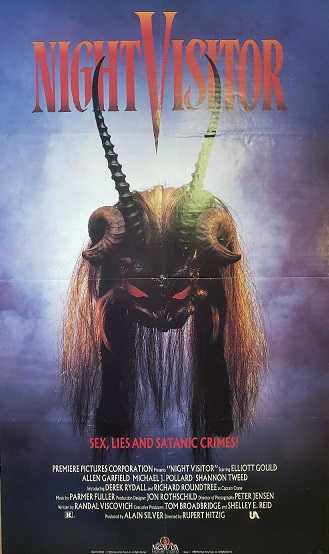
NIGHT VISITOR (US - 1989) Directed by Rupert Hitzig. Written by Randal Viscovich. Cast: Elliott Gould, Allen Garfield, Michael J. Pollard, Shannon Tweed, Richard Roundtree, Derek Rydall, Brooke Bundy, Teresa Vander Woude, Scott Fults, Kathleen Bailey, Teri Weigel, Henry Gibson, Bruce Kimmel, Ann Dane. (R, 93 mins) A ludicrous "Satanic Panic" riff on the '80s horror favorite favorite FRIGHT NIGHT with a bit of Hitchcock's REAR WINDOW, 1989's NIGHT VISITOR (just out on Blu-ray from Scorpion because physical media is dead), was pretty much swept under the rug by MGM/UA, who only got it on a handful of screens in a very limited release before it turned up in every video store in America. Horndog high school prankster and bullshit artist Billy Colton (Derek Rydall) gets pretty excited when sultry tease Lisa (Shannon Tweed) moves in next door. His mom sends him over with a gift basket and he gets a peck on the cheek goodbye as Lisa welcomes an older gentlemen friend at the door. His bedroom window happens to face hers, so he digs out a long-unused telescope and watches her having sex with the man, and from her look toward his window with a smile and wink, she seems perfectly OK with his newfound interest in voyeurism. When another guy stops over the next night, Billy is convinced she's a high-class prostitute but his dork buddy Loomis (Scott Fults) and platonic crush Kelly (Teresa Vander Woude) think he's full of shit. Determined to convince them of his hunch, Billy gets a ladder and takes a camera up to Lisa's roof to peep in her candle-illuminated bedroom window to get proof. Of course, it's the exact moment when a screaming Lisa, handcuffed to the bed, is stabbed to death by a robed figure wearing a horned goat mask as part of a Satanic sex ritual. Billy is attacked through the window by the killer and manages to snap some shots in the process before ripping off the goat mask. And wouldn't you know it? The killer is Billy's asshole history teacher Mr. Willard (Allen Garfield), who just had him suspended for excessive tardies and setting off an explosive whoopee cushion in class, which was actually dumbass Loomis' doing.
Capt. Crane (Richard Roundtree as yet another irate police captain in a late '80s B-movie) seems skeptical of Billy's story, especially with his history of pranks and dog-ate-my-homework lies, the fact that there's no photos of the killer since he forgot to take off the lens cap, and that he was on Lisa's roof peeping in the first place. But Crane is dealing with a series of serial ritual-style murders of prostitutes, with Lisa the latest victim, so he visits Willard's house and finds him and his half-wit brother Stanley (Michael J. Pollard, cast radically against type as "Michael J. Pollard") weird enough to consider Willard a person of interest. As well he should, since Willard permits Stanley to keep a hooker (Teri Weigel) chained up and ball-gagged in the basement as a human toy, and Willard starts threatening Billy over the phone and after class (cutting off a snip of his hair for a future ritual) since he knows his secret. With no one to turn to, Billy reaches out to his late father's buddy--alcoholic, retired forensics cop Devereaux (Elliott Gould)--to help prove Willard's guilt.
Cranked out in two-and-a-half weeks by debuting director and former producer (ELECTRA GLIDE IN BLUE, WOLFEN, JAWS 3-D) Rupert Hitzig, NIGHT VISITOR never takes itself too seriously. Or rather, the legitimate actors working through a career slump because they've got bills to pay never take it too seriously, with Pollard in particular grinning and smirking throughout and looking openly contemptuous of the material. Top-billed Gould doesn't even appear until halfway through and doesn't really look like he wants to be there, even though a hilarious climactic showdown pitting a shotgun-toting Gould against a chainsaw-wielding Pollard is almost worth the price of admission. NIGHT VISITOR might've worked more effectively if Garfield (also Gould's nemesis in Peter Hyams' amazing BUSTING) and Pollard weren't goofing off like a comedy team most of the time. From Mr. Willard's first appearance being a fussy, irritable prick to his students, a toupeed Garfield--a Character Actor Hall of Famer in the news a few months ago as one of the first Hollywood figures to succumb to COVID-19, contracted in a nursing home where he was living after a massive stroke in 2004--plays the character like a comical creep, coming off less like a malevolent threat along the lines of Chris Sarandon's vampire in FRIGHT NIGHT and more like a Satanist George Costanza.
As played by Garfield and Pollard, there's no way a pair of clowns like Willard and Stanley could get away with these murders for as long as they do. The name actors probably got onboard because they knew Hitzig from his producing days, which would explain Henry Gibson's improbable casting as a police department psychologist (Gibson, Garfield, and Gould were all in Robert Altman's NASHVILLE in better days). The best part of NIGHT VISITOR is Tweed, who's killed off rather early but is an absolute charmer in her brief screen time (the wink and the goofy grin she gives Billy as he spies on her from his bedroom feels like something she came up with on her own), and was always a better actress than her prolific career in countless unrated DTV erotic thrillers in the '90s would indicate. This also marked the beginning of Rydall's very short-lived career as a horror star, following this with the title role in the same year's PHANTOM OF THE MALL: ERIC'S REVENGE and the 1991 cult favorite POPCORN before quitting acting to become a writer, scripting several episodes of POWER RANGERS WILD FORCE and the sixth BEETHOVEN movie.
FM (US - 1978) Directed by John A. Alonzo. Written by Ezra Sacks. Cast: Michael Brandon, Eileen Brennan, Alex Karras, Cleavon Little, Martin Mull, Cassie Yates, Norman Lloyd, Linda Ronstadt, Jimmy Buffett, Jay Fenichel, James Keach, Joe Smith, Tom Tarpey, Tom Petty, Janet Brandt, Mary Torrey, Terry Jastrow, Cissy Wellman, Robert Patten, Brenda Venus, REO Speedwagon. (PG, 104 mins) Long erroneously credited with being the inspiration for WKRP IN CINCINNATI, which was in development at CBS at the same time, FM, released by Universal in the spring of 1978, is a killer soundtrack in search of a movie. The soundtrack, a time-capsule snapshot of 1978 rock radio with the title track written for the film by Steely Dan, ended up being a huge seller and was far more popular than the movie, which did only middling business. It's easy to see why: for a comedy, it's rarely laugh-out-loud funny, and the dramatic elements are managed in a heavy-handed way that leads to a contrived feelgood ending that comes off as phony and unearned. The cast is likable, though it might've helped to have someone more magnetic than Michael Brandon in the central role. Best known for his debut in 1970's acclaimed LOVERS AND OTHER STRANGERS and, if you're a horror fan, Dario Argento's 1971 giallo FOUR FLIES ON GREY VELVET, Brandon had a rare big-screen lead with FM at a time when he was pretty firmly entrenched as a TV actor or an occasional support (fourth-billed in 1980's A CHANGE OF SEASONS, for instance, after Shirley MacLaine, Anthony Hopkins, and Bo Derek). Just out on Blu-ray from Arrow (because physical media is dead), FM stars Brandon as Jeff Dugan, the program director and morning drive-time deejay at L.A.'s second highest-rated FM station QSKY. He manages a motley crew of characters, including Mother (Eileen Brennan), the aging veteran who's getting burned out with the weirdos who call in; Doc (Alex Karras), whose low ratings and country & western playlist in the pivotal afternoon slot ultimately cost him his job; Dugan's on-again/off-again girlfriend Laura (Cassie Yates), promoted from fill-in and weekends to replace Doc; the Prince of Darkness (Cleavon Little), who has the midnight-6am slot; and the mercurial Eric Swan (FERNWOOD 2 NIGHT star Martin Mull in his movie debut), the evening deejay who's hired an agent and is constantly looking to parlay his on-air popularity into something more, like hosting a game show, but is time and again his own worst enemy.
QSKY's corporate owners send in sales stooge Regis Lamar (Tom Tarpey) to drum up advertising, even calling on a friend in the Army to set up a deal where QSKY will play corny military recruitment jingles throughout the day. Of course, Dugan is vehemently against the idea, arguing that the station is already profitable and it has to be about more than dollars ("Wall-to-wall commercials!" Lamar beams, with Dugan sneering "Yeah, too bad we can't get rid of the music completely!"). Eventually, Dugan is canned after refusing to go along with corporate's directive, prompting Mother, Swan, and the rest of the staff to announce an on-air strike, barricading themselves in the building as fans riot outside to the tune of Queen's "We Will Rock You." Dugan is introduced speeding to work and avoiding the cops to the Eagles' "Life in the Fast Lane," and Swan has an on-air meltdown to Player's "Baby Come Back." Hardly a minute goes by without some now-classic rock staple putting in an appearance (here, check out the incredible tracklist; Anchor Bay released this on DVD many years ago and it's hard to believe they and now Arrow were able to clear all the music rights), and there's certainly an argument to made that FM's soundtrack is better than any K-Tel compilation of the day or as effective as any late '70s rock playlist you would create today (Fleetwood Mac's "Don't Stop" is also in the movie, but isn't on the soundtrack album). You also get live concert footage of Jimmy Buffett and Linda Ronstadt, and, in a canny display of corporate synergy, MCA Records rising star Tom Petty drops by the QSKY studio to plug his new single "Breakdown" and be interviewed on air by Dugan and Laura.
Much of the musical talent was corralled by executive producer/record exec/talent manager Irving Azoff, who ultimately had his name taken off the credits after a disagreement with Universal. The music is phenomenal and scenes like Dugan and Mother hosting an REO Speedwagon meet-and-greet at an L.A. Tower Records are priceless, but storywise, there just isn't much here. The lone feature directing effort by renowned cinematographer John A. Alonzo (CHINATOWN), FM is clearly the work of a D.P., with effective use of windows, glass, and reflections throughout, but is also saddled with a TV look at times, especially the climactic riot, which Alonzo is forced to stage in what looks like a cramped corner on a laughably unconvincing Universal backlot. The scant laughs usually come courtesy of Mull, whether he's getting blown by a fan in the deejay booth and unaware that he's on the air, or having one of his many diva moments where he goes silent with dead air, then comes to his senses by telling listeners that he just played the new single by Marcel Marceau. Both Brandon's Jeff Dugan and Gary Sandy's Andy Travis on WKRP IN CINCINNATI were based on famed KMET program director "Captain Mikey." But the difference between FM and WKRP is that FM errs in taking itself far too seriously, even if it gives Brennan some fine dramatic moments, like when she decides to quit, telling Dugan "I need more than five hours a night ego-tripping in this toy store." FM suffers from its inability to decide if it wants to be an insightful drama about the inner workings of a radio station or a wacky comedy about a zany crew of misfits who play by their own rules. It ends up falling short at both ends, and all that's left is the music, which, in this instance, is enough to justify its cult status.
FM opening in Toledo, OH on 5/5/1978
BETWEEN THE LINES (US - 1977) Directed by Joan Micklin Silver. Written by Fred Barron. Cast: John Heard, Lindsay Crouse, Jeff Goldblum, Gwen Welles, Bruno Kirby, Stephen Collins, Jill Eikenberry, Lewis J. Stadlen, Michael J. Pollard, Jon Korkes, Lane Smith, Joe Morton, Richard Cox, Marilu Henner, Raymond J. Barry, Gary Springer, Susan Haskins, Charles Levin, Guy Boyd, Martina Deignan, Robert Costanzo, John H. Gartner, Douglas Kenney, Southside Johnny and the Asbury Jukes. (R, 101 mins) Released a year before FM, BETWEEN THE LINES follows a similar formula and has many funny moments with several irreverent smartasses among its character ensemble, but it's a more observational piece of a specific time and place, with counterculture disillusionment setting in and the realities of "adulting" (to use the parlance of our times) and a changing business structure taking hold. Like FM, BETWEEN THE LINES saw the corporate nature of the '80s coming before it did, but many of the characters in BETWEEN THE LINES weren't paying attention to Peter Fonda's despondent "We blew it," near the end of EASY RIDER. The alternative Boston newspaper The Back Bay Mainline is at a turning point. Once a beacon of the underground and the counterculture going back to the late '60s, it's now gone relatively mainstream, with publisher Stuart (Richard Cox) needing more ad revenue to keep the paper afloat and pay the staff. Editor Frank (Jon Korkes) doesn't want to sacrifice copy and keeps butting heads with dweeby, bow-tied advertising sales director Stanley (Lewis J. Stadlen), who insists they need to cut down copy and increase ads to stay profitable. Stanley's the kind of guy who's only too happy about the rumors swirling that Stuart is looking to sell the paper to Roy Walsh (Lane Smith), a powerful business mogul who's amassing a print media empire, a move that will instill a sense of across-the-board policies and likely push out the writing staff, anchored by mainstay Harry Lucas (John Heard), once a counterculture hero in Boston but now just jaded, cynical and barely showing up for work.
At one point, Frank tells Stanley "There's two kinds of writers here: they're either on their way up or on their way down." There's also Michael (Stephen Collins), who's shopping around for a book deal to leave the Mainline behind and go to NYC, though colleague and girlfriend Laura (Robert Altman vet Gwen Welles) wants to stay put; photographer Abbie (Lindsay Crouse), who has an on-again/off-again thing going with Harry and often proves better at his job than he is; ambitious David (Bruno Kirby), who still wears a tie to work; the eccentric "Hawker" (Michael J. Pollard, cast radically against type as "Michael J. Pollard"), a seemingly homeless man who sleeps in the office and sells copies of the paper on the street; Max (Jeff Goldblum), the popular, wisecracking music critic who keeps failing to convince Stuart and Frank that his loyal following warrants a raise from his current pay of $75 per week; and Lynn (Jill Eikenberry), the sweet receptionist who has to put up with all of them. They do what they do because they love the job or, in Harry's case, what the Mainline once was, even though it pays so little that most of them have second jobs, with Max scrounging for extra cash by selling promo copies of reviewed LPs to a used record store down the street.
Directed by Joan Micklin Silver, who found much acclaim with her 1975 debut HESTER STREET (which earned Carol Kane a Best Actress Oscar nomination) and would go on to direct 1988's CROSSING DELANCEY among several other films, BETWEEN THE LINES deftly captures the mood, the spirit, and the lingo of working at a small publication that's struggling to keep the lights on. That's not surprising, as screenwriter Fred Barron (who would go on to create the Lea Thompson sitcom CAROLINE IN THE CITY) spent time in the early '70s working at the Boston alternative weekly The Real Paper, the most obvious influence on the Mainline. Amidst its serious issues and its predictions of exactly how corporate America would take over the news business (also hammered home a year earlier in the scathing NETWORK), with Walsh ultimately buying the paper and saying he wants to keep things the way they are but reminding Frank on day one that "I run several newspapers...I can have a staff in here tomorrow," there's a lot of laughs. They come mostly from Goldblum, in one of the earliest presentations of his "Jeff Goldblum" persona, and future Character Actor Hall of Famer Raymond J. Barry, not a guy generally known for his comedy skills, steals the one scene he's in as a crazed "conceptual artist" with long hair and overalls, barging into the office, smashing Lynn's typewriter to the floor and declaring "I call that 'End of Communication.'" Critically acclaimed at the time, BETWEEN THE LINES, like HESTER STREET, was released independently through Midwest Films, a company founded by Micklin Silver and her husband Raphael Silver. It didn't get a lot of theatrical exposure, though it was rescued from obscurity with a recent Cohen Media restoration that had a limited run in NYC and L.A. before hitting Blu-ray (Collins, his career essentially over following 2014 revelations of past instances of sexual contact with minors going back to 1973, is noticeably left out of the credits on the Blu-ray packaging). It's a time capsule from an bygone era that's never coming back, and with a great ensemble of young actors about to go places (Marilu Henner has a small role as a stripper, a year before TAXI), plus live footage of Southside Johnny and the Asbury Jukes and a cameo by National Lampoon co-founder Douglas Kenney. It's oddly fitting that both it and FM have been resurrected on Blu-ray at exactly the same time.
AMERICAN GOTHIC (UK/Canada - 1988) Directed by John Hough. Written by Burt Wetanson and Michael Vines. Cast: Rod Steiger, Yvonne De Carlo, Michael J. Pollard, Fiona Hutchison, Sarah Torgov, Mark Lindsay Chapman, Janet Wright, William Hootkins, Mark Erickson, Carolyn Barclay, Stephen Shellen. (R, 89 mins)
Recently released on Blu-ray by Shout! Factory, 1988's AMERICAN GOTHIC is a demented gem of a horror movie with a small cult following of fans who have largely kept it to themselves. The film has fallen off the radar somewhat even though the Vidmark VHS was a ubiquitous presence in every video store in America back in the day. Made at a time when horror was defined mostly by special effects and Freddy Krueger, it's something that probably would've gotten more attention a decade earlier during the post-TEXAS CHAINSAW MASSACRE era or a couple of decades later circa THE DEVIL'S REJECTS, a time when its deranged family of homicidal, inbred religious zealots could've allowed for more sociopolitical satire. AMERICAN GOTHIC was directed by veteran journeyman John Hough, whose hired-gun filmography ran the gamut from British horror (1971's TWINS OF EVIL, 1973's THE LEGEND OF HELL HOUSE) to American car chase actioners (1974's DIRTY MARY, CRAZY LARRY) to Disney (1975's ESCAPE FROM WITCH MOUNTAIN, 1978's RETURN TO WITCH MOUNTAIN, 1980's THE WATCHER IN THE WOODS) to drive-in horror sleaze (1982's THE INCUBUS) and terrible DTV sequels (1988's HOWLING IV: THE ORIGINAL NIGHTMARE). Retired since the 2002 DTV Patsy Kensit thriller BAD KARMA, Hough was always a director who took whatever gigs came his way, but with THE LEGEND OF HELL HOUSE and DIRTY MARY, CRAZY LARRY, he's got a couple of legitimately great films to his credit. AMERICAN GOTHIC is one of the better works from the inconsistent, clock-punching latter half of his career, sandwiched between the time-travel misfire BIGGLES and the dull HOWLING IV.
Just released from a mental hospital following a breakdown after her infant son drowned in the bathtub while she was on the phone, Cynthia (Sarah Torgov) is looking to rebuild her life with sympathetic husband Jeff (Mark Erickson). To keep Cynthia occupied and to show support, Jeff has arranged a weekend getaway with two other couples, chartering a small plane for a camping and fishing trip in the northwest, off the coast of Washington state. Engine trouble forces the plane to land at what appears to be a deserted island. The three couples--Jeff and Cynthia; Rob (Mark Lindsay Chapman) and Lynn (Fiona Hutchison); and Paul (Stephen Shellen) and Terri (Carolyn Barclay)--find an old cottage with the door unlocked, the inside a luddite fantasy land with no TV, phone, or electricity, looking frozen in time 50 years earlier. They mock the decor and old-fashioned clothing and generally act like assholes until the homeowners return. Ma (Yvonne De Carlo) welcomes the obnoxious strangers but Pa (Rod Steiger, in a brief exploitation B-movie phase after 1987's THE KINDRED and CATCH THE HEAT) isn't pleased, though one can hardly blame him considering the condescending tone of his uninvited guests.
Pa insists a local mechanic can't look at the plane until morning, so the three couples reluctantly stay the night, though Pa refuses to let the couples share a bed under his roof. There's also Ma and Pa's three children, mentally-stunted adults who look 50 but still dress and behave like little kids: daughter Fanny (Janet Wright), who's endlessly chipper, wears a little girl's dress and is "mom" to a mummified infant. The two sons are snotty, bratty Woody (Michael J. Pollard) and oafish Teddy (William Hootkins), both of whom are jealous of the men, especially when horny Fanny sets her sights on Jeff because she's tired of having sex with her brothers. It isn't long before Ma and Pa (probably brother and sister), and the kids start killing off the guests, with final girl Cynthia, already in a fragile state of mind, ultimately submitting to their will and becoming an adopted member of the family and someone to join lonely Fanny when she wants to play with her "big dolls," skeletons of past victims kept hanging in the basement.
Hough and screenwriters Burt Wetanson (a writer on the Saturday morning cartoon series THE SMURFS, of all things) and Michael Vines wisely keep things relatively restrained, considering the inherent parade of grotesqueries that make up the plot. A lot of it--the incest, the necrophilia--is implied rather than shown which, if done right, can make it even more disturbing and icky, and Hough is more concerned with suspense and dark humor than in-your-face gore and grossout. Pa, Ma, and the kids are perfectly cast, with a seething Steiger doing his Steiger thing, overacting even as he's saying grace. The kids are creepy as hell, though Pollard (an Oscar-nominee for 1967's BONNIE AND CLYDE) made a career out of playing weirdos and Hootkins (Porkins in STAR WARS) would explore further pervy depravity in his legendary performance doing the Wibberly-Wobberly Walk in Richard Stanley's 1990 classic HARDWARE. The standout is De Carlo--in a great late-career role for Lily Munster herself--giving her dialogue a folksy, homespun delivery (exclaiming things like "Land sakes, child!" and "You're not so growed up you don't need your 40 winks!") that's as unsettling as it is funny. Canadian actress Torgov, best known for 1979's MEATBALLS and as the wife of blind musician Tom Sullivan (Marc Singer) in 1982's IF YOU COULD SEE WHAT I HEAR, more or less gets lost in the shuffle given the five batshit performances going on around her, but she's quite effective as a shattered woman trying to cling to some shred of sanity. She does have one great moment, brainwashed and in a matching dress given to her by Fanny, where she flashes a maniacal grin after finishing her dinner, beaming with pride as she asks "Am I a clean-plate clubber now, Ma?" As good as she is here, Torgov nevertheless retired from acting after AMERICAN GOTHIC, married TV producer/writer Douglas Steinberg (PSYCH, BOSTON PUBLIC), and became a painter and children's book illustrator. Now that it's out on Blu-ray, perhaps AMERICAN GOTHIC's day has finally arrived. It's a forgotten late '80s treasure deserving of a bigger cult than it has, and it's held up very nicely over the last 30 years.