HIGH LIFE, the latest film from French auteur Claire Denis (CHOCOLAT, TROUBLE EVERY DAY) is an arthouse/sci-fi journey to the end of the universe and the kind of mainstream audience-alienating pisser-offer that's become synonymous with distributor A24. But even they knew to keep this one at a limited level, topping out at 146 screens at its widest release. Not unlike SUNSHINE or INTERSTELLAR if directed by Michelangelo Antonioni, HIGH LIFE is certainly like nothing else you'll see in 2019, and it even switches between aspect ratios (1.66:1 most of the time, but also 1.33:1 and 1.85:1) for maximum cineaste cred. Denis doesn't make it easy: the pace is extremely slow, and it takes time to find your bearings, with the opening of the film actually being the middle of the story, with non-linear editing and cutaways to various points past and future eventually filling in the blanks like an early Alejandro Gonzalez Inarritu film with a touch of the significant passage of time of Nicolas Roeg's THE MAN WHO FELL TO EARTH. The opening act is focused on Monte (Robert Pattinson), the lone remaining original member of the mission, and his infant daughter Willow, as something catastrophic has happened and Monte releases the bodies of several dead crew members into the forever nothingness of space. Denis cuts back and forth, revealing that a crew of death row convicts--among them Monte, Tcherny (Andre Benjamin), Boyse (Mia Goth), pilot Nansen (Agata Buzek), and Mink (Claire Tran)--who were assembled and given a chance to "serve science" on a journey to a black hole at the end of the universe in the hopes of harnessing a new energy source. It seems like a fool's mission, as one Earth-bound scientist (Victor Banerjee) even states that they won't even reach their destination in the lifetimes of those back home. But problems arise: captain Chandra (Lars Eidinger) suffers a stroke as a result of radiation poisoning and is put out of his misery by Dibs (Juliette Binoche), a deranged scientist who takes command of the mission and is obsessed with performing reproductive experiments and harvesting healthy fetuses, and isn't above sedating and raping a male subject to get the semen sample she needs.
In addition to the copious amounts of cum on display, nearly every bodily fluid and discharge puts in an appearance, including blood, piss, snot, breast milk, and menstrual blood. That's not to mention "The Fuck Box," a recreational masturbation chamber where the crew goes to let off some steam (and for Dibs to collect more specimens; seriously, there so much onscreen jizz in this that it probably qualifies for its own SAG card). Perhaps the most frequent Fuck Box flyer is Dibs herself, who rigs a contraption that gyrates in a mechanical bull-like motion as she rides a large silver dildo emerging from the center of it. Binoche leaves little to the imagination with her fearless performance here, and it's surprising that this managed to avoid an NC-17. HIGH LIFE isn't all about shock value, and the striking imagery of bodies floating in space, the sounds, and the overwhelming claustrophobia really stay with you even if the story proves frustratingly impenetrable at times. It feels like a more pervy Panos Cosmatos space movie at times, and another offbeat project for Pattinson, who also sings the closing credits song. Obviously, HIGH LIFE isn't for everybody (it would've been great to see this in a packed theater and count the walkouts), but it's a bold, original film that's an instant cult item and will no doubt take several viewings to unpack everything that's going on. (R, 113 mins)
THE PROFESSOR (US - 2019)
With his financial issues and the back-and-forth allegations and protracted legal battles with ex-wife Amber Heard, it's hard to tell from day to day whether Johnny Depp has been officially cancelled, but Lionsgate seemed to err on the side of caution by dumping THE PROFESSOR on VOD nearly two years after it was shot. Blatantly transparent Oscar bait for Depp, the film casts him as Prof. Richard Brown, a tenured Lit lecturer at an upscale university who's just been given a stage four lung cancer diagnosis. Facing the option of having maybe a year with treatment and six months without, he opts to live his remaining months to the fullest. Encouraged by his wife Veronica's (Rosemarie DeWitt) extramarital affair with asshole university president Henry (Ron Livingston), Richard goes all in--drinking in class, asking students for weed, raw-dogging a waitress in the men's room of a campus bar, and even accepting an offer of a blowjob from an admiring male student (Devon Terrell). He only confides his terminal illness to his colleague and best friend Peter (Danny Huston), and is unable to break the news to either Veronica or their teenage daughter Olivia (Odessa Young). THE PROFESSOR was shot under the title RICHARD SAYS GOODBYE, which may give it some connection to writer/director Wayne Roberts' debut KATIE SAYS GOODBYE, which played the festival circuit in 2016 but wasn't commercially released until it went straight to VOD in June 2019, a month after THE PROFESSOR. It's always amusing watching characters give zero fucks with nothing to lose, but too much of THE PROFESSOR plays like a disease-of-the-week take on AMERICAN BEAUTY, whether it's Olivia forced to listen to the passively aggressive combative dinnertime conversation between Richard and Veronica, or Richard threatening to blackmail Henry if he doesn't grant him permission to take a sabbatical. Livingston is saddled with a completely unbelievable character, never more so than when he sees Richard smoking a joint while lecturing his class outdoors, and harumphs "Is...is that a marijuana cigarette?!" like he just wandered in from REEFER MADNESS. Depp has some good moments, but the drama becomes more forced and implausible as it goes on. It's nice to see perennial sneering prick Huston in a rare sympathetic role, and Zoey Deutch is charming as one of Richard's students, but THE PROFESSOR just feels too rote and too familiar and a couple of decades too late to be borrowing so much of AMERICAN BEAUTY. (R, 92 mins)
Guadagnino and his BIGGER SPLASH screenwriter David Kajganich (whose writing credits also include 2009's BLOOD CREEK, a little-seen horror film that deserved a bigger audience) fashion their SUSPIRIA with the very Rainer Werner Fassbinder and Lars von Trier-esque subtitle "Six Chapters and an Epilogue Set in a Divided Berlin." Specifically, 1977 West Berlin, with the omnipresent Berlin Wall and the city in turmoil with bombings and recurring invocations of Baader-Meinhof, the far-left militant Red Army Faction, and the October hijacking of Lufthansa Flight 181 by the PFLP. In the midst of this is Markos Dance Academy student and Red Army supporter Patricia Hingle (Chloe Grace Moretz), who befriends elderly psychotherapist Dr. Josef Klemperer ("Lutz Ebersdorf"--more on him shortly) and frantically spells out the details of a wild story that the place is run by a coven of witches. When Patricia disappears--those close to her believe she went underground with a terrorist outfit--her spot at Markos becomes available and is given to Susie Bannion (Dakota Johnson), who's also running away, fleeing a domineering, terminally ill mother and a repressive Mennonite upbringing in rural Ohio.
A rebellious outcast in both her congregation and her own family going back to her childhood--whether she was constantly daydreaming about dancing, obsessed with learning all she could about Berlin, or being caught masturbating in her closet--Susie feels destined for Markos, and more specifically, its renowned choreographer Madame Blanc (Tilda Swinton), who soon takes the naive, sheltered American under her wing as her protegee for sinister reasons that have to do with more than dancing. Meanwhile, Dr. Klemperer (in the worst-kept secret of 2018, "Lutz Ebersdorf," initially described by the filmmakers as a practicing doctor and non-professional actor making his debut, is really Swinton under extensive prosthetics), haunted by the disappearance of his wife during the Holocaust 35 years earlier, is disturbed enough by Patricia's story and the notes scribbled in her left-behind journals that he begins his own investigation into her claims about the Markos Academy, one that dovetails with Markos dancer Sara (Mia Goth), who bonds with Susie but remains troubled by Patricia's vanishing.
That plot synopsis is really just scratching the surface of everything Guadagnino and Kajganich are up to here. SUSPIRIA '18 does a masterful job of capturing late '70s Berlin, with the gray, dreary atmosphere, the constant rain, the political tumult (bombs and commotion are frequently heard outside the walls of the Markos), the nods to Fassbinder and the casting of Volker Schlondorff regular Angela Winkler (THE LOST HONOR OF KATHARINA BLUM, THE TIN DRUM) as Miss Tanner, the right-hand to Madame Blanc. The film takes place in a Berlin that's literally divided by a wall, but also by politics and history, particularly the still-open wounds of WWII, as represented by the mournful Klemperer. That extends to the scheming and machinations going on in the academy, with the staff divided over whether to give control to Madame Blanc or the aging and unseen founder Helena Markos. The score by Radiohead's Thom Yorke is moodily effective--a complete contrast to the progasmic bombast of Goblin--but doesn't really signify "Berlin" in a musical sense.
Rest assured, Guadagnino doesn't forget that he's making an Italian horror film, whether it's numerous instances of stomach-turning gore, a truly nightmarish climax that goes completely off the rails, a Yorke piano cue that sounds directly lifted from Fabio Frizzi's score for Lucio Fulci's THE BEYOND, or a late-film cameo by Jessica Harper. There's also Argento-specific callbacks, from the friendship between Patricia and Klemperer reminiscent of Jennifer Connelly and Donald Pleasance in PHENOMENA, and Swinton's disguised second performance recalling Adrien Brody's ridiculous "Byron Deidra" act in the dreadful latter-day Argento dud GIALLO. In a physically demanding performance, Johnson is an effective Susie, whose character arc goes in a vastly different direction than Harper's did in Argento's film, allowing Goth's Sara to resonate more for the audience in a way that wasn't required of Stefania Casini, her predecessor in the role. The dance instructors who make up the coven are well-cast, particularly Winkler, Paul Verhoeven vet Renee Soutendijk, and Sylvie Testud, who's made up in way that looks like a tribute to Jane March's "Richie" in COLOR OF NIGHT. Swinton is a terrific Madame Blanc, whose mentoring of Susie echoes Klemperer's belief that "love and manipulation...they share houses very often." Guadagnino perhaps overindulges his friend and frequent star Swinton, who actually has a third role by the end of the film, coming perilously close to making this her own personal DR. STRANGELOVE (her work as Klemperer is a triumph of old-age prosthetic makeup that the Oscars should recognize, but she doesn't do enough with her voice to totally sell the "Lutz Ebersdorf" illusion). While an over-the-top, arthouse deep dive into late 1970s West German politics, history, sociology, and culture seems like a strange approach to remaking a legendary and beloved Italian horror film, it's too lofty in its ambitions and too unpredictably gonzo to simply dismiss, regardless of how much of a daunting horse pill it can be at times.
A throwback to both the French "extreme" horror movement of the mid-2000s as well as the vintage exploitation standby of the rape/revenge thriller, REVENGE hit international screens at just the moment that #MeToo and #TimesUp exploded in the global culture in the wake of the Harvey Weinstein scandal. As a result, many critics and bloggers seemed especially intent on making it a zeitgeist-capturing "issues" film when it really isn't. It's easy to see why molding it to fit a post-Weinstein narrative was easy: it's written and directed by Coralie Fargeat, working in a genre that's typically male-dominated from a behind-the-scenes standpoint. There's that, along with one of the main male villains spending the entire climax running around completely nude as he's being pursued by the vengeance-seeking Jen (a star-making performance by Matilda Lutz). Jen is the party-girl mistress of wealthy, married Richard (Kevin Janssens). He's got a weekend hunting trip planned at his posh desert getaway with two of his buddies, but he and Jen head out a day early to have the place to themselves. The buddies--Stan (Vincent Colombe) and Dimi (Guillaume Bouchede)--show up early and the quartet spend the evening drinking and having a good time. Jen and Stan do some playful slow dancing, and the next morning, while Richard is getting supplies for the hunt, Dimi is nursing a hangover, and Jen's packing so Richard's private chopper pilot can fly her home, Stan confronts her about "leading him on" and when she gets uncomfortable and tries to politely reject his advances, he rapes her as Dimi walks in, sees what's happening, closes the door, and turns up the volume on the living room TV to drown out the noise before blithely going for a swim. Richard returns and tries to calm Jen down, promising her a job with his company and wiring some money into her bank account to buy her silence. Furious that Richard's more concerned with protecting himself and his buddy than with her safety and well-being, she threatens to go to his wife, he belts her across the face, and she runs out of the house. The men chase her down, cornering her at a cliff as Richard pushes her off, impaling her on a tree branch and leaving her to die.
Of course, she survives, escaping with the branch still sticking out of her abdomen, and when Richard and the others return from their hunt assuming they'll dispose of her body, she's gone. After one of the more gruesome cauterization scenes in recent memory, Jen spends the rest of the film evading and eventually hunting down the trio, with results so violent and blood-soaked that it's really hard to believe this somehow managed to get an R rating. Even for the seasoned genre enthusiast, this is some pretty strong stuff, with one agonizing and painful scene with Stan rooting around inside his foot to remove a glass shard that goes on so absurdly long that a splatter newbie might very well throw up or pass out. Fargaet does a great job mining edge-of-your-seat suspense from Jen's pursuit of the men, often letting these scenes play out in long, real time takes. The final showdown between Jen and Richard is a wall-to-wall, floor-to-ceiling bloodbath. This is the kind of movie where a character has to Saran Wrap himself to keep his guts from spilling out. Lutz, previously seen in RINGS, which was hated by pretty much everyone, instantly establishes her genre bona fides in a ferocious performance that rivals Cristina Lindberg in Bo Arne Vibenius' THRILLER: A CRUEL PICTURE (1973) and Camille Keaton in Meir Zarchi's I SPIT ON YOUR GRAVE (1978). And with its gruesome revenge tropes and Richard's reprehensible victim-blaming ("You're so damn beautiful, it's hard to resist you," he says in an attempt to justify Stan's actions), those are the real antecedents here, albeit with a much diminished focus on the rape aspect (in another example of defying expectations, the rape mostly takes place offscreen, with Jen's cries for help drowned out by the TV), and some admittedly clunky, high school creative writing-level symbolic religious imagery, from a rotten apple to Jen's impalement on the tree being a sort-of crucifixion. Other than the novelty of being directed by a woman and exhibiting more male nudity than female, REVENGE isn't making any statement about empowerment that Vibenius and Zarchi didn't make over 40-plus years ago. But even as a present-day homage to those cult classics, REVENGE is a riveting, visceral experience, and a breakout not just for Lutz, who throws herself into this fearless abandon, but also Fargeat, who's obviously a filmmaker to watch. (R, 108 mins) MARROWBONE (Spain - 2017; US release 2018)
The Spanish-made, English-language thriller MARROWBONE is the feature directing debut of Sergio G. Sanchez, best known as the writing partner of Guillermo del Toro protege and JURASSIC PARK: FALLEN KINGDOM director J.A. Bayona on 2007's THE ORPHANAGE and 2012's THE IMPOSSIBLE. Bayona is onboard as an executive producer here, and THE ORPHANAGE's influence is felt throughout, along with shades of the 1977 cult classic THE LITTLE GIRL WHO LIVES DOWN THE LANE, at least until the twists and turns start becoming apparent. The story is structured as such that said twists and turns are calculated too far in advance to be as effective as they should be, and MARROWBONE is a film that feels like it should've been made a decade ago. Set in 1969, it begins with American expat Rose Fairbairn (Nicola Harrison) fleeing England with her four children--adult Jack (George Mackay), late teens Jane (Mia Goth) and Billy (Charlie Heaton), and young Sam (Matthew Stagg)--across the Atlantic all the way to Marrowbone, her family's namesake ancestral home in a remote area of Maine. The reasons are initially vague--something about an abusive father--and the journey prompts a precipitous decline in Rose's health. She dies not long after they settle in and shortly after that, their father (Tom Fisher) finds them, appearing out of the nearby forest and taking a shot at Jane through her bedroom window.
Sanchez then immediately jumps ahead six months, and that incident isn't mentioned again until much later, the first clear sign that vital info is being withheld from the audience and that there's an obvious twist with more to come after that. The longer Sanchez draws it out and throws in other subplots--the reveal of the real reason they left England and a scandal involving their father being dubbed "The Beast of Bampton" by the British press; Jack courting local librarian Allie (Anya Taylor-Joy) and vying for her affections with Porter (Kyle Soller), the smarmy lawyer in charge of the Marrowbone estate; Jack's efforts to keep his mother's death a secret and deal with an attempted blackmailing by Porter; and Jack's insistence that only he go to town for errands while his siblings stay at the house--the more likely you are to figure out most of the third act developments that start flying fast and furious after an extremely slow buildup. There's some effective atmosphere throughout and some creepy moments here and there (little Sam's encounter with "the ghost" in their mother's room and the gradual realization that something is in the attic), but by the end, the twists and reveals are just deployed at an almost absurd rate, to the point where once everything is explained and rationally tied together, it becomes harder to swallow than what might've transpired otherwise. The performances are good, particularly Mackay, and Sanchez does a nice job at building some tension, but by the end, it just feels like the end result of recycling some leftover ORPHANAGE ideas after binge-watching some earlier M. Night Shyamalan. (R, 110 mins) 2036: ORIGIN UNKNOWN (UK - 2018)
A sci-fi thriller so bad that its only surprise is that Netflix failed to acquire it, 2036: ORIGIN UNKNOWN wastes a committed performance by BATTLESTAR GALACTICA's Katee Sackhoff in what's largely a one-woman show. After a failed mission to Mars in 2030 resulted in the deaths of the entire crew, all space missions became manned with an artificial intelligence working in conjunction with a human "supervisor" there to ensure AI functionality. In 2036, Mackenzie "Mack" Wilson (Sackhoff) is a supervisor on a return mission to Mars, but she's informed at launch--by her bureaucratic older sister Lena (Julie Cox), who runs mission control--that she's been demoted to second in command behind ARTi (voiced by Steven Cree), the sentient, British-accented AI system that was also part of the 2030 mission, whose victims included Mack's and Lena's father. The assignment is to investigate a mysterious cube-like structure that has suddenly appeared on Mars and is demonstrating an ability to teleport. Mack is hesitant to put all of her trust in ARTi, arguing that "We created AI to help us, not to lead us." If this sounds familiar, you're right: 2036: ORIGIN UNKNOWN is basically celebrating the 50th anniversary of a Stanley Kubrick masterpiece by offering up 95 minutes of shamelessly derivative, nutsack-riding 2001: A SPACE ODYSSEY fan fiction, at least until an infuriating finale where it sees fit to reference EX MACHINA Turing tests before wrapping things up as a blatant ripoff of MOON. The mission is eventually joined by Sterling (Ray Fearon), one of Mack's colleagues, and director Hasraf "Haz" Dulull even has the chutzpah to stage a scene where Mack and Sterling sneak away to have a private conversation and are spied on by HAL 9--...er, I mean, ARTi. Dulull has a lot of experience on the visual effects and pre-viz teams of numerous big-budget Hollywood movies like HELLBOY II: THE GOLDEN ARMY, THE DARK KNIGHT, and PRINCE OF PERSIA: THE SANDS OF TIME, in addition to the TV documentary series NOVA. The interior ship design is handsomely mounted and Dulull admirably makes 2036: ORIGIN UNKNOWN look much more expensive than it is, but even that falls on its face for a few scattered action bits that are badly rendered with laughably cheap effects more fitting for a 20-year-old sci-fi TV show. Devotees of Sackhoff will no doubt have to watch this, but know going in that she's better than the material and this is the maybe the dullest and dreariest sci-fi flick to come down the pike since 1987's NIGHTFLYERS. (Unrated, 95 mins)
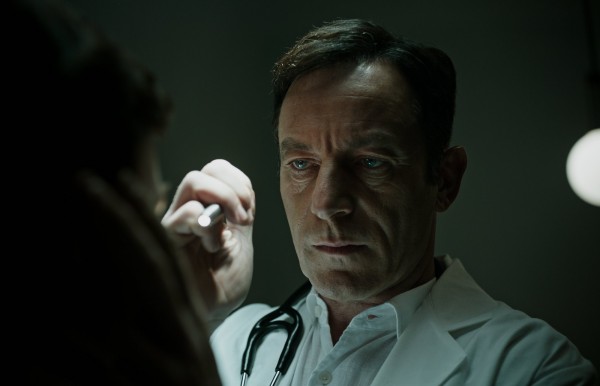
A CURE FOR WELLNESS (US/Germany - 2017) Directed by Gore Verbinski. Written by Justin Haythe. Cast: Dane DeHaan, Jason Isaacs, Mia Goth, Harry Groener, Celia Imrie, Ivo Nandi, Carl Lumbly, David Bishins, Lisa Banes, Adrian Schiller, Tomas Norstrom, Ashok Mandanna, Magnus Krepper, Johannes Krisch, Susanne Wuest, Rebecca Street, Craig Wroe. (R, 146 mins) It's a safe bet there won't be a more ambitious, audacious, and flat-out weird major-studio horror movie to hit multiplexes this year than A CURE FOR WELLNESS. That title probably isn't going to do it any favors, but in an era where horror films are typified by Blumhouse jump scares, found-footage fatigue, and the unbridled sycophancy of horror hipster scenesters, A CURE FOR WELLNESS seems like it's borne of another time and place. A modern-day gothic throwback, it seems to have been made with little concern for mainstream appeal by Gore Verbinski, who established his genre bona fides with the 2002 RINGU remake THE RING but soon became synonymous with bloated, mega-budget summer fare like the first three PIRATES OF THE CARIBBEAN films. Perhaps seeking a fresh start after the costly flop that was 2013's THE LONE RANGER, Verbinski was obviously allowed to make the film he wanted to make with A CURE FOR WELLNESS, even if 20th Century Fox was only willing to put up half of the $40 million budget, necessitating the involvement of German co-producers Studio Babelsberg. Headlined by recognizable actors but no expensive big names, it's a film so exquisitely crafted and meticulously detailed that it looks like it could've easily cost $200 million. Working from a script by REVOLUTIONARY ROAD and LONE RANGER screenwriter Justin Haythe, Verbinski wears his love of high-class horror on his sleeve throughout: themes and imagery conjure memories of everything from Stanley Kubrick's THE SHINING, the dreamlike scenarios of Andrei Tarkovsky, the claustrophobic anxiety of Roman Polanski classics like REPULSION, ROSEMARY'S BABY (especially that lullaby-like theme), and THE TENANT, and the gothic Italian chillers of the 1960s by genre legends like Mario Bava and Antonio Margheriti, with the climax especially feeling like a gushing love letter to a certain early 1970s Bava film. Verbinski's playing the long game with A CURE FOR WELLNESS, a film likely to alienate casual moviegoers but one that's intended more for the more hardcore horror devotee to appreciate and dissect for many years to come.
At a major NYC financial investment firm, young hotshot broker Lockhart (Dane DeHaan) is given a promotion and a corner office after his predecessor in the job drops dead of a heart attack. It's not long before he's called into the office by acting boss Green (David Bishins): a merger is imminent and Lockhart's been cooking the books. He's threatened with prison ("Have you ever had a 12-inch black dick up your ass?" one of the other honchos spits at him) unless he can retrieve the real boss, Roland Pembroke (Harry Groener). Pembroke's been MIA since having a breakdown and checking into the Volmer Institute, a luxurious "wellness spa" housed in a castle in the remote mountains of the Swiss Alps. Green instructs Lockhart to travel to Switzerland and bring Pembroke back to NYC so he can sign off on the merger and pin all the malfeasance--Lockhart's and their own--on him. Once at the spa, Lockhart is stone-walled and given the run-around by everyone, including the spa's head doctor Heinrich Volmer (Jason Isaacs). Volmer insists Pembroke is not well enough to leave and when Lockhart finally encounters his colleague, Pembroke agrees to get his things together but is quickly admitted to another section of the hospital, with Volmer explaining his "condition" has taken a turn for the worse. Lockhart ends up being admitted to the institute following a horrific car crash when Volmer's driver (Ivo Nandi) hits a deer while taking him to a hotel, and even from inside as a patient, he isn't given any access to Pembroke. While most of the patients are elderly, Lockhart is intrigued by the young and enigmatic Hannah (NYMPHOMANIAC's Mia Goth), a special patient whose parents died years earlier and who has been in Volmer's care since. Lockhart is subjected to bizarre treatments, including time spent in a sensory deprivation tank and an iron lung, and is haunted by recurring visions of large eels, with himself and all the patients constantly instructed to drink plenty of the purifying water and take regular eye-dropper oral doses of the liquid vitamin that Volmer insists is vital to their wellness.
You can count all the great two-and-half-hour horror movies on one hand, and while it's easy for an excitable and enthused genre fan to overrate something like A CURE FOR WELLNESS (some of the plot doesn't hold up under intense scrutiny, especially when it comes to Lockhart's bosses' slow response to his extended absence), it's also a near-certainty that you've never seen a genre mash-up quite like this one. Refreshingly, it's played completely straight and dead serious, never going for winking irony, cheap quips, or lazy references. Verbinski and Haythe set the ominous mood from the get-go, and it just gets more freakishly bizarre with each new plot turn as it crescendos into a symphony of absolute madness by the final act. Lockhart spends much of the film convinced Volmer and the staff are trying to drive him insane, but with the help of another patient, puzzle enthusiast Victoria (Celia Imrie), he discovers that the compound is a 200-year-old castle built over the partial ruins of another, the ancestral home of the demented Baron von Reichmerl, a 19th century nobleman killed by the villagers over his obsession with creating a pure and incestuous bloodline with his sister. A CURE FOR WELLNESS is set in the present day but seems to come from the 1970s. It's a triumph of chilling atmosphere, with ornate sets and carefully composed shots that give it a vivid feeling of cold, classic Kubrick. The three leads are fantastic, from the waif-like Goth conveying the naive innocence of Hannah to the historically annoying DeHaan, who's matured as an actor since the overrated CHRONICLE, which established him as a sort of excruciatingly whiny Emo DiCaprio. Isaacs has a blast in a vintage mad doctor role, relishing the sinister machinations of Volmer (what a classic-sounding mad doctor name) but never going overboard into hammy scenery-chewing. Indeed, in his controlled performance and the way Volmer plays his cards close to the vest, Isaacs is very reminiscent of a mid-career Christopher Plummer (I wouldn't be surprised if a studio suit at some point in the planning stages suggested Verbinski get Johnny Depp to play Volmer). A CURE FOR WELLNESS isn't for everyone, and if it's not your thing, then its 146 minutes will be an endurance test. But for the schooled and well-traveled horror scholar, it's probably the giddiest time you'll have with a genre offering this year. I don't care if this tanks in theaters--the fact that it even exists and I could see it in a theater in the year 2017 is a small miracle worth celebrating.