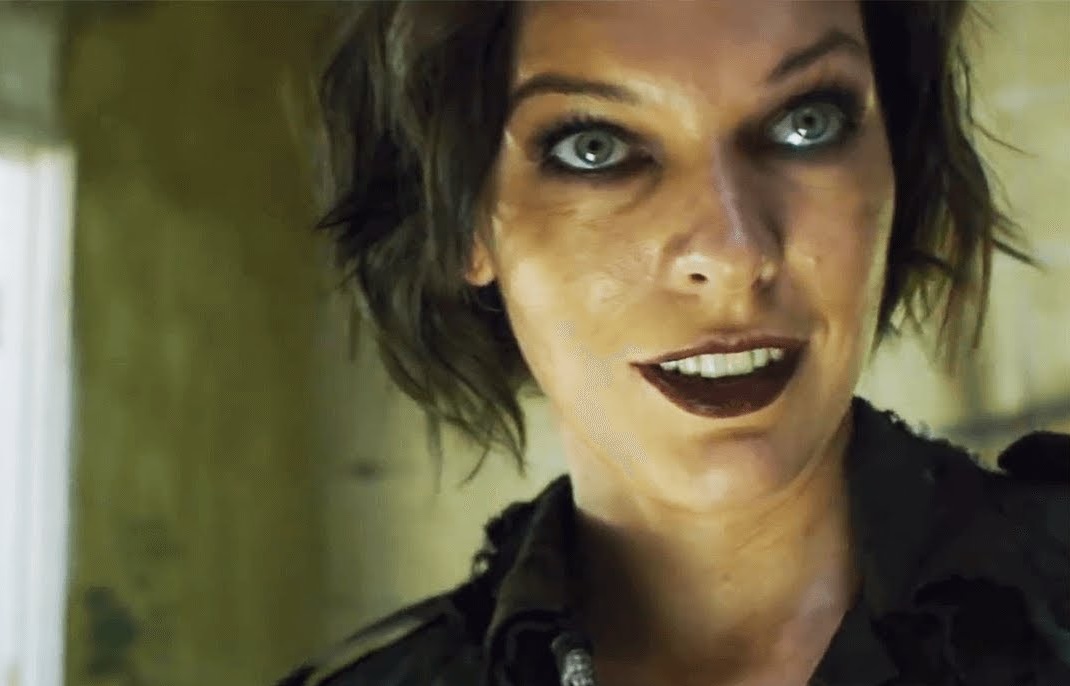
SHOCKING DARK aka TERMINATOR 2 (Italy - 1989) Directed by Vincent Dawn (Bruno Mattei). Written by Clayde Anderson (Claudio Fragasso). Cast: Cristofer Ahrens, Haven Tyler, Geretta Giancarlo Field (Geretta Geretta), Tony Lombardo (Fausto Lombardi), Mark Steinborn, Dominica Coulson, Clive Ricke, Paul Norman Allen, Cortland Reilly, Richard Ross, Bruce McFarland, Al McFarland. (Unrated, 90 mins)
For fans of Eurocult cinema, Italian ripoffs are among the most essential and endearing offerings. The flood of imitations in the wake of huge hits like THE GODFATHER, THE EXORCIST, STAR WARS, DAWN OF THE DEAD, ALIEN, CONAN THE BARBARIAN, THE ROAD WARRIOR, and RAMBO: FIRST BLOOD PART II only gained momentum in the 1980s when video stores needed product and Italy was offering a seemingly endless supply. Perhaps no other genre-hopping journeyman epitomized the concept of the shameless Italian ripoff more than Bruno Mattei, or, as he's known under his most frequently-employed pseudonym, "Vincent Dawn." Born in 1931, Mattei began his career as an editor in the late 1950s, usually on undistinguished and instantly obscure post-HERCULES peplum, and later, third-tier spaghetti westerns and 007 knockoffs. He's the credited editor on Jess Franco's COUNT DRACULA (1970) and would later work for Joe D'Amato on 1976's BLACK COBRA. By the late '70s, Mattei shifted into directing, with a couple of 1977 Nazisploitation outings with SS GIRLS and WOMEN'S CAMP 119, followed by some dalliances with nunsploitation (THE TRUE STORY OF THE NUN OF MONZA, THE OTHER HELL), zombies (HELL OF THE LIVING DEAD aka NIGHT OF THE ZOMBIES), post-nuke (RATS: NIGHT OF TERROR), women-in-prison (CAGED WOMEN, WOMEN'S PRISON MASSACRE), and even a Lou Ferrigno vehicle for Cannon (THE SEVEN MAGNIFICENT GLADIATORS). Mattei had a collaborative partnership with writer and future TROLL 2 auteur Claudio Fragasso, and the pair would frequently work as a team behind the camera, sometimes sharing credit with a pseudonym like "Stefan Oblowsky" on the nunsploitation films. In 1987, Mattei directed and Fragasso scripted the RAMBO ripoff STRIKE COMMANDO, their first effort for Italian producer Franco Gaudenzi. Gaudenzi's career in movies began with Mattei as part of the Joe D'Amato stock company, working as a set decorator, art director, and eventually assistant director on BLACK COBRA and the 1979 cannibal/necrophilia classic BEYOND THE DARKNESS. Mattei and Gaudenzi went way back, and when Gaudenzi formed his company Flora Film and became a producer based primarily in the Philippines, he had plenty of work for Mattei and Fragasso.
In his films for Gaudenzi, most of which were shot in and around Manila, Mattei really found his true calling as Italy's premier ripoff artist. He wasn't exactly new to the notion of swiping other people's ideas--HELL OF THE LIVING DEAD stole huge chunks of Goblin's DAWN OF THE DEAD score--but STRIKE COMMANDO really set the template for what the Three Stooges in the Gaudenzi/Mattei/Fragasso team would accomplish (with occasional uncredited script contributions from Fragasso's wife Rossella Drudi). STRIKE COMMANDO completely restages the finale of RAMBO: FIRST BLOOD PART II, while 1987's DOUBLE TARGET was a somewhat less obvious take on the same material. Gaudenzi kept Mattei occupied during a busy 1988: STRIKE COMMANDO 2 is a Namsploitation outing that's also an unexpected riff on ROMANCING THE STONE, with Mattei and Gaudenzi somehow corralling a seriously slumming Richard Harris (who would later claim to be retired at the time the film was made) for a supporting role; ROBOWAR is an almost scene-for-scene copy of PREDATOR; and so enamored of the Namsploitation craze were Gaudenzi, Mattei, and Fragasso that they even cranked out COP GAME, a quickie imitation of the Saigon-set Willem Dafoe/Gregory Hines non-hit OFF LIMITS. As if Mattei's 1988 schedule wasn't already packed enough in the sweltering Filipino heat (everyone in these movies is profusely sweating at all times), he was even called in from the nearby set of STRIKE COMMANDO 2 by a desperate Gaudenzi to take over for a surly and ailing Lucio Fulci, who had just walked off of ZOMBI 3 with only 50 minutes of usable footage in the can. Mattei and Fragasso finished the film, which feels more Mattei than Fulci, even though the latter retains sole credit. But it's 1989's SHOCKING DARK that is perhaps the most jaw-droppingly audacious of Mattei's ripoffs from his furiously productive Gaudenzi era.
Set not in Gaudenzi's usual Manila stomping grounds but in a toxic Venice "after 2000," SHOCKING DARK has an elite Marine unit called "Megaforce" venturing beneath the city's canals to investigate the disappearance of another group of soldiers offed by mutant creatures. It doesn't take long to recognize that this is a blatant ALIENS ripoff. Not only are entire scenes completely recreated and played out verbatim (including one where a meter shows the creatures closing in on them and somebody yells "That's impossible, they'd already be here!" and another where two people are seen on a monitor silently waving for help but the mission's saboteur stealthily turns it off) but the characters themselves are exact replicas. There's the team of military badasses led by the hysterically raging Koster (Geretta Geretta, best known as the doomed Rosemary from DEMONS and credited here as "Geretta Giancarlo Field"), who's a composite of ALIENS' Vasquez and Apone; Sarah (Haven Tyler), a scientist and the Ripley-like outsider sent along as a consultant; young orphan and Newt stand-in Samantha (Dominica Coulson); and special ops badass Samuel Fuller (Cristofer Ahrens), an operative from "The Tubular Corporation," which sounds about as believable as Vandelay Industries, who eventually functions as SHOCKING DARK's Burke but in a completely different way. You see--and SPOILERS follow--SHOCKING DARK isn't content to just rip off one classic James Cameron film. It's also a knockoff of THE TERMINATOR, a mid-film twist hinted at by naming Tyler's character "Sarah." The mutant creatures eventually take a backseat once "Samuel Fuller" is exposed as a cyborg hellbent on sabotaging the mission. Though the film was made as SHOCKING DARK, it was eventually retitled by Gaudenzi and sold as...wait for it..TERMINATOR 2 (!), flashing back to the practice of Italian ripoffs being passed off as sequels to blockbuster American movies.
The real TERMINATOR 2 was still a couple of years away, but Gaudenzi's rechristening of SHOCKING DARK certainly did it no favors in finding US distribution, where it would've likely gone straight-to-court instead of straight-to-video. Long available on the bootleg circuit, SHOCKING DARK has finally received an official US release nearly 30 years after it was made, thanks to Severin's new Blu-ray, along with two other Gaudenzi productions, ZOMBI 3 and 1989's AFTER DEATH, directed by Fragasso and now commonly known as ZOMBIE 4: AFTER DEATH. SHOCKING DARK comes barrelling out of the gate and seems poised to become a new MIAMI CONNECTION or NIGHTMARE WEEKEND-level bad movie discovery of WTF? proportions. The ridiculous dialogue works beautifully in conjunction with the cast, comprised mostly of one-and-done American non-actors who were never seen or heard from again. Portland, OR-born model Geretta Geretta is probably the most experienced cast member (now a convention regular, she spent a significant amount of time in Italy in the '80s and also acted in Mattei's RATS under the name "Janna Ryann"), but she's killed off 35 minutes in. Fausto Lombardi appeared in several Italian B-movies from the early '80s on (RATS, HANNA D: THE GIRL FROM VONDEL PARK, the TOP GUN ripoff BLUE TORNADO). And Ahrens had some small parts in Italian genre fare but seems to have left the industry after 1999.
But as for the bulk of the remaining cast members--Tyler, Coulson, Cortland Reilly as the rad surfer-dude soldier Caine, and Bruce McFarland as the colonel at the command center--they all seem to be American college students who may have been in an exchange program or were just partying in Italy when they answered a casting call to be in a low-budget horror movie (even Coulson, who's supposed to a child but is probably in her late teens and is almost as tall as Tyler). Their inexperience as actors is only highlighted by the fact that this is one of the rare instances in Italian exploitation where the filmmakers are using live sound and not dubbing everyone over. None of the usual suspects in the dubbing world are present here. Nope, these deer-in-the-headlights newbies are bellowing their lines in an overwrought fashion and standing around looking confused (Tyler never seems comfortable and looks directly into the camera twice in one scene), with Mattei doing little to hide their obvious inexperience. Most of Mattei's films for Gaudenzi had some established name actors to provide even the slightest modicum of credibility--Reb Brown and Christopher Connelly in STRIKE COMMANDO, Brown in ROBOWAR, Richard Harris (Richard Harris?!?!) in STRIKE COMMANDO 2, Miles O'Keeffe, Donald Pleasence and Bo Svenson in DOUBLE TARGET--but there's no such voice of experience for the neophyte actors to look to here, only the performances of Sigourney Weaver and everyone else on a VHS copy of ALIENS that they probably had to share.
Eventually, SHOCKING DARK settles into a bunch of repetitive scenes of people walking down long corridors in the maintenance area under Rome's Termini Station, standing in for the Venice underground, with the possibility of playing a great drinking game for every time Coulson's character shouts "Sarah!" It's got some dull stretches, but the sheer chutzballs of its straight-up plagiarism of early James Cameron (what, no flying piranha?), and its final ridiculous twist in the closing minutes, is at times truly astonishing. It's also the kind of film that's so sloppy that it misspells Fragasso's usual "Clyde Anderson" pseudonym as "Clayde Anderson." Before long, stealing plots wouldn't be enough for Mattei. By 1995's belated JAWS ripoff CRUEL JAWS, he was swiping footage wholesale from JAWS, JAWS 2, and the slightly less-belated 1982 ripoff GREAT WHITE. This blew open new doors of duplicity for the veteran director. By the time of his final films--zero-budget, shot-on-video drek like 2004's THE TOMB and 2007's ZOMBIES: THE BEGINNING--Mattei was pilfering unlicensed footage from the likes of RAIDERS OF THE LOST ARK, INDIANA JONES AND THE TEMPLE OF DOOM, ARMY OF DARKNESS, the 1999 version of THE MUMMY, and CRIMSON TIDE. Mattei died in 2007 at the age of 75, but the recent Blu-ray releases of SHOCKING DARK and WOMEN'S PRISON MASSACRE are doing their part to keep his dubious legend alive. Now all we need is a deluxe Blu-ray edition of STRIKE COMMANDO.
THE REINCARNATION OF PETER PROUD (US - 1975) Directed by J. Lee Thompson. Written by Max Ehrlich. Cast: Michael Sarrazin, Jennifer O'Neill, Margot Kidder, Cornelia Sharpe, Paul Hecht, Tony Stephano, Normann Burton, Anne Ives, Debralee Scott, Steve Franken, Fred Stuthman, Addison Powell. (R, 105 mins) Gifted with a vividly distinctive title that's ultimately more memorable than the film itself, THE REINCARNATION OF PETER PROUD has become one of those horror movies from a bygone era whose scarce availability has led to somewhat of an inflated reputation that it's some mythical, lost masterpiece. Rarely seen since its 1980s VHS release and its long-ago days in regular rotation on late-night TV in what had to be a drastically-cut version, PETER PROUD was never released on DVD but is now reincarnated on Blu-ray courtesy of Kino Lorber (because physical media is dead). It's likely that some may find it a little too dry and too skimpy with the shocks, considering its contemporaries were the likes of THE EXORCIST and THE OMEN. In its own way, THE REINCARNATION OF PETER PROUD, from the masters of erotica-infused horror at Bing Crosby Productions, carved its own niche for hard-R notoriety with its then-copious amounts of nudity and occasionally explicit sex, particularly an extended Margot Kidder bathtub masturbation scene that's usually the first and only thing anyone who's seen the film can recall whenever it's mentioned. "The Bathtub Scene" is also the subject of two different extras on the Blu-ray, which may further contribute to the legend that it's the 1970s horror geek equivalent of the LAST TANGO IN PARIS butter scene. But while Kidder leaves little to the imagination, it's still not the quite the teenage spank bank fodder that time and three decades of limited accessibility have made it out to be.
Adapted by veteran TV writer Max Ehrlich (THE DEFENDERS, THE UNTOUCHABLES, STAR TREK) from his 1973 novel, THE REINCARNATION OF PETER PROUD managed to be modest hit in the summer of 1975, though it's almost certain that some of those movie tickets were purchased by people who couldn't get into a sold-out JAWS and were already at the theater anyway. Haunted by recurring dreams where he's someone he's never met being murdered by a woman he doesn't know, college professor Peter Proud (Michael Sarrazin) is referred to parapsychologist Dr. Goodman (Paul Hecht), who puts him in a dream study only to discover that his dream activity isn't even registering and that they may be psychic visions showing him events that took place 30 years earlier. Peter eventually concludes the town he sees in his visions is in Massachusetts, and with his skeptical and eventually unsympathetic girlfriend Nora (Cornelia Sharpe) in tow, Peter travels across the country and eventually finds the town, Crystal Lake (!). He seeks out Marcia Curtis (Kidder), the woman in his visions who he repeatedly sees kill her husband Jeff (Tony Stephano), and in time, he becomes increasingly unable to differentiate between his own memories and the memories of the dead Jeff, feeling certain that Jeff's spirit has been reborn in his body. To get to Marcia, Peter befriends her 30-year-old daughter Ann (Jennifer O'Neill), though Marcia rightly assumes that something is off about Peter, disturbed by the overwhelming sense that she's met him before.
With a bored Nora heading back to California, Peter is freed up, which inevitably leads to a romance with Ann, thus establishing an undeniable ick factor in the sense that Peter, his body slowly becoming the vessel for the murdered and reborn Jeff, is essentially sleeping with his own daughter, who was only three months old when her father was killed. With Jeff inside his head, Peter comes to sympathize with why Marcia did what she did (Jeff was abusive and a serial adulterer) and as his love for Ann grows (even though he occasionally slips and refers to her as "my daughter"), he doesn't want to return to his old life. It wouldn't take a whole lot of tweaking to turn this into a maudlin, supernaturally-skewed Nicholas Sparks story if it were made today. Of course, you'd have to factor out the incestous elements, along with the fact that the masturbation scene is intercut with Marcia fantasizing about a time when Jeff violently raped her, a juxtaposition that, coupled with the incest, would launch at least two weeks' worth of AV Club and Vulture thinkpieces.
Even without her showstopping bathtub scene, Kidder gives the showiest performance, even though half of it is under aging makeup that's passable but doesn't quite stand up in the age of high-definition. Quebec-born Sarrazin, best known for 1969's THEY SHOOT HORSES, DON'T THEY? and in the midst of his run as a '70s Hollywood leading man before heading back to Canada in the mid '80s (he was big enough in his day to host SNL in 1978), is fine as the troubled Proud, though his performance requires more reacting than acting and a lot of driving, as the first hour offers so much of Peter behind the wheel that it threatens to become a supernatural road movie. THE REINCARNATION OF PETER PROUD is a middling effort from journeyman director J. Lee Thompson, whose career ran that gamut from revered classics like 1961's THE GUNS OF NAVARONE and 1962's CAPE FEAR to later Cannon essentials like 1983's 10 TO MIDNIGHT and 1989's KINJITE: FORBIDDEN SUBJECTS. There isn't much in the way of suspense or scares as the story plays out, requiring Thompson offer a little more skin than usual for this sort of thing, but there is one of Jerry Goldsmith's most unusual scores, one that eventually turns distinctively Goldsmithian near the end but for the most part, is a lot of eeric electronically-based sounds and effects. The most effective scene isn't Kidder's much-ballyhooed adult bathtime, but an emotional and heartbreaking one where Ann introduces Peter to her dementia-addled grandmother (Anne Ives), whose mind immediately returns from wherever it was as she sees her long-dead son Jeff in Peter and asks where he's been all this time. Most horror fans satisfying their curiosity about PETER PROUD won't be asking that when this reaches its conclusion, but for cult movie connoisseurs and fans of the recently deceased Kidder and the somewhat forgotten Sarrazin (who died in 2011), it's at least worth a look.
UPGRADE (US/Australia - 2018) Written and directed by Leigh Whannell. Cast: Logan Marshall-Green, Betty Gabriel, Harrison Gilbertson, Melanie Vallejo, Benedict Hardie, Linda Cropper, Richard Cawthorne, Christopher Kirby, Clayton Jacobson, voice of Simon Maiden. (R, 100 mins)
An imaginative take on the revenge thriller, the high-concept UPGRADE wouldn't have been out of place as Vidmark Entertainment title in the new release section of your favorite video store in the early '90s. That's meant as a compliment, as it's a fast, mean, and cynical indictment of our reliance on technology that has a message but doesn't take itself so seriously that it forgets to be entertaining. In other words, it's a B-movie like they used to make. In a vaguely-defined near-future America with self-driving cars, omnipresent surveillance drones, and MINORITY REPORT touch-screens everywhere, proudly blue-collar and stubbornly Luddite mechanic Grey Trace (Logan Marshall-Green) is a man out of his time. He hates technology, still listens to music on vinyl, drinks Budweiser, and refuses to use his wife Asha's (Melanie Vallejo) self-driving, autonomous car. Asha's the primary breadwinner, working for a robotics corporation called Cobalt, but Grey makes some decent money restoring old muscle cars for rich guys with money to burn. Asha is stunned to learn that Grey's latest client is Eron Keen (Harrison Gilbertson), a brilliant and reclusive young tech mogul who owns Vessel, a groundbreaking company whose achievements have far surpassed Cobalt. On the way home from delivering Keen's car, Asha's malfunctions and goes offline, speeding up and crashing until a rescue unit arrives and proceeds to kill Asha and shoot Grey in the back of the neck, leaving him to die.
Awakening after a three-month coma to find he's paralyzed from the neck down, Grey has no interest in being taken care of by machines or his mother (Linda Cropper), which leads to an attempted painkiller overdose. While recovering in the hospital, Grey is visited by Eron, who offers to make him a test subject in a secret experiment involving "STEM," his latest biomechanical creation. It's a small, insect-sized implant that will fuse with his spine and serve as the missing "bridge" between his brain and body, allowing him to walk again. The catch: it's still experimental and top-secret, so when he's not alone, he still has to be in the wheelchair and appear to be quadriplegic to everyone, including his mother. Once he learns to walk again, Grey is in for another surprise: STEM is alive, existing as a HAL 9000-like voice (Simon Maiden) that only he can hear. STEM not only assists in Grey's mobility but also with the investigation into Asha's murder, which is at a dead-end with Cortez (Betty Gabriel), the lone wolf cop who caught the case. Watching drone surveillance footage through Grey's eyes, STEM is able to identify one of the killers--all of whom have surgically implanted shotguns embedded in their arms that fire out of the palms of their hands--and directs Grey to his address. A scuffle ensues and Grey is getting his ass handed to him, at which point STEM informs him "I need your permission to operate independently." With permission granted, Grey becomes a one-man killing machine, reborn and unstoppable thanks to STEM's all-knowing, all-seeing technology, especially once STEM warns him that a concerned Eron is trying to take him offline and has him visit a hacker with specific directions to override its creator's capabilities.
Written and directed by SAW and INSIDIOUS writer/co-star Leigh Whannell, UPGRADE has its share of jokey, crowd-pleasing moments, with some insanely over-the-top splatter kills and one very nicely-done car chase. Whannell's script does let Grey's transformation from "everyman who can't fathom ending someone's life" to "wisecracking vigilante smartass" happen a little too abruptly, as he's only offing the second guy responsible for Asha's death before he's already dropping bon mots like "Don't you know I'm a fucking ninja?" The technophobic chip on Grey's shoulder is a little overplayed early on, with Whannell working too hard to present him as a working class hero of the future, but the message gets less ham-fisted the more UPGRADE goes on, with a pair of late revelations and an unexpected ending that's downbeat enough that you have to wonder if Whannell had to fight to keep it. It's a potentially star-making role for Marshall-Green (PROMETHEUS, THE INVITATION), whose performance is both gritty and funny, whether he's interacting with the voice of STEM to create a back-and-forth buddy movie that exists only in his head, or in some of his inspired, Buster Keaton-like physical acting when Grey cedes control of himself to STEM, pulling off the effect that his entire body is a puppet on a hardwired string. And after making a memorable impression in the second and best PURGE installment, her unforgettable work as Georgina in GET OUT, and with her tough, incredulous Cortez here, it's time for Gabriel to be rewarded with her own movie. Goofy, fast-moving, and ultraviolent, UPGRADE pulls off a lot with a pretty low budget. There's definitely some word-of-mouth sleeper hit potential, not to mention a very probable cult following once it hits streaming and then lands in cable rotation for the next few decades.
FUTURE WORLD (US/Italy/France/UK - 2018) Directed by James Franco and Bruce Thierry Cheung. Written by Bruce Thierry Cheung, Jeremy Craig Cheung and Jay Davis. Cast: James Franco, Milla Jovovich, Lucy Liu, Suki Waterhouse, Jeffrey Wahlberg, Margareta Levieva, Snoop Dogg, George Lewis Jr, Cliff "Method Man" Smith, Carmen Argenziano, Scott Haze, Rumer Willis, Ben Youcef. (R, 88 mins) Last year, THE DISASTER ARTIST showed that director James Franco was maturing as a filmmaker and was ready to move toward the commercially viable and finally leave his self-indulgent, home-movie vanity projects behind.
FUTURE WORLD: "Hold my beer."
His entire career is shaping up to be one long display of bizarre performance art, but as a filmmaker, Franco has historically been a poster boy for misbegotten ambition. Prior to THE DISASTER ARTIST, his efforts behind the camera have been typified by a series of classic American literature adaptations--the works of William Faulkner (AS I LAY DYING and THE SOUND AND THE FURY), Cormac McCarthy (CHILD OF GOD) and John Steinbeck (IN DUBIOUS BATTLE)--projects whose primary reason for being seemed to be their utter unfilmability to the point of being unwatchable by design. Franco's directed over 20 feature films, and has another four set for release this year, including the long-shelved ZEROVILLE, completed in 2014 and co-starring Franco, Seth Rogen, Megan Fox, and Will Ferrell. Right after finishing THE DISASTER ARTIST, which sat around for about a year and half before it was released, Franco dove into FUTURE WORLD, apparently after finding a couple of hours to watch MAD MAX: FURY ROAD and rounding up some of his buddies to quickly shit out their own DIY version of it. Franco co-directs with his longtime cinematographer Bruce Thierry Cheung and called in some favors from some pals, including his frequent star Scott Haze, whose biggest contribution to the Franco legacy thus far is taking an on-camera shit and wiping his ass with a stick at the beginning of CHILD OF GOD. It should tell you everything you need to know about CHILD OF GOD that it was all downhill from there.
A throwback to the kind of post-nuke actioners that came out of Italy and the Philippines and flooded video stores and cable in the wake of THE ROAD WARRIOR back in the early-to-mid '80s is a fun idea, but where most of Franco's work as a filmmaker can be charitably described as self-indulgent home movies made for an audience of one, FUTURE WORLD doesn't even seem to interest its own director. Say what you will about his endurance test literary adaptations, but at least Franco committed to them (and to be fair, IN DUBIOUS BATTLE was a step up in many ways and, at the very least, looks and feels like a real movie). FUTURE WORLD opens in a post-apocalyptic America, after the world's been destroyed following an era of prosperous technological advancement of robotics and artificial intelligence that proved too lethal in the hands of stupid, greedy, self-serving, and self-destructive humanity. "Synthetic" sex android Ash (Suki Waterhouse) is found in an abandoned factory and revived by Warlord (Franco), the despotic leader of a marauding desert biker gang called The Raiders. He keeps her as a slave for sex and murder, and eventually they cross paths with Prince (Jeffrey Wahlberg, Mark and Donnie's nephew), a teenager from the isolated utopian community "The Oasis." Prince is journeying through the "Neon Forest" to reach "The Temple" at "Paradise Beach" or some such nonsense, in the hopes of finding a miracle cure for his deathly ill mother Queen (Lucy Liu, spending almost all of her limited screen time bedridden). At a desert titty bar called Love Town, overseen by wisecracking host Love Lord (Snoop Dogg), Warlord programs Ash to kill Prince, but she starts displaying traces of a conscience and independent thought, defying Warlord and going on the run with Prince. They eventually end up in Drug Town, ruled by the ruthless Drug Lord (Milla Jovovich), with Warlord and his goons in hot pursuit.
You know the writers really put in the time and effort with the script when you've got "Love Town" run by a guy named "Love Lord" and "Drug Town" ruled by someone named "Drug Lord." One could argue that it's a cynical, Terry Gilliam-esque dystopian commentary on people being defined by their work, but that's probably giving FUTURE WORLD a little too much credit. Jovovich doesn't turn up until the midway point, and she provides FUTURE WORLD's only spark of life with what seems to be a largely improvised performance. Her character is completely despicable--and gets naive, innocent Prince hooked on drugs--but while a little of her manic, bug-eyed overacting and general smartassery goes a long way, it shows Jovovich is at least trying to make something out of nothing. Waterhouse, who tread similar ground in last year's dismal-but-suddenly-looking-better-now THE BAD BATCH, doesn't have much to do other than look like she's Pearl Prophet in a 2018 riff on the old Van Damme sci-fi favorite CYBORG. Top-billed Franco is absent for long stretches--probably the case behind the camera as well--and can't help but come off as a poseur Toecutter and Immortan Joe, turning in the kind of performance that makes one wonder whether he was perhaps spending too much time with Tommy Wiseau while prepping THE DISASTER ARTIST (how is a walking freakshow like Wiseau not in this?) Wahlberg doesn't quite have the presence of his uncle Mark or even his uncle Donnie, and it's gotta be an ominous sign that his acting coach gets an onscreen credit. Like most of his "hanging out and dicking off with his buddies" auteur endeavors, Franco corralled a potentially interesting and eclectic cast--there's also Method Man, Rumer Willis, and veteran character actor Carmen Argenziano, who gets killed by Warlord after about ten seconds of screen time--but, as usual, he abandons them, this time in a dull post-nuke flick that's not even up to the level of late-career Cirio H. Santiago.
James Franco in one of Warlord's more pensive moments.
There's an attempt at an intriguing subplot involving Ash discovering her emotions and falling for Lei (Margarita Levieva), Drug Lord's techie mechanic, but it leads to nothing but a tame sex scene, as Franco can't even be bothered to make something like that look exciting. Other than Jovovich's inexplicably spirited and wildly gesticulating performance, the only other positive is Franco managing to secure the services of acclaimed cinematographer Peter Zeitlinger, who's been Werner Herzog's go-to D.P. for the last 25 or so years (including the great documentaries GRIZZLY MAN, ENCOUNTERS AT THE END OF THE WORLD, and CAVE OF FORGOTTEN DREAMS). He likely met Zeitlinger while starring in Herzog's globally-panned QUEEN OF THE DESERT, one of approximately 258 movies Franco's been in over the last five years. Zeitlinger does a nice job with some of the desert footage and some long Steadicam takes, but overall, the film has the same ugly, cheaply digital look you'll see in any random clunker on the straight-to-VOD scrap heap. Only Franco could follow the universally-acclaimed THE DISASTER ARTIST with a project that makes him look like he's chucking it all to become the next Albert Pyun.
THE VAMPIRE DOLL (Japan - 1970; US release 1971) Directed by Michio Yamamoto. Written by Ei Ogawa and Hiroshi Nagano. Cast: Kayo Matsuo, Akira Nakao, Yukiko Kobayashi, Yoko Minamikaze, Kaku Takashina, Junya Usami, Atsuo Nakamura, Jun Hamamura. (Unrated, 71 mins) Japan's Toho Co, Ltd. will forever be inextricably linked with GODZILLA and the entire kaiju universe that it spawned nearly 65 years ago. A close second would be the classic films of Akira Kurosawa, but prompted by the success of the Poe series being churned out by AIP and the Hammer frightfests of the day, Toho briefly dabbled in classic horror in the early 1970s. That type of classical "western" horror was unusual for Toho or any Japanese production company, as most instances of Japanese horror (1965's KWAIDAN being a good example) were based in Japanese and "eastern" myths, customs, and styles. The so-called "Bloodthirsty Trilogy" is a loose collection of mostly classically traditional vampire films produced by Toho from 1970 to 1974, all of them directed by Michio Yamamoto, a former assistant to Kurosawa (1957's THRONE OF BLOOD) who never really broke out and established himself beyond the "Bloodthirsty Trilogy." Born in 1933, Yamamoto was only 43 when he quit the movie industry and became a minor footnote in the grand Toho story, never heard from again before his death in 2004. Just out on Blu-ray in a three-film set from Arrow Video, the titles in the "Bloodthirsty Trilogy" are available in their intended versions for the first time in years (the second film in the series, LAKE OF DRACULA, had the most exposure on American TV back in the day and was released on VHS by Paramount in 1994), hopefully rescuing the forgotten Yamamoto from oblivion.
1970's THE VAMPIRE DOLL is a stylish and eerie contemporary tale with ominous goings-on that begin on a dark and stormy night in a cursed, Usher-like house of the damned in the middle of nowhere. After working in America for six months, Kazuhiko Sagawa (Atsuo Nakamura) arrives at the family home of his girlfriend Yuko (Yukiko Kobayashi) only to be told by her grieving mother Mrs. Nonomura (Yoko Minamikaze) that she was killed in a car accident two weeks earlier. Kazuhiko is devastated and ultimately skeptical, especially when he keeps seeing Yuko in the house and on the grounds, confronting her at her own grave where her pale visage greets him and begs "Please kill me." Back home, Kazuhiko's younger sister Keiko (Kayo Matsuo) senses he's in danger and drags her fiance Hiroshi (Akira Nakao) to the Nonomura house to investigate. They arrive only to be told by Mrs. Nonomura that Kazuhiko left, but car trouble forces them to stay the night, and it isn't long before Keiko starts seeing Yuko as well. Yamamoto fills THE VAMPIRE DOLL with memorably creepy imagery, whether it's the appearance of the undead Yuko with her bloodied arms and glowing yellow eyes, Hiroshi exhuming Yuko's corpse and finding a lifeless doll in her coffin, an untraceable sound of weeping that faintly echoes through the house ("It's the wind blowing through the skylight window," Mrs. Nonomura claims), or Hiroshi's discovery of Kazuhiko's bloodstained cufflink at Yuko's grave, proof that he never left the grounds and that Mrs. Nonomura and her loyal, mute manservant Genzo (Kaku Takashina) are hiding something. THE VAMPIRE DOLL does stumble a bit when it tries to explain too much in regards to the tragic Nonomura family backstory as it ventures down a path that prefigures the later JU-ON films and J-Horror tropes as the town doctor (Junya Usami) shows up to function as a Japanese Basil Exposition. But it gets back on track fairly quickly, with Yamamoto fashioning the film as an almost identical replica of AIP, Hammer, and Amicus (Hiroshi even compliments his host's "splendid Western-style house") and despite the cultural differences, the universal language of classic horror translates beautifully. This is a moody, vividly atmospheric, and scary little gem with well-done jolts, wonderful set design and shot compositions and it benefits greatly from a brief 71-minute running time that relentlessly cuts through the bullshit.
LAKE OF DRACULA (Japan - 1971; US release 1973) Directed by Michio Yamamoto. Written by Ei Ogawa and Masaru Takesue. Cast: Choei Takahashi, Sanae Emi, Midori Fujita, Shin Kishida, Kaku Takashina, Hideji Otaki, Michiyo Yamazoe, Fusako Tachibana. (Unrated, 82 mins)
Yamamoto and VAMPIRE DOLL co-writer Ei Ogawa were back the next year with LAKE OF DRACULA, a peculiarly uneven vampire outing that gets off to a terrific start but stumbles and bumbles when it starts trying to pretend it's not a vampire movie. On a seasonal leave from her studies, Akiko (Midori Fujita) is spending her break at a cabin in a lakeside village with her younger sister Natsuko (Sanae Emi). She's haunted by a childhood memory 18 years earlier when her dog Leo wandered into a strange house and she encountered what appeared to be a vampire. A strange cargo delivery dropped off for local handyman Kyusaku (Kaku Takashina) is revealed to contain the coffin of Dracula (Shin Kishida). Dracula immediately puts the bite on Renfield...er, I mean, Kyusaku, who proceeds to kill Leo (who's pretty spry and energetic for a dog who must be at least 18 years old by this point) and attack Akiko. She gets away, but as Natsuko falls under Dracula's spell, Akiko and her doctor boyfriend Saeki (Choei Takahashi) attempt to get to the bottom of the strange occurrences.
Kishida is a terrifying Dracula, complete with a guttural, gurgling growl that makes him sound possessed. When LAKE OF DRACULA focuses on him--which isn't nearly enough--it's great stuff. But the film makes the bizarre decision to go off on a psychological tangent, with Saeki, who functions as whatever the plot needs him to be at any given moment (hard-working ER doc, vampire expert, psychologist, hypnotist), convinced that Akiko's problems lie with her repressed memories of sibling jealousy and that "Dracula" is just a mortal madman hypnotizing everyone into believing he's a vampire. It's an absurd bit of misdirection that only serves to pointlessly pad the story, since a) it's obvious from the supernatural shenanigans that this is a purely evil agent of the undead wreaking havoc, and b) the already short movie would only be about an hour long without it. The script tries to draw parallels between Akiko's family issues and a curse affecting the family of the vampire--who may be Dracula or just a present incarnation of him--but it's all psychological smoke and mirrors that works to the film's detriment. It's so preoccupied with bending over backwards to not be a Dracula movie that it ends up sabotaging itself, especially since Kishida is so great in the role. LAKE OF DRACULA has been the easiest of the "Bloodthirsty Trilogy" to see over the years. In addition to its surprise VHS appearance in 1994, it got a subtitled theatrical release in the US in 1973 before turning up in a dubbed version in a TV syndication package in 1980, along with its follow-up, EVIL OF DRACULA.
EVIL OF DRACULA (Japan - 1974; US release 1975) Directed by Michio Yamamoto. Written by Ei Ogawa and Masaru Takesue. Cast: Toshio Kurosawa, Kunie Tanaka, Katsuhiko Sasaki, Shin Kishida, Mariko Mochizuki, Mio Ota, Mika Katsuragi, Keiko Aramaki, Yunosuke Ito. (Unrated, 83 mins) The final installment in the "Bloodthirsty Trilogy" rights the ship after the erratic and uneven LAKE OF DRACULA. Shin Kishida is back as, if not Dracula, then a very similar vampire, this time in the guise of a principal at an isolated girls school in northern Japan. Prof. Shiraki (Toshia Kurosawa), a young instructor from Tokyo, arrives for a new teaching post and is shocked to walk into an already grief-filled situation: the professor's wife died two days earlier and her body is being kept in coffin in the basement per "local custom," and one of the students has gone missing. It doesn't take long for Shiraki to find both of them when they attack him in his room after he's been drinking, which causes him to dismiss it as a bad dream. Then next morning, the principal tells Shiraki that he's ill and wants him to take over his job. He's apprehensive, especially after meeting superstitious colleague Dr. Shimomura (Kunie Tanaka), an expert in local folklore, who informs him of a well-known area legend involving a European shipwreck survivor from two centuries earlier who was forced to drink his own blood to survive. He met a local woman and they continued feasting on one another's blood, thus perpetrating a curse that has haunted the region since. Doing some further digging and finding evidence of a string of long-missing "principals" who ran the school (which is a front for the vampire to procure slavishly-devoted "brides"), Shiraki and Shimamura discover that the vampiric "spirit" lives on, assuming the shape its latest victim and requiring a new body when its host is about to die.
Again drenched in atmosphere and showcasing numerous chilling moments (few more haunting than a student nearing the completion of her turn into the undead and using her last traces of humanity to make the conscious decision to fling herself to her death), EVIL OF DRACULA is also an interesting, almost HORROR EXPRESS-meets-THE THING-like take on vampire lore, with Kishida once again crushing it as one of the most ferocious of all cinematic "Dracula"s, for all intents and purposes. Like LAKE OF DRACULA, EVIL OF DRACULA doesn't use Kishida as much as it should, but it's a much more consistent and straightforward film with some inventive ideas and several solid jump scares. Yamamoto directed a couple more TV projects before calling it a career in 1976, while Kishida stayed busy as a character actor (he turned up in SHOGUN ASSASSIN in scenes culled from the first two LONE WOLF AND CUB movies) until he succumbed to lung cancer in 1982 at the far-too-young age of 42. If Arrow's release of this trilogy can lead to a renewed appreciation of the obscure Yamamoto as a sort-of Japanese Mario Bava, then let's hope it also serves to show horror fans that they've been missing one of the great screen Draculas in the form of Shin Kishida.
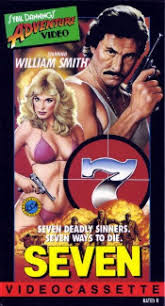
SEVEN (US - 1979) Directed by Andy Sidaris. Written by William Driskill and Robert Baird. Cast: William Smith, Barbara Leigh, Guich Koock, Christipher Joy, Martin Kove, Art Metrano, Ed Parker, Richard LePore, Lenny Montana, Reggie Nalder, Seth Sakai, Kwan Hi Lim, Tino Tuiolosega, Henry Ayau, Peter Knecht, Susan Kiger, Robert Relyea, Terry Kiser, John Alderman, Nick Georgiade, Little Egypt, Charles Picerni, Sandra Bernadou, Tadashi Yamashita, Russell Howell, Carol Needham. (R, 101 mins) Mention Andy Sidaris to any well-traveled B-movie fan of a certain age and you'll probably get a snicker of acknowledgment over the T&A action auteur's esteemed contributions to the video store glory days. Best known for his "Bullets, Bombs and Babes" series of Hawaii-shot, scantily-clad "L.E.T.H.A.L. Ladies" actioners featuring Playboy Playmates and Penthouse Pets that ran from 1985's MALIBU EXPRESS to 1998's RETURN TO SAVAGE BEACH, Sidaris' spot in exploitation history is secure. But before embarking on his movie career, he was already a highly-regarded, Emmy-winning sports director for ABC going back to the 1960s, known for his work on the network's coverage of the 1968 Summer Olympics in Mexico City as well as the long-running WIDE WORLD OF SPORTS. He also ran the control booth in the early years of ABC's MONDAY NIGHT FOOTBALL, pioneering what's known in the TV sports industry as the "honey shot"--close-ups of cheerleaders on the sideline--and his expertise in directing live sports action led to him being called upon by Robert Altman to serve as a technical adviser on the legendary football sequence in his 1970 classic MASH. Bitten by the filmmaking bug after spending time on the set with Altman, Sidaris made his feature directing debut with 1973's Roger Corman-financed actioner STACEY. It was a minor hit on the drive-in circuit, and Sidaris had enough clout with the networks to get some TV gigs, directing episodes of KOJAK and THE HARDY BOYS/NANCY DREW MYSTERIES. It would be six years before Sidaris made his second film with SEVEN, which effectively set the template and tone for the singularly unique Sidaris style seen over the next two decades.
Released in the fall of 1979 by American International in their waning days on life support just before being acquired by Filmways (LOVE AT FIRST BITE, THE AMITYVILLE HORROR and MAD MAX would be their final hits amidst bombs like C.H.O.M.P.S. and GORP), SEVEN was produced by shopping mall magnate Melvin Simon. Simon's time in the movies only lasted from the late '70s to the early '80s but yielded some big hits (LOVE AT FIRST BITE, WHEN A STRANGER CALLS, and the PORKY'S series), an acclaimed Oscar nominee (THE STUNT MAN), and a few stinkers (SCAVENGER HUNT, CHU CHU AND THE PHILLY FLASH). SEVEN came fairly early in Simon's brief run as a Hollywood mover and shaker, but in hindsight, considering how Sidaris' later, self-produced indies turned out, he obviously left the director alone to make the film he wanted to make. Sidaris films are way more convoluted and character-heavy than they need to be, and SEVEN is no exception. The needlessly and almost comically labyrinthine plot has a US government assignment being handed down to covert ops agent Drew Sevano (William Smith, in a role intended for Burt Reynolds in Sidaris' wildest dreams): kill six dangerous criminal figures in the employ of a seventh, The Kahuna (Lenny Montana, best known as Luca Brasi in THE GODFATHER), a nefarious Hawaii-based mastermind of a plot to eliminate key political and law enforcement figures and engineer a hostile takeover of the state for their own illegal interests. Sevano would rather spend his downtime with buxom Sybil (Carol Needham), but with the promise of $7 million and the ability to assemble his own motley crew of assassins, Sevano and his "Seven" take action.
Barbara Leigh and Susan Kiger in a scene
absolutely essential to the plot of SEVEN.
There's sultry Alexa (Barbara Leigh), good ol' boy Cowboy (the great Guich Koock), drag racer and all-around man of action T.K. (Christipher Joy), terrible stand-up comic Kincella (Art Metrano), lecherous gadget man "The Professor" (Richard LePore), and black belt karate instructor Ed Hunter (played in a real stretch by black belt karate instructor Ed Hunter, whose client roster once included Elvis Presley). They're joined by masseuse sidekick and soon-to-be Cowboy squeeze Jenny (former Playmate Susan Kiger, having an amazing 1979 at the drive-in between SEVEN, H.O.T.S, and ANGELS' BRIGADE), as Sevano lays out the mission, which is set to take place during a 30-minute period, with all of their targets eliminated before any of them have a chance to alert the others that they're being wiped out. The targets: crime lord The Hermit (Reggie Nalder, the same year he played the vampire Barlow in SALEM'S LOT), heroin dealer Butterfly (Henry Ayau), gunrunner and human trafficker Mr. Chin (Kwan Hi Lim), improbably-named money launderer Keoki McDowell (Seth Sakai), black market art dealer Mr. Lee (Tino Tuoilosega), and Hawaii's most lethal hit man, Kimo Maderos (Peter Knecht), with the ultimate prize, The Kahuna himself, reserved for Sevano.
Andy Sidaris (1931-2007), seen here having another shitty day at work at Malibu Bay Films headquarters
If you've seen any of Sidaris' later works under his banner of Malibu Bay Films, the company he formed with his wife and producing partner Arlene, the set-up and execution of SEVEN will sound very familiar. It may not officially be part of the extended Sidaris universe (though LePore did reprise a similar "Professor" role in 1988's PICASSO TRIGGER, and Sidaris would recycle the skateboarding henchman and the gag involving the inflatable sex doll in later films), but it's a de facto pilot film for the "Bullets, Bombs and Babes" series. Sidaris gets a bit more squibby and splattery here than he would once he established his formula (Hawaii, explosions, teams of assassins, hot tubs, saunas) with the likes of 1987's HARD TICKET TO HAWAII and 1989's SAVAGE BEACH, but SEVEN's got plenty of action, gratuitous nudity, and enough intentional humor (Ed Hunter's character having his own name, Savano staring right at Sybil's breasts and deadpanning "I think you need a nose job") that it's obvious Sidaris never took himself too seriously, not even when he was fairly new to movies. Sidaris kept going throughout the '90s, briefly stepping back and letting his son Christian Drew Sidaris direct a couple of "Bullets, Bombs and Babes" installments with 1993's ENEMY GOLD and 1994's THE DALLAS CONNECTION. But when he returned from that sabbatical with 1996's DAY OF THE WARRIOR, the formula was growing tired. The films looked cheaper, he wasn't getting recognizable names like MALIBU EXPRESS' Sybil Danning, GUNS' Erik Estrada, or DO OR DIE's Pat Morita, and the new group of L.E.T.H.A.L. Ladies didn't have the charm or even the talent level of Hope Marie Carlton or Dona Speir from the early entries. RETURN TO SAVAGE BEACH marked the end of the series and Sidaris subsequently retired from directing. Under the subtle pseudonym "Dick Bigdickian," Sidaris appeared in Jim Wynorski's trilogy of Skinemax-ready BLAIR WITCH PROJECT spoofs with 2000's THE BARE WENCH PROJECT, 2002's THE BARE WENCH PROJECT 2: SCARED TOPLESS, and 2003's THE BARE WENCH PROJECT: NYMPHS OF MYSTERY MOUNTAIN. Sidaris succumbed to throat cancer in 2007 at the age of 76.
In addition to vets like Montana and Nalder onboard, SEVEN features small supporting turns for future familiar faces like Martin Kove (THE KARATE KID) as a Kahuna flunky and Terry Kiser (Bernie in WEEKEND AT BERNIE'S) as a Hawaii senator offed in the opening scene. But Smith is the big name here (unless you count blatant product plugs for Orange Julius and Subaru), and he makes for a solid tough guy hero. He might not have had any Oscars in his future, but he was well-known for early '70s biker movies like ANGELS DIE HARD and CHROME AND HOT LEATHER and exploitation hits like INVASION OF THE BEE GIRLS, would regularly turn up in supporting roles in respectable films, and was having a bit of a moment in 1979 on the heels of his acclaimed turn as Falconetti in the gargantuan mini-series RICH MAN, POOR MAN and its followup RICH MAN, POOR MAN BOOK II and joining the cast of HAWAII FIVE-0 in its 12th and final season as a replacement for James MacArthur. After SEVEN, Smith would co-star as Clint Eastwood's bare-knuckle nemesis in ANY WHICH WAY YOU CAN and would have his best-known '80s role a few years later as the leader of the Soviet invasion of small-town America in RED DAWN. Now 85, Smith's IMDb page over the last 20 years is cluttered with dismal, Z-grade DTV fare that no one's heard of, his last notable credit being a guest spot on a 1999 episode of WALKER, TEXAS RANGER. Smith wasn't exactly Sir Laurence Olivier with his acting ability, but relative to the later likes of Sidaris male leads like Steve Bond and Bruce Penhall, he was established and accomplished, though even with Melvin Simon backing him, it's hard to believe Sidaris ever seriously entertained the absurd notion of getting an in-his-prime Burt Reynolds to star in this thing. Though it was released on video in the '80s, the enjoyably ridiculous SEVEN has been difficult to see for a number of years, a problem rectified with Kino Lorber's recent Blu-ray release, because physical media is dead.
CARGO (Australia/UK - 2018) Directed by Yolanda Ramke and Ben Howling. Written by Yolanda Ramke. Cast: Martin Freeman, Anthony Hayes, Susie Porter, Caren Pistorius, Kris McQuade, David Gulpilil, Simone Landers, Bruce R. Carter, Natasha Wanganeen, Andy Rodoreda, Marlee Jane McPherson-Dobbins, Lily Anne McPherson-Dobbins, Finlay Sjoberg, Nova Sjoberg. (Unrated, 104 mins) With its setting in the desolate Outback and the presence of veteran Australian cult hero David Gulpilil in a supporting role, it would be easy to snarkily dismiss the zombie apocalypse saga CARGO as THE WALKABOUT DEAD. It would seem that the last thing the horror genre needs is yet another zombie movie, but some recent offerings--like TRAIN TO BUSAN, THE GIRL WITH ALL THE GIFTS, and now this--seem cognizant of that and do things to stand out from the crowd. CARGO, a Netflix pickup, begins in a standard fashion but as it goes on, it stays focused on character and atmosphere, with the zombie sightings and flesh-chomping kept to a minimum. A feature-length expansion of a seven-minute 2013 short film by directors Yolanda Ramke (who also scripted) and Ben Howling, CARGO opens on a boat found and commandeered by Andy (SHERLOCK's Martin Freeman) and his wife Kay (Susie Porter). It's the aftermath of a viral pandemic, and every day is a struggle to find safe food for themselves and their one-year-old daughter Rosie (played by two different sets of twins) and avoid attracting the attention of the undead, here called "diggers." We soon learn, when Kay is attacked, that a bite from a digger usually gives the victim 48 hours before turning. Her wound, however, is so deep that the time is accelerated and as she turns sooner than expected, with an odd, mummified webbing forming over her eyes and face, she attacks and bites an exhausted Andy, who fell asleep while keeping watch on her. After mercy-killing what was once his wife, Andy, carrying Rosie on his back, ventures on foot to find some viable safe haven for his daughter before the inevitable happens.
They meet others along the way, most notably Thoomi (Simone Landers), a teenage aboriginal girl who regularly cuts herself and smears the blood on a tree to keep her turned-to-a-digger father distracted and not interested in attacking her. When Andy later encounters the seemingly affable Vic (Anthony Hayes), he's horrified to find that he rounds up aboriginal locals--including Thoomi and her grandfather (Gulpilil)--and keeps them as caged bait to attract diggers for him to kill in the hopes that they still have cash and jewelry on them that could come in handy in the post-pandemic Bartertown that the Outback has become. It doesn't take long for Vic to become the clear antagonist here, though he does disappear for a long stretch once Andy helps Thoomi escape and the trio moves on. As the clock ticks down and constant obstacles get in their way, a genuine sense of family develops between Thoomi, Andy, and little Rosie (I'm not sure which of the four Rosies are doing what, but in some scenes--and there's probably a lot of outtakes--this little girl's expressions, natural responses, and on-camera discipline are quite remarkable, and it's obvious Freeman spent some time bonding with at least one of them). With Thoomi desperate to get back to the family from which she and her father were separated during the outbreak, Andy's purpose in his dwindling hours becomes clear: to get Thoomi and Rosie--the "cargo" of the title--to safety.
CARGO would've looked great on a big screen. It's filled with breathtaking aerial cinematography that shows off the vast sense of forever that is the Outback. But its heart is on a smaller scale, and it's one of the most character-driven zombie apocalypse films you'll see. Freeman and young Landers are terrific, and while it feels familiar in the early going (especially for fans of 28 DAYS/WEEKS LATER), it gradually finds its own voice and establishes its own zombie mythos, whether it's the specific time or the webbing over the eyes as the victim's turn to digger reaches completion, an unsettling touch that may owe a debt to INVASION OF THE BODY SNATCHERS. The inherent racism of Vic--who's revealed to be a really despicable bastard--allows for the kind of social commentary that's reminiscent of the best work of George A. Romero. That's not to imply CARGO is anywhere near the caliber of Romero's original DEAD trilogy, but it's a film that's worth a look even if you're suffering from zombie fatigue. It has to use the tropes and the template (you might also be reminded of THE ROAD and maybe even SHOGUN ASSASSIN), but it very much becomes its own beast the more it goes on, leading to some serious drama and a surprisingly moving, heartbreaking finale.