Written and directed by Lewis Coates (Luigi Cozzi). Cast: Lou Ferrigno, Sybil Danning, Brad Harris, William Berger, Rossana Podesta, Ingrid Anderson, Mirella D'Angelo, Bobby Rhodes, John Garko (Gianni Garko), Yehuda Efroni, Delia Boccardo, Claudio Cassinelli, Frank Garland (Franco Garofalo), Gabriella George (Gabriella Giogelli), Steven Candell (Stelio Candelli), Eva Robbins, Roger Larry (Rocco Lerro). (PG, 99 mins)
When THE INCREDIBLE HULK ended its five-season run on CBS in 1982, two-time Mr. Universe Lou Ferrigno wanted to achieve the big-screen success that his PUMPING IRON rival Arnold Schwarzenegger was enjoying with the hit film CONAN THE BARBARIAN. The opportunity presented itself when he was approached by Menahem Golan and Yoram Globus about several projects for Cannon, including a new version of HERCULES. It was a dream come true for Ferrigno, who got into a bodybuilding during his teen years as a way of building his self-confidence and to combat bullying after an early childhood ear infection caused him to lose 80% of his hearing. Ferrigno discovered what would become one of his biggest inspirations when his father took eight-year-old Lou to see Steve Reeves in HERCULES in 1959, so he couldn't turn down the chance to make his own mark with a remake of a film that was such a milestone in his life.
Perhaps wanting a more traditional "Hercules" feel (but probably doing the math and realizing it would be cheaper to do it this way), Golan and Globus farmed HERCULES out to their Italian branch, which was being run by John Thompson, now an executive with Avi Lerner's Cannon cover band Millennium/NuImage. According to a 1992 Starlog interview with co-star Sybil Danning, the original script for HERCULES was filled with generous amounts of violence and sex, much like the very R-rated CONAN THE BARBARIAN. But as the project was near and dear to Ferrigno's heart and he likely didn't want to risk turning away the younger fan base he amassed from THE INCREDIBLE HULK, he and his wife Carla instituted some changes to make the film much more PG-ready and kid-friendly. What resulted was a bizarre collection of vignettes with a distinct sci-fi edge, with the retooled script liberally borrowing more from STAR WARS, SUPERMAN, and CLASH OF THE TITANS than it did from CONAN (Danning referred to the completed film as "a bad episode of FAERIE TALE THEATER"). Former Dario Argento associate Luigi Cozzi (using his regular pseudonym "Lewis Coates"), who had a minor drive-in hit with 1979's STAR WARS ripoff STARCRASH, was hired to write and direct the film and brought with him STARCRASH special effects designer Armando Valcauda, whose stop-motion animation and time-lapse photography techniques were antiquated at best, and laughable at worst, even more so coming at the end of a summer ruled by RETURN OF THE JEDI. So what began as a full-blooded sword-and-sandal saga for grown-ups turned into a cheap-looking, childish sci-fi adventure whose pitiful visual effects and cheesy dubbing (even Ferrigno, his natural voice affected by his hearing loss, would be dubbed by someone else in all of his Italian-made Cannon productions) got it laughed off multiplex screens nationwide when it opened in US theaters in late August 1983. Instead of Schwarzenegger-sized stardom, Ferrigno and the film were rewarded with a slew of Razzie nominations, including Worst Film, Worst Screenplay, and Worst Actor, with Danning winning Worst Supporting Actress (shared for this and her work in CHAINED HEAT) and Lou being named Worst New Star over such competition as Reb Brown in YOR: THE HUNTER FROM THE FUTURE and Cindy & Sandy, the Shrieking Dolphins in JAWS 3-D.
Good luck following the plot: on the moon, Zeus (Claudio Cassinelli) hurls a ball of light to Earth below and it enters the body of a newborn child of royal lineage who becomes baby Hercules. Then Hercules' parents are killed at the behest of the wicked King Minos (William Berger) and his scheming daughter Adriana (Danning), who orders flunky centurion Valcheus (Gianni Garko) to kill the child. When Hercules is sent floating down the river in a basket, a soldier is about to shoot an arrow at him when the idiotic Valcheus instructs him to just let him go, that "the river will take care of him for us." Hercules is then found and raised by childless couple Ma & Pa Kent...er, I mean, Father and Mother (Stelio Candelli, Gabriella Giorgelli). Years later, the grown Hercules finds his father being killed by a wild bear, which Hercules promptly hurls into space, creating a new constellation. When his mother is killed by a flying robot sent to Earth by King Minos, Hercules decides to forge his own path on his way to exacting vengeance on Minos and finding love with Cassiopea (Ingrid Anderson), daughter of the honorable King Augeias (Brad Harris, himself a former 1960s Hercules and another inspiration to Ferrigno), and briefly being turned into a giant by Circe (Mirella D'Angelo). This all leads to a showdown on a narrow catwalk over a bottomless pit with King Minos, who swings a multi-colored laser-y flaming sword that strongly resembles a light saber in a sequence that in no way is meant to look anything like a certain memorable part of THE EMPIRE STRIKES BACK. Hercules then defeats Minos by pulling a sword from a golden stone ("This sword consecrated to Zeus fears nothing!"), but it's in no way meant to remind you of EXCALIBUR.
HERCULES is just dreadful, from the lousy special effects to the copious amounts of stock footage from other sword & sandal epics that were at least 20 years old with completely mismatched film stock. Sure, there's some Bad Movie Night value, but it doesn't really get goofy until the climax. Until then, it's deadly dull despite a committed physical performance by Ferrigno, whose as effective-looking a Hercules as his idol Steve Reeves.
THE SEVEN MAGNIFICENT GLADIATORS (Italy - 1984)
Directed by Bruno Mattei. Written by Claude Fragass (Claudio Fragasso). Cast: Lou Ferrigno, Sybil Danning, Brad Harris, Dan Vadis, Carla Ferrigno, Barbara Pesante, Yehuda Efroni, Mandy Rice-Davies, Robert Mura, Ivan Beshears (Emilio Messina), Jody Wanger (Giovanni Cianfriglia), Michael Franz (Sal Borghese), Gary Levine (Raul Cabrera). (PG, 86 mins)
When HERCULES was released in theaters at the end of the summer of 1983, it was supposed to be Ferrigno staking his claim to Schwarzenegger-level big-screen fame. When that didn't exactly pan out, his subsequent Cannon films didn't get nearly the same rollout as HERCULES. THE SEVEN MAGNIFICENT GLADIATORS made it into a handful of US theaters exactly a year later in August of 1984, but it was shot before HERCULES, which Cannon and Ferrigno clearly deemed the more important picture in their new partnership. A CONAN-inspired remake of both Akira Kurosawa's SEVEN SAMURAI (1954) and its own remake THE MAGNIFICENT SEVEN (1960), THE SEVEN MAGNIFICENT GLADIATORS is surprisingly straight-faced and competently-made, considering it's directed by veteran Italian schlock king Bruno Mattei and written by future TROLL 2 director Claudio Fragasso. Mattei and Fragasso worked together throughout the '80s on such revered trash classics as HELL OF THE LIVING DEAD (1980), WOMEN'S PRISON MASSACRE (1983), RATS: NIGHT OF TERROR (1984) and the legendary STRIKE COMMANDO (1987), and its 1988 sequel, just to name a few, but THE SEVEN MAGNIFICENT GLADIATORS finds the dynamic duo in rare, restrained form, even making effective use of mostly outdoor locations. Even 1983 Cannon was big-time for these two, so maybe the additional money and answering to Golan & Globus helped them buckle down and stay focused (it also helps that the film necessitates relatively little in the way of inevitably hilarious visual effects), but I'll be damned if Mattei and Fragasso didn't turn in a generally serious and thoroughly watchable film not aimed for the kiddie crowd. Cheap and cheesy, yes...but surprisingly okay, very respectful of its sources, and other than the villain's clothing, not demonstrating much at all in the way of unintentional laughter.
The premise should be familiar to anyone who's seen the older films. Sadistic despot Nicerote (Dan Vadis) raids a village yearly to steal their food. Unable to defend themselves, the citizens, ruled by Nicerote's blind mother Anakora (Barbara Pesante), use a magical sword to guide them to the chosen one who will come to their aid. That turns out to be enslaved gladiator Han (Ferrigno), who brings along aging buddy Scipio (Brad Harris), and the two recruit five more magnificent gladiators along the way, including Julia (Sybil Danning). Ferrigno, Danning, and Harris would also go on to star in HERCULES, though Harris didn't have much to do. Oddly, it's Scipio who gets romantically involved with Julia, while Han only has eyes for village maiden Pandora, which isn't all that surprising when you consider that she's played by Ferrigno's wife Carla. Danning has said in interviews that she and Ferrigno didn't get along very well on either of these films, which may have resulted in her getting a different--and smaller--role in HERCULES than was originally intended. And that's a shame, because she's perfectly cast, even if she's dubbed by Pat Starke, who's here along with most of the golden era Italian dubbing icons.
Dan Vadis (1938-1987)
Vadis, himself a former Hercules and peplum regular in the '60s who had fallen on hard times by the '80s, is suitably hateful is the evil Nicerote. With the '60s muscleman craze finished, Vadis was acting infrequently in the early 1970s until Clint Eastwood started giving him small roles in some of his films (Vadis appeared in 1973's HIGH PLAINS DRIFTER, 1977's THE GAUNTLET, 1978's EVERY WHICH WAY BUT LOOSE, and 1980's BRONCO BILLY and ANY WHICH WAY YOU CAN), but the troubled actor was already losing a battle with alcohol and drugs. He was no longer in bodybuilding shape and was rather thin and gaunt-looking by 1983, and wasn't getting much help from his character's ludicrous wardrobe. As was the case with Harris (who also guest-starred on a final-season INCREDIBLE HULK episode), Ferrigno was a big fan of Vadis' old movies in his youth and probably pulled some strings to get him the part. THE SEVEN MAGNIFICENT GLADIATORS proved to be Vadis' last film: he died of a drug overdose at just 49 in 1987, his body found in his car in the Mojave Desert town of Lancaster, CA.
THE ADVENTURES OF HERCULES aka HERCULES II (Italy - 1985)
Written and directed by Lewis Coates (Luigi Cozzi). Cast: Lou Ferrigno, Milly Carlucci, Sonia Viviani, William Berger, Carlotta Green (Carla Ferrigno), Claudio Cassinelli, Nando Poggi, Maria Rosaria Omaggio, Venantino Venantini, Laura Lenzi, Margi Newton, Cindy Leadbetter, Serena Grandi, Eva Robbins. (PG, 88 mins)
Operating under the utterly false assumption that audiences were demanding a sequel to HERCULES, Ferrigno and Cozzi reunited for 1985's THE ADVENTURES OF HERCULES, released in some parts of the world as HERCULES II. Golan and Globus didn't even put their names on this one, and it doesn't look like they put much money into it, either. With an even more paltry budget than the first go-around, Cozzi relies on quite a bit of recycled footage from the first film (not to mention using the same Pino Donaggio score), so much so in the early going (the eight-minute, whoosh-filled SUPERMAN-inspired opening credits sequence contains highlights from the first film) that it's 17 minutes in before we get a new shot of Ferrigno, and you can tell when Cozzi's using stock footage from the 1983 film because in the new footage, Ferrigno's hair is cut shorter and he isn't nearly as bulky--his shoulders and neck aren't quite as huge and his chest is noticeably smaller. Cozzi's script is just as incoherent as the first: four rebel gods have stolen the seven thunderbolts of Zeus (Claudio Cassinelli), who calls on Hercules (Ferrigno) to recover them and stop the evil and chaos unleashed by their theft. Hercules teams up with two adoptive sisters, Urania (Milly Carlucci) and Glaucia (Sonia Viviani) to help him in his quest. The four rebel gods: Hera (Maria Rosaria Omaggio), Flora (Laura Lenzi), Aphrodite (Margi Newton), and Poseidon (Nando Poggi) resurrect the dead King Minos (William Berger), who is given a protective shield of "cunning, connivance, and chaos" by his snarky sidekick Daedalus (Eva Robbins). Hercules battles various types of weird creatures and is kidnapped by the Spider Queen and imprisoned in her magnetic web before escaping for his final battle with King Minos.
Here's where Cozzi just loses control of the film and lets things go completely bonkers. Just as Hercules and Minos face off--it's important to note that it's bulky 1983 Ferrigno at the beginning of this sequence--there's a couple of odd closeups of a grinning Berger before Minos and Hercules both turn into neon animated figures and begin dueling. Yes...Cozzi and his effects team simply used cheap rotoscoping effects over Hercules and Minos' climactic battle in the 1983 film to present it in a weird neon animated form and pass it off as a new confrontation. But that ends quickly as the animated Minos turns himself into a T-Rex and the animated Hercules becomes a giant gorilla and they start wrestling. The T-Rex Minos then turns into a giant snake and is hurled into space by Gorilla Hercules.
But Cozzi's cut-rate hackery doesn't end there! Cozzi recycles footage from the 1983 film where Circe turned Hercules into a giant, as Zeus calls upon him to "save mankind!" (cue destruction footage from the 1960 Steve Reeves version of THE LAST DAYS OF POMPEII) and proceeds to awkwardly construct a climax around inferior-looking, unused workprint footage of Ferrigno from the first film. In other words, the last 20 minutes of THE ADVENTURES OF HERCULES consist of two climactic action sequences that were assembled completely without Ferrigno's participation. Cozzi managed to have a Hercules/King Minos showdown with neither Ferrigno nor Berger anywhere near the set. I would've liked to have been in the room when someone said "Hey, a rotoscoped T-Rex and a gorilla! We can do this!"
Considering that Ferrigno isn't really even in the first or last 20 minutes, it's probably a safe bet that they didn't have him for very long or, given the universally negative reception the 1983 film got, maybe he just wasn't all that into it this time. It's hard to believe anyone wanted a sequel to such a dismal film, but it must've been a hit somewhere. In an odd way, THE ADVENTURES OF HERCULES is more entertaining than HERCULES, largely because of the batshit looney tunes climax. It's not quite as STAR WARS-influenced as the first film and some of the sets have a more traditional peplum look to them. Cannon didn't give this one the nationwide rollout that HERCULES was granted, only dumping it in a handful of theaters before it appeared on video store shelves and on cable.
SINBAD OF THE SEVEN SEAS (Italy - 1990)
Directed by Enzo G. Castellari. Written by Tito Carpi, Enzo G. Castellari, and Ian Danby. Cast: Lou Ferrigno, John Steiner, Roland Wybenga, Cork Hubbert, Enio Girolami, Haruhiko Yamanouchi, Yehuda Efroni, Alessandra Martines, Teagan, Leo Gullotta, Stefania Girolami, Donal Hodson, Melonee Rodgers, Romano Puppo, Daria Nicolodi, Giada Cozzi, Ted Rusoff. (PG-13, 93 mins)
Luigi Cozzi had a script ready for SINBAD OF THE SEVEN SEAS, which was set to be shot as a miniseries for Italian television right after HERCULES but Cozzi and Ferrigno ended up doing THE ADVENTURES OF HERCULES instead. After that, Cannon relieved Cozzi of his duties and turned SINBAD over to veteran journeyman Enzo G. Castellari (STREET LAW, 1990: THE BRONX WARRIORS), who rewrote Cozzi's script with frequent collaborator Tito Carpi (with additional rewriting by dubbing veteran Ian Danby), with Cozzi retaining a "Story by" credit under his "Lewis Coates" pseudonym. SINBAD was shot in 1986 and, according to an interview with Cozzi, Castellari had six hours of raw footage that Cannon deemed unusable and the entire project was shelved. Three years later, in an attempt to salvage something of the wreckage, a struggling Cannon rehired Cozzi to take the Castellari footage and construct a 90-minute feature out of it, which obviously explains the disjointed nature of the resulting film, released straight-to-video in late 1990. An attempt was also made to haphazardly tie it into a brief and mostly botched Edgar Allan Poe revival that was taking place (over 1988-1991, there were two new versions of THE MASQUE OF THE RED DEATH, plus THE HAUNTING OF MORELLA, THE HOUSE OF USHER, BURIED ALIVE, and Cozzi's own THE BLACK CAT, plus the George A. Romero/Dario Argento collaboration TWO EVIL EYES) by adding a pre-credits crawl claiming the film was based on Poe's short story "The Thousand and Second Tale of Scheherazade." Cozzi shot new wraparound sequences with Daria Nicolodi as a mom reading a bedtime story to her daughter (Cozzi's daughter Giada), with extensive voiceover narration valiantly attempting to hold things together. As in THE ADVENTURES OF HERCULES, stock footage was utilized to tie up further loose ends (including snippets from two older Ray Harryhausen SINBAD films and even Argento's PHENOMENA), with one amazing shot of Ferrigno's clean-shaven Sinbad about to dive in the water followed by a cut to stock footage from HERCULES of a fully-bearded Ferrigno swimming. Sloppily assembled and with no oversight at all (at one point, courtesy of some careless or desperate editing, Romano Puppo's character is in two places at once), it's a miracle that Cozzi was even able to assemble anything, considering the apparent mess left by Castellari, who's got a number of beloved genre films to his name (including the original 1978 cult classic INGLORIOUS BASTARDS) but was having a really off-day with SINBAD OF THE SEVEN SEAS.
The resulting film understandably feels made up as it goes along, with Ferrigno's heroic Sinbad on a quest to defeat evil wizard Jaffar (John Steiner), who casts a spell over the Caliph of Basra (Donal Hodson) in an attempt to steal his princess daughter (Alessandra Martines) from Prince Ali (Roland Wybenga). Sinbad faces all manner of danger, from zombie knights to styrofoam rock monsters to a wicked sorceress (Melonee Rodgers) and is aided by his faithful companions: Ali, along with the "Viking warrior" (Enio Girolami), Poochie the Dwarf (Cork Hubbert), "the bald cook" (Yehuda Efroni), and "the Chinese soldier of fortune" (played by Japanese Haruhiko Yamanouchi). Sinbad eventually meets the lovely Kyra (Castellari's daughter Stefania Girolami), daughter of a wacky comic relief magician (a shamelessly mugging Leo Gullotta), and is forced to fight an evil clone of himself created by Jaffar. Despite Cozzi's Herculean efforts, SINBAD OF THE SEVEN SEAS makes 90 minutes feel like 90 days, and the whole thing would be a complete washout were it not for one saving grace: Steiner's incredible, insane performance as Jaffar.
Unlike Ferrigno's past Italian efforts, some of the actors in SINBAD were recorded with live sound and not dubbed over (though Lou remains dubbed). British actor Steiner had a long and busy career in Euro-cult cinema (SALON KITTY, SHOCK, CALIGULA, TENEBRE, and countless others), sometimes dubbing himself, sometimes not. His magnificent voice is on full display here, as his perpetually wide-eyed Jaffar preens, sneers, grins, hisses his S's and rolls his R's with mad glee, turning all of his scenes into his personal playground and conducting a virtual seminar in how to perfectly play a camp movie villain, which he dials up even more with the mid-film arrival of his bitchy sidekick Soukra (female bodybuilder Teagan Clive), who asks "Have you taken your medication this morning?" In that respect, we should thank Cannon for rehiring Cozzi to piece together what he could from the stagnant remains of the shelved miniseries. Otherwise, we'd be deprived of Steiner's truly inspired histrionics: watch him shake his fist and yell "I'm winning!" or threaten Sinbad with "You are forcing me to carry out my most devastating act of magical madness!" or the way he yells "Guards!" or, in one of the greatest moments in all of cinema, getting in the princess' face and proclaming "No one, not Prince Ali, not even his friend Sinbad, the man who I hate more than hate itself, will stand between me...and my heart's desire! (long pause) HA!" Steiner doesn't just chew the scenery--he gorges on it with the rabid fervor of Mr. Creosote after skipping breakfast and lunch. Steiner's fully aware that he's in a shit sandwich of a movie, and where most actors would just punch a clock and move on to the next gig, Steiner acts like he's taking center stage in a Cecil B. DeMille production, just blowing everyone off the screen with his deliriously crazed acting. It's surprising that he never attempted to work in major Hollywood movies--there's any number of big budget '80s and '90s action movies where he could've played a perfect over-the-top villain. Steiner's hysterical Jaffar was a bit of a last hurrah for the veteran actor. A few years after SINBAD, he would grow bored with the lack of decent roles and the diminishing paychecks of the declining Italian film industry, prompting him to retire from acting in 1991 and make a completely unpredictable career and life change: at 50, he moved to Los Angeles and became a major Beverly Hills real estate mogul.
Is there any caption that will do this shot justice?
The marriage between Cannon and Ferrigno didn't really work out for either party, though each of the four films have their charms, and THE SEVEN MAGNIFICENT GLADIATORS, despite a recipe for disaster with Mattei and Fragasso, is the unlikely best of the bunch. Ferrigno has said in interviews that he enjoyed working on all four of these films and has nothing but nice things to say about Cozzi and Castellari. After his ill-fated journey through the Italian B-movie industry, Ferrigno returned to the US and appeared in several INCREDIBLE HULK TV-movies until star Bill Bixby's death in 1993. He also teamed with YOR's Reb Brown in the 1989 cagefighting actioner CAGE and its 1994 sequel CAGE II. Now 61, he's a regular guest at fan conventions as well as a sought-after motivational speaker about overcoming disabilities, and he's also proven willing to poke fun at himself, even spending some time on the Kevin James sitcom THE KING OF QUEENS as next-door neighbor "Lou Ferrigno."
Written and directed by Eran Creevy. Cast: James McAvoy, Mark Strong, Andrea Riseborough, David Morrissey, Peter Mullan, Johnny Harris, Jason Flemyng, Ruth Sheen, Daniel Mays, Natasha Little, Daniel Kaluuya, Elyes Gabel. (Unrated, 96 mins)
It won't win any points for originality, but the lean, mean WELCOME TO THE PUNCH is a highly entertaining British cop thriller produced by Ridley Scott and directed by the promising Eran Creevy, who achieved some acclaim for his 2008 debut SHIFTY. Creevy, a music video vet who cut his teeth as a production assistant on films by Matthew Vaughn (LAYER CAKE) and Danny Boyle (MILLIONS), is unquestionably a style-over-substance guy, as his script is pretty by-the-numbers with plot turns that barely twist, let alone surprise. But while his script may lack the punch promised by the title, it's obvious that Creevy worships at the altar of Michael Mann--not just in the big HEAT influence on PUNCH, but also in its look and feel, with everything drenched in a cold, blue sheen that brings scenes from vintage Mann classics like THIEF and MANHUNTER to mind. Like THE SWEENEY from a few weeks back, WELCOME TO THE PUNCH doesn't exactly forge a new path in the British crime genre, but it's diverting, well-acted, looks terrific, and doesn't try to be anything more than what it is.
Plays-by-his-own rules London detective Max Lewinsky (James McAvoy) is obsessed with bringing down criminal kingpin Jacob Sternwood (the always-excellent Mark Strong). The two come face to face in an underground tunnel, but Sternwood gets away after shooting Lewinsky in the knee. Three years later, and a hobbling Lewinsky is now the kind of cop who wakes up with a hangover and has to drain the fluid from his knee several times a day, with a wiseass partner in fiery Sarah Hayes (Andrea Riseborough). Meanwhile, a young man (Elyes Gabel) with a gunshot wound to the stomach causes a disturbance on an airport runway and it turns out he's Sternwood's son Ruan, who's been involved in a botched heist. Sternwood has been in hiding in Iceland for three years, and with Ruan in the hospital, Lewinsky is convinced he'll try to come back to London to see him. With the reluctant approval of police commissioner Geiger (David Morrissey), Lewinsky and Hayes stake out the hospital, and sure enough, Sternwood returns, but it turns out that Ruan was a pawn in a complicated chain of events that involve rampant corruption and backroom dealing and may (wait for it) lead all the way to the top of the department. Once realizing they share a common enemy who's employed sociopathic ex-military man-turned-hired killer Warns (Johnny Harris), Lewinsky and Sternwood put aside their Sworn Enemy status, forming an uneasy alliance to work together to blow the lid off a secret that may extend all the way to the government...
...if they don't kill each other first!
Creevy stages a number of impressive sequences, starting with the exciting chase that opens the film. There's also a memorable shootout in an empty nightclub, illuminated only by a bunch of rotating, spinning spotlights (don't look for a reason why...it just looks cool), and, in one of the few scenes that exhibit some creative writing, a tense encounter between a now-allied Lewinsky and Sternwood, accompanied by his gangland cohort Roy (Peter Mullan), and Warns, when Warns walks into the home of his sweet but dodderingly oblivious nan (Ruth Sheen) to find the other three already there waiting for him, his nan completely unaware that she's got a gun pointed to the back of her head. Of course, all roads lead to a showdown at a shipping yard (the abandoned warehouse must've been locked up), and you'll see the big reveals coming long before they happen, but WELCOME TO THE PUNCH gets a lot from its lead actors, both of whom are excellent, and it's ultimately undemanding, check-your-brain-at-the-door fun that doesn't have any pretentious aspirations about being anything more than mainstream entertainment (plus it features one of the more crowd-pleasing shotgun-blasts-to-the-head you'll ever see). Being distributed by IFC Films and featuring a cast of Brits automatically relegates it to a limited release arthouse run, but this is the kind of escapist flick that should be opening nationwide.
DAY OF THE FALCON (France/Italy - 2011; 2013 US release)
It's nice to see a grand, majestic 1960s-style desert epic that looks like it could've been made in the wake of LAWRENCE OF ARABIA, but Jean-Jacques Annaud's DAY OF THE FALCON is a rather tedious affair despite some outstanding cinematography and location shooting in Tunisia and Qatar. The initially intriguing story gradually becomes laborious, drawn out, and overly contrived, and after a while, it just starts to feel like this thing is never going to end, especially when the hero gets shot in the head, chunks of skull flying in several directions, instantly presumed dead and carried to his immediate funeral service...and he somehow survives and is just fine in the next scene. In the Arabian desert land of Hobeika in the 1920s, Emir Nesib (Antonio Banderas) and Sultan Amar (Mark Strong) have been fighting over a vast area known as the Yellow Belt. As part of a peace agreement, both men agree that the land is to be left alone and is owned by neither, but Amar is forced to hand over his two young sons to be raised by Nesib. 15 years later, the boys have grown into the outgoing, arrogant Saleh (Akin Gazi) and the sensitive, bookish Auda (Tahar Rahim), who has loved his adoptive sister Leyla (Freida Pinto) since childhood. In the ensuing years, a Texas oil company has informed Nesib that the Yellow Belt is rich in oil, and the formerly financially-strapped Emir has become the richest man in the region, albeit a benevolent one who shares the wealth by building a hospital, a school, and a library for his people. Amar views this as a violation of their agreement to leave the land alone and, sticking to his convictions, even turns down a share of the profits. Saleh, still devoted to his father, rebels against Nesib and is killed by his men, prompting a never-ending shifting of alliances as the withdrawn Auda, who has been granted marriage to Leyla in exchange for his continued loyalty to Nesib, finds his voice and becomes a leader, determined to do what's best for his people--something neither Nesib (blinded by money and power) nor Amar (blinded by religion and revenge) are now capable of doing.
Scripted by Annaud and former Steven Spielberg associate Menno Meyjes (THE COLOR PURPLE, INDIANA JONES AND THE LAST CRUSADE), DAY OF THE FALCON gets off to a decent start but ultimately just meanders and spins its wheels before a climax that grows more hackneyed and cliched by the minute. And Rahim, so terrific in 2009's riveting A PROPHET, is just a bland bore here. The desert locations look beautiful, even with some CGI augmentation, and it's nice to see relentlessly busy supporting actor Strong in a starring role, but despite all the right ingredients, DAY OF THE FALCON just never catches fire. (R, 130 mins)
EASY MONEY (Sweden/Denmark/France/Germany - 2010; 2012 US release)
SNABBA CASH was Sweden's biggest box office hit in 2010 and has already led to 2012's SNABBA CASH II and a third installment due to be released there later this year. Martin Scorsese saw it and helped broker a US distribution deal (earning a cosmetic "Martin Scorsese Presents" credit in the process) with the Weinstein Company, who rechristened it with the English-translated title EASY MONEY and released it on seven screens last summer. Joel Kinnaman (the scene-stealing Det. Holder on the AMC series THE KILLING, and star of next year's ROBOCOP remake) stars as broke economics student JW, who struggles to get by with a meager income provided by driving a cab part-time and doing term papers for other students. JW has ingratiated himself into a clique of jet-set rich kids in his obsessive climb up the social ladder. It's this ambition to abandon his lower-class roots that drives him into a life of crime, though he tries to pretend that he's not an active participant and seems legitimately shocked when his decisions and actions have consequences. As JW works his way into the inner circle with his financial smarts, his life intersects in various ways with escaped convict Jorge (Matias Padin Varela) and Serbian mob enforcer Mrado (Dragomir Mrcic), as both use the otherwise naive JW for their own purposes, though JW is just as quick to sell either of them out if it means a higher social/economic standing to impress his comes-from-an-insanely-rich-family girlfriend (Lisa Henni). She genuinely loves him and looks the other way when his lies collapse (at various points, he claims his blue-collar father is a diplomat to both India and South Africa), though it's hard to see what she sees in a vacuous, superficial poseur like JW in the first place.
Based on a novel by Jens Lapidus, EASY MONEY attracted enough international attention prior to its belated US release that it got director Daniel Espinosa a major Hollywood break with the 2012 Denzel Washington thriller SAFE HOUSE, but it's ultimately a bit on the disappointing side. Though you eventually figure it out, the film doesn't do a very coherent job of introducing many of the characters and establishing who they are in relation to everyone else. Also, at over two hours, it's at least 20 minutes too long and really drags in spots, and despite some interesting character touches (tough guy Mrado is forced to take custody of his impossibly cute eight-year-old daughter and drag her on jobs with him when his junkie ex-wife gets arrested), there's really no surprises in how these characters progress through the film. Though it doesn't involve cops, a lot of the situations seem a bit like a retread of INFERNAL AFFAIRS and its remake THE DEPARTED, so maybe that's why Scorsese was so enamored of it, but there's very little in the way of innovation or surprises here. Solid performances by the three leads do a lot to carry EASY MONEY through its many ponderous stretches, and it's strange seeing and hearing the Swedish Kinnaman, who's so good at playing a fast-talking, street-smart American cop on THE KILLING, speaking in his native tongue. The overrated EASY MONEY has its moments, but I honestly can't imagine it needing two sequels. (R, 125 mins)
Written and directed by Harmony Korine. Cast: James Franco, Selena Gomez, Vanessa Hudgens, Ashley Benson, Rachel Korine, Gucci Mane, Sidney Sewell, Thurman Sewell. (R, 94 mins)
After writing the script for Larry Clark's controversial KIDS (1995), Harmony Korine became an indie icon of sorts with his own directing efforts, ranging from the repugnant (GUMMO, TRASH HUMPERS) to the merely unwatchable (JULIEN DONKEY-BOY). While Korine has his defenders, I've never made it all the way through any of the films he's directed. The surprise with SPRING BREAKERS is not only that it's a Korine film in multiplexes nationwide, or that it has name actors, including the subversive casting of Disney good girls doing very bad things, but that it shows that Korine can indeed make a real movie once he decided to quit dicking around. It's by far his most commercial film yet, though still not for all tastes and certain to alienate most mainstream audiences, but it's filled with such dazzling visuals and garish colors (Korine is working with cinematographer Benoit Debie, who's shot films by Gaspar Noe, Fabrice du Welz, and Dario Argento), propelled by some memorably quotable dialogue, some very Steven Soderbergh-inspired editing, and a propulsive, constant score by Cliff Martinez (another Soderbergh fixture) and Skrillex, that it's an exhilirating, adrenalized, and very cinematic experience, miles ahead of anything Korine's done in the past or even seemed capable of doing. At 40, it's possible that Korine has finally grown up. SPRING BREAKERS is unexpectedly inspired, frequently brilliant, and one of the year's best films.
For a while, Korine fashions the film as a hard-R MTV Spring Break special, with copious amount of alcohol, drugs, partying, and the requisite jiggle and gratuitous nudity. But slowly, a style emerges and the plot kicks in as we follow four college students and their desperate attempt to get to Florida for spring break: wild girls Candy (Vanessa Hudgens of HIGH SCHOOL MUSICAL), Brit (Ashley Benson of PRETTY LITTLE LIARS), and Cotty (Rachel Korine of...uh, her marriage to Harmony Korine), and their more conservative, devoutly Christian friend and not-very-subtly-named Faith (Selena Gomez of THE WIZARDS OF WAVERLY PLACE). With only $300 in spending money between the four of them, Candy, Brit, and Cotty decide to rob an all-night diner called the Chicken Shack, using squirt guns and sledgehammers (an extremely impressive continuous tracking shot where Korine and Debie keep the camera in the car with Cotty, who drives slowly in front of the restaurant as we see masked Candy and Brit's mayhem through the Chicken Shack's windows and then make their escape out of the side exit). Faith doesn't approve of their methods, but wants to go to Florida, so off they go where it's a non-stop party until they get arrested in a raid at the motel.
It's here where the film really takes off, with the introduction of James Franco as Alien, a drug-dealer and aspiring rapper who bails them out of jail and comes off like a walking cliche: he's got a teardrop tat, neck tats, cornrows, wears a gold grill, he's decked out in assorted bling, has a pit bull, a house full of guns, a grand piano on his back patio, and gets an epic "Lookit my shit!" monologue that must be heard to be believed ("I got shorts!" and "I got SCARFACE on repeat! Constant y'all!" "See these guns? See these Franklins! Lookit my shit!"). Uncomfortable among Alien and his gangsta friends, Faith catches the first bus home but the other three become partners in crime with Alien and get involved in his turf war with former friend and now rival Archie (Gucci Mane). Alien calls this area his home and doesn't have much use for the throng of spring breakers ("every spring, the scum comes"), but he finds kindred spirits in Candy, Brit, and Cotty after a bizarre KILLER JOE-esque scene where Candy and Brit make Alien fellate two loaded guns at once.
SPRING BREAKERS is a surreal, hypnotic fever dream that may not exist in any kind of reality (it doesn't seem plausible that Faith, despite her willingness to drink and get high, would hang out with the other three), and even in their criminal exploits, the girls are constantly saying "It's just like a dream" or "It's just like a video game." While the plot itself likely isn't meant to be taken seriously--though there could be an argument made about Korine's misanthropic world view and the girls being coddled, overprivileged, and spoiled, with no idea of the world they're entering--the film is so well-crafted and compelling just on a visual level, with no shortage of audacious "Why the hell not?" set pieces like Franco's haunting piano rendition of Britney Spears' "Everytime," Franco's instant-classic monologue, and, well, everytime Franco's on screen really. It's easy to mock Franco when he does his "James Franco" things, but it's a performance like the one he turns in as Alien that justifies the hype he was getting as far back as his days on FREAKS AND GEEKS. Perhaps recognizing that there was only so far he could take the "Disney girls gone wild" element (Gomez doesn't strip, but the other three do nudity, and Hudgens and Benson have a swimming-pool threesome with Franco), Korine essentially lets Franco take center stage, and it was probably a smart move. In short, nothing Korine has done before has indicated what he accomplishes with SPRING BREAKERS, managing to deftly balance style, swagger, downbeat drama, dark comedy, social critique, and revenge thriller all in 90 minutes. From the visuals to the music cues (Ellie Goulding's "Lights" is the perfect closing credits tune for this), SPRING BREAKERS demonstrates a startling maturity of Korine from self-indulgent enfant terrible to a genuinely gifted filmmaker. The year's still young, but this is my favorite 2013 film so far.
Written and directed by David Mamet. Cast: Al Pacino, Helen Mirren, Jeffrey Tambor, Chiwetel Ejiofor, Rebecca Pidgeon, John Pirruccello, James Tolkan, David Aaron Baker, Matt Malloy, Jack Wallace, Matthew Rauch, Meghan Marx. (Unrated, 91 mins)
What exactly was David Mamet's point in making this film? It's hard to screw up an account of the Phil Spector murder trial, especially with a cast headed by Oscar winners Al Pacino and Helen Mirren, but with rare exception, writer-director Mamet makes one bad decision after another, starting with the opening disclaimer that the film is a work of fiction and not "based on a true story." The legendary Wall of Sound record producer Phil Spector is currently serving a 19 years-to-life sentence, convicted in the 2003 murder of D-list actress Lana Clarkson, but regardless of how you may feel about his guilt or innocence, one thing is certain: Mamet clearly thinks he's not guilty, and seems so intent on making Spector a Mumia Abu-Jamal or West Memphis Three for baby boomers that you'll wonder why the film isn't called FREE PHIL SPECTOR.
Opening in 2007, just before Spector's first trial, famed John Gotti attorney Bruce Cutler (Jeffrey Tambor) has a huge caseload and brings in pneumonia-stricken Linda Kenney Baden (Helen Mirren) to help out for a bit, which soon leads to her taking over the defense for Spector (Pacino). Spector, an eccentric with a penchant for waving guns around, be it in a record studio or to keep terrified women captive at his house, claims Clarkson (Meghan Marx) was goofing around with one of his guns and accidentally shot herself through the mouth. Gradually, despite his general bizarre nature and his love of distractingly freaky wigs, Spector wins over Baden, starting with what's probably the best scene in the film: Pacino's introduction as Baden arrives at Spector's castle-like mansion Alhambra and Mamet lets the camera snake through the many rooms of this museum of Spector's life while Pacino gets an epic monologue. It's all downhill from there, as Mamet turns PHIL SPECTOR into one of the very few courtroom dramas with no courtroom scenes, other than mock practice ones. The film ends with the opening of Spector's first trial, with the rest of the story (a mistrial, a second trial, and a conviction) covered in an onscreen post-script.
Mamet's directed some fine films (HOUSE OF GAMES, THE SPANISH PRISONER) and written some great ones (THE VERDICT, THE UNTOUCHABLES, GLENGARRY GLEN ROSS), but his signature rapid-fire dialogue sounds forced and over-rehearsed here, and from the directing end, he's going for a vintage kinetic Martin Scorsese feel a lot of the time--as well-done as it is, even the aforementioned tour through Spector's house feels like something Scorsese would do. There's also heavy use of Spector's music, which Scorsese has used in his films, and though Mamet can't be faulted for using something like the Ronettes' "Be My Baby," it can't help but evoke memories of Scorsese's MEAN STREETS even if Mamet wasn't going out of his way to make PHIL SPECTOR look and feel overtly Scorsesian. Pacino, Mirren, and Tambor are undeniably well-cast, though Mirren probably comes off best. Pacino is granted a little bit of leeway to do his bellowing Pacino thing, but Mamet sabotages his best bit of acting with some distracting handheld that ruins the scene. Elsewhere, his Spector mannerisms seem to be channeling Jeff Goldblum. We don't learn enough about Spector or Baden to care about either of them, but it's obvious Mamet wasn't interested in making a film with characters and arcs and a beginning, a middle, or an end. He just wanted the world to know that he thinks Spector is innocent, or at the very least, was scapegoated for things like the O.J. verdict. If he wants to make that film, then fine--make a documentary and present your case. Don't waste Pacino and Mirren in the process. There's a fascinating film to be made of this story, but the botched PHIL SPECTOR, which really feels truncated and incomplete at just 90 minutes, isn't the one.
Made by Makinov. Cast: Vinessa Shaw, Ebon Moss-Bachrach, Daniel Giminez Cacho, Gerardo Taracena, Alejandra Alvarez. (Unrated, 86 mins)
This remake of Narciso Ibanez Serrador's 1976 Spanish cult horror classic WHO CAN KILL A CHILD? (based on a novel by Juan Jose Plans and released in the US in 1978 by AIP on the grindhouse and drive-in circuit in a re-edited version under the titles ISLAND OF THE DAMNED and TRAPPED) is almost slavishly faithful to its source film, which may have been an influence on Stephen King's short story "Children of the Corn." The initial set-up of COME OUT AND PLAY differs in that it eliminates the rather heavy-handed political subtext--the original Spanish version of Serrador's film opened with an eight-minute montage of documentary footage of war atrocities commited against children--and gets right to the story. Running nearly 30 minutes shorter than WHO CAN KILL A CHILD?, COME OUT AND PLAY improves on the pacing of the original film by nixing much of the endless travelogue footage that comprised its opening half hour or so, as well as utilizing a droning, nerve-jangling synth score and demonstrating a creepily effective use of sound throughout. Beyond that, it's WHO CAN KILL A CHILD?, right down to many sequences being restaged in their entirety, almost exactly as they were in Serrador's film.
Francis (Ebon Moss-Bachrach) and his pregnant wife Beth (Vinessa Shaw) are vacationing in Mexico before the arrival of their third child (the other two are back home with Beth's mom). They rent a boat and head to the distant island of Punta Hueca, only to find it almost entirely abandoned except for some strange children. It appears that people left in a hurry, and Francis realizes that something is seriously wrong when he finds a group of children killing an old man. Then he starts finding bodies around the village as he and Beth are pursued by packs of crazed, murderous kids.
COME OUT AND PLAY is the writing/directing debut of one "Makinov," a mystery man who presents himself as a sort-of Banksy of the horror genre, reputed to be some kind of masked Belarusian performance artist with no filmmaking experience, speaks only Russian, hates giving interviews, and laid out his artistic goals in an online manifesto from his "Dark Forest" headquarters shortly before last fall's run of film festivals. He has never allowed himself to be photographed without a mask or a hood, and even wears it on the set. According to an interview with Moss-Bachrach, who's likely just going along with the joke, Makinov indeed worked masked/hooded at all times (even, according to the actor, when the two went on a fishing trip during a break in filming), and was more concerned with "image," while more or less letting the actors do what they wanted. This sideshow act is an obvious publicity stunt, and with some stellar copyright detective work by Video Junkie's William Wilson and some assorted two-year-old Twitter posts that can be found via a simple Google search, there's a good amount of evidence that points to "Makinov" really being Mexican filmmaker Gerardo Naranjo, who received some arthouse acclaim a year or so ago with the thriller MISS BALA (there's also some comments on an IndieWire article as far back as 2011 that specifically mention "the remake of WHO CAN KILL A CHILD? that Gerardo Naranjo's doing." Why Naranjo--or whomever--had to create this ridiculous and extensive fake backstory to direct a remake of a relatively obscure Spanish horror film is a mystery. Other than personal amusement, ego, or a sociological experiment designed to punk some of the horror scene's more sycophantic fanboys (that I could actually get behind), there's really no point, other than "Makinov" being yet another in a string of recent would-be horror "auteurs" who think they're the star of the show and the films are secondary.
Allegedly budgeted at around $150,000 with presumably a skeleton crew (there are no credits other than five actors and, of course, Makinov), COME OUT AND PLAY doesn't really have a reason to exist, but as far as remakes go, it's decent in spite of the predictable need to ratchet up the grossout factor (needless to say, Serrador's film didn't show the kids playing with limbs and organs and making necklaces out of ears and fingers). While its admirable that Makinov didn't eliminate the finale that has the male lead (Australian actor Lewis Fiander in Serrador's film) graphically machine-gunning a bunch of kids, the staging of the scene in the remake is much more brief and with much fewer children, but it's probably harder to get away with in 2013 than it was in 1976. Sure, Moss-Bachrach is shown taking an oar and smashing kids' heads in, but having revisited Serrador's film just before watching the remake, that shot of Fiander mowing down about 50 kids is still shocking today. Serrador's film remains powerful but isn't flawless: the pacing is extremely slow and it takes forever to get going, and Makinov's version unquestionably is an improvement in that department. The film is hardly great, but it's credible enough that it can stand on its own without all of Makinov's shenanigans and pre-fab cult horror flim-flammery. And why dedicate the film "to the martyrs of Stalingrad"? And who is Makinov that he can call the film "Makinov's COME OUT AND PLAY," and end it with the words "Made by" and the letters "M-A-K-I-N-O-V" going across the screen in a huge font one-by one? I'll say this much: I'm highly skeptical that masked guerrila filmmakers from Belarus who live off the grid in the Dark Forest and post YouTube manifestos about the nature of their art agree to sign posters for a Dread Central contest.
Directed by Antoine Fuqua. Written by Creighton Rothenberger and Katrin Benedikt. Cast: Gerard Butler, Aaron Eckhart, Morgan Freeman, Angela Bassett, Robert Forster, Rick Yune, Melissa Leo, Dylan McDermott, Radha Mitchell, Ashley Judd, Cole Hauser, Finley Jacobsen, Keong Sim, Malana Lea, Phil Austin, Sean O'Bryan. (R, 120 mins)
When the trailer for OLYMPUS HAS FALLEN started making the rounds a couple of months ago, with its seemingly intentionally bad visual effects and dialogue like "I'm the best hope you've got!," "America does not negotiate with terrorists!" and "They've opened the gates of Hell!," one could be forgiven for assuming that a bunch of big-name actors agreed to take part in a fake trailer mocking big-budget, overblown, jingoistic, flag-waving, "America! Fuck Yeah!", porn-for-red-states action explosion epics. But no...OLYMPUS HAS FALLEN is a real movie with real actors. And what's most surprising, other than it's not nearly as terrible as that trailer made it look, is that the actors lured by fat paychecks actually seem to be taking it seriously, as if this is the first film of its kind and they're really doing something groundbreaking. The outrageously overqualified cast is pretty much all this has going for it. They're the reason this thing cost $80 million and still looks like a shot-in-South Africa, straight-to-video Frank Zagarino flick directed by Sam Firstenberg in 1996. Avi Lerner and his Cannon cover band Millennium/Nu Image may be able to somehow pull $80 million out of their asses several times a year despite most of their films going straight-to-DVD and the two EXPENDABLES films being their only recent hits, but true to their Golan-Globus heritage, they haven't been able to shed their B-movie skin despite Herculean efforts to do so. Nowhere is this more apparent than in their continued employment of the Bulgarian visual effects outfit Worldwide FX, whose trademark digital splatter and SyFy Channel-level CGI is showcased here in all its chintzy, D-grade glory. Rushed into production in true Cannon fashion to beat Roland Emmerich's upcoming and very similar WHITE HOUSE DOWN into theaters, OLYMPUS HAS FALLEN is fast-moving and brainlessly entertaining, but the extended CGI destruction of Washington, D.C. (itself CGI'd even before the mayhem, as the film was shot in Louisiana) that's displayed here would've looked subpar in the mid-1990s. No matter how many A-listers they manage to reel in, Millennium/Nu Image will never be a major player with these kinds of shit-ass visual effects and shoddy, blurry greenscreen work.
Secret Service agent Mike Banning (Gerard Butler, who also co-produced) has been wallowing in guilt at his desk job at the Treasury office. 18 months earlier, he was the chief agent on the security detail of President Benjamin Asher (Aaron Eckhart), when a car accident during a snowstorm on a bridge along the icy road to Camp David resulted in Banning saving the President's life but not that of the First Lady (Ashley Judd), whose seatbelt was jammed as the limo plummeted into the cold waters below. The widower Commander-in-Chief removed Banning from his detail, not because he blamed him, but because his presence would be a constant reminder of the First Lady's tragic death to himself and his young son Connor (Finley Jacobsen). While staring at the computer monitor at his desk after another day of feeling sorry for himself, Banning gets a shot at redemption when North Korean terrorists attack D.C. from the air, killing hundreds of citizens and toppling the Washington Monument in a sequence that would be a stunner were the visuals not so cheap and tacky. The President is hosting a South Korean delegation, allowing them into the underground PEOC bunker when he and his staff are moved there. Of course, the delegation has been infiltrated by the same group of terrorists, led by the nefarious Kang (Rick Yung). Kang wants the US military to pull out of the DMZ between North and South Korea and he's prepared to kill President Asher, Vice-President Charlie Rodriguez (Phil Austin), and Secretary of Defense Ruth McMillan (Melissa Leo) before turning America into a post-nuke wasteland if his demands aren't met.
Kang's army overtakes the half-destroyed White House, wiping out the entire security detail, led by Banning's buddy Roma (Cole Hauser), a character who was doomed to die, as he's played by Cole Hauser. Banning takes out a number of Kang's men before infiltrating what's left of the White House, which apparently doesn't change any passwords or security codes over an 18-month period since Banning still has full access to everything in the Oval Office. He gets in contact with the Pentagon, where House Speaker Trumbull (Morgan Freeman) is the acting President, providing intel to him and his advisors, Secret Service chief Jacobs (Angela Bassett) and General Clegg (Robert Forster). Once he locates Connor--codename "Sparkplug"--and gets him to safety through an air vent (Banning sure knows a lot of easy, unsecured ways in and out of the White House), he goes to work eliminating Kang and his cohorts--including former Secret Service agent-turned-hired gun traitor Forbes (Dylan McDermott), who helped coordinate the infiltration--and rescuing the President.
If you think this sounds a lot like DIE HARD, well, you're right. Several scenes are restaged almost in their entirety, including a botched chopper rescue attempt that's shot in such a similar fashion that you almost expect Robert Davi and Grand L. Bush to show up as Agents Johnson and Johnson. And of course, even though he's "the best hope you've got," someone--in this case, Clegg--has to be the requisite "Deputy Chief of Police Dwayne T. Robinson" of the film and doubt Banning and his intentions at every turn, if only to have someone else pipe up about what a dedicated badass he is. And there's also the tough guy wisecrackery, but when Banning tells Kang "Let's play a few rounds of Fuck Off...you're it!," it doesn't quite have the same iconic punch as "Yippee-ki-yay, motherfucker!" Butler is OK in Hollywood's latest attempt to make Gerard Butler happen, though he isn't really exerting himself here in what amounts to a two-hour Bruce Willis impression. He does have a nice rapport in his scenes with young Jacobsen. Eckhart mainly clenches his teeth and yells "Fuck you!" a lot, while the hammy overacting is left to Leo, who gets kicked and beaten to a pulp not once but twice (after the first, she asks President Asher, with blood dripping from her mouth, "How's my hair?"), and in the film's most unintentionally hilarious moment, is dragged down a hallway by her hands to her presumed execution while kicking and shrieking "I pledge allegiance to the flag! Of the United States of aaaaagggghhh!"
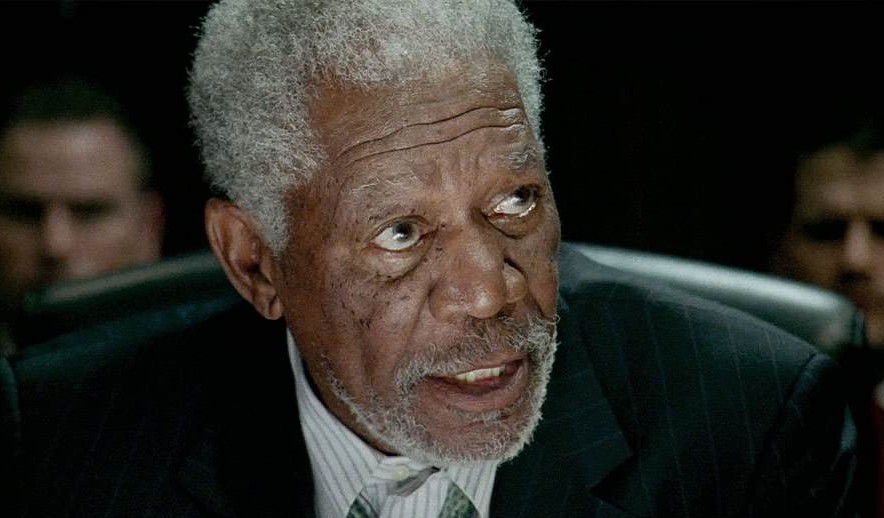
Freeman brings surprising humanity and gravitas to the Speaker of the House, a man who disagrees with the President but puts politics aside and demonstates humility and nervousness over the role he wasn't expecting to be playing when he woke up that morning. Considering the stock, one-dimensional characters in Creighton Rothenberger and Katrin Benedikt's script, I'm sure this level of complexity was brought to the table by Freeman himself, and his scenes have some unexpected credibility to them. I particularly liked his initial anxiety when confronted with the situation and how he's stammering and indecisive and rapidly losing the confidence of everyone in the room when he dodges questions and instead asks someone for a cup of coffee, "with double cream and three Sweet & Lows...and put it in a real cup, not one of those styrofoam things," then closes his eyes, and something snaps in him and he's ready to take charge. It's just a little moment of real, human feeling in an otherwise dumb movie, and Freeman, pro that he is, totally sells it when all he really needed to do was show up.
Directed by the underrated Antoine Fuqua, who fares much better with more grounded and gritty films like TRAINING DAY and the criminally underappreciated BROOKLYN'S FINEST, the shockingly cheap-looking OLYMPUS HAS FALLEN isn't quite the laugh-riot you'd expect from the trailer, and if it weren't for the horrible CGI and the fact that the President's high-tech bunker looks like it was quickly thrown together in Avi Lerner's basement, it would almost certainly play better. As it is, it's the kind of movie where an aerial shot featuring the Capitol Building and the Washington Monument includes a caption that reads "Washington, D.C." It's a forgettable but stupidly entertaining enough way to kill two hours, and for what it's worth, it's miles ahead of the abysmal A GOOD DAY TO DIE HARD. But really, it's long past the time for Worldwide FX to install a software update or close up shop because their work just isn't cutting it anymore. Say what you will about Roland Emmerich, but he's a guy who knows how to convincingly destroy Washington D.C., and his WHITE HOUSE DOWN (with President Jamie Foxx's life in the hands of Secret Service agent Channing Tatum. No, really) will undoubtedly make OLYMPUS HAS FALLEN look even more amateurish than it already does.


 HERCULES