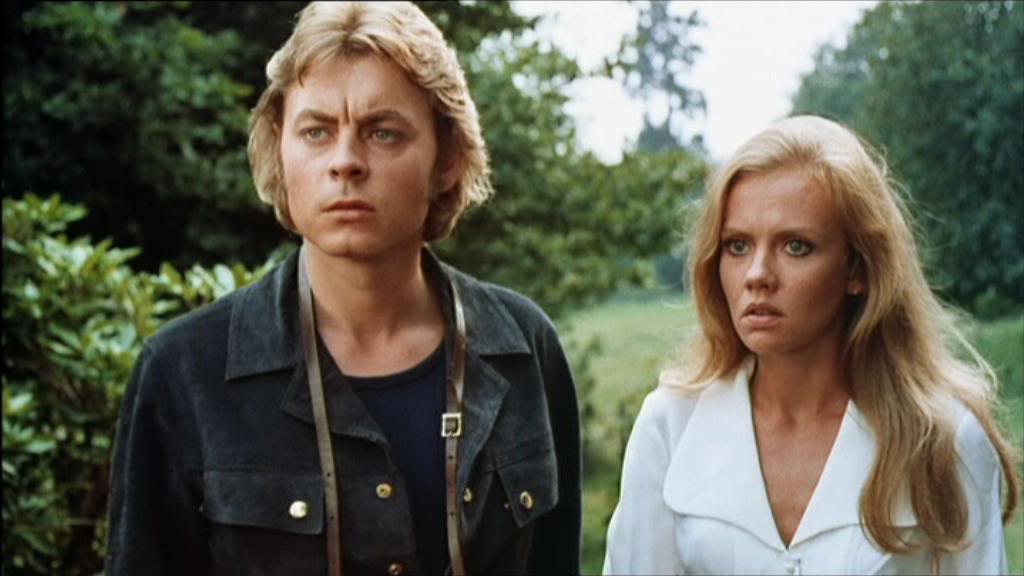
ENDLESS NIGHT (UK - 1972) Written and directed by Sidney Gilliat. Cast: Hayley Mills, Hywel Bennett, Britt Ekland, George Sanders, Per Oscarsson, Patience Collier, Aubrey Richards, Peter Bowles, Lois Maxwell, Madge Ryan, David Bower, Helen Horton, Walter Gotell, David Healy, Leo Genn. (Unrated, 99 mins) Along with the many versions of her 1939 novel And Then There Were None, usually under the title TEN LITTLE INDIANS, the overwhelming majority of Agatha Christie film and TV adaptations have been her mysteries featuring either Hercule Poirot or Miss Marple. With WITNESS FOR THE PROSECUTION, Billy Wilder's 1957 version of her 1925 courtroom drama short story, being tops among the exceptions, the film versions of her literary departures have proven mostly unsuccessful, particularly 1985's ORDEAL BY INNOCENCE, possibly the worst big-screen take on her work. 1972's ENDLESS NIGHT has been held in low regard for nearly 50 years, and its response was so unfavorable in its native UK that it was never even released in American theaters. It's not exactly obscure--between TV airings and its availability on VHS in the '80s and on DVD in the early '00s, it hasn't been all that difficult to see--but it's rarely-discussed and it's been generally dismissed, if not outright forgotten. Based on Christie's 1967 novel, ENDLESS NIGHT definitely falls into the ORDEAL BY INNOCENCE category in that it's a more inward psychological drama rather than a standard mystery, and the film is much more Hitchcockian than Christie in style and execution. And the connection is there, as writer/director Sidney Gilliat (1908-1994), whose career as a screenwriter dated back to the advent of talkies, first found success scripting Alfred Hitchcock films like 1938's THE LADY VANISHES and 1939's JAMAICA INN. ENDLESS NIGHT is generally faithful to Christie's novel, but like ORDEAL BY INNOCENCE, its story structure doesn't lend itself to a visual medium. As a result, unlike ensemble pieces featuring Poirot, Marple, or a group of strangers summoned to an isolated house where they're picked off one by one, Endless Night is one of Christie's works that's better-served on the page.
That doesn't mean it isn't interesting. In fact, it's unusual in the way that it's virtually impossible for it to work on a first viewing. It almost requires a second watch just to make sense of the plot. Its finale throws out twists and turns with such wild abandon that even if the intent is some kind of ambiguity, it will only result in frustration unless you have an opportunity to go back and rewatch key scenes, including a stilted, confusing opening that only makes sense on a second run-through. This is probably a big reason for its chilly reception, plus Christie mysteries just weren't a big draw at the time, with a lull of interest between the mid-1960s and the success of 1974's Oscar-winning MURDER ON THE ORIENT EXPRESS, which kickstarted a Christie renaissance just before her death in 1976. I don't mean to imply that ENDLESS NIGHT is some kind of innovative, misunderstood trailblazer, because at the end of the day, it really doesn't work. But it deserves some credit for being a little ahead of its time with the kind of smack-you-upside-the-head twists and kick-in-the-balls reveals that you'd start seeing regularly in the '90s, especially after THE USUAL SUSPECTS.
Recently released on Blu-ray by Kino Lorber (because physical media is dead), ENDLESS NIGHT was also notable for reuniting the stars of Roy Boulting's acclaimed 1968 chiller TWISTED NERVE: grown-up Disney child star and POLLYANNA herself, Hayley Mills, and cherubic David Hemmings-alike Hywel Bennett. Bennett, then coming off of 1971's penis-transplant sex farce PERCY, is Michael Rogers, an aimless, irresponsible, and immature young man who drifts from job to job with no real drive or sense of responsibility. He's a self-described "idle dreamer" obsessed with a large swath of land in the countryside called Gipsy's Acre, where he has a pie-in-the-sky notion of building a beautiful dream house. He loses a limo driving job over his attitude and is able to leave his new part-time job at a gas station after a chance encounter with free-spirited Ellie Thomsen (Mills). He soon discovers that she's an orphaned heiress--"the sixth-richest heiress in the world," in fact--and they marry after a whirlwind courtship where she surprises him by purchasing Gipsy's Acre. The marriage is frowned upon by her relatives who live on an allowance she doles out, including her bitter stepmother (Lois Maxwell, the Bond series' Miss Moneypenny seen here in rare bitch-on-wheels form). Ellie's cynical, condescending attorney Lippincott (an enjoyably snide performance by George Sanders, in his next-to-last film; he committed suicide six months before its release) even offers Michael a huge payout to divorce her and walk away, subtly implying that this isn't Ellie's first impulsive marriage. Things get strange, combative, and uncomfortable with the arrival of Ellie's friend Greta (Britt Ekland, Bennett's PERCY co-star), who seems familiar to Santonix (Per Oscarsson), an acquaintance of Michael's from his days as a limo driver and also a highly-regarded, terminally ill architect who designs the high-tech, state-of-the-art mansion that Michael and Ellie build at Gipsy's Acre, with Michael quickly coming to the realization that things aren't what they seem to be.
George Sanders (1906-1972)
Nothing is what it seems to be, and that becomes--I hesitate to use the word "clear"--the longer ENDLESS NIGHT goes on. Gilliat was better known as a writer than a director, though he was no slouch in that department, having helmed the great 1946 British mystery GREEN FOR DANGER. One can see why found this story appealing, with all of its Hitchcockian elements, plus the subterfuge, the misdirection, threats, secrets, and blackmail, all set to a score by Bernard Herrmann, whose contributions to Hitchcock classics like VERTIGO, NORTH BY NORTHWEST, and PSYCHO were inestimable. There's also the possibility that Michael is an unreliable narrator whose general shiftlessness, fleeting flashbacks to a tragedy from his childhood, and the fact that his own mother (Madge Ryan) doesn't seem to like him very much, all work together to imply that he's got his own secrets and ulterior motives. But the resolution happens so fast that it's almost too much to take in without going back and looking at parts of the movie again. Only then do things appear to begin coming together, and even then it's a shaky foundation. ENDLESS NIGHT is a film that's easier to appreciate than actually enjoy. It's not really a thriller, and despite some classifying it as "horror," it doesn't really fall into that category either, aside from a couple of creepy moments where Michael imagines Ellie as a faceless figure. Christie's novel was a journey into the mind of its main character, and that isn't easy to pull off as an "Agatha Christie" movie. For her part, Christie saw the film and expressed displeasure with the end result, though her biggest complaints stemmed from the concessions made to the era, primarily some Ekland nudity (Bennett also drops an F-bomb at one point, which isn't something you can imagine hearing from Hercule Poirot or Miss Marple). ENDLESS NIGHT also marked the end of the road for Gilliat, who called it a career and never wrote or directed another film.
CIRCUS OF HORRORS (UK - 1960) Directed by Sidney Hayers. Written by George Baxt. Cast: Anton Diffring, Erika Remberg, Yvonne Monlaur, Donald Pleasence, Jane Hylton, Conrad Phillips, Kenneth Griffith, Vanda Hudson, Yvonne Romain, Colette Wilde, Jack Gwillim, John Merivale, Carla Challoner, Walter Gotell, Kenny Baker. (Unrated, 92 mins) Known primarily for the first dozen films in the long-running CARRY ON series, the British production company and distributor Anglo-Amalgamated occasionally delved into the respectable with BILLY LIAR and DARLING, but was otherwise a prolific B-movie factory through the 1950s and 1960s. They got in on the residual Hammer horror action with what was unofficially termed "the Sadian trilogy" by film historian David Pirie in his groundbreaking 1971 British gothic horror chronicle A Heritage of Horror. 1959's HORRORS OF THE BLACK MUSEUM (directed by Arthur Crabtree) and 1960's classic PEEPING TOM (directed by Michael Powell) set the tone with their increased focus on the lurid, whether it's the grisly-for-the-time violence or the sexually suggestive elements (particularly in the self-explanatory PEEPING TOM) that took things a step beyond Hammer. 1960's CIRCUS OF HORRORS closed the "trilogy" in grand fashion and became a box-office success in the US, where it was released by American International and spawned multiple versions of Garry Mills' hit UK single "Look for a Star," which is heard several times throughout. Directed by Sidney Hayers, who would go on to helm 1962's terrifying BURN, WITCH, BURN, CIRCUS OF HORRORS is rather tame by today's standards but remains a trashy delight, anchored by the quintessential Anton Diffring performance, and is just out on Blu-ray from Scream Factory, because physical media is dead.
Diffring, fresh off off the title role in Hammer's THE MAN WHO COULD CHEAT DEATH, stars as Dr. Rossiter, an egomaniacal, quack plastic surgeon who flees post-war, 1947 London after a botched experimental operation that leaves a young socialite (Colette Wilde) horribly disfigured. Still convinced of his own genius, and with a pair of fawning sycophants in tow in sibling apprentices Martin (Kenneth Griffith) and Angela (Jane Hylton), Rossiter changes his appearance--primarily the removal of a proto-beatnik beard-- and starts going by "Dr. Schuller" by the time the trio end up in France, which is still in poverty-stricken devastation from the war. A chance encounter on the side of the road where Schuller asks a little girl (Carla Challoner) for directions leads him to a decrepit circus owned by the girl's widowed, drunkard father Vanet (a young-ish Donald Pleasence). The little girl--Nicole--has extensive facial scarring from a bomb blast, inspiring Schuller to concoct a scheme where he can continue to practice his craft by using the circus as a front. He restores the girl's beauty, which convinces Vanet to sign the circus over to him as part of a partnership. Then Schuller does absolutely nothing to intervene when the celebrating, shitfaced Vanet tries to dance with the circus' bear and is promptly mauled to death.
Ten years pass, and the circus has relocated to Berlin, where the grown Nicole (Yvonne Monlaur) now calls Schuller "Uncle," and the other circus performers--among them the star attraction Magda von Meck (Vanda Hudson) and the ambitious Ellissa Caro (Erika Remberg)--are all formerly scarred criminals being blackmailed by Schuller by being given a new lease on life and hiding incognito in the circus in exchange for letting Schuller operate on them. All goes well for Schuller until inconveniences start popping up--like Magda falling in love with wealthy Baron von Gruber (Walter Gotell) and wanting to leave the circus, or spiteful Ellissa making a lot of noise when Schuller starts devoting his attention to new and formerly burn-scarred attraction Melina (Yvonne Romain)--leading to the doctor cajoling the hapless Martin into staging a series of fatal "accidents" to keep them quiet. Adding to Schuller's dilemma is Angela's increasing resentment of being kept on the backburner after carrying a torch for him since his days as Rossiter, plus a detective (Conrad Phillips) who's gone undercover as a reporter to ingratiate himself into the "jinxed circus" to investigate why a dozen of its pretty female performers have died in freak mishaps over the last several years.
Anton Diffring (1916-1989)
The story is beyond preposterous, but it works thanks in large part to Diffring. Born in 1916, Diffring fled Hitler's Germany in 1939 only to find himself typecast as Nazi generals and commandants in films throughout the 1950s all the way to the 1980s (most notably in 1965's THE HEROES OF TELEMARK, 1966's THE BLUE MAX, 1969's WHERE EAGLES DARE, 1971's ZEPPELIN, 1975's OPERATION DAYBREAK, the epic 1983 ABC miniseries THE WINDS OF WAR, and Jerry Lewis' infamous and never-released THE DAY THE CLOWN CRIED). Diffring turned up in respectable films like Francois Truffaut's 1966 Ray Bradbury adaptation FAHRENHEIT 451, but he also found consistent employment in Eurotrash fare like 1971's THE IGUANA WITH THE TONGUE OF FIRE, 1973's MARK OF THE DEVIL PART II and SEVEN DEATHS IN THE CAT'S EYE, Jess Franco's 1977 nunsploitation potboiler LOVE LETTERS OF A PORTUGUESE NUN, the same year's German EMMANUELLE ripoff VANESSA (where he played Alain Cuny's aging sexual mentor role), and, in one of his last credits before his death in 1989, Franco's all-star 1988 plastic surgery gorefest FACELESS, where his very presence was an obvious shout-out to his turn in CIRCUS OF HORRORS. As sleazy as the proceedings can be, it's given a classy sheen with the cinematography of the great Douglas Slocombe, a future three-time Oscar-nominee whose long career lasted from 1940 until his retirement following 1989's INDIANA JONES AND THE LAST CRUSADE, after which he lived another quarter century until his death in 2016 at the age of 103 (in addition to THX-1138 co-star Pleasence, the film has another George Lucas connection with Kenny Baker, seen briefly as a circus dwarf 17 years before playing R2-D2 in STAR WARS). Though Hayers (1921-2000) displayed some undeniable chops in the horror genre between this and BURN, WITCH, BURN (and a pair of 1971 efforts with IN THE DEVIL'S GARDEN and INN OF THE FRIGHTENED PEOPLE), the remainder of his career was spent mostly in TV journeyman mode with credits on shows like THE AVENGERS, THE NEW AVENGERS, MAGNUM P.I., THE FALL GUY, MANIMAL, T.J. HOOKER, KNIGHT RIDER, and THE A-TEAM.
THE STUD (UK - 1978) Directed by Quentin Masters. Written by Jackie Collins, Dave Humphries and Christopher Stagg. Cast: Joan Collins, Oliver Tobias, Sue Lloyd, Mark Burns, Doug Fisher, Walter Gotell, Tony Allyn, Emma Jacobs, Peter Lukas, Natalie Ogle, Constantin De Goguel, Sarah Lawson, Franco De Rosa, Chris Jagger, Peter Bourke. (R, 96 mins) In constant rotation in Showtime's late night "After Hours" block in the early-to-mid '80s, the softcore porn cult classics THE STUD (1978) and its sequel THE BITCH (1979) were the first film projects of UK brewery and pub company Brent Walker as well as the first big-screen adaptations of legendary trashy romance novelist Jackie Collins. Co-scripted by Collins and conceived as a starring vehicle for her older sister Joan, THE STUD was a big hit in the UK and it proved to be the first step in reviving 45-year-old Joan's stagnant career, which began in the early 1950s but by 1978 found her slumming in Eurotrash crime movies and drive-in fare like EMPIRE OF THE ANTS. That would all change in 1981 when she enjoyed a major comeback with the zeitgeisty success of the ABC series DYNASTY. A resurgent Collins became so synonymous with the DYNASTY phenomenon that it's easy to forget that she didn't even join the show until its second season. THE STUD gave the actress a chance to give her Alexis Carrington/bitch-on-wheels act a test drive as Fontaine Khaled, owner of the posh, members-only disco Hobo and trophy wife to wealthy businessman Ben Khaled (Walter Gotell, best known as General Gogol in the Roger Moore-era 007 movies). Fontaine is a sexually voracious nympho with a ton of studs on standby, but her favorite is Tony Blake (Oliver Tobias), Hobo manager and insatiable player. Tony beds a different woman every night but is growing disillusioned with ennui and the excess of the night life and being at Fontaine's beck-and-call, and he's even planning on quitting Hobo and opening his own nightclub with unscrupulous investment broker Ian Thane (Peter Lukas).
Despite the film ostensibly being a showcase for Collins, the real focus of THE STUD is Tobias, who has a sort-of second-string Warren Beatty quality here, especially once Tony's SHAMPOO-esque character arc is complete. Though he doesn't change his ways immediately, he falls hard for Alex (Emma Jacobs), Fontaine's barely-legal stepdaughter. Alex is stuck in a boring relationship and wants revenge on serial adulteress Fontaine for cheating on her father, so she throws herself at Tony, who declares his love for her after one night of passion. He finally seems ready to settle down after a drug-fueled night at a hotel where he, Fontaine, her best friend Vanessa (Sue Lloyd) and Vanessa's husband Leonard (Mark Burns) have a foursome in the pool. Vanessa and Leonard are swingers, and Fontaine is "gifting" Tony to Vanessa for her birthday. While they're getting it on, Fontaine and Leonard ride a giant fuck-swing over the pool before the four-way, which comes to an abrupt end when a dazed Tony gathers his senses and realizes he's being blown by an adventurous Leonard. He finally lays it on the line for Alex, who flatly rejects him, cruelly informing him that she was just using him to get off and get back at Fontaine. This culminates in a New Year's Eve bash at Hobo where he finds out he's losing his job and his partnership with Thane is off, and he encounters a conga line of all of his conquests over the course of the film, almost as if his life is flashing before his eyes. THE STUD is totally unabashed trash, but there's some genuinely effective drama and ambition in this final sequence, which blurs the line between fantasy and reality to such a degree that you wouldn't be surprised if Tony started belting out "Bye Bye Life" from ALL THAT JAZZ. It's almost like director Quentin Masters stages it as a mini-homage to the legendary, one-hour banquet sequence in Luchino Visconti's THE LEOPARD, where Burt Lancaster's aristocratic nobleman goes from room to room witnessing the downfall of the upper class, essentially bidding farewell to the world of privilege he's always known. Tony faces the harsh reality of his situation and realizes that a change must be made. He races toward the exit as the New Year's countdown ticks away, finally getting out the door at "zero" and taking a deep breath, the weight of the world and Fontaine Khaled finally off his shoulders.
It's an unexpectedly serious and ingeniously constructed finish to an otherwise tawdry and campy affair. A frequently nude Collins has a blast as the vamping, strutting Fontaine, dropping bon mots like "When I first met Tony, he thought 69 was a bottle of scotch," and "Old Ben gets his cock sucked once a month, in the dark." There's some unexpected humor in a prophetic throwaway line by the frontman of a rock band who's warned about his hard-partying lifestyle and smirks "Who ever heard of a 70-year-old rock star anyway?" The line is funny now because the actor playing the rock star is Chris Jagger, the younger, lookalike brother of Mick. With its dated fashions and its plethora of disco tunes and cheesy, pre-Skinemax sex scenes, it's easy to laugh at THE STUD, but it really steps up its game in the home stretch, demonstrating some unexpected depth and thoughtfulness that one doesn't usually associate with the work of Jackie Collins. Dave Humphries and Christopher Stagg are credited with "additional material and dialogue," so it's possible they brought that out in some rewrites (Humphries' writing credits also include such respected titles as the 1977 cult horror film THE HAUNTING OF JULIA and the 1979 Who rock opera QUADROPHENIA). There's occasional hints of that drama here and there--there's just something haunting and sublimely melancholy about last call at a dimly-lit '70s nightclub with the remaining desperate stragglers either facedown drunk or hooking up to the tune of 10cc's 1975 hit "I'm Not in Love."
THE BITCH (UK - 1979) Written and directed by Gerry O'Hara. Cast: Joan Collins, Michael Coby (Antonio Cantafora), Kenneth Haigh, Ian Hendry, Mark Burns, Sue Lloyd, Carolyn Seymour, Doug Fisher, John Ratzenberger, Pamela Salem, Peter Wight, George Sweeney, Chris Jagger, Peter Burton, Maurice Thorogood, Bill Mitchell, Jill Melford. (R, 93 mins) THE STUD did a great job of capturing the UK perspective of the kind of Studio 54 debauchery that defined the excess of late '70s nightlife. It was such a smash in England--as well as a minor grindhouse and drive-in hit when Trans-American Films released it in the US in 1979--that it spawned an immediate sequel with 1979's THE BITCH, bringing back Joan Collins and much of THE STUD's supporting cast. Though it was based on her novel, Jackie Collins didn't return for THE BITCH, nor did director Quentin Masters, so the Brent Walker guys assigned writing and directing duties to veteran British journeyman Gerry O'Hara, whose career as an assistant and second unit director dated back to the 1940s before he moved into making his own films in the 1960s. Though he worked as an assistant on prestigious fare like RICHARD III (1955), ANASTASIA (1956), and CLEOPATRA (1963), O'Hara never really distinguished himself as his own director, jumping from genre to genre, finding a niche after THE BITCH with 1983's bawdy Brent Walker/Harry Alan Towers co-production FANNY HILL, and eventually ending his career with Cannon during their life support years, when he replaced Ken Russell during pre-production on the dire THE MUMMY LIVES, a horror movie with Tony Curtis that spent three years on the shelf before going straight to video in 1996. O'Hara sticks to the STUD formula with THE BITCH, but the results are less successful. The continuing chronicle of Fontaine Khaled's sexcapades is dull and plodding, even with a surplus of skin and sex scenes, and the action is bogged down by an uninteresting plot about Fontaine tangling with gangsters over an expensive diamond ring that inadvertently comes into her possession.
Fontaine gets the ring from mob-connected Nico Cantafora (BARON BLOOD's Antonio Cantafora, a Robert Goulet lookalike going by his "Michael Coby" pseudonym that he used in several TRINITY knockoffs with Paul Smith) on a flight from NYC to London, where the in-flight movie is...wait for it...THE STUD. He needs to get the ring through customs and knows he'll be stopped, so he plants it on Fontaine, hoping to catch up with her later. He needs the ring because its value will get him out of debt with a British crime organization led by ruthless mobster Thrush Feather (an ill-looking Ian Hendry), who's respected and feared by all despite being named "Thrush Feather." What follows is a convoluted chain of events with double-crosses and tons of sex, sort-of like O'Hara wanted to make a softcore porn version of THE LONG GOOD FRIDAY. There's also boring subplots about Fontaine being warned by her attorney (Kenneth Haigh) that her club Hobo is facing bankruptcy since she still insists on living the kind of jet-setting lifestyle she can't afford since Ben Khaled divorced her after the events of THE STUD. She finds herself in the Tony role here, falling for Nico even though he's just using her, though she eventually turns the tables and uses the ring to get herself out of debt. THE BITCH delivers when it comes to the kind of softcore action that made these two films so well-known to late-night cable viewers and hopeless insomniacs in the 1980s, but it really drags when people aren't bumping and grinding in quintessential 1979 soft focus.
Other than The Olympic Brothers' amazingly catchy earworm of a theme song that will stick with you for days, the most fascinating part of THE BITCH today is the sight of a young John Ratzenberger, then an American expat living and working in the UK a few years before moving back to the States and landing his signature role as Cliff Claven on CHEERS, as a New York mob guy who becomes Nico's contact in London. It's pretty surreal seeing the future Pixar voice mainstay in this bit of softcore sleaze, sharing scenes with Italian cult star Cantafora and tearing up the dance floor at a London disco with a chick on each arm (tragically, O'Hara deprives us of any J-Ratz sex action that talk show hosts could've ambushed him with forever). Ratzenberger gets a lot of scenes in the middle of the film, but then completely vanishes from the story, which is indicative of how sloppy and careless THE BITCH can be. Character motivations and behavior change from scene to scene with little regard for story continuity. People can be furious with someone in one scene and then walking arm in arm with them in the next like nothing happened. But hey, you aren't watching THE BITCH for the story, right? 1978-79 seemed to be a breakout period for Jackie Collins on the big screen: THE STUD and THE BITCH, both recently released on Blu-ray by Kino Lorber in defiant objection to the "physical media is dead" narrative (both have commentary tracks by film historians David Del Valle and Nick Redman, and THE BITCH features an interview with 92-year-old Gerry O'Hara) were two of four Jackie Collins-derived works over that two-year period, which also included another After Hours favorite with 1979's THE WORLD IS FULL OF MARRIED MEN, with Anthony Franciosa and Carroll Baker, and 1979's YESTERDAY'S HERO, an original Collins script about a hard-drinking, washed up soccer star (Ian McShane) that represented a bit of a departure from her signature romance trash. The British-made YESTERDAY'S HERO was never released theatrically in the US, despite McShane's love interest being played by Suzanne Somers, riding high at the time thanks to the enormously popular THREE'S COMPANY. From then on, Jackie Collins' novels were adapted for the small screen with miniseries like HOLLYWOOD WIVES and LUCKY CHANCES. THE STUD and THE BITCH did find a fan in Aaron Spelling, who saw both and hired Collins to add some catty, vindictive bitchiness to DYNASTY, which gave the veteran actress' stalled American career a powerfully gusting second wind that turned her into a TV icon.