tenebre

tenebre
Showing posts with label Sergio Corbucci. Show all posts

Saturday, April 15, 2017

Retro Review: SUPER FUZZ (1981)


SUPER FUZZ
(Italy - 1980; US release 1981)

Directed by Sergio Corbucci. Written by Sergio Corbucci and Sabatino Ciufini. Cast: Terence Hill, Ernest Borgnine, Joanne Dru, Marc Lawrence, Julie Gordon, Lee Sandman, Sal Borgese, Woody Woodbury, Dow Stout, Herb Goldstein, Sergio Smacchi, Don Sebastian, Claudio Ruffini, Jack McDermott. (PG, 101 mins)

If you were an 8-to-10-year-old boy anywhere from 1981 to 1984, chances are there was a brief moment in time when SUPER FUZZ was your favorite movie. Playing regionally across the US from the fall of 1981 to the summer of 1982, SUPER FUZZ became a sleeper hit and is probably the best known Terence Hill solo movie in America after the early '70s smashes THEY CALL ME TRINITY (1970) and TRINITY IS STILL MY NAME (1971) that paired him with frequent co-star Bud Spencer. Born in 1939, Hill, whose career began under his real name Mario Girotti in films like Luchino Visconti's THE LEOPARD (1963), found a niche in post-Sergio Leone/Clint Eastwood spaghetti westerns in the late '60s after adopting the Americanized "Terence Hill" pseudonym. Likewise, "Bud Spencer" was an alias for burly Carlo Pedersoli, and starting with 1967's GOD FORGIVES...I DON'T! and its sequels, 1968's ACE HIGH and 1969's BOOT HILL, Hill and Spencer made over 20 films together, with the last being 1994's TROUBLEMAKERS. By 1970, they were among the top box office draws in Europe, with the two TRINITY spaghetti western spoofs becoming major successes in the States. The duo would periodically make solo films but they were almost never as well-received on their own as they were together, though Hill enjoyed some success teaming with Henry Fonda for the Sergio Leone-produced 1973 spaghetti western MY NAME IS NOBODY. But when he tried his luck at crossing over to Hollywood in 1977, starring with Jackie Gleason in the comedy MR. BILLION and with Gene Hackman in the epic Foreign Legion adventure MARCH OR DIE, both films bombed and Hill went back to Italy to lick his wounds. Spencer's only attempt at going Hollywood never came to fruition: in 1987, Menahem Golan tried to kickstart an American career for him with the Cannon family comedy MY AFRICAN ADVENTURE, but Spencer was ultimately replaced by Dom DeLuise and the film retitled GOING BANANAS. His best-known solo vehicle away from Hill is 1979's THE SHERIFF AND THE SATELLITE KID, an Italian-produced, Georgia-shot CLOSE ENCOUNTERS OF THE THIRD KIND-inspired kids movie that skipped US theaters and debuted on cable. Spencer was paired with young Cary Guffey, memorably abducted by aliens in the Spielberg classic but here playing a cute extraterrestrial child who lands in Atlanta and spends a lot of time hanging out at Six Flags with the gruff Italian western star.


"Supa snoooo-paaaaah!"
While Spencer was making SATELLITE KID and its 1980 sequel WHY DID YOU PICK ON ME?, Hill starred in SUPER SNOOPER, a superhero cop comedy shot in Miami and directed by DJANGO auteur Sergio Corbucci. SUPER SNOOPER was acquired by Avco Embassy and retitled SUPER FUZZ for its October 1981 US release. Rather than opening it in theaters nationwide, Avco Embassy struck a limited number of prints and rolled it out regionally, moving from the west coast to the east coast at malls and drive-ins over a nine-month period. With a big TV push, the film became a moderate hit whose cult grew exponentially when it appeared on HBO by 1983, where its frequency in airing was perhaps rivaled only by THE BEASTMASTER. Possibly among the ten dumbest comedies ever made, SUPER FUZZ is ingratiatingly silly and filled with enough slapstick antics that it's easy to see why it appealed to young boys at an impressionable age. With his slight Italian accent giving him an Inspector Clouseau-meets-Latka Gravas goofball charm, Hill is engaging in a cartoonish way, mugging shamelessly as grinning, wide-eyed doofus Dave Speed, a rookie Miami cop delivering a traffic citation to an abandoned part of the Everglades where the government is testing a nuclear bomb (!). Unable to make it out in time, he's presumed killed in the line of duty until he reappears several hours later, boasting telepathic powers thanks to the radiation exposure. Paired with irate Willy Dunlop (Ernest Borgnine), a disgraced captain busted down to patrol duty, Dave finds he can see through and move objects, walk on water, catch bullets with his teeth, land on his feet after jumping out of the window of a skyscraper, outrun cars, fly through the air, create a makeshift radio just by making the "call me" gesture with his hand, and later, when he's falsely accused of murder, he can escape execution multiple times by beating the gas chamber, the electric chair, hanging, and a firing squad. His Kryptonite is the color red, a fact uncovered by fading '40s starlet Rosy Labouche ('40s and '50s leading lady Joanne Dru, in her first film since 1965 and her last before her death in 1996), the aging moll of Miami gangster Tony Torpedo (Marc Lawrence). Torpedo's nefarios plan is using his fish distribution company as a front for a counterfeit money operation that's being targeted by Dave and Willy, a former Hollywood stuntman still nursing a 40-year-old crush on Rosy.


Borgnine most likely shouting "ARE YOU CRAZY?!" 
SUPER FUZZ's infectious stupidity starts immediately, with the theme song "Super Snooper," performed by The Oceans. It's the kind of song that sticks with you forever, and its oft-invoked refrain--just one quick "Supa snooooo-paaaaaah!" functioning as a de facto mic drop whenever Dave does something amazing--was probably enough to induce giggle fits in the target demographic then and nostalgic chuckles to that same group now. There is no limit to how ludicrous SUPER FUZZ can be: marvel at how Dave gives three Torpedo guys a beatdown in a dog kennel, then frees the dogs and then crams the three guys into the cage as Corbucci ends the scene with goons panting; behold Dave's ability to communicate with fish while he's under water; and brace yourself for his ultimate display of superhero power ("Supa snooooo-paaaaaah!") as he rescues Willy from a sunken boat by chewing some gum and blowing a bubble so big that it lifts them out of the water and flies them high in the sky above Miami. Hill and Borgnine make a likable team, with Borgnine's Willy especially blustery over Dave's budding romance with his niece Evelyn (Julie Gordon). If you revisit SUPER FUZZ now and don't find yourself transported back to your childhood days of carefree innocence and a significantly less-refined taste in comedy, you can at least get shitfaced by taking a drink every time a harumphing, bloviating Borgnine gets a flustered "Why I oughta..." look on his face and shouts "Are you crazy?!" whenever Super Fuzz does something obviously crazy.


"Supa snoooo-paaaaah!" 
Avco Embassy made a few incidental changes to SUPER SNOOPER in its rechristening as SUPER FUZZ: some of the score cues throughout were replaced with more American-sounding library tracks and some minor edits were made to shorten the running time by a few minutes. The version currently streaming on Amazon is the European SUPER SNOOPER cut, in a pristine HD print with English audio and Italian credits sporting the title POLIZIOTTO SUPERPIU. Kudos to Avco Embassy for not messing up a great thing and leaving the song "Super Snooper" alone. A beloved figure in Italy, Hill is still with us--he's been starring as a crime-solving priest in the popular Italian TV series DON MATTEO since 2000--is very active on social media, and still looks spry and youthful at 78 (Spencer died in 2016 at 86). Where's the SUPER FUZZ Blu-ray with a Terence Hill commentary?


SUPER FUZZ opening in Toledo, OH on 1/29/1982


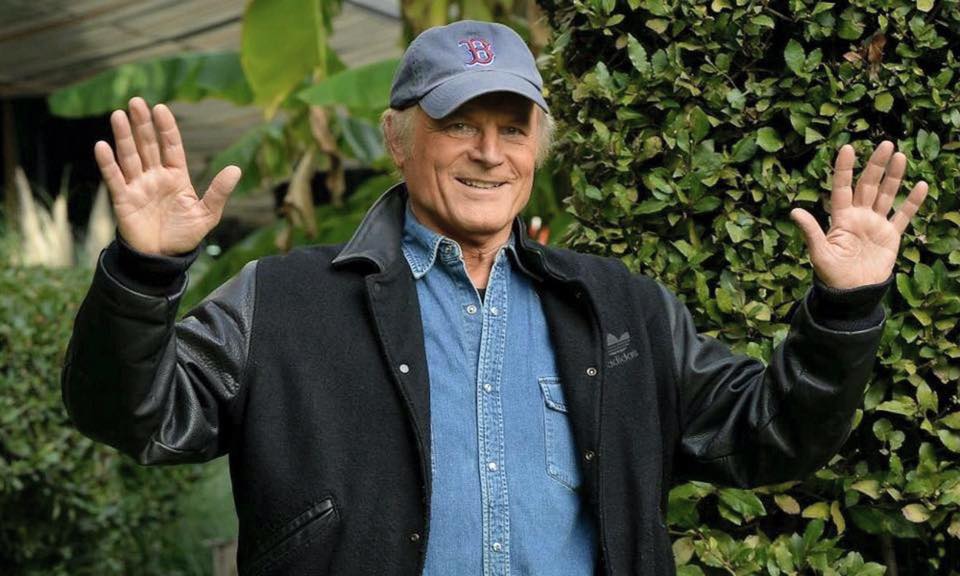
A recent photo of Hill, posted on his official Facebook page. 

Friday, December 28, 2012

In Theaters: DJANGO UNCHAINED (2012)


DJANGO UNCHAINED
(US - 2012)

Written and directed by Quentin Tarantino.  Cast: Jamie Foxx, Christoph Waltz, Leonardo DiCaprio, Samuel L. Jackson, Kerry Washington, Don Johnson, Dennis Christopher, Walton Goggins, Laura Cayouette, David Steen, Dana Gourrier, Nichole Galicia, James Remar, James Russo, Russ Tamblyn, Amber Tamblyn, Don Stroud, Tom Wopat, Bruce Dern, M.C. Gainey, Cooper Huckabee, Doc Duhame, Jonah Hill, Lee Horsley, Ted Neeley, Zoe Bell, Michael Bowen,  Tom Savini, Robert Carradine, Michael Parks, John Jarratt, Quentin Tarantino, and with the friendly participation of Franco Nero.  (R, 165 mins)


Perhaps cognizant of the fact that the likelihood of lightning striking twice with another reinvention of cinema along the lines of 1994's PULP FICTION is slim, Quentin Tarantino has spent the last 15 years content with being a mad scientist DJ of sorts, fusing various genres and making each new film an homage to the cult cinema of his past.  JACKIE BROWN (1997) was his love letter to Blaxploitation; the two-part KILL BILL (2003/2004) his tribute to martial-arts films; DEATH PROOF (2007) his '70s drive-in/car chase throwback; and INGLOURIOUS BASTERDS (2009) his spin on WWII movies.  DJANGO UNCHAINED is Tarantino's take on spaghetti westerns, namely Sergio Corbucci's DJANGO (1966), but reimagined as a pre-Civil War slavery/revenge saga.  Like most Tarantino films after JACKIE BROWN (maybe his most restrained, disciplined film and one that just gets better with each passing year), DJANGO UNCHAINED is guilty of unabashed self-indulgence on the part of its creator, but it's filled with such inspired enthusiasm, crackling dialogue, and a heart-on-its-sleeve love of movies that its appeal--so long as you can get by the splatter and the constant barrage of racial slurs--is positively infectious.  Tarantino's films of late aren't perfect and one could argue that there's some regression from the surprising maturity of JACKIE BROWN.  But really, if he just kept trying to top PULP FICTION, he'd fail miserably.  Films like BASTERDS and DJANGO UNCHAINED may not be reinventing the wheel (though they may try to reinvent history), but there's no denying that they're distinctly Tarantino and couldn't have been made with the same wit, style, and passion by any other director.  Flaws and indulgences aside, DJANGO UNCHAINED is a captivatingly unhinged, over-the-top blast.

In 1858 Texas, Django (Jamie Foxx) is a slave purchased by German dentist/bounty hunter Dr. King Schultz (Christoph Waltz).  Schultz is after the fugitive trio of Brittle brothers, and it's been brought to his attention that Django knows what they look like.  So, the doctor offers Django a deal:  travel with him as a "valet," and point out the Brittles, and receive a third of the reward money along with his freedom.  The two make such a great team that the deal blossoms into a partnership and a friendship, and Schultz offers to help Django find his wife Broomhilda (Kerry Washington), whose whereabouts are unknown after the two were split up by a vengeful plantation owner (Bruce Dern) when they attempted to escape.  After doing some research, Schultz discovers that Broomhilda was sold to Calvin Candie (Leonardo DiCaprio), the flamboyant owner of the plantation Candieland.  Posing as a pair of slavers interested in purchasing slaves for "Mandingo fighting," Schultz and Django arrive at Candieland to rescue Broomhilda, but face an unexpected obstacle in elderly house slave Stephen (Samuel L. Jackson).

Tarantino's gift for the verbose is on full display here, and, as in BASTERDS, it's Waltz who benefits the most, even though he's playing a good guy here--probably the moral center of the film--who's capable of shocking violence.  Schultz's mentor/student relationship with Django recalls Lee Van Cleef and Clint Eastwood, respectively, in Sergio Leone's FOR A FEW DOLLARS MORE (1965).  The pair make a memorable team and are given strong support by the villainous turns of DiCaprio and Jackson. Candie is the easily identifiable villain and DiCaprio relishes the chance to play such a pompously sneering scumbag, but Candie is frequently acting under the manipulative machinations of Jackson's Stephen, who arguably emerges as the film's true antagonist.  One of the most diabolical representations of the "Uncle Tom" stereotype ever presented, Stephen's self-loathing of his race and his alternately pragmatic, humiliating, and malicious eagerness to constantly be in the good graces of the rich and powerful Candie makes him one of the most complex characters in all of Tarantino's films.  It's a difficult role that Jackson essays very well while still dropping "motherfucker"'s as only Samuel L. Jackson can.


The supporting cast is filled with recognizable faces and Tarantino B-movie favorites, some of whom have little more than walk-ons.  Original Django Franco Nero has a brief conversation with Foxx's Django ("The D is silent," Foxx says after introducing himself.  "I know," Nero replies), and it's great to see guys like Dern, Don Stroud, Russ Tamblyn, Tom Wopat, and Lee Horsley again, however briefly.  Going back to John Travolta in PULP FICTION, Robert Forster in JACKIE BROWN, and David Carradine in KILL BILL, Tarantino always seems to give a forgotten actor another shot, and here it's BREAKING AWAY (1979) star Dennis Christopher in a showy supporting role as Candie's weasally lawyer.  Jonah Hill turns up as a doofus KKK member for apparently no other reason than Tarantino wanted to put him somewhere.  The KKK bit and a later sequence with Tarantino attempting an Australian accent as a slave trading employee with Michael Parks and John Jarratt (two of the director's apparently 10,000 favorite actors) are probably the two most egregious examples of things that should've been cut and could've brought the running time down to something more reasonable than a bloated 165 minutes, especially with Parks/Jarratt/Tarantino sequence coming after a jaw-dropping, splatter-filled shootout (all glorious squibs! No CGI!) that paints the walls of Candieland bright red and would've made Sam Peckinpah hard.

Continuing his trend of anachronistic music cues (like David Bowie's CAT PEOPLE theme turning up in BASTERDS), Tarantino expectedly utilizes vintage Italian western themes by Luis Bacalov, Ennio Morricone, and Riz Ortolani, but also songs by Rick Ross, James Brown & 2Pac, and even Jim Croce, and the effect, while jarring, actually works.  DJANGO UNCHAINED is an insane, freewheeling mash-up of cult movie/spaghetti western/exploitation madness that could only be a Quentin Tarantino film.  He may not have another game-changer like PULP FICTION in him, but he really doesn't need one.  There's nobody who does what Tarantino does with such unbridled glee and on such a grand scale.  DJANGO UNCHAINED isn't his best film, but like most of his work (except for that dreadful first half of DEATH PROOF), it will likely prove to be an endlessly rewatchable one, and that'll do just fine.


Wednesday, August 8, 2012

New from Warner Archive: Special Sword & Sandal edition: THE SLAVE (1962), SANDOKAN THE GREAT (1964), and HERCULES, SAMSON & ULYSSES (1964)


Warner Archive recently released six MGM-distributed Italian sword-and-sandal epics from the early 1960s.  Inspired in equal parts by Hollywood epics like Cecil B. DeMille's THE TEN COMMANDMENTS (1956) and Stanley Kubrick's SPARTACUS (1960), but even more so by their homegrown blockbuster HERCULES (1957), the sword & sandal peplum scene exploded in Italy from the late 1950s to the mid-1960s, providing a lot of work for American and Italian bodybuilders, stunning international beauties, and aging Hollywood actors and directors looking for working vacations in Europe.  Bad dubbing and decades of beat-up, horribly cropped, and pan-and-scanned TV airings served to perpetuate the myth that these were cheap, shoddy, low-budget affairs and while some certainly were, a good number of them were lavish, big-budget spectacles with gorgeous widescreen cinematography, high-end production values, incredible sets and locations, and thousands of extras.  Many of these films that have been presented on DVD thus far have been in those $10, 50-film public domain sets that use the same beat-to-hell TV prints that have misrepresented this genre for so long.  Hopefully, these six releases from Warner Archive can accomplish something in the way of reconsidering many of these films, most of which are not lost classics by any means, but were ambitiously made by talented and creative craftsmen (with a lot of future famous Italian directors on the crews) and were often richly entertaining and in their day, quite popular.

THE SLAVE
(Italy - 1962)


American bodybuilder Steve Reeves was crowned Mr. Universe in 1950, but had a difficult time getting his acting career off the ground--one of his early films was Ed Wood's JAIL BAIT (1954)--until he went to Italy and became an overnight sensation with 1957s HERCULES, with stardom following back home after the film's 1959 US release.  The huge international success of HERCULES immediately led to countless similar muscleman epics pouring out of Italy.  THE SLAVE is a SPARTACUS knockoff that reunited Reeves with two of his HERCULES co-stars (Ivo Garrani and Gianna Maria Canale) for the story of Randus (Reeves), a respected centurion in the army of Julius Caesar (Garrani).  Caesar gets word of a potential coup by the nefarious, gold-hoarding Crassus (Claudio Gora) and dispatches Randus and his loyal sidekick Verus (Franco Balducci) to visit Crassus and keep an eye on him.  In the course of his journey, Randus witnesses the cruel and unfair treatment of slaves by Crassus and his soldiers, and eventually discovers that he's the lost son of the legendary slave Spartacus, crucified 25 years earlier by Crassus.  Torn between his allegiance to Rome and his desire to free the slaves and follow in the footsteps of his father,  Randus goes full Zorro and starts disguising himself under a helmet and launching raids to free slaves and start a revolt against Crassus, always leaving his "S" mark behind.


An early effort by director Sergio Corbucci, who would go on to helm numerous classic spaghetti westerns like DJANGO (1966) and THE GREAT SILENCE (1968), THE SLAVE shows embryonic signs of the savage violence and dark nihilism that Corbucci would utilize to a greater extent in those westerns. In addition, Corbucci handles the huge production very well, with excellently-staged action sequences and swordplay, a lot of which is shot on location in Egypt. A beardless Reeves, looking like a really beefed-up Jason Patric, is a commanding hero, and even with the hammy line deliveries and the silly conclusion (you just know it'll riff on "I am Spartacus!"), THE SLAVE is on the high-end of the sword-and-sandal genre. Notable future Italian directors on the crew include cinematographer Enzo Barboni, camera operator Stelvio Massi, and second unit director Franco Giraldi. The 2.40:1 anamorphic transfer is in mostly good shape but there is some noticeable print damage and wear & tear in some scenes. Overall, a fine presentation of a very good example of this type of film. (Unrated, 102 mins)


SANDOKAN THE GREAT
(France/Italy/Spain - 1964)

Reeves also stars in SANDOKAN THE GREAT, the first of four 1964 SANDOKAN films in two simultaneous franchises, one with Reeves and the other with American actor/director Ray Danton.  Released in the US in 1965 by MGM, SANDOKAN THE GREAT gets off to a clunky start and is relentlessly talky for a long time before it starts to pick up.  There's a lot of solid action sequences throughout, but there's also a lot of padding and it could stand to be at least 20 minutes shorter.  Reeves' Sandokan is the son of a Malaysian sultan who's been imprisoned by nefarious British colonials led by the sneering Lord Guillonk (Leo Anchoriz).  To gain leverage, Sandokan and his band of rebels kidnap Guillonk's niece Mary Ann (Genevieve Grad), with the British in hot pursuit through the treacherous jungles, which gives director Umberto Lenzi a chance to frequently cut to stock footage of wild animals.  And of course, Mary Ann sees her uncle's evil ways as she and Sandokan fall in love. Sandokan and his rebels face an angry tiger, a traitor from within, stampeding elephants, poisonous snakes, a monsoon, and a native tribe sporting some of the most cringe-inducing blackface ever seen on screen.  You can actually see it rubbing off during some action scenes. There's some rousing excitement in the machine gun-and-dynamite-filled climax after Sandokan & Co. get some help from a newly-acquired wacky chimp sidekick, but the pace is just too draggy and the film too long.  Some tightening would've made it much more enjoyable.


Lenzi, now 81 and retired from filmmaking since 1992, was a career journeyman who went wherever cinematic trends took him, starting in adventures like SANDOKAN, going to post-DIRTY DOZEN "macaroni combat" films in the late '60s and a few gialli in the early '70s, and then really making his mark with cop thrillers in the mid-to-late '70s and finally with cannibal jungle gorefests in the early '80s.  It's interesting to see, from the copious nature stock footage to the journey through the jungle to Mary Ann being abducted by a tribe of headhunters, just how much SANDOKAN THE GREAT plays like one of Lenzi's later cannibal thrillers like EATEN ALIVE and CANNIBAL FEROX (aka MAKE THEM DIE SLOWLY), minus the extreme gore, the graphic nudity, and the reprehensible onscreen animal killings (SANDOKAN does have one brief shot of a slaughtered pig that doesn't look faked).  Also with Andrea Bosic, Rik Battaglia, Maurice Poli, Enzo Fiermonte, and eagle-eyed Eurocultists will also spot an uncredited Dakar (ZOMBIE, ZOMBIE HOLOCAUST, ATOR THE FIGHTING EAGLE) as one of Sandokan's followers.  The very nice 2.40 anamorphic transfer looks to be in better overall condition than THE SLAVE, but THE SLAVE is the better film by far.  (Unrated, 110 mins).


HERCULES, SAMSON & ULYSSES
(Italy - 1964)

Despite his association with Hercules, Reeves only played the character twice: in the first film and its sequel HERCULES UNCHAINED, both directed by Pietro Francisci.  Numerous other actors stepped into the role over the next several years, sometimes officially and unofficially.  Kirk Morris (real name Adriano Bellini) starred as Maciste, another mythical muscleman, in a series of HERCULES knockoffs that often became HERCULES movies through the wonders of English dubbing or false advertising.  Morris finally got to legitimately portray Hercules in Francisci's 1964 muscle mash-up HERCULES, SAMSON & ULYSSES.  Here, Hercules, Ulysses (Enzo Cerusico), and others are sent by King Laertes (Andrea Fantasia) to find and kill a giant sea monster (which just looks like a seal shot in extreme close-up, with dubbed-in roars).  After completing that task, they get lost at sea and end up in Judea, where Samson (Iranian muscleman Iloosh Khoshabe, using the name "Richard Lloyd"--he also did several films under the awesome moniker "Rod Flash") is hiding because of a bounty placed on his head by evil Philistine King Seren (Aldo Giuffre, best known as the booze-soaked Union captain in THE GOOD, THE BAD AND THE UGLY).  Samson hatches a plan to confuse King Seren into mistaking Hercules for Samson, which prompts Seren to hold all of Hercules' companions hostage and he gives him three days to find Samson, with Seren's queen Delilah (Liana Orfei) in tow.  Hercules finds Samson, and the two duke it out before deciding to join forces and take on King Seren.  HERCULES, SAMSON & ULYSSES is dumb, brainless fun, full of melodramatic dubbing, styrofoam bricks and boulders, and arrows that make a sci-fi laser sound when fired.  It takes Hercules and Samson an hour to meet up, and the titular trio only come together in the closing minutes.  An underused Ulysses is held hostage for much of the film, but it's he who discovers that Hercules and Samson are about to walk into a Philistine ambush.  Hercules and Samson taking out the Philistine army by lifting a gigantic stone temple and tipping it on them is hysterically funny, as is the sight of a bunch of Greeks struggling to row a ship under Hercules' supervision, when Hercules could probably row the thing on his own.  Despite some obviously cheap effects, this looks very good in this remastered 1.78 anamorphic transfer, with its massive sets and beautiful locations. (Unrated, 86 mins)


Other Italian sword & sandal epics in this Warner Archive batch include THE TARTARS (1961) with Orson Welles and Victor Mature; GOLD FOR THE CAESARS (1963) with Jeffrey Hunter and Ron Randell, and DAMON AND PYTHIAS (1962) with Guy Williams and Don Burnett.