THE DEADLY TRAP (France/Italy - 1971; US release 1972) Directed by Rene Clement. Written by Sidney Buchman, Eleanor Perry, Daniel Boulanger and Rene Clement. Cast: Faye Dunaway, Frank Langella, Barbara Parkins, Maurice Ronet, Karen Blanguernon, Raymond Gerome, Michele Lourie, Patrick Vincent, Gerard Buhr, Massimo Farinelli, Robert Lussac, Franco Ressel. (PG, 97 mins) French filmmaker Rene Clement (1913-1996) dabbled in various genres over his career, achieving notoriety for some WWII-themed films like 1952's Oscar-winning FORBIDDEN GAMES, 1963's THE WAY AND THE HOUR, and 1966's all-star epic IS PARIS BURNING? But beginning with 1960's PURPLE NOON--from the same Patricia Highsmith novel that was the basis for 1999's THE TALENTED MR. RIPLEY--and especially with 1970's RIDER ON THE RAIN, he carved a niche for himself as a sort-of French Hitchcock. After RIDER, Clement would maintain that image by focusing exclusively on mystery and suspense thrillers for the remainder of his career until his retirement after 1975's WANTED: BABYSITTER, generally considered his worst film. After the worldwide success of RIDER ON THE RAIN, which was also the key film in establishing Charles Bronson as an international superstar (much like PURPLE NOON did for Alain Delon), Clement followed in rapid succession with 1971's THE DEADLY TRAP, and 1972's AND HOPE DIE. Both films have just been released on Blu-ray by Kino Lorber, because physical media is dead.
Based on the 1966 Arthur Cavanaugh novel The Children Are Gone, THE DEADLY TRAP's script is credited to four writers, among them Clement, Eleanor Perry (who wrote several of her husband Frank Perry's films, including DAVID AND LISA, LAST SUMMER, and DIARY OF A MAD HOUSEWIFE), as well as a Hollywood old-timer in Sidney Buchman, whose long list of credits included 1939's MR. SMITH GOES TO WASHINGTON, 1941's HERE COMES MR. JORDAN (which won him an Oscar), and 1963's CLEOPATRA. There was also an uncredited fifth writer, with contributions from then-recent M*A*S*H Oscar-winner Ring Lardner, Jr. With all of those cooks in the kitchen, it's little wonder THE DEADLY TRAP is a muddled and curiously uninvolving mess with disparate plot elements that never quite come together. Expat American couple Jill (Faye Dunaway) and Philip (Frank Langella, who had just co-starred in the Perrys' DIARY OF A MAD HOUSEWIFE) live in Paris with their two young children Cathy (Michele Lourie) and Patrick (Patrick Vincent). Jill seems preoccupied and has been plagued of late with memory lapses, which have been prevalent enough that it's beginning to cause a rift in their marriage (Jill, defending her recurring distractions and her wandering mind: "Have you done always done exactly what you're supposed to do?" Philip: "Yes. When you got pregnant, I married you. Isn't that what I was supposed to do?"). Philip works as an editor for a publisher of mathematics textbooks, and he's got his own distractions to worry about: he's been summoned by a sinister former employer (Maurice Ronet) to fulfill one final "contract" in his past life of corporate espionage. It was a shady and often dangerous business and it's hinted that it's the reason he and Jill fled to Paris. But the past has caught up with Philip, and they won't take no for answer, going so far as to follow Jill and the kids around. They even use an associate (Karen Blanguernon) posing as an employee from the couple's regular babysitting service to pull off the abduction during one of Jill's frequent easily-distracted moments on a busy street outside a crowded department store at Christmastime.
The cops suspect Jill of negligent parenting at best and outright murder at worst, with lead investigator Chameille (Raymond Gerome) straight-up accusing her of killing the children as a way to get her husband's attention, even interrogating her with humiliating questions like "You and your husband haven't had sexual relations in some time, yes? So, he has a mistress, then?" Jill has the support of her best friend, downstairs neighbor Cynthia (Barbara Parkins), who may or may not have a thing for Philip, while Philip knows that the kids have been kidnapped but can't say anything without divulging his own past as a corporate spy and putting them in even greater danger. THE DEADLY TRAP certainly has the makings of a solid thriller with some pieces that foreshadow the non-supernatural aspects of DON'T LOOK NOW, but its lugubriously slow pace (it's a good 45 minutes before the kids are even taken) and the meandering story are handled with little sense of urgency by Clement, who seems to be having somewhat of an off-day after RIDER ON THE RAIN. The story has two potentially interesting threads--Jill's almost Leonard Shelby-like memory issues and Philip and the kids being threatened by his previous employers--but doesn't follow either to a wholly satisfying conclusion. There's no suspense in the kidnapping angle, and the big reveal about one supporting character is something you'll see coming the moment they're introduced.
THE DEADLY TRAP opening in Toledo, OH on 11/15/1972
It's interesting to see the two stars in an early '70s Eurothriller, with the often-difficult Dunaway already in a post-BONNIE AND CLYDE/THOMAS CROWN AFFAIR slump from which she'd emerge after 1974's CHINATOWN (Langella recounted a story in his memoir about Dunaway wasting an entire day of shooting deciding which pair of shoes she wanted for a particular shot). THE DEADLY TRAP opened in Europe in June 1971 but didn't hit the US until October 1972, courtesy of then-struggling National General Pictures, which would be defunct by the beginning of 1974. It aired in prime-time on CBS in August of 1978 and occasionally ran on late-night TV into the 1980s, but aside from a 1988 VHS release, absurdly retitled DEATH SCREAM and shortened by several minutes--that same crummy DEATH SCREAM print is what's streaming on Amazon Prime--THE DEADLY TRAP has been tough to see in its proper form until now and is probably the least-remembered film from Dunaway's heyday (even 1969's notorious bomb THE EXTRAORDINARY SEAMAN turns up on TCM with some degree of regularity). Fans of Dunaway, Langella (in just his third film, maybe hoping Clement could do for him what he did for Delon and Bronson), and VALLEY OF THE DOLLS star Parkins will find completist curio value here, but given that roster of talent and with Clement coming off RIDER ON THE RAIN, this was regarded as a big disappointment then and the passage of time hasn't made it any better.
THE DEADLY TRAP airing in prime time on CBS on 8/15/1978
AND HOPE TO DIE (France - 1972) Directed by Rene Clement. Written by Sebastian Japrisot. Cast: Jean-Louis Trintignant, Robert Ryan, Lea Massari, Aldo Ray, Jean Gaven, Tisa Farrow, Andre Lawrence, Nadine Nabakov, Daniel Breton, Louis Aubert, Beatrice Belthoise, Don Arres, Mario Verdon, Emmanuelle Beart. (PG, 141 mins) After the middling THE DEADLY TRAP was greeted with shrugging indifference by critics and moviegoers, Rene Clement quickly returned with 1972's AND HOPE TO DIE, a loose adaptation of David Goodis' 1954 novel Black Friday that also reunited him with RIDER ON THE RAIN screenwriter Sebastian Japrisot. The end result is even more eccentric than RIDER, and one of the most unusual and offbeat European crime films of its day. Loaded with references to Lewis Carroll and Alice's Adventures in Wonderland and Alice Through the Looking Glass from the opening shot of a mirror and a bookstore window adorned with the grinning visage of the Cheshire Cat, AND HOPE TO DIE is a fascinating, metaphorically oblique puzzle that's never quite solved, starting with a shy child being taunted by some other kids (including a very young Emmanuelle Beart, 15 years before MANON OF THE SPRING) and an onscreen quote "My love, we're simply overgrown children running around before we go to sleep." Clement cuts to a train arriving at a Montreal station in almost spaghetti western fashion, as three members of a gypsy clan are waiting for Antoine "Tony" Cardot (Jean-Louis Trintignant), a French fugitive who manages to get away, hitching a ride and hiding out in the abandoned American Pavilion (later turned into the Montreal Biosphere) at the Expo 67 World's Fair site. Tony's luck doesn't get any better, as he happens to stumble into a shootout where corrupt ex-cop Renner (Louis Aubert) is whacked by cohorts Rizzio (Jean Gaven) and Paul (Daniel Breton). Just before he dies, Renner hands Tony a wallet and an envelope with $15,000, but after stuffing the money down his pants, he's caught by Rizzio and Paul before he can get away. They handcuff him and take him by car (where he manages to push Paul out of the vehicle, causing a serious head injury), then by boat to a vacant inn being used as a hideout for their gang of criminals led by the fearsome Charley (Robert Ryan), with the gypsy mystery men following close behind and not letting Tony out of their sight.
It soon becomes apparent to Tony that he's traded in one deadly predicament for another. Charley wants the $15,000 that Rizzio and Paul were supposed to get--Tony initially claims he doesn't have it--and in addition to Charley's threats, he also has to deal with his brutish, hapless flunky Mattone (Aldo Ray). Derisively rechristened "Froggy" by Charley, Tony tells a story about how he's on the run because he killed a cop, which gets him enough cache to be kept alive for a while, but he remains on thin ice with Charley throughout, the situation growing even more volatile when he starts sleeping with Charley's free-spirited, open-relationship girlfriend Sugar (Lea Massari). Tony also unexpectedly bonds with Pepper (Tisa Farrow, Mia's younger sister and later the star of Lucio Fulci's ZOMBIE), Paul's younger sister (they were "adopted" by Charley as kids, when their father--a member of Charley's crew--was killed on a job), who feels drawn to him even though she knows he's responsible when Paul eventually dies from his head injury. With Paul out of the picture and already down another man in dead traitor Renner, Charley decides to include Tony as an impromptu fill-in for a bizarre heist he's been commissioned to pull off by an incarcerated mobster (Mario Verdon).
The what and why of the heist ("Toboggan?") would be revealing too much, but it's perfectly in line with this remarkably unconventional crime thriller that's on Blu-ray in its original 141-minute French-language version. It's easy to see why US distributor 20th Century Fox didn't know what the hell to do with AND HOPE TO DIE, cutting it by 42 minutes (!) when it hit American theaters in November 1972 and puttered across the country well into the next year (it opened in Cleveland, OH as late as August 1973). The 99-minute, English-language US cut occasionally aired on late-night TV and had a VHS release through Monterey Home Video, but has since completely disappeared from circulation. It would've been an interesting bonus feature on the Blu, but one can assume the American version eliminates much of the character-building, the slow-burn tension, the Lewis Carroll allusions, and does what it can to offset the general sense of the strange, dreamy melancholy of the entire situation to instead focus on the more action-oriented heist and its aftermath. The reviews were predictably brutal (New York Times film critic Vincent Canby put it on his ten-worst list for 1972), but even European audiences experiencing Clement's intended vision may have been left baffled and scratching their heads. It's filled with nail-biting suspense, but it's not really interested in being a straightforward thriller (there's even some absurdist humor in the way Charley makes Tony sleep in a child's bed), and it's book-ended by scenes of children playing that may even indicate that it's all being imagined. You're never sure if a character is being truthful about their background, starting with Tony, whose reasons for being on the run--hinted at in almost William Friedkin-esque subliminal flash cuts--are eventually revealed to be quite different than what he's telling everyone. Even a whiny, dim-witted meathead like Mattone has layers to his character, and his weird and seemingly out-of-nowhere encounter with a psychic majorette (Nadine Nabokov) will have disastrous consequences later on. That's just one example of how everything that seems random and nonsensical in AND HOPE TO DIE is there for a reason, probably an important aspect of the film's construction that was likely lost on 20th Century Fox when they hacked it down and sold it as action-packed caper.
AND HOPE TO DIE is easily the most peculiarly idiosyncratic film of Clement's career. With its genuinely unpredictable story, character development and arcs, and some effective use of Montreal locations, it's a unique, forgotten gem and a buried treasure of a cult item that's been patiently waiting to be rediscovered, even if it takes a while to adjust to a dubbed-in-French Robert Ryan, who's absolutely terrific in one of his last films (he gets a great intro, putting a cigarette out in Tony's coffee, kicking off a running gag where they don't let him eat or drink). Already terminally ill with lung cancer, Ryan spent the final year of his life working nonstop (he made four more movies after this--LOLLY-MADONNA XXX, THE OUTFIT, EXECUTIVE ACTION, and THE ICEMAN COMETH, the last three being posthumously released in the months after his death in July 1973 at 64). He doesn't look well here, but he doesn't allow cancer to hinder him in the slightest (that would especially be the case with his brilliant final performance in THE ICEMAN COMETH), participating in a few action sequences and getting into rough scuffles with Trintignant and Ray throughout. Though they're revoiced in French (with the American cut seemingly lost and no clips of it on YouTube to verify--not even a US trailer--it's possible Clement shot two versions of the all dialogue scenes, one in French and one in English, like he did with RIDER ON THE RAIN), Americans Ryan and Farrow are phonetically speaking/mouthing the language, and Ray, who previously worked with Ryan in 1957's MEN OF WAR and 1958's GOD'S LITTLE ACRE, goes one step further by delivering his entire performance in French with his actual voice. Aldo Ray fluent in French? Who knew? It's a jarring sight and sound, and an unexpected level of commitment from a guy who was notoriously difficult in his prime, was a couple years away from slumming in Al Adamson movies, who would cap off the decade by appearing in a non-sexual co-starring role in the 1979 Carol Connors hardcore porn western SWEET SAVAGE, and would later have his SAG membership temporarily revoked in the mid '80s for taking quick cash in non-union projects. AND HOPE TO DIE has totally fallen off the radar in the decades since its release, but this new Blu-ray will hopefully be the start of a long-overdue resurrection and reappraisal. It's an often impenetrable, strangely haunting, one-of-a-kind film that stays with you for days after seeing it, and deserves to be mentioned in the same breath as revered Clement essentials like FORBIDDEN GAMES, PURPLE NOON, and RIDER ON THE RAIN.
A MINUTE TO PRAY, A SECOND TO DIE (Italy - 1968) Directed by Franco Giraldi. Written by Louis Garfinkle, Ugo Liberatore and Albert Band. Cast: Alex Cord, Arthur Kennedy, Robert Ryan, Nicoletta Machiavelli, Mario Brega, Enzo Fiermonte, Renato Romano, Franco Lantieri, Giampiero Albertini, Spartaco Conversi, Rosita Palomar, Ottaviano Dell'Acqua, Aldo Sambrell, Daniel Martin, Antonio Molino Rojo, Lorenzo Robledo. (R, 99 mins) A minor spaghetti western that used to be a fixture on late-night TV back in the '70s and '80s, the memorably-titled A MINUTE TO PRAY, A SECOND TO DIE has yet to be seen in the US in its intended form, and that's still the case with Kino Lorber's new Blu-ray release. Shorn by 19 minutes for America, the film has an understandably choppy feel, especially early on, but the biggest change can now be seen in the Blu-ray's bonus features, which include a blurry but watchable snippet of the extended international ending from an overseas TV broadcast. It completely changes the movie and strongly suggests something much more substantive and cynical than the happy ending that the film's American fans have always seen. Produced with the input of Selmur Pictures, a short-lived feature film division of ABC, A MINUTE TO PRAY was possibly intended to go straight to network TV in the US, which would explain trimming the 118-minute European version down to just about 100 minutes, the perfect run time for a two-hour time slot with commercials.
But it ended up playing in theaters and drive-ins over the summer and fall of 1968, which is right around the time Hollywood was really trying to make Alex Cord happen. Best known these days as the eye-patched Archangel on the hit 1980s CBS series AIRWOLF, Cord was being groomed for stardom in the late 1960s. Born in 1933, the actor had numerous TV guest spots going back to 1961, and was tapped to play John Wayne's "The Ringo Kid" character opposite Ann-Margret in the 1966 remake of STAGECOACH, but the movie bombed with critics and audiences. After A MINUTE TO PRAY, Cord starred in three high-profile flops--as Mafioso Kirk Douglas' kid brother in Paramount's pre-GODFATHER mob drama THE BROTHERHOOD (1968); the steamy Harold Robbins adaptation STILETTO (1969); and the British mercenary actioner THE LAST GRENADE (1970), with Richard Attenborough and ZULU's Stanley Baker--that more or less ended his big-screen aspirations. He starred in the 1972 Italian horror film THE DEAD ARE ALIVE and was part of the ensemble of the 1974 bats-in-a-bomb shelter cult favorite CHOSEN SURVIVORS among a scattered few theatrical films, but he concentrated on guest spots on pretty much every TV show in the 1970s and 1980s, including obligatory stops on POLICE STORY, THE LOVE BOAT, FANTASY ISLAND, and MURDER, SHE WROTE before co-starring with Jan-Michael Vincent and Ernest Borgnine as eye-patched covert ops chief "Archangel" on AIRWOLF gave his career a bit of a small screen resurgence in the mid '80s. Now 85 and an occasional guest on the convention circuit, Cord seems to be retired from acting, with his last credit being the 2009 DTV Kevin Sorbo actioner FIRE FROM BELOW.
A serviceable journeyman ideal for one-off TV guest spots (how was he never on a LAW & ORDER?), Cord wasn't the most magnetic big screen leading man, which is apparent throughout A MINUTE TO PRAY, A SECOND TO DIE. Cord stars as Clay McCord, an epileptic outlaw with a $10,000 bounty on his head. He's on the run with his significantly less-wanted partner Fred Duskin (Giampiero Albertini) when they get word that the small New Mexico town of Tuscosa is offering amnesty to any wanted criminal wishing to renounce their evil ways and start a new life and make an honest living in an expanding territory. The edict is handed down from New Mexico governor Lem Carter (Robert Ryan), but is pretty much ignored by Tuscosa marshal Roy Colby (Arthur Kennedy), who has his deputies setting traps outside of town to keep any undesirables out and stop bottom-feeding bounty hunters also waiting to ambush any amnesty-seeking criminals in the vicinity for some easy reward money that Colby doesn't feel like paying. Increasingly frail and with his seizures increasing, McCord hopes to get medical help in Tuscosa but first has to get through Escondido, a haven for outlaws ruled by the ruthless Kraut (spaghetti stalwart Mario Brega). McCord snaps and kills one of Kraut's men after seeing him gun down a grieving widow in cold blood after she blames Kraut for the death of her husband and son (they were seeking amnesty and were killed by bounty hunters), which sends McCord fleeing from Escondido and trying to get past the bounty hunters and Colby's deputies to find safe passage into Tuscosa, where Carter himself has arrived to kick ass when word gets to him that Colby is being derelict in his duty.
A MINUTE TO PRAY, A SECOND TO DIE was directed by Franco Giraldi, a veteran assistant and second unit director on films like Sergio Corbucci's 1962 SPARTACUS knockoff THE SLAVE and, more importantly, Sergio Leone's 1964 game-changer A FISTFUL OF DOLLARS. Giraldi soon graduated to directing second-tier spaghetti oaters like SEVEN GUNS FOR THE MACGREGORS and its sequel UP THE MACGREGORS, though they were released in the US in reverse order. Like his star, Giraldi brings a workmanlike efficiency to the table and gets the job done, but there's very little in the way of the style and artistry that guys like Leone and Corbucci displayed in their landmark contributions to the genre. Likewise, Carlo Rustichelli's score is largely by the numbers and lacks the rousing and instantly iconic feel of Ennio Morricone's compositions for Leone. If the additional sequence in the Blu-ray bonus features are any indication, it would be interesting to see if Giraldi's extended European version perhaps has more going on than the US cut would indicate. In its 99-minute incarnation, A MINUTE TO PRAY feels more like a Hollywood western, with only the supporting cast (including stalwarts like Aldo Sambrell and the perpetually doomed Lorenzo Robledo who, predictably, shows up long enough to get immediately killed), some familiar dubbing voices (Ed Mannix and Tony La Penna can be heard) and McCord being haunted by a past trauma (think Col. Mortimer's raped and murdered sister in FOR A FEW DOLLARS MORE or Harmonica's older brother in ONCE UPON A TIME IN THE WEST) to really contribute to the expected Italian aura. That's likely due to the involvement of ABC as well as the script contributions of Americans Albert Band (father of Empire Pictures and Full Moon honcho Charles Band), who was doing a lot of work in Italy at the time, like writing Sergio Corbucci's underrated THE HELLBENDERS , and Louis Garfinkle, whose writing credits include Band's 1959 cult film FACE OF FIRE, 1972's THE DOBERMAN GANG, the 1973 little person gangster oddity LITTLE CIGARS, and, of all things, 1978's Oscar-winning THE DEER HUNTER.
Of course, the film gets a huge boost from the presence of Kennedy and especially the great Ryan (the same year that both also appeared in the big-budget Italian WWII epic ANZIO), the latter appearing about an hour in, immediately kicking ass, and more or less taking over the film over the film once Cord's McCord is sidelined with an emergency surgery. This leads to a strangely maudlin plot twist that feels more like a spaghetti western AFTERSCHOOL SPECIAL. It's in no way as overtly political as the "Zapata" spaghettis of Corbucci and Damiano Damiani that were just around the corner, but A MINUTE TO PRAY has a very bleeding heart figure in Ryan's Carter, whose plan to forgive almost all outlaws is never really explained. It could be what drew Ryan, one of Hollywood's most outspoken liberal activists of his day, to the role or it could've been a paid vacation to Almeria. Still, the film really comes alive when Carter, Colby, McCord, and Tuscosa town doc Chase (Enzo Fiermonte) are holed up in a small ranch RIO BRAVO-style as Kraut and his Escondido bad guys close in on them. There's even a visibly dangerous bit where the ranch is set ablaze and Kennedy is on the roof surrounded by flames. A MINUTE TO PRAY, A SECOND TO DIE is far from an essential spaghetti western, but it's worth seeing for fans of the genre and Ryan, who takes what could be a check-cashing walk-through in a B-movie and busts his ass like he's on a big-budget Hollywood epic. The Blu-ray looks terrific (there's also a commentary by REPO MAN director and spaghetti western junkie Alex Cox) and the inclusion of that extended ending as a bonus--even in a less than pristine form--is enough to at least consider that Europe has gotten a much more complex and interesting film than America's been able to see. Hopefully we'll get a restored version of it someday.
LOLLY-MADONNA XXX aka THE LOLLY-MADONNA WAR (US - 1973) Directed by Richard C. Sarafian. Written by Rodney Carr-Smith and Sue Grafton. Cast: Rod Steiger, Robert Ryan, Jeff Bridges, Scott Wilson, Season Hubley, Gary Busey, Joan Goodfellow, Tresa Hughes, Paul Koslo, Ed Lauter, Kiel Martin, Randy Quaid, Timothy Scott, Katherine Squire. (PG, 106 mins) In the years before her career took off in 1982 with A is for Alibi, the first of her ongoing "alphabet mysteries" (the 24th, titled simply X, was released last year), novelist Sue Grafton worked primarily in television, writing numerous made-for-TV movies in addition to being a creative force behind Michael Learned's post-WALTONS CBS series NURSE. She made the move to TV in an effort to polish her plotting and character-building skills after her first two books tanked. Her second novel, The Lolly-Madonna War, was published overseas in 1969 with little fanfare, not even attracting interest from a US publisher. British writer/producer Rodney Carr-Smith (BARTLEBY) bought the movie rights and brought it to MGM in an attempt to establish himself in America (still unpublished in the US, The Lolly-Madonna War remains Grafton's most obscure novel, and used mass market paperback import copies currently range from $423 to $880 on Amazon). Carr-Smith collaborated with Grafton on the screenplay adaptation and the film version was rechristened as the ill-advised LOLLY-MADONNA XXX, which didn't do it any favors as many confused moviegoers and theater owners may have understandably mistaken it for a porno. The title refers to a signature on a postcard, with the "xxx" being "kisses," but it proved problematic enough that MGM pulled the film and relaunched it under its original book title as the more straightforward THE LOLLY-MADONNA WAR (and judging from the trailer, it was also titled FIRE IN THE MEADOW at some point prior to its release), though the LOLLY-MADONNA XXX title is what it's most commonly known as today. Under either title, the movie bombed and Carr-Smith's adventures in Hollywood, as well as his career in cinema, came to an abrupt end.
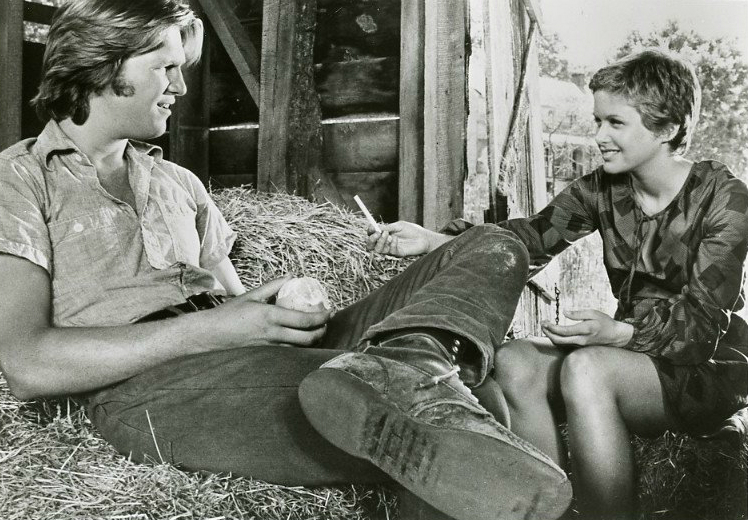
A then-contemporary take on the feud between the Hatfields and the McCoys, updated to rural backwoods Tennessee, LOLLY-MADONNA XXX opens with young Roonie Gill (Season Hubley) switching buses in a podunk town on her way to Nashville and being mistaken for Lolly-Madonna, the supposed fiancee of Ludie Gutshall (Kiel Martin). Roonie is abducted from the bus stop by Thrush (Scott Wilson) and Hawk Feather (a never-better Ed Lauter), two sons of Laban Feather (Rod Steiger), who's in a property dispute with former best friend and rival moonshiner Pap Gutshall (Robert Ryan, in one of his last films; he died less than five months after it was released). Correctly assuming Feather's dumb sons would take the bait and head to the bus stop, Ludie put a forged postcard from a non-existent "Lolly-Madonna" in the Feather mailbox (right next to the Gutshalls on the roadside), asking to be picked up, giving Ludie and two other Gutshall sons, Zeb (Gary Busey) and Villum (Paul Koslo), time to run up to the Feather still and vandalize it. This is just one in a series of escalating back-and-forth pranks that the Feather and Gutshall sons have been playing for the last couple of years, as the bond between the families has deteriorated to the point where star-crossed lovers Skyler Feather (Timothy Scott) and Sister E. Gutshall (Joan Goodfellow) are forced to carry on their relationship in secret. Things headed south after Gutshall's other daughter married Zack Feather (Jeff Bridges) and was killed in a horse-riding accident that Laban blamed on black sheep Thrush. Following Gutshall's purchase of a disputed piece of land that went up for auction when Feather owed back taxes on it, tensions have done nothing but flare and it's only made worse by the presence of Roonie, who is held captive by the Feathers and can't convince Laban or any of his sons--even Zack, with whom she falls in love in what may be a case of Stockholm Syndrome--that she's not Lolly-Madonna and has no idea who the Gutshalls are.
LOLLY-MADONNA XXX is a strange and often twisted film that somehow got a PG rating in 1973 despite some grim and disturbing developments as things take a decidedly dark turn. Ludie confronts Thrush and cracks his skull open with a rock, requiring stitches. Heading to the hills for a clandestine dalliance with Skyler, Sister E. is spotted by Thrush and Hawk (the latter with his face smeared in Roonie's makeup and wearing her bra and granny panties), who attack her and take turns raping her. Pap demands justice for his daughter's rape and wants Thrush and Hawk whipped, which only enrages Laban as the violence and lunacy intensifies and the Feather patriarch sets the disputed piece of land ablaze while leading his clan in a sing-along of "For He's a Jolly Good Fellow." Eventually, Pap and his sons--with the exception of pacifist Zeb, who goes behind his father's back and attempts to broker a truce with an unconvinced Zack, pack an arsenal of weapons to launch an assault on the Feather homestead.
Directed by journeyman Richard C. Sarafian (VANISHING POINT), LOLLY-MADONNA XXX is surprisingly strong stuff that would probably get an R rating even today with the mostly-implied but still unsettling rape scene (it's actually more effective that Sarafian cuts away just as it's about to get really unpleasant), the bloody violence, and fleeting nudity by both Hubley and Goodfellow. Though it prefigured oncoming hillbilly-centered films like GATOR BAIT by a couple of years and the great SOUTHERN COMFORT by eight, it feels a lot like a big-studio version of a really grimy drive-in hicksploitation flick, almost like THE WALTONS-meets-DELIVERANCE, definitely revealing an unexpected side to Sue Grafton's writing if you're only familiar with her very mainstream mystery novels. The climax--a long, protracted, Sam Peckinpah-meets-Walter Hill-style shootout where all hell breaks loose while a catatonic and insane Laban can do nothing other than silently stew at the kitchen table and angrily make himself a mayonnaise-and-ketchup sandwich--is the kind of batshit craziness that did little to win LOLLY-MADONNA XXX any fans then but makes it a terrific and bizarre curio item today (one of Hollywood's great overactors, Steiger is one of the very few people who can overdo the act of pouring ketchup). It's hard to believe there was once a time when a character played by a young and still-serious Gary Busey (in just his fourth film) would function as the most stable and level-headed voice of reason in a movie (speaking of crazy, a young Randy Quaid is also on hand as a mentally-challenged Feather son). Despite its more exploitative elements, there's certainly an anti-war Vietnam era metaphor to LOLLY-MADONNA XXX in the way Laban and Pap express concern over what's going on but do absolutely nothing to stop it, instead being complicit in its escalation and content to let their sons do the fighting and the dying. Vietnam is also directly invoked by Pap Gutshall having lost a son in combat and Zack Feather being established as a draft dodger. Even by the standards of the more adventurous, chance-taking cinema of the post-EASY RIDER, pre-summer blockbuster 1970s, LOLLY-MADONNA XXX is one of the weirder movies to come from a major studio in that era and is worth seeing on that basis alone, and even more so when you look at that fascinating mix of old-school Hollywood and up-and-coming youngsters. Shortly after completing this film, Ryan and Bridges would work together again on John Frankenheimer's THE ICEMAN COMETH, released several months after Ryan's death from lung cancer.