DEATH RAGE (Italy - 1976; US release 1978) Directed by Anthony M. Dawson (Antonio Margheriti). Written by Guido Castaldo and Giacomo Furia. Cast: Yul Brynner, Martin Balsam, Barbara Bouchet, Massimo Ranieri, Giancarlo Sbragia, Giacomo Furia, Sal Borgese, Loris Bazzocchi, Rosario Borelli, Luigi Williams (Luigi Bonos), Renzo Marignano, Tomasso Palladino. (R, 96 mins) A rather routine and formulaic Eurocrime outing from well-traveled Italian journeyman Antonio Margheriti, 1976's DEATH RAGE was a fixture on late-night TV and in video stores in the '80s and since has appeared on countless "50 Action Hits!" public domain DVD sets over the years, always looking like garbage and usually presented in a butchered 76-minute cut culled from an ancient TV print. It hit US theaters in 1978 at 85 minutes courtesy of short-lived S.J. International Pictures, but has just been issued on Blu-ray by Dark Force Entertainment--imagine, if you can, Code Red's less stable cousin--in a best-it-can-possibly-look transfer sourced from the original 96-minute Italian version, because physical media is dead. It's still got some print damage and scratches, but visually, it's a drastic improvement over every other version that's out there. The English soundtrack covers the 85 minutes that comprised the US release, with the eleven extra minutes scattered throughout presented in Italian with hit-or-miss subtitling, but it's doubtful you'll miss any important information. DEATH RAGE isn't really a standout in either the Eurocrime subgenre or in Margheriti's filmography, but it is of some historical significance as the big screen swan song of the great Yul Brynner (1920-1985), who would spend the remaining years of his life constantly touring with stage productions of THE KING AND I, arguably his most famous role and the one that won him the Best Actor Oscar for the 1956 film version.
Brynner played the villainous "Deaf Man" in the 1972 Burt Reynolds cop movie FUZZ and enjoyed a surprise box-office hit riffing on THE MAGNIFICENT SEVEN with his memorable turn as the robotic gunslinger in 1973's WESTWORLD, but those were rare highlights in an ongoing slump dating back to the late 1960s. 1975's post-apocalyptic THE ULTIMATE WARRIOR was a minor hit at drive-ins, but by 1976, his brief resurgence was over. He was reduced to an embarrassing cameo reprising his role as the Gunslinger in the lackluster WESTWORLD sequel FUTUREWORLD, and after heading to Italy to star in DEATH RAGE, he decided he was done with movies. It isn't exactly a Brynner classic, but it's a better one to go out on than FUTUREWORLD. He at least gets to spend the whole movie looking like a stone-cold badass: dressed in black, doing hardcore shit like throwing a guy under a speeding train and shooting another right in the gut with no hesitation and letting him bleed out even after the guy cooperates and gives him the info he demanded, and perhaps most importantly, spending long stretches of screen time with a frequently nude Barbara Bouchet. Hey...it's good to be the King.
DEATH RAGE in Toledo, OH on 9/29/1978
Far more convoluted than it needs to be in its original version--a problem that was actually rectified by the US cut with hired-gun editor and "creative adviser" Fima Noveck streamlining the opening 15 minutes and relaying the clunky exposition in a much more concise fashion that really improves the film overall--DEATH RAGE (shot as CON LA RABBIA AGLI OCCHI, or ANGER IN HIS EYES) was misleadingly sold in America as a vigilante thriller in the vein of DEATH WISH, with the poster art screaming "Bronson started it...Brynner finishes it!" However, it's really just a conventional Italian crime flick with Brynner as Peter Marciani, a retired and still-feared hit man summoned from NYC to the old country when he's informed that a mob hit at a racetrack in Naples was commissioned by Gennaro Gallo (Giancarlo Sbragia), the same top capo who ordered the death of his younger brother in NYC years earlier. He heads to Naples and meets up with Angelo (Massimo Ranieri, looking a lot like MEAN STREETS-era Harvey Keitel), an ambitious young hood who witnessed the racetrack hit and is eager to make his name under the tutelage of feared legend such as Marciani, who's been out of the game but whose lethal exploits are still whispered about in mob circles. The cops--headed by a perpetually irate commissario (Martin Balsam, who likely worked on Franco Prosperi's 1976 polizia MEET HIM AND DIE during the same trip to Italy)--also know that Marciani is in town and they desperately want to avoid an all-out mob war. Of course, it happens anyway with multiple botched attempts on Marciani's life--including acid in place of the eye drops he uses for a psychosomatic vision issue that he's had since witnessing his brother's murder-- that inevitably lead to him launching a one-man war on Gallo's organization.
DEATH RAGE in Toledo, OH on 9/29/1978
He also finds time for romance with stripper Anny, played by Bouchet, whose nude scenes were significantly trimmed in the US cut. Quentin Tarantino screened his print of DEATH RAGE at the New Beverly in L.A. in 2007 and flew Bouchet over from Europe for the occasion, hosting an audience Q&A where she told several stories about not getting along with Brynner and how unpleasant he was with the crew. Regardless of his alleged boorish behavior behind the scenes, he appears to be having a good time here. He has no chemistry with Bouchet but establishes a nice rapport with Ranieri (the two also appeared together in 1971's THE LIGHT AT THE EDGE OF THE WORLD), even though the younger actor's "eager protege" role seems completely superfluous and he really has nothing consequential to do until the very end. Margheriti was as much of a journeyman as every other Italian genre director of his day, and like all of them, he had his specialties, like his 1960s space operas and his 1980s commando jungle explosion movies. He just doesn't seem as engaged with DEATH RAGE, the type of post-GODFATHER Eurocrime/polizia offshoot more in the wheelhouse of a Fernando Di Leo (CALIBER 9, THE ITALIAN CONNECTION) or an Umberto Lenzi (ALMOST HUMAN, ROME ARMED TO THE TEETH), though he would follow it with one of his best films, 1978's wonderfully grimy, slushy, NYC-blizzard-shot Lee Van Cleef heist thriller THE SQUEEZE. DEATH RAGE does have an effective score by Guido and Maurizio De Angelis, though the fast tempos and blaring horns during the action sequences sound a lot like Franco Micalizzi cues from a Lenzi polizia. There's also a long mid-film car chase, and it's too bad Margheriti never finds a use for the apparently mandatory stock footage shot from Sergio Martino's THE VIOLENT PROFESSIONALS, with a car crashing though a stack of cardboard boxes engulfed in flames.
THE SALAMANDER (UK - 1981; US release 1983) Directed by Peter Zinner. Written by Robert Katz and Rod Serling. Cast: Franco Nero, Anthony Quinn, Eli Wallach, Martin Balsam, Claudia Cardinale, Sybil Danning, Christopher Lee, Cleavon Little, Paul Smith, John Steiner, Renzo Palmer, Anita Strindberg, Jacques Herlin, Marino Mase, Fortunato Arena, John Stacy, Andre Esterhazy, Nello Pazzafini, Tom Felleghy, Gitte Lee. (R, 101 mins) Based on the 1973 novel by Morris West, the long-in-the-works conspiracy thriller THE SALAMANDER began life as a screenplay adaptation by TWILIGHT ZONE and NIGHT GALLERY creator Rod Serling, left unfinished following his death in 1975. It languished for several years until Robert Katz (THE CASSANDRA CROSSING, THE SKIN) reworked and completed it. The film finally went into production in 1980, with veteran editor Peter Zinner making his directing debut at 62, fresh off his Oscar win for editing 1978's THE DEER HUNTER. Zinner was a late-blooming hot commodity at the time, as his other credits included 1967's IN COLD BLOOD, 1972's THE GODFATHER and 1974's THE GODFATHER PART II, but he really was a hired gun at heart, as his work on THE DEER HUNTER was sandwiched between esteemed prestige projects like 1977's TINTORERA and 1979's THE FISH THAT SAVED PITTSBURGH. Shot entirely in scenic locations throughout Italy and featuring an all-star cast, THE SALAMANDER should've been a hit but was a DOA dud worldwide. It was another in a string of flops from Sir Lew Grade's ITC Entertainment, the British company that produced THE MUPPET SHOW and had some hits like THE MUPPET MOVIE, ON GOLDEN POND, and THE GREAT MUPPET CAPER, but lost a ton of money over 1980-81 on expensive bombs like the Village People's CAN'T STOP THE MUSIC, the Farrah Fawcett-pursued-by-horny-robot-in-space sci-fi dud SATURN 3, the Clive Cussler adaptation RAISE THE TITANIC!, and the ill-fated THE LEGEND OF THE LONE RANGER. ITC had distribution through various means, whether it was their own Associated Film Distribution or major studios like Universal and 20th Century Fox, but after being released in Europe in 1981, THE SALAMANDER remained unseen in the US until it turned up in one theater in NYC in May 1983 before being bum-rushed off to television and a belated VHS release in 1986. Pathfinder released it on DVD with no fanfare in 2002 but otherwise, it's spent 30 years in relative obscurity despite a cast packed with cult icons and big-screen legends and it's just been resurrected on Blu-ray courtesy of Scorpion Releasing. It's nice that it's available again and in a quality presentation, but it should come as no surprise that THE SALAMANDER isn't exactly an unsung classic waiting for its day in the sun.
The film opens in Rome with the assassination of beloved Gen. Panteleone (Fortunato Arena), a beloved statesman, WWII hero, and champion of democracy in his younger, post-war years. The truth behind his murder is buried and "natural causes" is the reason given to the public. Carabinieri officer Col. Dante Matucci (Franco Nero) is assigned to investigate, along with his big brotherly mentor Capt. Stefanelli (Martin Balsam). Both are stonewalled by everyone, from Panteleone's heir apparent Gen. Leporello (Eli Wallach) to Italy's counterintelligence chief Prince Baldasar (Christopher Lee), and the body count rises as anyone Matucci questions or is about to question turns up dead. After tying Panteleone's death to a decades-long string of assassinations of war criminals staged to look like suicides--pulled off by a hit man known as "The Salamander," the long-retired alter ego of billionaire industrialist Bruno Manzini (Anthony Quinn)--Matucci uncovers a plot to orchestrate a coup d'etat by a renegade group of military officials and high-powered politicos attempting a Make Italy Great Again move by taking the country back to the Mussolini glory days.
Matucci's investigation also involves a momentum-killing romance with Polish spy Lili Anders (Sybil Danning, who had just co-starred with Nero in Enzo G. Castellari's THE DAY OF THE COBRA), some ballbusting with his NATO-based USMC buddy Malinowski (Cleavon Little), and a sadistic and profusely sweaty torturer known as "The Surgeon" (Paul Smith, doing his usual MIDNIGHT EXPRESS stink-eye side-glancing act). Even with the cast and the potentially intriguing story, THE SALAMANDER just never catches fire despite the heroic efforts of a typically excellent score by Jerry Goldsmith that belongs in a more exciting movie. It gets bogged down in sequence after sequence of Matucci going to see someone, interviewing them, and then moving on to the next person. Zinner offers one low-energy car chase in which both cars crash through oddly-placed fruit stands right on cue. Intermittently-deployed voiceover narration by Nero is a clear indication of Zinner scrambling to cover gaps in the narrative, and most of the big names--Quinn, Lee, Little, Wallach, Claudia Cardinale (as Leporello's wife)--have little more than extended cameos. Balsam has one great bit where the camera slowly moves in on his aging face as he delivers a devastating monologue about how he, as a young man during WWII, stepped out for cigars and returned home to find his entire family massacred, but then Zinner ruins it, breaking the spell by inexplicably cutting to a reaction shot from a cat. There's a little oomph offered by some third-act sleaze, with Mrs. Leporello having a torrid affair with her husband's aide-de-camp Roditi (John Steiner, dubbed by Larry Dolgin) and the discovery that Gen. Leporello has a thing for very young girls, plus some unintended hilarity with a torture scene leading to a Franco Nero/Paul Smith brawl, with a hirsute Nero sporting nothing but a jockstrap with his bare ass flailing all over the place and nearly giving Smith a faceful of his taint. THE SALAMANDER is an interesting curio if for no other reason than that cast, all of whom are fine and do what's expected of them (Lee's smug, sinister Baldasur allows him to pull out almost every move in his "pompous prick" arsenal), but it proved to be one-and-done for Zinner as a director. After the film's failure, he returned to his regular job, earning an Oscar nomination for editing 1982's AN OFFICER AND A GENTLEMAN and several Emmy nominations for various TV gigs, including the epic 1983 ABC miniseries THE WINDS OF WAR and its 1988 sequel WAR AND REMEMBRANCE, winning for the latter. Zinner died in 2007 at 88.
COUNSELOR AT CRIME aka THE COUNSELLOR (Spain/Italy - 1973; US release 1975) Directed by Alberto De Martino. Written by Adriano Bolzoni, Vincenzo Flamini (Vincenzo Mannino), Leonardo Martin and Alberto De Martino. Cast: Martin Balsam, Tomas Milian, Francisco Rabal, John Anderson, Dagmar Lassander, Carlo Tamberlani, Manuel Zarzo, Eduardo Fajardo, George Rigaud, Franco Angrisano, Giovanni Carbone, Fortunato Arena, Carla Mancini, Lorenzo Piani, Sacheen Littlefeather, Nello Pazzafini. (R, 102 mins) While most films in the polziotteschi subgenre of politically-charged Italian crime movies of the 1970s took place in Rome, Naples, and Sicily, COUNSELOR AT CRIME is a bit of an outlier in that it's set almost entirely in America. Journeyman director and co-writer Alberto De Martino (whose later credits included the EXORCIST ripoff THE ANTICHRIST, the OMEN ripoff HOLOCAUST 2000, and the MST3K favorite THE PUMAMAN) fashions COUNSELOR as a pretty blatant, albeit contemporary GODFATHER knockoff. Shot largely in San Francisco and Albuquerque in January and February of 1973, COUNSELOR AT CRIME (or, as it was known in Italy, IL CONSIGLIORI) hits everything on the GODFATHER checklist: Sonny-at-the-causeway-like ambushes; a treacherous, Sollozzo-like troublemaker trying to make a name for himself by eliminating a powerful Don; an unexpected sojourn to Sicily when things get too hot at home in the States; and someone is even handed the severed head of a fish, a clever way to knock two things off the checklist by combining "sleeps with the fishes" with the horse's head in the movie mogul's bed. IL CONSIGLIORI was released in Europe in the summer of 1973 but didn't make its way to the US until 1975, when low-grade exploitation outfit Joseph Green Pictures picked it up and retitled it COUNSELOR AT CRIME. It's a largely by-the-numbers gangster picture that goes out of its way to look as American as possible, spotlighting the San Francisco locations where De Martino valiantly attempts to keep the Golden Gate Bridge visible as often as possible (there's even a sequence taking place at the same exit ramp where a pimp is killed in the same year's Dirty Harry movie MAGNUM FORCE), with Riz Ortolani's score having a definite "'70s cop show" sound to it when the composer isn't straight-up borrowing a key theme from his VALACHI PAPERS score from the previous year.
A low-level, syphilitic gangster loses his shit in a bowling alley, setting in motion a chain of events that sees underboss Garofalo (played by a backup Michael Ansara toupee planted on the head of Francisco Rabal) make a ballsy power play to take over the San Francisco organization ruled by Don Antonio Magadino (Martin Balsam). Magadino's mind is elsewhere since his godson and consigliere Thomas Accardo (Tomas Milian) is being paroled after serving a stretch for jury tampering in Santa Fe State Prison in New Mexico, the same joint that houses incarcerated Boss of Bosses Don Vito Albanese (American character actor John Anderson, dubbed by Robert Spafford). Accardo is welcomed back to the organization by Don Antonio, who raised him as his own son after he was orphaned as a child (a character trait in no way influenced by Robert Duvall's Tom Hagen in THE GODFATHER), but Accardo has other plans. He continued his legal studies while in prison, and fell in love with Laura Murchison (Dagmar Lassander), a professor at the University of New Mexico. He wants to leave the Family, marry Laura, and live a normal life away from the Mafia. Don Antonio grants him his wish, despite the ironclad rule that no one leaves, which enrages Garofalo, who then plots to whack Accardo so he doesn't talk, and Don Antonio over his flagrant disregard of their sacred Mafia oath.
COUNSELOR AT CRIME offers one bit of interesting trivia that tangentially connects it to THE GODFATHER: it's one of the very few movie appearances of Native American activist Sacheen Littlefeather, best known for taking the stage at the 1973 Oscars to refuse Marlon Brando's GODFATHER Oscar for him, and seen here in a brief bit as a hooker. Beyond that, it also offers one of the most low-key performances of Milian's career, a real surprise considering his string of flamboyantly over-the-top psycho characters in Umberto Lenzi classics like ALMOST HUMAN (1974) and ROME ARMED TO THE TEETH (1976). Rabal is dubbed by the gruff Ed Mannix but definitely looks the part as the arrogant, untrustworthy Garofalo, and Balsam is a solid pro as the stern and paternal Don Antonio, and while he may not ooze the charismatic charm of Brando's Vito Corleone, it's superb casting, and De Martino even lets him take part in some action sequences and shootouts. Balsam was in the early years of a relentlessly busy decade that found the Oscar-winning actor (1965's A THOUSAND CLOWNS) alternating between supporting roles in A-list Hollywood projects (SUMMER WISHES WINTER DREAMS, THE TAKING OF PELHAM ONE TWO THREE, MURDER ON THE ORIENT EXPRESS, ALL THE PRESIDENT'S MEN) and starring roles in Italian crime films (CONFESSIONS OF A POLICE CAPTAIN, CHRONICLE OF A HOMICIDE, MEET HIM AND DIE, DEATH RAGE), and his presence here definitely helps sell the idea of making it look like an American gangster movie, and he fares much better than the miscast Anderson, whose two scenes were actually shot inside Santa Fe State Prison, complete with several inmates in the chow line turning to look straight into the camera.
It's a mostly routine post-GODFATHER mob movie until a surprisingly strong finale where both Balsam and Milian really get to show some chops without saying much at all. And it's in the finale where COUNSELOR AT CRIME makes its only real attempt to branch off from THE GODFATHER with the notion that it's not the aging mob bosses who hand off the power to the next generation, but rather, it's the older generation that's still around to pick up the pieces when their dealings and grudges end up sacrificing that next, doomed generation. It's an interesting perspective that should've been explored in a more in-depth fashion by the script, which was written by De Martino with three other writers (including frequent collaborator Vincenzo Mannino) before being translated into English and reworked by an uncredited Michael V. Gazzo, the raspy-voiced playwright and sometime actor who would get an Oscar nomination for his performance as bitter mob informant Frankie Pentangeli in 1974's THE GODFATHER PART II.
TWO EVIL EYES (Italy - 1990; US release 1991) Directed by Dario Argento and George A. Romero. Written by George A. Romero, Dario Argento and Franco Ferrini. Cast: Harvey Keitel, Adrienne Barbeau, Ramy Zada, Sally Kirkland, Martin Balsam, E.G. Marshall, John Amos, Kim Hunter, Madeleine Potter, Bingo O'Malley, Tom Atkins, Jeff Howell, Holter Ford Graham, Julie Benz, Christine Forrest, Chuck Aber, Anthony DiLeo Jr., Tom Savini. (R, 120 mins) In its earliest stages of development, TWO EVIL EYES was intended by producer Dario Argento to be a four-part anthology horror film celebrating the work of Edgar Allan Poe, with the Italian master of horror joined by fellow genre legends George A. Romero, Wes Craven, and John Carpenter. By the time production began in Pittsburgh in the summer of 1989, Craven and Carpenter bowed out, leaving Argento and Romero as the remaining participants, each helming a present-day Poe segment running approximately one hour in length. TWO EVIL EYES was supposed to be timed with the ill-fated Poesploitation craze of 1989, which primarily saw rival producers Roger Corman and Harry Alan Towers cranking out a series of Poe adaptations in honor of the 140th anniversary of the writer's death (this included two competing versions of THE MASQUE OF THE RED DEATH). Most of these films weren't released until 1990 or 1991, thereby making the anniversary element pointless, and that went for TWO EVIL EYES as well. While it debuted in Europe in January 1990, it wouldn't hit US theaters until much later in October 1991, courtesy of Taurus Entertainment, who gave it a limited release on just 150 screens. Though an Italian production and Argento's baby, both segments of TWO EVIL EYES were shot in Romero's Pittsburgh stomping grounds, with the beloved NIGHT OF THE LIVING DEAD auteur providing his usual behind-the-scenes crew for Argento to use, including production designer Cletus Anderson, editor Pasquale Buba, and makeup effects maestro Tom Savini. Though he did some location work in Central Park for 1980's INFERNO, TWO EVIL EYES marked the first time Argento shot an entire project in the US, and he would return to the States for 1993's TRAUMA, which found him unable to create much of a stylish giallo atmosphere in exotic Minneapolis.
Romero kicks things off with "The Facts in the Case of Mr. Valdemar," previously filmed by Roger Corman as the closing segment in 1962's TALES OF TERROR and best remembered for Vincent Price waking from the dead and melting into ooze over scheming hypnotist Basil Rathbone. Wealthy Ernest Valdemar (Bingo O'Malley) is in a coma induced by his physician and amateur hypnotist Dr. Robert Hoffman (Ramy Zada). Hoffman is having an affair with Jessica (Adrienne Barbeau), a former flight attendant who became an aging Valdemar's trophy wife years ago and is anxious to reap the benefits of his impending passing ("I let him use me," she explains. "For pleasure and for show...and I intend to be paid for my services"). Hoffman puts Valdemar under hypnosis to ease the pain but that's also the time that he can control the old man's mind, getting him to repeat things over the phone to his suspicious attorney Pike (E.G. Marshall) and signing documents transferring untold amounts of cash over to Jessica. They need to keep Valdemar alive for three weeks before the estate transfers to Jessica, but he dies while under hypnosis, putting him in a purgatory where he remains "alive" and part of our world and "the next," with the ominous "the others" attempting to use him to cross over. Romero takes some significant liberties with the story, his attempt to wedge in some social commentary about the greed of the wealthy doesn't really work (nor does the shot of blood dripping on money--Romero wasn't usually so ham-fisted in his societal critiques), and it's flatly shot in a way that makes it resemble a gorier-than-usual episode of TALES FROM THE DARKSIDE, but "Valdemar" has some effective moments that make it better than its reputation. It's certainly a lesser work in the Romero canon, trying but not quite succeeding in re-establishing that CREEPSHOW mood--with Barbeau as another bitchy harridan, plus the presence of Marshall and O'Malley, not to mention Romero's then-wife Christine Forrest, playing a mean nurse just like she did in 1988's MONKEY SHINES--but it just looks bland and Romero doesn't feel as engaged as he might've been if this project was his idea rather than him being the only guest who showed up to Argento's party thinking Craven and Carpenter would be there as well.
Argento's "The Black Cat" is almost universally regarded as the superior half of TWO EVIL EYES, and while it's got some signature Argento style and, like Romero's "Valdemar," is a reasonably entertaining horror piece, it's too uneven in its approach to be a complete success. A lot of the problems with "The Black Cat" stem from a miscast Harvey Keitel, caught just before his spectacular early '90s resurgence thanks to films like BUGSY (his only Oscar nomination to date), THELMA & LOUISE, RESERVOIR DOGS, and BAD LIEUTENANT. Though he was occasionally appearing in prestigious offerings like THE LAST TEMPTATION OF CHRIST and THE TWO JAKES around this same time, he was also making ends meet by taking a lot of hired gun gigs in instantly obscure European films that nobody saw. As anyone who's seen the FROM DUSK TILL DAWN documentary FULL TILT BOOGIE will recall, Keitel has been known to be a needy method actor who requires extensive one-on-one time with his directors, and if there's one thing for which Argento has zero patience, going back to his combative working relationship with Tony Musante on 1970's THE BIRD WITH THE CRYSTAL PLUMAGE, it's actors who pester him with questions about character motivation. Argento's been bitching about Musante for 47 years, and while little has been said about his experiences with Keitel, the actor doesn't really look happy to be there, almost like he's intentionally shutting down and withdrawing inside himself when his character is going crazy and he should be a little more animated.
"The Black Cat," written by Argento and frequent collaborator Franco Ferrini, is a mash-up of several Poe stories, filled with characters named after Poe protagonists. Keitel is Rod Usher, a Pittsburgh crime scene photographer who's working on compiling his shots of murder and death into a morbid coffee table book called Metropolitan Horrors. His dark side seems to be known to his younger girlfriend Annabel Lee (Madeleine Potter), a new age-y violinist who adopts a black cat, much to Usher's disapproval. While she's away on a short tour, Usher gets drunk and kills the cat. Of course he denies it, though Annabel isn't buying it, especially when he buys her a new cat--from a sultry barmaid named Eleonora, played by Sally Kirkland--and she catches him trying to murder that one as well. In a violent rage, Usher kills Annabel and walls her up in a closet, while her students (among them a young Julie Benz), nosy neighbors Mr. and Mrs. Pym (Martin Balsam and Kim Hunter), and dogged detective Legrand (John Amos) keep bothering him with questions about her disappearance, clearly not buying his story that she left him. All the while, Usher is tormented incessantly by a ringing phone a la "The Tell-Tale Heart," along with a persistent meowing coming from somewhere in the house.
Where Romero's segment had almost no visual flair at all, Argento goes full throttle, with some arresting camera work, dazzling Steadicam moves throughout Usher's massive three-story house, and some uniquely Argento-ish touches like a premonition of death in the form of a noose-shaped white marking on the cat's otherwise black hair. It ends in an abrupt fashion, which would typify a lot of Argento's films in the coming years, where he often starts the closing credits while the final scene is still playing out (I'm thinking specifically of 2001's SLEEPLESS), and breaks the cardinal rule of horror anthologies that the end segment has be an ace closer to send the audience out buzzing (though Pino Donaggio's closing credits score sorta helps). Regardless of its flaws, Romero's "Valdemar" has the more relatively crowd-pleasing ending, but "The Black Cat" never gets around Keitel being completely wrong for the part. He's a weirdo from the start and it's hard to grasp why Annabel is even interested in this creep, but Keitel makes the mistake of overplaying it early and underplaying it later. He's screaming "I didn't do anything!" immediately after murdering the first cat in a way that only a guilty person would, but later on, when he's being driven batty by the phone and all of the meddling interlopers, he suddenly seems half-asleep, mumbling and morose. It's a strange, mannered performance that never finds the right tone, and it's all the more perplexing because Keitel is one of our great actors, though given the track record of both of them, it's not hard to imagine Keitel and Argento not getting along. Horror fans would've gone to see TWO EVIL EYES in theaters had it been playing anywhere near them. Romero was in his commercial Hollywood phase at the time, between MONKEY SHINES and the Stephen King adaptation THE DARK HALF, and Argento's notoriety among American horror enthusiasts was significant even though much of his work was still difficult to see in the pre-DVD era (his 1987 film OPERA had finally been given a straight-to-video release just a month earlier in September 1991, retitled TERROR AT THE OPERA), with his post-1990 output showing some wild inconsistency that morphed into a precipitous decline from the late '90s onward that continues to this day. TWO EVIL EYES opened the same weekend as HOUSE PARTY 2 and CURLY SUE, but landed in 17th place and was out of theaters a week later, leaving most Argento and Romero fans to discover it in video stores. It doesn't represent either filmmaker at their pinnacle--for that we'd have to go back to 1979 when SUSPIRIA-era Argento helped finance DAWN OF THE DEAD, got Goblin onboard for the score, and recut the film as ZOMBI for European audiences--but it's entertaining enough to make it required viewing for superfans and completists.
George A. Romero and Dario Argento on the set of TWO EVIL EYES
MEET HIM AND DIE (Italy/West Germany - 1976) Directed by Franco Prosperi. Written by Peter Berling, Antonio Cucca, Claudio Fragasso, Alberto Marras. Cast: Ray Lovelock, Martin Balsam, Elke Sommer, Riccardo Cucciolla, Ettore Manni, Heinz Domez, Ernesto Colli, Peter Berling. (Unrated, 94 mins)
Raro USA has done a fine job bringing cult classic 1970s poliziotteschi and other Eurocult gems to DVD and Blu-ray over the last few years, frequently in comprehensive, near Criterion-level packaging (their first box set of Fernando Di Leo crime films, featuring CALIBER 9, THE ITALIAN CONNECTION, THE BOSS, and RULERS OF THE CITY is absolutely essential). There have been stumbles along the way: a pressing error caused the entire run of Massimo Dallamano's THE SECRET OF DORIAN GRAY (1970) to be recalled, the DVD release of Di Leo's TO BE TWENTY (1978) had a glitch that causes it to skip the last chapter of the film, forcing you to go to the chapter selections to see the end of the movie, and their recent Blu-ray release of Umberto Lenzi's NIGHTMARE CITY (1980) has been knocked for its subpar transfer that doesn't even look as good as the decade-plus-old Anchor Bay DVD. You can't knock them all out of of the park, but their edition of MEET HIM AND DIE is an unmitigated disaster of shit-the-bed proportions.
The movie itself is fine--it's not the best polizia and it's not where one should start when exploring the subgenre, but it's an entertaining action thriller. The plot is filled with shootouts, double-crosses, and some nicely-done chase sequences. Massimo (Ray Lovelock of LIVE LIKE A COP, DIE LIKE A MAN) is busted for holding up a jewelry store and sent to prison. It's revealed very early that he's actually an undercover cop, ostensibly posing as a criminal to help orchestrate an escape for incarcerated mob boss Giulianelli (Martin Balsam), who's still overseeing his smuggling operation from the inside and the cops know there's bigger fish to catch. But Massimo's ultimate goal is to use Giulianelli to get to Perrone (Ettore Manni), who employs the two goons who shot and paralyzed his mother. From the action to the memorable score by Ubaldo Continiello to--if you watch the English track--the appearances of all the usual suspects in the dubbing world (Balsam--the same year he co-starred in ALL THE PRESIDENT'S MEN--dubs himself, while Lovelock is voiced by Ted Rusoff, and Elke Sommer turns up about an hour in and is dubbed by Pat Starke), MEET HIM AND DIE is a perfectly serviceable polizia. There's nothing new here, but fans will find a lot to enjoy.
That is, if they can get past the botched transfer. Whether it was Raro's doing or them just working with what they had, the DNR (digital noise reduction) here is off-the-charts. It's as bad as the infamous PREDATOR Blu-ray. In the long shots, it actually looks sort-of OK, but close-ups of the actors--and director Franco Prosperi (more on him in a bit) uses a lot of close-ups--look like they're coated in a waxy glaze, all lines and definition completely removed as everyone just has a smooth, lifeless appearance, surrounded by garish, overly-bright colors. All the grain has been removed, with a fake grain sort-of "hovering" over the image (Blue Underground's Blu-ray release of Dario Argento's THE CAT O'NINE TAILS is a horrific example of this), and it's most noticeable whenever Riccardo Cucciolla (as Massimo's boss) is on screen--watch how the designs on his loud sport jackets sort of move. Sure, there are some moments where it's not awful-looking, but for the most part, this is a horribly ugly transfer and indicative of everything people misunderstand about the concept of high-definition. This is not how movies should look. This is not how film looks, especially when it's one from the mid-1970s. It's anti-HD.
As if the transfer and the absurd levels of DNR weren't bad enough, Raro completely embarrasses itself with the accompanying booklet. There's an essay about the film by polizia expert Mike Malloy, who recently directed the documentary EUROCRIME, which looks at the genre and interviews virtually every still-living actor who appeared in them. Malloy obviously knows his shit, and his essay, as well as a video segment in the bonus features where he talks about the movie, the actors, and the subgenre itself, are nicely-done (I liked his description of the Italians latching on to what was popular--peplum, spaghetti westerns, crime movies--and "strip-mining" it until everyone was completely exhausted with it). But there's also a two-page bio of Prosperi and an accompanying filmography, and here lies the problem: as strange as it seems, there were two Franco Prosperi's working in Italian cinema from the 1960s to the 1980s. The MEET HIM AND DIE Prosperi was a genre and exploitation journeyman who dabbled in a little of everything over his mostly unexceptional career (007 ripoffs in the '60s, horror films in the '70s, and CONAN ripoffs in the '80s). The two-page bio is for the other Franco Prosperi, best known for co-directing, with Gualtiero Jacopetti, the MONDO CANE documentaries. The filmography listed after the bio? That's for the correct (MEET HIM AND DIE) Franco Prosperi. Now, I don't expect the general public to know (or care) that there are two very different Franco Prosperi's--I didn't know until a few years ago and even the most hardcore Eurotrash disciple has gotten them confused at some point in their travels. But shouldn't someone at Raro maybe not fallen asleep at the wheel? Was anyone paying attention? Was anyone in charge of proofreading or fact-checking? Did they even watch the video that Malloy shot for them? Because he specifically mentions the "two different Franco Prosperi's" phenomenon and he specifically says "The director of MEET HIM AND DIE is not the guy who made MONDO CANE." Can you imagine Criterion ever making a gaffe that egregious? Did anyone not find it odd that the bio of Prosperi made no mention of the film in which it's packaged? Malloy is the only credited author of the booklet, but it's obvious from his video segment that he didn't write the bio, since he knows it's not the correct Prosperi. So, between the shitty picture quality and the careless packaging, is there any reason at all to get behind this tire fire of a Blu-ray release? The relatively obscure MEET HIM AND DIE (which may have had some brief US exposure under the title RISKING) is far from essential, but even the worst polizia deserves better than what it gets here: a release that does nothing for the film, the genre, either Franco Prosperi, or Raro USA's sinking reputation. This whole package is riddled with the kind of bush-league fuck-ups that make you hesitant to purchase anything else they release in the future. Get it together, guys.
Directed by Larry Ludman (Fabrizio De Angelis). Written by Gianfranco Clerici and Vincenzo Mannino. Cast: Oliver Tobias, Ernest Borgnine, Henry Silva, Charles Napier, Martin Balsam, Melissa Palmisano, Jeff Moldovan, Jim Kelly, Jim Kiick, Jim Jensen, Bart Schuchts, Elmer Bailey, Mark Rush. (Unrated, 85 mins)
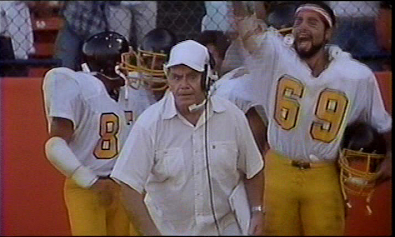
In a perfect world, THE LAST MATCH would be an integral part of the Super Bowl pre-game show, an ideal time to annually visit one of the all-time dumbest action movies ever barely released to an ambivalent public. Made at the end of the '80s Italian action cycle and, as far
as I can tell, never released in the US, not even on video (IMDb credits Vidmark Entertainment, and the above art--not only showcasing '70s-style "faces in boxes" but also head shots of the actors that actually appear to be from the '70s--has the Imperial Entertainment logo, but neither ended up actually releasing it), this hilariously awful
actioner from director/head coach Fabrizio De Angelis (utilizing his trusty "Larry
Ludman" alias seen on such 1980s video store mainstays as the THUNDER WARRIOR trilogy, DEADLY IMPACT and the KARATE KID ripoff KARATE WARRIOR), with input from offensive coordinator Gianfranco Clerici and
special teams coach Vincenzo Mannino, fails to execute its howler of a game plan,
drawing multiple flags for sheer idiocy.
Pro football quarterback Cliff Gaylor
(Oliver Tobias) calls an audible (OK, I'll stop) when his daughter Jenny (Melissa Palmisano)
is falsely accused of drug smuggling and thrown in prison while vacationing in
an unnamed Latin American country. After a useless US Embassy official (Charles
Napier) does nothing but refer him to a corrupt local attorney (a profusely
sweaty Martin Balsam), Gaylor thinks all hope is lost. That is, until his gruff,
fatherly coach (Ernest Borgnine) shows up with the team to draw up the perfect game plan. And Borgnine is a coach who really thinks outside the box: the team brought along their uniforms and
equipment, along with props like a sliced-open football, into which their kicker stuffs a grenade and punts at a hovering chopper! Coach Borgnine and his
special infrared binoculars are able to survey the prison and he directs his
players where to fire and when to attack, which they do with enthusiastic grunts
of "Hut! Hut! Hut!" as they crash through doors and walls, guns blazing, clad in full
game-day attire. Why? Because it's the biggest game of their lives! Evil,
leering prison warden Henry Silva never stands a chance against this Hall of
Shame team!
I'm not making this up. This movie is for real. It exists. Don't believe me? Well, here you go:
The above clip, coupled with the one below, is essentially THE LAST MATCH in a nutshell. This second clip gives you more "Hut! Hut! Hut!" football commando action, Henry Silva overacting, Coach Ernie's infrared binoculars, staggeringly bad music, a sleepy Tobias, and even an inside-the-helmet POV shot.
THE LAST MATCH probably sounds a lot more delirious than it plays. It's carelessly shot and lacks even the production values of cheap Italian action films of just a few years earlier, with much of the budget obviously going to aging, coasting vets like Borgnine, Balsam, and Silva. But once the football commandos suit up and raid Silva's prison, it becomes every bit the lunatic idiocy that the poster promises. The film was shot in Florida, and adding to its insanity is that it also offers supporting roles for a few
off-season or retired football players with Florida ties as members of Coach Ernie's football commando unit: former Florida State star and then-Buffalo
Bills QB Jim Kelly (early in the Bills' 1989-93 stretch of Super Bowl futility,
for which THE LAST MATCH must at least be partially accountable) and all-purpose Miami Dolphin Jim "Crash" Jensen are clearly visible, along with some retired Dolphins like tailback Mike Kozlowsky, receiver Elmer Bailey and Jim Kiick, a RB with the legendary undefeated 1972 team. Former Miami Hurricanes RB Mark Rush and Bart Schuchts, a Florida State standout and then-linebacker for the Arena League's Denver Dynamite, also appear. Has Jim Kelly ever fessed up to being in this thing? There's no mention of it on his Wikipedia page or his web site. Why is he in this? How did this happen? Did he have nothing better to do in his offseason? Kelly was at the height of his career in 1990--it's amazing that he wasn't used to sell this in the US. I
wonder why they didn't just go ahead and make this an outright comedy. It's
actually played totally serious, though Borgnine seems to be at least partially
amused. Silva doesn't do much but smirk at Tobias, leer at Palmisano and yell at
his guards, while Napier and Balsam aren't even in it enough to register.
Tobias, who previously played for Coach Fabrizio on the much better COBRA MISSION (aka OPERATION NAM), is terrible, trying to be all grim and pissed-off
but looking more like he took a sedative that's just starting to kick
in.
Packed with establishing and filler shots that take entirely too much
screen time (not to mention a completely anti-climactic ten-minute coda that just proves De Angelis has no idea how to piece together a convincing-looking football game), clumsy shots of the unnamed Latin American country that happens to have Florida highway signs, an utterly terrible score, slumming name actors (including two Oscar winners in Borgnine and Balsam), a
woefully weak lead performance, and arguably the most ridiculous premise in all
of 1980s (for all practical purposes) Italian B-movie action, THE LAST MATCH is
a total fumble, but a must-see for all bad-movie aficionados.