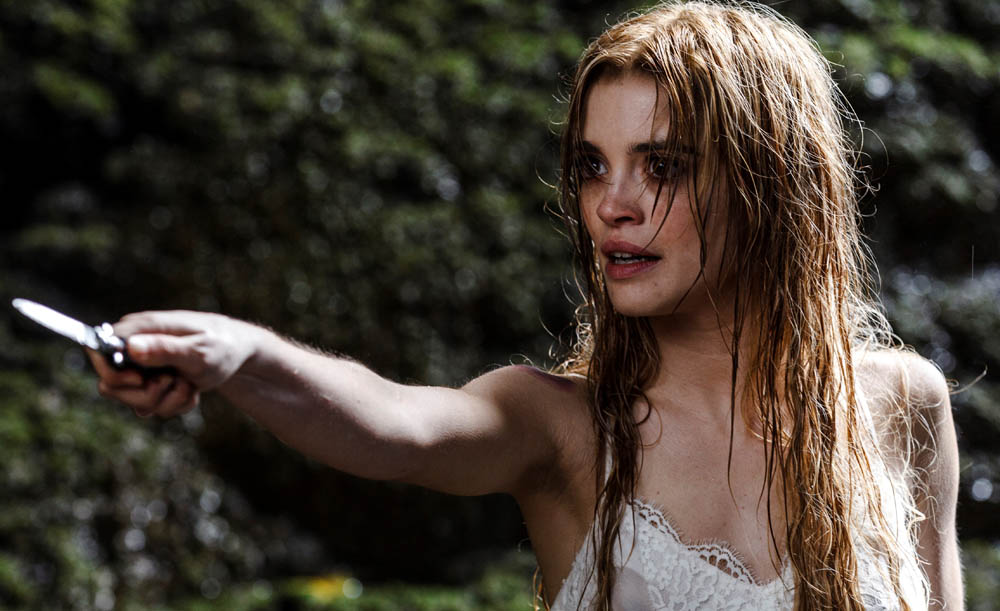
THE MAN WHO KILLED DON QUIXOTE (Spain/Belgium/France/Portugal - 2018; US release 2019) Directed by Terry Gilliam. Written by Terry Gilliam and Tony Grisoni. Cast: Adam Driver, Jonathan Pryce, Stellan Skarsgard, Olga Kurylenko, Joana Ribeiro, Jordi Molla, Sergi Lopez, Rossy de Palma, Jason Watkins, Oscar Jaenada, Hovik Keuchkerian, William Miller, Paloma Bloyd, Will Keen, Jorge Calvo, Antonio Gil, Rodrigo Poison. (Unrated, 133 mins) Terry Gilliam is no stranger to overcoming obstacles and adversity in bringing his vision to life, whether it's running wildly over budget on 1989's THE ADVENTURES OF BARON MUNCHAUSEN, bitterly clashing with Universal studio head Sid Sheinberg on 1985's BRAZIL and Miramax's Harvey Weinstein on 2005's THE BROTHERS GRIMM, or being forced to completely overhaul 2009's THE IMAGINARIUM OF DOCTOR PARNASSUS after Heath Ledger's sudden death midway through production. But those were walks in the park compared to Gilliam's Sisyphean ordeal in getting THE MAN WHO KILLED DON QUIXOTE made. A dream project he began mulling over around the time of BARON MUNCHAUSEN, THE MAN WHO KILLED DON QUIXOTE was conceived by Gilliam and frequent collaborator Tony Grisoni (the pair also worked together on 1998's FEAR AND LOATHING IN LAS VEGAS and 2006's TIDELAND) as a revisionist take on the classic Miguel de Cervantes novel Don Quixote, and began shooting in September 2000 with beloved French actor Jean Rochefort as Don Quixote and Johnny Depp as Toby, a present-day marketing executive who gets sucked back in time to the 16th century and is mistaken for loyal sidekick Sancho Panza by the aging and insane knight-errant.
Jean Rochefort in Gilliam's unfinished 2000 version
On the first day of filming, the problems started: while completing some early location work in Spain, Gilliam discovered that the constant flights from a nearby NATO training base would render the sound unusable, necessitating post-production dubbing and sound effects. On the second day, a hailstorm and some intense flash floods destroyed some equipment and altered the appearance of the surrounding cliffs, forcing Gilliam to scrap all of the first day's work since the shots wouldn't match. On the third day, Gilliam was told that the production's insurance company wouldn't cover the cost of the damaged or lost equipment. Then some actors started bailing. On the fifth day, the 70-year-old Rochefort was in obvious pain, wincing during takes and unable to ride a horse. He flew to Paris to visit his doctor and was diagnosed with a double herniated disc that required immediate surgery. With no timetable set for the return of Rochefort--who never acted in an English-language film to that point and spent several months learning the language just for the role--Gilliam and Depp soldiered on, shooting whatever they could to work around his absence, but production was soon suspended. By November, the ailing Rochefort was still sidelined under doctor's orders and the French producers and their insurers--citing the flood damage and Rochefort's medical issues as "acts of God"--shut down the production for good two months into filming. This was chronicled in the 2002 documentary LOST IN LA MANCHA, directed by Keith Fulton and Louis Pepe and intended to be a making-of for the eventual DVD release, but the production grew so chaotic and cursed so quickly that they were gifted with an opportunity to create their own feature film instead.
While working on other projects in the ensuing years, Gilliam always had DON QUIXOTE on the backburner. From 2003 to 2016, he made it to various stages of pre-production, with Robert Duvall, Michael Palin, and John Hurt attached as Quixote at certain points (production was nearly set to begin in mid-2015 but was halted once more when Hurt was diagnosed with pancreatic cancer), along with Depp, Ewan McGregor, Colin Farrell, and Jack O'Connell as the time-traveling Sancho Panza stand-in. A falling out and protracted legal battle with Portuguese producer Paulo Branco (who later tried--unsuccessfully--to halt the film's release, the stress of which contributed to Gilliam suffering a minor stroke in May 2018), and the implosion of a distribution deal with Amazon almost derailed the film again in 2016, but shooting finally began--finally, for real--in March 2017 with Gilliam's BRAZIL star Jonathan Pryce, who was originally cast in another role back in 2000, as Quixote, and Adam Driver as Toby. Gilliam and Grisoni had plenty of time to revise and restructure the story, and much like AVATAR had been brewing in James Cameron's head for so long that he used bits and pieces of it in other films over his career, longtime Gilliam fans will recognize familiar ideas and characterizations that may have surfaced in a similar form in his work over the last 30 years (there's more than a little of John Neville's Baron Munchausen and Robin Williams' Parry from THE FISHER KING in Pryce's portrayal of Don Quixote). But unlike Gilliam's 2014 film THE ZERO THEOREM, it doesn't play like a stopgap Gilliam's Greatest Hits package. THE MAN WHO KILLED DON QUIXOTE is the best thing Gilliam's done since 1995's 12 MONKEYS, and it's so near and dear to its maker's heart that you can sense his passion in every scene, almost like he can't believe it's finally being made. Or that after nearly 30 years of this being his white whale (the opening credits have a self-congratulatory "25 years in the making...and unmaking"), he'd have absolutely no excuse for not getting it right.
In Spain shooting a TV commercial, Driver's Toby is a former film school wunderkind who long ago succumbed to jaded cynicism, selling out to work in advertising. He's inspired when his obnoxious boss (Stellan Skarsgard) picks up a bootleg DVD from a gypsy peddler (Oscar Jaenada). It's Toby's award-winning student film from a decade earlier, a micro-budget, black-and-white version of Don Quixote that he shot in a nearby village, starring a cast of locals headed by simple, elderly shoemaker Javier (Pryce). Unable to focus on the TV commercial, Toby impulsively leaves the set and visits the village, which is still feeling the effects of the movie shoot from ten years ago: local innkeeper Raul (Hovik Keuchkerian) remains bitter over Toby telling his teenage daughter Angelica (Joana Ribeiro) that she could be a movie star, prompting her to run away in search of stardom that has only led a life as an escort for wealthy men; and Javier still remains in costume as a sideshow attraction, convinced he's Don Quixote. "Quixote" sees Toby and thinks he's Sancho Panza returning to serve as his faithful squire for more marvelous adventures in "chivalry."
Johnny Depp in the abandoned 2000 version
To say anything more would deprive you of the rambunctious and inspired mayhem that transpires, running the gamut from slapstick comedy to heartfelt drama (most notably, the time-travel element has been mostly jettisoned, with Gilliam having used it extensively in 12 MONKEYS and with the idea of alternate realities in THE IMAGINARIUM OF DOCTOR PARNASSUS, which really seems to have been a landing point for a lot of his initial QUIXOTE ideas). In a performance that would be generating awards buzz if this got any kind of release (it was given a one-night Fathom Events screening in theaters before heading to VOD on April 19, courtesy of Screen Media Films), Pryce is an absolute joy to behold. Watching him here, it's easy to imagine an alternate universe when Gilliam made this 25 or 30 years ago with a still-living Peter Sellers as Quixote. Pryce is matched by Driver, who spends much of the film in a state of sustained rage and confusion over the often absurdist plot turns that make this the funniest film Gilliam's done since his days in Monty Python.
Following the multi-decade nightmare of getting THE MAN WHO KILLED DON QUIXOTE out of his head and on the screen (Fulton and Pepe have also made their own sequel, HE DREAMED OF GIANTS, detailing the events following LOST IN LA MANCHA), Gilliam turns Quixote's saga into a very personal one that deals with the effects of the creative process and the sacrifices made in the name of art and integrity, whether it's an obsessive, ambitious filmmaker like young Toby blithely unaware of his impact on Javier and Angelica, or the cynicism and bitterness that can take hold when nothing goes right (Skarsgard's "The Boss" even casually tosses out "Act of God" as an excuse at one point, echoing the producers who shut the production down in 2000). It's a film that marches to the beat of its own drum, unafraid to go off on unexpected tangents and not really concerned with tying everything together, but always entertaining and never feeling self-indulgent. Considering the number of times he's faced insurmountable odds over his storied career, and let's be honest, some of it he brings on himself (re: THE BROTHERS GRIMM, why even get involved with a control-freak studio head known industry-wide as "Harvey Scissorhands" unless you're looking for a fight?), it's just nice to see this work as beautifully as it does and to see that ultimately, the struggle was worth it. THE MAN WHO KILLED DON QUIXOTE (Gilliam dedicates it to Rochefort and Hurt, both of whom died in 2017) is just exuberant filmmaking on an grand scale, and the best buddy movie of 2019 so far.
Produced by Shane Abbess, director of the awful INFINI, TERMINUS is another Australian genre outing trying to pass itself off as American but succeeding marginally better than most. Set in the US midwest, TERMINUS is a low-key and slowly-paced sci-fi drama that's perhaps aiming for more targets than it can handle. Director/co-writer Marc Furmie liberally borrows elements from beloved sci-fi films of the past while making points about US military operations in the Middle East and blending it all into a pre-apocalyptic end-of-the-world saga that seems to be advocating nuking the planet to oblivion and starting over from scratch. There's some potential for some scathing insight and abrasive dark humor here, but Furmie's almost mumblecore approach doesn't really mesh with the message he's trying to send, and the film is ultimately too dour and sluggish for its own good. TERMINUS stars Jai Koutrae as David, a widower mechanic in a small, blue collar town. Still mourning the loss of his wife, who died when her body rejected the kidney he donated, David wallows in an alcoholic stupor and because he forgot to pay the tuition, his daughter Annabelle (Kendra Appleton) has just been bounced out of college and moves back home to get him back on his feet again. David witnesses a meteor crashing in the woods near his house and the next thing he remembers after a vision of his late wife is waking up in the hospital. Medical personnel are shocked to see that his donated kidney has regenerated itself, and after he takes his Iraq War vet buddy Zach (Todd Lasance) to move the meteor to his barn, Zach's amputated leg, blown off in combat, starts growing back. Meanwhile, shady and increasingly unhinged government agent Stipe (Bren Foster) has gone rogue and is on the trail of David's meteor and others like it, convinced that they the ability to end America's involvement in the concept of war. He's really out to harness the healing power of the meteor--not to end war, but to use it on injured soldiers to expedite their return to battle.
Furmie could've made a blistering critique of the idea of the endless war, but since he doesn't, one almost wonders what his point was in setting it in America, unless it was simply for export value. Everybody does a decent job with their American accents, with the exception of one actor playing a sheriff's deputy who inexplicably sounds like the world's worst Crocodile Dundee impersonator at open mic night at your city's shittiest comedy club. Instead, the filmmakers seem more interested in seeing how many past sci-fi films that can reference, whether it's CLOSE ENCOUNTERS OF THE THIRD KIND (David's obsession with the meteor and his insane idea to build a shelter to harness the meteor's power and protect them all from the oncoming apocalypse), COCOON (the healing power), INTERSTELLAR (communication across planes of being and a fractured father/daughter relationship), and FIRE IN THE SKY (with an alien force invading a tightly-knit town of hardworking everymen). Boasting some very welcome practical effects, TERMINUS is a thoughtful and ambitious film that admirably swings for the fences but whiffs too often to be completely successful. Though it has its moments, and Koutrae and Appleton are good, it doesn't really have the courage of its convictions and ends up feeling derivative and utterly ordinary by the time it's all over. A nice try, but file this one away as a noble, well-intentioned misfire. (R, 94 mins)
NARCOPOLIS
(UK - 2015)
This low-budget, partially Kickstarter-funded British dystopian sci-fi thriller isn't shy about openly cribbing from legendary cinema of the past. It's got the future-noir cityscapes of BLADE RUNNER and the time travel elements of THE TERMINATOR and 12 MONKEYS, but what it lacks is an interesting story and any sense of momentum or pacing whatsoever. It looks great and it works wonders with not very much money at its disposal, but ambitious director Justin Trefgame is constantly thwarted by the tired cliches and predictable twists utilized by screenwriter Justin Trefgame. Opening in 2044 but set mostly in 2024, NARCOPOLIS takes place in a future where all drugs were made legal in 2019 and an industry monopoly is held by the immensely powerful AmbroCorp, a pharmaceutical empire overseen by Todd Ambro (James Callis). By 2044, AmbroCorp essentially controls the world, but back in 2024, Ambro's power over the newly-legalized drug traffic is just beginning to take hold. Enter loner detective Frank Grieves (Elliot Cowan), a recovering "dreck" (addict) who somehow managed to hold on to his job after botching a bust and shooting his boss Nolan (Robert Bathurst) in the face. Nolan survived and a recovering Grieves is still a cop, though he's separated from his wife (Molly Gaisford) and son (Louis Trefgame, the writer/director's son). Grieves finds himself in a convoluted mystery when an unidentifiable body turns up just before time-travelling Eva (Elodie Yung of Netflix's DAREDEVIL) arrives from 2044, hellbent on preventing Ambro from building his globally dominant empire. Grieves' investigation is thwarted at every turn by Ambro goons as well as Nolan and the irate police chief (Nicky Henson), who runs the police force as little more than an extension of AmbroCorp.
Drab, downbeat, and dull, NARCOPOLIS gets the quintessentially bleak and rainy dystopia look down cold, but that's really all it has going for it. Trefgame's script is unfocused and confusing, and you'll see it all coming together (who's the guy with Eva in the 2044 prologue? Who's the dead guy Grieves finds in 2024?) long before Grieves does. As Grieves, Cowan has a vaguely Stathamian physical presence with his receding hairline and the appropriate thickness of the stubble but with none of the engaging personality or gruff charm. In what's probably a nod to BRAZIL and perhaps the minor British cult movie SHOPPING (there's a bit of an early Paul W.S. Anderson vibe to this as well), Jonathan Pryce has little to but collect a paycheck in a small role as a renegade scientist who helps Grieves in his investigation. In the end, NARCOPOLIS is an effective-looking but generally pointless retread with monotonous techno music and simplistic metaphors about the rich and powerful controlling the poor and weak-willed masses. Trefgame's got potential from a style standpoint, but someone else should write his next screenplay. (R, 96 mins, also streaming on Netflix).
RATTER
(US - 2016)
RATTER is a not always probable tech-paranoia thriller that frequently overcomes its gimmickry and produces more than a few genuinely chilling and unsettling moments until it's done in by what might be the least satisfying ending in recent memory. Grad student Emma (Ashley Benson of PRETTY LITTLE LIARS and SPRING BREAKERS) has just arrived from Wisconsin to attend NYU and settles into a small Brooklyn apartment. Just out of a bad relationship and looking to spend some time on her own, she lives a generally quiet life and hangs out with her friend Nicole (Rebecca Naomi Jones) and eventually begins dating Michael (Matt McGorry of ORANGE IS THE NEW BLACK), a nice guy from one of her classes. Unbeknownst to Emma, all of her web devices--laptop, tablet, phone--have fallen victim to a "ratter," one who hacks into and gains control of such a device. Before long, photos start disappearing from her laptop, important phone messages are deleted, she's receiving hardcore porn from Michael's e-mail address, and the unseen ratter watches Emma at all times through her devices, whether she's on Skype with her mom, playing video games, practicing ballet, shaving her legs, or masturbating. A camera has also been planted in her living room, and while she sleeps, a dark figure enters and exits the apartment, sometimes watching her but also opening her music box in the other room and letting it play.
Red herrings abound--is it Michael? Her ex Alex, who still calls her from Wisconsin and isn't over getting dumped? Michael's dudebro roommate Kent (John Anderson)?--and throughout Benson does a credible job of playing an already stressed person pushed to a point beyond frazzled. Writer/director Branden Kramer, expanding on his 2012 short WEBCAM, borrows from other cyberstalker thrillers like ALONE WITH HER and THE DEN, but he does a very effective job of creating a doomy unease and discomfort throughout, and his decision to shoot everything from the POV of Emma's electronic devices and the hidden camera in her apartment sounds tired and hackneyed, but it works and contributes significantly to the sense of helplessness and claustrophobia. But RATTER is a film that implodes in its final seconds, and while I get what Kramer was going for and how it drives home the point that you never know who's watching you or how open you've left yourself, it doesn't make for anything resembling what an audience might consider a good ending. On one hand, I admire the audacity of going for an ending that's only going to succeed in pissing off everyone who watches the film, but from a commercial thriller angle, you probably want a better finish than what RATTER offers. There's a debate to be had about the closing scene of RATTER, but the film was dumped on DVD just three weeks after a very limited theatrical run (I'm surprised this didn't open wide), so nobody's seen it. It's tough to say whether it's a bad ending or if it's just the ending audiences don't want. Regardless, RATTER succeeds for 98% of its running time as a nailbiter that grows more tense and invasive with each passing scene, and Kramer deserves some credit for taking some found-footage/faux-doc techniques and making such played-out crutches work as well as they do here. Like last year's UNFRIENDED, RATTER is far more accomplished and compelling than it has any business being, but I'm still undecided on that ending. (R, 80 mins)
THE SALVATION (Denmark/UK/South Africa - 2014; US release 2015)
Produced by Lars von Trier's Zentropa Entertainments, THE SALVATION is a dark, brutal western that will please fans of films like THE PROPOSITION and the more recent THE HOMESMAN. Shot in some desolate regions of South Africa that stand in for an almost otherworldly, apocalyptic version of the 1870s Old West, the film centers on Jon Jensen (Mads Mikkelsen), a Danish immigrant and war veteran who settled in America seven years earlier with his brother Peter (Mikael Persbrandt). Jon has finally achieved enough success and financial security that he can afford to bring over his wife Marie (Nanna Oland Fabricius) and Kresten (Toke Lars Bjarke), his son who was just an infant when he left for America. When fate has them sharing a coach ride to town with two drunken louts, the Jensen family's American dream quickly goes south: the drunks attempt to rape Marie and hold a knife to Kresten's throat before throwing Jon from the coach. By the time Jon catches up to them, he finds the dead bodies of his wife and son in the road and the two men still in the coach, sleeping it off. Jon kills both men and he and Peter bury Marie and Kresten. It turns out one of the drunks was the younger brother of Henry Delarue (Jeffrey Dean Morgan), the ruthless, cold-blooded enforcer for an oil baron looking to buy up the town and run everyone out. Delarue gives the mayor (Jonathan Pryce) and the sheriff (Douglas Henshall) two hours to find his brother's killer or they have to pick two of their own residents to sacrifice. It says a lot about this town that they don't even bother investigating and instead spend the two hours deciding which two people they'll give Delarue before settling on an old woman and a paraplegic. It doesn't take long for everyone to realize Jon is the killer, and even though they know and like Jon and know the men killed his family, they're only too eager to turn him and Peter over to Delarue, who makes the mistake of underestimating the resourcefulness and the resolve of the Jensen brothers.
Directed and co-written by von Trier's Dogme 95 colleague Kristian Levring, THE SALVATION is an absolutely riveting western that could've been a hit if it had gotten a wide release. One of the most commercially accessible films to come out of the von Trier camp--and a complete break from Dogme 95 for Levring--THE SALVATION presents one of the most dour and hellish looks at the west this side of HIGH PLAINS DRIFTER, and the town is populated by what may very well be the western genre's most shameless cowards--the mayor (who's also the undertaker) and the sheriff (who's also the minister) not only sacrifice a frail, elderly woman and a disabled man ("I don't bother anybody! I don't want to die!" the legless man cries) rather than do their jobs, but when Jon sells his land back to the mayor for a measly $150, the mayor tells him to keep the money in his boots strictly so he'll know where to recover his $150 when Delarue strings Jon up and lets him bake in the sun later on. And in an infuriating display of tone-deafness, the old woman's grandson (Alexander Arnold) actually calls Peter a coward for not stepping up to stop Delarue's reign of terror. Mikkelsen and Morgan make outstanding adversaries, and even playing mute doesn't make Eva Green tone down her usual crazy-eyes routine that Eva Greeniacs have come to know and love in her performance as "The Princess," the silent widow of Delarue's younger brother. She had her tongue cut out by "savages" as a little girl and has a strange relationship with Delarue where she's both co-conspirator and captive. As is the case with so many movies these days, it's some dodgy CGI late in the game (some really unconvincing fire) that takes you out of the film, but subtracting that, THE SALVATION is a must-see for western fans, a film that very effectively invokes nihilistic memories of classic spaghetti westerns--right down to its Kaspar Winding score that emulates the more somber, reflective side of Ennio Morricone--without becoming winking or self-conscious in any way. This one's a small masterpiece that's going to find a strong cult following very quickly. (R, 92 mins)
INTO THE GRIZZLY MAZE (US - 2015)
An initially OK throwback to the kind of nature-run-amok horror movie that followed in the wake of JAWS in the late '70s and early '80s, INTO THE GRIZZLY MAZE, a loose remake of 1976's GRIZZLY, devolves into a laughable mess of crummy CGI and bad editing. The cutaways to the titular beast often look like haphazardly-inserted stock footage of Bart the Bear, and it's a rare occurrence where you get the feeling that the rampaging grizzly is actually in the same vicinity as the cast. By the very end, director David Hackl (SAW V) is resorting to a totally CGI'd bear and some CGI fire that would have the digital effects team at the Asylum looking away in embarrassment. This doesn't help make the case for the long-delayed INTO THE GRIZZLY MAZE, which was completed in 2012, is on its second distributor (Open Road acquired it and sat on it for a year and a half before selling it to Indomitable Entertainment), and its third retitling after being known as RED MACHINE, ENDANGERED, and GRIZZLY. A movie about a bear chasing people through a forest shouldn't have this much behind-the-scenes strife. Fittingly, the film went straight to VOD, since its climax would probably get it laughed off the screen in wide release. There's ample evidence to suggest that INTO THE GRIZZLY MAZE knows that it's garbage--no one's going to argue that a mauled-and-presumed dead Billy Bob Thornton reappearing with the left side of his face hanging off as he takes aim at the grizzly isn't entertaining as hell, or another character sinking into a rotting, maggot-infested deer carcass like it's quicksand doesn't deliver the gory goods, but INTO THE GRIZZLY MAZE keeps stumbling every time it gets some goofy momentum going.
The script, co-written by BUNRAKU director Guy Moshe, works in entirely too much family squabbling between estranged brothers Rowan (James Marsden who, between this, THE LOFT, and ACCIDENTAL LOVE, has become the Patron Saint of Shelved Cinema) and Beckett (Thomas Jane). Rowan is an ex-con just paroled after a seven-year stretch for manslaughter, and Beckett is the deputy sheriff in their small Alaskan hometown. Rowan is back to look for local guide Johnny (Adam Beach), who's been missing with two hunters in the "Grizzly Maze" for nearly two weeks. There's evidence that a rampaging, rogue bear is on the loose, but nature-minded Beckett, who's tagged and collared numerous bears in the forest in order to protect them from being hunted, doesn't want Sheriff Sully (Scott Glenn) or eccentric local bear expert Douglass (Thornton, functioning as the "Jon Voight-in-ANACONDA" or "Henry Silva-in-ALLIGATOR" asshole) to just go in and kill it. There's some attempt at statement-making with Douglass, a Grizzly Whisperer if you will, incessantly talking about how man has upset the balance of nature and the bear is pissed off and ready to eat anything that gets in its way to restore that balance ("He's a machine. He doesn't give a shit. You all taste the same to him!"). Beckett, Rowan, and local medic Kaley (Michaela McManus) end up joining forces, both to find the bear and to locate Beckett's deaf wife Michelle (Piper Perabo), a nature photographer and conservationist who went exploring the forest to take shots for a new project, because sure, a deaf person in a forest ruled by potentially pissed-off bears who have had it with poachers and loggers is a great idea (SPOILER ALERT: the bear sneaks up behind her multiple times). Until Hackl gets way too comfortable resorting to unconvincing CGI, INTO THE GRIZZLY MAZE is an intermittently fun B-movie throwback. There's a good amount of stuff to like about it: Thornton knows what kind of movie he's in and is clearly enjoying himself as the hectoring, antagonizing Douglass, who ventures into the maze on his own solo mission to exterminate the bear and keeps taunting Rowan and Beckett when they periodically cross paths, and the location shooting in Utah and in Vancouver is often breathtakingly beautiful. But there's just too much needless backstory on everyone, from Rowan and Beckett's tortured dad and cancer-stricken mom to their dad and Douglass having some falling out years earlier, to the real reasons behind Rowan's incarceration, and Sully allowing poachers into the forest because he's about to retire and needs a cushier nest egg. It's a movie about a killer grizzly...no one gives a shit about Sully's pension. The ending flies off the rails in a way that will amuse followers of bad movies, but it didn't need to be that way. Clumsy editing, subpar special effects, reshoots, and a plethora of post-production and "additional editing" credits show the tell-tale signs of a project in which no one was really sure what they wanted. You'd think it would be hard to screw up a B-horror movie about a killer bear, but INTO THE GRIZZLY MAZE too often manages to do it. (R, 90 mins) CHILD 44 (US - 2015)
Up until a week or so before its release, CHILD 44 was scheduled to bow on 2500 screens. At the eleventh hour, Summit abruptly came to its senses and downgraded it to a limited release, instead rolling it out on just 510 screens in a valiant attempt to contain the fallout. Landing in 17th place and grossing a paltry $600,000 in its opening weekend, the $50 million CHILD 44 was one of the biggest box office bombs of the year (a legit bomb--not one of those "It only grossed $80 million its opening weekend, so it's a flop" bombs that you read about every Sunday evening on Variety's web site), though it would've been even more catastrophic on five times as many screens. Produced by Ridley Scott and based on Tim Rob Smith's 2008 bestseller, CHILD 44 has a top-notch screenwriter (Richard Price, who scripted THE COLOR OF MONEY, SEA OF LOVE, and CLOCKERS among others), a solid director (Swedish filmmaker Daniel Espinosa, best known for SAFE HOUSE), and a terrific cast, but it's just lugubrious misfire from the start. The pace is mind-numbingly slow, the film absurdly overlong at 137 minutes (and it still feels like whole sections of story are missing), the cast of British and Swedish actors pays loving homage to Yakov Smirnoff with their cartoonish Boris & Natasha accents, and it takes a ridiculous 75 minutes for the main plot to even kick into gear. In the Soviet Union in the late 1950s, MGB (later known as the KGB) officials are busy burying evidence of a string of murders where the victims, all young boys, are found naked. Calling murder "a capitalist disease," the officials instead chalk all of the killings up to "train accidents," which doesn't rest well with MGB officer Leo Demidov (Tom Hardy). He's already butting heads with colleague Vasili (Joel Kinnamon), who starts a rumor that Demidov's wife Raisa (Noomi Rapace) is a traitor. This gets the Demidovs demoted to Volsk where, months later, a similar murder catches Leo's attention and gets him in hot water with his superior General Nesterov (Gary Oldman), a company man happy to look the other way when it's obvious there's a serial killer at work. Price and Espinosa throw in a number of subplots that feel like superfluous padding, and while the period detail is excellent, there's little context in terms of where the story fits into Soviet history other than having barking officers barging through a door to find starving people in tattered clothing, huddled together as they cry and scream, which seems to happen every few minutes. There's such a lack of focus that the story becomes increasingly difficult to follow, there's a few fight scenes that are completely incoherent, and the cast of proven but defeated actors are terrible across the board. Did Espinosa spend all of his energies focusing on the production design at the expense of everything else? Aside from the gray, dreary look of the film, absolutely nothing in the miserable CHILD 44 works. One of the most oppressive film experiences of 2015. (R, running time: endless)