An independently-made pickup for a post-Menahem Golan Cannon, John Frankenheimer's THE FOURTH WAR was a timely winding-down-of-the-Cold War thriller that failed to find an audience in the spring of 1990, bombing in 15th place its opening weekend as the much more high-profile HUNT FOR RED OCTOBER was still playing to packed houses. Though his days as an A-lister were done, Roy Scheider's steely star power and gravitas remained as strong as ever in an intense performance as Col. Jack Knowles, a career Army man and legendary Vietnam War hero with a history of bad behavior and losing his temper. He's been stationed at faraway bases like Manila and Guam and granted the respect he's earned from his service but essentially kept on a tight leash with easy assignments designed to keep him out of trouble. His buddy Gen. Hackworth (Harry Dean Stanton) gives him another shot in the limelight with a command post at an Army base at the West German/Czechoslovakia border. After witnessing Soviet officers kill a potential defector as he was running to cross into West Germany, Knowles starts a pissing contest with Soviet base commander Valachev (Jurgen Prochnow) that starts with snowballs, escalates to rocket launchers, and eventually, an international incident that takes them to the brink of WWIII.
Scheider and Prochnow are excellent as battle-hardened warriors--one shattered by Vietnam, the other by Afghanistan--who don't know what to do with themselves in peacetime. They served their country with honor, but war is all they know and when they have no war to fight, they're happy to create their own. Both actors do a terrific job of conveying the rage they can't articulate while the same time giving off subtle indications--a look, a half-hearted smile--indicating that underneath all the fighting, there's a grudging respect for what the other guy's been through and an acknowledgment that they speak the same language. Frankenheimer (THE MANCHURIAN CANDIDATE, THE TRAIN) was a pro wise enough to spare us a hackneyed "We're a lot alike, you and I" discussion between Knowles and Valachev, and while it gets silly and implausible at times, Scheider and Prochnow keep it grounded and compelling, and there's fine support from Tim Reid as Knowles' by-the-book second-in-command. A solid little gem from Frankenheimer's lost years prior to his ANDERSONVILLE and RONIN resurgence in the late '90s, THE FOURTH WAR followed 52 PICK-UP (also with Scheider) and the Don Johnson actioner DEAD-BANG, all three Frankenheimer joints deserving better receptions than moviegoers gave them. He stumbled badly with his next project, 1991's dismal YEAR OF THE GUN, an ill-advised Andrew McCarthy/Sharon Stone thriller set in Italy during the Red Brigades domestic terror attacks and the kidnapping of former Prime Minister Aldo Moro, which was an even bigger box-office bomb than THE FOURTH WAR and one of the great director's worst films. (R, 91 mins)
THE MISSOURI BREAKS (US - 1976) Directed by Arthur Penn. Written by Thomas McGuane. Cast: Marlon Brando, Jack Nicholson, Randy Quaid, Kathleen Lloyd, Frederic Forrest, Harry Dean Stanton, John McLiam, John P. Ryan, Sam Gilman, Steve Franken, Richard Bradford, Luana Anders, Hunter von Leer, Virgil Frye, Dan Ades. (PG, 126 mins)
When it was released in theaters in the summer of 1976, the western THE MISSOURI BREAKS was arguably the anticipated event film of the season. It was the first and ultimately only pairing of Marlon Brando, offscreen since his GODFATHER/LAST TANGO IN PARIS triumphs of 1972 and 1973, and Jack Nicholson, who had just won the Best Actor Oscar for the previous year's ONE FLEW OVER THE CUCKOO'S NEST. The script was written by acclaimed novelist and screenwriter Thomas McGuane (92 IN THE SHADE, RANCHO DELUXE) right in the midst of a particularly chaotic, excess-fueled phase of his life where those close to him were dubbing him "Captain Berserko." Like seemingly every major 1970s studio film, it also featured additional script contributions by an uncredited Robert Towne (THE LAST DETAIL, CHINATOWN). The director was Arthur Penn, no stranger to westerns (1958's THE LEFT HANDED GUN, 1970's LITTLE BIG MAN), but best known for his iconic BONNIE AND CLYDE (1967). In short, THE MISSOURI BREAKS' pedigree was without doubt. This was the very definition of a sure thing.
Then, much to the detriment of everyone involved, it was released. Critics hated it. Audiences hated it. The word-of-mouth was toxic. The movie bombed.
There's no shortage of notable, worthwhile, and even classic films that tanked on their initial release only to find appreciation some time--weeks, months, years, decades--later. THE MISSOURI BREAKS existed in that odd time between the auteurist, maverick mindset that became the Hollywood norm post-EASY RIDER, and the new summer blockbuster ethos ushered in the previous year by JAWS and made industry standard the next summer with STAR WARS. While most of 1976's biggest moneymakers (ROCKY, A STAR IS BORN, KING KONG, SILVER STREAK) were released in the fall, the two most successful films of the summer represented both ends of the spectrum: the topical ALL THE PRESIDENT'S MEN was released in April and continued to be a huge hit throughout the summer, and THE OMEN was released in June. THE MISSOURI BREAKS was flat-out rejected by everyone. There's a good chance that if it came out a few years earlier, it might've gotten a more hospitable reception. If it came out a few years later, it would've been focus-grouped into losing its personality and engineered into a commercial crowd-pleaser. On one hand, it's a film that refuses to stick to convention, but on the other, a western that promised a face-off between what many considered film's greatest living actor and his heir apparent and instead turned their confrontation into an anticlimactic afterthought that practically takes place offscreen does feel like a bit of a dick move.
THE MISSOURI BREAKS opens with wealthy northern Montana ranch owner Braxton (John McLiam) and his strongarm Pete (Richard Bradford) overseeing the execution-by-hanging of Sandy (Hunter von Leer), who was caught trying to rustle horses off of Braxton's property. Sandy was part of a group of horse thieves led by Tom Logan (Nicholson). Logan and the rest of the gang--Calvin (Harry Dean Stanton), Little Tod (Randy Quaid), Cary (Frederic Forrest), and Si (John P. Ryan)--hatch a plan that involves using money from a nearly-botched train robbery to buy a ranch near Braxton's land. While the other four men are off on a separate horse-rustling job near the Canadian border, Logan is planting crops and creating the illusion of being an upstanding citizen while plotting his revenge on Braxton, even being cordial with Braxton and secretly courting his fiercely independent daughter Jane (Kathleen Lloyd). After Logan secretly kills Pete and leaves him hanging from the same tree where Sandy was executed, Braxton hires legendary "regulator" Robert E. Lee Clayton (Brando), an eccentric, lilac-perfurmed Irish bounty hunter, to track down and bring to justice (meaning, kill) the men responsible. Clayton sees right through Logan's "average farmer" act, which sets the stage for the regulator obsessively pursuing the other men and offing them one by one before coming back for Logan, who goes soft when he grows accustomed to working an honest living and finding true love with Jane. "You're pretty far gone, ain't ya?" Calvin asks in disgust as Logan beams with pride over the progress of his ranch work. "That's how it happens, isn't it?" Logan shrugs. The deranged Clayton manages to take over Braxton's ranch, usurping his power and instilling his own brand of HIGH PLAINS DRIFTER terror to the townsfolk, getting under Braxton's skin enough that the rancher can't call him off the job and Clayton, who's now just in it for the kill, doesn't even want to be paid. "It's about the job," he says with wild eyes. "I always finish the job."
The revisionist nature of THE MISSOURI BREAKS makes it easy to see what drew Penn to the project. With BONNIE AND CLYDE and LITTLE BIG MAN and even his 1975 box-office flop NIGHT MOVES, a film dismissed in its day and now regarded as one of the essential films of its decade, he was a filmmaker who thrived on the offbeat, the unexpected, and the groundbreaking. For a while in the early-going, THE MISSOURI BREAKS is very similar to the quieter moments in some of Sam Peckinpah's westerns--it's beautifully-photographed (by Michael Butler), with very deliberate pacing and a focus on character development, like Logan initially vowing revenge but finding he might just want to live a quiet farming life. Nicholson turns in a surprisingly restrained, understated performance, rarely raising his voice and only very sporadically resorting to some quintessential "Jack" late in the game when Clayton forces his hand by killing all of his friends. His performance is more in line with the work he had recently done for Michelangelo Antonioni in 1975's THE PASSENGER rather than the McMurphy schtick of CUCKOO'S NEST. He seems happy to be part of the ensemble of great character actors that make up his gang, and he's very charismatic in his scenes with Lloyd, a charming actress who should've been bigger and is largely forgotten today (she went on to co-star in THE CAR, reunite with Forrest and Ryan in Larry Cohen's IT LIVES AGAIN, and have a recurring role on MAGNUM, P.I. before spending the next three decades doing TV guest spots). Penn's handling of the Nicholson end of the plot is indicative of a filmmaker in control of his vision. Where THE MISSOURI BREAKS loses its balance--and not necessarily in a bad way--is with Brando.
This was Brando's first film appearance in three years, and it's essentially the beginning of the final phase of his career: the "I'm just going to riff and do what I want because I'm Marlon Brando and I'm getting paid more than everybody else here" phase. This is the Brando who showed up on the APOCALYPSE NOW set without having read the script and opting to intentionally stall filming because his contract stipulated that he stood to make more money if he was still needed after a certain date. This is the Brando who wore an ice bucket on his head for no reason in THE ISLAND OF DR. MOREAU. This is the Brando who was now almost openly contemptuous of his craft and the whole concept of Hollywood. Brando had a history of being difficult and, at least with 1969's THE NIGHT OF THE FOLLOWING DAY, purposefully attempting to sabotage a film with his antics, but while he may be undisciplined, unfocused, and impossibly hammy in THE MISSOURI BREAKS, he's doing what he needs to do keep things interesting, and from the looks of it, he's having a blast. Penn directed Brando in 1966's underrated THE CHASE, which contains one of the actor's best performances from his mid-to-late 1960s downward spiral. Only a decade had passed, but it wasn't the same controlled, serious Brando who showed up to work on THE MISSOURI BREAKS. Brando first appears around the 35-minute mark, hanging off a horse and sporting an over-the-top Irish brogue that sounds like a tribute to his MUTINY ON THE BOUNTY co-star Richard Harris. His performance is a parade of eccentricities that starts off quirky and rapidly escalates to gonzo. He walks into Pete's funeral, roughs up the body, lying in ice in a casket, and proceeds to grab some ice cubes and rub them all over his face. Elsewhere, Brando's Clayton dons a variety of costumes in his pursuit of Logan's gang, disguising himself as a mandolin-strumming preacher mumbling through mouthful of tobacco and later, maniacally cackling in drag in a frontier granny dress as he hurls a spike through someone's head. He sets another on fire while screaming "Smoked meat!" He plays with bubbles in the bathtub. He taunts Braxton while wearing a dorky derby and munching on a plate of raw carrots like a distinguished Bugs Bunny. When Braxton tells Clayton "You're out of control!" it's hard to tell if McLiam is in character or talking to Brando personally. Brando treats the entire project as a self-indulgent, absurdist playground, opting to goof off to his heart's content on United Artists' dime (interestingly, the studio would go bankrupt in four years with another revisionist western, Michael Cimino's much more costly and similarly-reviled-and-now-reconsidered HEAVEN'S GATE), but unlike some of his later films (CHRISTOPHER COLUMBUS: THE DISCOVERY, anyone?), no one can accuse him of phoning this one in. 1976 audiences might've been pissed off, but Brando was having the time of his life.
Brando grows more unhinged with each passing scene, and while his material is at odds with the relative seriousness of the rest of the film (there's bits of dark humor here and there, like a blubbering Ryan crying "It ain't even legal!" when some Canadian Mounties have the audacity to cross the border to take back their stolen horses), they give THE MISSOURI BREAKS much of its unique personality. Over the years, it's Brando's insane performance that's drawn people to the film, not the horse-rustling plot or the romance between Nicholson and Lloyd. THE MISSOURI BREAKS has a level of weirdness that's probably very off-putting for a first-time viewer or those 1976 audiences who expected a more traditional western. Audiences who loathed THE MISSOURI BREAKS responded much more positively to Clint Eastwood's THE OUTLAW JOSEY WALES, released a month later, but westerns were generally moving away from the John Wayne tradition (though the Duke went out strong in 1976 with THE SHOOTIST), with offbeat films like THE MISSOURI BREAKS, Robert Altman's BUFFALO BILL AND THE INDIANS OR SITTING BULL'S HISTORY LESSON, and Andrew V. McLaglen's THE LAST HARD MEN. In THE MISSOURI BREAKS, Brando and Nicholson have a few scenes together, but they spend the bulk of the film apart, and the only really lunkheaded artistic decision Penn and McGuane make is in the final confrontation between Clayton and Logan, which is virtually over before it even begins. It's not quite the resolution that the teaming of titans like Brando and Nicholson would seemingly promise.
Though it has yet to enjoy a NIGHT MOVES-style renaissance, THE MISSOURI BREAKS' reputation has improved significantly over the years, at least as far as fans of bizarre cult movies are concerned. In addition to critics hating it, the film also got some bad press after it was condemned by the American Humane Association when one horse drowned and several others were injured at various points in the shoot. It was also revealed that the crew was using tripwires on the horses, a practice that the AHA and the major studios previously agreed to cease, and the responsibility for that rightfully fell on Penn and the producers. It's a slow, strange film, almost revisionist to the point of being an anti-western, and it's hard to argue with anyone who finds it a bit of a misfire (it still rates a "BOMB" in Leonard Maltin's movie guide, which calls it "a great director's worst film and one of the worst 'big' movies ever made"). It's a film frequently at odds with itself, almost like Penn realized that trying to corral Brando was a lost cause so he instead focused on what he could control. Perhaps Nicholson's restraint was a sympathetic concession to his director, like the actor realized the film (and Penn, for the matter) didn't need two outrageous, mischievous scamps trying to out-ham one another. After THE MISSOURI BREAKS, Penn never again tackled a huge, highly-publicized project of this sort. He laid low, spending five years licking his wounds and waiting for the smoke to clear before returning with 1981's character-driven drama FOUR FRIENDS, a film filled with a cast of relative newcomers like Craig Wasson, who wouldn't give him any headaches or force him to measure up to impossible expectations. He made a few more films, the most notable being 1987's underrated suspense thriller DEAD OF WINTER, before retiring after directing an episode of the Sidney Lumet-produced TV series 100 CENTRE STREET in 2001. Penn died in 2010 at the age of 88, hopefully aware that THE MISSOURI BREAKS, while a flawed mess, is a much more worthwhile, intriguing, and entertaining film than the moviegoers of 1976 realized.
The latest from revered Italian filmmaking brothers Paolo and Vittorio Taviani (1977's PADRE PADRONE) is an improvement over their last effort, 2007's LARK FARM (released straight-to-DVD in the US in 2010), a misfired look at the 1915 Armenian Genocide and a multi-country co-production that asked us to buy German actor Moritz Bleibtreu (RUN LOLA RUN) dubbed into Italian and playing a Turkish officer named "Youseff." Mired in near telenovela-level histrionics and tacky splatter effects, LARK FARM was so appallingly tone-deaf that it seemed the aging siblings--Paolo is now 82, Vittorio 84--had completely lost it. CAESAR MUST DIE is an OK rebound and won the Golden Bear at the 2012 Berlin International Film Festival, but it's really not that good. The Tavianis indulge in a little smoke & mirrors what what they're doing here, setting up CAESAR MUST DIE as a documentary, only to reveal itself as a mock documentary that becomes a meta commentary on itself. With rare exception (BEING JOHN MALKOVICH and THE CABIN IN THE WOODS are two examples), these meta movies usually end up being exercises in pretension and directorial wankery. But the mostly black-and-white CAESAR MUST DIE is deceptively simple in its premise and execution, which makes you wonder why they chose to go with the ruse in the first place? A straight documentary on the same subject would've been fascinating: inmates in the high-security wing of Rome's Rebibbia Prison take part in a therapeutic theater workshop putting on a production of Shakespeare's Julius Caesar. The inmates are not actors (except for Salvatore Striano as Brutus; Striano was in Matteo Garrone's GOMORRAH and served time in Rebibbia but was released and pardoned), but the action is staged. We're not watching a documentary of rehearsals--we're watching a staged re-enactment of rehearsals in the guise of a documentary. Comparisons to Abbas Kiarostami's CLOSE-UP were numerous, and I don't really see what the Tavianis are trying to accomplish by staging the film in this fashion. The inmates rehearse around the prison, so at times it resembles Julius Caesar re-imagined as a gritty prison drama, and again, that strikes you as another concept that would've been more intriguing than another meta venture.
For not being professional performers, some of the inmates are surprisingly credible actors with undeniable screen presence (Giovanni Arcuri as Caesar and Cosimo Rega as Cassius are standouts). Regardless of what acts they've committed--ranging from drug trafficking to, in Rega's case, murder--putting on this play gives the men purpose and a chance to immerse themselves in art. It's a point brought home in the final scenes as they return to their cells after their performance and it's a powerful image that the Tavianis ruin by having Rega look into the camera and make the heavy-handed proclamation "Since I got to know art, this cell has become a prison." Really, guys...we would've gotten the message. CAESAR MUST DIE is a mixed-bag and a bit of a missed opportunity, but it has its moments. (Unrated, 77 mins)
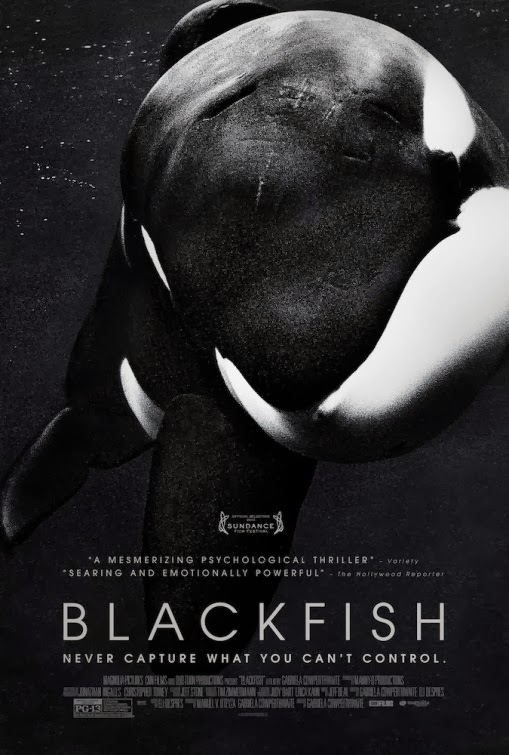
BLACKFISH (US - 2013)
Produced by CNN, BLACKFISH is a harsh condemnation of the practices of SeaWorld. Focused primarily on Tilikum, a six-ton orca at the Orlando SeaWorld, the film follows the killer whale from his 1983 capture to the present day. Tilikum has killed three people and has shown signs of aggression since his early days at the Canadian water park Sealand, a decrepit facility where part of his training involved being bullied by the other whales. It was there that he killed a trainer in 1991 and the park closed shortly after. He was moved to SeaWorld despite his record of aggression, primarily because the park was in need of a breeder. We see interviews with numerous former trainers juxtaposed with old camcorder footage of these same trainers during their SeaWorld days. All reiterate a consistent pattern of SeaWorld sweeping Tilikum's violent history under the rug. An unauthorized visitor was found dead in Tilikum's tank in 1999, after having snuck into the park in an apparent attempt to swim with the whale. Tilikum's most infamous act came in February 2010 when he attacked and ate trainer Karen Brancheau just after a performance (the film opens with a 911 call to an incredulous operator who responds with "A whale...ate one of the trainers?"). The former trainers, often holding back tears, tell of a systematic, calculated burying of information by SeaWorld executives who they felt had an obligation to inform them of the past incidents involving Tilikum, who still performs at the Orlando SeaWorld today. SeaWorld representatives declined to be interviewed for the film, but of course dispute its findings. Cowperthwaite clearly has an agenda, but she keeps the vitriol even-keeled and matter-of-fact, often letting archival footage and court records tell the story. Footage of baby whales being captured and the anguished cries of their mothers are absolutely gut-wrenching to witness, as is the notion of these great, majestic beasts being confined to tanks, psychologically defeated, their fins turning down (SeaWorld claims this is natural but the film asserts it only happens to 1% of whales not in captivity), and, in Tilikum's case, used essentially as a sperm donor. The film also notes that a few of Tilikum's 21 known offspring have been involved in other acts of captive aggression, indicating that the whale has a genetic predisposition to such behavior. Emotional, enraging, and often terrifying (the footage of a trainer being yanked by his foot and remaining calm as he's held underwater by one whale is one of the most frightening sequences in any movie this year), BLACKFISH is a must-see. (PG-13, 83 mins)
SHEPARD AND DARK (US - 2013)
Actor/writer Sam Shepard has been friends with Johnny Dark since 1963. Even as their lives drifted in different directions and they'd go a year or more without seeing one another, their bond remained. Shepard, of course, is a Pulitzer Prize-winning playwright and busy Hollywood character actor. Dark lives a quiet life in Deming, New Mexico, working at a supermarket, content to live among his books, smoke a little weed, and write stories and essays on his ancient PC. In 2010, Shepard was asked to donate his personal papers to the University of Texas and takes the opportunity to go through some letters he received from Dark over the decades. Dark, meanwhile, saves and archives everything and has his life meticulously mapped out in scrapbooks and photo albums. Shepard reaches out to Dark to share the letters sent to him and put their decades of correspondence in a book. Shepard tells Dark that he set up the book deal because he's got no money coming in (Shepard doesn't appear to live extravagantly, but it's doubtful that needs the money), but part of it is that he wants to help his old friend out and build him a bit of a financial cushion. As the two men reconnect and reminisce, it's great fun watching them laugh at decades-old inside jokes as they sift through letters in a corner booth at Denny's (there's also some footage at Shepard's 67th birthday dinner, where he's joined by pals Harry Dean Stanton and T-Bone Burnett). But as they get deeper into the project, director Treva Wurmfeld gradually reveals vital details to the audience: Dark's late wife Scarlett was the mother of Shepard's first wife, actress O-Lan Jones. The four lived together for years and they all took care of Scarlett after she survived a brain aneurysm. By 1983, Shepard's acting career was taking off and he met Jessica Lange, eventually deciding to leave his family and run off with her. It was a decision he agonized over, especially since he was hesitant to leave his and Jones' 13-year-old son Jesse, but he did it anyway, leaving Dark to be a surrogate father to the boy. Shepard and Lange were together until 2009, and the breakup is still heavy on Shepard's mind at the time of this book project. Dark surmises that this project was really just Shepard's way of dealing with it and being able to put it away and move on. Shepard is clearly haunted by his decisions, he's critical of his selfishness ("I've hurt people," he says, shaking his head) and going through the letters rips open old wounds and takes him back to a place he wasn't ready to go (not just with Lange, but with his alcoholic father), or at least isn't ready to share with Wurmfeld.
What starts out as two friends jovially reconnecting after some time apart turns into a devastating self-examination for Shepard. It's hard watching him reflect on the choices he's made and the guilt he still feels over leaving his wife and son. There's a line in a Shepard play that Wurmfeld spotlights about "how unprepared we are to face the truth," and Dark illustrates just how much of Shepard's life--his father, the guilt over leaving his family, the recurring "responsible brother" figure (meaning, Dark)--is in his work (think of Stanton leaving his son in the care of brother Dean Stockwell in Wim Wenders' Shepard-penned 1984 film PARIS, TEXAS). Dark is content with his life and never had the restlessness or the need to wander like Shepard has, though he does confess that he frequently feels more like Shepard's sidekick than his best friend. Wurmfeld very cleverly and deliberately lets the story build as it goes places no one--Shepard, Dark, the viewer--expects it to go, and she doesn't sugarcoat things to make Shepard look better. A frequently remarkable gem, and one of the best films of this year that you've heard nothing about. (Unrated, 88 mins)
THIS MUST BE THE PLACE (Italy/France/Ireland - 2011; 2012 US release)
The Weinstein Company acquired this eccentric, glacially slow-moving road film from IL DIVO director Paolo Sorrentino and sat on it for over a year before sneaking it onto 15 screens in the US last fall. It's certain to attain at least some minor cult status thanks to Sean Penn in perhaps the strangest role of his career as a reclusive, aging, Robert Smith-lookalike goth rocker named Cheyenne. Living in Dublin with his firefighter wife Jane (Frances McDormand), Cheyenne, who still dresses the part despite having not performed or recorded in 20 years, is forced to travel home to America upon hearing that his estranged father has died. Once back in NYC, Cheyenne is reminded of his Jewish heritage and learns from aging, foul-mouthed Nazi hunter Mordecai Midler (Judd Hirsch) that his father (whose letters are read in voiceover by an uncredited Fritz Weaver) devoted his life to tracking down a Nazi officer who tortured him at Auschwitz and is now living somewhere in the US. Cheyenne, haunted by his own demons--he quit writing "depressed songs for depressed kids" and withdrew from public life when two teenaged Irish fans committed suicide after listening to his music--and permitted by his wealth and celebrity to remain a child in many ways, believes he's finally found his true purpose when he decides to finish his father's work and locate the Nazi war criminal.
Sorrentino's film functions as an homage to road films past, particularly the work of Wim Wenders, a point driven home by the presence of PARIS, TEXAS star Harry Dean Stanton as a chatty old-timer who claims to have invented the wheeled suitcase. Cheyenne becomes quite the detective on his quest down the back roads of America, awkwardly meeting a retired teacher (Joyce Van Patten) who was once married to the alleged Nazi, which leads him to the man's granddaughter (Kerry Condon), a widowed waitress with a young son. Filming in Dublin, NYC, New Mexico, Utah, and Michigan, Sorrentino does a nice job of capturing the peculiar sounds and rhythms of rural America, and commendably doesn't go for cheap, fish-out-of-water laughs, with the mumbling, vaguely effeminate Cheyenne often finding accepting, kindred spirits among these misfit souls who live off the beaten path. This is an enigmatic and sometimes frustrating film that leaves several vital pieces of the puzzle open to interpretation, particularly Cheyenne's friendship with Mary (Eve Hewson, daughter of U2's Bono), a Dublin teenager with a delusional mother who hasn't been right since Mary's brother mysteriously vanished, but if you give it chance, it has its rewards, especially with some frequently arresting visuals and Penn's performance, while initially affected, off-putting, and feeling a bit like a stunt, gradually finds its place after a scene where he dumps all of his emotional baggage on old friend David Byrne (playing himself), whose Talking Heads song gives the film its title. The US theatrical cut was shortened by seven minutes from Sorrentino's original version, completely removing Shea Whigham's appearance as a fast-talking businessman and the explanation of how Cheyenne is suddenly driving a pickup truck on his journey (Whigham apparently asked him to drive it cross-country for him). THIS MUST BE THE PLACE isn't an easy film to like and anyone who assumes from a cursory glance that it'll be a Cure-inspired goth-rock CRAZY HEART will bail in record time, but road flick nerds and Penn completists will certainly want to give it a look. (R, 111 mins)
STORAGE 24 (India/UK - 2012; 2013 US release)
Uninspired at best and dreadful at worst, STORAGE 24 feels clumsily torn between being a horror movie and a Noel Clarke vanity project. British TV star Clarke, who wrote and co-directed the moderately entertaining Tarantino/Guy Ritchie knockoff 4.3.2.1, is still trying to mount some kind of Simon Pegg/Edgar Wright breakthrough in the US market, with little success thus far. Clarke co-produced, co-wrote, and stars in STORAGE 24, which starts its cribbing with a set-up straight out of SUPER 8 as a military cargo plane crashes near Hyde Park in central London. As the military closes in, the area is locked down and a group of people in a 24-hour storage facility (very) slowly discover that they've got company in the form of a rampaging alien that looks an awful lot like PREDATOR minus the rasta braids. But before any of that, director Johannes Roberts overindulges Clarke, who seems like he wanted to write a boring breakup drama intermittently interrupted by gory alien kills. Far too much time is spent on Charlie (Clarke) bellyaching to his best buddy Mark (Colin O'Donoghue) about getting dumped by Shelley (Antonia Campbell-Hughes), who's also at the storage facility and, it turns out, has been secretly seeing Mark for months. Even when the alien starts offing people one-by-one and the film just starts to blatantly copy other, better movies (mostly ALIEN and ALIENS, but also PREDATOR, DISTRICT 9, and ATTACK THE BLOCK just to name a few), with the alien dragging people up through the ceiling tiles, people crawling through air shafts, John Carpenter-esque score, etc. without any sense of style, fun, humor or homage, Charlie is still fixating on why things didn't work out. Ploddingly-paced with a dull cast and shoddy CGI gore effects, STORAGE 24 accomplishes nothing other than reminding you of past films that you'd be better off rewatching instead. (R, 87 mins)
Directed by Kim Jee-woon. Written by Andrew Knauer. Cast: Arnold Schwarzenegger, Forest Whitaker, Johnny Knoxville, Luis Guzman, Eduardo Noriega, Rodrigo Santoro, Jaimie Alexander, Peter Stormare, Zach Gilford, Genesis Rodriguez, Harry Dean Stanton, Daniel Henney, Christiana Leucas, Rio Alexander, John Patrick Amedori. (R, 106 mins)
As much a review as an autopsy after a disastrous opening weekend that saw it land in tenth place, THE LAST STAND marks Arnold Schwarzegger's first starring role since 2003's TERMINATOR 3: RISE OF THE MACHINES. And it doesn't appear that many people care. Grossing just $6 million, this is easily Arnold's worst opening and there's any number of reasons why. Wrong month, bad marketing (ads closer to the release date played up the comedy angle with co-star Johnny Knoxville), Arnold's dirty laundry being aired, or that memoir where he didn't seem to portray himself all that well. Or "the kids" just aren't interested in him or the adults were all seeing ZERO DARK THIRTY. Maybe these action vets only do well in EXPENDABLES situations where there's a bunch of them. Jason Statham is about one box-office dud away from going straight to DVD. And it'll be interesting to see what happens with Sylvester Stallone's BULLET TO THE HEAD and Bruce Willis' A GOOD DAY TO DIE HARD in the coming weeks. Or, for that matter, Arnold's proposed new CONAN sequel. And Stallone and Arnold are teaming up in the prison thriller THE TOMB, due out in the fall. THE LAST STAND is a lot of fun until it fumbles badly in a crucial point--more on that in a bit--but overall, it's a blast and it's great to see Arnold kicking ass on the big screen again. Sure, maybe he's a shitty husband, but I honestly expected him to get a warmer reception than barely cracking the top ten.
YES!
Schwarzenegger is Ray Owens, retired L.A. supercop who's now enjoying a quiet life as sheriff of Sommerton Junction, a tiny Arizona town near the Mexico border. There isn't much for him to police in Sommerton Junction, and his day off is ruined when Las Vegas-based FBI agent Bannister (Forest Whitaker) informs him that Mexican drug cartel kingpin Gabriel Cortez (Eduardo Noriega) has escaped custody and taken a female FBI agent (Genesis Rodriguez) hostage, and to be on the lookout since they may be headed in the general vicinity. Owens is already suspicious of a stranger (Peter Stormare) he's seen in town and when two of his deputies, Sarah (Jaimie Alexander) and Jerry (Zach Gilford) find a local farmer (Harry Dean Stanton) murdered, he knows there's a connection. Sarah and Jerry find the stranger overseeing the installment of a narrow, temporary bridge over a small canyon divide separating the outskirts of Sommerton Junction from Mexico. A gunfight ensues and Jerry is killed, and Owens figures out that the bridge is there to allow Cortez to flee the country. Bannister warns Owens to step aside and let the Feds handle it, but Owens and his ragtag team of law enforcers--Sarah, Deputy Figueroa (Luis Guzman), newly-deputized Iraq War hero and now town drunk Frank (Rodrigo Santoro), and eccentric local gun nut Dinkum (Knoxville)--decide to take on Cortez and his goons themselves.
THE LAST STAND is essentially a modern western, right down to the deliberately Ennio Morricone-esque score and other genre staples like the retired city lawman who becomes a small-town sheriff because he's seen too much killing, the town drunk who puts down the bottle so he can help, the eager rookie who may as well be named Dead Meat, the comic relief sidekick, and the cackling villain. It's a little RIO BRAVO, a little HIGH NOON, and a bit of a spaghetti western--with Noriega channeling a young Tomas Milian at times--and for the most part, it's entertaining and works very well. Arnold looks a bit older but hasn't lost a beat. Andrew Knauer's script--with uncredited contributions from George Nolfi (THE ASSASSINATION BUREAU) and Jeffrey Nachmanoff (TRAITOR)--does give a little too much time to Knoxville and his JACKASS antics that are frequently distracting from the lean, mean action that constitutes the bulk of the film.
THE LAST STAND marks the American debut of South Korean auteur Kim Jee-woon, director of A TALE OF TWO SISTERS (2003), THE GOOD, THE BAD, THE WEIRD (2008), and the unforgettable revenge thriller I SAW THE DEVIL (2010). It's an unlikely endeavor for Kim, but he brings an energetic sense of style and obvious enthusiasm to the film, from an imaginative car chase in a corn field to the violent showdowns in the streets of Sommerton Junction. His handling of the actors is good, considering he doesn't speak English. Where Kim--or the visual effects team--really botches the job is in the final confrontation between Owens and Cortez on the bridge. To this point, the film has shown seamless and conservatively utilized CGI and practical visuals--the explosions and car wrecks look mostly real, the blood looks wet--but this showdown is a disaster. Maybe the sequence was a hastily-assembled reshoot, but the greenscreen is bush-league, nothing in the scene--from the bridge to the landscape to even the actors--looks real. I'm not even entirely convinced Schwarzenegger and Noriega were there at the same time or even there at all. When we first see Arnold standing on the bridge, he's digitally composited into the shot so badly that his image seems to be hovering on top of the frame and his body isn't even the correct scale to the size of the bridge. The whole sequence is shockingly and inexcusably sloppy, and doesn't even look finished. How are professional filmmakers and visual effects teams still screwing up greenscreen and CGI? It's 2013 and for the most part (unless it's by design--say, SIN CITY or SUCKER PUNCH), when it's used to simulate a "real" setting, this shit still isn't ready for prime-time. Get some crew people together and drive the actors to a bridge and shoot the scene. Enough is enough.
But for the brisk 90 minutes leading up to what looks like a Photoshop job that even The Onion would reject, THE LAST STAND is a welcome return for Schwarzenegger, and he's been missed. Regardless of how badly it bombs theatrically (and it's looking ugly), this will find an appreciative audience on DVD/Blu-ray and cable. It's great that guys like Arnold and Stallone are still getting it done, but for how long? Unless it's for a jokey, self-referential nostalgia trip like THE EXPENDABLES, audiences aren't really interested in geriatric action stars. Even Clint Eastwood's movies were tanking in the late '80s before UNFORGIVEN turned him into a serious filmmaker in 1992. Charles Bronson's late '80s offerings didn't exactly rake in the money. Maybe THE LAST STAND bombing isn't such a surprise after all. It just feels weird. Arnold was always a box-office guarantee (even THE LAST ACTION HERO opened better than THE LAST STAND, and that was in 1993 figures). He'll be 66 this summer, Stallone will be 67, and Willis is creeping up on 60. How many more of these do they have in them--regardless of how in-shape they are--when even 45-year-old Statham is losing his box-office appeal? Well...there's always THE EXPENDABLES 3.
The film's more recent one-sheet, emphasizing
the comedy element and, for some reason,
third-billed Johnny Knoxville.
Written and directed by Martin McDonagh. Cast: Colin Farrell, Sam Rockwell, Woody Harrelson, Christopher Walken, Tom Waits, Abbie Cornish, Olga Kurylenko, Zeljko Ivanek, Harry Dean Stanton, Gabourey Sidibe, Michael Pitt, Michael Stuhlbarg, Kevin Corrigan, Linda Bright Clay, Long Nguyen, Brendan Sexton III. (R, 110 mins)
Writer/director Martin McDonagh's follow-up to his acclaimed IN BRUGES (2008) again demonstrates his deftness at mixing the comedic and the dramatic and doing so without jarring or uneven shifts in tone. SEVEN PSYCHOPATHS adds a "meta" element that's somewhat reminiscent of Shane Black's 2005 cult favorite KISS KISS BANG BANG (a great film totally abandoned by its distributor). With rare exception--KISS KISS BANG BANG, for example--self-reflexive meta films of this sort tend to exude a certain air of smugness about them, almost as if the filmmakers are too busy marveling at how preciously clever they're being. For the most part, McDonagh does a good job at keeping that element in check, but it doesn't always work as well as it should, or as well as McDonagh thinks it is. Contrary to what the trailers, TV spots, and poster art are selling, this isn't exactly the wacky comedy about a ragtag group of criminal miscreants that it appears to be. It's *A* film like that...just not the one being advertised.
In Hollywood, hard-drinking Irish screenwriter Marty (McDonagh's IN BRUGES star Colin Farrell) is having a hard time finding inspiration for his latest script, titled SEVEN PSYCHOPATHS. He's got one: the Jack of Diamonds serial killer, who happens to be going around wiping out mobsters and leaving a jack of diamonds card behind. Marty's best friend Bobby Bickle (Sam Rockwell) is an out-of-work actor who makes a living in a lucrative scam with aging, dapper, cravat-wearing criminal Hans (Christopher Walken), where Bobby kidnaps a dog and after a few days, Hans returns it to the owner for the reward. Things spiral out of control when Bobby kidnaps Bonny, a Shih Tzu owned by hot-tempered, trigger-happy crime boss Charlie Costello (Woody Harrelson), who thinks nothing of killing anyone who gets in the way of him retrieving his beloved dog.
That's the essential "plot," and that's where a typical Hollywood points A-to-B-to-C story would focus. But McDonagh takes things in unexpected directions with various sidetracks and detours as he cinematically demonstrates the stages of the writing process as Marty and Billy (who wants to help write the script) brainstorm and the film turns into a running commentary on itself. These are tricky waters for a film to navigate. If it's done right, it's brilliant. If it's not, then it's pompous and insufferable. SEVEN PSYCHOPATHS isn't brilliant as a whole, but it seems headed that way for the first half. It's filled with sharp writing, witty and profane dialogue, great characters, and inspired situations that often border on silly but are immensely enjoyable. McDonagh weaves together hilarious comedy, devastating drama, and some surprising scenes of shocking violence with confidence and energy, but once Marty suggests, instead of a big shootout, the characters in his script should just go to the desert and talk, that's exactly what McDonagh has his characters in the film do. While it's nice watching Farrell, Rockwell, and Walken explore these characters and give them added dimensions, there's no denying it kills the momentum for a while. There's certainly an argument that subverting that expectation of a big shootout (which we eventually get) is McDonagh's whole point, but it's the only time the film threatens to become one of those meta movies where the winking gets a little forced and you start to feel like the filmmakers think the material is beneath them. There's some good stuff after this section, but SEVEN PSYCHOPATHS never returns to being as entertaining as it was for that first hour.
Even if it doesn't quite hang together all the way through, SEVEN PSYCHOPATHS does boast a terrific ensemble cast. Rockwell has rarely been better, and Hans is easily Walken's best role in years. Whether he's doting over his cancer-stricken wife (Linda Bright Clay), making odd facial expressions, or saying things like "Fuck the cops! Fuck 'em!" in ways that only he could say them, Walken turns in a marvelously inspired "Christopher Walken"-y performance that's great fun to watch. Rockwell and Walken are the standouts, but Farrell and Harrelson do fine work, and there's also memorable supporting turns by Tom Waits, Harry Dean Stanton, and, of course, Bonny the Shih Tzu. SEVEN PSYCHOPATHS functions on multiple levels and is the kind of film that probably requires more than one viewing to catch and process everything. It's one of those films where subsequent viewings will likely bring other things to the surface to enrich the experience. I certainly enjoyed enough of it to pick up the eventual Blu-ray and spend more time studying it in greater detail. It's just that kind of film.
DEATH WATCH (France/Germany - 1980; 1982 US release)
Directed by Bertrand Tavernier. Written by David Rayfiel and Bertrand Tavernier. Cast: Romy Schneider, Harvey Keitel, Harry Dean Stanton, Max von Sydow, Bernhard Wicki, Therese Liotard, Vadim Glowna, William Russel, Caroline Langrishe, Robbie Coltrane. (R, 130 mins).
In a near-future society where disease has been almost completely eliminated, Catherine Mortenhoe (Romy Schneider) is diagnosed with an extremely rare terminal
illness. Unscrupulous TV exec Vincent Ferriman (Harry Dean Stanton)
tries to cajole her into appearing on DEATH WATCH, a reality-TV show where his
camera crews will follow her as she lives out her final days, giving viewers the rare chance to see someone dying of something other than natural causes or old age. She agrees, only to provide money for her husband (Vadim Glowna), but arranges an escape from the camera crews farely quickly. Ferriman
sends cameraman Roddy (Harvey Keitel)--who has a camera implanted in his
eyes--after her. Finding her at a church shelter, Roddy befriends the dying
Catherine, and unbeknownst to her, is filming her for the DEATH WATCH broadcast.
Complications arise when Roddy develops feelings for Catherine, who's on her way
to visit her ex-husband (Max von Sydow), and die with dignity, on her own terms. Roddy also has to manage the fact that,
because of the camera implantation, he has to have a constant light source and
can't close his eyes for more than a few seconds or it will cause near-instant
blindness (one glaring weakness of the film is that it never sufficiently explains how Roddy sleeps, other than him saying "I never did sleep much. I always felt that I'd miss something").
Catherine (Romy Schneider) on the run
with Roddy (Harvey Keitel), unaware that
he's filming her for DEATH WATCH.
Directed by Bertrand Tavernier (COUP DE TORCHON, ROUND MIDNIGHT), who co-wrote with frequent collaborator David Rayfiel, this
sci-fi art film is, in retrospect, filled with surprisingly prescient
visions of today's reality TV and a media and schadenfreude-obsessed, tragedy-as-entertainment culture
("Death is the new pornography," says Ferriman). I'm surprised this hasn't been
remade. Quietly released in the US by Quartet Films
in 1982, about a month before Schneider's sudden death from cardiac arrest at just 43 (her 14-year-old son died a year earlier after being impaled on a spiked fence he was attempting to climb, and it was a tragedy from which Schneider never recovered), this vanished quickly but eventually found a cult thanks to home video and late-night TV airings in the 1980s. It benefits from
a genuinely jarring feel throughout--European production, Americans and
Europeans in the cast, shot in Scotland, and is quite unique in the sci-fi,
"futuristic" genre, in that it largely looks just like 1980 Glasgow (except for
a great THEY LIVE-esque moment in a huge, Costco-type supermarket, with subliminal "Don't steal...you'll feel much better if you don't" messages
loudly playing over the speaker system). It loses a little momentum near the end
with a few long monologues from von Sydow, but the climax is quite emotional and
well-played by the actors. The beautiful Schneider has rarely been better,
and she and Keitel work very well together, despite their reportedly not getting
along all that well. It's interesting seeing Keitel and Stanton in such odd (for
them) settings. They seem to be improvising in many of their scenes together.
Schneider with Harry Dean Stanton as network exec Vincent Ferriman
DEATH WATCH was just released in a Blu-ray/DVD set from Shout Factory, and presents Tavernier's uncut European version for the first time in the US. Running 12 minutes longer than the US version, the European DEATH WATCH is a great example of how small edits and subtle changes can make a completely different film.
(SPOILERS)
In the US cut, Catherine is legitimately sick. In the European cut, Ferriman's subject dies earlier than expected and, needing a new "star," he bribes Catherine's doctor (William Russel) into convincing her that she's got two months to live. The doctor gives her a painkiller prescription, but it's the pills that are designed to make her feel sick when she's really not, and the whole plan is to have her be miraculously "cured" at the end of the show's run. It's established early on that it's all scripted by Ferriman and the network (Roddy is not involved in that aspect of the plan; he thinks Catherine is truly ill) to maximize ratings and profits. The European cut is even more tragic and cynical in its critique of corporate greed and the invasive, rubbernecking nature of reality TV.
The ending and Ferriman's motivation are the biggest differences in the US and European cuts, with the doctor getting some added commentary like "What a circus," and "Drug her and make her sick, then 'cure' her, all for what? Ratings?" but the European version also includes a scene with Catherine visiting her dementia-stricken father (Bernhard Wicki) in a mental hospital. Wicki remained credited in the US cut, but was nowhere to be found.
Trailer for the film's 2012 UK re-release
Shout Factory's Blu-ray/DVD combo pack also finally allows North American fans to see DEATH WATCH in its original 2.35:1 aspect ratio. The US version was released on VHS by Embassy Home Entertainment, and looked atrocious in a washed-out, faded, and hideously-cropped 1.33:1. The Blu-ray is a revelation in terms of detail, textures, and color. The only extra is a photo gallery that runs just over a minute. A more comprehensive package, or at least an interview with Tavernier, would've been nice, but it's enough of an event to have this ambitious, thinking person's sci-fi film at long last available in its intended version after all these years. It's a dark, scathing, brilliant and beautifully-shot film that's more relevant and powerful than ever. Is it much of a stretch for the 1980 science-fiction of DEATH WATCH to become as real as the 1976 satire of NETWORK that's happening on cable news and countless tabloid TV shows every hour of every day?