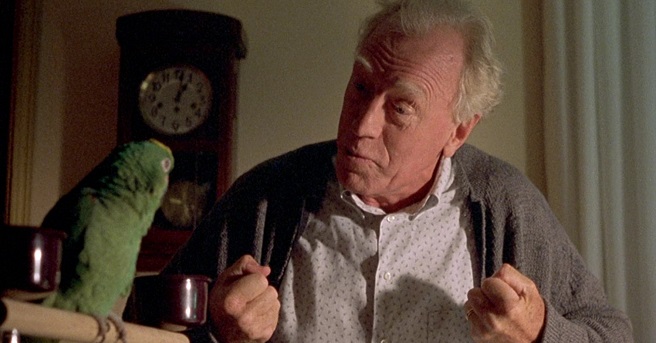
SLEEPLESS (Italy - 2001) Directed by Dario Argento. Written by Dario Argento, Franco Ferrini and Carlo Lucarelli. Cast: Max von Sydow, Stefano Dionisi, Chiara Caselli, Gabriele Lavia, Rossella Falk, Paolo Maria Scalondro, Roberto Zibetti, Roberto Accornero, Barbara Lerici, Barbara Mautino, Conchita Puglisi, Massimo Sarchielli, Elena Marchesini, Guido Morbello, Aldo Massasso, Diego Casale, Alessandra Comerio, Daniela Fazzolari. (Unrated, 117 mins) Those Dario Argento fans who lament his decline after his trailblazing run from 1970's THE BIRD WITH THE CRYSTAL PLUMAGE to 1987's OPERA often speak of those later films as if he just suddenly started making terrible movies out of the blue. The shift was gradual, though it's easy to let an outright fiasco like 1998's THE PHANTOM OF THE OPERA cloud your judgment and taint everything surrounding it in his filmography. While things started to get precipitously bad around 2007's MOTHER OF TEARS, Argento's early 21st century output following PHANTOM--SLEEPLESS, THE CARD PLAYER, DO YOU LIKE HITCHCOCK?--has its merits and those films aren't as bad as their reputations suggest, even if they're unquestionably second-tier Argento. Such is the case with 2001's SLEEPLESS, a minor giallo in the Argento canon in retrospect but an important one at the time, as it was such an unabashed "give the fans what they want" movie that SHAMELESS might've been a better title. THE PHANTOM OF THE OPERA was met with such hostility and was so flatly rejected by everyone, that SLEEPLESS served as an olive branch, made with the promise of being the old Argento you know and love, and he even got disbanded DEEP RED and SUSPIRIA composers Goblin to reunite for the soundtrack.
If Argento wasn't such a gifted stylist, the greatest-hits pandering he engages in throughout SLEEPLESS would almost be embarrassing. He's like a legendary classic rocker coming off an ambitious, badly-received concept album and a costly tour that flopped and is now determined to win back the fans by promising to play nothing but the old hits. There's endless, constant callbacks to his earlier classics in scene after scene after scene--a teeth-bashing murder and a set-up similar to the "walking dummy" bit from DEEP RED; a riff on the way someone suddenly appears in the frame like the climax of TENEBRAE; murder sequences in the rain like TENEBRAE, and another bit with a woman outside a train station that recalls Jessica Harper waiting for a taxi in a torrential downpour outside the airport in SUSPIRIA, or Eleonora Giorgi outside the library in INFERNO; a parent trying to cover for a their murderer child in PHENOMENA; an aging protagonist with a disability like Karl Malden's blind earwitness to murder in THE CAT O'NINE TAILS; a locked, abandoned villa that holds a secret, much like DEEP RED; a long tracking shot across the carpeted floor of a theater leading to a brutal murder that's strongly reminiscent of the famous Louma crane shot in TENEBRAE; and most important to all of Argento's gialli, the notion of the amateur sleuth who's hung up on a barely-remembered and seemingly insignificant detail that's ultimately the key to the mystery.
SLEEPLESS opens with a brief scene in Turin in 1983, as detective Ulisse Moretti (Max von Sydow) comforts a little boy who was hiding and listening as his mother was brutally murdered via an English horn being repeatedly, violently crammed into her mouth and throat. She's the latest victim of a "killer dwarf" in what's been dubbed by the press as "The Dwarf Murders." Cut to 2000 and the bizarre murders start once again, and though the murderer claims to be the Killer Dwarf, it's immediately deemed the work of a copycat, since the primary suspect in the Dwarf Murders drowned in what was ruled a suicide 17 years earlier, though his body washed away and was never found. The current detective on the case, Manni (Paolo Maria Scalandro) has no leads and reaches out to pick the brain of the retired Moretti, now an elderly widower with a heart condition and a spotty memory and seemingly in the earliest stages of Alzheimer's. Though he's foggy on some of the details, Moretti is still brought in as a consultant and ends up reconnecting with Giacomo (Stefano Dionisi), the now-grown little boy from 1983 who's coincidentally been summoned from Rome to Turin by his childhood friend Lorenzo (Roberto Zibetti) when the Dwarf Murders become front-page news once again.
Much like Karl Malden and James Franciscus in THE CAT O'NINE TAILS, David Hemmings and Daria Nicolodi in DEEP RED, Anthony Franciosa and Christian Borromeo in TENEBRAE, and Jennifer Connelly and Donald Pleasence in PHENOMENA, von Sydow's Moretti and Dionisi's Giacomo become yet another in a long line of Argento's unlikely sleuth teams resorting to their own investigation when the police either dismiss their concerns or have reached a dead-end. As you might guess, as they get closer to the truth, their lives are in danger (someone attempts to poison Giacomo's beer in a crowded bar at one point, but Lorenzo ends up drinking it and almost dies), and numerous red herrings abound, among them Lorenzo, his Giacomo-hating, asshole father (DEEP RED and INFERNO co-star Gabriele Lavia), and the killer dwarf's still-grieving, embittered mother (a semi-retired Rossella Falk, veteran of numerous vintage non-Argento gialli like Luigi Bazzoni's THE FIFTH CORD, Paolo Cavara's BLACK BELLY OF THE TARANTULA, and Umberto Lenzi's SEVEN BLOOD-STAINED ORCHIDS). And, as usual, the key to the mystery involves some obscure detail, in this case a little-known nursery rhyme for which Moretti can't remember the words, and a strange hissing sound heard amidst his mother's blood-gurgled screams that has stuck with Giacomo all these years and he still can't identify. There's absolutely nothing new here, but it's fun to see all of these Argento tropes being served up like giallo comfort food, not to mention the immeasurable boost it gets from the regal screen presence of the great von Sydow.
For these reasons, and in looking at Argento's subsequent decline through the benefit of hindsight, SLEEPLESS has aged better than expected. Much of that is due to the terrific transfer on Scorpion's new Blu-ray (because physical media is dead), which represents the first proper presentation the film has had in America. Artisan Entertainment picked it up for the US and released it straight-to-video in the fall of 2001, but the DVD was a subpar transfer, and to add insult to injury, was only offered in 1.33:1 pan & scan. Of course, this was prior to the days of widescreen HDTV being the standard, but even then, most DVDs offered both widescreen and 1.33:1 "fullscreen" versions--either as two-sided discs or two different packages--the fullscreen option there for those holdouts who still couldn't grasp the concept of letterboxing. Now, at last, SLEEPLESS looks and sounds like it should, but it still has its faults that keep it firmly entrenched as second-rate Argento. The initially-welcome familiarity becomes a slight liability after a while, as one gets over the joy of Argento being Argento again and realizes that, no matter how much better this is than PHANTOM OF THE OPERA, it kinda just becomes Dario Argento's homage to Dario Argento. The killer, once revealed, starts using a weird vocal affect that sounds less like a sinister serial killer and more like a lost Festrunk brother; and at just under two hours, it's entirely too long, which makes the film's final minutes even more bizarre in the way Argento has the closing credits roll over the final scene as shit is still happening. It probably sounded like an outside-the-box idea on paper as a way of messing with the audience, but in execution, it's jarring and distracting, like the film is already 20 minutes too long but now he's in a mad rush to wrap it up. He would do the same thing over a final scene with Stefania Rocca in THE CARD PLAYER, but it was in a much less obtrusive fashion. SLEEPLESS is a far from perfect film, and it doesn't even crack the top ten of any "Best of Argento" lists, but at the same time, it also doesn't belong anywhere near the bottom, and at least now, with a quality Blu-ray presentation, it can be assessed on its own admittedly flawed terms by devout Argentophiles.
THE PHANTOM OF THE OPERA (Italy - 1998; US release 1999) Directed by Dario Argento. Written by Gerard Brach and Dario Argento. Cast: Julian Sands, Asia Argento, Andrea Di Stefano, Nadia Rinaldi, Coralina Cataldi-Tassoni, Istvan Bubik, Lucia Guzzardi, Aldo Massasso, Zoltan Barabas, Gianni Franco, David D'Ingeo, Kitty Keri, John Pedeferri, Leonardo Treviglio, Massimo Sarchielli, Luis Molteni, Enzo Cardogna, Itala Bekes, Ferenc Deak B., Sandor Bese. (Unrated, 104 mins)
Every bad movie has its defenders, and while a few people have gone to bat for Dario Argento's 1998 version of THE PHANTOM OF THE OPERA, it's almost universally regarded as his worst film, though it later got some stiff competition from 2012's DRACULA. A revisionist take on Gaston Leroux's classic novel, PHANTOM is usually cited as the point of no return in a decline from which Argento has yet to recover. It was recently released on Blu-ray by Scorpion, along with 2004's THE CARD PLAYER, another title from the director's much-maligned modern era, with 2001's SLEEPLESS on the way, because physical media is dead. Unfortunately, the passage of time has not turned THE PHANTOM OF THE OPERA into an unjustly neglected gem that was misunderstood in its time. It's still the laughably awful, hopelessly misbegotten train wreck that it's always been, the only differences now being that a) the clarity of HD at least reveals a generally nice-looking film that's well-shot by the great cinematographer Ronnie Taylor, an Oscar-winner for his work on 1982's GANDHI and an Argento collaborator on 1987's OPERA, and along with the appropriately ornate production design by Antonello Geleng, reveal qualities that were significantly diminished when the film went straight-to-video in the US in 1999, courtesy of the lowly T&A and D-grade action purveyors at A-Pix Entertainment (though it must be said that 1080p doesn't do any favors for the primitive CGI and the embarrassing, Tommy Wiseau-esque greenscreen work), and b) Argento repeatedly having his daughter Asia disrobe on screen once she turned 18 for 1993's TRAUMA and then again for some violent rape scenes in 1996's THE STENDHAL SYNDROME has always been a little, well, weird.
For instance, here he depicts her, albeit briefly, engaged in a fully-nude, doggy-style, soft-focus sex scene with the title character that's prefaced with a leering, lingering close-up of her ass that takes up nearly the entire screen. This is followed later by the Phantom raping her character as she initially fights him off but eventually gives in and is shown enjoying it. Asia Argento has always cultivated a reputation as an edgy, hell-raising wild child, but these scenes were strange and ill-advised in 1999 and are completely uncomfortable and a little gross two decades later following her involvement in the Harvey Weinstein scandal and then with sexual assault accusations leveled at her by her HEART IS DECEITFUL ABOVE ALL THINGS co-star Jimmy Bennett. Asia worked again with her father on 2007's MOTHER OF TEARS and 2012's DRACULA (his last film to date), and while most fans regard THE STENDHAL SYNDROME as his last front-to-back good movie (some go back as far as 1987's OPERA, but I might even say 1985's PHENOMENA), maybe there's some connection between the beginning of Dario Argento's slow, sad, ongoing decline coinciding with when he started having his daughter get naked in his movies.
Asia Argento is the ingenue Christine Daae, the understudy to obnoxious diva Carlotta Altieri (Nadia Rinaldi) in a production of Faust at the Paris Opera House in 1877. Christine finds an admirer in the Phantom (Julian Sands, in a role Argento initially pitched to John Malkovich), a notorious mystery figure who lives in the catacombs beneath the opera house, where he was abandoned as an infant and raised by rats (!). The Phantom--who isn't disfigured and wears no mask--develops a telepathic communication with Christine and the pair soon fall in love as Christine is powerless against seductive Phantom pick-up lines like "Your perfume...your female smell...it flows through my veins like the melody of the rolling ocean!" The Phantom offs various interlopers who get in the way of his love for Christine, with Argento wasting a ton of screen time on opera house staffers Alfred (David D'Ingeo) and Paulette (Kitty Keri), who are introduced with a sex scene (their copulation gets a reaction shot from a caged bird), then endlessly venturing into the catacombs where it takes forever for the Phantom to kill them. Competition arrives in the form of the lovestruck Baron Raoul de Chagny (Andrea Di Stefano), but Christine keeps their relationship platonic, even as the Phantom becomes possessive and escalates to violence, madness, and murder to keep her close to him.
Argento and co-writer Gerard Brach (a longtime Roman Polanski collaborator going back to REPULSION) opt to make everyone in Paris ugly and grotesque (the monstrous Carlotta's awful treatment of everyone, plus Eurocult stalwart Aldo Massasso as a pedophile arts patron who keeps trying lure little girls with chocolates) while giving the Phantom a relatively handsome visage. This is unlike every other interpretation of the character within the horror genre--most notably Lon Chaney in 1925, Claude Rains in 1943, Herbert Lom in 1962, and Robert Englund in 1989--though with his long blond wig and wailing away on an organ, Sands often resembles an emo Rick Wakeman. It's an approach that just never works, mainly due to the overwrought performance of Sands, who was appropriately menacing in the first two WARLOCK films--which altered the course of his career from Merchant-Ivory regular (A ROOM WITH A VIEW, MAURICE) to cult horror star for several years--but he makes an annoyingly needy, clingy, codependent Phantom here. It's too bad almost nothing works in THE PHANTOM OF THE OPERA, because this is clearly a more prestigious production than what Argento was doing around this time, especially with revered names like Taylor, Brach, and composer Ennio Morricone onboard.
This most assuredly is not a junky horror movie, but Argento is having a really off day, even recycling what appear to be some unused steampunk-inspired props from the previous year's THE WAX MASK, which he intended to produce for Lucio Fulci but assigned to Sergio Stivaletti after Fulci died during pre-production. For all of his trailblazing success with his early gialli and his SUSPIRIA supernatural horrors, Argento stumbles badly when he ventures into classic horror: DRACULA, with its crummy digital effects, a whiny title vampire (Thomas Kretschmann) calling himself "an out-of-tune chord in the divine symphony" and transforming into a human-sized mantis while being pursued by a sleepwalking Rutger Hauer as cinema's dullest Van Helsing, is just about as bad as THE PHANTOM OF THE OPERA. Argento went on to make some OK-but-not-great films down the road, like SLEEPLESS (a back-to-basics giallo, basically an acceptable mea culpa after PHANTOM was flatly rejected by everyone), THE CARD PLAYER, and 2005's DO YOU LIKE HITCHCOCK?, but he's never totally regained his mojo or been anywhere close to "vintage Argento" strength since. The Blu-ray features a commentary by film historians Troy Howarth and Nathaniel Thompson, where both acknowledge the film's flaws and its extremely low standing among Argentophiles (even referring to it as the director's "folly") while offering a reasoned, rational defense of it that probably won't change your opinion, but refreshingly avoids resorting to desperate, hyperbolic, "Dario can do no wrong!" fanboy apologia.
THE CARD PLAYER (Italy - 2004) Directed by Dario Argento. Written by Dario Argento and Franco Ferrini. Cast: Stefania Rocca, Liam Cunningham, Silvio Muccino, Adalberto Maria Merli, Claudio Santamaria, Fiore Argento, Cosimo Fusco, Mia Benedetta, Giovanni Visentin, Claudio Mazzenga, Conchita Puglisi, Micaela Pignatelli, Luis Molteni, Jennifer Poli, Elisabetta Rocchetti, Vera Gemma, Antonio Cantafora, Gualtiero Scola, Robert Madison, Emanuel Bevilacqua. (Unrated, 104 mins) After his base's talk-to-the-hand rejection of THE PHANTOM OF THE OPERA, the giallo throwback SLEEPLESS served as an acquiescing Argento's "give the fans what they want" movie. Continuing in that vein, THE CARD PLAYER is his attempt to bring the giallo into the 21st century. It's second-tier Argento without question, and looking at it again a decade and a half later, the film has taken on an even greater air of familiarity thanks to all the post-CSI police procedurals that your dad watches. From Claudio Simonetti's score that sounds like an alternate version of the NCIS theme to its high-concept plot that incorporates the internet in the most simplistic ways and doesn't really completely understand how computers work, THE CARD PLAYER feels very much like a two-hour pilot episode of a hypothetical CSI: ROME. Probably best known to American moviegoers for her supporting role in THE TALENTED MR. RIPLEY, Stefania Rocca stars as Detective Anna Mari (whose name is similar to Asia Argento's Detective Anna Manni in THE STENDHAL SYNDROME), who's challenged by a killer via e-mail to a game of online poker for the life of an abducted British tourist, seen on a live webcam begging for her life. For every hand the killer wins, he amputates something, his ultimate goal being to murder her on camera. That's exactly what happens when hapless cop Sturni (Claudio Santamaria) volunteers to take him on and loses every hand. Mari eventually teams with John Brennan (Liam Cunningham, several years before playing Davos on GAME OF THRONES), a blustery, alcoholic forensics expert dispatched from the British embassy to assist in the investigation. Their luck doesn't improve when bull-headed police commissioner Marini (Adalberto Maria Merli) orders them to not engage and refuses to allow them to play when the killer abducts another girl, who's soon found floating in a river with a Joker card inserted into her vagina. They eventually resort to bringing in young poker expert Remo (Silvio Muccino), which proves helpful when Marini's daughter Lucia (Fiore Argento, Dario's eldest daughter) is the next woman taken.
There's a noticeable lack of "classic" Argento set pieces in THE CARD PLAYER, as most of the suspense sequences revolve around characters gathered around Mari's desk and grimacing at her computer screen as they wait for the cards to be revealed. It's an unbelievably silly story, and the killer's identity should be obvious to anyone who's seen a murder mystery before. But still, Argento, working with frequent writing partner Franco Ferrini (PHENOMENA, DEMONS, DEMONS 2), manages to squeeze in some inspired moments amidst the SE7EN-meets-ROUNDERS goofiness (we could probably use more of the tap-dancing, opera-singing, comic relief coroner). One vintage giallo bit has something in an ashtray on Mari's coffee table catching her eye, as she quickly realizes that it's a reflection of the masked killer watching her while hiding in the bushes right outside an opened patio door, the proximity very reminiscent of David Hemmings barely having enough time to lock the door into his music room when he realizes the killer is in the apartment with him in DEEP RED. And later, off investigating on his own, Brennan has one of those classic giallo realizations where he accidentally cracks the case after piecing together two seemingly unrelated details involving a mysterious sound in a public place and strange seeds from a rare plant, a stylistic callback to discovering the killer's identity in Argento's 1970 directing debut THE BIRD WITH THE CRYSTAL PLUMAGE.
Sure, the filmmaker is repurposing some old ideas, but it's in these moments that THE CARD PLAYER gets some of that distinct Argento momentum going, something that's certainly lacking in the astoundingly dumb climax that literally has the killer securing Mari to the railroad tracks like a silent movie villain, but forcing her to play online poker for her life. THE CARD PLAYER has a great cinematographer in Benoit Debie (IRREVERSIBLE, ENTER THE VOID, SPRING BREAKERS), but doesn't really take advantage of it, as Argento opts to give the film a generally TV-like look to go along with CSI-ready dialogue like "We're playing by his rules!" It also has some pacing issues in the middle and has another jarringly abrupt final shot like SLEEPLESS, but it gets some much-needed gravitas from Cunningham and Rocca, who make a good team and are about as close as late-period Argento is gonna get to David Hemmings and Daria Nicolodi in DEEP RED.
RED RINGS OF FEAR aka ENIGMA ROSSO aka RINGS OF FEAR aka TRAUMA aka VIRGIN KILLER (Italy/West Germany/Spain - 1978) Directed by Alberto Negrin. Written by Marcello Coccia, Massimo Dallamano, Franco Ferrini, Stefano Ubezio, Alberto Negrin and Peter Berling. Cast: Fabio Testi, Christine Kaufmann, Ivan Desny, Jack Taylor, Fausta Avelli, Bruno Alessandro, Tony Isbert, Helga Line, Brigitte Wagner, Caroline Ohrner, Silvia Aguilar, Taida Urruzola, Maria Asquerino, Cecilia Roth. (Unrated, 84 mins)
The final installment of a loosely-connected "Schoolgirls in Peril" trilogy that began with 1972's WHAT HAVE YOU DONE TO SOLANGE? and 1974's WHAT HAVE THEY DONE TO YOUR DAUGHTERS?, the giallo RED RINGS OF FEAR was a troubled production even before filming began. Massimo Dallamano, a career journeyman (A BLACK VEIL FOR LISA, DORIAN GRAY, THE NIGHT CHILD) who established himself as a top cinematographer in the 1960s with Sergio Leone's A FISTFUL OF DOLLARS and FOR A FEW DOLLARS MORE, directed SOLANGE and DAUGHTERS and was set to helm the third installment, but was killed in a car accident in Rome in November 1976, not long after the release of his final film, the polizia COLT 38 SPECIAL SQUAD. He was still in the process of completing the RED RINGS script, which was then cycled through an additional five credited writers--including future Dario Argento collaborator Franco Ferrini--over the next year and a half before shooting finally began. In Dallamano's stead, directing duties were assigned to Alberto Negrin, who's spent his entire career in Italian television as a go-to guy for prestigious RAI Radiotelevisione Italiana TV-movies and miniseries that would occasionally make it onto American networks, such as the 1985 miniseries MUSSOLINI AND I with Susan Sarandon, Anthony Hopkins, and Bob Hoskins as Il Duce, and 1990's VOYAGE OF TERROR: THE ACHILLE LAURO AFFAIR with Burt Lancaster and Eva Marie Saint. RED RINGS OF FEAR remains Negrin's only theatrical feature to date in a career going back to 1971, and he took the opportunity to cut loose and run with it. Typical of the sleazy direction gialli would take in the latter half of the 1970s beginning with the likes of the subtly-titled STRIP NUDE FOR YOUR KILLER, RED RINGS OF FEAR doesn't go as far as the 1979 giallo/porno crossovers GIALLO A VENEZIA and PLAY MOTEL, but it doesn't avoid embracing the trashier side of things, with a twisty and perverse story involving murders, corruption, cover-ups, abortion, and Catholic schoolgirls forced to take part in a prostitution ring being run by one of their own teachers.
Fabio Testi starred in WHAT HAVE YOU DONE TO SOLANGE? as a lecherous teacher at a posh girls school who, as per giallo rules, becomes an amateur sleuth in an attempt to get to the bottom of a mystery in which he's briefly the main suspect. Here, dubbed by the velvet tones of Ted Rusoff, he plays the actual detective in charge of the case, Insp. Gianni Di Salvo, assigned to investigate the death of a teenage girl whose genitally-mutilated corpse was found wrapped in plastic and dumped in a river near a dam. The girl was a student a nearby Catholic girls school and, from a tip by the victim's little sister Emily (Fausta Avelli), learns that she was part of a clique known as "The Inseparables." He immediately suspects the other girls are hiding something, and since it's a giallo, he's right. The investigation leads to numerous red herrings, mostly involving the teaching staff who all act like they're hiding something, including an uptight headmistress and another who pointlessly sleeps with one black glove on his bedside table. The dead girl's diary also has recurring drawings of a designer jeans logo, which eventually leads to the involvement of uncooperative clothing store owner Parravicini (Jack Taylor with a perm). Anger management case Di Salvo begins losing his patience, especially after an attempt on his life as well as an escalating body count when a teacher (Tony Isbert) is killed in a mysterious hit-and-run accident and the remaining Inseparables become targets themselves.
Unlike SOLANGE and DAUGHTERS, RED RINGS OF FEAR was never released theatrically in the US, instead going straight to video in 1985 as TRAUMA (one of its many retitlings, another being the grindhouse-ready VIRGIN KILLER), in one of those Wizard Video big boxes that also erroneously included five-time Oscar-nominee Arthur Kennedy in the credits on the packaging (he was in his share of Eurotrash movies in the mid-to-late '70s, but this wasn't one of them). It's just out now on Blu-ray from Scorpion in a restored transfer, properly framed at 2.35:1, and looking better than it ever has after decades of barely watchable VHS prints that were ported over to numerous public domain DVD sets. From the time of Dallamano's tragic death, the film was plagued with problems, from script changes to, as Nathaniel Thompson points out on the Blu-ray's commentary track, co-star Jack Taylor even claiming the film was never completely finished. At the very least, things seem to be missing and possibly never shot, which may explain the unusually brief running time of just 84 minutes. Second-billed Christine Kaufmann, an Austrian actress and former Hollywood ingenue who was married to Tony Curtis for five years after co-starring with him in 1962's TARAS BULBA, is barely in the movie as Di Salvo's kleptomaniac friend-with-benefits. It's not really clear if they already know each other when he catches her stealing cat food at the supermarket early on (some of the dialogue even hints at the possibility that she's a prostitute) and nothing results from a later revelation after they have a fight and she's next seen sleeping with Di Salvo's boss, Chief Insp. Roccaglio (Ivan Desny, dubbed by Ed Mannix). She's never seen again after that--it's unknown whether she had scenes cut or never filmed and her appearances are sporadic and pointless enough that it's not out of the question to wonder if she simply quit the movie. For a prominently-billed actress of established repute in both Europe and Hollywood (she won the Golden Globe for Best Newcomer Female for 1961's TOWN WITHOUT PITY and went on to appear in several Rainer Werner Fassbinder films before and after RED RINGS OF FEAR), it's a strangely minor and insignificant role. Spanish cult actress Helga Line (HORROR EXPRESS) also has a brief bit part as the first victim's mother and future Pedro Almodovar regular Cecilia Roth (ALL ABOUT MY MOTHER) has a small early role as a Parravicini employee sleeping with her boss. In keeping with the choppy, seemingly rushed nature of the film's assembly, Riz Ortolani's main theme sounds like it belongs more to a 1970s cop show than a giallo murder mystery (Thompson points out that it was recycled in full from Ortolani's score for Dallmano's 1973 crime film SUPERBITCH).
But RED RINGS OF FEAR holds your attention: you've got Testi's rageaholic detective barging into a school meeting and bellowing "Somebody with a cock THIS BIG raped and killed her!"; you've got a bizarre sequence where, following the designer jeans lead, Di Salvo's partner (Bruno Alessandro) goes jeans shopping and struts around in skin-tight denim; you've got Di Salvo sarcastically calling the same partner "Starsky," something obviously ad-libbed by Rusoff in the dubbing studio; you've got one victim being stabbed in the neck with a flaming hot curling iron; bullying Di Salvo interrogating and threatening a scared-shitless Parravicini on a speeding rollercoaster; there's an ominous, unsettling vibe in the dimly-lit hallways of the school, filled with intimidatingly-placed religious iconography and a statue of a scowling, finger-pointing nun at the top of the main staircase, seemingly silently and pre-emptively judging everyone who walks in the building; an Argento-like sequence where an absurd amount of marbles are poured down a staircase being ascended by one of The Inseparables; a memorable performance by young Avelli, the other little red-haired girl in 1970s Italian horror movies who was called upon when the far creepier Nicoletta Elmi was busy (Avelli is probably best known to mainstream audiences as "Sweets," the little girl O.J. Simpson is killed trying to rescue in the 1977 plague-on-a-train disaster movie THE CASSANDRA CROSSING); and, in what has to be the film's most notorious bit, a cross-cutting juxtaposition of Inseparables member Virginia (Silvia Aguilar) going to a clinic for an abortion, intercut with flashback footage of the Inseparables at the orgy where the first victim was killed, bleeding out after her vagina was penetrated and torn apart by an oversized dildo. It has to rank as one of the tackiest sequences in any giallo up to that point, made even more retroactively surreal since one of the actresses playing The Inseparables is a dead ringer for Jennifer Lawrence. It had to be hard to fathom the giallo getting any more tasteless, but fear not, the 1979 double shot of GIALLO A VENEZIA and PLAY MOTEL saw ENIGMA ROSSO's abortion/orgy jawdropper, said "Hold our beers," and introduced hardcore porn into the genre, pretty much taking things as far as they could go and effectively ending the giallo at least until it was given a post-slasher film resurrection with a return to relatively traditional, classier fare in the 1980s. RED RINGS OF FEAR is a mess, but it's got its share of unusual, inventive, and audacious moments that make it hard to outright dismiss, especially with a quality Blu-ray presentation that helps it make a credible case for itself.
The back of the Wizard Video big box from 1985,
with Arthur Kennedy mistakenly credited.
BRIMSTONE (Netherlands/Germany/UK/ France/Belgium/Sweden - 2017) Written and directed by Martin Koolhoven. Cast: Guy Pearce, Dakota Fanning, Kit Harington, Carice Van Houten, Emilia Jones, Paul Anderson, William Houston, Ivy George, Bill Tangradi, Jack Roth, Jack Hollington, Vera Vitali, Carla Juri, Adrian Sparks, Naomi Battrick, Justin Salinger, Frederick Schmidt, Dan Van Husen. (R, 148 mins) Dutch filmmaker Martin Koolhoven's first film since his acclaimed 2008 WWII drama WINTER IN WARTIME is a western so relentlessly bleak, grim, and disturbing that it makes HIGH PLAINS DRIFTER look like a Gene Autry vehicle. Equal parts Quentin Tarantino, Lars von Trier, and Paul Thomas Anderson, the ambitious BRIMSTONE has moments of stunning atmosphere and remarkable audacity, scathingly critical of religion and patriarchy and those who use them to manipulate and subjugate. Told in four chapters (shades of von Trier and Tarantino) that unfold in reverse order (very Tarantino-like, but also perhaps a nod to star Guy Pearce being in MEMENTO), BRIMSTONE assembles the pieces of its puzzle--which later involves a couple of cast members taking on seemingly multiple roles--very deliberately and skillfully over its mammoth and often punishing two-and-a-half hours. As far as Guy Pearce westerns go, BRIMSTONE makes THE PROPOSITION seem like a feelgood crowd-pleaser by comparison. It's decidedly not for everyone and seems to be getting a more positive response in Europe than it is in the US, where its nonexistent commercial appeal has, not surprisingly, banished it to VOD with no push at all.
In the first chapter, titled "Revelation," mute frontier midwife Liz (Dakota Fanning) lives a happy life with her husband Eli (William Houston), their young daughter Sam (Ivy George), and Matthew (Jack Hollington), Eli's son with his late first wife. The family's life falls apart after Liz delivers a baby in church for a local woman when complications arose, forcing her to make a judgment call to save the mother instead of the baby. This makes her a pariah with the townsfolk, egged on by the recent arrival of a nameless Reverend (Pearce), who accuses Liz of playing God and whose presence upsets Liz for reasons that will become increasingly and tragically clear over the course of the film. In the second chapter, "Exodus," we're introduced to teenage Joanna (Emilia Jones), who's first seen wandering the desert in a state of distress before she falls in with Frank (Paul Anderson), owner of the local saloon/cathouse Frank's Inferno (in case it wasn't quite clear that they're all in Hell). Frank has the other women groom young Joanna for a life of prostitution and after a few years, the adult Joanna (Fanning) is one of the more popular girls at the Inferno, though they all live in fear of Frank, who often resorts to punishing those who misbehave with customers--Sally (Vera Vitali, daughter of longtime Stanley Kubrick associate Leon Vitali) is hanged by Frank's sheriff brother (Frederick Schmidt) after she kills a man who was attempting to rape young Joanna; and Elizabeth (Carla Juri) is subjected to eye-for-an-eye justice after she bites off the tongue of an abusive customer. A mysterious stranger (Pearce again) buys out the Inferno for the night. Joanna clearly recognizes him and things escalate when he chooses her over the other women, with the intent of making her pay for past misdeeds.
The third chapter is "Genesis," and it's here where BRIMSTONE's story threads begin to coalesce. To go into specifics beyond that would mean significant spoilers, but the events that unfold will also involve outlaws Samuel (Kit Harington of GAME OF THRONES) and Wolf (Jack Roth, Tim's lookalike son) and Samuel's attempt to rescue young Joanna (Jones makes a return appearance) from a physically and psychologically abusive situation that claims the life of her mother (Carice Van Houten, another GAME OF THRONES cast member) in a frontier settlement of Dutch immigrants lorded over by...you guessed it...a younger Reverend. The fourth chapter, "Retribution," brings things full circle back to the present, with Liz, Sam, and Matthew on the run from the Reverend, who's hellbent on killing her family as part of his obsessive quest for vengeance against Liz. The monstrous Reverend grows increasingly diabolical as the chapters take BRIMSTONE further back in time, with Pearce creating what could go down as the most astonishingly repellent villain of 2017. Whether he's forcing women to wear a medieval headgear (sort of a like CPAP chastity belt) to keep their mouths silent or singing hymns as he's salivating over the opportunity to restrain and whip young Sam and "make her a woman," Pearce will make your skin crawl as the pedophile Reverend. He waxes rhapsodic about how "young girls carry the scent of innocence...older women smell different," and uses religion and his position as a man of God as a means of control and for justifying his own perversions, abetted and emboldened by a devoted and subservient congregation that looks the other way and lets it happen. When asked to explain his transgressions, he simply says "I can do whatever I want."
Pearce is matched by Fanning, doing career-best work thus far in a role that was originally intended for Mia Wasikowska (Robert Pattinson was cast as Samuel until he and Wasikowska backed out during pre-production). Playing most of the film mute, Fanning has to convey a lot with facial expressions and sign language, but she's quietly powerful in a difficult role that sees her dragged through a gauntlet of emotions from start to finish. Her scenes with young George provide the few moments of warmth and humanity in an otherwise unrelenting barrage of abuse, violence, and horror. BRIMSTONE isn't the easiest watch--few films have so bluntly put children in such traumatic circumstances involving everything from sexual abuse to forced mercy-killing--and it can be as oppressive as von Trier at his most misanthropic. It's the kind of film that you'll either find completely alienating and off-putting or be drawn in and challenged by its frequent instances of brilliance, its fascinating story structure, and its willingness to go to some uncomfortably dark places. It's interesting to note that frequent Dario Argento collaborator Franco Ferrini (PHENOMENA, DEMONS, OPERA) is credited as "story consultant." Perhaps he came up with the memorable bit where Pearce's Reverend disembowels a guy and strangles him with his own intestines. Feel what you will about BRIMSTONE, but it gets your attention and provokes a reaction.