CANDY (Italy/France - 1968) Directed by Christian Marquand. Written by Buck Henry. Cast: Charles Aznavour, Marlon Brando, Richard Burton, James Coburn, John Huston, Walter Matthau, Ringo Starr, Ewa Aulin, John Astin, Enrico Maria Salerno, Elsa Martinelli, Sugar Ray Robinson, Anita Pallenberg, Florinda Bolkan, Marilu Tolo, Nicoletta Machiavelli, Umberto Orsini, Joey Forman, Fabian Dean, Lea Padovani, Peter Dane, Enzo Fiermonte, Buck Henry. (R, 124 mins) Based on the controversial 1958 "dirty book" of the same name by Terry Southern and Mason Hoffenberg, CANDY is the kind of movie that could only have been made in the late 1960s. Unevenly mixing slapstick sex farce with trippy psychedelia and counterculture satire in one bloated, overly indulgent, and almost instantly dated package, CANDY is a chaotic all-star mess of the 1967 CASINO ROYALE variety, but like that film, it's an endlessly fascinating one. Contrary to the myth that's stuck over the nearly 50 years since its release, it was not a box office disaster. Indeed, opening in December 1968, it made $16 million and was the 18th highest grossing film of the year in the US, sandwiched between THE BOSTON STRANGLER and THE THOMAS CROWN AFFAIR. Adjusted for inflation, that's $111 million in 2016 dollars. Can you imagine something as balls-out insane as CANDY making $111 million in theaters today?
Adapted by Buck Henry, who had just been nominated for an Oscar for co-writing THE GRADUATE, and directed by Christian Marquand, the French actor who co-starred with Brigitte Bardot in the iconic AND GOD CREATED WOMAN (1956), CANDY's biggest draw was the spectacle of a huge cast of big names and a couple of Oscar winners starring in a smutty comedy based on a book that was widely considered pornography. Much less explicit than the book, the film nevertheless has a high raunch factor and a decent amount of nudity that still warrants the R rating it got 46 years ago. Opening with what looks like her arrival on Earth (2001: A SPACE ODYSSEY special effects mastermind Douglas Trumbull designed some of the surreal visuals in the opening and closing sequences), CANDY centers on naive high-school student Candy Christian (18-year-old Ewa Aulin) and her wild sexual escapades with a increasingly deranged parade of pervy older men. What was played as comedy in 1968 would undoubtedly be labeled rape by today's trigger warning-obsessed thinkpiece writers, but the oblivious Candy just rolls with it, starting with drunken poet MacPhisto (Richard Burton), who has his way with her in the back of his glass-bottom limo, slurping spilled champagne off the floor while ranting and grunting about his "overpowering need!" Arriving at her house while her social sciences teacher father T.M. (John Astin) is still at school, Candy is attacked by Mexican gardener Emmanuel (Ringo Starr) who shouts "Viva Zapata!" as he ejaculates and MacPhisto dry-humps a Candy-lookalike doll on the floor. Enraged by her dalliance with Emmanuel, her uptight, conservative father tries to take her to NYC with his lecherous brother Jack (also Astin), and Jack's swinging wife Livia (Elsa Martinelli), but they're accosted on the airport runway by Emmanuel's domineering, revolutionary biker sisters (Florinda Bolkan, Marilu Tolo and Nicoletta Machiavelli). Hopping aboard a refueled military plane that's been transporting the squadron of Gen. Smight (Walter Matthau) around the globe for six years, T.M. suffers a head injury while sexually frustrated Smight tries to force Candy to bear his child. Landing in NYC, they rush T.M. to the hospital where he's the next production in the gala theater of superstar brain surgeon A.B. Krankheit (James Coburn), who hosts a wild post-surgery after-party/orgy where Uncle Jack has sex with Candy in her father's hospital bed, pushing his brother onto the floor when he gets in the way. Krankheit seduces Candy in another room while a partially lobotomized T.M. wanders the halls, and even enraged hospital head Dr. Dunlap (John Huston) tries to spread unconscious Candy's legs and look up her skirt. From there, Candy is separated from Uncle Jack and Livia, and crashes the set of sex-crazed filmmaker Jonathan J. John (Enrico Maria Salerno) and is soon pursued by a pair of horny cops (Joey Forman, Fabian Dean). Then she meets a hunchback (Charles Aznavour) in Central Park, who asks her for "rub dub dub" before taking her back to his mansion, where he can fly and climb walls. Candy's next escapade finds her in an Indian temple housed in the back of a big rig, where she's mentored in the ways of bullshit philosophy and tantric sex by fake guru Grindl (Marlon Brando).
Unless you're in the mood for it, CANDY can be downright unwatchable, but the once-in-a-lifetime cast makes it mandatory viewing at least once (there's also model and longtime Keith Richards girlfriend Anita Pallenberg as Krankheit's chief nurse and boxing legend Sugar Ray Robinson as MacPhisto's chauffeur Zero). It gets more bewildering as it goes along, all the way to a fourth-wall breaking finale where a wandering Candy actually sees Marquand himself directing the movie that's imploding on itself. The good slightly outweighs the bad, and while some segments are tedious duds (the sequences with Matthau, Salerno, and Aznavour just land with a thud, and Starr's Mexican caricature is embarrassing even by 1968 standards), others are legitimately funny. Burton gets the best entrance of his career as MacPhisto, his hair and scarf constantly blown back by a seemingly supernatural wind that surrounds only him. Coburn is great as the demented Krankheit, with the notion of the rock star-like surgeon, years before Buckaroo Banzai, the height of the film's absurdist Southern influence (Southern also co-wrote DR. STRANGELOVE and would write 1969's star-studded and equally anarchic THE MAGIC CHRISTIAN, which also starred Starr). Brando is also quite amusing as the phony mystic, sheepishly trying to hide a footlong sub and a bottle of beer as Candy awakens after a marathon of Twister-like sex.
Of all the star power in the cast, the biggest surprise is Astin, who's a riot as the shameless horndog Uncle Jack, constantly leering and making suggestive, over-the-line comments as he tirelessly tries to get in his niece's pants. According to legend, Marquand's original choice for the T.M./Uncle Jack dual roles was Peter Sellers, and there's a lot of Sellers' style in Astin's performances, particularly the Clare Quilty skeeziness he brings to Uncle Jack's LOLITA-like designs on Candy. Probably because he was known as a TV actor, his spot in television history forever cemented by his Gomez Addams on THE ADDAMS FAMILY (he also briefly replaced Frank Gorshin as the Riddler in the second season of BATMAN), Astin isn't even granted the dignity of having his name above the title with the others--where, alphabetically, he would've been top-billed before legendary French singer Aznavour--even though between both of his roles, he's got the most screen time other than Aulin. Sellers would've been incredible but Astin's work in CANDY is rarely cited as one of its strong points and that's a shame. He manages to upstage his significantly higher-profile co-stars and gets some of the biggest laughs in the movie. Given an "introducing" credit even though it was her fourth film, Swedish actress Aulin's voice is dubbed but she certainly looks the part, and seems like a good sport considering she spends a good chunk of the film in various states of undress while being pawed by a bunch of overpaid and presumably highly intoxicated A-listers (quoted in the 2004 book The Candy Men by Terry Southern's son Nile, about the controversy surrounding the novel, Coburn claimed that inexperienced Aulin had a breakdown and needed several days off to decompress after dealing with Brando). CANDY's notoriety didn't really open any doors for Aulin, despite a Golden Globe nomination for Most Promising Female Newcomer (she lost to Olivia Hussey in ROMEO AND JULIET). She remained busy in Italian films, most notably the gialli DEATH LAID AN EGG (1968) and DEATH SMILES ON A MURDERER (1971), with her most high-profile post-CANDY role being in the Gene Wilder-Donald Sutherland comedy START THE REVOLUTION WITHOUT ME (1970). Tired of being offered the same kinds of sexpot roles, the now-66-year-old Aulin quit acting in 1974, enrolled in college, became a schoolteacher, and focused on raising her kids. She made a one-off comeback in a supporting role in the little-seen 1996 Italian comedy STELLA'S FAVOR and quickly returned to a life completely off the celebrity grid.
An unmistakable product of its time (featuring music by The Byrds and Steppenwolf), CANDY was hard to see after its theatrical run in 1968 (where it was in cinemas the same time as the similarly time-capsule-worthy SKIDOO), Outside of some occasional and highly-edited late-night TV airings, the film built a cult mystique as it essentially disappeared for a number of years. It was never released on home video until Anchor Bay's DVD and VHS editions in 2001. It recently debuted on Blu-ray courtesy of Kino Lorber, with a very good Buck Henry interview, where the 85-year-old comedy writing legend is pretty blunt about what works and what doesn't and shares a number of stories about the production.
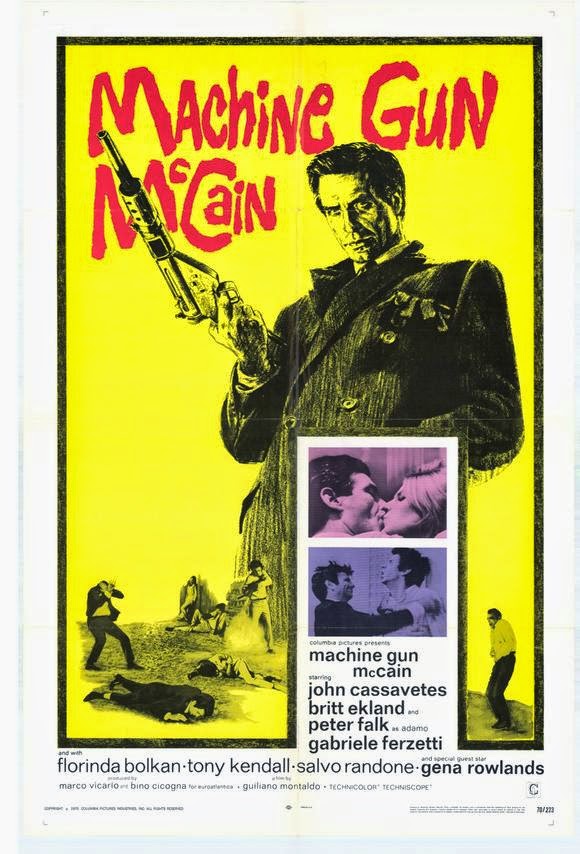
MACHINE GUN MCCAIN (Italy - 1969; US release 1970) Directed by Giuliano Montaldo. Written by Mino Roli and Israel Horovitz. Cast: John Cassavetes, Britt Ekland, Peter Falk, Gabriele Ferzetti, Gena Rowlands, Florinda Bolkan, Tony Kendall, Salvo Randone, Luigi Pistilli, Pierluigi Apra, Steffen Zacharias, James Morrison, Claudio Biave, Margherita Guzzinati, Val Avery, Carol Doda. (Unrated, 96 mins)
Actor/writer/director John Cassavetes (1929-1989) was one of the key figures in the birth of the American independent film. He was already a jobbing character actor throughout the 1950s in films like THE NIGHT HOLDS TERROR (1955), CRIME IN THE STREETS (1956) and EDGE OF THE CITY (1957), and on television, where he earned a shot at headlining his own series with the short-lived NBC private eye drama JOHNNY STACCATO in 1959. Though he was building a solid reputation as an actor, Cassavetes' true passion was directing (NBC let him direct several JOHNNY STACCATO episodes) and that same year, he released his self-financed writing/directing debut SHADOWS, which he actually shot twice, once in 1957 and again in 1959, preferring the reshot '59 version. SHADOWS received high praise, particularly from European critics, and it led to Cassavetes getting a couple of Hollywood studio directing gigs with the 1961 Bobby Darin vehicle TOO LATE BLUES and 1963's A CHILD IS WAITING, with Burt Lancaster and Judy Garland. Cassavetes took the latter film as an assignment after original director Jack Clayton (ROOM AT THE TOP, THE INNOCENTS) left over a scheduling conflict, and didn't get along with either of his legendary stars or producer Stanley Kramer, all of whom were old school Hollywood and very set in their ways and had no use for Cassavetes' love of improvisation and gritty sensibilities. Kramer took the film away from Cassavetes and fired him during the editing stage. Cassavetes ultimately disowned A CHILD IS WAITING while reiterating his respect for Kramer and conceding that it wasn't the kind of film he should've been directing in the first place. If Cassavetes took anything away from his unsuccessful stint as a Hollywood studio director, it was the mindset of the character played by Darin in TOO LATE BLUES, a talented jazz musician torn between selling out for easy money or sticking to his ideals and making the art he wished to make, regardless of commercial appeal or financial reward.
After his miserable experience on A CHILD IS WAITING, Cassavetes decided that he would no longer compromise himself as a filmmaker, and the easiest way to do this would be to compromise himself as an actor. Cassavetes wanted to make the films he wanted to make and didn't give a shit that some found them talky and self-indulgent. Like their maker, Cassavetes' films are raw, intense, and unpleasant, sometimes to the point of belligerence. He didn't want to fall into the same trap that continually managed to snag another maverick, Orson Welles, who perpetually found himself beholden to producers and investors who seduced him with romantic promises of total autonomy only to take the films away from him anyway once the realization set in that they most likely wouldn't be getting their money back. Cassavetes started taking acting gigs to both support his growing family with actress wife Gena Rowlands (they married in 1954) and their three children, but also to bankroll his own directing efforts so he'd have to answer to no one. He spent the next several years on television with guest spots on shows like THE ALFRED HITCHCOCK HOUR, BURKE'S LAW, VOYAGE TO THE BOTTOM OF THE SEA, and COMBAT! plus 1964's THE KILLERS, which was shot as the first made-for-TV-movie but released to theaters when it was deemed too violent, including a notorious scene where Angie Dickinson is slapped around by a vicious gangster played by Ronald Reagan in his final acting role before entering politics. Cassavetes returned to the big screen in 1967 with the biker movie DEVIL'S ANGELS and as one of THE DIRTY DOZEN. His performance in THE DIRTY DOZEN earned him an unexpected Best Supporting Actor Oscar nomination (he lost to George Kennedy in COOL HAND LUKE), and much to his surprise, his acting career was taking off. 1968 was a banner year for Cassavetes, as he co-starred in ROSEMARY'S BABY and re-established his dormant filmmaking career with his breakthrough FACES, which received Oscar nominations for Cassavetes' script as well as the supporting performances of Seymour Cassel and Lynn Carlin. As his career behind the camera gained significant momentum, Cassavetes' interest in acting diminished, but he soldiered on since it provided him with the budgets he needed for his personal projects, and as that interest waned, his reputation as "difficult" grew, which certainly wasn't helped by his heavy drinking. He didn't get along with Roman Polanski on ROSEMARY'S BABY, and this would be a recurring theme throughout the rest of Cassavetes' acting career. Shortly after THE DIRTY DOZEN and ROSEMARY'S BABY, Cassavetes acted in a pair of Italian gangster films: Alberto De Martino's ROME LIKE CHICAGO (1968), which wasn't even seen in the US until it aired on CBS in 1974, and Giuliano Montaldo's MACHINE GUN MCCAIN (1969), released in the US in the summer of 1970.
MACHINE GUN MCCAIN is an interesting film on Cassavetes' acting resume. While it's obviously a money gig for him first and foremost, producers Bino Cicogna and Marco Vicario allowed him to bring along members of his stock company, including Rowlands, and two of his best friends, Peter Falk and Val Avery. MCCAIN is an occasionally uneven film that tries to juggle more characters than it can handle in its 96 minutes (though the European version is reportedly 20 minutes longer), but it contains one of Cassavetes' best performances as ex-con Hank McCain. Hardened criminal McCain is unexpectedly pardoned 12 years into a life sentence at San Quentin. He's met by his 20-year-old son Jack (Pierluigi Apra), a two-bit hood who claims to have paid $25,000 to have him set free. Jack and two buddies, Cuda (James Morrison, in a role IMDb erroneously credited to Jim Morrison for years--yes, the Doors singer) and Barclay (Claudio Biave), woo him with a $2 million heist of The Royal, a new casino in Las Vegas. McCain doesn't buy that these three losers came up with this plan--or the $25,000--on their own (he gives Jack some tough-love with "You're gonna be small change your whole life"), and he's right: the job has been orchestrated by powerful mobster Charlie Adamo (Falk) and his consigliere Duke Mazzanga (Luigi Pistilli), who run the west coast operation for New York-based Don Salvatore (Salvo Randone) and his second-in-command, nephew Don Francesco DeMarco (Gabriele Ferzetti). Based in San Francisco, Adamo was given the west coast with specific instructions to stay out of Vegas, but believing Don Salvatore lacks confidence in him, Adamo thinks asserting his power in Vegas will prove that he's a player. What he doesn't know is that Salvatore and DeMarco secretly own The Royal, and when he finds out, he backs down, telling Jack that the heist is off and that he'll no longer need McCain. McCain doesn't care and moves ahead with the job on his own, along with Irene (Britt Ekland), a young woman he met at the Royal and impulsively married. Once McCain pulls off the heist and with Adamo and Mazzanga dead men walking, Don Salvatore dispatches top hit man Peter Zacari (Tony Kendall) to track down an on-the-run McCain and Irene, who are offered sanctuary by McCain's bitter ex Rosemary (Rowlands).
MACHINE GUN MCCAIN is almost three films in one: McCain doesn't figure much in the first third, which focuses more on the scheming of Adamo and Mazzanga, their ill-conceived plan to rob the casino, and the mob bosses deciding what to do with them. Then things shift to McCain and Irene and things bog down a bit, since Ekland, who looks great, isn't given much of a character to play and we never really care about Irene or, for that matter, learn anything significant about her (another missed opportunity: Cassavetes and Falk have no scenes together). Once the heist, pulled off with a complicated set of small explosions inside the casino, is over, MCCAIN becomes almost like a Cassavetes film, especially when Rowlands turns up about 80 minutes in. What makes MCCAIN an interesting and offbeat film for its type is not just its eclectic mix of American and European actors and settings (location work was done in California and Nevada, with most of the interiors shot in Rome), its fusing of the gangster genre with the then in-vogue international heist film (Montaldo had just directed 1967's GRAND SLAM, an essential entry in the subgenre), and its in-depth depiction of the legitimate business side of the Mafia, but most notably in what Cassavetes took from the project. The role almost seems written for him: Hank McCain is a gangster version of Cassavetes himself, doing things his own way, refusing to back down, and taking on the Mafia (read: "the system") all on his own, consequences be damned. This is a motif that would turn up again in later Cassavetes films like 1976's THE KILLING OF A CHINESE BOOKIE, with connected strip club owner Ben Gazzara roped into killing the head of the Chinese Mafia on the west coast in order to settle a debt to a mob boss; in 1980's GLORIA, his biggest commercial success as a director, with Rowlands in an Oscar-nominated performance as a hit woman on the run, protecting an orphaned boy after his parents are murdered by her bosses; and again with Cassavetes as an actor, co-starring with Falk in Elaine May's largely improvised and very Cassavetes-ish MIKEY AND NICKY (1976). Considering his increasingly surly reputation as an actor (it's no accident that he's name-checked by Denis Leary in the song "Asshole"), Cassavetes found some common ground with Montaldo, who speaks highly of his star on Blue Underground's 2010 DVD/Blu-ray release of the film. They clashed early in the filming, but once Montaldo asserted that he was the director and earned Cassavetes' trust, the pair got along fine, and Cassavetes even assisted his director with some indie/underground, guerrilla location filming tactics during the American portion of the shoot, securing a couple of rented cars and helping Montaldo catch some scenes on the fly in San Francisco, bypassing permits. It's probable that Cassavetes wrote much of his own dialogue, though the script is credited to GRAND SLAM co-writer Mino Roli, who would work again with Montaldo on 1971's SACCO & VANZETTI and go on to write Enzo G. Castellari's 1976 spaghetti western KEOMA. English dialogue is credited to Israel Horovitz, whose most noteworthy credit otherwise is for writing the 1982 Al Pacino comedy AUTHOR! AUTHOR!, though undoubtedly his biggest contribution to popular culture is fathering Adam Horovitz of the Beastie Boys. MACHINE GUN MCCAIN also featured a catchy score by Ennio Morricone, as well as the over-the-top "Ballad of Hank McCain," a Jackie Lynton-sung ditty more appropriate for a spaghetti western of the era, and one that was covered in 2000 by John Zorn and Faith No More frontman Mike Patton.
Using the money from his lucrative Hollywood and Italian acting gigs, Cassavetes funded 1970's HUSBANDS, a mid-life crisis drama starring himself, Falk, and their other best buddy Ben Gazzara (the trio going on THE DICK CAVETT SHOW completely drunk to plug the film is some priceless TV history, where they give Cavett so much grief that the host quips "This is why I didn't join a fraternity"). Occasionally, Cassavetes would be promised total freedom, as was the case with 1971's MINNIE AND MOSKOWITZ, made by Universal during their short-lived courting of indie filmmakers in post-EASY RIDER Hollywood that resulted in Monte Hellman's TWO-LANE BLACKTOP and Dennis Hopper's infamous THE LAST MOVIE. Universal still cut an early scene out of MINNIE despite Cassavetes' objections--the scene was later restored but he was once again disillusioned with Hollywood and went back to his usual routine. Only now, the acting roles temporarily slowed down and Cassavetes mortgaged his house to finance 1974's A WOMAN UNDER THE INFLUENCE with Rowlands and Falk. He followed that and CHINESE BOOKIE with 1977's OPENING NIGHT while finding work in front of the camera in big-budget movies like TWO-MINUTE WARNING (1976), BRASS TARGET (1978), and Brian De Palma's THE FURY (1978), which ends with Cassavetes getting one of cinema's all-time greatest death scenes.
Cassavetes made GLORIA with Columbia, originally planning to simply sell the studio his screenplay but Rowlands talked him into directing it and it became a surprise sleeper hit. Still, Cassavetes wasn't interested in going Hollywood. He continued acting in films for others, starring opposite Richard Dreyfuss in John Badham's WHOSE LIFE IS IT ANYWAY? (1981), with Rowlands in Paul Mazursky's acclaimed TEMPEST (1982), and reteaming with BRASS TARGET director John Hough on the grimy horror film THE INCUBUS (also 1982). In 1984, the drinking and the chain-smoking caught up with Cassevetes as he was diagnosed with cirrhosis of the liver and given months to live. He decided to spend the time making one more film, this time teaming up with none other then Menahem Golan and Yoram Globus for LOVE STREAMS. Though known for schlocky action movies, the Cannon duo of Golan & Globus also tried to cultivate a serious reputation with directors like Cassavetes, Jean-Luc Godard, Robert Altman, and Franco Zeffirelli just to name a few. Time went on, and though Cassavetes was slowed down by his liver problems, he was still around. In 1986, he directed his last film, the doomed BIG TROUBLE. Conceived as a follow-up to 1979's THE IN-LAWS and reuniting stars Falk and Alan Arkin with writer (and now director) Andrew Bergman, the film was a disaster from the start. Bergman quit 1/3 of the way into filming and had his writing credit removed (the script is credited to "Warren Bogle"). Knowing his friend's days were numbered, he could use the money, and would probably like to direct again, Falk talked Columbia into letting Cassavetes step in and finish the film, which he did without incident. He viewed it as a job and wasn't really bothered when the studio recut the film and barely released it. BIG TROUBLE is so bad then even producer Mike Lobell took his name off the movie. A few more years went by and Cassavetes was still beating the odds and planning to direct a project titled SHE'S DE-LOVELY, but he finally succumbed to his illness and died in February 1989 at 59, five years after he was told he had just a few months to live. Cassavetes and Rowlands' three children have all become filmmakers: son Nick (born in 1959), a sometime actor (FACE/OFF), would direct the retitled SHE'S SO LOVELY in 1997 as a tribute to his dad and go on to direct his mom in the tearjerker THE NOTEBOOK (not quite the Hollywood iconoclast his old man was, Nick's most recent film is the Cameron Diaz comedy THE OTHER WOMAN), daughter Xan (born in 1965) directed the acclaimed 2004 documentary Z CHANNEL: A MAGNIFICENT OBSESSION and the 2012 horror indie KISS OF THE DAMNED, and daughter Zoe (born in 1970) directed their mom in 2007's BROKEN ENGLISH.
Cassavetes and Rowlands in a photo
taken near the end of John's life.