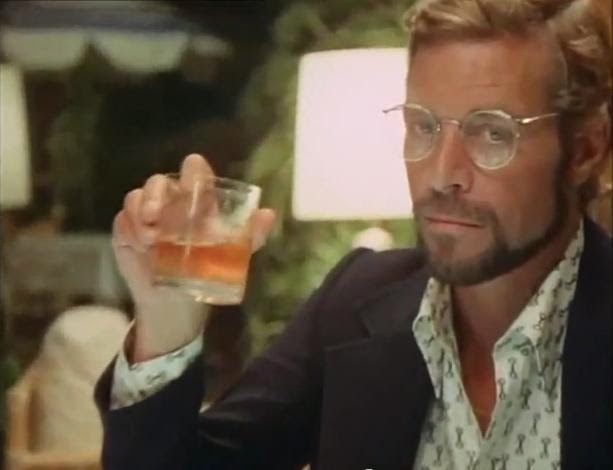
KILLER FISH (UK/Italy/Brazil/US - 1979) Directed by Anthony M. Dawson (Antonio Margheriti). Written by Michael Rogers. Cast: Lee Majors, Karen Black, Margaux Hemingway, Marisa Berenson, James Franciscus, Gary Collins, Anthony Steffen, Dan Pastorini, Roy Brocksmith, Frank Pesce, Charlie Guardino, Fabio Sabag, Chico Arago, Jorge Cherques. (PG, 101 mins)
A hybrid of heist thriller, disaster movie, and JAWS ripoff, KILLER FISH is a perfect example of the kind of international co-production insanity that only could've happened in the 1970s. Produced by the UK's Sir Lew Grade, Italy's Carlo Ponti, the Brazilian company Filmar do Brasil, and American TV power couple Lee Majors and Farrah Fawcett-Majors, the film was designed as a star vehicle for Lee Majors, whose successful five-season run on ABC's THE SIX MILLION DOLLAR MAN had just come to a close in 1978. Majors, a veteran of several past TV hits like THE BIG VALLEY, THE VIRGINIAN, and OWEN MARSHALL, COUNSELOR AT LAW, was trying to parlay his television success into a big-screen career and from 1978 to 1981, starred in several B-movies of usually dubious quality, while at the same time turning down an offer from Paramount to co-star with Nick Nolte in NORTH DALLAS FORTY (1979). Majors' role--a hard-partying, good ol' boy star quarterback--went to Mac Davis and the film is now regarded by many as the definitive serious football film. While NORTH DALLAS FORTY was a box office hit and opened to almost universal acclaim, Majors was making KILLER FISH and other films like THE NORSEMAN (1978), STEEL (1980), AGENCY (1981), and THE LAST CHASE (1981), all of which were out of theaters in a week, and by the end of 1981, he was back on ABC for another series, THE FALL GUY, which ran until 1986.
Of those five films Majors made before going back to TV, KILLER FISH has become a legitimate cult film, primarily for its loony plot and its unusual cast, and that it's directed by legendary Eurocult journeyman Antonio Margheriti, using his usual "Anthony M. Dawson" pseudonym. Margheriti was just coming off his NYC-shot heist thriller THE SQUEEZE and brought that film's suddenly slumming co-star Karen Black along to Brazil for another heist plot. Shot entirely in some stunningly beautiful locations, it's very likely that it was the idea of a working vacation in Rio that lured much of KILLER FISH's cast, which had an unusually large number of American actors for such trashy European-ish fare. While the Italian/West German co-production THE SQUEEZE is probably Margheriti's most American-looking film thanks to some effective location work in some grimy parts of Manhattan and just over the river in New Jersey, KILLER FISH is right alongside the US/Spanish blaxploitation western TAKE A HARD RIDE (1975) and the rainforest-set Italian RAMBO ripoff INDIO (1989) as the most American-feeling of Margheriti's vast output. Much effort was made to package KILLER FISH like a typical Hollywood disaster movie, with only one Italian actor in the cast (former DJANGO Anthony Steffen, best known for 1971's THE NIGHT EVELYN CAME OUT OF THE GRAVE), several Americans, including model Margaux Hemingway, part-time actor and soon-to-be talk show and Miss America host Gary Collins and, as usual in these types of movies, an off-season football star--in this case, Houston Oilers QB Dan Pastorini. KILLER FISH also sported its own Maureen McGovern-mandated disaster movie theme song, "Winner Takes All," performed by flash-in-the-pan disco queen Amii Stewart, who had a chart-topping, Grammy-nominated hit in early 1979 with "Knock on Wood."
KILLER FISH is great cheesy entertainment, but other than the outstanding location shooting by cinematographer Alberto Spagnoli, it can barely compete with the budget-conscious likes of Roger Corman, let alone the expensive product that Master of Disaster Irwin Allen was cranking out. The main reason is that Margheriti was too attached to his use of outdated miniatures, which he would be until the end of his career. Sloppy rearscreen projection work is one thing, but toy trains and model dams that look like Lionel factory irregulars aren't going to cut the mustard. Of course, now these laughable effects are part of KILLER FISH's charm, but Margheriti's continued insistence on using techniques that were antiquated in the 1960s would consistently undermine his work into the 1990s. Margheriti was adept at action scenes and shootouts and could stage an explosion as impressively as any director who ever stepped on to a movie set, but it's hard to get into the excitement of a car chase in something like CODENAME: WILDGEESE (1984) when you can clearly see in a few shots that it's a toy car with an immobile plastic action figure in the driver's seat. For all the big names involved in the financing, KILLER FISH often looks ridiculously cheap. It's more likely that most of money went to the actors, their hotel bills, their bar tabs, and their per diems than toward anything that ended up on the screen. KILLER FISH is so lacking in funds for special effects and spectacle that Ponti had Margheriti open it with a factory explosion lifted completely from THE SQUEEZE.
In Brazil, former mine executive and fanatical backgammon enthusiast Paul Diller (James Franciscus), pushed out of the company after a heart attack, has hired a team of professional thieves led by Lasky (Majors) to break into a secure part of the mine and make off with a large stash of diamonds and emeralds. Helping Lasky is Diller's girlfriend Kate (Black), and when the team stashes the diamonds in a weighed-down metal container at the bottom of a lake, tensions start to mount when Kate suggests they wait 60 days for the cops to give up looking for them or the loot. That doesn't sit well with Lasky, who's conspired with a pair of sibling mooks, Warren (Frank Pesce) and Lloyd (Charlie Guardino) to replace the container in the lake with another and make off with the goods. When Lloyd dives into the lake to retrieve the container, he's promptly devoured by something unseen, which Warren thinks is "a giant snake." Warren talks their getaway driver Hans (Pastorini) into diving into the lake to check things, and when he starts being eaten in a similar fashion, Warren falls in trying to rescue him and they're both dead. It seems that months before pulling off the heist, Diller introduced an especially vicious strain of piranha into the lake to breed ("There's probably tens of thousands of them by now," he sneers), completely altering the ecosystem of a major tourist destination just in case some criminal co-conspirators got greedy. When one of cinema's least convincing hurricanes hits and destroys a nearby dam, the piranha are let loose in the open water and almost everyone in the cast who hasn't been eaten ends up on a small, damaged, dead-in-the-water charter boat captained by rugged local sea salt Max (Steffen, dubbed by Ted Rusoff), who's acting as a guide for a fashion shoot for supermodel Gabrielle (Margaux Hemingway), her manager Ann (Marisa Berenson), and portly, flamboyant photographer Ollie (Roy Brocksmith). As an untold number of hungry piranha surround the boat, Diller--after a backgammon showdown with Lasky--is willing to kill everyone if it means getting away and keeping his diamonds, and it's up to playboy pilot Tom (Collins) to rescue the stranded boaters.
The climax is quite hilarious at times, with Majors' Lasky and Steffen's Max indulging in heroics so stupid that you might even think they deserve to be piranha chow. Franciscus is appropriately dastardly and Black has one very convincing scene where her character is having a convulsing panic attack as she's being pulled out of the water after nearly being eaten. There's also a strange sexual undercurrent to the film, with Kate growing intensely jealous over Lasky's pre-mayhem resort romance with Gabrielle, and Gabrielle subtly suggesting to Lasky that they have a threesome with the bisexual Ollie. In addition, Margheriti and screenwriter Michael Rogers (probably a pseudonym for a committee of Italian writers, as this is "Rogers"' only IMDb credit) spend far too much time on Tom trying to get in Ann's pants. There's too many characters in KILLER FISH, with Tom and Ann's flirting, Ollie functioning as dual stereotypes of the raging queen and comic-relief fat guy, and even more extraneous characters turning up on the boat with no purpose at all. When KILLER FISH focuses on the heist, the piranha, and the janky special effects--the piranha swimming shots are priceless--it's a lot of fun.
Arriving not long after the definitive piranha movie, Joe Dante's PIRANHA (1978), KILLER FISH opened in US theaters in December 1979 and promptly bombed. It played on NBC a few times starting in 1981, under the title DEADLY TREASURE OF THE PIRANHA, and was released on VHS in 1986 as KILLER FISH, but has only now been released on DVD and Blu-ray, courtesy of Scorpion Releasing/Kino Lorber. The 1.78 transfer is pristine as can be, and the sole bonus feature is a nearly-hour-long informal dinner discussion between Frank Pesce and cult filmmaker William Lustig (MANIAC, MANIAC COP), who's known Pesce for decades and worked as a production assistant on the American location shooting of Margheriti's THE SQUEEZE. Pesce found work as an extra in THE GODFATHER (1972) and THE GODFATHER PART II (1974) and was hanging around the set of ROCKY (1976), lucking into acting after winning $6 million in the New York state lottery in 1976. He's appeared in many movies and TV shows over the years, usually B or straight-to-video titles, but he's occasionally turned up in big movies--he's the bolting cigarette buyer at the beginning of BEVERLY HILLS COP (1984) and returned to further incur Axel Foley's wrath in BEVERLY HILLS COP II (1987), and he played gangsters in MIDNIGHT RUN (1988) and DONNIE BRASCO (1997). His story was chronicled in the 1991 film 29TH STREET, with Anthony LaPaglia as Pesce, and the film produced and based on a story by Pesce and Franciscus, who became good friends after working together on KILLER FISH (Franciscus retired from acting in 1985 and died of emphysema at just 57 in 1991, a few months before 29TH STREET's release). Pesce and Lustig get sidetracked, as old friends do, and don't start talking about KILLER FISH until midway through the segment, but Pesce's got some priceless stories about his and Lustig's late friend Joe Spinell, and about working as a stand-in for Robert De Niro on TAXI DRIVER (1976), and Roy Scheider on MARATHON MAN (1976) and in the NYC scenes in SORCERER (1977). He also talks about Black trying to convert him to Scientology and tells a great story about some KILLER FISH cast and crew members going to a popular Rio disco, where Pesce's working his magic on an attractive blonde and was about to make his move when a bat flew into his hair, startling him and prompting him to scream loudly. The blonde immediately lost interest and Pesce later saw her leaving with Majors, who was "with her" for the rest of the shoot. Regarding Majors and his then-wife Farrah Fawcett-Majors, Pesce recalls that it was during the filming of KILLER FISH that Majors got word that Fawcett was involved with Ryan O'Neal, or as Pesce eloquently puts it, "Lee found out that whatsisname, Ryan O'Neal, was bangin' Farrah."
Shout! Factory's second "Cult Movie Marathon" set gets off to an inauspicious start with ANGELS FROM HELL, a loose follow-up to 1967's essential HELL'S ANGELS ON WHEELS, and one of the dullest entries in the late '60s biker subgenre. After supporting roles in films like THE SPY WHO CAME IN FROM THE COLD (1965) and THE DEVIL'S BRIGADE (1968), Tom Stern was about to find a brief niche in these things with ANGELS FROM HELL and HELL'S ANGELS '69, but his time in the spotlight was over before it started. Here, Stern plays Mike, the leader of the Madcaps of Bakersfield motorcycle club who returns from Vietnam to take his MC to the next level. He hangs with a hippie commune, gets involved with a Hollywood producer and tangles with local sheriff Bingham (Jack Starrett), who, interestingly, is actually sympathetic to bikers and reminds his deputies that they have the same rights as everyone else. Tensions keep flaring, but nothing really happens, Stern is a terrible actor, and the dialogue is atrocious (Mike, laying out his agenda to the rest of the club: "I'm gonna lay some jazz on your minds..."), though it does have a memorably nasty leg break and a gut-punch of a final shot that might make you think you saw a better film than you did. But for 85 of its 86 minutes, ANGELS FROM HELL is a snore-inducing drag and Jerry Wish's script lays the verbiage of the era on so thickly that it starts to sound like it's trying entirely too hard. Also with Ted Markland and Arlene Martel, and songs by The Peanut Butter Conspiracy. Director Bruce Kessler only made a few features, most notably 1969's THE GAY DECEIVERS, a sort-of proto-I NOW PRONOUNCE YOU CHUCK AND LARRY where two buddies pretend to be gay to avoid the draft, and the 1971 cult horror film SIMON, KING OF THE WITCHES, and went on to become a busy TV director until the late '90s. Most of these biker movies haven't aged very well, but this one especially feels like it was laughably dated the moment it was released. (R, 86 mins)
CHATTERBOX! (US - 1977)
Easily cinema's all-time greatest talking vagina film, CHATTERBOX! is mildly amusing at times and plays like an R-rated sitcom pilot. Nice hairdresser Penelope Pittman ('70s drive-in icon Candice Rialson) finds her vagina (called "Virginia") is suddenly capable of talking, singing, and in the case of her overconfident boyfriend Ted (Perry Bullington), roasting ("You call that a fuck?" Virginia screeches after Penelope and Ted have sex). Virginia initially causes all sorts of problems for Penelope, especially at her job (Rip Taylor plays her boss!), but the pair soon become a media sensation, going on the game show The Mating Game, appearing at the Rose Bowl parade, and performing such elaborate musical numbers as "Cock-a-Doodle Doo," and "Wang Dang Doodle." CHATTERBOX! has quite a B-movie pedigree: the screenwriters were involved in such films as THE GREAT TEXAS DYNAMITE CHASE and SAVAGE STREETS, director Tom De Simone went on to make HELL NIGHT (1981), THE CONCRETE JUNGLE (1982), REFORM SCHOOL GIRLS (1986) and ANGEL III: THE FINAL CHAPTER (1988), and doubled as a gay porn director using the name "Lancer Brooks." And of course, Rialson (1951-2006) logged time in several Roger Corman productions, like CANDY STRIPE NURSES (1974) and HOLLYWOOD BOULEVARD (1976) before retiring from movies in 1979 to focus on raising her family. CHATTERBOX! is pretty bad, but it has some entertainment value as a nice snapshot of late '70s softcore porn in the guise of a markedly less-sophisticated Mel Brooks-style smutty comedy. It's nothing spectacular, but if you see only one talking vajayjay movie in your life, it should probably be CHATTERBOX! Also with Larry Gelman (THE BOB NEWHART SHOW, MAUDE) as Penelope's doctor, Jane Kean as her mother, and Professor Irwin Corey as himself. 1.33:1 (R, 73 mins)
THE NAKED CAGE (US - 1986)
Three years after his legendary 1983 cult classic CHAINED HEAT, director Paul Nicholas, a pseudonym for German exploitation vet Lutz Schaarwachter, returned to the women-in-prison genre with this entertaining trash for Cannon. Nice girl Michelle (Shari Shattuck) is in the wrong place at the wrong time when her ex (John Terlesky) and psycho bad girl Rita (Christina Whitaker) rob the bank where she works. The ex is killed and the cops think Michelle was in on it, so like most WIP protagonists, she's a dewy-eyed innocent (and she has a horse!) who's about to get schooled. And of course, it's a prison filled with rape by drooling male guards, drugs, racial conflicts, and the corrupt warden (Angel Tompkins) has lesbian hookups with inmates. Not quite on the level of CHAINED HEAT, but really, what is? This could probably use a slumming big name or two, but there's enough hilarious dialogue and nasty violence (one inmate is force-fed a large mirror shard) to make it required viewing for fans of such delightful sleaze. Also with Lucinda Crosby, Aude Charles, the frightening Faith Minton (who looks like a roid-raging Mark Gregory), the inevitable Carole Ita White, and "Tuff Enuff" by the Fabulous Thunderbirds, thereby fulfilling THE NAKED CAGE's apparently ASCAP-mandated obligation that it be featured in every film released in 1986. 1.33:1 (R, 97 mins)
SAVAGE ISLAND (US - 1985)
Empire Pictures and future Full Moon honcho Charles Band acquired two sleazy Italian/Spanish women-in-prison films from 1980--ESCAPE FROM HELL and ORINOCO: PRISON OF SEX--both shot back-to-back by Italian exploitation vet Edoardo Mulargia with much of the same cast (Anthony Steffen, Cristina Lai, and transsexual Eurotrash icon Ajita Wilson), and had them re-edited into one film. The resulting cut-and-paste hack job, was then bookended with new footage shot five years later in Los Angeles with Linda Blair and HOGAN'S HEROES co-star Leon Askin, and released to drive-ins and grindhouses in 1985 as SAVAGE ISLAND--probably to cash in on Blair's 1984 drive-in hit SAVAGE STREETS. It's as much of an incoherent mess as you can imagine, but bad-movie lovers will rejoice at such sights as night switching to day in the middle of the same action scene, constant back-and-forth wardrobe and hairstyle changes, the same actor playing two different characters, and one character getting killed only to have same actor turn up later and get killed again--all the inevitable results of carelessly trying to fuse two movies into one. The credited director on SAVAGE ISLAND is Nicholas Beardsley, who has no other IMDb credits before or since, so it may very well be a pseudonym for someone in the Empire stock company. Empire, or Beardsley, or whomever, obviously didn't even know who some of the actors were. Wilson is credited as Maria and Lai as Muriel, when it's vice versa, the venerable Luciano Pigozzi is credited as "Paco," but plays the prison warden, and not the guy everyone calls "Paco." Luciano Rossi also seems to be playing the warden in some scenes, because he was in ORINOCO and Pigozzi wasn't.
Blair and Askin worked one day on the wraparound scenes. A slumming, career-in-the-toilet Blair, who claims she was "conned" into appearing in this and urged fans to stay away from it while happily starring in things like the wretched POLICE ACADEMY ripoff NIGHT PATROL, plays Daly, a former inmate in a South American prison who shows up at the office of emerald dealer Luker (Askin) after killing his security guard (Penn Jillette!). She's there to explain that women forced into slave labor are procuring his precious jewels, and then the two haphazardly-assembled Mulargia films proceed, with intermittent voiceover from Blair in a hapless attempt to pull the plot together. It's all for naught, and Beardsley eliminates most of the sleazier elements. He does leave some nudity--Lai plays an entire action sequence with her breasts popped out of her top--but the focus is ultimately more on action, with some nice over-the-top gunshot splatter near the end. Also with Stelio Candelli and WIP sleaze fixture Serafino Profumo, who looks like the Italian Sid Haig, and played similar sadistic guard roles in such dubious Nazisploitation gems as S.S. EXPERIMENT LOVE CAMP and S.S. CAMP: WOMEN'S HELL. Barely watchable and feeling endless even at 79 minutes, but aficionados of truly awful cinema will have a strange appreciation for it. 1.33:1 (R, 79 mins)
With the upcoming release of Quentin Tarantino's long-awaited DJANGO UNCHAINED, there's been a renewed interest in the spaghetti westerns that inspired it. Sergio Corbucci's DJANGO (1966) was itself just one of the hundreds of spaghetti westerns made after the incredible success of the Sergio Leone/Clint Eastwood films A FISTFUL OF DOLLARS (1964), FOR A FEW DOLLARS MORE (1965), and THE GOOD, THE BAD AND THE UGLY (1966), but it managed to create--at least in Italy--a phenomenon of its own. DJANGO, which starred Franco Nero as a mysterious stranger who drags behind him a coffin containing a large machine gun, led to a stampede of assorted sequels, knockoffs, and ripoffs that featured "Django" in the title. The only "official" sequel with Nero came two decades later with Nello Rossati's belated, dismal, RAMBO-inspired DJANGO STRIKES AGAIN (1987), but starting with Giulio Questi's insane DJANGO, KILL! (IF YOU LIVE SHOOT!) (1967) with Tomas Milian and going into the early 1970s, there were no less than 50 so-called DJANGO films, starring a ton of different leading men, not to mention other knockoffs like DJURADO (1966), DRANGO (1966), RINGO (1967), CJAMANGO (1967), GARRINGO (1969), SHANGO (1970), and about 20 different SARTANA films, including several that teamed Sartana with Django. And it gets even more confusing when you consider that future Django Anthony Steffen starred in the practically interchangeable DRANGO, RINGO, GARRINGO, and SHANGO, and that DRANGO was also released as SOME DOLLARS FOR DJANGO. In short, the Italian habit of making unofficial sequels to blockbuster successes wasn't limited to just influential American hits (George Romero's DAWN OF THE DEAD was released in Italy as ZOMBI, which led to Lucio Fulci's ZOMBI 2, which was released as ZOMBIE in the US; Ridley Scott's ALIEN led to Ciro Ippolito's ALIEN 2: SULLA TERRA; and Michael Cimino's THE DEER HUNTER was released in Italy as IL CACCIATORE, which begat Antonio Margheriti's IL CACCIATORE 2, aka THE LAST HUNTER in the States), but also to their own. The huge Italian success of DJANGO led to an entire "Django" genre. Timeless Media, a division of Shout Factory, has just released two budget-priced double feature sets with four DJANGO obscurities. Each set lists at $6.99, and while they certainly aren't Criterion-level transfers, they look much better than the list price would indicate, all in anamorphic widescreen and looking positively pristine compared to the usual public domain YouTube-level stuff you get on those $9.99 "50 Western Classics" cheapie sets. With only one outright clunker over the course of these two releases, cult movie nerds and spaghetti western completists will definitely want to pick these up.
DJANGO KILLS SILENTLY (Italy - 1967)
DJANGO'S CUT PRICE CORPSES (Italy - 1971)
DJANGO KILLS SILENTLY (aka DJANGO KILLS SOFTLY) stars Eurocult fixture George Eastman (aka Luigi Montefiori) in one of his earliest films. The 6' 9" Eastman, best known to Italian horror fans as the cannibalistic killer who rips the fetus out of a pregnant woman and eats it, and later devours his own disemboweled entrails at the end of Joe D'Amato's THE GRIM REAPER (1981), gets a rare good guy role here as Django, riding into the small town of Santa Anna and getting involved in a turf war between the powerful Thompson (Luciano Rossi, billed as "Edwin G. Ross") and the outlaw El Santo, which, if the performance of Mimmo Maggio is any indication, is Spanish for "Almost Tuco." Django has a score to settle with El Santo, who killed an old friend, and he doesn't care much for Thompson either, so--stop me if you've heard this plot before--he decides to play them against one another. Written by BLACK MAGIC RITES auteur Renato Polselli (as "Leonide Preston"), and directed by Massimo Pupillo (1965's BLOODY PIT OF HORROR) under the pseudonym "Max Hunter," DJANGO KILLS SILENTLY looks and sounds like a spaghetti western, but aside from the Leone-esque opening credits and Berto Pisano's blatantly Morricone-inspired score, it plays a lot like a western from the 1940s or 1950s. Lots of saloon brawls and standard-issue shootouts, and certainly none of the nihilism or political subtext of even the Corbucci or Questi films. Still, it's an enjoyable enough western on its own terms, with Eastman (dubbed by Tony La Penna) a likable Django, and there's a scene-stealing, hilariously twitchy performance by spaghetti western regular Federico Boido (as "Rik Boyd") as The Nervous One, an exceptionally edgy Thompson gunman. 1.66:1 anamorphic widescreen. (Unrated, 94 mins).
DJANGO'S CUT PRICE CORPSES (aka A PISTOL FOR DJANGO) is a bit more in line with the rougher, more violent post-DJANGO spaghetti scene. Directed by veteran sleaze merchant Luigi Batzella (THE DEVIL'S WEDDING NIGHT, NUDE FOR SATAN, and the vile Nazisploitation "classic" SS HELL CAMP, aka THE BEAST IN HEAT) under the name "Paolo Solvay" (one of several pseudonyms he used), CUT PRICE CORPSES has bounty hunter Django (Jeff Cameron, dubbed by Frank von Kuegelgen) riding into a Mexican town in search of the four nefarious Cortez brothers, led by Ramon (Edilio Kim). Ramon, his brothers, and his gang are on the run after a Silver City bank robbery and the kidnapping of a young woman (Dominique Badou). Also pursuing them is bank investigator and steely card sharp Fulton (Gengher Gatti), who switches alliances as quickly as anyone else in this thing. Django briefly joins forces with outlaw Pedro (future screenwriter Gianfranco Clerici, credited under his acting name "Mark Devis"), who used to run with the Cortez gang, but it goes nowhere when Pedro tries to kill Django maybe ten seconds later and gets shot in the gut for his trouble, making about 12 minutes of screen time utterly pointless (except for the fact that the ruthless Django seduces Pedro's wife to get to him). The very low-budget CUT PRICE CORPSES is pretty average as far as these go--watchable and diverting but cliched and predictable. Almost everything is ripped off from other movies--Django even tells the town undertaker to "get four coffins ready," which is in no way similar to Clint Eastwood's introduction in A FISTFUL OF DOLLARS; Gatti is obviously meant to be a Lee Van Cleef stand-in; and Django's eventual sidekick Pickwick (John Desmont) is the burly sort of which Bud Spencer had been playing for a few years and would continue to in the TRINITY movies and its various knockoffs. And the big, meaningless plot twist--SPOILER--that the fourth Cortez brother is actually a woman (Esmeralda Barros) is obvious from the first moment she's onscreen.
Really? You're not supposed to be able to tell this is a woman?
The fashions are a bit more 1971 than you'd expect, with Django sporting a Peter Fonda-in-EASY RIDER hairstyle, and Pedro's hilarious white-dude afro and bellbottoms. It's silly and inconsquential, the sets are laughably cheap, a lot of it doesn't make sense (why does a confused Pickwick totally lose his shit and attack Django for no reason?) and Cameron isn't the most charismatic Django (he had a very busy few years in spaghetti knockoffs, playing Sartana on a few occasions and starring in other ripoffs like the same year's COFFIN FULL OF DOLLARS before disappearing from movies in 1973) but DJANGO'S CUT PRICE CORPSES is OK enough for spaghetti western die-hards and enjoyably dumb if you're in the right mood. 1.85:1 anamorphic widescreen (Unrated, 82 mins)
A MAN CALLED DJANGO! (Italy - 1971)
DJANGO AND SARTANA'S SHOWDOWN IN THE WEST (Italy - 1970)
Anthony Steffen (real name Antonio De Teffe) is best known to American grindhouse fans for the 1971 Italian horror film THE NIGHT EVELYN CAME OUT OF THE GRAVE, but he was enormously popular in his native country for his many spaghetti westerns that came in the wake of DJANGO. Steffen had already played Django twice before 1971's A MAN CALLED DJANGO! (aka W DJANGO!, aka VIVA, DJANGO!) in a pair of Sergio Garrone westerns from 1969: A NOOSE FOR DJANGO and the supernatural western/horror hybrid DJANGO THE BASTARD (aka THE STRANGERS GUNDOWN). Prior to that, as mentioned above, he also had the title roles in the DJANGO ripoffs DRANGO (aka SOME DOLLARS FOR DJANGO), RINGO, A TRAIN FOR DURANGO (1969), and SHANGO. A MAN CALLED DJANGO! was directed by Edoardo Mulargia (as "Edward G. Muller"), who himself was not a stranger to the world of DJANGO ripoffs, having previously directed SHANGO, CJAMANGO, and 1967's DON'T WAIT, DJANGO...SHOOT! The intense Steffen is a terrific Django in this violent, cynical, and downbeat film, obsessively pursuing the men responsible for the murder of his wife. He rescues about-to-be-hanged horse thief Tuco, er...I mean, Carranza (Glauco Onorato, dubbed by Ed Mannix), who used to run with the men responsible but was in jail at the time of the murder, and two form the usual unholy alliance when Django agrees to help Carranza get revenge on his own enemy, the sadistic Jeff (Stelio Candelli), a vicious thug who controls the town. Of course, the various threads intersect and double and triple crosses ensue in somewhat predictable ways, but A MAN CALLED DJANGO! benefits from a legitimately devastating finale--complete with a nicely-done final shot that borrows from Sam Peckinpah--that Steffen plays wonderfully, making him probably the most effective Django after Nero and Milian. This one probably deserves to be better known. 2.35:1 anamorphic widescreen. (Unrated, 90 mins)
DJANGO AND SARTANA'S SHOWDOWN IN THE WEST stars American actor Jack Betts as Django. Betts, who's still active today in small roles on TV and in movies, was a TV actor in the late 1950s and early 1960s who started going by the name "Hunt Powers" in 1964, and relocated to Europe in 1967, where he became a busy spaghetti western fixture. He played Django in several films, including 1972's marvelously-titled DOWN WITH YOUR HANDS...YOU SCUM! He frequently worked with director Demofilo Fidani, regarded by some as the "Ed Wood of spaghetti westerns." Though there's only a little about SHOWDOWN IN THE WEST that's terrible from a technical standpoint, it's certainly the low point of these double feature sets, even with Fidani hiding behind what might be the greatest fake American-sounding pseudonym ever:
Dull and confusing, DJANGO AND SARTANA'S SHOWDOWN IN THE WEST (aka DJANGO AND SARTANA ARE COMING...IT'S THE END) dithers around and doesn't even bring the two heroes together until an hour in, and even then they don't ever work side by side and don't exchange words until the last scene. Crazed outlaw Black Burt (Gordon Mitchell) kidnaps a young woman and plans to take his gang to Mexico when word gets out that Django and Sartana (Franco Borelli, credited as "Chet Davis") are both separately coming for them. Instead of fleeing, Black Burt sticks around, ranting and raving and playing poker against his reflection in the mirror. Mitchell's insane performance is really the only reason to watch this, and it drags badly when he's not around, feeling about twice as long as its brief 83 minutes. Betts is appropriately stoical as Django, but Borelli's Sartana is barely in it, and the film is so meandering and incoherently edited in the early going that it was a full 40 minutes before I was entirely sure that Betts was Django and Borelli was Sartana (the DVD packaging and IMDb both have it wrong, crediting Betts as Sartana and Borelli as Django). I think the dubbing crew might've even been confused as well on a couple occasions. The film's low budget is apparent during the climax, when Django is shooting a bunch of different members of Black Burt's gang and the shots of Betts firing and the gang members being shot don't even match, with the gunshot outlaws obviously culled from stock footage from other movies. Betts is an alright Django, but DJANGO AND SARTANA'S SHOWDOWN IN THE WEST is pretty bottom-of-the-barrel stuff. 1.85 anamorphic widescreen (Unrated, 83 mins)