WOLFEN (US - 1981) Directed by Michael Wadleigh. Written by David Eyre and Michael Wadleigh. Cast: Albert Finney, Diane Venora, Edward James Olmos, Gregory Hines, Dick O'Neill, Tom Noonan, Peter Michael Goetz, Dehl Berti, Reginald Veljohnson, James Tolkan, Victor Arnold, Max M. Brown, Anne Marie Pohtamo, Sarah Felder, Caitlin O'Heaney. (R, 115 mins) Thanks to influential makeup effects wizards like Rob Bottin and Rick Baker and their mastery of their craft, werewolf movies were able to make a huge comeback in 1981. Rather than the old time-lapse method done with Lon Chaney Jr. in the Universal horror movies of the 1940s, it was now possible to show a character's entire agonizing transformation into a wolf. Released in the spring of 1981, Joe Dante's THE HOWLING boasted stunning man-to-wolf transformation work by Bottin that still looks better than CGI today, and the same goes for John Landis' AN AMERICAN WEREWOLF IN LONDON, released at the end of the summer of 1981, which featured makeup so convincing that it won Baker an Oscar. WOLFEN was released in July 1981, between THE HOWLING and AMERICAN WEREWOLF, and while it isn't a werewolf movie in the vein of those other two films, it typically gets lumped in with them. Based on the 1978 novel The Wolfen by Whitley Strieber, who would later be best known for his alien abduction memoir Communion (turned into a 1989 movie with Christopher Walken as Strieber), WOLFEN is much more ambitious in scope than either of 1981's other big wolf movies, with a labyrinthine plot involving Native American folklore, police surveillance, radical activism, urban trust-fund guerrillas, domestic terrorism, voodoo, urban legend, and urban decay, among other themes that range from half-explored to abandoned. With extensive location shooting in the hellhole that was The Bronx of that time, WOLFEN is very much a product of its era, while at the same time being amazingly prescient in its depictions of corporate greed, gentrification, and the way its NYPD's secret surveillance unit draws obvious comparisons to the NSA and prefigures the Patriot Act. Make no mistake--the film is an often unwieldy, confused mess but it's a fascinating mess. If WOLFEN is guilty of anything, it's biting off more than it can chew in two hours.
When multi-millionaire developer and political scion Christopher van der Veer (Max M. Brown), his coke-snorting wife, and their bodyguard are torn to pieces in Battery Park, the culprits are believed to be the "Gotterdamerung," an underground, left-wing urban guerrilla network protesting van der Veer's demolishing of old buildings in the Bronx and other boroughs to replace them with expensive high rises, driving out the longtime residents and bringing in the wealthy and the privileged. Given van der Veer's status and Washington ties, the case is deemed top priority by the mayor and the police commissioner, and is handed to (of course) troubled, eccentric detective Dewey Wilson (Albert Finney), a recovering alcoholic who's brought off suspension by his beleaguered captain Warren (Dick O'Neill). Department brass works hard to establish any connection to Gotterdamerung, but Wilson and criminal psychologist Rebecca Neff (Diane Venora) aren't convinced, primarily because the murders were too violent for a bunch of rich kid activists. When a similar slaughtering of a homeless man draws them to an abandoned church in the Bronx, Wilson hears a wolf's howl and is further convinced the killer isn't human when coroner Whittington (Gregory Hines) discovers hairs on the victims belonging to the wolf family but aren't indicative of any known breed. Acting on a hunch, Wilson visits Native American activist Eddie Holt (Edward James Olmos)--Wilson arrested him on a murder charge years earlier--who talks of shapeshifting and "Wolfen," a unique breed of wolf that's lived in secret alongside humanity, a close-knit clan that will do what it needs to do to protect its turf--turf that was being threatened by van der Meer's revitalization of the Bronx.
Almost everything in WOLFEN turns out to be red herrings and misdirection. Much time is devoted to the police investigation of Gotterdamerung activists that turns out to have no bearing on anything. Holt's "shapeshifting"--witnessed when he's tailed by Wilson--turns out to be nothing more than Eddie stripping nude after dropping acid and pretending he's a wolf. Unlike the lupine creatures in THE HOWLING and AMERICAN WEREWOLF, the wolves in WOLFEN are just that: wolves, albeit a unique breed of wolf, the next step in canus lupus evolution, complete with near-human intelligence and heat-sensory vision conveyed in then-innovative Steadicam tracking shots using thermal imagery that would be popularized several years later in the 1987 Arnold Schwarzenegger classic PREDATOR. In their hunting and the establishment of their turf, the Wolfen have survived on the least visible, and therefore least missed, people. Hence, their stronghold in the Bronx, an area filled with the homeless and the disenfranchised, and all of that is threatened by van der Veer's attempts to gentrify the area. The message is hardly subtle: whether it's the wealthy or the Wolfen, something's always feeding on society's least fortunate.
Garrett Brown (with Steadicam) and director Michael Wadleigh (turned around,
facing stars Finney and Venora) on location in the ruins of the Bronx in 1979.
Recently released on Blu-ray by Warner Archive, WOLFEN was a troubled production that started shooting in and around NYC in the fall of 1979, with director/co-screenwriter Michael Wadleigh at the helm. This was Wadleigh's first film since his directing debut, the 1970 Best Documentary Oscar-winner WOODSTOCK. Prior to that, Wadleigh dropped out of medical school and enrolled in NYU's film school, where he met fellow student Martin Scorsese. Born in Akron, OH in 1942, Wadleigh made short political documentaries and found work as a cinematographer on several micro-budget underground films, including 1968's WHO'S THAT KNOCKING AT MY DOOR?, Scorsese's directorial debut. Scorsese repaid the favor when Wadleigh got his first major gig, helping his friend out as an assistant director and editor on WOODSTOCK. After that film's phenomenal success, Scorsese cemented his place as one of America's great young directors with 1973's MEAN STREETS, while Wadleigh spent the bulk of the decade planning what would've been an epic about the American Revolution that ultimately never came to fruition. When funding fell apart in 1979, he was offered a list of potential projects by then-fledgling Orion Pictures as a consolation prize and chose to adapt The Wolfen, not because of any desire to work in the horror genre but more likely because of the activism themes in the novel. When filming wrapped on WOLFEN in February 1980, Wadleigh assembled a four-hour rough cut and neither the producers nor the execs at Orion were happy with what they saw when Wadleigh turned in his finished version, which clocked in at 149 minutes. Claiming Wadleigh made a "message picture" and lost sight of the fright factor, the producers demanded more horror and a shorter running time. When the filmmaker wouldn't budge and it became obvious that the delays would now force the $10 million film to miss its announced October 1980 release date, Wadleigh was fired. Screenwriter Eric Roth, who would go on to win an Oscar for his FORREST GUMP script, was commissioned for rewrites and director John Hancock (LET'S SCARE JESSICA TO DEATH, BANG THE DRUM SLOWLY) was called in for reshoots that were done in November 1980 to reach a sufficient horror and gore quota. Neither Hancock nor Roth received credit for their work and an irate Wadleigh unsuccessfully tried to have his name removed from the film, which ran 115 minutes when it was finally released on July 24, 1981, its cost nearly doubled to a then-expensive $17 million by the time it was completed. WOLFEN was met with generally positive reviews, but the often-confused jumble of half-baked ideas is strongly indicative of too many cooks in the kitchen (there are four credited editors), and the lack of werewolves or transformation scenes have always placed WOLFEN a distant third among fans when it comes to the big three 1981 lycanthrope classics.
Finney and Olmos atop the Manhattan Bridge. No doubles, no CGI, no greenscreen.
Nevertheless, it has moments of greatness. Though commonplace today, the groundbreaking thermal imagery tracking shots (with help from Steadicam creator Garrett Brown) are outstanding and the film's sound design is remarkably effective, whether it's garbled surveillance chatter or the fingernails of a corpse scraping across a morgue slab as the body is being moved. WOLFEN has a terrific performance by a grumbly, shaggy-haired Finney and a scene-stealing, star-making one by Hines in what was his big-screen debut, even though Mel Brooks' HISTORY OF THE WORLD: PART 1 (1981) was shot later but released first. There's some amusingly dark humor throughout (Finney's Wilson stuffing cookies into his mouth while viewing an autopsy) and the climactic showdown between Wilson, Rebecca, and Warren with a pack of Wolfen (probably shot by Hancock, considering the amount of splatter involved) is terrifying. In addition, WOLFEN boasts one of the earliest scores by the late, legendary James Horner. Wadleigh and cinematographer Gerry Fisher do a stunning job of capturing the sights of 1979-80 NYC, from Battery Park to the war-zone-like Bronx to some dizzying shots of Olmos atop the Brooklyn Bridge and Olmos and Finney on the Manhattan Bridge, both sequences done pre-CGI and with much effort made to show that, yes, the actors are really up there in a way that just wouldn't be done today, both for the sake of safety and efficiency (how did they get a camera crew up there?). Watch Finney on top of the Manhattan Bridge--it's a windy day and he's visibly terrified. That's exactly why the scene works as well as it does.
Wadleigh (with headband) and Martin Scorsese (on headset)
during the shooting of the landmark documentary WOODSTOCK
A 2013 photo of Michael Wadleigh
After his unpleasant experience on WOLFEN, Wadleigh almost completely withdrew from the film industry, emerging from self-imposed exile every now and again, whenever WOODSTOCK gets an anniversary re-release in theaters or on DVD/Blu-ray. He also apparently recorded a commentary track for the 2002 DVD release of WOLFEN with Olmos and the late Hines (who died in 2003) that was ultimately shelved and never heard by the DVD-buying public (any bets that he's still bitter and let it be known on the commentary?). In the decades since, he earned degrees in Physics and Medicine, and became a Harvard professor. Still a counterculture icon to his core at the age of 72, the now-UK-based Wadleigh may be an enigmatic figure in the world of cinema, but he's known in activist circles, working for various nonprofit organizations, traveling the world, and giving interviews, lectures, and multimedia presentations on the dangers of climate change. Barring any surprise comeback attempts after 35 years away from the game, it's a safe assumption that Wadleigh is done with mainstream filmmaking. If so, he leaves a unique, if very brief, body of work behind, with two movies in the last 45 years being the kind of sparse output that makes Stanley Kubrick look like Woody Allen.
With their Roger Corman line and their endless parade of classic TV shows among other offerings, it's been a busy couple of years for Shout! Factory, who have quietly emerged as the top genre Blu-ray/DVD label for serious cult movie fans and only look to get bigger with their "Scream Factory" offshoot and an MGM licensing deal. Here's a look at several of their releases from the last couple of months.
CRIME STORY (Hong Kong - 1993)/ THE PROTECTOR (US/Hong Kong - 1985)
Two atypical Jackie Chan films are paired on a single disc, starting with 1993's CRIME STORY, which was released in a dubbed version in the US by Dimension Films in 1996 to capitalize Chan's RUMBLE IN THE BRONX breakthrough (this offers the English dub and the original Cantonese with English subtitles). It's a different kind of Chan film in that it's a dark and very violent kidnapping thriller that's completely lacking his usual comedic flair. In a role originally intended for Jet Li, Chan is Detective Eddie Chan, an honest cop trying to get to the bottom of the abduction of a millionaire construction magnate. CRIME STORY reveals early on that the culprit is actually Chan's partner Hung (Kent Cheng) and there's a nice pre-INFERNAL AFFAIRS vibe to their game of cat & mouse as Hung gets increasingly nervous about Chan's incessant digging. Chan found the film too dark and insisted, against the wishes of director Kirk Wong (who's interviewed on the Blu-ray) on dumping a subplot about Det. Chan's psychological issues and adding some typically acrobatic martial-arts action sequences. These scenes don't really gel with the gritty vibe Wong was going for, and because we know in the very beginning that Hung is responsible, there isn't a whole lot of suspense in the film. The spectacular action scenes then, are really the highpoints, so perhaps Chan was right to overrule Wong. CRIME STORY suffers from inconsistent pacing, Chan's need to present his character as selflessly heroic as possible (not one, but two scenes where he puts his job aside to rescue someone in distress--you're the hero, we get it) and a very intrusive score, but the memorable action scenes, including one incredible car chase, make it worthwhile. Wong came to Hollywood a few years later for the 1998 Mark Wahlberg actioner THE BIG HIT, but hasn't directed a film since 2000's THE DISCIPLES, which is credited to "Alan Smithee."
Coming a decade before Chan finally found success in the US with RUMBLE IN THE BRONX, 1985's much-maligned THE PROTECTOR was the second attempt by Golden Harvest to make Jackie Chan a star in the US. 1980's THE BIG BRAWL bombed and Chan's co-starring roles in both CANNONBALL RUN films did little to endear him to American fans. Chan was never happy with THE PROTECTOR and reportedly clashed with writer/director James Glickenhaus (THE EXTERMINATOR) throughout the shoot and eventually ended up preparing his own version of the film for the Asian market, adding fight scenes and reshooting others, dumping the nudity and the profanity to make it a more traditional Chan film. THE PROTECTOR tanked in the US, grossing less than $1 million, but time has been pretty kind to it. If one approaches it as a Glickenhaus film first and a Chan film second, they'll have a better time with it. The first 20 minutes contain some vintage Glickenhaus fused with Chan's incredible stuntwork. Chan is NYC cop Billy Wong, who's sent to Hong Kong with crass partner Garoni (Danny Aiello) to take down the crime lord who's kidnapped the daughter of a Manhattan business partner. THE PROTECTOR drags a bit in the middle, but Glickenhaus, one of the action genre's most underrated craftsman, is really at the top of his game here and the film is immensely enjoyable if you're into the whole trashy B-movie thing. It's nonstop F-bombs (even one from Chan!), gratuitous nudity, insane violence, Aiello dialing his Noo Yawk schtick to 11, and every cop movie cliche known to man. Shout's 1.85:1 Blu-ray features some nice extras, including an interview with a diplomatic Glickenhaus, who says the disagreements came after the film was finished and insists he and Chan were always amicable and professional, a great featurette showing the NYC locations then and now, and the 88-minute Chan-supervised Asian cut, dubbed in Cantonese with English subtitles. It follows the same basic plot structure, but adds a subplot with actress Sally Yeh and has enough major differences that it qualifies as a completely different film. (CRIME STORY: Unrated, 107 mins./THE PROTECTOR: R, 95 mins; THE PROTECTOR, Chan cut: Unrated, 88 mins)
DEADLY BLESSING (US - 1981)
Low-key Wes Craven horror film takes its time getting revved up, but offers a few decent scares and one memorable bathtub encounter with a snake that's endeared itself to devout followers of '80s horror cinema. After her husband dies mysteriously, pregnant Maren Jensen (the original BATTLESTAR GALACTICA) and her two visiting friends (GREASE's Susan Buckner and Sharon Stone in one of her earliest roles) are terrorized and persecuted by the husband's estranged family, a community of Hittites from which he was banished. Craven does some clever misdirection and we're of course led to believe that Jensen's irate father-in-law (Ernest Borgnine) is behind all the mayhem, but that's too easy and always be wary of prominently billed actors who don't appear to have much to do with the plot. DEADLY BLESSING almost feels like the kind of slow-burner that a lot of indie horror filmmakers are going for today (I'm surprised it hasn't been remade with some kind of Westboro Baptist Church-type extremist group in place of the Hittites), and it subverts expectations time and again. The plot twist in the finale is genuinely unexpected in the way it changes your views of the perceived crazies and who the real antagonists of the story were. An interesting and unusual film that's marred only by a last shot that feels like it doesn't belong, only in the sense that it takes a frightening premise essentially grounded in reality and turns it otherworldly and supernatural in a way that provides a cool shock to go out on, but also cheapens the film to some degree. Also with Lois Nettleton, Michael Berryman (as the Hittite village idiot...or is he?), Jeff East, and "introducing" Lisa Hartman, even though she'd been in several TV movies and starred in a TV series years before doing this film. Shout's 1.78:1 Blu-ray features a commentary with Craven and Horror's Hallowed Ground's Sean Clark (where Craven admits he hasn't seen the film in many years and is "foggy" on a lot of details but says he's always been "embarrassed" by the last shot), and interviews with Buckner and Berryman. (R, 102 mins)
DEATH VALLEY (US - 1982)
This desert-set thriller wasn't a success in theaters, coming along at the height of the slasher craze, but it's bit more restrained than most (there's some brief nudity and a couple of gory throat slicings) and feels a lot like a made-for-TV movie. Heavy cable rotation in the mid-1980s has earned it some sentimental affection and a devoted cult following. For the most part, it's sluggishly-paced and rather average, with an overbearing score by Dana Kaproff that really goes out of its way to mimic Bernard Herrmann at his stringiest, but it has its moments and Stephen McHattie is a memorably effective killer, pursuing young Peter Billingsley (a year before A CHRISTMAS STORY), who's vacationing in Arizona with his divorced mom (Catherine Hicks) and her new boyfriend (Paul Le Mat). Director Dick Richards and screenwriter Richard Rothstein give us a lot of repetitious character-building scenes of young Billingsley sullenly giving Le Mat the cold shoulder before forming a tentative bond, but things pick up considerably once Le Mat and Hicks go out to dinner, leaving Billingsley alone with one of horror cinema's most useless babysitters as McHattie shows up ready to kill. Shout's 1.78:1 Blu-ray transfer looks good and there's a commentary track with Richards, best known as the producer of 1982's TOOTSIE and as the guy who got into an on-set brawl with Burt Reynolds during the making of 1987's ill-fated HEAT. DEATH VALLEY isn't bad--it was nice to revisit it after 30 years but it's nothing special, and a good example of something whose status may be elevated somewhat because it was seen at such an impressionable age. (R, 88 mins)
THE DUELLISTS (UK - 1977)
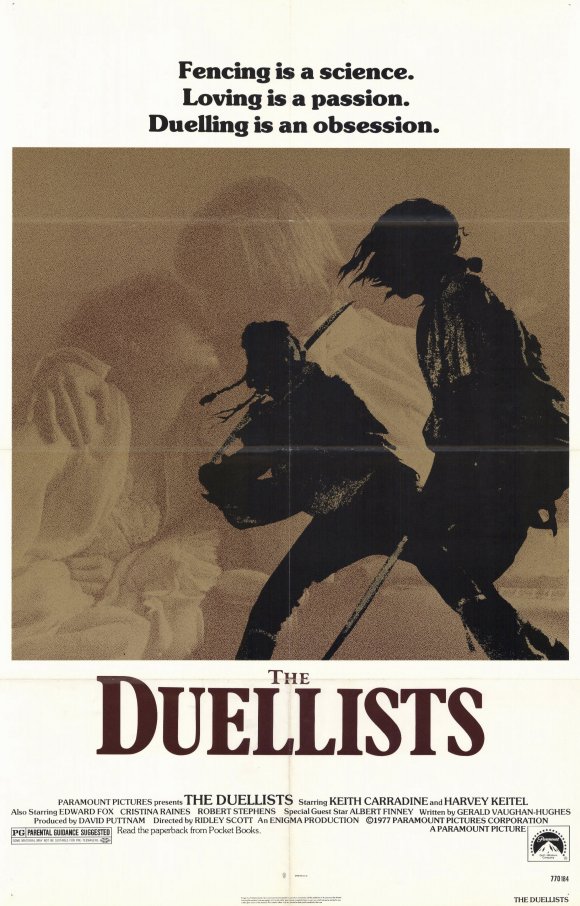
Ridley Scott's debut feature wasn't a big box office hit but it became a major cult film and established him as enough of a visual stylist that it led to his breakthrough blockbuster ALIEN two years later. Based on Joseph Conrad's short story "The Duel," THE DUELLISTS finds two French army officers in the Napoleonic era, D'Hubert (Keith Carradine) and Feraud (Harvey Keitel), engaged in a nearly 20-year battle over a perceived insult that neither of them even remember by the end of the film. In 1800, the easy-going D'Hubert was assigned to find hot-tempered, bullying Feraud and place him under house arrest at the base camp after the dueling-obsessed Feraud nearly killed the local mayor's son. An offended Feraud instead takes his frustrations out on D'Hubert and so begins a grudge match that consumes their lives over the next two decades. Their battle is a metaphor for the madness of war, a recurrent Conrad theme that was being explored at the same time by Francis Ford Coppola's APOCALYPSE NOW (1979), of course based on Conrad's novel Heart of Darkness. Working with fencing choreographer William Hobbs (whose expertise also helped make 1973's THE THREE MUSKETEERS, 1974's THE FOUR MUSKETEERS, and 1981's EXCALIBUR, among others, so memorable) and debuting cinematographer Frank Tidy (who never again shot a film this beautiful), Scott makes his mark with THE DUELLISTS, showcasing intense, brutal, bloody duels (how did this manage to get a PG rating?), and utilizing the natural lighting style that made Stanley Kubrick's BARRY LYNDON (1975) so visually stunning. Shout's Blu-ray looks very good, easily the best it's ever looked since it was in theaters, but shows some wear at times, and it's likely just inherent in the 1970s film stock. Some of the exterior shots (particularly in the closing scene) and ornate interiors are absolutely breathtaking. Carradine and Keitel do good work, despite both being miscast as officers in Napoleon's army. Scott gathered a fine supporting cast: Edward Fox, Robert Stephens, Cristina Raines, Tom Conti, Diana Quick, Alan Webb, Jenny Runacre, Alun Armstrong, Maurice Colbourne, W. Morgan Sheppard, a young Pete Postlethwaite, and Albert Finney. Narrated by Stacy Keach. Carradine and Keitel would reunite a decade later in Damiano Damiani's ancient Rome-set religious mystery THE INQUIRY (1986). (PG, 100 mins)
THE SEVEN-PER-CENT SOLUTION (US - 1976)
The 1970s saw numerous revisionist Sherlock Holmes films, such as Billy Wilder's THE PRIVATE LIFE OF SHERLOCK HOLMES (1970) and THEY MIGHT BE GIANTS (1971), with George C. Scott as a mental patient who thinks he's Holmes. THE SEVEN-PER-CENT SOLUTION, adapted by Nicholas Meyer (TIME AFTER TIME, STAR TREK II: THE WRATH OF KHAN) from his own novel, opens with the dark, rarely-depicted-on-screen drug-addicted side of Holmes, showing the great detective (Nicol Williamson) in the midst of a crazed cocaine binge as his brother Mycroft (Charles Gray) and Dr. Watson (Robert Duvall) conspire to trick him into going to Vienna to rehab with none other than the renowned Dr. Sigmund Freud (Alan Arkin). While in Vienna, a cleaned-up, clear-thinking Holmes finds himself with Watson and Freud in pursuit of one of Freud's kidnapped patients (Vanessa Redgrave). All of this leads to a thrilling train chase and Holmes and the villain squaring off for a swashbuckling showdown atop a speeding train. Meyer and director Herbert Ross find the perfect balance between drama, humor, and spectacular action throughout, and while such shifts in tone might have come off as jarringly uneven, they make it a very natural and organic progression. Williamson's Holmes ranks among the best, and while Duvall initially feels miscast as Watson, he eventually settles into the role and captures the spirit of Watson even if is his strange accent is a bit distracting. The film is mainly played straight, especially in the early going, but has a lot of humor, such as Holmes and Watson investigating a bordello where Holmes tries to shield the proper Watson's eyes from some of the more lascivious sights on display (it plays like a moment that Williamson might have ad-libbed). This was a big-budget release from Universal, and Meyer's script got an Oscar nomination, but these days, THE SEVEN-PER-CENT SOLUTION is generally well-regarded but remains little known outside of cult movie circles and hardcore Holmes enthusiasts, which is a shame. It's a rousing adventure, brilliantly acted, and prefigures Guy Ritchie's SHERLOCK HOLMES in a number of ways, and Robert Downey, Jr.'s portrayal of Holmes owes much to Williamson's often manic interpretation of the character. Also with Laurence Olivier as an innocent, falsely-accused Moriarty, Joel Grey, Samantha Eggar, and Jeremy Kemp, THE SEVEN-PER-CENT SOLUTION is a richly entertaining film that's aged beautifully. Shout's 1.85:1 transfer spotlights Ken Adam's stunning production design, and the Blu-ray/DVD combo set also offers an interview with Meyer. (PG, 114 mins)
Directed by Sam Mendes. Written by Neal Purvis, Robert Wade, and John Logan. Cast: Daniel Craig, Javier Bardem, Ralph Fiennes, Judi Dench, Albert Finney, Naomie Harris, Berenice Lim Marlohe, Ben Whishaw, Rory Kinnear, Ola Rapace, Helen McCrory. (PG-13, 143 mins)
The James Bond franchise celebrates its 50th anniversary with an exceptional entry in the series. Perhaps not quite the "Best Bond Ever!" but it's up there, with richly complex characterizations and themes that demonstrate an unusual depth for these films, which have always been great fun but usually on a spectacle level. There's no shortage of that spectacle in SKYFALL, which kicks off with one of the best pre-credits sequences of the series, but it expands upon the psychological side of 007 that was explored to some degree in Daniel Craig's Bond debut CASINO ROYALE (2006), and it gets things back on course after the OK but disappointing QUANTUM OF SOLACE (2008).
A mission in Turkey to recover a hard drive with the names of British agents working undercover with terrorist organizations goes bad when Bond gets in the way of a bullet meant for an enemy agent (Ola Rapace) and is presumed dead. He resurfaces after a terrorist attack on MI-6 headquarters in London, and is put back to work by M (Judi Dench), whose judgment and effectiveness are being questioned by bureucratic intel official Mallory (Ralph Fiennes) after several outed MI-6 agents are executed. Bond fails the physical and psychological testing to be reinstated, but M buries the test results because she knows he'll get the job done. The villain is Silva (Javier Bardem), a rogue ex-MI-6 agent with a personal score to settle with M: he was a brilliant agent but too much of a loose cannon, and M sold him out to China shortly before the Hong Kong handover in 1997.
The Bond films have never been a director's showcase. In the initial 1962-1989 era, the films were directed by a rotating group of reliably efficient pros starting with Terence Young, Guy Hamilton, and Lewis Gilbert, with occasional promotions from within like editor Peter Hunt or second-unit director John Glen, who ended up helming all of the Bond films in the 1980s. When the series restarted in 1995 after a six-year break, the job fell to journeymen like Martin Campbell (THE MASK OF ZORRO), Roger Spottiswoode (TURNER & HOOCH), Michael Apted (the UP documentary series, COAL MINER'S DAUGHTER), and Lee Tamahori (THE EDGE), brought in for some new perspective, but who primarily replicated the look and feel of the earlier Bond films. Campbell was brought back for CASINO ROYALE and Marc Forster (MONSTER'S BALL) apparently thought he was hired for a BOURNE sequel when he directed QUANTUM OF SOLACE. That brings us to the surprising choice of Sam Mendes to helm SKYFALL. The Oscar-winning director of AMERICAN BEAUTY, ROAD TO PERDITION, and REVOLUTIONARY ROAD seems like an unlikely pick, but it's an important element in establishing some credible seriousness to the film. Partnering with Oscar-nominated cinematographer and Coen Bros. favorite Roger Deakins, Mendes fashions one of the best-looking of all Bond films, and not just with its breathtaking action sequences. A neon-drenched showdown in a Shanghai skyscraper and a shot of M standing aside a row of Union Jack-draped caskets provide particularly arresting images.
It's also one of the best-written of the Bonds. Series veterans Neil Purvis and Robert Wade, plus Oscar-nominated screenwriter John Logan (GLADIATOR, RANGO, CORIOLANUS, HUGO) offer, in addition to a study in duality in that Bond and Silva are essentially two sides of the same coin, both with an axe to grind with M, but handling it in vastly different ways--an unprecedented look into Bond's childhood and how it shaped the man he's become during an unexpected third-act detour when Bond goes off the grid and on the run with M after an attempt on her life by Silva's goons. There's also a recurrent theme throughout of dealing with age and change: M butting heads with Mallory, Bond spending a good part of the film sporting white stubble, the MI-6 operation being called into question for its relevancy and usefulness. Mendes and the screenwriters succeed in creating a Bond film that manages to re-establish new rules while simultaneously utilizing the established template. The character of Q is re-introduced here, in the form of a techno-geek in his late 20s (Ben Whishaw), which reverses the roles in the Bond-Q relationship: now it's cranky old 007 busting the young kid's balls, but they immediately take a liking to each other much like Bond and the perpetually-annoyed but fatherly Q did in the older films.
From the opening scenes of CASINO ROYALE, it was obvious that Craig would be a terrific Bond, but he really hits his stride with SKYFALL. He's matched by an inspired Bardem, who doesn't even appear until 70 minutes in but quickly makes an unforgettable impression as Silva, creating one of the great Bond villains. Watch the entrance Mendes gives him, delivering a long monologue while walking from a distance toward the stationary camera, all in one take. It's a bold and unusual shot that, with all due respect, a John Glen or a Lee Tamahori wouldn't have done. Dench gets by far her biggest role as M yet, and she's essentially a central character along with Bond. The Bond girls are represented by rookie MI-6 agent Eve (Naomie Harris) and doomed Severine (Berenice Lim Marlohe), who works for Silva, and we know how that always turns out. There's also some fine work from Fiennes (who gets one of the best lines in the film, during M's court testimony) and a burly-looking Albert Finney, who turns up in a showy supporting role late in the film with quite a bit more to do here--even hoisting a sawed-off shotgun--than his prominently-billed 12-second YouTube cameo in THE BOURNE LEGACY.
The James Bond series has never been beholden to any strict sense of continuity, understandable given the length of its duration. Other than recurring characters like M, Q, Miss Moneypenny, Blofeld, and Bond's CIA buddy Felix Leiter, the films generally exist as stand-alone stories. 23 films in and there's only been one official "direct" sequel (QUANTUM OF SOLACE picks up right where CASINO ROYALE leaves off), though there have been similar instances of a continued character or story element through the decades, most notably three that stem from the stunningly downbeat finale of 1969's ON HER MAJESTY'S SECRET SERVICE, which found George Lazenby's Bond getting married to Tracy (Diana Rigg) only to see her immediately murdered as they drive off on their honeymoon: Sean Connery returned as Bond in the next film, 1971's DIAMONDS ARE FOREVER, and is seeking revenge on Blofeld, though it's never specified that Tracy's murder is the reason; and the beginning of 1981's FOR YOUR EYES ONLY has Roger Moore's Bond visiting Tracy's grave, while 1989's LICENCE TO KILL has Timothy Dalton's Bond somberly mentioning that he was married once, but declines to elaborate. Richard Kiel made a huge impression as the henchman Jaws in 1977's THE SPY WHO LOVED ME and was brought back--as a lovestruck good guy, no less--for 1979's unfortunate MOONRAKER. Joe Don Baker's CIA agent Jack Wade appeared in 1995's GOLDENEYE and 1997's TOMORROW NEVER DIES (and Baker played a completely different military character in 1987's THE LIVING DAYLIGHTS). Early Bond girl Sylvia Trench (Eunice Gayson) turns up briefly in 1962's DR. NO and 1963's FROM RUSSIA WITH LOVE. And the less said about good old boy Louisiana sheriff J.W. Pepper (Clifton James) in 1973's LIVE AND LET DIE inexplicably test-driving an AMC Matador while vacationing in Bangkok in 1974's THE MAN WITH THE GOLDEN GUN, the better.
It's hard to say where SKYFALL fits into the continuity in general, especially since Dench was also M to Pierce Brosnan's Bond in the '90s, well before she kept the role in the Craig-led reboot. SKYFALL exists on its own terms (no references to Craig's two prior turns), but it ends on a bittersweet "circle of life" note that seems to set things back to the beginning--as in, 1962--in a way that will put a smile on the face of any 007 fan. 50 years in, with undeniable ups and downs, but SKYFALL displays a franchise that's changed and adapted effectively and is certainly as vital and as promising as it's ever been. A terrific film, one of 2012's best.