JUPITER ASCENDING (US - 2015) Written and directed by The Wachowskis. Cast: Channing Tatum, Mila Kunis, Sean Bean, Eddie Redmayne, Douglas Booth, Tuppence Middleton, Nikki Amuka-Bird, Gugu Mbatha-Raw, Tim Piggot-Smith, Maria Doyle Kennedy, James D'Arcy, Doona Bae, Kick Gurry, Jeremy Swift, Edward Hogg, Terry Gilliam, Rupert Frazer, Christina Cole, Nicholas A. Newman, Frog Stone, Ramon Tikaram, Ariyon Bakare, David Ajala, Vanessa Kirby, Charlotte Beaumont. (PG-13, 127 mins)
It's already more or less expected that the $175 million JUPITER ASCENDING, the latest from MATRIX masterminds Andy and Lana Wachowski, will be yet another costly box-office dud to follow 2008's SPEED RACER and 2012's CLOUD ATLAS (co-directed with Tom Tykwer), not to mention 2009's NINJA ASSASSIN, which they produced. After the disappointing reception that followed the back-to-back MATRIX sequels, only V FOR VENDETTA (produced by the siblings and directed by their protege James McTeigue) seemed to get a positive reaction from mainstream audiences. But time can change perspective, and by now, SPEED RACER and especially CLOUD ATLAS already have strong cult followings with viewers who can simply appreciate the incredible visuals and wild ambition inherent in the Wachowskis' work (even the much-maligned MATRIX sequels have their defenders). Given the "What have you done for me lately?" attitude of Hollywood studios, it's amazing that they can still get someone to gamble nearly $200 million on greenlighting a massively-budgeted auteurist vision that still gives them more creative control than most filmmakers are granted in 2015. That MATRIX cache still carries a lot of cred, even though they haven't had anywhere near the same level of financial success, but when the sci-fi epic JUPITER ASCENDING was yanked from the summer 2014 schedule and bumped to February 2015 to "work on the visual effects," the online snark machine revved up. By the time the film was released, it was already anointed the next BATTLEFIELD EARTH before anybody even saw it. If anything, it's the 2015 SUCKER PUNCH, and much like Zack Snyder's one-of-a-kind vision was trashed by everyone only to enjoy a quick turnaround as a misunderstood cult film, so JUPITER ASCENDING will likely go. The elements are in place for a colossal flop of career-ending proportions, but just when nobody is expecting it, the Wachowskis turn in their loosest, craziest, and even more so than SPEED RACER, infectiously fun movie yet.
Every penny of that $175 million is up on the screen to create a cinematic canvas that resembles the covers of pulpy sci-fi paperbacks by the likes of Isaac Asimov or John Ringo, David Weber and the entire Baen Books back catalog. The Wachowskis have fashioned JUPITER ASCENDING as an insane mash-up of STAR WARS, DUNE, BUCK ROGERS, the 1980 FLASH GORDON, BLADE RUNNER, and even a brief segue into the satirical sci-fi nightmare bureaucracy of BRAZIL-era Terry Gilliam. There's a lot of story and some of the subplots and extraneous characters get shortchanged or abandoned outright. It's representative of the kind of world-building that, if this were the 1980s, probably could've resulted in an entire series of spinoff novels like the Star Wars and Star Trek novels that still fill the sci-fi sections of bookstores today. Jupiter Jones (Mila Kunis), the daughter of a British father who was killed by home invaders before she was born, and a Russian mother (Maria Doyle Kennedy) who gave birth to her midway across the Atlantic while emigrating to America, lives in a cramped house with her mother's entire extended immigrant family. While her uncle and cousins engage in shady con games, Jupiter and her mother work as housecleaners for Chicago's wealthy. All of that changes when the three children of the late Seraphi Abrasax, the matriarch of the Abrasax family who recently died, her life tragically cut short by murder at just 91,000, discover that her royal genomic code has "recurred" in Jupiter. The Abrasax offpsring--fey, hissing Balem (Eddie Redmayne), playboy Titus (Douglas Booth), and kind Kalique (Tuppence Middleton), looking smashing for 14,004--are intergalactic one-percenters who collectively own most of the galaxy, left to them by their mother, whose genomic recurrence in Jupiter--a reincarnation of sorts--means that Queen Jupiter will control their assets through a complex DNA-related legal loophole of the laws of space royalty.
Enter disgraced ex-soldier Caine Wise (Channing Tatum), an albino half-man/half-wolf mercenary hired by Titus Abrasax to protect Jupiter from the forces of Balem. Earth is merely one tiny but very important piece of property to Balem, and like most planets, it's used to harvest life to provide eternal youth to the most wealthy and privileged among the galaxy's movers and shakers. Caine, expelled from the military after biting a member of the "Entitled" class ("I'm more dog than man," he explains to a lovestruck Jupiter), saves Jupiter from the clutches of Balem's minions and leaves Chicago for a country farm where his old commanding officer and bee DNA-carrier Stinger (Sean Bean) lives with his daughter and countless active beehives ("Bees are genetically designed to sense royalty," he tells Jupiter in one of the film's sillier deus ex machina lines). Caine delivers Jupiter to Titus, who of course, has ulterior motives, which leads to numerous power shifts between the siblings. Balem has Jupiter's family taken from Earth to be harvested, essentially holding them as ransom until Jupiter cedes control of Earth, while Caine and Stinger set aside their differences to team up with hard-nosed Cmdr. Diomika Tsing (Nikki Amuka-Bird) and her crew of half-human/half-animal officers, heading to Balem's planet stronghold to rescue Jupiter and bring an end to the Abrasax dynasty.
JUPITER ASCENDING is an utterly ludicrous space opera, and comparisons to GUARDIANS OF THE GALAXY are inevitable (likely why it was bumped from last summer), but it works in spite of its silliness. The production design and visual effects are on par with the best the sci-fi genre has ever offered, and it takes less time than expected to get over the sight of a lupine, Spock-eared Tatum. A miscast Kunis never quite works as Jupiter, but top (over)acting honors must go to THE THEORY OF EVERYTHING Oscar-nominee Eddie Redmayne as the preening Balem, looking like a young Peter Cushing as an emo Grand Moff Tarkin, melodramatically gasping his lines while indulging in some intermittent Al Pacino shouting. It's exactly the kind of goofy, cartoonish performance the film needs and it only enhances the go-for-broke, bonkers nature of the entire project. There's a good chance people will laugh this off the screen, but it's earnest, entertaining, and offers some smart, subtle political and economic commentary on top of the space action and mayhem. I'm not sure how much longer the Wachowskis will get this kind of money to make movies this bizarre. Certainly, well-schooled cineastes can appreciate all the throwback sci-fi referencing, but how many casual, mainstream moviegoers, especially the younger ones to which studios and focus groups pander, are even aware of BUCK ROGERS and FLASH GORDON at this point? And who other than the most ardent sci-fi nerds or bookstore employees will even get the film's production design being an homage to garish, over-the-top sci-fi paperback artwork? It's a too-expensive film for a comparatively small pop culture niche, but that niche will find much to like if they don't approach it with an MST3K attitude. Check your sighing and eye-rolls at the door and go in with the right attitude and roll with it as big, dumb, visually stunning entertainment, and you'll be surprised at how much of a blast JUPITER ASCENDING turns out to be.
A MOST VIOLENT YEAR (US/United Arab Emirates - 2014) Written and directed by J.C. Chandor. Cast: Oscar Isaac, Jessica Chastain, David Oyelowo, Albert Brooks, Alessandro Nivola, Elyes Gabel, Catalina Sandino Moreno, Peter Gerety, Christopher Abbott, Ashley Williams, Jerry Adler, Elizabeth Marvel, David Margulies, Glenn Fleshler, John Procaccino, Robert Clohessy, Annie Funke. (R, 125 mins)
If you were to walk into J.C. Chandor's A MOST VIOLENT YEAR blind, knowing nothing about it, you might very well think it's a lost Sidney Lumet "gritty NYC" movie that's been on the shelf since 1981. In the course of just three films since 2011--he previously wrote and directed the mesmerizing financial meltdown chronicle MARGIN CALL and the Robert Redford lost-at-sea survivalist drama ALL IS LOST--Chandor has established himself as arguably the most versatile young talent in American filmmaking. With A MOST VIOLENT YEAR, Chandor wears his love of Lumet and a bygone era of NYC filmmaking on his sleeve. Set in the winter of 1981 during a record wave of violent crime, A MOST VIOLENT YEAR crackles with the kind of energy and intensity you just don't see much of these days. This is a movie for people who like big-city corruption dramas of the 1970s and early 1980s. Chandor's attention to detail is sharp and precise, and he lets the atmosphere, characterization, and performances convey the era rather than resorting to the easy, go-to tropes of garish clothing or the popular music of the period, which usually means a scene in a disco where Blondie's "Heart of Glass" is playing, or making the whole film play like the coked-up paranoia section of GOODFELLAS, which only works if you're AMERICAN HUSTLE. The problem with many of today's films that are set in the 1970s and 1980s is that they overdo the easy signifiers like hairstyles, clothing, and music. Chandor doesn't even break out those crutches, and instead approaches A MOST WANTED YEAR from a you-are-there 1981 perspective devoid of any sense of nostalgia. It's as if he's possessed by the spirit of the late, legendary Lumet.
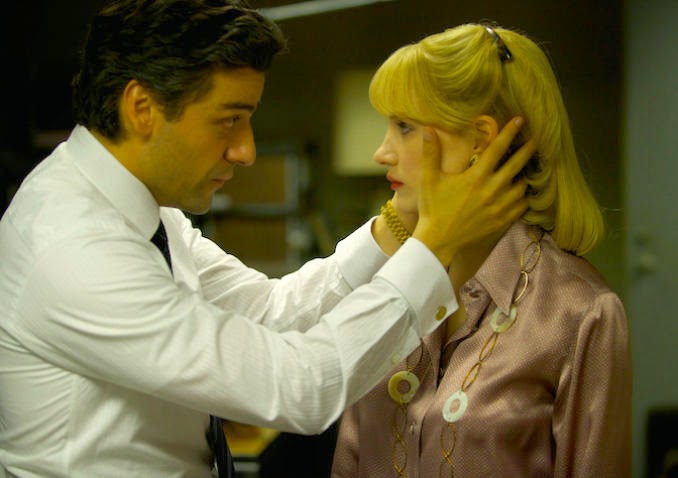
In a performance that channels the best of the youthful Al Pacino and Robert De Niro, Oscar Isaac (INSIDE LLEWYN DAVIS) is Abel Morales, the president of the relatively small-time Standard Heating Oil. Abel has several rivals throughout the Five Boroughs, and they're all jockeying for better positions in the local market. Abel and his business partner/wife Anna (Jessica Chastain) have dumped their life savings into a deposit on a riverfront land purchase from Hasidic businessman Josef (Jerry Adler), a fuel and oil storage facility that will give Abel leverage in the local competition. All he needs to do is come up with $1.5 million in 30 days and the land is his. Otherwise, Josef keeps the deposit and sells the property to a competitor. Abel is stressed but confident. He runs a clean business, prides himself on Standard's presentation and dedication to customer service, and has a great relationship with his bank. Of course, everything starts falling apart. For the last year, Abel's trucks have been occasionally hijacked on their routes, the drivers assaulted and the oil sold to the competition. These occurrences have been on an alarming increase, the latest one resulting in dedicated driver Julian (Elyes Gabel) getting his face smashed and his jaw broken. Abel and his lawyer Andrew Walsh (an almost unrecognizable Albert Brooks) go to District Attorney Lawrence (David Oyelowo) to address the problem, only to be told that the city's been riddled with crime for over a year and hijacked heating oil trucks aren't a priority. And on top of that, Lawrence is launching an investigation into corruption among the city's heating oil providers, with a particular emphasis on Standard. And when the hijackings continue, Walsh and Anna, behind Abel's back, make an agreement with Teamsters rep O'Leary (Peter Gerety) to supply the drivers with guns accompanied by permits that range from sketchy to completely forged.
As all of these issues crash in on the beleaguered Abel, he keeps telling himself that everything will be OK because he runs an honest business, but he's deluding himself. In the revisionist bio he's imagined for himself, he thinks he's built the business from the ground up, when in fact, he bought it cheap from his low-level mobster father-in-law, with Anna cooking the books in a subtle enough way that it's taken the D.A.'s office ten years to catch on to it. An immigrant, Abel believes in the American dream so much that he's willing to convince himself that he's above the corruption that infests his chosen industry. In a very intense, controlled, and pitch-perfect performance, Isaac vanishes into his character the way a young Pacino and De Niro would. His Abel Morales is, at his core, a fundamentally good man who thinks that as long as he doesn't see something illegal happening, everything's going to be OK. He's too smart to not know about Anna's machinations, whether she's falsifying tax records or skimming off the top. The one major flaw in Chandor's script is the sometimes one-dimensional presentation of Anna, though it's not the fault of Chastain. She's a loving wife and, in a rarity for this type of film, an equal partner, but she's still too often cartoonishly bitchy and ruthless, saddled with heavy-handed, melodramatic ways of showing that she's the decisive ballbuster while Abel needs to man up and get with the program, such as the scene where they're driving home from dinner and hit a deer. Opting to put the poor creature out of its misery, Abel hesitantly dithers with a tire iron, while Anna pulls out a gun and shoots it in the head.
Elsewhere, Chandor offers two marvelous, pulse-pounding chase sequences--one during a shootout on the 59th Street Bridge in heavy traffic, the other a long, stunning FRENCH CONNECTION homage when Abel hears a truck hijacking on the radio and realizes he's right in the area where it's taking place. At the end, after a bitingly cynical dialogue exchange between Abel and Lawrence that illustrates just how intertwined politics and business really are, A MOST VIOLENT YEAR is still just Lumet-worship first and foremost (with some bonus affection for guys like William Friedkin and Alan J. Pakula). But it's the closest thing to a new Sidney Lumet film that you're ever going to get, and I imagine that's the best praise one can bestow upon it. Dialogue-heavy and character-driven, set in a world that exists in a perpetual shade of moral and ethical gray, A MOST VIOLENT YEAR is the kind of film that should've been an Oscar darling, but still-not-ready-for-prime-time distributor A24 Films only gave it a minimal, NYC/L.A. release on December 31, 2014. While that wasn't a fatal mistake, A24 completely fell asleep on the job when they were too late getting screeners out to Academy members to qualify it for awards consideration. As a result, what was pegged as a surefire Oscar candidate ended up with exactly zero nominations, all but killing its awards-season momentum and any moviegoer interest with the film finally opening nationwide at the end of January. Nevertheless, its day will come, as it's the work of a strong, confident filmmaker who's only starting to hit the peak of his powers. There's going to be some great films from J.C. Chandor in the coming years.
THE TOWN THAT DREADED SUNDOWN (US - 2014) Directed by Alfonso Gomez-Rejon. Written by Roberto Aguirre-Sacasa. Cast: Addison Timlin, Veronica Cartwright, Gary Cole, Anthony Anderson, Edward Herrmann, Joshua Leonard, Denis O'Hare, Travis Tope, Ed Lauter, Andy Abele, Spencer Treat Clark, Wes Chatham, Lance E. Nichols. (R, 86 mins)
Charles B. Pierce's revered 1976 cult classic THE TOWN THAT DREADED SUNDOWN provides the foundation for this reboot/meta-sequel of sorts that makes the creative decision of incorporating the existence of the original film into its story. A thriller dramatizing a series of murders in the small Texas/Arkansas border town of Texarkana in 1946 by a sack-hooded killer dubbed "The Phantom," SUNDOWN '76 has enjoyed a devoted following over the years despite its uneven structure and dismal comic relief, unwisely provided by Pierce himself as numb-skulled deputy Sparkplug. As a director, Pierce (THE LEGEND OF BOGGY CREEK) is Pierce the actor's biggest fan, repeatedly killing the momentum with Sparkplug's wacky antics, blithely oblivious to how much damage his slapstick self-indulgence does to an otherwise well-made, chillingly effective film. A drive-in hit in its day, SUNDOWN '76 is still embraced by horror fans who are obviously more forgiving of Sparkplug than I am--I don't exaggerate when I say Pierce's endless clowning ruins his own movie. There's no doubting SUNDOWN '76's influence: its killer's "Sackhead" look was blatantly copied for the pre-hockey mask Jason in FRIDAY THE 13TH PART 2 (1981).
Co-produced by GLEE and AMERICAN HORROR STORY mastermind Ryan Murphy and, like every current horror movie, "from the producer of PARANORMAL ACTIVITY and INSIDIOUS," SUNDOWN '14 takes place in present-day Texarkana, still a tiny town forever haunted by the events not just of 65 years earlier, but by the movie itself, now such a cult classic that its drive-in showings and TV airings have made it as much of the town's history as the murders that influenced it. In a way, orphaned teenager Jami (Addison Timlin) is herself a victim of the SUNDOWN mythology even though she was born decades after both the murders and the movie. Years earlier, frightened by the movie being shown and someone wearing a sackhead hood at a sleepover, young Jami called her parents to come and pick her up and they were killed in a car accident on the way home, leaving Jami to be raised by her grandmother Lillian (Veronica Cartwright). After leaving a showing of the movie because of her obvious discomfort, Jami and her boyfriend Corey (Spencer Treat Clark) are accosted in a nearby dirt-road Lovers' Lane by a sackheaded copycat who brutally kills Corey. Jami escapes, but the murders continue, prompting the sheriff (the late, great character actor Ed Lauter, who died in 2013, shortly after the film's completion) and his asshole deputy Tillman (Gary Cole) to bring in Texas Ranger Lone Wolf Morales (Anthony Anderson, very good in some unexpected casting) to help find the madman. Meanwhile, Jami and shy library archive staffer Nick (Travis Tope) conduct their own investigation, leading them to none other than Charles B. Pierce, Jr (Denis O'Hare), who insists he knows the copycat killer's true identity.
Anchored by a strong performance by the charming Timlin, who looks and sounds like the second coming of late '80s scream queen Jill Schoelen (THE STEPFATHER, POPCORN), SUNDOWN '14 is a surprisingly effective sleeper that deserved more exposure than it got from the relaunched Orion Pictures. Scripted by Roberto Aguirre-Sacasa (a writer on GLEE and AHS who also penned 2013's dreary CARRIE remake) and directed by Murphy's GLEE/AHS vet Alfonso Gomez-Rejon, who utilizes numerous visual tricks like some De Palma split-diopters, long tracking shots, and impressively swooping and well-choreographed crane shots. These days, it's expected that a reboot of this sort will be filled with self-conscious snark and shock value in place of actual horror (especially coming from so many AMERICAN HORROR STORY personnel), but SUNDOWN '14 is legitimately scary, with Sackhead's attacks--several of the '76 film's more iconic kills are restaged here--startling, brutal, and utterly relentless. But beyond it just being an unexpectedly solid fright film, SUNDOWN '14 is ambitious and very clever, with special attention given to showy filmmaking technique, giallo-inspired color schemes, and inspired mise-en-scene, from the jarring ways Gomez-Rejon has Sackhead enter the frame when you least expect it to the sardonic placement of a dead-end road sign.
There's also the scathing visual commentary of a billboard of finger-pointing, fear-mongering, Bible-thumping Reverend Cartwright (the late Edward Herrmann in one of his last roles) forming the backdrop of a shot that puts his judgmental visage right between two gay male high-school students about to have sex in a car before Sackhead attacks. Another scene set in a junkyard filled with signs of all the defunct Texarkana businesses that have gone under or left town over the years is essentially eulogizing the passing of small-town America. The empty streets and boarded-up storefronts of downtown Texarkana reveal a town decimated by past tragedies from which it can never recover and those ghosts are everywhere. Without the 1976 movie to keep it in the public consciousness, this dark part of the town's history could pass on like those who lived through it. But when it comes to cinema, everything is immortal. SUNDOWN '14 isn't flawless (the idea of Pierce Jr coincidentally living on the outskirts of Texarkana all these years is a little too convenient) but it subverts almost all expectations in an era where old-school horror fans usually approach these things, if at all, by preparing for the worst. There isn't a loud music cue or a pointless jump scare to be had and it makes a loud-and-clear statement regarding its stance on "Sparkplug" by completely Jar-Jar Binksing the character to a two-second, non-speaking walk-on. Like a serious SCREAM without the sense of smug self-awareness that its success spawned, and even at times recalling everything from the investigative obsessiveness of David Fincher's ZODIAC (2007), the meta-before-it-was-cool WES CRAVEN'S NEW NIGHTMARE (1994), and the movie vs. reality elements of Bigas Luna's cult oddity ANGUISH (1987), the 2014 revamp of THE TOWN THAT DREADED SUNDOWN is a smart, unnerving, and ferociously uncompromising film that's far better than it has any right or reason to be. It's pretty much an anomaly in today's horror scene. If this was a found-footage remake, you know it would've opened on 3000 screens instead of getting dumped on VOD.
THE LOFT (US/Belgium - 2015) Directed by Erik Van Looy. Written by Wesley Strick. Cast: Karl Urban, James Marsden, Wentworth Miller, Eric Stonestreet, Matthias Schoenaerts, Rachael Taylor, Isabel Lucas, Rhona Mitra, Valerie Cruz, Kali Rocha, Elaine Cassidy, Margarita Levieva, Kristin Lehman, Robert Wisdom, Graham Beckel, Dora Madison Burge, Ric Reitz, Kathy Deitch, Laura Cayouette. (R, 103 mins)
It's rarely a good sign when a movie arrives in theaters in 2015 sporting a 2013 copyright after being shot in 2011. THE LOFT's nearly four years on the shelf have been attributed to distributor issues, with its release date shuffled numerous times as the film went from Warner Bros. to Universal, then finally to the smaller Open Road. It's not a terrible movie by any means, though it comes up far short of the USUAL SUSPECTS-type twistfest that it desperately tries to be. What's here is generally entertaining, diverting trash that could actually stand to be a little more trashy instead of just piling on the red herrings and dropped plot threads with reckless abandon. It's the kind of movie that offers unintended laughs when five people are in a room knowing that one among them is a killer, and we get close-ups of the five regarding each other with shifty, squinty eyes, accompanied by a ludicrously melodramatic Big Reveal/Cliffhanger/"Dun-Dun-DUUUUN!"-style music cue.
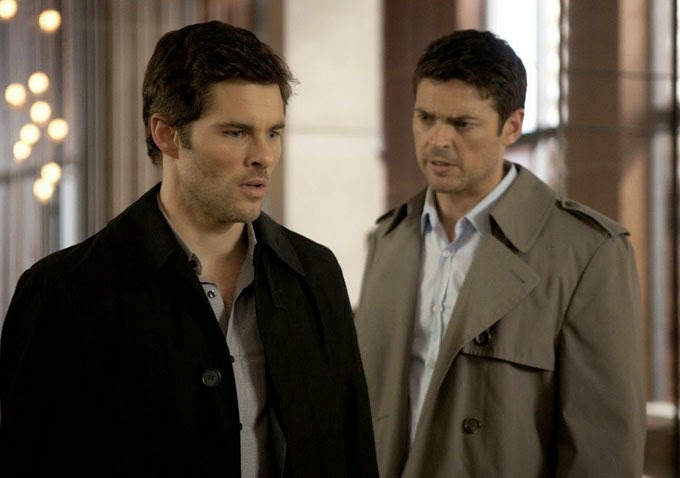
THE LOFT is an almost shot-for-shot remake of the 2008 Flemish-language thriller LOFT, which still stands as Belgium's highest-grossing homegrown film. LOFT was remade in similarly identical fashion as the Dutch LOFT in 2010. The 2008 LOFT was helmed by Erik Van Looy (THE MEMORY OF A KILLER), who makes his English-language directing debut with THE LOFT. Van Looy was also pressed into service on the Dutch LOFT when its director, Antoinette Beumer, and five others were injured by falling scaffolding on the set, stepping in as an uncredited backup director for a couple of weeks while Beumer recovered from her injuries. I'm not sure what else Van Looy can wring out of this story that he hasn't already, but THE LOFT (shot mostly in Brussels) follows the template of Bart De Pauw's original 2008 script, adapted by Wesley Strick, whose screenwriting credits include CAPE FEAR (1991), FINAL ANALYSIS (1992), and THE GLASS HOUSE (2001): five married guys have a secret apartment they agree to use as a getaway to hook up with mistresses and one-night stands. The whole thing is the brainchild of successful architect Vincent (Karl Urban), who gives keys to his four buddies: Chris (James Marsden), Luke (Wentworth Miller), Marty (Eric Stonestreet), and Philip (Matthias Schoenaerts, who played the same role in the Belgian LOFT). The film opens with Luke showing up at the loft and finding a dead, blood-covered blonde handcuffed to the bed. Van Looy cuts back and forth between the five men trying to work their way out of the situation and being interrogated by skeptical detectives (Kristin Lehman, Robert Wisdom), and the events of the previous year, starting with Vincent proposing the idea of the loft. All of the guys are bored with their perpetually sour-faced, ballbusting, complaining and/or needy wives. Shrink Chris fancies himself a family man but falls hard for icy blonde Anne (Rachael Taylor), who's not only the mistress of a city councilman (Ric Reitz), but also the sister of a patient who committed suicide. Vincent steps out on his wife (Valerie Cruz) with a younger woman (Isabel Lucas), with whom Luke is obsessed. Gregarious Marty, the loud fat guy of the group, sees his marriage ruined by his indiscretion on a business trip with Vincent and Luke. And Philip, the younger half-brother of Chris, is a violent cokehead who marries into a rich family and is irrationally overprotective of his 20-year-old sister (Dora Madison Burge).
Of course, as these five dipshits try to figure out which one of them is responsible for the dead body in their party pad, long-simmering resentments and grudges boil over, usually involving creepy Luke and his seething jealousy over Vincent's way with women or someone making a passive-aggressive accusatory comment and getting a "What the fuck is that supposed to mean?" in response. Or, one guy telling another "You're a sick fuck!" and getting "No, YOU'RE a sick fuck!" and a shove as a retort. It's hinted that Luke is a closeted homosexual who secretly desires Vincent, but that's quickly tossed aside (it's an interesting side note that Miller himself came out of the closet in 2013) because THE LOFT isn't daring enough to take it in that direction. The contrivances and conveniences come at a furious clip and it's all moderately entertaining enough, if a bit lacking in the courage to be anything but standard and safe. The resolution isn't so much unpredictable as it is ridiculous, with characters making one dumb, nonsensical decision after another just so Van Looy can keep the movie going. Say what you will about 1998's similar VERY BAD THINGS, but at least it had a sick-humored, anything-goes sense of adventure to it. By the time everything is explained, THE LOFT has nothing left to do but end with a whimper, offering up one of the weakest denouements in recent memory. THE LOFT is perfectly OK as the kind of movie you stop on while channel-surfing, and it'll no doubt have a long life on Netflix Instant and cable. But while it's always nice to see a '90s-style thriller on the big screen these days, it would've been a lot better if it didn't take itself so seriously, inadvertently serving as the perfect example of why these kinds of movies faded from popularity in the first place.
WILD CARD (US - 2015) Directed by Simon West. Written by William Goldman. Cast: Jason Statham, Michael Angarano, Milo Ventimiglia, Dominik Garcia-Lorido, Stanley Tucci, Hope Davis, Anne Heche, Sofia Vergara, Jason Alexander, Max Casella, Francois Vincentelli, Chris Browning, Matthew Willig, Davenia McFadden. (R, 92 mins)
Jason Statham's peak days as a solo box-office draw appear to be hitting a valley with recent under-performers like KILLER ELITE (2011), SAFE (2012), PARKER (2013), and HOMEFRONT (2013). Even the third EXPENDABLES entry did significantly less business than its predecessors, and all of that has combined to damn WILD CARD to a limited release/VOD burial from Lionsgate, who've apparently lost faith in Statham's ability to open a movie. None of this means the 47-year-old action hero is done: he's still got his Liam Neeson action icon rebirth to look forward to in a decade or so, and in the immediate future, he's playing the villain in the upcoming FURIOUS 7, and teams up with Melissa McCarthy in the slapstick comedy SPY, due out this summer. WILD CARD is a remake of the forgotten 1987 Burt Reynolds box-office bomb HEAT, based on a novel by Oscar-winning screenwriter William Goldman (BUTCH CASSIDY AND THE SUNDANCE KID, ALL THE PRESIDENT'S MEN, MARATHON MAN). If HEAT is remembered at all today, it's for being the movie where an irate Reynolds infamously punched director Dick Richards in the face after an on-set disagreement. Scripted by Goldman himself, HEAT was so plagued by production problems that Richards was actually the film's second director, a replacement for Robert Altman, who quit after one day of shooting. After the altercation with Reynolds, Richards quit and was then replaced by veteran journeyman Jerry Jameson (AIRPORT '77), who finished the movie without incident, with final credit going to a semi-pseudonymous "R.M. Richards."
HEAT was Reynolds' first film back from being sidelined for two years by a jaw injury sustained on the set of 1984's CITY HEAT, when he was shooting a fight scene and was hit in the face by a real chair instead of a breakaway prop chair. He had to have reconstructive jaw surgery and was on a liquid diet for months, leading to a drastic weight loss and rumors that he was dying of AIDS. Reynolds looked fit and healthy in HEAT, but by that point, audiences stopped caring. Just a few years earlier, he was the biggest movie star in the world, but by early 1987, HEAT was in and out of theaters in two weeks. The film itself is a noble failure, but it's better than its reputation, with a solid performance by Reynolds, and unlike most of his 1980s work, he's actually trying. HEAT was more a character study than an action thriller--probably why Altman was involved in the first place--and Reynolds took it seriously, but the few who saw it wanted an action movie.
Since so few people remember HEAT (and it's been slightly overshadowed by another, much more revered HEAT), it should be easy for audiences to take WILD CARD on its own terms. Goldman, now 83 and with his first screenplay credit in 12 years, essentially dusts off his HEAT script and adds a few modern touches, but it's largely the same film in terms of plot. However, its most unexpected element is that it only succeeds in making one appreciate HEAT. WILD CARD offers Statham in mostly serious mode (like the similarly dumped REDEMPTION) and while his acting chops are better than he's even given credit, he just looks bored here and can't enliven this bland, lifeless story. Statham is Nick Wild, a Las Vegas "security consultant" reduced to letting clients deck him to impress their girlfriends. He's trying to put together a $500K nest egg to pack up and move to Corsica, but even he knows he'll just be counting the days until he's back in Vegas. Like HEAT, WILD CARD gives Nick two stories that never really come together: his prostitute ex Holly (Dominik Garcia-Lorido, Andy Garcia's daughter) is brutally beaten and raped by sniveling brat mob scion Danny DeMarco (Milo Ventimiglia) and his two dudebro goons, prompting her to beg Nick to help her exact revenge; and Nick is also pestered by wealthy computer genius Cyrus Kinnick (Michael Angarano), a likable but spineless sort who wants lessons in standing up for himself and facing his fears.
And that's pretty much it. A number of familiar faces turn up in brief roles--Anne Heche as a waitress, Hope Davis as a blackjack dealer, Jason Alexander as Nick's lawyer/business partner Pynchus "Pinky" Zion (played by a scene-stealing Howard Hesseman in HEAT), Sofia Vergara as a woman impressed that her weakling beau handled Nick (she's gone before the opening credits), and Stanley Tucci as a flamboyant, god-like, mob-connected casino boss who tries to mediate the dispute between Nick and DeMarco while acting like a slightly toned-down version of Dean Stockwell's Ben in BLUE VELVET. Director Simon West (CON AIR, THE EXPENDABLES 2, and the Statham remake of THE MECHANIC) tries to keep things low-key, even attempting that sort of juxtaposed, jump-forward-then-backtracking with overlapping past/future dialogue editing style frequently (and much more successfully) used by Steven Soderbergh in films like THE LIMEY and OUT OF SIGHT, but coming from the School of Bruckheimer, he's utterly lacking in the nuance and the sense of fluidity required to make tricks like that work. Brian De Palma was signed on to direct this when it was announced but he quit the project during pre-production. One can only imagine how much differently WILD CARD might've turned out with the split-screens and the split-diopter shots and Statham really getting to show his range for one of cinema's all-time great filmmakers. The possibilities, even with De Palma not at the top of his game and in the self-parody phase of his career, are more exciting to ponder than anything that ended up in the finished product.
The worst part of WILD CARD is the distracting and clumsy insertion of elaborately-choreographed fight scenes overseen by veteran martial-arts coordinator Cory Yuen (director of THE TRANSPORTER). This is clearly intended to be a character-driven drama for Statham, but the occasional outbursts of quick-cut martial-arts mayhem as Nick breaks out the JOHN WICKstrionics are jarringly incongruous to the rest of the film and are obviously only there to prevent this from completely turning into the Statham equivalent of KILLING THEM SOFTLY, the kind of dialogue-heavy, misleadingly-advertised mood piece that would've sent die-hard action fans bolting for the exits. But WILD CARD's dramatic elements don't work either, the film ends with an almost anti-climactic shrug of surrender, and when it's all said and done, it's just a tonally confused DOA dud that can't reconcile giving its star a chance to stretch with the expectation that he be a one-man wrecking crew. It does nothing to correct the mistakes of HEAT--which were due more to its messy production than anything else--and instead just ends up making more of its own that are totally unique to this pointless remake of a film that absolutely no one was demanding. Statham's having a really off-day here, and while it's likely that the declining box office of his solo actioners in the last couple of years might've a hand in the stealth release of WILD CARD, there's also no way of getting around the fact that it's his worst film and that's the more likely reason why Lionsgate opted to sneak this into as few theaters as possible.
WHY DON'T YOU PLAY IN HELL? (Japan - 2013; US release 2014)
Japanese auteur Sion Sono has several fascinating films in his back catalog--2001's SUICIDE CLUB, 2005's STRANGE CIRCUS, and 2010's COLD FISH to name three--but none on the level of his masterpiece, 2008's LOVE EXPOSURE, belatedly released in the US in 2012. A mammoth, four-hour epic about religion, forbidden love, and upskirt photos, LOVE EXPOSURE is a film like no other. Like the Takashi Miike of a decade and a half ago, the prolific Sono is always working on something, but WHY DON'T YOU PLAY IN HELL? is his first film to get a US release since LOVE EXPOSURE, and it's one where a little goes a long way. An absurdist satire that takes on the yakuza tradition and the state of Japanese filmmaking, HELL gets off to a funny start with the introduction of an enthusiastic but talentless filmmaking collective who call themselves "The Fuck Bombers." There's a long prologue set ten years ago before two parallel storylines kick off and finally converge around 80 minutes into the 130-minute film. Ten years ago, the wife (Tomochika) of yakuza boss Muto (Jun Kunimura) was sent to prison for going on a stabbing rampage that took out several flunkies of Muto's rival Ikegami (Shinichi Tsutsumi). This prompts a toothpaste company to take a popular series of commercials off the air that showcase a catchy jingle sung by Muto's young daughter Mitsuko (played as a child by Nanoka Hara), on whom Ikegami has an unusual and questionable fixation. Ten years later, Mrs. Muto is about to be released from prison and Mitsuko (Fumi Nikaido) is starring in a cheap yakuza thriller when she runs off the set with her hapless boyfriend Koji (Gen Hoshino). When Muto's men apprehend the couple, Mitsuko convinces her father that Koji is a filmmaker and was going to put her in a better movie to impress her mother. Forced to pretend he's a movie director, Koji recruits his childhood acquaintances in The Fuck Bombers, led by the delusional and oblivious Hirata (Hiroki Hasagawa), who sees this as his ticket to the big time and stages an epic, captured-on-film battle-to-the-death between Muto's and Ikegawa's perpetually-warring crews.
Sono is aiming all over the place throughout the often tedious HELL, but it improves quite a bit once Hirata starts shooting his magnum opus as blood, limbs, heads and appendages fly across the screen with wild abandon. Hirata insists on using 35mm and his resulting masterwork, also titled WHY DON'T YOU PLAY IN HELL? ultimately represents the death of film for Japanese cinema (I'm sure Sono is being facetious in his overuse of CGI splatter) as it goes out in a blaze of glory, where even the two-person camera crew starts firing assault rifles while making sure they get their shots. There's a bit of a STUNT MAN method to Hirata's Eli Cross-like madness, but ultimately, the film just starts getting too meta for its own good, with a late-in-the-game Buddy Bizarre wall-breaker that takes it into BLAZING SADDLES territory. There's some clever and funny bits scattered throughout, from offbeat humor (this is a guy, after all, whose EXTE: HAIR EXTENSIONS was a film about killer hair extensions) to simple sight gags (a bunch of yakuza goons bracing themselves and scrambling to avoid an approaching assassin that turns out to be a cat) and the message about the death of film being the end of an era is a poignant and elegiac one. But a dawdling Sono lets the pace drag and takes too long to say what he has to say, spending entirely too much time on standard-issue yakuza cliches straight out of any Beat Takeshi joint, and general goofball silliness with the Fuck Bombers (it's surely by design, but Hasagawa's performance is grating) that only serve to pad the running time. LOVE EXPOSURE was a four-hour work of art that I would've happily spent another four hours watching. With HELL, however, Sono could've trimmed it by at least 30 minutes and ended up with a stronger film as a result. (Unrated, 130 mins)
OPEN WINDOWS (Spain/US - 2014)
In the years following the phenomenal success of the LORD OF THE RINGS trilogy, Elijah Wood has done voice work in the HAPPY FEET films but has generally laid low in indies and offbeat projects like the cult TV series WILFRED. He's also embarked on an unexpected side career in European-made thrillers like Alex de la Iglesia's THE OXFORD MURDERS and Franck Khalfoun's MANIAC, a remake of the 1980 horror classic. OPEN WINDOWS, the latest from TIMECRIMES director Nacho Vigalondo, puts Wood in a similar predicament his character encountered in another recent Spanish thriller, GRAND PIANO. In that film, Wood played a famous and reclusive concert pianist, returning from a very public nervous breakdown and being taunted and threatened via earpiece in mid-comeback performance by the voice of John Cusack as a sniper perched in the balcony, threatening to shoot him if he plays one wrong note. It was a high concept that didn't carry through to the end but had enough De Palma-esque visual flourishes to keep it giddily entertaining. Wood is harangued by an unseen voice yet again in OPEN WINDOWS, this time as Nick, a dweeby blogger and webmaster for a fan site devoted to B-movie actress Jill Goddard (Sasha Grey). Nick is in Austin, where Jill is premiering her latest cheesy horror film and he's won a contest to have dinner with her. He's contacted in his hotel room by Chord (Neil Maskell), who tells him that the dinner is off and that the bitchy Jill never had any intention of meeting up with him anyway. Chord has inside knowledge of Jill's activities and convinces Nick that he's part of her team and is just trying to let him down easy. He sends Nick some links that give him access to her phone and its contents, and even hacks into Nick's digital camera to provide an inside look into Jill's hotel room, where she's stepping out on her boyfriend with her agent. Nick's naivete has allowed Chord to completely take over his laptop and use it to remotely hack into every aspect of Jill's life, and only then does the slow-on-the-uptake Nick realize there never was any contest and that Chord is setting him up to take the fall for his plan to stalk and eventually kill Jill.
Around the time OPEN WINDOWS got a limited and VOD release in the US, celebrity cell phone hacks of Jennifer Lawrence, Mary Elizabeth Winstead, and others were making headlines, followed sometime later by the Sony e-mail hacks over the controversial THE INTERVIEW. OPEN WINDOWS blows a chance to be a smart and unexpectedly prescient thriller by going off the deep end and not taking better advantage of its high concept--almost the entire film plays out as pop-up windows on Nick's laptop. Yes, we've gone from found-footage to feature-length Skyping, but the first 30 or so minutes are terrific and very well-orchestrated by the director. But then Vigalondo makes the fatal mistake that so many filmmakers do when dealing with something like this: he should've kept Nick in his hotel room, glued to his laptop. That's what cranks up the suspense--when he's helpless and has nowhere to go. Instead, Vigalondo can't wait to get Nick out of the hotel and into a car, where he ends up being chased by the cops, laptop open in his passenger seat as Chord continues to terrorize him. There's also a team of French hackers who dial in to help Nick, and then there's a whole subplot about them mistaking Nick for a criminal known as "Nevada," who might actually be Chord but maybe not. Vigalondo also introduces one nonsensical twist after another, involving identity theft, doubles, and masks and no one being who they say they are. While Nick is in his hotel room, OPEN WINDOWS is taut, plausible, and terrifying, but as soon as he's out, it collapses almost instantly as Vigalondo not only subscribes to the belief that computers can do what they do in CBS police procedurals, but he piles on one ludicrous twist after another, digging himself into such a hole that the resolution makes no sense whatsoever. It hardly matters, since you'll have stopped caring long before that. OPEN WINDOWS gets off to a killer start but implodes faster than any fright film this side of LEGION. (Unrated, 101 mins) MAS NEGRO QUE LA NOCHE (Mexico/Spain - 2014)
Pantelion Films, an offshoot of Lionsgate and Mexico's Grupo Televisa, is a specialty distributor of films targeted toward Spanish-speaking audiences in the US. Pantelion had a breakout hit with 2013's INSTRUCTIONS NOT INCLUDED and recently released the biopic CANTINFLAS, which wasn't quite as successful. Released on 178 screens last fall, where it had a respectable $3000 per screen average to land in 17th place its opening weekend, the 3-D horror film MAS NEGRO QUE LA NOCHE was so geared toward a particular audience that it went out under its original title instead of the translated "Darker Than Night." Other than its release pattern, there's absolutely nothing special about NOCHE, a remake of a 1975 film of the same title that's somewhat revered by Mexican moviegoers, though it didn't make much of a dent in the States. Presumably working from a checklist provided by Lionsgate, NOCHE '14 is yet another rote "vengeful ghost" saga that you've seen countless times before, loaded with jump scares and loud music cues. When Greta (Zuria Vega) was orphaned as a child, she was raised by her rich Aunt Ofelia (Lucia Guilmain), a spinster who lived with her beloved cat Becker and fiercely devoted housekeeper Evangelina (Margarita Sanz). Years later, Aunt Ofelia has died and Greta inherits everything, with the caveat that she must care for the seemingly ageless Becker. Greta moves into Ofelia's mansion with her cheating, dirtbag fiance (producer Josemaria Torre Hutt) and her three hard-partying besties, much to the chagrin of Evangelina as well as Aunt Ofelia, whose enraged ghost still prowls the grounds. When Greta's coke-whore friend Vicky (Ona Casamiquela) finds that her ferret's been killed by Becker, she drowns the cat in the pool, which sets Ofelia's ghost on a rampage of vengeance that eventually results in the possession of Greta, who starts offing everyone in a variety of gruesome ways. NOCHE '14 is an abysmally dull failure that takes forever to get going and when it finally does, it simply goes through every modern horror cliche in the book: predictable jump scares and fake-outs, a creepy music box, constantly flickering lights and creaking doors accompanying Ofelia sightings, and endless running and screaming down long corridors like some botched tribute to the slamming-door farce. NOCHE '14 clearly has some money up on the screen with some effectively dank and ominous production design (THE OTHERS and THE ORPHANAGE are major stylistic influences here), but when it's finally and mercifully over, writer/director Henry Bedwell's film is nothing more than a tired, D-list Guillermo del Toro ripoff, with loathsome characters, a dearth of scares, and the pointless bonus of ending with Marilyn Manson's cover of Carly Simon's "You're So Vain," for some reason. (R, 110 mins)
BOARDING GATE (France - 2007; US release 2008) Written and directed by Olivier Assayas. Cast: Asia Argento, Michael Madsen, Kelly Lin, Carl Ng, Kim Gordon, Alex Descas, Joana Preiss, Raymond Tsang, Boss Mok. (R, 106 mins)
French filmmaker Olivier Assayas' sleek and glossy thriller BOARDING GATE was met with shrugs at best to outright hostility at worst when it opened in Europe in 2007 and then in the US in 2008. It shares certain similarities with Assayas' impenetrable corporate espionage thriller DEMONLOVER (2003), but is much more streamlined, straightforward work, even with all of its arthouse bells and whistles. Indeed, it wouldn't take much tweaking to turn BOARDING GATE into a commercial chase actioner, but that would be too easy for Assayas, the acclaimed auteur behind the deconstructionist filmmaking satire IRMA VEP (1996), the little seen addiction/recovery drama CLEAN (2004), the keenly insightful family saga SUMMER HOURS (2008), and the incredibly ambitious CARLOS (2010). BOARDING GATE was roundly criticized as Assayas feebly attempting to make a trashy erotic thriller, but such a labeling does it a huge disservice. Yes, it has tawdry and silly elements, but it's far too well-made and beautiful to look at to be so easily dismissed. It may be a tawdry and silly erotic thriller at its core, but BOARDING GATE does its damnedest to be the most hypnotic and compulsively watchable one you'll ever see.
Using the cutthroat financial sector wheeling-and-dealing as a backdrop, Assayas' focus on BOARDING GATE is Sandra (Asia Argento), a lone-wolf antihero with a mysterious past involving drug addiction and prostitution. She's currently working as a shipping and receiving supervisor at a Paris-based import/export shipyard run by Lester (Carl Ng) and Sue Wang (Kelly Lin). She's got a side business running off-the-manifest drug shipments, all part of a plan to ditch Paris and run off to Beijing to buy into a nightclub with Lester, with whom she's having a clandestine affair behind Sue's back. At the same time, Sandra is trying to find closure in her complicated, S&M-heavy relationship with American businessman Miles Rennberg (Michael Madsen), whose days as a power player in the world of global finance are behind him and now he's just looking to sell his stake in a French company to settle a debt with some shady Hong Kong investors. Years earlier, Rennberg was a major name in the business world, and Sandra was on his payroll as a corporate spy, seducing Rennberg's rich associates and investors and coaxing secrets out of them for her boss, who was less interested in the information than in what Sandra did to get the information. Rennberg's tendencies toward sexual sadism are at odds with his sensitive side, as he remains very much in love with Sandra even though he gets off on demeaning her ("I'm gonna handcuff you, and then I'm gonna fuck you"). Rennberg has his tender moments, but he's still the kind of guy who likes to play rough bondage games and have Sandra choke him with a belt while she straddles him and jerks him off. Out of nowhere, Sandra handcuffs Rennberg for what he thinks is a game but she instead shoots him in the back of the head, killing him. She flees his apartment and is picked up by Lester, who talked her into killing Rennberg and sends her and another employee, Lisa (Joana Preiss) to Hong Kong to lay low. Once there, Sandra has no idea who to trust, as she's faced with an embittered Sue--who's not all that oblivious about her husband's extramarital flings--as well as Kay (Sonic Youth's Kim Gordon), a shady American who oversees a sweatshop specializing in knockoff designer jeans and may have been part of the plot to eliminate Rennberg, which turns into a plot to eliminate Sandra.
A basic synopsis makes BOARDING GATE sound like a predictable suspense thriller, but Assayas isn't interesting in following that path. Much of the first hour is devoted to showing the layers of complexity in Sandra's relationship with Rennberg. It ended badly and both know they can't go back, but that pull is still there, and Assayas lets that play out in a long conversation between the two of them in Rennberg's office, and again in and even longer sequence that takes over 20 minutes of screen time, leading to Sandra's murder of Rennberg. Assayas probably could've got an entire film just out of the relationship between these two characters, and though Argento's reputation as a provocateur and enfant terrible seems to at least partially be a youthful attempt to establish herself beyond being Dario Argento's daughter (it's worth noting that she's fast-approaching 40 and has settled down quite a bit in recent years), it's also done her a disservice even this far into her nearly 30-year career by still eclipsing her acting talent. Away from the drawn-out and depressingly funereal decline of her father's films and his strange habit of putting his daughter in nude scenes that's always left a bit of an unpleasant aftertaste, not to mention her ill-advised attempts to break into Hollywood (Vin Diesel's XXX was a huge hit, but it did nothing for her in America), Argento probably has her career-best role in BOARDING GATE. Sure, the poster art plays on her hellraising, wild-child persona ("She's losing control again"), and Sandra at first seems like another variation on Argento's similar corporate seductress (named "Sandii") in Abel Ferrara's cyberpunk misfire NEW ROSE HOTEL (1999). But she has an alluring, edgy. and intense screen presence that Assayas uses for maximum effect, whether she's parading around in skimpy underwear, touching herself in Rennberg's office, glaring intensely while pulling a trigger, or letting emotion get the best of her in her final meeting with Rennberg. Judging from her work in BOARDING GATE, somebody really missed the boat by not casting Argento as a cold, ruthless, badass Bond femme fatale of the Luciana Paluzzi variety during the Pierce Brosnan era.
Even if you hate BOARDING GATE, if nothing else, Assayas deserves some credit for being the last filmmaker (as of this writing) to cast the perpetually slumming Madsen in a serious, significant role. Though he exits at the midway point, Madsen's presence is felt throughout BOARDING GATE, and watching this now is both gratifying and depressing. Gratifying in the sense that it's a rare glimpse of the electrifying, early '90s Madsen that showed up for THELMA & LOUISE and RESERVOIR DOGS, and depressing in that today, he's lumped in with fellow promising actors-turned-mercenaries Val Kilmer, Christian Slater, Eric Roberts, Tom Sizemore, and John Savage, guys who simply can't turn down a gig, no matter how dubious it is, especially if they're on and off the set in a day or less. Other than SIN CITY and an occasional CSI or BLUE BLOODS guest spot, the last decade of Madsen's IMDb page is infested with the likes of NOT ANOTHER NOT ANOTHER MOVIE, FOREST OF THE LIVING DEAD, PIRANHACONDA, and tons of other instantly obscure and unreleased YouTube-quality titles that barely qualify as films. Watching BOARDING GATE again now, it's almost as if Assayas created Miles Rennberg as a sort-of intervention for Madsen about where his career was heading. The parallels between Rennberg and Madsen are impossible to ignore: a buzzed-about shooting star years earlier, now looking for quick cash and clinging to the fringes of his industry thanks to name recognition and past accomplishments, and with, as Sandra points out, "a body gone to seed." A pasty, schlubby-looking Madsen sells it perfectly with his slumped shoulders, his middle-aged paunch, and a lurching gait that makes him look like he's babying a chronically nagging back injury. The actor does appear in Quentin Tarantino's currently in-production western THE HATEFUL EIGHT, but until that's released, BOARDING GATE stands as the last documented example of Michael Madsen giving a shit onscreen.
BOARDING GATE's second half is where it splits off into its more commercial direction, but even then, there's enough ambiguity in the ending to completely eliminate it from "crowd-pleaser" contention. Assayas and cinematographer Yorick La Saux (SWIMMING POOL, ONLY LOVERS LEFT ALIVE) masterfully capture the dizzying, disorienting feel of overcrowded Hong Kong, whether in shopping centers, markets, or just in the busy streets. It's brilliantly abetted by the droning ambiance of selections from Brian Eno's back catalog, like "Lizard Point" and "Music for Airports 2/2," and "The Heavenly Music Corporation," by Eno and King Crimson's Robert Fripp. It all reaches a stunning crescendo in a finale that's heavy on the complicated camera moves and long tracking shots as Sandra follows Lester with the intent of exacting revenge for hanging her out to dry and cutting her out of their club deal. As Eno's music drones and throbs, Assayas comes up just a split-screen and a split-diopter shy of going into all-out Brian De Palma worship. Nevertheless, Sandra's tailing of Lester brings to mind fond memories of similar De Palma sequences like Angie Dickinson following her anonymous hook-up through the art museum in DRESSED TO KILL or Craig Wasson's lovestruck pursuit of his doomed neighbor through an L.A. shopping mall and to the beach in BODY DOUBLE.
Drenched in melancholy and yet alive with kinetic energy, BOARDING GATE seems to be held in higher regard now than it was seven years ago, and as a result, it's formed a minor cult following. By no means a secret masterpiece, it's still the kind of film that improves greatly on subsequent viewings, once you realize where the story is going and can further examine why Assayas has it play out the way it does. And in doing so, the viewer begins to unexpectedly empathize with Sandra and understand the devastation and resignation she feels in that deliberately open-ended final shot as a lifetime of self-destructive choices and terrible misdeeds hits her all at once. Most reviews of BOARDING GATE approach it from the viewpoint of Assayas offering a commentary on the state of global commerce and capitalism. That's all well and good, but it was also covered by the director in DEMONLOVER. Though it turns into a gripping thriller that's a tad esoteric and somehow manages to be convoluted and vague, BOARDING GATE is at its most intriguing in its first half, when it's a much more stripped-down and intimate film with devastating performances by Argento and Madsen...even if it does cleverly disguise itself as a tawdry and silly erotic thriller.