Directed by George Clooney. Written by George Clooney and Grant Heslov. Cast: George Clooney, Matt Damon, Cate Blanchett, Bill Murray, John Goodman, Jean Dujardin, Bob Balaban, Hugh Bonneville, Dimitri Leonidas, Justus von Dohnanyi, Holger Handtke, Zahary Baharov, Sam Hazeldine. (PG-13, 118 mins)
For all of George Clooney's fame and tabloid ubiquity over the last 20 years, he hasn't been in a lot of box office blockbusters other than the THE PERFECT STORM, OCEAN'S ELEVEN films and GRAVITY. He's largely chosen quality scripts over easy star vehicles (OUT OF SIGHT, SYRIANA, MICHAEL CLAYTON, UP IN THE AIR), isn't afraid to go for non-commercial material (SOLARIS, THE GOOD GERMAN, THE AMERICAN) and with his matinee idol looks, he's often described as a throwback to the Hollywood of old, a sort-of Cary Grant for today's cinema. For the most part, his directorial career also seems rooted in the past: CONFESSIONS OF A DANGEROUS MIND (2002) was an adaptation of GONG SHOW host Chuck Barris' improbable memoirs, GOOD NIGHT AND GOOD LUCK (2005) chronicled CBS News icon Edward R. Murrow and his battle against the McCarthy hearings, LEATHERHEADS (2008) was a screwball romantic comedy set in the world of 1920s football, and THE IDES OF MARCH (2011) was a thriller set in the scheming world of present-day politics but nevertheless felt like the kind of movie Alan J. Pakula, Sidney Lumet, or Sydney Pollack would've made in the 1970s. Clooney has more than established his bona fides as an actor and director, and the WWII epic THE MONUMENTS MEN, with its motley crew of unlikely heroes going into battle, is cut from the same cloth as the grand, large-scale men-on-a-mission classics of the 1960s, like THE GUNS OF NAVARONE (1961), THE TRAIN (1964), THE DIRTY DOZEN (1967), and KELLY'S HEROES (1970) to name just four.
The difference here is that those films didn't have a soapbox to stand on, and if Clooney has a weakness as a filmmaker, it's the need to endlessly speechify with issues of Grand Importance. I enjoyed the relatively light LEATHERHEADS and the conspiratorial suspense of THE IDES OF MARCH, but I found GOOD NIGHT AND GOOD LUCK a little too smug and self-satisfied, regardless of how remarkable David Strathairn was as Murrow. Every scene seemed to have someone stopping to mention how what they were doing was Changing the World, and some of that comes into play with THE MONUMENTS MEN. There seems to be no momentum that Clooney the director won't halt in order to allow Clooney the actor one more chance to deliver a windy treatise on The Importance of Art and how they're Preserving History. The constant invocations start to grow wearying after a while and it doesn't help that Clooney can't seem to settle on what kind of WWII movie he wanted to make. Is it lighthearted? Is it a serious memorial to the Greatest Generation? Is it a comedy? Is it transparent Oscar bait? Yes. It's all of those.
Inspired by a true story, THE MONUMENTS MEN is set in the final months of Hitler's reign before Germany's surrender. With word that Der Fuhrer has gathered and stored massive art collections pilfered during the Nazi takeover of Europe, renowned art professor Frank Stokes (Clooney) pleads with FDR to put together a team of art experts and historians to go through the war-torn areas of Europe to salvage and protect the remaining art and recover what's gone missing. This means putting together the usual ragtag group of Unlikely Heroes: Stokes' old friend James Granger (Matt Damon), architect Richard Campbell (Bill Murray), sculptor Walter Garfield (John Goodman), art experts Donald Jeffries (Hugh Bonneville) and Preston Savitz (Bob Balaban), and Frenchman Jean Claude Clermont (Jean Dujardin), plus a bonus recruit in German-speaking Jersey-based private Epstein (Dimitri Leonidas). Damon's Granger spends most of the film on his own separate mission, investigating some missing French art with curator Claire Simone (Cate Blanchett), who's been keeping a log of art stolen by her scheming, Nazi-aligned boss (Justus von Dohnanyi). For about 40 minutes or so, THE MONUMENTS MEN is moving along nicely enough, coasting on the screen presence of its stars and the no-expense-spared production design, but there's a scene with Damon and Blanchett that's so tone-deaf and wrong-headed that you can actually see the film fall on its face and consequently spend the remainder of its running time trying to regain its footing.
Claire takes Granger to a vast and seemingly endless warehouse packed with paintings, furniture, glasses, dishes, books, etc. Granger looks around in wide-eyed wonder.
Granger: "What is all of this?" Claire: "People's lives." Granger: "What people?" Claire: "Jews."
At that moment, Alexandre Desplat's maudlin, manipulative score swells and Granger's sense of wonder sinks with the saddened realization that...the Holocaust was happening? What does he mean "What people?" Where does he think all this stuff came from? How pie-in-the-sky naïve can he be? There had to be a more effective way to convey the horror of concentration camps than making Damon's character look like an idiot.
There's also little sense of camaraderie between the Monuments Men. Clooney and Damon get the bulk of the screen time, with the rest relegated to the sidelines. Sure, Murray, Goodman, and the others are onscreen a lot, but they're just there, and not really given characters to play. Campbell playfully busts Savitz's chops throughout, but they have no other defining characteristics that necessitated them being played by distinctive actors like Murray and Balaban. It's nice to see all these actors working together and there's no doubt they had a good time, but why put Murray, Balaban, and John Goodman together to have them play cardboard characters that anybody could've played? Murray's big scene involves playing a record sent from home with his granddaughter singing "Have Yourself a Merry Little Christmas" as tears well in his eyes. Given the context, it's not a revealing character moment but instead comes off as the kind of cheap, heavy-handed melodrama that someone as sharp as Murray can't possibly be taking seriously.
THE MONUMENTS MEN is passable and it's never boring, but it just misses the mark. Films of this sort had a sense of fun and adventure that this is sorely lacking. They can make big statements without advertising that they're Big Statements. Clooney and writing partner Grant Heslov seem to be in such a mad rush to get to the lecturing and the pontificating that they don't bother establishing anything with the characters. Other than a scene where Campbell and Savitz get the edge on a Nazi art thief, there's rarely a sense of danger or even where they're really at. There's a lot of looking at maps and saying "We have to go here," but it never really registers. They just go from one place to another, Stokes says something like "We're Doing Something Important!" and they find some stashed art, stare at it as Desplat's score tells us to how to feel, and they move on. It looks like a classic WWII movie that belongs on TCM, but in the end, it's just pretending to be one. This was originally scheduled to be released in December 2013, but was abruptly yanked to "finish the visual effects," with the date bounced to the barren wasteland of February. That may be the case, as the film looks superb, but it's hard to ignore the sneaking suspicion that this wasn't the automatic Oscar magnet that Sony and Clooney were hoping it would be.
Directed by Ben Wheatley. Written by Amy Jump. Cast: Reece Shearsmith, Michael Smiley, Peter Ferdinando, Richard Glover, Ryan Pope, Julian Barratt. (Unrated, 90 mins)
With his working-class, financially-strapped characters and his "kitchen sink" aesthetics, British filmmaker Ben Wheatley is frequently described as the Ken Loach or Mike Leigh of horror cinema. Wheatley established a name for himself with his second feature, KILL LIST (2011), which found much praise in cult horror circles but suffered from a young filmmaker too eager to show his hand, thus dampening what he thought was a shocker of a twist ending when in fact, any horror fan worth their salt should've seen it coming 20 minutes into the movie. While KILL LIST could've used some work on the writing end, it was extremely well-made, and Wheatley's next film, SIGHTSEERS (2012), a deadpan black comedy about the world's dullest couple on a serial-killing road trip, was a significant improvement, though some of that may be due to it being written by others. Wheatley's usual writing collaborator is his wife Amy Jump, and she gets sole writing credit for Wheatley's latest film, A FIELD IN ENGLAND, released in the UK last summer but just now arriving in the US, complete with a glowing recommendation from none other than Martin Scorsese.
The kind of film for people who found Nicolas Winding Refn's VALHALLA RISING a little too mainstream, fast-paced, and audience-friendly, A FIELD IN ENGLAND is a departure from Wheatley's usual downtrodden killers and miscreants in bleak surroundings, a psychedelic, mind-altering period piece set in 1648 at the time of the English Civil War--Cromwell is invoked at one point--that could almost be titled VALHALLA TRIPPING. Opening at the conclusion of an offscreen battle, alchemist's assistant Whitehead (Reece Shearsmith) meets a trio of deserters--Jacob (Peter Ferdinando of the Brit cult film TONY), Friend (Richard Glover), and Cutler (Ryan Pope)--and the four make camp in a field as Cutler prepares soup with some mushrooms found in the vicinity. From that moment on, nothing is as it seems as a rope appears as the men seem to engage in a one-sided game of tug-of-war. Materializing at the end of the rope is O'Neil (Michael Smiley, looking like Vincent Price in WITCHFINDER GENERAL), a renegade alchemist who was being hunted by Whitehead. O'Neil has other plans, turning the tables on the four men and forcing them to dig in the field for an alleged buried treasure. Before long, the men are turning on each other, Friend is killed but resurrected, and all are haunted by visions of a black, pulsating sun--even Whitehead, who didn't even eat any of Cutler's soup.
The film opens with a warning that it contains flashing images and stroboscopic sequences, and that's when all hell breaks loose near the finale as O'Neil's psychological grip on the men reaches its apex. It's basically the kind of trippy visuals where any random shot could be freeze-framed and used as a '70s prog rock album cover. Wheatley and Jump are never explicitly clear on anything, but there's obviously some other world/other dimension stuff going on, and classical "death/rebirth" mythic elements. Witness the fact that O'Neil doesn't appear until they've ingested the mushrooms, but it almost feels as if they're "pulling" him from another place during the tug-of-war sequence--or perhaps he's pulling them. Either way, A FIELD IN ENGLAND has "midnight movie" written all over it, like it's gunning to be the EL TOPO of the streaming generation (there's some pretty clear Jodorowsky worship going on in the closing scenes). Shot in black and white, there's no shortage of visually stunning moments, with Wheatley and usual cinematographer Laurie Rose using every bit of the 2.35 frame to maximize the vastness of the field and its simultaneous feeling of trapped claustrophobia. Some of the character arcs are interesting, especially the spineless, cowardly Whitehead's transformation into a badass, earning the respect of the initially dismissive Jacob. Shearsmith runs the gamut of emotions here, the high point being a scene of sustained offscreen screaming followed by a "rebirth" of sorts, emerging from a tent with the most disturbing, almost demonic facial expression you'll ever see. It's a long shot that Wheatley lets play out in slow motion, and it's unforgettable.
There's a whole subgenre of films whose biggest fans insist "You gotta be stoned to get it," and A FIELD IN ENGLAND falls into that...not that I agree with that assessment, but this is that kind of movie. Like VALHALLA RISING, it's an acquired taste (and VALHALLA really is an accessible crowd-pleaser compared to this), and for every person who loves it, there'll be one who loathes it. I wouldn't call it a great film, but I admire its audacity and its individuality. It refuses to be labeled and with every shot, you can tell Wheatley is making the film he wanted to make. By design, it doesn't fully come together on a narrative level (though this is probably a case where layers reveal themselves on repeat viewings), and even with a pace that makes you feel like you took some Slo-Mo from DREDD, Wheatley's enthusiasm and stylish direction shine through. I'm still not ready to anoint him a master of horror, primarily because I'm just not sold on all the KILL LIST love. I still think SIGHTSEERS is his best work thus far, but there's a bold ambition to A FIELD IN ENGLAND that can't be ignored, regardless of your feelings about it. It's such a radical change in style and tone from his past work that I'm wondering if even Ben Wheatley is sick of the Ben Wheatley hype (though it did get him the sweet gig of helming the first two episodes of the Peter Capaldi incarnation of DOCTOR WHO and he's doing the upcoming HBO series SILK ROAD). With shout-outs to the likes of Alejandro Jodorowsky, Ingmar Bergman, and Bela Tarr, A FIELD IN ENGLAND is bound to be a divisive film that provokes as many declarations of brilliance as it does sighs of "What a pretentious asshole," but that's likely the intent.
There's some intriguing ideas in this occasionally effective but more often muddled horror film that has a hard time deciding what it wants to be. Debuting writer/director Blair Erickson shows some promising technique, knows how to use darkness to his advantage and has a clear knack for delaying reveals to the point of nail-biting agony--plus I'm always a sucker for the inherent unease of instantly disturbing garbled radio transmissions--but the movie's a bit of a mess and once everything is laid out, the finale is too predictable to be the shocking twist that Erickson wants it to be. Predominantly straight narrative but mixing in bits of faux doc and found-footage (ugh...I know), BANSHEE CHAPTER focuses on Anne (Katia Winter of DEXTER and SLEEPY HOLLOW), a reporter investigating the disappearance of her friend James (Michael McMillian of TRUE BLOOD). She has some footage of James ingesting a dose of a liquid drug supposedly used in the US government's top-secret MK Ultra mind control experiments of the 1960s. He got the drug from a source in Colorado and upon ingesting it, immediately senses that "they're coming," and a shadowy figure appears by the window as James' face distorts and his eyes bleed and turn black. Anne's investigation leads her to Colorado where she meets James' source: washed-up '60s counterculture hero and gonzo writer/conspiracy theorist Thomas Blackburn (Ted Levine). Blackburn informs her that the drug doesn't cause hallucinations, but rather, allows the user to become a receiver to see our "alternate reality." All clues point to an abandoned military research station, so the pair hit the road, all the while seeing visions of monstrous figures and hearing a nursery rhyme and gibberish coming from a short-wave numbers station.
Playing a lot like a shaky-cam, road-movie version of Stuart Gordon's FROM BEYOND with the Soy Sauce element of Don Coscarelli's JOHN DIES AT THE END, BANSHEE CHAPTER suffers from a clunky, lugubriously-paced first half that takes forever to get going in a typical post-Ti West slow-burn fashion, and the early found-footage sequences just feel like desperate pandering to make sure the film would be able to find a distributor (Anne even starts out filming her trip in faux-doc style, but Erickson abandons that rather quickly). The film gets a lot of mileage out of a strong performance by Winter and a gregarious one by Levine, playing a character clearly based on Hunter S. Thompson. There are some undeniably chilling moments scattered about, especially the long sequence where Anne is in a lab at the abandoned military facility and looks back eight minutes on the security footage and sees that something has entered the room and must still be in there with her. But too much of BANSHEE CHAPTER is derivative and filled with ostensibly smart characters doing dumb things. While his script could've used another polish or two, Erickson demonstrates enough skill behind the camera that I'm intrigued to see what he does next. Zachary Quinto was one of the producers. (R, 87 mins)
RUNNER RUNNER (US - 2013)
Justin Timberlake's status as an iconic pop music figure and his comedic skills on SNL are without question, but he hasn't had a lot of luck on the big screen other than supporting roles in acclaimed films like THE SOCIAL NETWORK and INSIDE LLEWYN DAVIS. Duds like IN TIME haven't done much to establish him as a box office draw and that trend continues with RUNNER RUNNER, a bland, boring thriller that audiences pretty much avoided during its theatrical run last fall. It had potential, considering the script was written by ROUNDERS scribes David Levien and Brian Koppelman, but it seems like all they did was rewrite that script and move it to the world of online gambling while half-assedly peppering it with references to the financial meltdown of several years ago. Timberlake is Richie Furst, a former Wall Street hot shot who lost everything in the collapse and is now struggling to pay his way through Princeton, largely through bookmaking and with commission earned by luring profs and fellow students to an online poker site. When he's ordered by the dean (Bob Gunton!) to shut down his operation, Richie gambles his entire savings on a poker site and loses. Sensing something fishy about the algorithms, Richie learns he was scammed and does what any struggling, broke college student would do: flies to Costa Rica to personally confront online gambling magnate Ivan Block (Ben Affleck), who's able to operate unencumbered by US federal laws. He manages a brief meet with Block, who's impressed enough to hire Richie to work for his operation. Now with money beyond his wildest dreams--and getting to sleep with Ivan's sultry assistant/lover (Gemma Arterton)--Richie is living the life. That is, until he's shaken down by overzealous FBI agent Shavers (Anthony Mackie), who's obsessed with bringing down Block and will do anything to nab him, even planting drugs in Richie's luggage to ensure his cooperation.
Unlike ROUNDERS, which felt gritty and real, RUNNER RUNNER is cartoonish and absurd from the start, following a template very much like the structurally similar and equally forgettable financial thriller PARANOIA, right down to the villain threatening the protagonist's father (John Heard shows up for a couple of scenes). RUNNER RUNNER is filled with lazy writing to explain away its endless contrivances (Richie's roommate: "You're about to jet off to a country you've never been to, with a language you don't speak, bluff your way into Ivan Block's posse and expect him to just give your money back?"...next shot, Richie's landing in Costa Rica), and characters who say things like "You know who Meyer Lansky is?" and "You know what Napoleon said?" Even Ivan Block is prefaced by someone saying "He's like the Wizard of fucking Oz...no one gets behind the curtain!" He could've been a fun nemesis along the lines of ROUNDERS' Teddy KGB, so brilliantly played by John Malkovich in that film, but Affleck seems so bored that his performance--essentially a Bond villain version of his BOILER ROOM character--never really comes to life, even when he's dumping liquid chicken fat on some guys and threatening to feed them to his crocodiles (Affleck does get one great line, telling Timberlake's Richie "That's the problem with your generation...you sat around with your vintage T-shirts and your participation medals, but you never did anything"). By the time Richie inevitably devises an elaborate scheme to turn the tables on his mentor, the clichés and trite dialogue are simply out of control: "This isn't poker. This is my life...and I've got one play left." Levien and Koppelman are accomplished writers, but are they even trying here? Lifelessly directed by Brad Furman (THE LINCOLN LAWYER), RUNNER RUNNER is the kind of predictable, paint-by-numbers product that can't even mask how utterly bored it is with itself. (R, 91 mins)
BAD GRANDPA is a departure film for the JACKASS team as Johnny Knoxville goes solo in the franchise's first narrative feature. Of course, the plot isn't the focal point of this ramshackle affair as Knoxville, under heavy makeup as lecherous 86-year-old widower Irving Zisman, who goes on a road trip to throw his wife's body off of a bridge (per her final wishes) and turn his eight-year-old grandson Billy (Jackson Nicoll) over to his shitbag father (Greg Harris) when Irving's daughter (Georgina Cates) has to go to jail. The hook here is that other than the primary actors, no other onscreen players are in on what Knoxville and a show-stealing Nicoll are up to as they go on a series of outrageous misadventures that owe more than a slight debt to Sacha Baron Cohen's BORAT and BRUNO. There are quite a few screamingly funny scenes--Irving in an African-American male strip club; Irving sharting in a diner; Irving bringing a margarita blender to a bingo hall; Billy in drag at a beauty pageant, dancing to Warrant's "Cherry Pie"--and quotable dialogue ("They used to call me Jizzy Gillespie in my younger days"), but the whole narrative element is unnecessary and not that interesting. It works best when focused on the shocked reactions of those around them, caught by numerous concealed cameras as shown during the closing credits (usually the owners of the establishments were in on it, but not the patrons). Knoxville has a great rapport with a game Nicoll, a brave and fearless young actor who's so good at staying in character and keeping a straight face that you can see genuine affection and admiration even through the old-man latex on Knoxville's face. It's ragged and inconsistently-paced, but an outrageous, offensive blast all the same. (R, 92 mins; 102-minute unrated version also available)
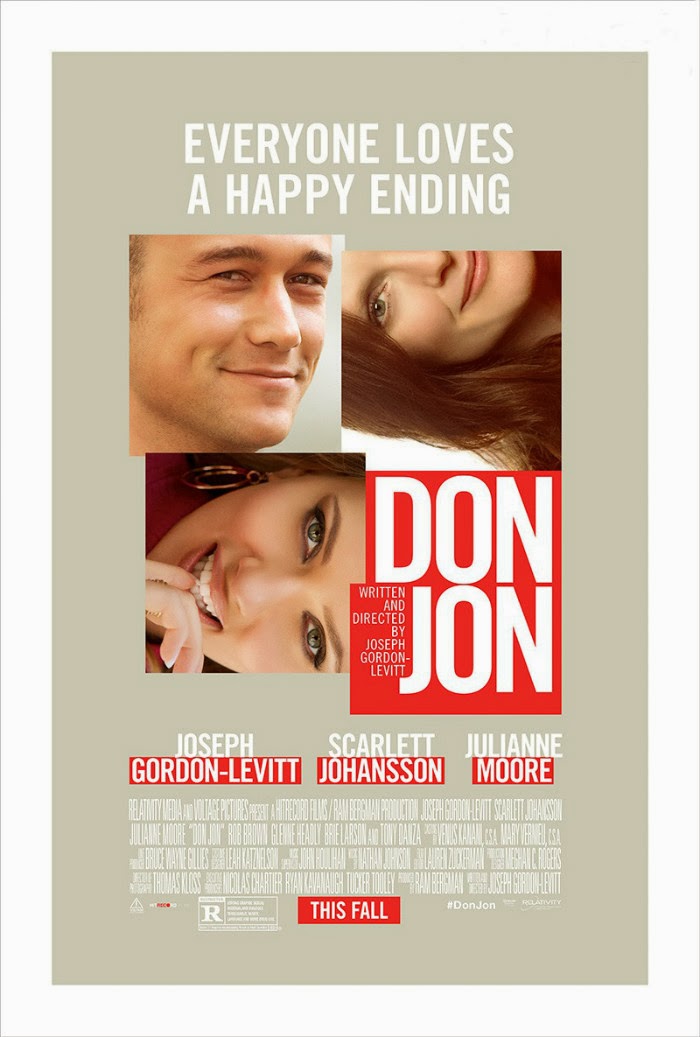
DON JON (US - 2013)
In films both small (MYSTERIOUS SKIN, THE LOOKOUT) and huge (INCEPTION, THE DARK KNIGHT RISES), Joseph Gordon-Levitt has built a solid reputation as one of the most gifted, natural actors of his generation. He's also an immensely likable guy, though he does seem to occasionally try a little too hard to please, so it's nice to see that his debut as a filmmaker--directing, writing, and starring in DON JON--is indicative of a confidant and assured talent behind the camera as well, the work of someone who's clearly spent a lot of time on movie sets observing and learning from others. It's to Gordon-Levitt's credit that DON JON isn't the vanity project that it could've been, though it's not quite as deep and meaningful as its creator intended. In a role originally planned for Channing Tatum but taken over by Gordon-Levitt himself, the actor plays Jersey meathead Jon, a cartoonish pussy hound who enjoys the simple things in life: working out, clubbing with his bros (Rob Brown, Jeremy Luke), and getting laid. He also has a serious pornography addiction that's rendered real sex with real women unsatisfying, and he goes to church every Sunday to confess his sins, which are usually limited to out-of-wedlock sex and how many times he masturbated to online porn. Thinking a meaningful relationship will make the sex more fulfilling, Jon pursues Barbara Sugarman (Scarlett Johansson), a gum-smacking Jersey goddess who tries to mold him into her image of the perfect guy, including making him watch insipid romantic comedies and badgering him into taking night classes to better himself. While the sex is OK--he laments that she won't do anything but missionary and refuses to give him blowjobs--he genuinely loves her but can't resist the temptations of the anything-goes, money-shot netherworld that awaits him on his laptop.
Gordon-Levitt is good as the conflicted Jon, who's not quite as dumb as he tries to make himself look. He and Barbara exists in one of those Italian-American Jersey enclaves firmly devoted to tradition and remaining largely unchanged over the decades: other than the HDTV and Jon's morose sister (SHORT TERM 12's Brie Larson) silently texting, Jon's parents (screeching Glenne Headly and a bloviating Tony Danza) live in a house that looks like it's frozen in 1980, with Jon Sr. generally wearing a wifebeater with a football game blaring in the background and Mom wanting nothing more than grandchildren (the first thing out of Jon Sr.'s mouth when he hears the name "Barbara Sugarman" is "She a Jew? She sure as hell ain't Italian"). Though very light on explicitness, there's a hard-R boldness to DON JON in its dialogue and in Gordon-Levitt's decision to play a character that constantly straddles the line between likable mook and a lunkheaded Neanderthal. A late-film subplot involving Julianne Moore as a middle-aged classmate is well-played by Moore but its transformative effect on Jon doesn't really ring true, nor does his falling head over heels for Barbara, who almost immediately comes off as a manipulative, ballbusting cliché. DON JON is a credible directing debut for its talented star, but it plays a lot like the kind of diverting but generally forgettable indie that Miramax would've bought at Sundance in the '90s. (R, 90 mins)
DARK TOUCH (France/Ireland/Sweden - 2013)
Since working for her mentor Francois Ozon as an actress (1997's SEE THE SEA, 1998's SITCOM) and as a writer (2002's 8 WOMEN), Marina de Van has demonstrated a no-holds-barred penchant for in-your-face provocation. 2002's IN MY SKIN, her profoundly disturbing directing debut, found the writer/star crafting an almost Cronenbergian take on self-harm and body image, with de Van casting herself as a young woman whose leg injury leads to self-mutilation and eventually graduating to consuming her own flesh. 2009's double-identity head-games thriller DON'T LOOK BACK was purported to be her "maturing" work, though it comes off as a bit too ponderous and gimmicky despite strong performances from Monica Bellucci and Sophie Marceau. Apparently staying behind-the-camera full-time now (she hasn't acted since 2007), de Van returns with DARK TOUCH, which has an almost mainstream air about it (it's also her first English-language film) while still dealing with sensitive and uncomfortable issues. Opening in a disorienting, in medias res cacophony of confusion, 11-year-old Niamh (Missy Keating) flees her house and takes refuge with neighbors/family friends Nat (Marcella Plunkett) and Lucas (Padraic Delaney). Niamh's tongue is cut and she's covered in bruises, which are explained away by her parents Maud (Catherine Walker) and Henry (Richard Dormer) when they arrive to pick her up. The next night, a supernatural force invades Niamh's house, destroying the interior and brutally killing her parents. Her infant brother, also seen covered in bruises, dies as a result of Niamh clutching him too tightly while escaping the destruction. The local Garda attribute it to a home invasion, but nobody seems to do much investigating as Niamh temporarily moves in with Nat and Lucas, who have two children of their own and recently lost their oldest daughter--around Niamh's age--to cancer. Niamh remains unreceptive to any kind of affection and soon demonstrates a telekinetic, CARRIE-like ability to move objects as well as possessing a strange, psychic hold over other children when she feels threatened by them.
Young Keating is very impressive in a demanding, difficult role, and de Van succeeds in weaving a thorny subtext into what plays very much like a commercial horror film. The abuse Niamh endures at the hands of her parents has generated an uncontrollable telekinetic ability born of sheer rage, and it's an anger she uses to take on the adults in her town, even ones like Nat and Lucas, who are trying to help her but don't really know how. Feeling almost like it could've been a British or Italian fright film made in the 1970s, DARK TOUCH uses the classic tropes of the "evil children" subgenre--in addition to CARRIE, you'll spot elements of ORPHAN (2009), Tom Shankland's little-seen gem THE CHILDREN (2009), the OMEN-inspired British cult favorite THE GODSEND (1980), and Narciso Ibanez Serrador's WHO CAN KILL A CHILD? (1976)--to show the horrific effects of child abuse on the victims and those around them. It works merely on a surface level, but de Van is digging for something more and doesn't always find it. Some plot threads are underexplored, perhaps intentionally, and some may find the loose ends frustrating. It's not the confrontational galvanizer that IN MY SKIN was, but de Van continues to be a bold, ballsy voice in European cinema. (Unrated, 92 mins)
Directed by Peter Hyams. Written by Eric Bromberg & James Bromberg. Cast: Jean-Claude Van Damme, Tom Everett Scott, Orlando Jones, Linzey Cocker, Christopher Robbie, Kris Van Damme, Zahari Baharov, Dimo Alexiev, Vladimir Mihaylov, Teodor Tzolov. (R, 85 mins)
Back in the late '80s, Jean-Claude Van Damme built his fan base and became a star the old-fashioned way: by working his ass off. As he graduated from low-budget B-movies that became surprise box-office hits (1988's BLOODSPORT, 1989's CYBORG) to bigger-budgeted A-list fare (1992's UNIVERSAL SOLDIER, 1993's HARD TARGET, 1994's TIMECOP), he became a proven player with a solid track record. By 1996, he had enough clout that Universal let him star in and direct his pet project THE QUEST, and then it all started to implode. THE QUEST bombed, followed by tabloid fodder like multiple marriages, stories of drug abuse and being labeled "difficult." In his memoir My Word is My Bond, THE QUEST villain Roger Moore offered this observation on being asked what it was like working with Van Damme: "I've always believed that if you can't say something nice about someone, don't say anything at all. So I'll say nothing at all." The movies kept tanking (1997's DOUBLE TEAM, 1998's KNOCK OFF), LEGIONNAIRE (1998) went straight to video, and the "Muscles from Brussels" was becoming something between an industry pariah and punchline. After 1999's last-ditch, desperation Hail Mary UNIVERSAL SOLDIER: THE RETURN, Van Damme's movies started bypassing theaters altogether. But then a funny thing happened: he straightened up his act, settled down, and focused on his work, and the movies were often shockingly good. Much like his earlier days, Van Damme was once more building his career by word-of-mouth: low-budget B-movies like the gritty IN HELL (2003), WAKE OF DEATH (2004), UNTIL DEATH (2007), and THE SHEPHERD (2008) are as good as, if not better, than many of the films from his theatrical heyday. The 2008 meta/mockumentary/confessional JCVD got some acclaim but didn't open any serious doors for him, and after a few more quality DTV outings like UNIVERSAL SOLDIER: REGENERATION (2009) and ASSASSINATION GAMES (2011), Van Damme was invited back to the big screen to play the villain in THE EXPENDABLES 2 (2012), and the Van Dammessaince was on. The brilliant UNIVERSAL SOLDIER: DAY OF RECKONING (2012) managed to get raves from serious cineastes, and a recent Volvo commercial became a viral sensation. Everyone loves an underdog, and once more, after years of hard work and rebuilding his reputation, the 53-year-old Van Damme has engineered the quietest comeback in recent memory, even if some are approaching it ironically. He never went away--it's just that he managed to accomplish some of his best work when the industry dismissed him and no one was paying attention.
I've been saying for years that Van Damme would make a great Bond villain, and THE EXPENDABLES 2 did a nice job of demonstrating that. His latest film, ENEMIES CLOSER, again finds JCVD in bad-guy mode, with the initial focus on Henry Taylor (Tom Everett Scott), a ranger at a park near the US/Canada border. He's the only employee and lives in the ranger station, with only one other resident--cranky old Mr. Sanderson (Christopher Robbie)--living on the other end of the park. Taylor prefers the solitude after dealing with the emotional and physical scars of time spent in the military, serving in Afghanistan. After helping stranded hiker Kayla (Linzey Cocker), the two make a dinner date, but it's put on the backburner when Taylor is approached at gunpoint at the ranger station by Clay (Orlando Jones). Clay has a personal beef with Taylor: his younger brother was killed in Afghanistan and Taylor was his commanding officer. Taylor tries to explain that Clay's brother got separated from their group and he was given orders to leave him behind. Taylor had a breakdown and spent years blaming himself and the ranger job was as far as he could run from the world. Clay doesn't buy any of it and takes him out to the deep woods to execute him.
Meanwhile, a plane filled with a large heroin shipment has crashed in the lake surrounding the island park. Just as the skeleton crew of border patrol officers ("It's just us...they only care about the Mexican border!" one officer laments) goes to investigate, they're massacred by Xander (Van Damme), the eccentric, environmentally-conscious, vegan cartel boss who's introduced talking about his refusal to wear leather shoes and the methane in cow farts. Xander and his crew encounter Taylor and Clay just as Clay's about to kill Taylor. Shots are fired, and the hunt is on as Xander and his crew start pursuing Taylor and Clay through the massive park, forcing the two men to set aside their differences and work together...
...if they don't kill each other first!
The script by Eric and James Bromberg has a lot in the way of logic lapses--why would Taylor and Clay leave Xander's last remaining henchman merely knocked out instead of killing him like they did all the others? (this flunky is played by JCVD's son Kristopher Van Varenberg, who's now just cutting the shit and going by "Kris Van Damme"; Van Damme keeps putting his kids in his movies, and it needs to stop, though Kris is a marginally better actor than his sister Bianca Bree). Why, you ask? Well, so he can pull a surprise appearance just when he needs to, and prompt Clay to grumble "I shoulda killed you when I had the chance." YES, YOU SHOULD HAVE! The Sanderson character is absolutely pointless and there's no shortage of trite dialogue when Van Damme is offscreen (at one point, Clay says "I didn't prepare for a war," to which Taylor actually replies "This war came to us"). There's a third-act twist that you'll see coming long before Taylor and Clay do, but for all its predictability and occasional stupidity, ENEMIES CLOSER is entertaining thanks to a completely unhinged performance by Van Damme. Sporting a bizarre hairstyle that looks like Christopher Walken in a high humidity climate, mugging shamelessly, complaining that Taylor's coffee isn't fair trade, and prone to waxing rhapsodic about a childhood that included a pet goose named Edith Piaf, Van Damme sinks his teeth into this thing, devouring every bit of scenery that he can. It's a thoroughly cartoonish performance that's engineered to go over the top, and seeing Van Damme do his best "Gary Oldman-in-THE PROFESSIONAL" is impossible to resist.
This is the star's third collaboration with veteran director Peter Hyams (TIMECOP, SUDDEN DEATH), a past master of commercial genre fare, with BUSTING (1974), CAPRICORN ONE (1978), OUTLAND (1981), and RUNNING SCARED (1986) to his name. Now 70, Hyams was once respected enough in the industry to be entrusted with helming 2010, the surprisingly solid 1984 sequel to Stanley Kubrick's 2001: A SPACE ODYSSEY (1968), but he's been skidding for well over a decade, hitting bottom with A SOUND OF THUNDER (2005), a complete disaster that was abandoned by its producers and actually released with unfinished special effects after three years on the shelf. ENEMIES CLOSER is no Hyams classic, but it's his best film since 1997's THE RELIC. He doesn't really bring any distinct touches (Hyams in his 1974-1986 prime, when he was scripting his own films, had a distinct "Hyams" feel--just check out Hal Holbrook's incredible CAPRICORN ONE monologue), other than having one character named "Spota," a name that turns up in many of his films (it's his wife's maiden name). Van Damme and Hyams obviously like one another and enjoy working together, and Van Damme has also starred in three films directed by Hyams' son John, including the instant cult classic UNIVERSAL SOLDIER: DAY OF RECKONING. John Hyams served as editor on ENEMIES CLOSER, and the film, shot in Bulgaria and Louisiana, feels more in line with the current crop of high-end DTV fare cranked out by the likes of John Hyams and Isaac Florentine. It's probably a good bet that a lot of that was achieved in the editing stages with John helping his old man out. Peter Hyams is more than capable of pulling off a high-intensity action flick, but in the many fight scenes, the influence of John Hyams, who's becoming a genuine action auteur in his own right, is very obvious.
It's too bad Lionsgate and After Dark Films aren't capitalizing on the Van Dammessaince and giving this a bigger rollout than a handful of theaters and VOD, but given the tepid commercial response to the recent string of quality aging action star vehicles that don't feature the word "expendables" in the title, you can't really be surprised. Sure, Van Damme doesn't have--and probably never will have--the box office pull that he once did, and nobody in 2014 is going to the multiplex to see Tom Everett Scott or Orlando Jones, but it's just a bit disheartening to see the company dump this one off but put I, FRANKENSTEIN on 3000 screens.
One of the most acclaimed films at Sundance in 2013, IN A WORLD... is exactly the kind of movie that plays better at film festivals than in commercial release. It's pleasant, occasionally amusing, and it's made with the best intentions. There's nothing egregiously wrong with it, but it doesn't really do anything with its ideas and is rather slight and forgettable by the end. CHILDREN HOSPITAL's Lake Bell, a proven comic and dramatic performer who rarely gets the attention she deserves, writes, directs, and stars in this labor of love as Carol, a Los Angeles-based vocal coach who specializes in helping actors nail accents (she's introduced getting a voice mail from a sound mixer who needs her to work with Eva Longoria on a period film, as her Cockney accent "sounds like a retarded pirate"). She's successful in her field, but lives in the shadow of her legendary father Sam (Fred Melamud), a famed movie trailer voice who had a mentor in the late, great Don LaFontaine (Bell opens the film with a nice tribute to that great "In a world..." voice). She lives with Sam, a widower who promptly kicks her out so his one-year-younger-than-Carol girlfriend Jamie (Alexandra Holden) can move in. While working with Longoria in the studio where the actress has to re-loop her entire performance, Carol narrates a trailer as a goof, and she nails it so well that she finds herself in the running to voice the trailer for the Cameron Diaz blockbuster "AMAZON GAMES quadrilogy," which puts her in conflict with her dad and Gustav (Ken Marino), the other main voice in the trailer business.
Movie buffs will appreciate the occasional glimpses at the inner workings of the voiceover industry, but too much of IN A WORLD... is devoted to standard-issue rom-com stuff, with Carol falling for sound mixer Louis (Demetri Martin) and trying to patch things up between her sister Dani (Michaela Watkins) and her husband Moe (Rob Corddry) when concierge Dani fools around with AMAZON GAMES director and hotel guest Terence Pouncer (Jason O'Mara), plus some easy jabs at THE HUNGER GAMES and L.A. women with "sexy baby voices" who talk like every sentence ends with a question mark? Bell and Watkins have a nice sibling chemistry, Holden's Jamie is unpredictably handled in the way she legitimately loves Sam and is not just drawn by his fame, and Melamud has a voice that was made for trailers (Marino, however, does not), but the whole "female empowerment" message that Bell is going for is too heavy-handed by the end, and she can't resist the indie hipster crutch of using '70s and '80s hits ironically (Dani and Moe reconcile to the tune of Gerry Rafferty's "Right Down the Line," and Carol and Louis' night out is a montage set to Tears for Fears' "Everybody Wants to Rule the World," for some reason). In the end, there's a few chuckles for film dorks, but that's ultimately the biggest problem. Bell got all of her cult comedy friends together (there's also supporting turns by Nick Offerman, Stephanie Allynne, Tig Notaro, and Jeff Garlin, plus Geena Davis as a ballbusting movie exec), and it grossed $3 million on 144 screens against a $1 million budget, but its appeal is too narrow. It feels like the kind of movie Tom Dicillo made in the '90s that nobody outside the industry gave a shit about. Bell is a charming and immensely likable actress, but IN A WORLD... too often comes off like little more than a rejected IFC pilot. (R, 93 mins)
SUNLIGHT JR. (US/UK - 2013)
Here's another example of a well-intentioned film that just has no chance once it's away from the secure and loving embrace of the film festival circuit. It was a major title at last year's Tribeca fest, and it's the kind of offering that the indie and the festival scene just eats up: gritty subject matter, socially and culturally relevant themes, name actors working for scale or less and getting their hands dirty on a pack-your-own-lunch labor of love that shows how serious they are about their craft...and it was ultimately given a zero-publicity VOD dumping while only playing on a few screens nationally. Written and directed by SHERRYBABY's Laurie Collyer, SUNLIGHT JR. stars Naomi Watts and Matt Dillon as Melissa and Richie, a severely down-on-their-luck Florida couple who've been beaten to shit by life: he's a hard-drinking paraplegic living disability check to disability check, fixing VCRs and siphoning gas from cars, and she's supporting them by scrambling for shifts at a rundown convenience store called Sunlight Jr., where she's routinely hassled by her stalker ex Justin (Norman Reedus), who demonstrated his love by routinely beating her and getting her hooked on prescription painkillers. They live in a fleabag motel but they're happy together, and that happiness intensifies when she discovers she's pregnant. But, since this is a depressing indie drama that could almost be called BLUE VALENTINE: THE LATER YEARS, that joy is short-lived as her asshole boss (Antoni Corone) threatens her job and Justin's behavior grows more menacing now that his restraining order's been lifted.
Watts, Dillon, and the film are moving along just fine until the pregnancy, when Collyer just starts piling on one misfortune after another in a way that crosses the line from realism into deck-stacking misery porn. The problems with her boss exist only to make the story take a more miserable turn. It's a corporate chain--as evidenced by a company HR rep visiting to administer drug tests--so there's no reason Melissa can't tell someone higher-up that she's being sexually harassed by her boss ("Are those pants wet because of me?" he asks Melissa after she walks to work in the rain), and his other managerial practices are flat-out abusive and intimidating. And given Justin's behavior, there's no valid reason for the restraining order to be lifted other than Collyer needs him to show up at Sunlight Jr to cause dramatic conflict and offer Melissa some painkillers. And later, when they're kicked out of the motel and have to move in with her alcoholic mother (Tess Harper) and her brood of unruly foster kids that she lets run wild so she can keep the foster care checks coming in, there's not only Richie's ramped-up boozing and the foster kids being bitten by bedbugs, but also the mom's asshole landlord--who else?--JUSTIN! To Collyer's credit, she doesn't turn Melissa and Richie into martyrs or succumb to white trash caricaturing, and she does a commendable job of capturing the atmosphere of crippling economic depression, shooting in locations that look like a desolate wasteland of homeless people, closed-down strip malls with weeds growing through the concrete, pawn shops, flea markets, and dive bars. Watts and Dillon are excellent until the plot developments start threatening to turn the characters into cardboard cutouts; Watts perseveres but Dillon can't do much with the clichéd arc undergone by Richie. SUNLIGHT JR sometimes falls victim to ham-fisted melodrama, but there's a lot of positives to be found with the performances, a very Ry Cooder-ish score by J. Mascis, and Collyer's compassionate depiction of a struggling underclass. (Unrated, 95 mins)
Directed by George Pan Cosmatos. Written by Tom Mankiewicz, Robert Katz and George Pan Cosmatos. Cast: Sophia Loren, Richard Harris, Burt Lancaster, Ava Gardner, Martin Sheen, O.J. Simpson, Ingrid Thulin, Lee Strasberg, Lionel Stander, Ann Turkel, Lou Castel, John Phillip Law, Ray Lovelock, Alida Valli, Tom Hunter, Stefano Patrizi, Carlo De Mejo, Fausta Avelli, Angela Goodwin, Renzo Palmer, John P. Dulaney. (R, 129 mins)
SPOILERS DISCUSSED THROUGHOUT
Disaster movies were one of the signature genres of 1970s cinema. Though the concept wasn't new and dated back to the early days of the movies to SAN FRANCISCO (1936) and 1950s hits like THE HIGH AND THE MIGHTY (1954) and ZERO HOUR! (1957), and would continue later with the likes of ARMAGEDDON (1998), THE DAY AFTER TOMORROW (2004) and 2012 (2008), the subgenre really exploded in the 1970s. Starting with box-office blockbusters like AIRPORT (1970), THE POSEIDON ADVENTURE (1972) and THE TOWERING INFERNO (1974) to less-popular but still entertaining later offerings like the sniper-in-a-football-stadium TWO-MINUTE WARNING (1976), the Goodyear Blimp-blowing-up-the-Super Bowl BLACK SUNDAY (1977), and the mad-bomber-terrorizing-amusement-parks ROLLERCOASTER (1977), disaster films showcased then-state-of-the-art special effects depicting catastrophes both natural and man-made, and a large cast of stars both current and from Hollywood's golden age. The incredible success of these films spawned countless imitations, from exclamatory made-for-TV disaster movies like HEAT WAVE! (1974), FLOOD! (1976), and FIRE! (1977) to drive-in exploitation like THE BEES (1978) and AVALANCHE (1978) to the inevitable foreign-made ripoffs with films like TIDAL WAVE (1975), which inserted new footage of Lorne Greene into a Japanese disaster movie; the Italian oil fire thriller OIL (1977); the Canadian city-on-fire thriller CITY ON FIRE (1979); and the Italian/Brazilian co-production KILLER FISH (1979), which involved an emerald heist, a laughable tornado, and a river filled with hungry piranha. It's unfortunate that most of these films lacked the hyperbolic punctuation that the TV movies used--think how much better KILLER FISH would be if it was called KILLER FISH!
In addition to the mandatory "faces in boxes" poster design, disaster movies frequently featured supporting roles for an off-season or retired sports star, usually from the NFL, such as Rosey Grier in SKYJACKED (1972), O.J. Simpson in THE TOWERING INFERNO, Alex Karras in WHEN TIME RAN OUT (1980), and then-Houston Oilers quarterback Dan Pastorini in the aforementioned KILLER FISH, as well as college football star Mark Harmon in BEYOND THE POSEIDON ADVENTURE (1979). Other such stunt casting included the likes of fake evangelist-turned-actor Marjoe Gortner in EARTHQUAKE (1974), singer Helen Reddy in AIRPORT 1975 (1974), and game-show host and frequent TONIGHT SHOW guest host John Davidson--the Ryan Seacrest of the 1970s--in THE CONCORDE: AIRPORT '79 (1979). Audiences grew tired of the increasingly silly and often shoddy spectacles (how can we forget 1978's THE SWARM or 1979's METEOR?) and the demand for these things vanished. Kinji Fukasaku's mega-budget Japanese epic VIRUS (1980), featuring such stars as Glenn Ford, George Kennedy, Henry Silva, Sonny Chiba, and Robert Vaughn, was perhaps the most ambitious disaster film of them all, but couldn't find a US distributor even with a sappy Janis Ian theme song, and was cut by nearly an hour and drastically re-edited before going straight-to-video in 1984 (Fukasaku's complete 155-minute version is a masterpiece). By the time so-called "Master of Disaster" Irwin Allen, the man behind THE POSEIDON ADVENTURE, THE TOWERING INFERNO, and THE SWARM, unveiled the volcano epic WHEN TIME RAN OUT, the title could've applied to the genre itself, especially when it was expertly parodied that same year by AIRPLANE!, from the gathering of stoical, serious actors known for their stern gravitas (Peter Graves, Leslie Nielsen, Robert Stack), right down to the casting of NBA legend Kareem Abdul-Jabbar as himself, moonlighting as a pilot named "Roger Murdock." Disaster movies, at least in their 1970s incarnation, were done.
These films always had eclectic casts populated by actors you'd never expect to find working together (THE CONCORDE: AIRPORT '79 managed to get Alain Delon, Charo, Jimmie Walker, and Sylvia Kristel in the same movie), but the British/Italian/West German co-production THE CASSANDRA CROSSING provides a bizarre mix of international A-list, Hollywood old guard, Eurocult regulars, and one vacationing football star nearing the end of his playing days. It's not often you see people like O.J. Simpson and Martin Sheen mixing it up with the likes of THE LIVING DEAD AT MANCHESTER MORGUE's Ray Lovelock and FISTS IN THE POCKET's Lou Castel. Like many of its genre brethren, THE CASSANDRA CROSSING offers multiple problems for its heroes to conquer and is actually two disaster movies in one: first a terrorist exposed to a deadly plague stows away on a Geneva-to-Stockholm train, then the US military tries to contain the disease by intentionally diverting the train to an unsafe bridge in the hopes that it will collapse, killing all the passengers and making for a nice, convenient cover-up. There's a level of cynicism in THE CASSANDRA CROSSING that doesn't exist in other disaster movies. The US government is the villain here, and it's interesting that it's represented by Burt Lancaster, who starred in the same year's TWILIGHT'S LAST GLEAMING, a bile-soaked screed of a conspiracy thriller that depicted the US President's own cabinet members sending the newly-elected and earnestly naïve Commander-in-Chief (Charles Durning) to his own execution when he decides to go public with his predecessors' classified memos that will expose the truth about America's Vietnam policies. He's advised against it by those in his inner circle, old men who tell him "This is just how it's always been," and he pays the price for breaking tradition.
In CASSANDRA, Lancaster's Col. Mackenzie is dispatched to the World Health Organization headquarters in Geneva after three Swedish terrorists (Castel, Stefano Patrizi, and Carlo De Mejo) infiltrate the building and the resulting shootout ends up exposing them to a strain of pneumonic plague that's been developed--illegally and in secret--by the US government and stored in a lab on the premises. De Mejo is killed by a guard, Patrizi is wounded and captured, and Castel escapes. Mackenzie, his aid Major Stack (John Phillip Law), and WHO-based Dr. Stradner (Ingrid Thulin) get no information out of Patrizi before he dies, and Mackenzie orders the body burned. Castel, the lead terrorist, makes his way to a nearby train station and sneaks aboard the express going to Stockholm. It's here where CASSANDRA, for a while at least plays out as your standard issue '70s disaster epic. The major players onboard are renowned neurosurgeon Dr. Jonathan Chamberlain (Richard Harris); his romance novelist ex-wife Jennifer (Sophia Loren); requisite elderly con man Herman Kaplan (Lee Strasberg); hippie lovebirds Tom (Lovelock) and Susan (Ann Turkel); a grandmother (Alida Valli) and her granddaughter Katerina (Fausta Avelli); wealthy Nicole Dressler (Ava Gardner, also in EARTHQUAKE and CITY ON FIRE), wife of a German arms magnate, along with her heroin-addicted, drug-dealing boy-toy Robby Navarro (Sheen); and Haley (Simpson), an incognito-as-a-priest Interpol agent tailing Navarro. The script by Tom Mankiewicz, Robert Katz, and director George P. Cosmatos (who would go on to Hollywood blockbusters like 1985's RAMBO: FIRST BLOOD PART II and 1993's TOMBSTONE) spends a little too much time on the soapier elements of Jonathan and Jennifer's inevitable rekindling of their romance (they've already been divorced twice), but once the terrorist makes his way through the train, quickly infecting many of the passengers, things pick up considerably.
Oddly, the plague part of the film is resolved rather quickly. Chamberlain, in conference with Dr. Stradner, concludes that in a highly-oxygenated environment like a train, the disease will eventually run its course and people will recover unless, like the terrorist, it was directly absorbed into the bloodstream. The terrorist eventually dies, but those onboard who are afflicted soon find themselves on the mend. That's not good enough for Mackenzie, who orders the train to be diverted to a quarantined area--a former concentration camp--that will require it to cross a condemned bridge that hasn't been used since WWII. Of course, his intention--his orders--are to bury this incident by any means necessary, as the US was illegally developing deadly germ warfare in Geneva and keeping it secret. Mackenzie has the train met in Nuremberg by a team of 40 Army officers in HazMat suits led by Col. Scott (Tom Hunter). Scott's job is to keep everyone onboard and kill anyone who tries to get off the train. So, about midway through the film, with the plague story wrapped up, the action now centers on Chamberlain leading a passenger revolt against Scott and his goons and stop the train before it reaches the Cassandra Crossing.
Make no mistake, the bulk of THE CASSANDRA CROSSING is, like most of its disaster contemporaries, silly and illogical. Many of the actors on the train don't seem to be on the same page as far as what kind of movie they're in: Harris, Sheen, and Simpson play it straight and serious (as seriously as O.J. dressed as a priest can be taken), while Gardner, perhaps still amused by being cast as Lorne Greene's daughter in EARTHQUAKE, is glib and snarky at all the wrong times. Loren doesn't really have much to do other than look glamorous in soft focus, which Cosmatos ensures since her husband Carlo Ponti was the producer (Loren's introduction, where she's given numerous close-ups from various angles, is a bit excessive and obviously done to please Ponti). Strasberg's con man character keeps trying to sell phony watches, while you could make a drinking game out of how many times Valli helplessly says "Katerina!" to no one in particular after she gets separated from the little girl. And my God, I haven't even gotten to the song.
Any self-respecting '70s disaster movie had the mandatory maudlin theme song, like "The Morning After" from THE POSEIDON ADVENTURE and "We May Never Love Like This Again" from THE TOWERING INFERNO. Both of those songs were sung by Maureen McGovern and both won Oscars for Best Original Song. THE CASSANDRA CROSSING gives us a fine Ennio Morricone-esque score by Jerry Goldsmith, but also offered co-star Turkel--who was married to Harris at the time--singing something called "I'm Still on My Way," and she sings it early in the film, as she and Lovelock and some other hippie pals are jamming in one of the train cars. And just when you think it can't get any sillier, train conductor Max (Lionel Stander) takes a break from his duties to just hang out with them. It seems unnecessary to mention that their efforts were not rewarded with a Best Original Song Oscar. It's easily the worst scene in the film, and one that completely stops it cold and one that I never knew existed until I saw it on Turner Classic Movies some years back. For decades, I only knew the version that aired on NBC and in syndication, which mercifully cut that scene out entirely. Also absent from the television version are some gory bits from the finale, as the train indeed crashes and a good chunk of the passengers die horribly violent deaths: watch for the train rail cutting through a car and impaling a passenger right through his gut, yet another example of this film's unrepentant mean streak.
THE CASSANDRA CROSSING isn't the best of its type, but it's maintained a well-deserved cult-following over the decades, primarily for its unusual international cast and because it works very well as an entertaining thriller. But if you approach it from the angle of Lancaster's Mackenzie, there's some unexpected depth to the film. Of course, an old pro like Lancaster knows just how to play the various subtleties and nuances, and perhaps there wasn't anything in the script and he simply took it upon himself as an experienced actor to make something out of nothing. At the conclusion of the film, after telling Dr. Stradner "I know you see me as some kind of monster," and essentially saying he did what he had to do, you can see the sadness in Lancaster's eyes and it's the first moment in the film that Mackenzie seems remotely human. And in that moment, Lancaster makes us see that, like Stack and Scott and those under him, he's just a part of the machine. Lancaster nails it when he's about to leave the building. Stack offers to take him to a nearby bar and buy him a drink. Mackenzie says nothing, putting on his coat and unconsciously reaching for his uniform service cap, stopping himself, and going for his fedora instead. It's not that he isn't worthy of wearing it. No, he was a good soldier who followed orders. He's just too sickened by those orders to wear it, and by rejecting it, he retains some semblance of humanity. And as Mackenzie leaves the room without saying a word and heads down a long hallway to the exit, Stack can be heard on the phone with an unknown superior: "He's leaving right now. Yes, he and the doctor are both under surveillance." Mackenzie is as expendable as the people killed in the bridge collapse and he likely isn't making it to his next destination. In that closing scene, using no dialogue, Lancaster's aging face perfectly illustrates a career military man who served his country only to be made a fall guy who knows shit rolls downhill and it's coming straight for him. In that respect, THE CASSANDRA CROSSING--or, more accurately, Lancaster's sequences in it--makes for a fascinating companion piece to TWILIGHT'S LAST GLEAMING, where he played another soldier who just followed orders issued down a corrupt chain of command until his conscience could no longer allow it.