You'd be able to spot the David Cronenberg influence on ANTIVIRAL even without the knowledge that it's the writing/directing debut of his son Brandon. It's a good thing to say the apple doesn't fall far from the tree here. ANTIVIRAL juggles a lot of concepts--too many, in fact--but despite its minor flaws, it's one of the most original and disturbing films to come down the pike in a while, a scathing indictment of vapid celebrity culture fused with the "body horror" elements that figured so prominently in the elder Cronenberg's trail-blazing early work. In a near-future, dystopian Toronto, celebrity worship has grown so huge that bored people with too much time and money on their hands now pay to be infected with viruses harvested directly from their favorite tabloid and entertainment magazine fixtures, as a way to be "closer" to them and be "part of them." Lucas Clinic sales rep Syd March (Caleb Landry Jones) spends his days selling celebrity sicknesses to pathetic customers and his nights selling those same viruses on the black market using equipment stolen from his employers at the clinic. His most lucrative supply comes from beloved celebrity Hannah Geist (Sarah Gadon)--and it's never really specified what Hannah does--she's just always in the news. He pays her a visit to draw some blood during her latest illness (he's previously sold her various flus and even her cold sore virus to a guy who wanted to feel like he'd kissed her and contracted it). When he injects himself with the virus in order to sneak it on to the black market, he becomes violently ill and quickly realizes that something is very wrong with Hannah.
Growing increasingly horrific but not in the ways you expect, ANTIVIRAL is the kind of bleak film that really gets under your skin. While Brandon's story ideas and scripting are an inventive outgrowth of today's culture, he utilizes the clinical methodology of his father's early work. So many images recall the elder Cronenberg: the presence of THE BROOD and THE DEAD ZONE co-star Nicholas Campbell as the head of the Lucas Clinic; the cold, desolate look of Toronto, brilliantly captured by cinematographer Karim Hussain, is reminiscent of everything from SHIVERS to VIDEODROME to CRASH (there's also a lot of CRASH in the shots of endless lines of cars speeding along the freeway); Syd's black-market hustling and his business arrangement with disease dealer Arvid (Joe Pingue), who grows the viruses supplied by Syd into meat patties to sell to his customers, recalls the shady Civic TV wheeling-and-dealing of Max Renn (James Woods) and his tech-geek buddy Harlan (Peter Dvorsky) in VIDEODROME. The increasingly sickly Syd comes across like a more introverted Max Renn, and Jones (THE LAST EXORCISM), with his pale skin and sullen demeanor, reminded me of younger, vaguely androgynous Brad Pitt. Though it's a bit overlong and could've used some trimming in the second half, ANTIVIRAL is a bold and original work, despite the myriad of influences and references--in a way, it seems like it's doing the film a disservice to mention all the David Cronenberg callbacks, but it's impossible to not mention them. It's almost as if Brandon Cronenberg is carving his own path while putting all the "Yes, David Cronenberg is my father" stuff on the table from the start. For fans of the still very active Pops Cronenberg, it's reassuring to see that his legacy and the Cronenberg name will carry on at least one more generation and that his son obviously spent of lot of time observing and learning from Dad and is eager to honor that heritage. And you can't help but smile knowing how proud the old man must've been when he first saw this. Also with Wendy Crewson and Malcolm McDowell in small roles, ANTIVIRAL ranks right up there with Duncan Jones' MOON (2009) and Panos Cosmatos' BEYOND THE BLACK RAINBOW (2012) as the most promising genre debuts in recent years. It's a grim and depressing downer, but would you want anything else from a Cronenberg? (Unrated, 108 mins)
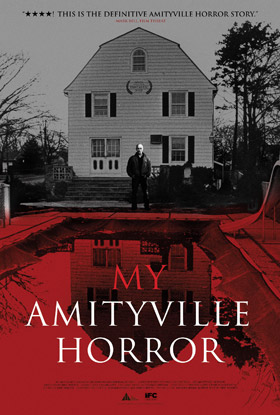
MY AMITYVILLE HORROR (US - 2013)
The alleged haunted house at 112 Ocean View Ave. in the Amityville neighborhood on Long Island has remained a pop culture phenomenon for nearly 40 years since the DeFeo murders took place in 1974. The house was purchased by the Lutz family in 1975, and they left after 28 harrowing days of unexplained and relentless paranormal phenomena. That's been the story all these years, through several books and at least ten movies, though the whole thing is largely accepted to be a hoax (none of the five occupants of the house since 1976 have reported any strange happenings). MY AMITYVILLE HORROR is a documentary that focuses on Daniel Lutz, the oldest of the three Lutz children, who was ten years old when they lived in the house. Now in his late 40s, Lutz is still traumatized by his experiences, and he still claims all of the paranormal occurrences really happened. Lutz is an angry man haunted by a painful childhood. He talks at length about his resentment of George marrying his mother Kathy (which he would only do if Kathy allowed him to legally adopt the kids as his own) and severing ties with his biological father. Lutz portrays George as a manipulative, bad-tempered, and often abusive man with an interest in the occult, with books on paranormal phenomena, hypnosis, and various religions. Psychologists and paranormal experts alike question the validity of Lutz's claims, saying that he may be confusing the incidents from the books and the movies and that the negative memories and unaddressed trauma of his childhood have convinced him of things that may not have happened.
Regardless of where one stands on the Amityville story, MY AMITYVILLE HORROR is a film that probably would've worked better as a 20/20 segment. The abrasive Lutz almost seems to be playing "Daniel Lutz" at times, a character that he's seemingly based on Ed Harris from the looks of it. Director and Amityville historian Eric Walter frequently cuts to shots of Lutz jamming and shredding on his guitar, for no apparent reason other than to kill time. Fans of the recent THE CONJURING will be interested to see Lorraine Warren (played by Vera Farmiga in the film) meeting with Lutz. Lorraine and her late husband Ed went through the Amityville house in 1976, during which time an image was allegedly captured of the "demon boy" reputed to be the ghost of the youngest DeFeo child, when it was actually a member of their own investigating team. There's some interesting observations about the power of a manipulative, controlling person on the collective psyche of a family (and it's worth noting that George Lutz died in 2006 and can't defend himself) and how that impacts entire lives (Lutz's two younger siblings declined to take part in this), but MY AMITYVILLE HORROR doesn't really have enough substance to warrant being feature-length. (Unrated, 89 mins)
This long-shelved horror/western hybrid is best known as the movie Wesley Snipes was working on in Namibia when he was indicted on federal tax evasion charges. Filmed mostly in 2006, GALLOWWALKERS (then without the "s" on the end) suspended production while Snipes returned to Florida to meet with attorneys and deal with his legal issues. The judge allowed him to return to Namibia to finish shooting and then there were additional reshoots in 2008. Snipes worked on three more films in the meantime (THE ART OF WAR II, BROOKLYN'S FINEST, and GAME OF DEATH), then served most of his three-year prison sentence before being released in April 2013. All the while, GALLOWWALKERS languished in a state of incompletion, with missed release dates in 2010 and 2011. It's finally out, quietly dumped on DVD seven years after most of it was shot, and it's hardly a triumphant "comeback" for Snipes. This was obviously an extremely troubled production and despite Snipes being allowed to go back to Namibia to finish his scenes, it's clear that the star's offscreen issues caused more of a disruption than the filmmakers let on. In its released state, GALLOWWALKERS is an incoherent mess, riddled with choppy editing, extended stretches where Snipes is offscreen, much voiceover narration by Snipes' character--almost always a last ditch desperation move to tie loose plot threads together, but that, coupled with Snipes not doing the narration is a good indication that the filmmakers were still frantically putting Band-Aids on this thing long after they lost access to their star. The plot has to do with Aman (Snipes), a bounty hunter in a strange desert purgatory where a curse put upon him causes those he kills to come back from the dead, forcing him to kill them again. He's on a quest of vengeance after his wife is gang-raped and killed by psychotic outlaw Kansa (Kevin Howarth) and his men, so he recruits hotshot gunfighter Fabulos (Riley Smith) to help him out after the undead Kansa and his zombified gang return.
It's hard telling what director/co-writer Andrew Goth is going for with GALLOWWALKERS. It's a hodgepodge of BLADE, UNDERWORLD, and splatter spaghetti western, with visual and dialogue shout-outs to Sergio Leone (Charles Bronson's classic "You brought two too many" line from ONCE UPON A TIME IN THE WEST is quoted here), and some of the surreal visuals in the very slowly-paced opening hour almost bring to mind what a hypothetical "Alejandro Jodorowsky's FOR A FEW ZOMBIES MORE" might look like. Characters wander in and out of the story, Kansa and his zombies look different from scene to scene (I think there's two concurrent timelines going on here, but it's never really clear), one guy looks like the sinewy Frank from HELLRAISER and another looks like THE TOXIC AVENGER, and other than a couple of inspired action scenes that are too little, too late, the only real positive of GALLOWWALKERS is the impressive widescreen cinematography of Namibia's stunning desert landscape. Sixth-billed Patrick Bergin, once a leading man opposite Julia Roberts and now just mixed in with no-name co-stars without even the dignity of an "and Patrick Bergin" credit, shows up for five minutes as a marshal and is immediately killed (Hollywood tried to make Bergin happen from 1991-93 and he was just flatly rejected by moviegoers--was it the mustache?), and wrestling fanatics might be interested in seeing Diamond Dallas Page in a small role, but ultimately, GALLOWWALKERS is just a misfire that was probably too doomed to salvage. The notion of Snipes as a cursed gunfighter being pursued by his resurrected victims is an interesting metaphor for a man trying to outrun the ghosts of his past, but even after seven years, GALLOWWALKERS still feels thrown-together and unfinished. It's too bad, because there's some good ideas here that Goth, for a variety of reasons (many not his fault), can't bring together. (R, 92 mins)
AFTERSHOCK (US/Chile - 2013)
Taking a break from following Quentin Tarantino around and acting like Chester to QT's Spike, Eli Roth produced, co-wrote, and stars in this would-be disaster epic that was filmed back-to-back in Chile with his still-unreleased THE GREEN INFERNO, an homage to the Italian cannibal films of the late 1970s/early 1980s. A sort-of EARTHQUAKE for the extreme horror crowd, AFTERSHOCK gets off to a laborious start, spending its interminable opening 35 minutes on what plays like a dull HANGOVER knockoff, with Roth as an American partying in Valparaiso with two Chilean friends (Ariel Levy as Ed Helms and Nicolas Martinez as Zach Galifianakis). They hook up with some girls (Andrea Osvart, Natasha Yarovenko, and Lorenza Izzo) and hit some clubs. There's drawn-out attempts at character development: Roth is a single dad, Levy is still pining for his ex, Osvart and Izzo are sisters with unresolved issues, and Martinez is an inexplicable chick magnet. Finally, a massive earthquake hits and chaos reigns as Valparaiso quickly turns into hell on earth.
To his credit, co-writer/director Nicolas Lopez gets the lead out once disaster strikes and the group finds themselves on the run from a band of thrill-killing convicts from a nearby prison, and there's an admirably cruel and unpredictable randomness to the order in which the cast members are killed off. The tag line of AFTERSHOCK's poster is "The only thing more terrifying than Mother Nature is human nature," and unlike a lot of disaster films where everyone sets aside their differences and pulls together in full "triumph of the human spirit" mode, this film opts for the misanthropic "everyone is an asshole looking out for #1" route, and in that respect, in today's culture, that's probably a little more plausible. But Lopez and Roth don't really explore the psychological elements that they hint at, and it takes so long to get to the main plot that once it gets going, it feels like they're in a rush to get to the end. They get lazy (watch how the streets go from jam-packed to empty with no explanation) and a plot twist involving an additional character who joins the group doesn't really make much sense. There's some scattered moments in AFTERSHOCK that work very well on a visceral level for gorehounds (one person poking their head out of a manhole cover only to have it immediately squashed by a speeding car), and Hungarian actress Osvart seems to be trying a lot harder than any of her co-stars, but a lot of the CGI effects are weak and it feels less like a cohesive film and more like an excuse for Roth and his boys to party in Chile (and not just the boys: Selena Gomez has a pointless cameo) and shit out a movie in their spare time. Most of the same cast and crew worked on THE GREEN INFERNO, so let's hope everyone was a little more focused when they made that one. (R, 89 mins)
Directed by Baltasar Kormakur. Written by Blake Masters. Cast: Denzel Washington, Mark Wahlberg, Paula Patton, Edward James Olmos, Bill Paxton, James Marsden, Fred Ward, Robert John Burke, Greg Sproles, Patrick Fischler, Azure Parsons, Ambyr Childers. (R, 110 mins)
We don't get nearly as many buddy/action movies of the 48 HRS/LETHAL WEAPON sort as we did back in the '80s and '90s...you know, the wisecracking, foul-mouthed, excessively violent sort of actioner where two mismatched heroes have to set aside their differences while still constantly busting one another's balls to take on a common enemy...if they don't kill each other first!2 GUNS is that sort of movie, and while it's not creative in the slightest, it's a likable diversion and a nice change of pace in a summer filled with too much CGI destruction and superhero burnout. It speaks volumes about today's Hollywood that something this clichéd feels like a breath of fresh air.
Denzel Washington and Mark Wahlberg are, respectively, Bobby Trench and Stig (why wasn't this called TRENCH & STIG?), two mid-level criminals trying to set up a coke deal with Mexican cartel boss Papi Greco (Edward James Olmos). Papi's feeling some heat and isn't transporting any coke, so an irate Stig decides to steal the $3 million that Papi keeps in a safe deposit box in a bank in a small Texas town near the border. Stig doesn't know that Trench is an undercover DEA agent who's spent three years infiltrating Papi's organization, and Trench doesn't know that Stig is a disgraced Naval intelligence officer, working for his C.O. Quince (James Marsden) to obtain Papi's cash to fund secret, off-the-books Naval operations. Trench and Stig blow up the bank vault and are shocked to find not $3 million, but $43 million that Papi insists is not his, setting off a war between the DEA, the Navy, the CIA, Papi's soldiers, and crazed assassin Earl (Bill Paxton), who represents the owners of the extra $40 million, a crew that even the all-powerful Papi fears, as Trench and Stig find themselves pursued and on the run, forced to set aside their differences and work together...if they don't kill each other first!
2 GUNS doesn't put forth a lot of effort and gets by primarily on the chemistry of the two stars, who seem to enjoy playing off each other. Icelandic director Baltasar Kormakur (who also directed Wahlberg in last year's CONTRABAND) does his job with a minimum of flash and style, keeping the action brisk and the insults flying in a film so formulaic that you almost expect it to already have the TNT logo in the lower right corner of the frame for the duration. With a less enthused cast, it probably wouldn't have worked, but Washington and Wahlberg play this perfectly, and sometimes a dumb action movie comes along at the right time and just fits the bill. The stars get solid support from a strong supporting cast, which also features Paula Patton as Trench's DEA partner and ex, Robert John Burke as Trench's boss, and Fred Ward as an Admiral. In the end, 2 GUNS is only slightly less generic than its title, but it's fully cognizant of what it is and concentrates on its strengths. It's rarely plausible and the biggest impact it will have from a pop culture standpoint will likely be a couple of topless Patton shots causing the Mr. Skin site to crash, but it's fast, funny, and entertaining, and at this point in the summer, that works just fine.
When Jess Franco died in April 2013 at the age of 82, cult cinema lost one of its most beloved icons, a legendarily prolific writer/director with over 200 films to his credit, but a comprehensive Franco filmography is all but impossible, given the number of unfinished films and the plethora of pseudonyms he used. Franco bounced around from genre to genre for the length of his career, sometimes for money, sometimes for personal expression, but from 1959 until his death, he never stopped working, often making multiple films in any given year (11 in 1975 alone). He's best known for his contributions to the horror genre, but he made comedies, dramas, spy thrillers, action films, erotica, and hardcore porn. Over the last couple of decades, serious film scholars have reconsidered Franco's gargantuan output and many, most notably Video Watchdog's Tim Lucas, have called him a genuine auteur. Indeed, many of Franco's self-financed films of the 1970s are some of the most aggressive examples of a filmmaker putting his obsessions front and center for everyone to see. I've always had conflicted feelings about Franco. When he had a budget, a competent crew, and real actors, he was completely capable of putting a thoroughly professional film together. His association with British producer Harry Alan Towers in the late 1960s resulted in several box office hits with actors who rarely turned down a sizable paycheck (Christopher Lee, Herbert Lom, Klaus Kinski) to others who may have been in a career slump and took what they could get (Jack Palance, Mercedes McCambridge, George Sanders, Leo Genn). But on his own, the low budgets and lack of quality control are sometimes too distracting to ignore. Franco would later express feelings of discontent working in commercial cinema, which led to his more independent films of the 1970s and beyond, but many of those "commercial" films represent his best filmmaking (1969's VENUS IN FURS is probably my favorite Franco film). Franco often had ambitions that lied beyond the capabilities of his budget (1970's COUNT DRACULA is a perfect example, finally allowing a frustrated Lee the chance to play Dracula as Bram Stoker intended, but hampered by cheap sets that appear ready to collapse around the actors at any moment). By 1970, Franco had grown tired of working for other producers and trying to make his own films while dealing with Spain's strict censorship laws. He needed a change, but had to leave Spain to do so. Two of those films are out on Blu-ray from Kino/Redemption on August 20, along with Franco's 1962 breakthrough THE AWFUL DR. ORLOF.
THE AWFUL DR. ORLOF (Spain/France - 1962)
Considered to be the first Spanish horror film, THE AWFUL DR. ORLOF owes a lot to Georges Franju's EYES WITHOUT A FACE (1960) with its central plot element of Dr. Orlof (Howard Vernon) and his deformed, blind sidekick Morpho (Ricardo Valle) murdering women in order to perform skin graft experiments to restore the disfigured face of Orlof's daughter. The Franju film would be a major influence on Franco's career, with several subsequent Orloff (the extra 'f' was added by the US distributor in 1964 and it stuck) films, all the way up to 1988's FACELESS, where murderous surgeon Helmut Berger pulls an Orloff to try and salvage his sister's scarred face, even seeking counsel from Vernon's Orloff at one point. THE AWFUL DR. ORLOF isn't very original and suffers from some clumsy exposition in spots, but it's an important film in the evolution of Spanish horror, Eurocult, and Franco himself, and looks terrific in this new Blu-ray edition. The 1.66:1 transfer looks appropriately film-like and doesn't see fit to remove every flaw and scratch in the image, but the detail is superb. Kino presents the film in its uncensored French version (with an English-dubbed option), which had two instances of nudity clumsily inserted by the French co-producers. Lucas contributes an extremely informative, exhaustive commentary that's overflowing with trivia (American expat actor Frank Wolff, best known as Brett McBain in Sergio Leone's ONCE UPON A TIME IN THE WEST, was one of the voice actors for the English-dubbed version), and comprehensively details Franco's influences for the film (Franju and THE LODGER/HANGOVER SQUARE director John Brahm being the major ones, but also classic Universal horror, Hammer, AIP's Edgar Allan Poe series, and the expanding Italian horror scene headed by Riccardo Freda and Mario Bava), the earliest examples of recurring Franco themes and archetypes (Orloff, the Morpho character, as well as incompetent police detective Tanner, played here by Conrado San Martin, would reappear in various forms in many subsequent Franco works), and the differences in the various versions of the film (the bombastic jazz score that opens the French print is significantly toned-down in the Spanish version). Despite its many derivative elements, THE AWFUL DR. ORLOF is one of Franco's most accessible and satisfying horror films, progressive in its themes and presentation but very deeply-rooted in classical and traditional horror. It was his first success and fittingly, the perfect starting point for anyone interested in exploring the director's work. The Blu-ray also features an interview with a frail-looking Franco, where he addresses his battles with the Spanish censors and his love-hate relationship with the horror genre in general, saying he wanted to be an Antonioni-style filmmaker but ended up doing other kinds of films. But, as he finally admits with a smile, "I like horror films." (Unrated, 86 mins)
NIGHTMARES COME AT NIGHT (France/Liechtenstein - 1970)
NIGHTMARES COME AT NIGHT was considered a lost film for over 30 years. Given a theatrical release only in Belgium in 1970, the film vanished from view and only when a print was discovered in the early 2000s, followed by a DVD release from Media Blasters in 2004, were Franco fans able to see it and place it in its proper context. According to Lucas' commentary on the new Blu-ray, Franco shot NIGHTMARES during some down time between two 1970 Harry Alan Towers productions--THE BLOODY JUDGE (released in the US in 1972 as NIGHT OF THE BLOOD MONSTER) and COUNT DRACULA. Franco had more personal projects in mind and by the time THE BLOODY JUDGE came around, grew tired of working in these multi-country co-productions and trying to appease the various producers involved. NIGHTMARES COME AT NIGHT serves a sign of things to come from Franco throughout the rest of his career--the more auteur side of him as a filmmaker that would explode once he met his muse and life partner Lina Romay in the next few years. NIGHTMARES stars Diana Lorys (who co-starred in THE AWFUL DR. ORLOF) as Anna, a former stripper at "a second-rate nightclub in Zagreb." She fears she's being driven insane and confides in Dr. Lucas (Paul Muller). Living with Cynthia (Collette Jack), she's haunted by vivid dreams in which she commits murder. Meanwhile, a mystery couple (Andre Montchall and Soledad Miranda, billed as "Susan Korda") watch the proceedings from a neighboring house.
If NIGHTMARES COME AT NIGHT feels disjointed and patched together, that's because it was. The scenes with Montchall and tragic Franco muse Miranda (who was killed in a car accident in Portugal the same year) came from an unfinished Franco project shot around the same time. Franco worked the footage into the film by creating a jewel heist subplot where Cynthia was in cahoots with these two and their plan is to drive Anna insane and pin the crime on her while they get away. Lucas doesn't go into this in any great detail, but there is a supplemental feature where Kino Blu-ray producer Bret Wood demonstrates how the film came from two different sources: the Lorys/Muller/Jack scenes are shot in 1.33:1 and the Montchall/Miranda scenes are shot in 1.66:1. Kino reformatted the entire film to 1.66:1 for the sake of continuity, while also pointing out that the final scene between Muller and Jack is shot in 1.66:1, indicating that Franco shot it after the fact in an attempt to bring both plots together. Of these three new Blu-rays, NIGHTMARES COME AT NIGHT probably fares the worst, though it's not really any fault of Kino's. The flaws in the visual presentation are inherent in the film itself, culled from a test print since wide-release prints were never struck and the negative is lost. By design, the dream sequences are grainy, but here, they're so grainy that it's impossible to tell what's going on. The Blu-ray offers the option of French with English subtitles or an English-dubbed track. The English-dubbed track is one of the worst I've ever witnessed, so French is clearly the way to go here.
This is the conundrum of watching Jess Franco films. Few filmmakers are given such wide leeway for sloppiness as Franco, whose status as an iconic movie maverick is often confused with his extraordinarily prolific output. Quantity is often mistaken for quality, and NIGHTMARES COME AT NIGHT may be given a bit of a pass since it was a "lost" film and fans were eager to discover it. It's really not very good at all. On his commentary, Lucas makes some credible and thoughtful arguments for Franco's recurring metaphors for Spain's fascistic government, but elsewhere, his defenses of the shoddy cinematography, mismatched footage, and haphazard construction seem like real reaches: the backdrop of Anna's dance routine is a wrinkled curtain; Lucas says that's by design but I'm going with "Franco was in too much of a hurry to give a shit about having it ironed." Devoted Franco fans insist that the amateurish filmmaking, the continuity errors, shots out of focus, the camera pointed in the wrong direction, etc are all part of some grand, subversive, Luis Bunuel master plan to mock the rules of conventional cinema. I just don't buy it. He was capable of solid filmmaking and occasionally stunning images, but he was also a guy who liked to make movies with a lot of hot, naked women (Lorys is nude for about 90% of the movie and she's spectacular). This became very apparent once Romay entered his life: it's around this time (1973's FEMALE VAMPIRE and on) that the quantity of the films becomes inversely proportional to the quality. And yet, this period is one of his most revered and Franco's personal favorite. But it's during this phase that the sloppiness becomes epidemic and he seems to be going for as many lingering crotch-zooms as possible, almost as if low-budget, pervy, DIY Franco was holding the camera with one hand and fondling himself with the other. Franco loved to make movies--all kinds of movies--and, especially in his later years, became a beloved cult figure and captivating raconteur in interviews for the many DVD releases of his films. Franco's interviews are frequently more interesting than his films. Look, I love Franco. How can you not? I could watch interviews with him all day long, but some of these films are indefensible and there seems to be a calculated movement to put him on the same iconoclastic pedestal as Orson Welles, frequently cited as "Franco's mentor," even though Franco only assisted him on two films (the unfinished-in-Welles'-lifetime DON QUIXOTE and 1966's CHIMES AT MIDNIGHT). I agree that there is something there with Franco. His more disciplined films (and something like CHRISTINA, PRINCESS OF EROTICISM--more on that shortly) prove it. But sometimes--to use but two examples, as shown in CANNIBALS and DEVIL HUNTER, Franco's two dismal 1980 contributions to the Italian cannibal craze that show jungle natives who look like they were rounded up from the nearest disco, right down to the perms, sideburns, and in one case, a visible wristwatch--shitty filmmaking is just shitty filmmaking. That said, the completists and apologists will get far more out of NIGHTMARES COME AT NIGHT than the casual viewer. (Unrated, 85 mins)
A VIRGIN AMONG THE LIVING DEAD (1973/1981) with CHRISTINA, PRINCESS OF EROTICISM (France/Liechtenstein - 1973) and A VIRGIN AMONG THE LIVING DEAD (France - 1981)
The biggest surprise in this latest batch of Kino/Redemption Franco titles has an even more complicated backstory than NIGHTMARES COME AT NIGHT. Shot in 1971 as NIGHT OF THE SHOOTING STARS but unreleased until 1973 under a handful of various titles, the film most popularly known as A VIRGIN AMONG THE LIVING DEAD is quite a revelation in this new Blu-ray edition. If you've only seen this in its mid-1980s big-box Wizard Video incarnation as A VIRGIN AMONG THE LIVING DEAD, then it's worth a reconsideration. Presented in a full-frame, washed-out, terribly-dubbed print, the old VHS edition was ejected fairly quickly when I gave it a look back in the day, not even bothering to fast-forward to the inevitable nude scenes and zombie attacks. As fans learned later on, that version was reworked from what Franco had originally intended. That version contained zombie footage directed by French cult auteur Jean Rollin (FASCINATION) in 1981, presented as dream sequences with an unconvincing double for lead actress Christina Von Blanc, as well as some softcore sex footage directed by Pierre Queret that utilized equally dubious-looking doubles for the main actors. French distributor Eurocine wanted to hop on the post-DAWN OF THE DEAD/ZOMBIE bandwagon and figured adding some nonsensically inserted zombies into an existing film would be the cheapest way to do it. Franco disowned this VIRGIN AMONG THE LIVING DEAD cut of the film, but confusion is inevitable since Eurocine also used that title on Franco's original 1973 cut, which has come to be known as CHRISTINA, PRINCESS OF EROTICISM, a misleading title that seems more fitting for a softcore porn romp than the somber, meditative art film that Franco made.
Released on DVD by Image Entertainment several years ago, the CHRISTINA, PRINCESS OF EROTICISM cut looks quite nice on Blu-ray. Flaws inherent in the print itself remain in the 1.66:1 transfer, but it looks fine. The previous DVD edition included the Rollin-added scenes as an extra, but this new Blu-ray set offers two cuts of the film: Franco's preferred CHRISTINA cut, running 79 minutes, and the 1981 Eurocine revamp A VIRGIN AMONG THE LIVING DEAD, with the Rollin/Queret scenes, running 90 minutes. It's amazing what a mere 11 minutes of padding can do to throw off the rhythm of an entire film. Despite my utmost respect for film scholars like Lucas and the many Franco fans and apologists, I've often dismissed the notion that Franco is some misunderstood genius, but watching CHRISTINA, PRINCESS OF EROTICISM, regardless of its ridiculous title, goes a long way in almost validating many of those claims. Self-financed and shot on the fly with a skeleton crew, the film is often technically inept (less than three minutes in, shooting some location footage along the coast of Portugal, a local man looks directly into the camera and quickly looks away), but has numerous moments of undeniable, poetic beauty that you'd never figure seeing given either of the film's grindhouse-ready titles. Von Blanc stars as Christina, who travels from London to Portugal upon the death of her estranged father (Paul Muller), a man she never really knew and hadn't seen since she was a small child. At her father's estate, she encounters other members of the "family," including her uncle Howard (Howard Vernon), seductive mystery woman Carmence (the stunning Britt Nichols), and grunting, dimwit handyman Basilio (Franco, billed as "Jesus Manera"). The film becomes a surreal fever dream as Christina is plagued by nightmares and nothing seems real, encounters the ghost of her father (in a great shot where they both seem to be floating through the air), leading to a terrific plot twist in the finale and culminating in a final sequence that's one of the most heartbreaking, haunting scenes in Franco's entire filmography.
Conceived as a mournful eulogy for the late Soledad Miranda (Lucas points out in his typically thorough and info-packed commentary that the footage shot along the coastal road seen in the opening credits was the same route Miranda was taking before she was killed in the car accident), CHRISTINA, PRINCESS OF EROTICISM is one of Franco's best films, even with its many gaffes and Franco self-indulgences. Sure, there's the requisite day/night continuity errors, an actress playing a corpse is seen blinking, and there's one incredibly annoying scene where Franco's Basilio laughs and giggles and makes assorted noises while Nichols' drunk Carmence rolls around on the floor in front of him for about four solid minutes of screen time, but the images captured by Franco and cinematographer Jose Climent are often breathtakingly beautiful. Watching this in its intended form, you get the impression that this is the kind of film Franco always wanted to make. This is the kind of film his devout fans are talking about when they praise him as an unheralded cinematic genius. 1970s Franco is often compared to Rollin (who also dabbled in hardcore porn when his financial situation demanded it), and for my money, Rollin was the more consistent and visionary filmmaker (his FASCINATION is a brilliant work that feels a lot like what Jess Franco might've accomplished with time, budget, a full crew, discipline, and a little self-control), but CHRISTINA, PRINCESS OF EROTICISM comes very close to that Rollin level of dream-like surrealism. It's incredibly atmospheric, at times feeling a lot like Mario Bava's LISA AND THE DEVIL (which was actually made a year later, before anyone would've had a chance to see Franco's film) with its gathering of cursed souls at an eternally damned house. I noticed this before listening to Lucas' commentary (over the CHRISTINA cut), and while he touches upon the similarities--including von Blanc's Christina having the surname "Reiner," also the last name of Elke Sommer's Lisa--he doesn't delve into them as much as I thought he would, considering his status as the world's foremost Mario Bava scholar, having written a comprehensive, 1128-page doorstop of a biography of the legendary father of Italian horror. Also contributing greatly to the hazy, dream-like aura of CHRISTINA is the score by Bruno Nicolai, which prominently features everything from the mournful vocals of Edda Dell'Orso, a frequent Ennio Morricone associate, to an all-out prog-rock freakout near the end. The schizophrenic score is as unpredictable as the film itself. CHRISTINA, PRINCESS OF EROTICISM is one of Franco's most ambitious films. If all the other alleged "classics" had the hints of greatness that this film demonstrates, I'd be onboard with the whole "Franco is a genius maverick of cinema" movement. Kino's Blu-ray presents the film with two audio options: French with English subtitles and in English. The English dub isn't quite as bad as the one on NIGHTMARES COME AT NIGHT, but it's close. Among the bonus features: an interview with Franco; a short piece detailing the various versions of the film, and five minutes of "alternate erotic footage" with Alice Arno that was shot for an unrealized third variant of the film.
The biggest bonus feature is the complete, 90-minute 1981 cut of A VIRGIN AMONG THE LIVING DEAD that was on the old Wizard Video VHS issued in 1985. Queret shot some sexually explicit footage with doubles for Vernon and Nichols--including a shot of "Vernon"'s character with an erection and turned the climactic accosting of Christina into a rape (with Vernon getting a thrusting-butt double), while Rollin shot several minutes worth of quickie zombie attack scenes that represent Christina's nightmares. These scenes were shot at the same time as Rollin's Eurocine hackjob ZOMBIE LAKE (also 1981), and feature a double for von Blanc, clearly indicated by the fact that her hair always seems to be covering her face. These inserted scenes are hastily-shot and hilariously awful (ZOMBIE LAKE was purely a money gig for Rollin, who stepped in when Franco abandoned the project over disagreements with the producers), and show that it's very easy for zombies to bust through a door when production assistants have already clearly removed the hinges. The 1981 revamp of A VIRGIN AMONG THE LIVING DEAD is barely entertaining on a bad-movie level (though with enough proper medication, I suppose it could be fun), but it's an outright travesty after seeing CHRISTINA, PRINCESS OF EROTICISM. (Unrated, 79 mins/90 mins)
Directed by Paul Schrader. Written by Bret Easton Ellis. Cast: Lindsay Lohan, James Deen, Nolan Funk, Amanda Brooks, Tenille Houston, Gus Van Sant, Jim Boeven, Victor of Aquitane, Lily Labeau, Thomas Trussell. (Unrated, 99 mins)
Despite the rollercoaster nature of his career, Paul Schrader has cemented his place in film history. As a screenwriter, he penned such influential Martin Scorsese films as TAXI DRIVER (1976), RAGING BULL (1980), and THE LAST TEMPTATION OF CHRIST (1988) and directed his own scripts for memorable films like BLUE COLLAR (1978), HARDCORE (1979), AMERICAN GIGOLO (1980), and LIGHT SLEEPER (1992). While his name is inextricably linked with Scorsese's in the eyes of devout cinephiles (Schrader also wrote Scorsese's 1999 film BRINGING OUT THE DEAD), Schrader generally hasn't enjoyed the accolades and mainstream adoration that his old friend has. He's had a hard time bouncing back from the EXORCIST prequel debacle of a decade ago that saw producers shelving his film and remaking it from scratch with Renny Harlin (Schrader's version was eventually given a limited release, and go figure, it's much better than Harlin's, but the damage was already done). Schrader made two small indie films after that: 2007's THE WALKER and 2008's ADAM RESURRECTED, a bizarre, little-seen Holocaust drama headlined by what might be Jeff Goldblum's career-best performance. 30 years ago, Schrader was one of the leading voices in cinema. Today, at 67, he's reduced to THE CANYONS, a $250,000 indie, funded mostly by Kickstarter contributions, and starring the infamously unemployable Lindsay Lohan.
People in career ruts are often capable of very quietly doing their best work when no one's paying any attention, but that can't be the case here with perpetual tabloid magnet Lohan. Rather than go about their work, the tumultuous making of THE CANYONS, from behind-the-scenes disagreements between the filmmakers (Less Than Zero and American Psycho novelist Bret Easton Ellis wrote the script) to Lohan's unpredictable behavior, was very publicized and everyone seemed to be waiting anxiously to pile on what was all but guaranteed to be a disaster. It is a disaster, but not for those reasons. Lohan is the most competent actor in the film, even if by default. She stars as Tara, who lives with her boyfriend Christian (insanely prolific porn star James Deen, veteran of anywhere between 1000 and 4000 adult films since 2004, whose most recent credits include ANAL STUDENTS 2, COME INSIDE ME, GANGBANGED 6, and ANAL BUFFET 8), a trust-fund douchebag and all-around sociopath who's working as a B-movie producer to show his father that he's doing something with his time and his generous allowance. Christian's main concern is manipulating everyone around him, particularly Tara, for whom he frequently arranges anonymous male and female sex partners for threesomes or to just watch. Tara was once an aspiring actress, but now just shops, drinks, and fucks, and she's been seeing her ex-boyfriend Ryan (Nolan Funk), who's in a relationship with Christian's assistant Gina (Amanda Brooks). Christian is bankrolling a slasher movie Gina scripted for Ryan to star in, and he starts having suspicions that Tara is involved with someone else, even going so far as to have a hoodie-wearing flunky follow her. Christian's jealousies still don't prevent him from regularly visiting yoga-instructor/part-time actress/fuck-buddy Cynthia (Tenille Houston), who knows Ryan from a past acting class. Christian, who's OK with Tara being with other guys if he's there to watch or partake, eventually figures out that Ryan is the guy Tara's seeing and sets out to sabotage his career, first by convincing a gay co-producer (Jim Boeven) to seduce him and then by having a hacker drain his bank account. Eventually, Christian's crazed jealousy and his lust for power drive him to extreme measures to keep Tara under his thumb.
THE CANYONS is a film filled with loathsome assholes. Even the one ostensibly "good" character (Ryan) turns out to be a completely repellent creep. Tara is an opportunistic leech. She doesn't really love or even like Christian, but goes along with his degrading sexual mind games because it beats working for a living. When Ryan asks her if she's happy with him, she coldly replies "Who said anything about happy? He takes care of me." These characters are vintage Bret Easton Ellis all the way: vapid, empty, self-loathing, over-privileged, and drowning in ennui. They fit right in with every other Hollywood Hills stereotype. But Schrader just blows his opportunity to make whatever statement he was trying to make. He hates these characters as much as they hate themselves, and the key to Schrader's hate lies in frequent photos of closed-down movie theaters. They're haunting images that play under the credits and are seen throughout the film. Is Schrader mourning the death of Hollywood? Is he making some statement about trust-fund kids and social media attention-whores more concerned with celebrity than talent or art? It's a valid argument, but Schrader goes about it the wrong way. There's no shortage of examples of angry Hollywood filmmakers taking vitriolic aim at the movie business. Billy Wilder's SUNSET BOULEVARD (1950), Blake Edwards' S.O.B. (1981), and Robert Altman's THE PLAYER (1992) are textbook cases. But Schrader's misguided approach is as subtle as a jackhammer and it doesn't take you long to imagine him grumbling "In my day..." as if self-absorption, all manner of excess, and sucking/fucking your way to the top didn't happen in the 1970s. Or before.
The biggest problem with THE CANYONS is that the potentially explosive combination of Schrader and Ellis ultimately has nothing substantive to say. Does Schrader have a point or is he just mad that Scorsese hasn't called him lately? In what purports to be a eulogy for the ways of cinema past, where old movie theaters are closed and left to rot, where toasts of the town now can't find a job, and where a schadenfreude-driven 24/7 "news" culture and relentless paparazzi live to watch the rich and famous implode, Schrader is railing against Tinseltown sycophants, bottom-feeders, and star-fuckers, but doesn't seem to realize that in doing so, in this fashion, that he becomes part of the problem. Maybe he thinks he's fighting it from the inside, but in doing a movie bankrolled by a Kickstarter campaign, and hitching himself to a tabloid train wreck like Lohan and making sure everyone knows she's going to be naked and doing three-and-four-ways and starring opposite an active porn actor reeks of the same crass, cynical, exploitative opportunism that he's supposed to be pissed off about.
Director Paul Schrader
And he might've pulled it off if the end result wasn't so amateurish. Lohan is the most professional actor in the film, and the many long conversations between the characters play like filmed rehearsals. Lohan tries--and there's one great, fourth-wall-breaking shot during a sex scene where she looks right into the camera in a truly jarring moment (she was reportedly looking at Schrader, who stripped naked to direct the scene in order to make her more comfortable)--but the film only serves as a reminder of her well-documented offscreen problems. On that note, it's perfect casting, especially since she's 27 and doesn't look a day under 40. But it's just a missed opportunity with too much facile, ham-fisted messaging, and Schrader just cashes out when he turns the film into a rote "obsessive psycho" thriller and it becomes painfully apparent that he doesn't know how to wrap this up. There's a few positives: the shots of the vacant, dilapidated theaters have an eerie quality, but there's a ton of web sites devoted to that sort of thing, and there's an early shot of an upscale, outdoor shopping center where everyone is staring blankly at their smartphones while shopping for nothing in particular that has a stark Antonioni feeling of cold disconnect. But it's all downhill from there, and even the much-ballyhooed sex scenes aren't that explicit (nor are they erotic, but they aren't supposed to be), so all the hype was really for naught, much like the entire endeavor. There's an almost mid-1970s Jess Franco quality to the crudeness of this project, and on that end, I'm sure THE CANYONS will quickly find passionate defenders. It's cheap and it doesn't try to make itself look like a bigger movie than it is. It looks like the kind of movie that's funded by a trust-fund kid and a Kickstarter campaign. The difference is that, unlike Franco, Schrader doesn't seem happy with what he's doing, and the misery is contagious.
When he isn't helming crummy video-game adaptations, Uwe Boll has made a habit of belatedly jumping on bandwagons that have already passed through long ago, be it torture porn horror (SEED), an end-of-days LEFT BEHIND ripoff (THE FINAL STORM) or a late '80s-style Vietnam exploitationer (1968 TUNNEL RATS). Dr. Boll is slightly more topical with his latest, ASSAULT ON WALL STREET, which boasts his best--relatively speaking--cast in years in a hysterically hyperbolic attack on big-money fat cats and assorted one-percenters while putting his "hero" through an introductory hour of deck-stacking misery. Dominic Purcell stars as armored truck guard Jim Baxford, a decent, hard-working, blue-collar guy just trying to make ends meet in the aftermath of his wife Rosie's (Erin Karpluk) battle with a brain tumor. The prognosis is good, but she still needs some expensive treatments, and Jim's reached his insurance cap. At the same time, the economy crashes and he loses his savings in some bad investments, and through some legal fine print in a real estate deal, finds he's on the hook for an additional $60,000 that he doesn't have. He borrows $10,000 from his buddy (a haggard, bleary-eyed Edward Furlong) to retain the services of a high-priced attorney (Eric Roberts), who then never takes his calls. Then the bank forecloses on his house and his boss is forced to let him go after a collection agency tries to garnish his wages. Then Rosie kills herself. Jim decides to make Wall Street pay for ruining his life and does all the textbook things that pissed-off-guys-on-rampages do in movies: wanders the streets, glowering and chain-smoking; rents a room in a fleabag hotel; has maps, newspaper headlines, magazine covers, and pics of the financial bigwigs he's targeting pinned to the wall (of course, he draws a big red "X" through their mugs after he kills them); spends hours listening to talk radio; lets his calls to go voice mail; buys some guns and ammo from a skeezy creep (Clint Howard!); and practices drawing his weapons in front of a mirror. Stopping just short of giving himself a mohawk and saying his name is Henry Krinkle, Jim arms himself to the teeth with various guns and grenades and goes after the firm that mishandled his savings.
Boll's glamorization of Jim is appalling. Of course we're supposed to hate these financial assholes, but the way it pans out--with Jim confronting callous, heartless, egotistical CEO Jeremy Stancroft (John Heard, seated at the same desk in all of his scenes, probably shot in one day) and turning the tables on him in the most improbable way imaginable--makes Jim out to be some avenging superhero of the middle class. There's supposed to be a gray area when it comes to vigilante protagonists. Movies like DEATH WISH (the first one, not the later ones), TAXI DRIVER, and ROLLING THUNDER justify the cathartic actions of the vigilante in the context of the film but stop short of legitimizing them as "heroes." Not here. It's probably just his way of again poking people with sticks, much like POSTAL's jokes about 9/11 and concentration camps, but in POSTAL's defense, it is a comedy. When Jim starts mowing down investment brokers, is the audience supposed to stand up and cheer? Boll's done ripped-from-the-headlines drama before with surprisingly competent results--his ATTACK ON DARFUR really isn't that bad--but his frothing histrionics over the Wall Street implosion and eventual bailout don't make for a credible film. It would be one thing if Boll presented this as some anarchic, absurdist, satirical fantasy but up until Jim goes on his rampage, ASSAULT is humorlessly stone-faced and serious, handled with zero subtlety (does any character name scream "rich asshole" like "Jeremy Stancroft"?), and prone to ham-fisted proclamations by the characters (Michael Pare and Keith David, as Jim's disgruntled cop buddies, almost serve as a Greek chorus, spouting dialogue like "We bust homeless people and issue citations for jaywalkin', but the real criminals are downtown, on fuckin' Wall Street, wearin' suits that cost more than we make in a year!"). Purcell doesn't help matters. This guy's a lumbering bore in everything he does, and even from the outset, Jim comes off like a ticking time bomb with a huge chip on his shoulder, so it's hard to really "like" the guy. It's also hard for a film to establish any credibility when it casts Edward Furlong as someone who has $10,000 readily available. (R, 99 mins)
BLACK ROCK (US - 2013)
Upon first glance, BLACK ROCK looks like writer/producer/mumblecore icon Mark Duplass (BAGHEAD, CYRUS, JEFF, WHO LIVES AT HOME) designed it as a vanity project for his wife Katie Aselton, who directed and co-stars. But it's actually a surprisingly effective fusion of character piece and wilderness/survivalist thriller, a sort-of chick flick version of DELIVERANCE or SOUTHERN COMFORT. Sarah (Kate Bosworth) arranges a weekend getaway with Lou (Lake Bell) and Abby (Aselton) to a distant, abandoned island they explored as children. It's also a chance for Sarah to play peacemaker for Lou and Abby, who haven't spoken in six years since Lou drunkenly slept with Abby's then-boyfriend. Tensions flare between the two and when they seem to be making progress toward a reconciliation, they find they aren't alone on the island. Henry (Will Bouvier), Derek (Jay Paulson), and Alex (Anslem Richardson) stumble upon the girls' camping area, carrying hunting rifles. They recognize Henry as the younger brother of Jimmy, a guy in their graduating class (Abby to Lou: "Didn't you blow Jimmy in high school?") and Abby invites them to hang out. Married Abby gets drunk and starts aggressively flirting with Henry, eventually luring him into the woods where they start making out while Derek tells Sarah and Lou about their dishonorable discharge from the military for a murderous act that they justify by saying "you do what you have to do." Abby tries to stop it from going to far and when Henry gets forceful, she bashes him in the head with a rock. Enraged, Derek and Alex decide to kill the women but they manage to get away, leading to an all-night pursuit through the island's dense forest.
BLACK ROCK admirably doesn't pretend to be anything more than what it is: a suspenseful B-movie. There's some clever sleight-of-hand in the way what seems like a mumblecore drama focused on three old friends having a weekend getaway quickly shifts gears and becomes a gritty, intense, brutal thriller. There's nothing particularly inventive here, but it's well-acted, fast-moving, wastes no time, and does what it does, all in the span of 80 brief minutes. The three stars have a solid chemistry and really feel like old friends in the way they read each other and know how to push one another's buttons and in the way the set aside the baggage of the past and deal with the serious shit at hand. The lean and admittedly slight BLACK ROCK isn't a threat to the supremacy of DELIVERANCE or SOUTHERN COMFORT (or even RITUALS) in this sort of genre offering and it only made it into a handful of theaters in early summer, but it's likely to find an audience on DVD, VOD, and its inevitably long life as an eventual Netflix streaming title. (R, 80 mins)
It took three years to find a US distributor, but the German import THE SILENCE was worth the wait. In a chilling prologue set in 1986, two pedophiles--apartment-building maintenance man Peer (Ulrich Thomsen) and university math student Timo (Wotan Wilke Mohring)--follow 11-year-old Pia (Helene Doppler). Peer rapes her in a field while Timo watches. When Pia fights back, Peer repeatedly hits her in the head until she dies. A horrified Timo sits in the car in shock as Peer dumps the body in a lake and without even telling Peer, immediately packs his bags and leaves town. Pia's bicycle and headphones are found in the field and when her body is discovered some weeks later, a memorial is placed in the field by her mother Elena (Katrin Sass). 23 years later, her murder remains unsolved, and on the anniversary of her disappearance, 13-year-old Sinikka (Anna-Lena Clenke) has a fight with her parents and is later ditched by her friends at a carnival. She then goes missing, with her bicycle and gym bag left in the same spot as Pia's memorial. Retiring cop Mittich (Burghart Klaussner) is still bothered that he was never able to close the Pia case and is certain Sinikka is dead and it's the work of the same killer. The investigation is mostly left to the shaky Jahn (Sebastian Blomberg), who's still mourning the death of his wife from cancer, sometimes even blacking out and waking up in her dresses. The coincidences of both cases create a media frenzy, and guilt-ridden Timo, now a successful architect with a wife and two kids, journeys back to the town to find Peer, convinced he's recreated the crime. Peer is still working and living at the same building and is happy to see his friend again, even inviting him in to watch kiddie porn. Peer denies he's responsible for Sinikka's disappearance and that Pia was "a one-time thing," but Timo isn't buying it, and as the cops re-interview potential witnesses and go back through the case files, Jahn doesn't think the parts add up. And Timo is faced with the dilemma of going to the cops with his suspicions about Peer's involvement in the new crime, which will then expose his own sickness and complicity in the 1986 case.
Writer/director Baran Bo Odar, working from a novel by Jan Costin Wagner, has about an eight-hour miniseries' worth of plot to deal with (I didn't even get into Mittich's affair with Elena, or all the other weird things Jahn does as part of the grieving process) in just two hours, but does a commendable job of keeping the dark, grim story clear, concise, and captivating. There's a definite Friedrich Durrenmatt feel to the story, particularly with the Mittich character, but the film is more about the effect of the dead/missing girls on the people left behind--the families who loved them, the police who want to bring the perps to justice, and the perps who have to live with what they've done. It's a powerful film about guilt, grief, regret, and loneliness. Everyone is damaged and hurting. It's also very refreshing to see a plot take an unexpected direction and have it play very naturally as opposed to a hackneyed, shoehorned-in twist ending. The wrap-up is unexpected, but it's a plausible unexpected. THE SILENCE is very downbeat and depressing, but it's superbly-crafted and the ensemble cast is excellent. Music Box Films only opened this on 11 screens in the US, but it's worth seeking out. (Unrated, 119 mins)
VEHICLE 19 (US/South Africa/Germany - 2013)
With some down time between FAST & FURIOUS sequels and doing Vin Diesel's laundry, Paul Walker headed to South Africa to shoot this barely-released thriller that offers the novel concept of the actor being chased in a vehicle. Arriving in Johannesburg to meet up with his estranged girlfriend who's giving him one last chance, American ex-con Michael Wells (Walker) is mistakenly given a mini-van at the airport car rental office but since he's in a hurry, he decides to keep it. First he's stuck in a traffic jam and his girlfriend doesn't believe him, then he finds a phone in the glove compartment and a gun under the seat. A cop calls him and says there was a mix-up at the rental office and that his car was intended for a cop on an undercover assignment, that they have his car and that they need to meet to make an exchange. On his way to meet the cop, Michael discovers a bound and gagged woman stowed away in the storage area behind the backseat. She's local prosecutor Rachel Shabangu (Naima McLean), who recently disappeared after starting a crusade against corrupt Johannesburg cops. Michael soon realizes that the cops are going to kill her and frame him for it and finds himself a wanted man in a strange land as the cops start a citywide manhunt, forcing him to clear his name and blah blah blah.
Writer/director Mukunda Michael Dewil tries to do something a little different and sets almost the entire film inside the mini-van, but it never really establishes the claustrophobic tension of a PHONE BOOTH or a BURIED. Dewil shows little sense of pacing and the film manages to be deadly dull despite the urgency of the situation. Also, too many details are simply glossed over: why is Michael's girlfriend in Johannesburg? Why do they have to start their life over there? Does she transfer to a job there? Who knows? How can Michael so easily violate his parole and board a plane in the US, headed for a foreign country and then effortlessly pass through customs? It's also amazing how quickly Michael acclimates himself to driving on the opposite side of the car and the road. After nearly killing someone because of the driving confusion, he's eating a Twinkie, slurping a juice box, and talking on the phone in heavy Johannesburg traffic in no time. I also love how he's given directions and has no idea where anything is, and just drives around the huge, bustling city hoping he'll find his destination. Add to that a frustrating non-ending, clichéd dialogue ("I'm a man with nothin' to lose!" Michael tells the taunting cop on the phone), and a bland Walker performance and there's little reason to see the forgettable VEHICLE 19. (R, 85 mins)
THE JEFFREY DAHMER FILES (US - 2013)
Originally titled JEFF--a title I actually like a lot more--this documentary approaches the story of the infamous Milwaukee cannibal/serial killer from the perspective of three people whose lives were changed by their involvement in the 1992 case: medical examiner Dr. Jeffrey Jentzen, homicide detective Pat Kennedy, and Pamela Bass, who lived in the apartment across the hall from Dahmer. All three are remarkably candid in their memories of Dahmer--Kennedy, who spent hours in an interrogation room with Dahmer, even admits part of him empathized with the killer, and Bass expresses anger when she found out about the house of horrors across the hall, still unsettled by the memories of occasional lunches she had with her introverted but friendly neighbor, saying "We'd have a beer, and he would make sandwiches...I've probably eaten someone's body parts." Director Chris James Thompson incorporates re-enactments with co-writer Andrew Swant as Dahmer that play a lot like a mumblecore take on Dahmer's day-to-day life, buying several gallons of bleach at the grocery store, inquiring about buying huge barrels, sitting at the bus stop, etc. The style of the staged footage is probably what attracted IFC Films to pick this up, and while it's interesting, with the facts presented quite bluntly ("There were containers with penises in them"), there's nothing really cinematic about THE JEFFREY DAHMER FILES. Given its rather short length, it plays a lot like the kind of true crime doc that you see all over cable on the weekends. Consistently engrossing--how can anything about the Dahmer story not be?--and it offers a sometimes unique perspective on a subject that's been covered to death, but we're not talking Errol Morris-level documentary filmmaking here. (Unrated, 76 mins, also streaming on Netflix)